



Epoxy Molding Compound Market
Epoxy Molding Compound Market Insights, Competitive Landscape, and Market Forecast - 2033
Global Epoxy Molding Compound Market Forecast
- The Epoxy Molding Compound Market is valued at USD 2.8 Bn in 2026 and is projected to reach USD 4.6 Bn, growing at a CAGR of 7% by 2033.
Quick Report Digest
A Look Back and a Look Forward – Comparative Analysis
The majority of consumers are replacing conventional materials as the market changes. Products based on epoxy molding compounds are used instead of these conventional materials, propelling the market for epoxy molding compounds. These substances offer dimensional stability, heat resistance, and corrosion resistance. Due to their reduced weight and improved fuel efficiency, these compounds are also increasingly utilized in the automotive sector. Using these compounds in automobiles will lower fuel emissions because of their lightweight and lower fuel consumption. These elements are fueling the market expansion for epoxy molding compounds.
Throughout the historical period of 2018-2022, the market had staggered growth. The market was only driven by an increase in electronic industry applications. Thermoset molding compounds offer anti-corrosive and heat-resistant qualities that lengthen product life and improve Electronics application efficiency, boosting the market.
Epoxy molding compounds are widely utilized in the fabrication of films and wraps as well as the packaging of a variety of consumer goods as a result of the increased awareness of hygiene-related activities. The industry is expected to grow significantly over the next few years due to increased investments in building infrastructure in nations including the United States, China, Japan, Mexico, and India.
Key Growth Determinants
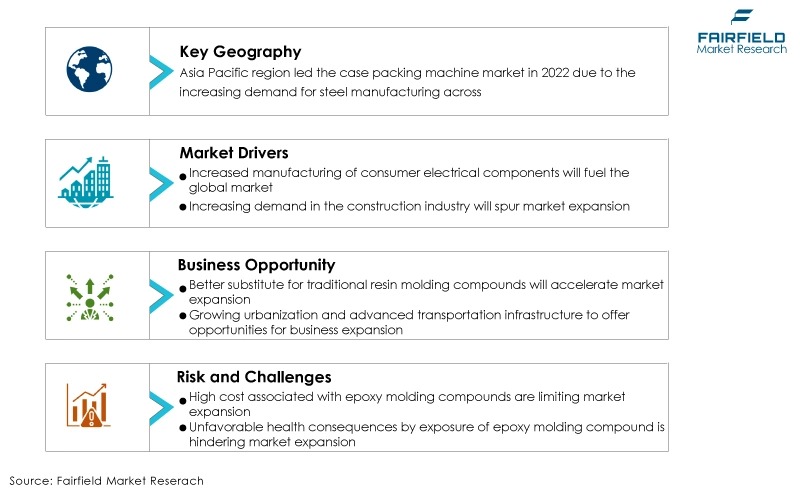
- Increased Manufacturing of Consumer Electronics
The demand for consumer Electronics components is rising due to the complexity and variety of mobile phone functions and the rising popularity of 5G communication technologies.
Adding new application modules, such as wireless charging, multi-camera modules, 3D sensors, off-screen fingerprint readers, etc., necessitates using more passive components in mobile phones to regulate voltage, filter, and current and guarantee the equipment's steady operation.
It is common for wearable technology to include motion sensors, environmental sensors, biosensors, etc., and there is a high demand for Electronics components with sensing capabilities. The market for epoxy molding compounds will continue to expand as it plays a significant role in manufacturing consumer Electronics components.
- Increasing Demand from Construction Industry
The epoxy molding compounds market is anticipated to grow over the projected period as a result of increasing demand in the building industry. The construction industry covers various tasks, including building and infrastructure development, product supply and manufacturing, repair, upkeep, and disposal. Epoxy molding compounds thus create various building materials and components, including plastics, flooring, paints, varnishes, primers and sealants, adhesives, and more.
Due to their outstanding resistance to blistering, stains, fractures, chemicals, and extreme temperatures, these compounds are frequently utilized in various industries, including the marine industry, the automotive industry, wastewater treatment facilities, and commercial and residential buildings. They perform exceptionally well in adhesion, anti-corrosion, and low-volatile organic compound production.
- Increasing Adoption by Semiconductor Industry
The epoxy mold compound is essential for the packaging and defense of electronic parts. With the help of this cutting-edge material, semiconductors can be reliable and long-lasting in various applications.
The EMC's remarkable mechanical qualities, low coefficient of thermal expansion, and excellent thermal conductivity guarantee effective heat dissipation and reduce the possibility of stress-related failures.
Along with protecting fragile integrated circuits from external conditions, its excellent adhesion and moisture resistance also increase their performance and lifespan. EMC is still crucial in enabling cutting-edge electronic gadgets and ensuring their flawless performance as technology develops. Thus, this is anticipated to boost market expansion.
Major Growth Barriers
- High Costs
The use of epoxy molding compounds adds complexity and has a high starting cost, which causes issues in the manufacturing industries. Furthermore, market restrictions for the growth of the epoxy molding compound are projected to come from high costs linked to growing difficulties and problems with recycling.
- Potential Health Consequences by EMC Exposure
The market expansion is hampered by the unfavorable health consequences of exposure to epoxy molding compounds, which are industrial plastics widely utilized in the industrial sector and can cause eye irritation, coughing, throat infections, and skin irritation. This element controls the market for epoxy molding compounds slowing down.
Key Trends and Opportunities to Look at
Traditionally, casting resins were employed as a mold; however, epoxy resin solves some of the drawbacks of the conventional resin mold, which fuels the market expansion for epoxy molding compounds.
In terms of heat resistance, corrosion resistance, UV protection, tolerance, hardness, and other factors, epoxy molds are superior to conventional resins. Such elements fuel the market's expansion for epoxy molding compounds.
- Growing Urbanisation, and Advanced Transportation Infrastructure
- Growth in Demand for Eco-friendly EMC
Due to rising urbanisation and the ensuing expansion of the transportation system, there is a boost in demand for epoxy molding compounds, which propels market expansion.
Comparing epoxy molding compounds to traditional ones reveals their durability and other advantages. Epoxy molding compounds are in high demand worldwide because of these factors.
The green epoxy molds are constructed of plant-based materials like legumes and plant latex, safer for the environment than conventional polyester or chemical-driven molding compounds.
Traditional molding compounds contain chemicals that might irritate the skin. These elements fuel the market expansion for epoxy molding compounds.
How Does the Regulatory Scenario Shape this Industry?
Several national, regional, and sector-specific laws govern epoxy molding compounds used in electronics production. A significant law that prohibits using specific hazardous compounds in Electronics and electronic equipment (EEE) is the Restriction of Hazardous Substances (RoHS) directive. The use of materials like lead, mercury, cadmium, and others is restricted by the RoHS regulations; therefore, EMCs used in electronics packaging must adhere to these rules.
Furthermore, the electronics industry also uses the Association Connecting Electronics Industries (IPC) standards. These standards cover various topics related to electronic assembly, including production methods and materials. In the sector, adherence to IPC standards is frequently required.
Fairfield’s Ranking Board
Top Segments
The normal epoxy molding compounds segment dominated the market in 2022. Normal epoxy molding compound segments are used extensively in various sectors due to their advantages, including excellent heat stability, UV protection, corrosion avoidance, improved coating capabilities, etc. They are a coating substance designed to shield electronics circuits and transistors from outside influences such as moisture, shock, dirt, and dust.
The normal epoxy molding compounds segment's market dominance results from various reasons, including a classic production process, low-cost processing, and straightforward maintenance.
The green epoxy molding compounds category is expected to grow significantly over the forecast period. The production procedures or materials used to create the green epoxy molding compounds are environmentally beneficial. These chemicals might be made using less harmful substances, with less of an impact on the environment, or with recycling in mind.
Additionally, green EMCs usually adhere to the RoHS directive, which limits the use of some hazardous compounds, including lead, mercury, and cadmium, in electronic equipment.
- Semiconductor Encapsulation Leading Application
- The Electronics Category Spearheads
In 2022, the semiconductor encapsulation sector dominated the market and is predicted to grow significantly throughout the forecast period. The rise in demand across different industries has caused the market to expand. To shield them from moisture, heat dissipation, corrosion, etc., epoxy molds are widely used to coat semiconductors. Encapsulation covers a semiconductor chip in a solid shell using an epoxy mold.
Furthermore, the electronic components category is expected to expand significantly. Various Electronics, electronic, and home appliance goods are produced using EMC. These goods include fuses, switchgear, televisions, refrigerators, coffee makers, toasters, irons, and air conditioners. Additionally, over the projection period, increasing urbanization and strong population growth will likely fuel demand for such products.
The Electronics held the majority of the market share. Electronicss have traditionally used epoxy molding compounds to provide insulation, moisture resistance, and protection against short circuits. A thermosetting plastic is used as the epoxy molding component. It may be shaped into various forms and sizes for various applications, including Electronics items like switch gears and automobile components.
During the forecasted years, the automotive category accounts for the second-largest market share due to the epoxy molding compounds' ability to resist rust and corrosion on the body and other important metal sections of vehicles, which lowers maintenance costs and lengthens the average vehicle lifespan. They are used in valve corners, headlight liners, and mounting for electric motors.
Regional Frontrunners
Asia Pacific Takes up the Largest Share of the Pie
The region with the biggest market share for epoxy molding compounds is expected to be Asia Pacific during that forecast period. This can be due to the increasing demand for steel manufacturing across various end-use industries, including infrastructure building, the automotive industry, and others. Additionally, the need for iron and steel has increased, which has resulted in a large production of molding compounds with temperature stability.
China currently dominates the epoxy mold market in Asia Pacific region with a substantial share followed by Japan. The Chinese consumer goods industry has concentrated on projects like corrosion resistance, a key driver of epoxy market expansion throughout APAC.
North America to Ascend Rapidly
The epoxy molding compounds market is expanding at the fastest rate in North America, which presents a significant opportunity for the industry. The automotive and energy industries' expanding use of epoxy molding compounds is propelling market revenue growth in this area. The market has changed as a result of technological advances in chemical processing. The United States is also a world leader in developing and manufacturing electric vehicles (EVs).
In addition, major industry players are investing heavily, which is expected to spur innovation and support market growth. These investments are generally directed at creating new goods and the growth of distribution systems, both of which will increase demand in the future. These factors will significantly fuel the market growth during the anticipated period.
Fairfield’s Competitive Landscape Analysis
As per the Fairfields analysis, the market for epoxy molding compounds will expand even more due to major market participants' significant investments in R&D to diversify their product offerings. Significant market developments include new product releases, contractual agreements, mergers and acquisitions, greater investments, and collaboration with other organizations. Market participants also engage in various strategic initiatives to increase their market share.
Who are the Leaders in Global Epoxy Molding Compound Space?
- Sumitomo Bakelite Ltd.
- Hitachi Chemical
- Chang Chun Petrochemical
- Hysol Huawei Electronics Ltd.
- Panasonic
- Kyocera
- KCC Corporation
- Samsung SDI
- Eternal Materials
- Jiangsu NOVORAY New Material Co., Ltd.
- Shin-Etsu Chemical
- Hexion
- Nepes
- Tianjin Kaihua Insulating Material
- Nitto Denko Corporation
Global Epoxy Molding Compound Market is Segmented as Below:
By Type
- Normal Epoxy Molding Compound
- Green Epoxy Molding Compound
By Application
- Semiconductor Encapsulation
- Electronic Components
By End-use Industry
- Electronics
- Automotive
- Aerospace
- Miscellaneous
By Geographic Coverage:
- North America
- Europe
- Asia Pacific
- Latin America
- Middle East & Africa
- Executive Summary
- Global Epoxy Molding Compound Market Snapshot
- Future Projections
- Key Market Trends
- Regional Snapshot, by Value, 2026
- Analyst Recommendations
- Market Overview
- Market Definitions and Segmentations
- Market Dynamics
- Drivers
- Restraints
- Market Opportunities
- Value Chain Analysis
- COVID-19 Impact Analysis
- Porter's Five Forces Analysis
- Impact of Russia-Ukraine Conflict
- PESTLE Analysis
- Regulatory Analysis
- Price Trend Analysis
- Current Prices and Future Projections, 2025-2033
- Price Impact Factors
- Global Epoxy Molding Compound Market Outlook, 2020 - 2033
- Global Epoxy Molding Compound Market Outlook, by Type, Value (US$ Bn), 2020-2033
- Normal Epoxy Molding Compound
- Green Epoxy Molding Compound
- Global Epoxy Molding Compound Market Outlook, by Application, Value (US$ Bn), 2020-2033
- Semiconductor Encapsulation
- Electronic Components
- Global Epoxy Molding Compound Market Outlook, by End-use Industry, Value (US$ Bn), 2020-2033
- Electronics
- Automotive
- Aerospace
- Miscellaneous
- Global Epoxy Molding Compound Market Outlook, by Region, Value (US$ Bn), 2020-2033
- North America
- Europe
- Asia Pacific
- Latin America
- Middle East & Africa
- Global Epoxy Molding Compound Market Outlook, by Type, Value (US$ Bn), 2020-2033
- North America Epoxy Molding Compound Market Outlook, 2020 - 2033
- North America Epoxy Molding Compound Market Outlook, by Type, Value (US$ Bn), 2020-2033
- Normal Epoxy Molding Compound
- Green Epoxy Molding Compound
- North America Epoxy Molding Compound Market Outlook, by Application, Value (US$ Bn), 2020-2033
- Semiconductor Encapsulation
- Electronic Components
- North America Epoxy Molding Compound Market Outlook, by End-use Industry, Value (US$ Bn), 2020-2033
- Electronics
- Automotive
- Aerospace
- Miscellaneous
- North America Epoxy Molding Compound Market Outlook, by Country, Value (US$ Bn), 2020-2033
- U.S. Epoxy Molding Compound Market Outlook, by Type, 2020-2033
- U.S. Epoxy Molding Compound Market Outlook, by Application, 2020-2033
- U.S. Epoxy Molding Compound Market Outlook, by End-use Industry, 2020-2033
- Canada Epoxy Molding Compound Market Outlook, by Type, 2020-2033
- Canada Epoxy Molding Compound Market Outlook, by Application, 2020-2033
- Canada Epoxy Molding Compound Market Outlook, by End-use Industry, 2020-2033
- BPS Analysis/Market Attractiveness Analysis
- North America Epoxy Molding Compound Market Outlook, by Type, Value (US$ Bn), 2020-2033
- Europe Epoxy Molding Compound Market Outlook, 2020 - 2033
- Europe Epoxy Molding Compound Market Outlook, by Type, Value (US$ Bn), 2020-2033
- Normal Epoxy Molding Compound
- Green Epoxy Molding Compound
- Europe Epoxy Molding Compound Market Outlook, by Application, Value (US$ Bn), 2020-2033
- Semiconductor Encapsulation
- Electronic Components
- Europe Epoxy Molding Compound Market Outlook, by End-use Industry, Value (US$ Bn), 2020-2033
- Electronics
- Automotive
- Aerospace
- Miscellaneous
- Europe Epoxy Molding Compound Market Outlook, by Country, Value (US$ Bn), 2020-2033
- Germany Epoxy Molding Compound Market Outlook, by Type, 2020-2033
- Germany Epoxy Molding Compound Market Outlook, by Application, 2020-2033
- Germany Epoxy Molding Compound Market Outlook, by End-use Industry, 2020-2033
- Italy Epoxy Molding Compound Market Outlook, by Type, 2020-2033
- Italy Epoxy Molding Compound Market Outlook, by Application, 2020-2033
- Italy Epoxy Molding Compound Market Outlook, by End-use Industry, 2020-2033
- France Epoxy Molding Compound Market Outlook, by Type, 2020-2033
- France Epoxy Molding Compound Market Outlook, by Application, 2020-2033
- France Epoxy Molding Compound Market Outlook, by End-use Industry, 2020-2033
- U.K. Epoxy Molding Compound Market Outlook, by Type, 2020-2033
- U.K. Epoxy Molding Compound Market Outlook, by Application, 2020-2033
- U.K. Epoxy Molding Compound Market Outlook, by End-use Industry, 2020-2033
- Spain Epoxy Molding Compound Market Outlook, by Type, 2020-2033
- Spain Epoxy Molding Compound Market Outlook, by Application, 2020-2033
- Spain Epoxy Molding Compound Market Outlook, by End-use Industry, 2020-2033
- Russia Epoxy Molding Compound Market Outlook, by Type, 2020-2033
- Russia Epoxy Molding Compound Market Outlook, by Application, 2020-2033
- Russia Epoxy Molding Compound Market Outlook, by End-use Industry, 2020-2033
- Rest of Europe Epoxy Molding Compound Market Outlook, by Type, 2020-2033
- Rest of Europe Epoxy Molding Compound Market Outlook, by Application, 2020-2033
- Rest of Europe Epoxy Molding Compound Market Outlook, by End-use Industry, 2020-2033
- BPS Analysis/Market Attractiveness Analysis
- Europe Epoxy Molding Compound Market Outlook, by Type, Value (US$ Bn), 2020-2033
- Asia Pacific Epoxy Molding Compound Market Outlook, 2020 - 2033
- Asia Pacific Epoxy Molding Compound Market Outlook, by Type, Value (US$ Bn), 2020-2033
- Normal Epoxy Molding Compound
- Green Epoxy Molding Compound
- Asia Pacific Epoxy Molding Compound Market Outlook, by Application, Value (US$ Bn), 2020-2033
- Semiconductor Encapsulation
- Electronic Components
- Asia Pacific Epoxy Molding Compound Market Outlook, by End-use Industry, Value (US$ Bn), 2020-2033
- Electronics
- Automotive
- Aerospace
- Miscellaneous
- Asia Pacific Epoxy Molding Compound Market Outlook, by Country, Value (US$ Bn), 2020-2033
- China Epoxy Molding Compound Market Outlook, by Type, 2020-2033
- China Epoxy Molding Compound Market Outlook, by Application, 2020-2033
- China Epoxy Molding Compound Market Outlook, by End-use Industry, 2020-2033
- Japan Epoxy Molding Compound Market Outlook, by Type, 2020-2033
- Japan Epoxy Molding Compound Market Outlook, by Application, 2020-2033
- Japan Epoxy Molding Compound Market Outlook, by End-use Industry, 2020-2033
- South Korea Epoxy Molding Compound Market Outlook, by Type, 2020-2033
- South Korea Epoxy Molding Compound Market Outlook, by Application, 2020-2033
- South Korea Epoxy Molding Compound Market Outlook, by End-use Industry, 2020-2033
- India Epoxy Molding Compound Market Outlook, by Type, 2020-2033
- India Epoxy Molding Compound Market Outlook, by Application, 2020-2033
- India Epoxy Molding Compound Market Outlook, by End-use Industry, 2020-2033
- Southeast Asia Epoxy Molding Compound Market Outlook, by Type, 2020-2033
- Southeast Asia Epoxy Molding Compound Market Outlook, by Application, 2020-2033
- Southeast Asia Epoxy Molding Compound Market Outlook, by End-use Industry, 2020-2033
- Rest of SAO Epoxy Molding Compound Market Outlook, by Type, 2020-2033
- Rest of SAO Epoxy Molding Compound Market Outlook, by Application, 2020-2033
- Rest of SAO Epoxy Molding Compound Market Outlook, by End-use Industry, 2020-2033
- BPS Analysis/Market Attractiveness Analysis
- Asia Pacific Epoxy Molding Compound Market Outlook, by Type, Value (US$ Bn), 2020-2033
- Latin America Epoxy Molding Compound Market Outlook, 2020 - 2033
- Latin America Epoxy Molding Compound Market Outlook, by Type, Value (US$ Bn), 2020-2033
- Normal Epoxy Molding Compound
- Green Epoxy Molding Compound
- Latin America Epoxy Molding Compound Market Outlook, by Application, Value (US$ Bn), 2020-2033
- Semiconductor Encapsulation
- Electronic Components
- Latin America Epoxy Molding Compound Market Outlook, by End-use Industry, Value (US$ Bn), 2020-2033
- Electronics
- Automotive
- Aerospace
- Miscellaneous
- Latin America Epoxy Molding Compound Market Outlook, by Country, Value (US$ Bn), 2020-2033
- Brazil Epoxy Molding Compound Market Outlook, by Type, 2020-2033
- Brazil Epoxy Molding Compound Market Outlook, by Application, 2020-2033
- Brazil Epoxy Molding Compound Market Outlook, by End-use Industry, 2020-2033
- Mexico Epoxy Molding Compound Market Outlook, by Type, 2020-2033
- Mexico Epoxy Molding Compound Market Outlook, by Application, 2020-2033
- Mexico Epoxy Molding Compound Market Outlook, by End-use Industry, 2020-2033
- Argentina Epoxy Molding Compound Market Outlook, by Type, 2020-2033
- Argentina Epoxy Molding Compound Market Outlook, by Application, 2020-2033
- Argentina Epoxy Molding Compound Market Outlook, by End-use Industry, 2020-2033
- Rest of LATAM Epoxy Molding Compound Market Outlook, by Type, 2020-2033
- Rest of LATAM Epoxy Molding Compound Market Outlook, by Application, 2020-2033
- Rest of LATAM Epoxy Molding Compound Market Outlook, by End-use Industry, 2020-2033
- BPS Analysis/Market Attractiveness Analysis
- Latin America Epoxy Molding Compound Market Outlook, by Type, Value (US$ Bn), 2020-2033
- Middle East & Africa Epoxy Molding Compound Market Outlook, 2020 - 2033
- Middle East & Africa Epoxy Molding Compound Market Outlook, by Type, Value (US$ Bn), 2020-2033
- Normal Epoxy Molding Compound
- Green Epoxy Molding Compound
- Middle East & Africa Epoxy Molding Compound Market Outlook, by Application, Value (US$ Bn), 2020-2033
- Semiconductor Encapsulation
- Electronic Components
- Middle East & Africa Epoxy Molding Compound Market Outlook, by End-use Industry, Value (US$ Bn), 2020-2033
- Electronics
- Automotive
- Aerospace
- Miscellaneous
- Middle East & Africa Epoxy Molding Compound Market Outlook, by Country, Value (US$ Bn), 2020-2033
- GCC Epoxy Molding Compound Market Outlook, by Type, 2020-2033
- GCC Epoxy Molding Compound Market Outlook, by Application, 2020-2033
- GCC Epoxy Molding Compound Market Outlook, by End-use Industry, 2020-2033
- South Africa Epoxy Molding Compound Market Outlook, by Type, 2020-2033
- South Africa Epoxy Molding Compound Market Outlook, by Application, 2020-2033
- South Africa Epoxy Molding Compound Market Outlook, by End-use Industry, 2020-2033
- Egypt Epoxy Molding Compound Market Outlook, by Type, 2020-2033
- Egypt Epoxy Molding Compound Market Outlook, by Application, 2020-2033
- Egypt Epoxy Molding Compound Market Outlook, by End-use Industry, 2020-2033
- Nigeria Epoxy Molding Compound Market Outlook, by Type, 2020-2033
- Nigeria Epoxy Molding Compound Market Outlook, by Application, 2020-2033
- Nigeria Epoxy Molding Compound Market Outlook, by End-use Industry, 2020-2033
- Rest of Middle East Epoxy Molding Compound Market Outlook, by Type, 2020-2033
- Rest of Middle East Epoxy Molding Compound Market Outlook, by Application, 2020-2033
- Rest of Middle East Epoxy Molding Compound Market Outlook, by End-use Industry, 2020-2033
- BPS Analysis/Market Attractiveness Analysis
- Middle East & Africa Epoxy Molding Compound Market Outlook, by Type, Value (US$ Bn), 2020-2033
- Competitive Landscape
- Company Vs Segment Heatmap
- Company Market Share Analysis, 2025
- Competitive Dashboard
- Company Profiles
- Sumitomo Bakelite Ltd.
- Company Overview
- Product Portfolio
- Financial Overview
- Business Strategies and Developments
- Hitachi Chemical
- Chang Chun Petrochemical
- Hysol Huawei Electronics Ltd.
- Panasonic
- Kyocera
- KCC Corporation
- Samsung SDI
- Eternal Materials
- Shin-Etsu Chemical
- Sumitomo Bakelite Ltd.
- Appendix
- Research Methodology
- Report Assumptions
- Acronyms and Abbreviations
|
BASE YEAR |
HISTORICAL DATA |
FORECAST PERIOD |
UNITS |
|||
 |
2025 |
 |
2019 - 2024 |
 |
2026 - 2033 |
Value: US$ Billion |
|
REPORT FEATURES |
DETAILS |
|
Type Coverage |
|
|
Application Coverage |
|
|
End-use Industry Coverage |
|
|
Geographical Coverage |
|
|
Leading Companies |
|
|
Report Highlights |
Key Market Indicators, Macro-micro economic impact analysis, Technological Roadmap, Key Trends, Driver, Restraints, and Future Opportunities & Revenue Pockets, Porter’s 5 Forces Analysis, Historical Trend (2019-2021), Market Estimates and Forecast, Market Dynamics, Industry Trends, Competition Landscape, Category, Region, Country-wise Trends & Analysis, COVID-19 Impact Analysis (Demand and Supply Chain) |
Our Research Methodology
Considering the volatility of business today, traditional approaches to strategizing a game plan can be unfruitful if not detrimental. True ambiguity is no way to determine a forecast. A myriad of predetermined factors must be accounted for such as the degree of risk involved, the magnitude of circumstances, as well as conditions or consequences that are not known or unpredictable. To circumvent binary views that cast uncertainty, the application of market research intelligence to strategically posture, move, and enable actionable outcomes is necessary.
View Methodology
Quality Assured
Rigorous Validation Process

Confidentiality Assured
End-to-end Data Security

Custom Research Services
Tailored To Your Objectives
FAQs
The epoxy molding compound market size is USD 2.8 Bn in 2026.
The epoxy molding compound market is projected to grow at a 7% CAGR by 2033.
The epoxy molding compound market growth drivers include rising consumer electronics manufacturing, growing semiconductor packaging demand, and increasing construction industry applications.
Asia Pacific is a dominating region for epoxy molding compound market.
Sumitomo Bakelite Ltd., Panasonic, Shin-Etsu Chemical, Hexion, and KCC Corporation are some leading industry players in the epoxy molding compound market.
Related Reports
Medium Density Fiberboard Market Insights, Competitive Landscape, and Market Forecast 2026–2033
Medium Density Fiberboard Market to reach US$84.75 Bn by 2033, growing at 8.3% CAGR, driven by furniture, construction, and sustainable MDF demand.
Hazardous Waste Management Market Insights, Competitive Landscape, and Market Forecast 2026–2033
Hazardous Waste Management Market to reach US$88.22 Bn by 2033, growing at 6.6% CAGR, driven by regulations, industrial waste, and ESG commitments.
Firestopping Sealants Market Insights, Competitive Landscape, and Market Forecast 2026–2033
Firestopping Sealants Market to reach US$872.32 Mn by 2033, growing at 8.3% CAGR, driven by fire safety regulations, construction, and building retrofits.
Reusable Packaging Market Insights, Competitive Landscape, and Market Forecast 2026–2033
Reusable Packaging Market is projected to reach US$227.35 Billion by 2033, driven by sustainable packaging adoption,and RFID-enabled tracking.
Polybenzimidazole Market Insights, Competitive Landscape, and Market Forecast 2026–2033
Polybenzimidazole Market is projected to reach US$70.61 Mn by 2033, driven by aerospace, semiconductor, and high-performance protective applications.
Breathable Films Market Insights, Competitive Landscape, and Market Forecast 2026–2033
Breathable Films Market to reach US$32.87 billion by 2033, growing at 5.7% CAGR, driven by hygiene demand, healthcare applications, and sustainable innovations.