



High-dose Radiotherapy Systems Market
High Dose Radiotherapy Market Insights, Competitive Landscape, and Market Forecast - 2033
High-dose Radiotherapy Systems Market Forecast
- The high-dose radiotherapy systems market is projected to reach a size of USD 4.1 Bn by 2033, showing a significant boost from the USD 3.1 Bn achieved in 2026.
- The market for high-dose radiotherapy systems is expected to show remarkable growth with an evaluated CAGR of 4% during the forecast period from 2026 to 2033.
High-dose Radiotherapy Systems Market Insights
A Look Back and a Look Forward - Comparative Analysis
The market analysis of high-dose radiotherapy systems shows lucrative growth in the global market. According to the industry assessment, the market size in 2019 was US$1.5 Bn which is projected to reach US$1.7 Bn by 2023. This represents a growth rate of 3.3% from 2019 to 2023.
The projected growth is attributed to new and innovative radiotherapy systems that are cost-effective and compact. Further, the growth of high-dose radiotherapy systems is expected to be US$1.8 Bn in 2024 and reach US$2.3 Bn by 2031. This indicates a growth rate of 3.7% from 2024 to 2031.
Several factors are driving this industry's growth. Technological advancements in high-dose radiotherapy systems drive the increasing demand for these treatments, particularly in treating a more comprehensive range of cancer cases. Advancements in IMRT, stereotactic radiotherapy, IGT, and particle therapy have improved long-term disease control and reduced radiation-related adverse effects.
Key Growth Determinants
- Advancements in Radiotherapy Techniques and Technologies
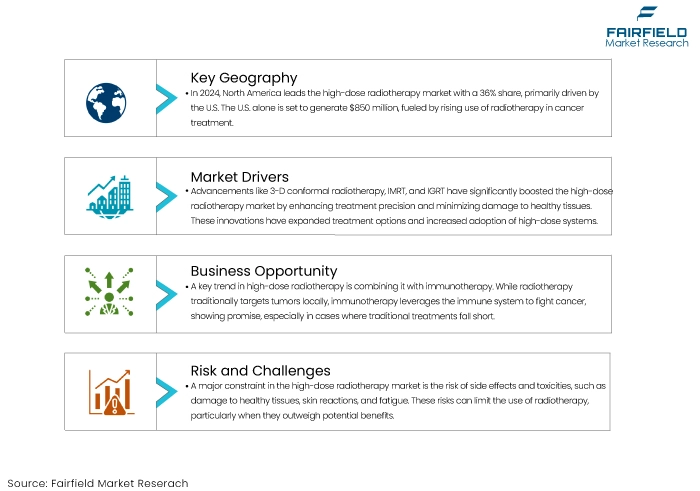
Advancements in radiotherapy techniques and technologies have played a crucial role in expanding the high-dose radiotherapy systems market. Innovations such as 3-D conformal radiotherapy, intensity-modulated radiotherapy (IMRT), and image-guided radiotherapy (IGRT) have improved the precision and effectiveness of radiation treatment.
Radiotherapy techniques allow for more accurate targeting of tumours while minimizing damage to surrounding healthy tissues. These advanced techniques have expanded the possibilities for treating various types of tumours, leading to increased adoption of high-dose radiotherapy systems.
- Increasing Incidence of Cancer
The increasing incidence of cancer globally has significantly driven the growth of high-dose radiotherapy systems market revenue. Cancer is a condition characterized by the uncontrolled growth and reproduction of cells in specific parts of the body.
Radiotherapy is one of the most common treatments for cancer, involving the use of carefully selected doses of ionizing radiation to damage the DNA of cancer cells. As the number of cancer cases continues to rise, the demand for high-dose radiotherapy systems has increased to meet the treatment needs of patients.
- Focus on Patient Safety and Treatment Efficacy
There has been a growing focus on patient safety and treatment efficacy in radiotherapy. Regulatory bodies and healthcare organizations have implemented guidelines and standards to ensure radiotherapy's safe and effective use.
As per the high-dose radiotherapy systems market overview, government regulations emphasize the importance of accurate treatment planning, precise dose delivery, and minimizing the impact on healthy tissues. With their advanced technologies and techniques, these systems enable healthcare providers to adhere to these safety and efficacy standards, driving their adoption and growth.
Key Growth Barriers
- Potential Side Effects and Toxicities
One of the main restraints for high-dose radiotherapy systems market sales is the potential for side effects and toxicities associated with radiation treatment. While radiotherapy is an effective cancer treatment, it can also cause damage to healthy tissues surrounding the tumour.
Radiotherapy aims to deliver the highest possible dose to the tumor while minimizing the dose to healthy tissues. However, there is always a risk of radiation-induced side effects, such as skin reactions, fatigue, and damage to organs or tissues near the treatment area. These potential side effects and toxicities can limit the use of these systems, especially in cases where the risks outweigh the potential benefits.
- Regulatory Compliance and Safety Standards
Another growth restraint for high-dose radiotherapy machines is the need to comply with regulatory requirements and safety standards. Radiotherapy is a highly regulated field due to the potential risks associated with radiation exposure.
Healthcare providers must adhere to strict guidelines and protocols to ensure patient safety and treatment efficacy. These regulations can include requirements for accurate treatment planning, precise dose delivery, and monitoring of radiation doses.
High-dose Radiotherapy Systems Market Trends and Opportunities
- Combination Therapy with Immunotherapy
One significant trend in the field of high-dose radiotherapy systems is the combination of radiotherapy with immunotherapy. Traditionally, radiotherapy has been viewed as a local treatment primarily focused on achieving local control of tumours.
Immunotherapy is a rapidly evolving field that harnesses the body's immune system to fight cancer. It has shown promising results in various types of cancer, particularly in cases where traditional treatments have been less effective.
Combining immunotherapy with radiotherapy can enhance treatment outcomes by leveraging the immune system's ability to recognize and attack cancer cells throughout the body. The combination of radiotherapy and immunotherapy has gained significant attention in recent years, with ongoing clinical trials and research exploring the synergistic effects of these two treatment modalities.
- Personalized Treatment Approaches
An exciting opportunity for high-dose radiotherapy systems lies in developing and implementing personalized treatment approaches. Each patient's cancer is unique, and their response to treatment can vary significantly.
Personalized medicine aims to tailor treatments to individual patients based on their specific characteristics, such as genetic makeup, tumour biology, and treatment response. Advanced imaging techniques, such as functional and molecular imaging, can provide valuable information about the tumour's characteristics and response to treatment.
Advancements in genomics and molecular profiling have the potential to identify specific genetic markers or biomarkers that can predict treatment response and guide treatment decisions. As these fields continue to advance, high-dose radiotherapy systems market opportunities to deliver more precise and effective treatments through personalized approaches will expand.
How Does Regulatory Scenario Shape this Industry?
The regulatory scenario is crucial in shaping the demand for high-dose radiotherapy systems. In recent years, there has been an increased focus on radiation dose management in the healthcare industry.
Concerns about the consequences of excessive radiation exposure have led to new regulations and requirements for healthcare providers. These regulations aim to ensure the safe and effective use of radiotherapy while minimizing the risks associated with radiation exposure.
The lack of standardization around dose management protocols and practices has been a concern. To address this issue, industry stakeholders have introduced new regulations and requirements. For example,
The Centers for Medicare and Medicaid Services (CMS) implemented the Medicare Access and Chip Reauthorization Act (MACRA) ruling, which includes more stringent dose management and reimbursement requirements.
The high-dose radiotherapy systems market research report shows that the public's growing concern over patient and staff radiation exposure has also influenced the regulatory scenario. Efforts have been made to provide practical indications on DVCs for OaRs in external beam radiotherapy, combining recommendations from international guidelines, literature reviews, clinical studies, and expert opinions.
Fairfield’s Ranking Board
Segments Covered in the Report
- LINAC Devices Segment Dominates the Market Through Effective Treatment
The LINAC devices segment has emerged as the dominant force in the global high-dose radiotherapy systems market. LINAC devices are widely utilized for cancer treatment, offering accessibility and versatility in delivering various forms of radiation therapy, including IMRT, SRS, SBRT, VMAT, and IGRT.
The adaptability of LINAC devices allows for the effective treatment of a wide range of malignancies, contributing to their extensive use worldwide.
- Cancer Treatment Centers & Clinics Top the Market Through Accessibility
As per the high-dose radiotherapy systems market forecast, cancer treatment centers and clinics hold a significant market share of 47.%. These centers play a pivotal role as primary healthcare settings where patients with cancer receive treatment. In regions with a high incidence of cancer, there is a critical demand for radiotherapy systems to meet the treatment needs.
Cancer treatment centers and clinics in these areas often offer favorable reimbursement policies making radiotherapy treatments accessible for patients.
Regional Analysis
North America Takes the Charge in the Market
North America dominates the market for high-dose radiotherapy systems and is expected to have 36% of the market share in 2024.
The United States has emerged as the dominant player in the region generating an impressive revenue of US$ 850 million in 2024. The market in the United States is primarily driven by the increasing utilization of radiotherapy in cancer treatment and management.
According to the Organization for Economic Co-operation and Development (OECD), the country witnessed a rise in the number of radiotherapy machines per 100,000 people, reaching 11.7 in 2019 compared to 11.5 in 2018. This growth trend positions the United States to continue dominating the global market in the future.
Europe to be a Leading Revenue-Generating Region
Europe is likely to be a key revenue generating region over the forecast period as it is projected to expand 1.5X by 2031. With the soaring incidence of cancers across European countries, the healthcare infrastructure in this region is expected to remain lucrative for the adoption of effective cancer therapies such as radiotherapy. Germany emerges as a prominent market through technological advancements.
According to Fairfield’s high-dose radiotherapy systems market concentration report, Germany, with a 5.9% global market share in 2022 dominated Europe market. Multiple factors drive the country's prominence. The increasing prevalence of cancer in Germany is one of the key factors. Also, technological advancements, such as improved imaging techniques and precision delivery systems create opportunities for effective and targeted treatments.
Fairfield’s Competitive Landscape Analysis
Several key players in the market characterize the competitive landscape for high-dose radiotherapy systems. While a comprehensive competitive landscape analysis requires access to detailed market reports and industry data, we can provide some insights based on the available search results.
There may be other high-dose radiotherapy systems market companies operating in the market. These companies are the leading medical device manufacturers and radiation therapy providers, indicating their strong presence in the market.
Key Market Companies
- • Varian Medical Systems
• Elekta AB
• Accuray Incorporated
• Mevion Medical Systems
• ViewRay, Inc.
• Isoray, Inc.
• Hitachi Ltd.
• TomoTherapy Incorporated
• P-Cure, Ltd.
• Provison Healthcare, LLC
• Ion Beam Applications S.A.
An Expert’s Eye
- Innovations in imaging and radiation delivery, such as intensity-modulated radiotherapy (IMRT) and stereotactic body radiotherapy (SBRT) are enhancing the precision and safety of high-dose treatments, leading to better patient outcomes.
- Favourable regulatory approvals and better reimbursement policies in key regions are facilitating the adoption of high-dose radiotherapy technologies.
- Despite the advantages, the high cost of equipment and treatment, along with the need for specialized training for healthcare providers, remains a barrier to widespread adoption, particularly in lower-income regions.
High-dose Radiotherapy Systems Market is Segmented as-
By Product
- LINAC Devices
- Proton Therapy Devices
- Brachytherapy
By End User
- Hospitals
- Cancer Treatment Centers & Clinics
- Research Centers
By Region
- North America
- Latin America
- Europe
- Asia Pacific
- Middle East & Africa
- Executive Summary
- Global High Dose Radiotherapy Market Snapshot
- Future Projections
- Key Market Trends
- Regional Snapshot, by Value, 2026
- Analyst Recommendations
- Market Overview
- Market Definitions and Segmentations
- Market Dynamics
- Drivers
- Restraints
- Market Opportunities
- Value Chain Analysis
- COVID-19 Impact Analysis
- Porter's Five Forces Analysis
- Impact of Russia-Ukraine Conflict
- PESTLE Analysis
- Regulatory Analysis
- Price Trend Analysis
- Current Prices and Future Projections, 2025-2033
- Price Impact Factors
- Global High Dose Radiotherapy Market Outlook, 2020 - 2033
- Global High Dose Radiotherapy Market Outlook, by Product, Value (US$ Bn), 2020-2033
- LINAC Devices
- Proton Therapy Devices
- Brachytherapy
- Global High Dose Radiotherapy Market Outlook, by Application, Value (US$ Bn), 2020-2033
- Breast Cancer
- Lung Cancer
- Liver Cancer
- Prostate Cancer
- Global High Dose Radiotherapy Market Outlook, by End-User, Value (US$ Bn), 2020-2033
- Hospitals
- Cancer Treatment Centers
- Clinics
- Research Institutes
- Global High Dose Radiotherapy Market Outlook, by Region, Value (US$ Bn), 2020-2033
- North America
- Europe
- Asia Pacific
- Latin America
- Middle East & Africa
- Global High Dose Radiotherapy Market Outlook, by Product, Value (US$ Bn), 2020-2033
- North America High Dose Radiotherapy Market Outlook, 2020 - 2033
- North America High Dose Radiotherapy Market Outlook, by Product, Value (US$ Bn), 2020-2033
- LINAC Devices
- Proton Therapy Devices
- Brachytherapy
- North America High Dose Radiotherapy Market Outlook, by Application, Value (US$ Bn), 2020-2033
- Breast Cancer
- Lung Cancer
- Liver Cancer
- Prostate Cancer
- North America High Dose Radiotherapy Market Outlook, by End-User, Value (US$ Bn), 2020-2033
- Hospitals
- Cancer Treatment Centers
- Clinics
- Research Institutes
- North America High Dose Radiotherapy Market Outlook, by Country, Value (US$ Bn), 2020-2033
- U.S. High Dose Radiotherapy Market Outlook, by Product, 2020-2033
- U.S. High Dose Radiotherapy Market Outlook, by Application, 2020-2033
- U.S. High Dose Radiotherapy Market Outlook, by End-User, 2020-2033
- Canada High Dose Radiotherapy Market Outlook, by Product, 2020-2033
- Canada High Dose Radiotherapy Market Outlook, by Application, 2020-2033
- Canada High Dose Radiotherapy Market Outlook, by End-User, 2020-2033
- BPS Analysis/Market Attractiveness Analysis
- North America High Dose Radiotherapy Market Outlook, by Product, Value (US$ Bn), 2020-2033
- Europe High Dose Radiotherapy Market Outlook, 2020 - 2033
- Europe High Dose Radiotherapy Market Outlook, by Product, Value (US$ Bn), 2020-2033
- LINAC Devices
- Proton Therapy Devices
- Brachytherapy
- Europe High Dose Radiotherapy Market Outlook, by Application, Value (US$ Bn), 2020-2033
- Breast Cancer
- Lung Cancer
- Liver Cancer
- Prostate Cancer
- Europe High Dose Radiotherapy Market Outlook, by End-User, Value (US$ Bn), 2020-2033
- Hospitals
- Cancer Treatment Centers
- Clinics
- Research Institutes
- Europe High Dose Radiotherapy Market Outlook, by Country, Value (US$ Bn), 2020-2033
- Germany High Dose Radiotherapy Market Outlook, by Product, 2020-2033
- Germany High Dose Radiotherapy Market Outlook, by Application, 2020-2033
- Germany High Dose Radiotherapy Market Outlook, by End-User, 2020-2033
- Italy High Dose Radiotherapy Market Outlook, by Product, 2020-2033
- Italy High Dose Radiotherapy Market Outlook, by Application, 2020-2033
- Italy High Dose Radiotherapy Market Outlook, by End-User, 2020-2033
- France High Dose Radiotherapy Market Outlook, by Product, 2020-2033
- France High Dose Radiotherapy Market Outlook, by Application, 2020-2033
- France High Dose Radiotherapy Market Outlook, by End-User, 2020-2033
- U.K. High Dose Radiotherapy Market Outlook, by Product, 2020-2033
- U.K. High Dose Radiotherapy Market Outlook, by Application, 2020-2033
- U.K. High Dose Radiotherapy Market Outlook, by End-User, 2020-2033
- Spain High Dose Radiotherapy Market Outlook, by Product, 2020-2033
- Spain High Dose Radiotherapy Market Outlook, by Application, 2020-2033
- Spain High Dose Radiotherapy Market Outlook, by End-User, 2020-2033
- Russia High Dose Radiotherapy Market Outlook, by Product, 2020-2033
- Russia High Dose Radiotherapy Market Outlook, by Application, 2020-2033
- Russia High Dose Radiotherapy Market Outlook, by End-User, 2020-2033
- Rest of Europe High Dose Radiotherapy Market Outlook, by Product, 2020-2033
- Rest of Europe High Dose Radiotherapy Market Outlook, by Application, 2020-2033
- Rest of Europe High Dose Radiotherapy Market Outlook, by End-User, 2020-2033
- BPS Analysis/Market Attractiveness Analysis
- Europe High Dose Radiotherapy Market Outlook, by Product, Value (US$ Bn), 2020-2033
- Asia Pacific High Dose Radiotherapy Market Outlook, 2020 - 2033
- Asia Pacific High Dose Radiotherapy Market Outlook, by Product, Value (US$ Bn), 2020-2033
- LINAC Devices
- Proton Therapy Devices
- Brachytherapy
- Asia Pacific High Dose Radiotherapy Market Outlook, by Application, Value (US$ Bn), 2020-2033
- Breast Cancer
- Lung Cancer
- Liver Cancer
- Prostate Cancer
- Asia Pacific High Dose Radiotherapy Market Outlook, by End-User, Value (US$ Bn), 2020-2033
- Hospitals
- Cancer Treatment Centers
- Clinics
- Research Institutes
- Asia Pacific High Dose Radiotherapy Market Outlook, by Country, Value (US$ Bn), 2020-2033
- China High Dose Radiotherapy Market Outlook, by Product, 2020-2033
- China High Dose Radiotherapy Market Outlook, by Application, 2020-2033
- China High Dose Radiotherapy Market Outlook, by End-User, 2020-2033
- Japan High Dose Radiotherapy Market Outlook, by Product, 2020-2033
- Japan High Dose Radiotherapy Market Outlook, by Application, 2020-2033
- Japan High Dose Radiotherapy Market Outlook, by End-User, 2020-2033
- South Korea High Dose Radiotherapy Market Outlook, by Product, 2020-2033
- South Korea High Dose Radiotherapy Market Outlook, by Application, 2020-2033
- South Korea High Dose Radiotherapy Market Outlook, by End-User, 2020-2033
- India High Dose Radiotherapy Market Outlook, by Product, 2020-2033
- India High Dose Radiotherapy Market Outlook, by Application, 2020-2033
- India High Dose Radiotherapy Market Outlook, by End-User, 2020-2033
- Southeast Asia High Dose Radiotherapy Market Outlook, by Product, 2020-2033
- Southeast Asia High Dose Radiotherapy Market Outlook, by Application, 2020-2033
- Southeast Asia High Dose Radiotherapy Market Outlook, by End-User, 2020-2033
- Rest of SAO High Dose Radiotherapy Market Outlook, by Product, 2020-2033
- Rest of SAO High Dose Radiotherapy Market Outlook, by Application, 2020-2033
- Rest of SAO High Dose Radiotherapy Market Outlook, by End-User, 2020-2033
- BPS Analysis/Market Attractiveness Analysis
- Asia Pacific High Dose Radiotherapy Market Outlook, by Product, Value (US$ Bn), 2020-2033
- Latin America High Dose Radiotherapy Market Outlook, 2020 - 2033
- Latin America High Dose Radiotherapy Market Outlook, by Product, Value (US$ Bn), 2020-2033
- LINAC Devices
- Proton Therapy Devices
- Brachytherapy
- Latin America High Dose Radiotherapy Market Outlook, by Application, Value (US$ Bn), 2020-2033
- Breast Cancer
- Lung Cancer
- Liver Cancer
- Prostate Cancer
- Latin America High Dose Radiotherapy Market Outlook, by End-User, Value (US$ Bn), 2020-2033
- Hospitals
- Cancer Treatment Centers
- Clinics
- Research Institutes
- Latin America High Dose Radiotherapy Market Outlook, by Country, Value (US$ Bn), 2020-2033
- Brazil High Dose Radiotherapy Market Outlook, by Product, 2020-2033
- Brazil High Dose Radiotherapy Market Outlook, by Application, 2020-2033
- Brazil High Dose Radiotherapy Market Outlook, by End-User, 2020-2033
- Mexico High Dose Radiotherapy Market Outlook, by Product, 2020-2033
- Mexico High Dose Radiotherapy Market Outlook, by Application, 2020-2033
- Mexico High Dose Radiotherapy Market Outlook, by End-User, 2020-2033
- Argentina High Dose Radiotherapy Market Outlook, by Product, 2020-2033
- Argentina High Dose Radiotherapy Market Outlook, by Application, 2020-2033
- Argentina High Dose Radiotherapy Market Outlook, by End-User, 2020-2033
- Rest of LATAM High Dose Radiotherapy Market Outlook, by Product, 2020-2033
- Rest of LATAM High Dose Radiotherapy Market Outlook, by Application, 2020-2033
- Rest of LATAM High Dose Radiotherapy Market Outlook, by End-User, 2020-2033
- BPS Analysis/Market Attractiveness Analysis
- Latin America High Dose Radiotherapy Market Outlook, by Product, Value (US$ Bn), 2020-2033
- Middle East & Africa High Dose Radiotherapy Market Outlook, 2020 - 2033
- Middle East & Africa High Dose Radiotherapy Market Outlook, by Product, Value (US$ Bn), 2020-2033
- LINAC Devices
- Proton Therapy Devices
- Brachytherapy
- Middle East & Africa High Dose Radiotherapy Market Outlook, by Application, Value (US$ Bn), 2020-2033
- Breast Cancer
- Lung Cancer
- Liver Cancer
- Prostate Cancer
- Middle East & Africa High Dose Radiotherapy Market Outlook, by End-User, Value (US$ Bn), 2020-2033
- Hospitals
- Cancer Treatment Centers
- Clinics
- Research Institutes
- Middle East & Africa High Dose Radiotherapy Market Outlook, by Country, Value (US$ Bn), 2020-2033
- GCC High Dose Radiotherapy Market Outlook, by Product, 2020-2033
- GCC High Dose Radiotherapy Market Outlook, by Application, 2020-2033
- GCC High Dose Radiotherapy Market Outlook, by End-User, 2020-2033
- South Africa High Dose Radiotherapy Market Outlook, by Product, 2020-2033
- South Africa High Dose Radiotherapy Market Outlook, by Application, 2020-2033
- South Africa High Dose Radiotherapy Market Outlook, by End-User, 2020-2033
- Egypt High Dose Radiotherapy Market Outlook, by Product, 2020-2033
- Egypt High Dose Radiotherapy Market Outlook, by Application, 2020-2033
- Egypt High Dose Radiotherapy Market Outlook, by End-User, 2020-2033
- Nigeria High Dose Radiotherapy Market Outlook, by Product, 2020-2033
- Nigeria High Dose Radiotherapy Market Outlook, by Application, 2020-2033
- Nigeria High Dose Radiotherapy Market Outlook, by End-User, 2020-2033
- Rest of Middle East High Dose Radiotherapy Market Outlook, by Product, 2020-2033
- Rest of Middle East High Dose Radiotherapy Market Outlook, by Application, 2020-2033
- Rest of Middle East High Dose Radiotherapy Market Outlook, by End-User, 2020-2033
- BPS Analysis/Market Attractiveness Analysis
- Middle East & Africa High Dose Radiotherapy Market Outlook, by Product, Value (US$ Bn), 2020-2033
- Competitive Landscape
- Company Vs Segment Heatmap
- Company Market Share Analysis, 2025
- Competitive Dashboard
- Company Profiles
- Varian Medical Systems
- Company Overview
- Product Portfolio
- Financial Overview
- Business Strategies and Developments
- Elekta AB
- Accuray Incorporated
- Mevion Medical Systems
- ViewRay, Inc.
- Isoray, Inc.
- Hitachi Ltd.
- TomoTherapy Incorporated
- P-Cure, Ltd.
- Provison Healthcare, LLC
- Ion Beam Applications S.A.
- Varian Medical Systems
- Appendix
- Research Methodology
- Report Assumptions
- Acronyms and Abbreviations
|
BASE YEAR |
HISTORICAL DATA |
FORECAST PERIOD |
UNITS |
|||
 |
2025 |
 |
2020 - 2025 |
 |
2026 - 2033 |
Value: US$ Billion |
|
REPORT FEATURES |
DETAILS |
|
Product Coverage |
|
|
End User Coverage |
|
|
Geographical Coverage |
|
|
Leading Companies |
|
|
Report Highlights |
Key Market Indicators, Macro-micro economic impact analysis, Technological Roadmap, Key Trends, Driver, Restraints, and Future Opportunities & Revenue Pockets, Porter’s 5 Forces Analysis, Historical Trend (2019-2021), Market Estimates and Forecast, Market Dynamics, Industry Trends, Competition Landscape, Category, Region, Country-wise Trends & Analysis, COVID-19 Impact Analysis (Demand and Supply Chain) |
Our Research Methodology
Considering the volatility of business today, traditional approaches to strategizing a game plan can be unfruitful if not detrimental. True ambiguity is no way to determine a forecast. A myriad of predetermined factors must be accounted for such as the degree of risk involved, the magnitude of circumstances, as well as conditions or consequences that are not known or unpredictable. To circumvent binary views that cast uncertainty, the application of market research intelligence to strategically posture, move, and enable actionable outcomes is necessary.
View Methodology
Quality Assured
Rigorous Validation Process

Confidentiality Assured
End-to-end Data Security

Custom Research Services
Tailored To Your Objectives
FAQs
The market is expected to rise fromUSD 3.1 Bn in 2026 to USD 4.1 Bn by 2033.
The rising prevalence of cancer, and research initiatives are propelling industry growth.
Baxter International Inc., Braun Melsungen AG, Nipro Corporation, and Leventon, S.A.U. are some of the key industry players operating in the market.
North America dominates the market for high-dose radiotherapy.
Continuous technological advancements and a growing focus on home healthcare services present significant opportunities for the market players.
Related Reports
Advanced Therapy Medicinal Products Market
The global advanced therapy medicinal products market will reach US$ 48.04 Bn by 2033, growing at a 14.6% CAGR, driven by demand for innovative therapies
Pen and Injector Drug Delivery Devices Market
The global pen and injector drug delivery devices market will reach US$ 20.88 Billion by 2033, growing at an 8.9% CAGR from 2026-2033
Healthcare Waste Treatment Market Insights, Competitive Landscape, and Market Forecast - 2033
The healthcare waste treatment market will grow from USD12.80 billion in 2026 to USD20.15 billion by 2033, driven by expanding healthcare systems.
Medical Rehabilitation Service Market Size and Forecast 2033
Medical Rehabilitation Service Market to reach USD 54.27 Bn by 2033, growing at 7.6% CAGR, driven by aging populations, outpatient care, and home-based rehabilitation.
Growth Factor Plus Market Insights, Competitive Landscape, and Market Forecast 2033
Growth Factor Plus Market to reach USD 798.88 Mn by 2033, growing at 9.6% CAGR, driven by clinical skincare, dermatology, medical aesthetics, and premium formulations.
At-home Genetic Testing Market Insights, Competitive Landscape, and Market Forecast - 2033
The at-home genetic testing market is expected to grow from USD 3.10 billion in 2026 to USD 7.38 billion by 2033, driven by rising consumer health data interest