



HVAC Market
Global HVAC Market Insights, Competitive Landscape, and Market Forecast 2033
Global HVAC Market Forecast
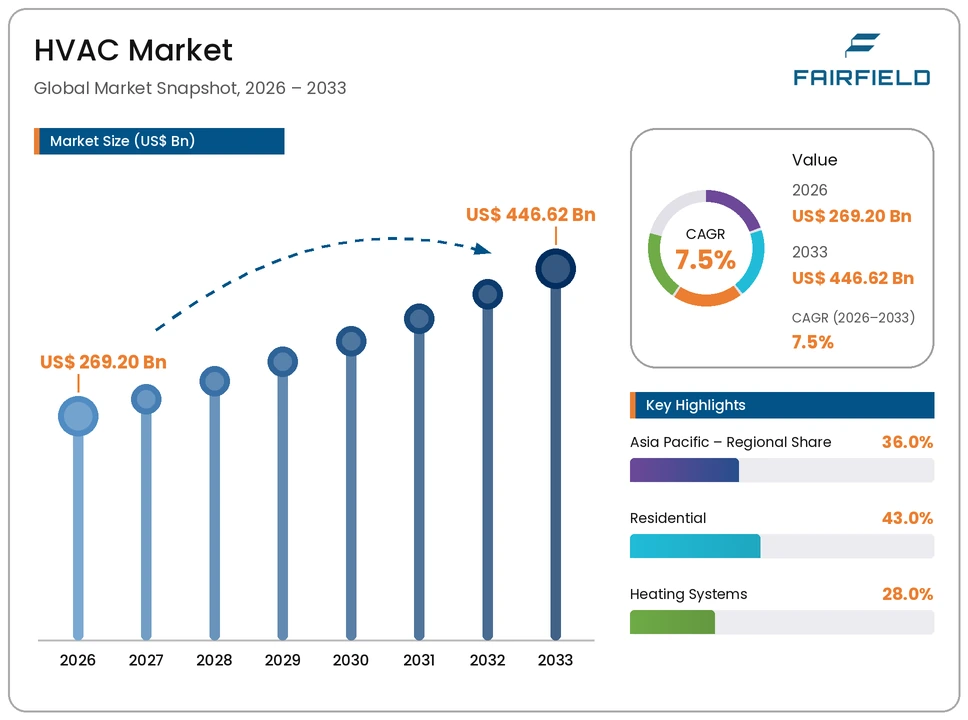
The global HVAC market is expected to be valued at US$ 269.20 Billion in 2026 and is projected to reach US$ 446.62 Billion by 2033, growing at a CAGR of 7.5% between 2026 and 2033.
The European Union's Energy Performance of Buildings Directive (EPBD), recast in 2024, mandates zero-emission new buildings from 2030 and requires progressive deep renovations of existing stock, a structural demand signal that sustains this growth trajectory well beyond near-term construction cycles. For institutional investors evaluating capital allocation across the built-environment value chain, this trajectory is not speculative: it is policy-locked.
Key Highlights
- Asia Pacific's structural dominance sets the pace for global HVAC expansion. The region holds 36.0% of 2026 market value and is expanding at approximately 9% CAGR, nearly double the rate of North America.
- Residential end users command 43.0% of global HVAC revenues, anchored by a continuous replacement cycle in mature markets and first-installation demand in high-growth emerging economies.
- Heating Systems' 28.0% equipment-type share reflects the non-discretionary nature of thermal comfort in cold-climate geographies.
- Smart & Connected HVAC is the fastest-growing technology segment, driven by the commercial building sector's adoption of AI-based energy management platforms.
- The data centre cooling subsegment represents an emerging, high-value revenue pocket within the broader HVAC landscape.
Market Growth Drivers
- Tightening Building Energy Codes and Mandatory Retrofit Requirements
Energy codes are no longer advisory benchmarks, they are enforceable compliance thresholds reshaping HVAC procurement across residential and commercial segments. The U.S. Department of Energy (DOE) finalised updated minimum efficiency standards for central air conditioners and heat pumps in January 2023, requiring higher Seasonal Energy Efficiency Ratio (SEER2) ratings across new equipment sold in all U.S. climate zones. Compliance timelines force mass equipment turnover that would not occur through organic replacement demand alone. Facility managers, property developers, and public-sector estate planners are now scheduling HVAC capital expenditure against regulatory deadlines rather than equipment failure, a structural shift that compresses replacement cycles and supports sustained volume growth through the forecast period.
Market Restraints
- High Upfront Capital Costs and Fragmented Retrofit Economics
The installed-cost gap between conventional and energy-efficient HVAC systems remains a persistent adoption barrier, particularly in price-sensitive residential segments and smaller commercial properties. A cold-climate heat pump system with ducting modifications can cost two to three times the installed price of a gas furnace replacement, and payback periods frequently exceed seven years without incentive support. While subsidy programmes such as the U.S. Inflation Reduction Act (IRA) heat pump tax credits partially bridge this gap, programme awareness remains low among homeowners and small landlords, limiting the policy's reach relative to its stated ambition.
Market Opportunities
- Rapid Data Centre Expansion Driving Precision Cooling Demand
Hyperscale data centre construction is creating one of the most commercially significant demand pools within the commercial HVAC landscape. Microsoft, Google, and Amazon Web Services each committed to multi-billion-dollar data centre investment programmes in 2024, with aggregate announcements spanning the United States, Europe, and Southeast Asia. These facilities require precision cooling architectures, including liquid cooling, computer room air handlers (CRAHs), and adiabatic cooling systems, that carry substantially higher per-unit value than standard comfort cooling. HVAC manufacturers with validated data centre cooling portfolios, such as Vertiv Holdings and Stulz GmbH, are positioned to capture disproportionate revenue growth as AI infrastructure investment accelerates deployment timelines.
Category-wise Insights
- Equipment Type Analysis
Heating Systems account for 28.0% of the global HVAC market in 2026, equivalent to US$ 75.38 Billion. This segment retains its leading position because heating demand is geographically non-discretionary across large northern hemisphere populations, residential homeowners in Canada, Germany, and Russia cannot defer heating investment through seasonal avoidance. Boiler replacement programmes and forced-air furnace upgrades in ageing housing stock sustain baseline volume, while the transition to heat pump systems is elevating average transaction values within the same budget cycle.
Ventilation Systems are the fastest-growing equipment segment. Post-pandemic indoor air quality (IAQ) mandates are the primary catalyst: the U.S. Centers for Disease Control and Prevention (CDC) updated its guidance on airborne pathogen mitigation in 2023, reinforcing demand for energy recovery ventilators (ERVs) and HEPA-integrated ventilation units in schools, healthcare facilities, and commercial offices undergoing reinstatement-driven refurbishment.
- End User Analysis
Residential buyers account for 43.0% of the global HVAC market in 2026, equivalent to US$ 115.76 Billion. Homeowner-driven replacement spending and new housing construction sustain this segment's dominance. In the United States, single-family homeowners replacing ageing split-system air conditioners represent a structurally recurring demand base: the Air-Conditioning, Heating, and Refrigeration Institute (AHRI) estimates the average installed HVAC system lifespan at 15–20 years, implying a continuous replacement cohort across the substantial housing stock built during the 1990s and 2000s. High-efficiency system upgrades supported by the IRA tax credit schedule reinforce this tendency.
Commercial is the fastest-growing end-user segment. Large-scale office-to-residential conversions and the accelerated build-out of data centres, logistics warehouses, and life sciences facilities are creating new commercial HVAC demand pools. Trane Technologies reported materially higher commercial order intake in 2024, citing healthcare campus expansions and industrial facility HVAC upgrades as the primary contributors, use cases requiring sophisticated multi-zone climate control and energy management integration.
- Technology Analysis
Conventional HVAC systems account for 51.0% of the global HVAC market in 2026, equivalent to US$ 137.29 Billion. This technology tier retains majority share because the installed base of residential and light-commercial properties globally remains overwhelmingly served by standard split systems, packaged units, and ducted gas furnaces. Replacement-for-replacement purchasing behaviour, common among cost-constrained residential buyers and smaller commercial operators, systematically favours like-for-like conventional equipment where infrastructure compatibility reduces total installed cost.
Smart & Connected HVAC is the fastest-growing technology segment. Johnson Controls launched its OpenBlue Connected Equipment platform in 2023, enabling real-time performance monitoring, predictive maintenance alerts, and remote diagnostics for commercial HVAC assets across networked building portfolios. Large facility operators and sustainability-focused corporate occupiers adopting these systems are driving demand for variable refrigerant flow (VRF) units with integrated BACnet/IP controls, deployments that carry significantly higher per-unit revenue than conventional alternatives.
Regional Insights
- North America HVAC Market Trends and Insights
North America accounts for 28.0% of the global HVAC market in 2026, representing US$ 75.38 Billion. The region's mature replacement cycle, strong contractor distribution infrastructure, and aggressive federal incentive architecture under the Inflation Reduction Act collectively sustain above-historical-average equipment demand through the forecast period. Electrification momentum, specifically the heat pump transition, is realigning product mix toward higher average-selling-price categories, supporting revenue growth independent of unit volume expansion.
United States HVAC Market Size
The United States HVAC market represents 82.0% of the North America regional market in 2026, equivalent to US$ 61.81 Billion. Residential retrofit activity underpins this dominance, with the DOE's efficiency rulemaking creating a forced-upgrade environment across Sun Belt states where SEER2 thresholds are most stringent. The ongoing electrification of space heating in previously gas-dominant markets signals sustained unit price appreciation through the 2030s.
- Asia Pacific HVAC Market Trends and Insights
Asia Pacific accounts for 36.0% of the global HVAC market in 2026, representing US$ 96.91 Billion, and is the fastest-growing region at an estimated 9% CAGR. Urbanisation rates across South and Southeast Asia, combined with rising middle-class purchasing power and intensifying summer heat extremes, are compressing the adoption timeline for residential air conditioning. Midea Group and Daikin Industries are both expanding manufacturing capacity within the region to capture this demand without the cost friction of intercontinental logistics.
China HVAC Market Size
The China HVAC market represents 43.0% of the Asia Pacific regional market in 2026, equivalent to US$ 41.67 Billion. Domestic manufacturers including Midea, Gree Electric Appliances, and Haier Smart Home dominate the residential split-system segment through cost-competitive multi-inverter platforms. China's 14th Five-Year Plan energy efficiency targets are simultaneously accelerating commercial HVAC upgrade cycles across state-owned and local government building portfolios, sustaining institutional procurement volumes through 2025 and beyond.
Japan HVAC Market Size
The Japan HVAC market represents 16.0% of the Asia Pacific regional market in 2026, equivalent to US$ 15.51 Billion. Daikin Industries and Mitsubishi Electric maintain dominant domestic positions through premium-tier VRF and multi-split systems valued for ultra-low-noise operation and inverter energy efficiency. Japan's Building Energy Efficiency Act amendments, effective from 2025, extend mandatory energy compliance to smaller commercial buildings, a regulatory catalyst for accelerated system upgrades in the sub-1,000-square-metre commercial stock.
India HVAC Market Size
The India HVAC market represents 15.0% of the Asia Pacific regional market in 2026, equivalent to US$ 14.54 Billion. India's residential air conditioning penetration rate remains below 10% of households, according to Bureau of Energy Efficiency (BEE) estimates, a structural whitespace that positions the country as among the highest-potential incremental HVAC markets globally. Accelerating urban heat island effects and rising disposable incomes are converting latent demand into active purchasing, with LG Electronics and Voltas (a Tata Group company) competing aggressively for first-time buyer share.
Competitive Landscape
The global HVAC industry is moderately consolidated at the premium tier and intensely fragmented in mid-market and emerging-economy segments. Carrier Global, Daikin Industries, and Trane Technologies collectively command a significant share of high-efficiency commercial and industrial HVAC revenues, competing primarily on system performance, service network depth, and software integration capability. The mid-market is contested by LG Electronics, Mitsubishi Electric, Panasonic Holdings, and Samsung Electronics, companies that leverage consumer electronics distribution infrastructure to extend HVAC reach into residential channels. Chinese manufacturers including Midea Group and Gree Electric Appliances are executing aggressive international expansion strategies, introducing competitive pricing pressure in markets previously dominated by Japanese and American brands. Winning in this landscape now requires demonstrated sustainability credentials, refrigerant-transition readiness, and the ability to offer connected service contracts alongside hardware.
Companies Covered in HVAC Market
- Daikin Industries
- Carrier Global
- Trane Technologies
- Johnson Controls
- LG Electronics
- Samsung Electronics
- Mitsubishi Electric
- Lennox International
- Panasonic Holdings
- Midea Group
- Gree Electric Appliances
- Haier Smart Home
- Vertiv Holdings
- Honeywell International
- Voltas (Tata Group)
- Stulz GmbH
Market Segmentation
By Equipment Type
- Heating Systems
- Ventilation Systems
- Air Conditioning Systems
- Control & Monitoring Systems
By End User
- Residential
- Commercial
- Industrial
By Technology
- Conventional HVAC
- Energy-efficient HVAC
- Smart & Connected HVAC
By Regions
- North America
- Europe
- East Asia
- South Asia & Oceania
- Latin America
- Middle East & Africa
1. Executive Summary
1.1. Global HVAC System Market Snapshot
1.2. Future Projections
1.3. Key Market Trends
1.4. Regional Snapshot, by Value, 2026
1.5. Analyst Recommendations
2. Market Overview
2.1. Market Definitions and Segmentations
2.2. Market Dynamics
2.2.1. Drivers
2.2.2. Restraints
2.2.3. Market Opportunities
2.3. Value Chain Analysis
2.4. COVID-19 Impact Analysis
2.5. Porter's Five Forces Analysis
2.6. Impact of Russia-Ukraine Conflict
2.7. PESTLE Analysis
2.8. Regulatory Analysis
2.9. Price Trend Analysis
2.9.1. Current Prices and Future Projections, 2025-2033
2.9.2. Price Impact Factors
3. Global HVAC System Market Outlook, 2020 - 2033
3.1. Global HVAC System Market Outlook, by Equipment Type, Value (US$ Bn), 2020-2033
3.1.1. Heating Systems
3.1.2. Ventilation Systems
3.1.3. Air Conditioning Systems
3.1.4. Control & Monitoring Systems
3.2. Global HVAC System Market Outlook, by End User, Value (US$ Bn), 2020-2033
3.2.1. Residential
3.2.2. Commercial
3.2.3. Industrial
3.3. Global HVAC System Market Outlook, by Technology, Value (US$ Bn), 2020-2033
3.3.1. Conventional HVAC
3.3.2. Energy-efficient HVAC
3.3.3. Smart & Connected HVAC
3.4. Global HVAC System Market Outlook, by Region, Value (US$ Bn), 2020-2033
3.4.1. North America
3.4.2. Europe
3.4.3. Asia Pacific
3.4.4. Latin America
3.4.5. Middle East & Africa
4. North America HVAC System Market Outlook, 2020 - 2033
4.1. North America HVAC System Market Outlook, by Equipment Type, Value (US$ Bn), 2020-2033
4.1.1. Heating Systems
4.1.2. Ventilation Systems
4.1.3. Air Conditioning Systems
4.1.4. Control & Monitoring Systems
4.2. North America HVAC System Market Outlook, by End User, Value (US$ Bn), 2020-2033
4.2.1. Residential
4.2.2. Commercial
4.2.3. Industrial
4.3. North America HVAC System Market Outlook, by Technology, Value (US$ Bn), 2020-2033
4.3.1. Conventional HVAC
4.3.2. Energy-efficient HVAC
4.3.3. Smart & Connected HVAC
4.4. North America HVAC System Market Outlook, by Country, Value (US$ Bn), 2020-2033
4.4.1. U.S. HVAC System Market Outlook, by Equipment Type, 2020-2033
4.4.2. U.S. HVAC System Market Outlook, by End User, 2020-2033
4.4.3. U.S. HVAC System Market Outlook, by Technology, 2020-2033
4.4.4. Canada HVAC System Market Outlook, by Equipment Type, 2020-2033
4.4.5. Canada HVAC System Market Outlook, by End User, 2020-2033
4.4.6. Canada HVAC System Market Outlook, by Technology, 2020-2033
4.5. BPS Analysis/Market Attractiveness Analysis
5. Europe HVAC System Market Outlook, 2020 - 2033
5.1. Europe HVAC System Market Outlook, by Equipment Type, Value (US$ Bn), 2020-2033
5.1.1. Heating Systems
5.1.2. Ventilation Systems
5.1.3. Air Conditioning Systems
5.1.4. Control & Monitoring Systems
5.2. Europe HVAC System Market Outlook, by End User, Value (US$ Bn), 2020-2033
5.2.1. Residential
5.2.2. Commercial
5.2.3. Industrial
5.3. Europe HVAC System Market Outlook, by Technology, Value (US$ Bn), 2020-2033
5.3.1. Conventional HVAC
5.3.2. Energy-efficient HVAC
5.3.3. Smart & Connected HVAC
5.4. Europe HVAC System Market Outlook, by Country, Value (US$ Bn), 2020-2033
5.4.1. Germany HVAC System Market Outlook, by Equipment Type, 2020-2033
5.4.2. Germany HVAC System Market Outlook, by End User, 2020-2033
5.4.3. Germany HVAC System Market Outlook, by Technology, 2020-2033
5.4.4. Italy HVAC System Market Outlook, by Equipment Type, 2020-2033
5.4.5. Italy HVAC System Market Outlook, by End User, 2020-2033
5.4.6. Italy HVAC System Market Outlook, by Technology, 2020-2033
5.4.7. France HVAC System Market Outlook, by Equipment Type, 2020-2033
5.4.8. France HVAC System Market Outlook, by End User, 2020-2033
5.4.9. France HVAC System Market Outlook, by Technology, 2020-2033
5.4.10. U.K. HVAC System Market Outlook, by Equipment Type, 2020-2033
5.4.11. U.K. HVAC System Market Outlook, by End User, 2020-2033
5.4.12. U.K. HVAC System Market Outlook, by Technology, 2020-2033
5.4.13. Spain HVAC System Market Outlook, by Equipment Type, 2020-2033
5.4.14. Spain HVAC System Market Outlook, by End User, 2020-2033
5.4.15. Spain HVAC System Market Outlook, by Technology, 2020-2033
5.4.16. Russia HVAC System Market Outlook, by Equipment Type, 2020-2033
5.4.17. Russia HVAC System Market Outlook, by End User, 2020-2033
5.4.18. Russia HVAC System Market Outlook, by Technology, 2020-2033
5.4.19. Rest of Europe HVAC System Market Outlook, by Equipment Type, 2020-2033
5.4.20. Rest of Europe HVAC System Market Outlook, by End User, 2020-2033
5.4.21. Rest of Europe HVAC System Market Outlook, by Technology, 2020-2033
5.5. BPS Analysis/Market Attractiveness Analysis
6. Asia Pacific HVAC System Market Outlook, 2020 - 2033
6.1. Asia Pacific HVAC System Market Outlook, by Equipment Type, Value (US$ Bn), 2020-2033
6.1.1. Heating Systems
6.1.2. Ventilation Systems
6.1.3. Air Conditioning Systems
6.1.4. Control & Monitoring Systems
6.2. Asia Pacific HVAC System Market Outlook, by End User, Value (US$ Bn), 2020-2033
6.2.1. Residential
6.2.2. Commercial
6.2.3. Industrial
6.3. Asia Pacific HVAC System Market Outlook, by Technology, Value (US$ Bn), 2020-2033
6.3.1. Conventional HVAC
6.3.2. Energy-efficient HVAC
6.3.3. Smart & Connected HVAC
6.4. Asia Pacific HVAC System Market Outlook, by Country, Value (US$ Bn), 2020-2033
6.4.1. China HVAC System Market Outlook, by Equipment Type, 2020-2033
6.4.2. China HVAC System Market Outlook, by End User, 2020-2033
6.4.3. China HVAC System Market Outlook, by Technology, 2020-2033
6.4.4. Japan HVAC System Market Outlook, by Equipment Type, 2020-2033
6.4.5. Japan HVAC System Market Outlook, by End User, 2020-2033
6.4.6. Japan HVAC System Market Outlook, by Technology, 2020-2033
6.4.7. South Korea HVAC System Market Outlook, by Equipment Type, 2020-2033
6.4.8. South Korea HVAC System Market Outlook, by End User, 2020-2033
6.4.9. South Korea HVAC System Market Outlook, by Technology, 2020-2033
6.4.10. India HVAC System Market Outlook, by Equipment Type, 2020-2033
6.4.11. India HVAC System Market Outlook, by End User, 2020-2033
6.4.12. India HVAC System Market Outlook, by Technology, 2020-2033
6.4.13. Southeast Asia HVAC System Market Outlook, by Equipment Type, 2020-2033
6.4.14. Southeast Asia HVAC System Market Outlook, by End User, 2020-2033
6.4.15. Southeast Asia HVAC System Market Outlook, by Technology, 2020-2033
6.4.16. Rest of SAO HVAC System Market Outlook, by Equipment Type, 2020-2033
6.4.17. Rest of SAO HVAC System Market Outlook, by End User, 2020-2033
6.4.18. Rest of SAO HVAC System Market Outlook, by Technology, 2020-2033
6.5. BPS Analysis/Market Attractiveness Analysis
7. Latin America HVAC System Market Outlook, 2020 - 2033
7.1. Latin America HVAC System Market Outlook, by Equipment Type, Value (US$ Bn), 2020-2033
7.1.1. Heating Systems
7.1.2. Ventilation Systems
7.1.3. Air Conditioning Systems
7.1.4. Control & Monitoring Systems
7.2. Latin America HVAC System Market Outlook, by End User, Value (US$ Bn), 2020-2033
7.2.1. Residential
7.2.2. Commercial
7.2.3. Industrial
7.3. Latin America HVAC System Market Outlook, by Technology, Value (US$ Bn), 2020-2033
7.3.1. Conventional HVAC
7.3.2. Energy-efficient HVAC
7.3.3. Smart & Connected HVAC
7.4. Latin America HVAC System Market Outlook, by Country, Value (US$ Bn), 2020-2033
7.4.1. Brazil HVAC System Market Outlook, by Equipment Type, 2020-2033
7.4.2. Brazil HVAC System Market Outlook, by End User, 2020-2033
7.4.3. Brazil HVAC System Market Outlook, by Technology, 2020-2033
7.4.4. Mexico HVAC System Market Outlook, by Equipment Type, 2020-2033
7.4.5. Mexico HVAC System Market Outlook, by End User, 2020-2033
7.4.6. Mexico HVAC System Market Outlook, by Technology, 2020-2033
7.4.7. Argentina HVAC System Market Outlook, by Equipment Type, 2020-2033
7.4.8. Argentina HVAC System Market Outlook, by End User, 2020-2033
7.4.9. Argentina HVAC System Market Outlook, by Technology, 2020-2033
7.4.10. Rest of LATAM HVAC System Market Outlook, by Equipment Type, 2020-2033
7.4.11. Rest of LATAM HVAC System Market Outlook, by End User, 2020-2033
7.4.12. Rest of LATAM HVAC System Market Outlook, by Technology, 2020-2033
7.5. BPS Analysis/Market Attractiveness Analysis
8. Middle East & Africa HVAC System Market Outlook, 2020 - 2033
8.1. Middle East & Africa HVAC System Market Outlook, by Equipment Type, Value (US$ Bn), 2020-2033
8.1.1. Heating Systems
8.1.2. Ventilation Systems
8.1.3. Air Conditioning Systems
8.1.4. Control & Monitoring Systems
8.2. Middle East & Africa HVAC System Market Outlook, by End User, Value (US$ Bn), 2020-2033
8.2.1. Residential
8.2.2. Commercial
8.2.3. Industrial
8.3. Middle East & Africa HVAC System Market Outlook, by Technology, Value (US$ Bn), 2020-2033
8.3.1. Conventional HVAC
8.3.2. Energy-efficient HVAC
8.3.3. Smart & Connected HVAC
8.4. Middle East & Africa HVAC System Market Outlook, by Country, Value (US$ Bn), 2020-2033
8.4.1. GCC HVAC System Market Outlook, by Equipment Type, 2020-2033
8.4.2. GCC HVAC System Market Outlook, by End User, 2020-2033
8.4.3. GCC HVAC System Market Outlook, by Technology, 2020-2033
8.4.4. South Africa HVAC System Market Outlook, by Equipment Type, 2020-2033
8.4.5. South Africa HVAC System Market Outlook, by End User, 2020-2033
8.4.6. South Africa HVAC System Market Outlook, by Technology, 2020-2033
8.4.7. Egypt HVAC System Market Outlook, by Equipment Type, 2020-2033
8.4.8. Egypt HVAC System Market Outlook, by End User, 2020-2033
8.4.9. Egypt HVAC System Market Outlook, by Technology, 2020-2033
8.4.10. Nigeria HVAC System Market Outlook, by Equipment Type, 2020-2033
8.4.11. Nigeria HVAC System Market Outlook, by End User, 2020-2033
8.4.12. Nigeria HVAC System Market Outlook, by Technology, 2020-2033
8.4.13. Rest of Middle East HVAC System Market Outlook, by Equipment Type, 2020-2033
8.4.14. Rest of Middle East HVAC System Market Outlook, by End User, 2020-2033
8.4.15. Rest of Middle East HVAC System Market Outlook, by Technology, 2020-2033
8.5. BPS Analysis/Market Attractiveness Analysis
9. Competitive Landscape
9.1. Company Vs Segment Heatmap
9.2. Company Market Share Analysis, 2025
9.3. Competitive Dashboard
9.4. Company Profiles
9.4.1. Daikin Industries
9.4.1.1. Company Overview
9.4.1.2. Product Portfolio
9.4.1.3. Financial Overview
9.4.1.4. Business Strategies and Developments
9.4.2. Carrier Global
9.4.3. Trane Technologies
9.4.4. Johnson Controls
9.4.5. LG Electronics
9.4.6. Samsung Electronics
9.4.7. Mitsubishi Electric
9.4.8. Lennox International
9.4.9. Panasonic Holdings
9.4.10. Midea Group
10. Appendix
10.1. Research Methodology
10.2. Report Assumptions
10.3. Acronyms and Abbreviations
By Equipment Type
- Heating Systems
- Ventilation Systems
- Air Conditioning Systems
- Control & Monitoring Systems
By End User
- Residential
- Commercial
- Industrial
By Technology
- Conventional HVAC
- Energy-efficient HVAC
- Smart & Connected HVAC
By Regions
- North America
- Europe
- East Asia
- South Asia & Oceania
- Latin America
- Middle East & Africa
Our Research Methodology
Considering the volatility of business today, traditional approaches to strategizing a game plan can be unfruitful if not detrimental. True ambiguity is no way to determine a forecast. A myriad of predetermined factors must be accounted for such as the degree of risk involved, the magnitude of circumstances, as well as conditions or consequences that are not known or unpredictable. To circumvent binary views that cast uncertainty, the application of market research intelligence to strategically posture, move, and enable actionable outcomes is necessary.
View Methodology
Quality Assured
Rigorous Validation Process

Confidentiality Assured
End-to-end Data Security

Custom Research Services
Tailored To Your Objectives
FAQs
The global HVAC market is valued at US$ 269.20 Billion in 2026 and is projected to reach US$ 446.62 Billion by 2033, advancing at a 7.5% CAGR.
Mandatory minimum efficiency standards enforced by bodies such as the American Society of Heating, Refrigerating and Air-Conditioning Engineers (ASHRAE) are driving equipment replacement ahead of natural end-of-life cycles. Rising cooling degree days across South Asia, the Middle East, and sub-Saharan Africa are simultaneously expanding the addressable residential air conditioning market into populations with historically low penetration rates.
Residential buyers hold the largest end-user share at 43.0%, sustained by the universal nature of thermal comfort spending and the high frequency of replacement-driven purchasing in mature housing markets.
Asia Pacific leads the global HVAC market with approximately 37% of global value, driven by China's vast installed-base replacement cycle and India's first-installation demand surge among a rapidly expanding urban middle class.
Demand-controlled ventilation and precision cooling for AI data centres represent the highest-margin near-term opportunity within the HVAC sector. Equipment suppliers that have secured validated reference installations with hyperscale operators are best positioned, with the enabling condition being the IEA's projected doubling of global data centre electricity consumption by 2026 creating non-deferrable cooling infrastructure requirements.
Related Reports
Industrial Belt Scale Market Size, Share, Insights, Competitive Landscape, and Forecast 2026 to 2033
Industrial belt scale market to reach US$909.1 million by 2033 at 6.0% CAGR. Explore product types, accuracy classes, regional trends and key players.
Industrial Automation and Control System Market Size, Share, Insights, Competitive Landscape, and Forecast 2026 to 2033
Industrial automation and control system market to reach US$289.7 billion by 2033 at 6.8% CAGR. Explore trends, segments, regions and key players.
Fabric Filter Market Size, Share, Insights, Competitive Landscape, and Forecast 2026 to 2033
The global fabric filter market is valued at US$11.2 billion in 2026, reaching US$16.4 billion by 2033, growing at a 5.6% CAGR
Grow Lights Market Size, Share, Insights, Competitive Landscape, and Forecast 2026 to 2033
The global grow lights market is valued at US$4.1 billion in 2026, reaching US$7.7 billion by 2033, growing at a 9.4% CAGR
Ground Penetrating Radar Market Size, Share, Insights, Competitive Landscape, and Forecast 2026 to 2033
The global ground penetrating radar market is valued at US$0.70 billion in 2026, reaching US$1.20 billion by 2033, growing at an 8.0% CAGR
3D Machine Vision Market Size, Share, Insights, Competitive Landscape, and Forecast 2026 to 2033
The global 3D machine vision market is valued at US$9.10 billion in 2026, reaching US$22.30 billion by 2033, growing at a 13.7% CAGR