



CNC Milling Machines Market
CNC Milling Machines Market Insights, Competitive Landscape, and Market Forecast 2033
Global CNC Milling Machines Market Forecast
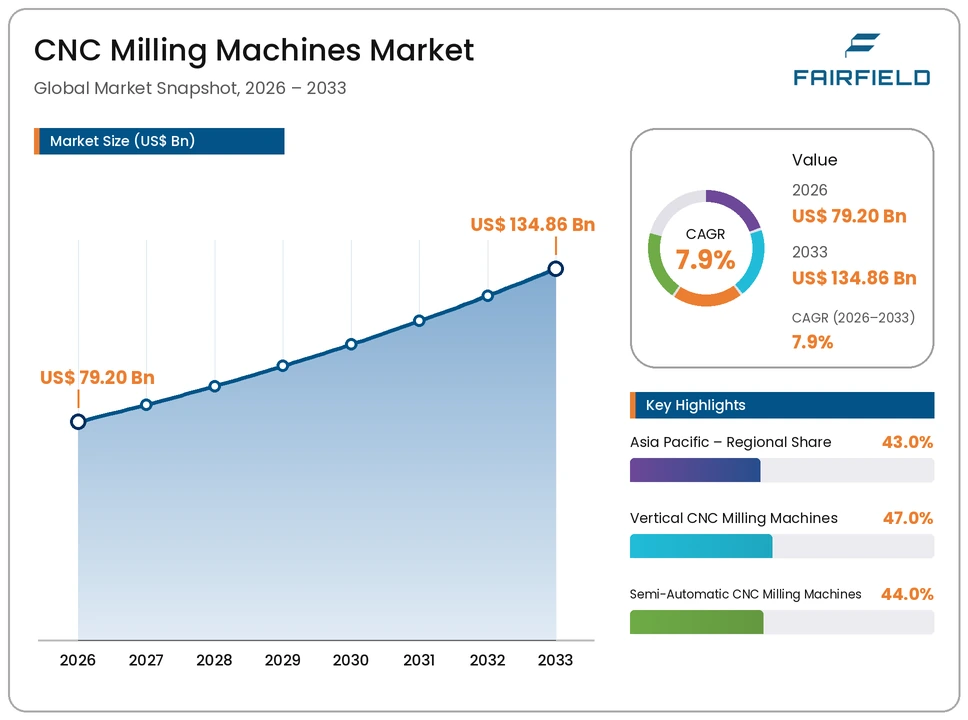
The global CNC milling machines market is expected to be valued at US$ 79.20 Billion in 2026 and is projected to reach US$ 134.86 Billion by 2033, growing at a CAGR of 7.9% between 2026 and 2033. This trajectory builds on a 6.3% historical CAGR between 2020 and 2025, reflecting sustained investment in subtractive machining even as additive technologies mature. The U.S. CHIPS and Science Act, enacted in 2022, catalysed domestic semiconductor fabrication tooling demand, a direct downstream stimulus for high-precision CNC milling capacity.
Key Highlights
- Asia Pacific commands 43% of global CNC milling machines market value in 2026, equivalent to US$ 34.06 Billion, and is expanding at approximately 9% CAGR, the fastest of any region.
- Vertical CNC milling machines hold 47.0% of global market share in 2026, and their position is structurally stable: the segment's dominance reflects the economics of high-mix, low-to-medium volume job shop production, where vertical machining centres offer the best balance of setup flexibility, footprint efficiency, and total cost of ownership across automotive and industrial machinery applications.
- Fully automated CNC milling machines are accelerating fastest within the automation level segmentation, enabled by collaborative robotics integration and adaptive process control.
- The 5-axis CNC milling machines segment is attracting the highest per-unit capital deployment in the industry, driven by aerospace prime contractors and medical device manufacturers for whom multi-surface milling in a single setup eliminates costly repositioning errors.
- The integration of IIoT-connected CNC milling platforms represents the single most consequential strategic opportunity across the forecast period.
Market Growth Drivers
- Industrial Reshoring and Near-Shoring Driving Capital Equipment Investment
Manufacturers across North America and Europe are repatriating production in response to supply chain disruptions documented through 2021–2023. The European Commission's Critical Raw Materials Act, adopted in 2024, elevated domestic machining capacity to strategic priority status, incentivising investment in computer numerical control equipment across the bloc. Machine tool procurement, particularly vertical and horizontal milling centres, accelerated at Tier 1 automotive and industrial suppliers seeking to reduce single-source exposure. This structural shift represents a durable, policy-anchored demand base rather than a cyclical procurement upturn, sustaining machine tool capex through the forecast period.
Market Restraints
- Skilled Operator Scarcity Constraining Machine Utilisation
Advanced CNC milling centres, particularly 5-axis configurations, require operators with proficiency in CAM software, G-code programming, and multi-axis fixturing. The Manufacturing Institute in the United States estimated that approximately 2.1 million manufacturing jobs could go unfilled by 2030 due to skills mismatches, with CNC machining representing a disproportionate share of hard-to-fill roles. Equipment sits underutilised not because of procurement hesitation but because qualified operators are unavailable. This constraint is most acute at small-to-medium enterprises (SMEs) that cannot compete on compensation with tier-1 OEMs for experienced machinists.
Market Opportunities
- Integration of Industrial IoT and Adaptive Control Systems
Smart/connected CNC milling machines, equipped with real-time sensor arrays, adaptive feed-rate control, and cloud-based predictive maintenance, represent the fastest-moving frontier in the CNC milling machines industry. Siemens AG's Sinumerik ONE digital-native CNC controller, launched commercially in 2023, enables full digital twin simulation of milling operations before physical cuts, reducing setup waste by an estimated 30%. Manufacturers deploying connected milling platforms gain measurable throughput advantages, and system integrators capable of retrofitting legacy spindles with IIoT connectivity modules are finding strong order pipelines. For investors, the software-and-services layer attached to connected milling platforms offers margin profiles materially above traditional machine tool economics.
Category-wise Insights
- Machine Type Analysis
Vertical CNC milling machines account for 47.0% of the global CNC milling machines market in 2026, equivalent to US$ 37.22 Billion. Their dominance reflects a fundamental fit between spindle orientation and the most common machining tasks: flat-surface finishing, cavity milling, and drilling operations on prismatic workpieces. Automotive die shops and electronics enclosure manufacturers deploy vertical machining centres as workhorse platforms, Haas Automation's VF-series remains among the most widely installed vertical milling platforms globally, favoured by job shops for its combination of reliability, programmability, and service network depth. Setup ergonomics and lower chip-evacuation complexity further sustain buyer preference.
5-axis CNC milling machines are the fastest-growing segment, propelled by aerospace structural component demand. Airbus SE's ramp-up of A320neo family production at its Hamburg and Toulouse facilities requires simultaneous 5-axis milling of complex aluminium rib sections and titanium bulkheads in a single setup, eliminating repositioning error. DMG MORI's DMU 50 and comparable platforms have seen extended lead times through 2024 as aerospace primes and their Tier 1 suppliers compete for allocated machine slots.
- End-use Industry Analysis
The automotive segment accounts for 32.0% of the global CNC milling machines market in 2026, equivalent to US$ 25.34 Billion. Precision milling underpins virtually every powertrain and chassis subsystem: cylinder head porting, brake caliper bodies, steering knuckles, and, increasingly, aluminium battery enclosures for battery electric vehicles. Toyota Motor Corporation's global manufacturing system specifies tight surface-finish requirements for engine and hybrid system components that only high-speed CNC milling centres can consistently achieve, sustaining volume procurement across the company's global supplier base.
Aerospace & Defense is the fastest-growing end-use segment. Lockheed Martin's ongoing F-35 Lightning II production programme demands 5-axis milled titanium and aluminium structural frames in quantities that have grown consistently since 2022 Department of Defense procurement increases. The parallel rise of commercial space, including SpaceX's Raptor engine components, which require complex contoured milling on Inconel alloys, is broadening the aerospace demand base beyond traditional defence prime contractors.
- Automation Level Analysis
Semi-automatic CNC milling machines account for 44.0% of the global CNC milling machines market in 2026, equivalent to US$ 34.85 Billion. This segment dominates because the majority of global CNC milling capacity resides in job shops and mid-tier manufacturers that require operator involvement for fixture changes, quality inspection, and programme adjustments between varied part families. A precision job shop producing low-to-medium volumes of diverse aluminium housings for industrial customers, the economic backbone of Germany's Mittelstand manufacturing sector, runs semi-automatic centres that balance flexibility with throughput.
Fully automated CNC milling machines are the fastest-growing automation segment. FANUC Corporation's ROBODRILL platform, integrated with robotic pallet changers and in-process gauging, enables lights-out milling of repetitive components in automotive and electronics applications. Following Japan's revised industrial robot safety guidelines under JIS B 8433-1:2023, collaborative automation adjacent to milling centres has accelerated, enabling smaller floor-space deployments without full safety caging, a catalyst for SME adoption of higher automation tiers.
Regional Insights
- North America CNC Milling Machines Market Trends and Insights
North America accounts for 24.0% of the global CNC milling machines market in 2026, representing US$ 19.01 Billion. Reshoring-driven capital expenditure and defence procurement expansion, the U.S. Department of Defense's FY2025 budget allocated over US$ 895 Billion, with machining-intensive platforms prominently featured, underpin near-term demand. Advanced manufacturing hubs in Ohio, Michigan, and Texas are absorbing significant CNC milling investment as Tier 1 automotive and aerospace suppliers expand domestic capacity.
United States CNC Milling Machines Market Size
The United States CNC milling machines market represents 82.0% of the North America regional market in 2026, equivalent to US$ 15.59 Billion. Domestic demand is anchored by aerospace MRO facilities, automotive retooling for EV platforms, and semiconductor fab equipment manufacturing. Continued CHIPS Act disbursements through 2026–2027 will sustain precision machining procurement across the semiconductor equipment supply chain.
- Asia Pacific CNC Milling Machines Market Trends and Insights
Asia Pacific accounts for 43.0% of the global CNC milling machines market in 2026, representing US$ 34.06 Billion, and expands at the fastest regional CAGR of approximately 9.0% through 2033. China's continued investment in domestic machine tool self-sufficiency, Japan's export-oriented precision manufacturing, and India's Production Linked Incentive (PLI) scheme for advanced manufacturing collectively sustain the region's structural leadership in CNC milling capacity expansion.
China CNC Milling Machines Market Size
China's CNC milling machines market represents 42.0% of the Asia Pacific regional market in 2026, equivalent to US$ 14.30 Billion. Domestic OEM consolidation, led by manufacturers including SMTCL (Shenyang Machine Tool Co., Ltd.), is progressively displacing imported machining centres in mid-tier precision applications, compressing foreign brand margin. Export-oriented electronics manufacturing in the Pearl River Delta sustains high-volume CNC milling demand for enclosures and heat-sink components.
Japan CNC Milling Machines Market Size
Japan's CNC milling machines market represents 22.0% of the Asia Pacific regional market in 2026, equivalent to US$ 7.49 Billion. Okuma Corporation and Makino Milling Machine Co., Ltd. anchor domestic supply with high-precision machining centres specified into global aerospace and automotive supply chains. Japan's ageing capital stock in precision machining is driving a replacement cycle in fine-tolerance vertical milling equipment through the mid-2020s.
India CNC Milling Machines Market Size
India's CNC milling machines market represents 15.0% of the Asia Pacific regional market in 2026, equivalent to US$ 5.11 Billion. The government's PLI scheme for White Goods and Advanced Chemistry Cells, combined with defence indigenisation under Aatmanirbhar Bharat, is expanding domestic demand for precision CNC milling capacity. India's rapidly scaling aerospace MRO sector, anchored by Bengaluru's aerospace manufacturing cluster, represents the highest-growth sub-segment within the country's CNC milling landscape.
Competitive Landscape
The CNC milling machines industry is moderately concentrated at the premium end and fragmented in the mid-tier and entry-level segments. DMG MORI, Yamazaki Mazak Corporation, and Okuma Corporation collectively hold significant share in 5-axis and high-speed machining centres, competing primarily on spindle performance, CNC controller capability, and global service network density. FANUC Corporation exerts outsized influence through its CNC controller systems, which power machinery from multiple competing OEMs. Mid-market competition centres on Haas Automation and Hurco Companies, whose open-architecture controls and aggressive pricing attract job shops. Chinese manufacturers are advancing rapidly in sub-US$ 150,000 vertical machining centres, applying margin pressure on established players in price-sensitive emerging markets.
Companies Covered in CNC Milling Machines Market
- DMG MORI
- Yamazaki Mazak Corporation
- Okuma Corporation
- Makino Milling Machine Co., Ltd.
- FANUC Corporation
- Haas Automation
- DN Solutions
- GF Machining Solutions
- Hurco Companies
- JTEKT Corporation
- Doosan Machine Tools (now DN Solutions)
- SMTCL (Shenyang Machine Tool Co., Ltd.)
- Hermle AG
- Chiron Group SE
- Matsuura Machinery Corporation
- Kitamura Machinery Co., Ltd.
Market Segmentation
By Machine Type
- Vertical CNC Milling Machines
- Horizontal CNC Milling Machines
- 5-Axis CNC Milling Machines
By End-use Industry
- Automotive
- Industrial Machinery
- Aerospace & Defense
- Electronics
- Medical Devices
By Automation Level
- Semi-Automatic CNC Milling Machines
- Fully Automated CNC Milling Machines
- Smart/Connected CNC Milling Machines
By Regions
- North America
- Europe
- East Asia
- South Asia & Oceania
- Latin America
- Middle East & Africa
- Executive Summary
- Global CNC Milling Machines Market Snapshot
- Future Projections
- Key Market Trends
- Regional Snapshot, by Value, 2026
- Analyst Recommendations
- Market Overview
- Market Definitions and Segmentations
- Market Dynamics
- Drivers
- Restraints
- Market Opportunities
- Value Chain Analysis
- COVID-19 Impact Analysis
- Porter's Five Forces Analysis
- Impact of Russia-Ukraine Conflict
- PESTLE Analysis
- Regulatory Analysis
- Price Trend Analysis
- Current Prices and Future Projections, 2025-2033
- Price Impact Factors
- Global CNC Milling Machines Market Outlook, 2020 - 2033
- Global CNC Milling Machines Market Outlook, by Machine Type, Value (US$ Bn), 2020-2033
- Vertical CNC Milling Machines
- Horizontal CNC Milling Machines
- 5-Axis CNC Milling Machines
- Global CNC Milling Machines Market Outlook, by End-use Industry, Value (US$ Bn), 2020-2033
- Automotive
- Industrial Machinery
- Aerospace & Defense
- Electronics
- Medical Devices
- Global CNC Milling Machines Market Outlook, by Automation Level, Value (US$ Bn), 2020-2033
- Semi-Automatic CNC Milling Machines
- Fully Automated CNC Milling Machines
- Smart/Connected CNC Milling Machines
- Global CNC Milling Machines Market Outlook, by Region, Value (US$ Bn), 2020-2033
- North America
- Europe
- Asia Pacific
- Latin America
- Middle East & Africa
- Global CNC Milling Machines Market Outlook, by Machine Type, Value (US$ Bn), 2020-2033
- North America CNC Milling Machines Market Outlook, 2020 - 2033
- North America CNC Milling Machines Market Outlook, by Machine Type, Value (US$ Bn), 2020-2033
- Vertical CNC Milling Machines
- Horizontal CNC Milling Machines
- 5-Axis CNC Milling Machines
- North America CNC Milling Machines Market Outlook, by End-use Industry, Value (US$ Bn), 2020-2033
- Automotive
- Industrial Machinery
- Aerospace & Defense
- Electronics
- Medical Devices
- North America CNC Milling Machines Market Outlook, by Automation Level, Value (US$ Bn), 2020-2033
- Semi-Automatic CNC Milling Machines
- Fully Automated CNC Milling Machines
- Smart/Connected CNC Milling Machines
- North America CNC Milling Machines Market Outlook, by Country, Value (US$ Bn), 2020-2033
- U.S. CNC Milling Machines Market Outlook, by Machine Type, 2020-2033
- U.S. CNC Milling Machines Market Outlook, by End-use Industry, 2020-2033
- U.S. CNC Milling Machines Market Outlook, by Automation Level, 2020-2033
- Canada CNC Milling Machines Market Outlook, by Machine Type, 2020-2033
- Canada CNC Milling Machines Market Outlook, by End-use Industry, 2020-2033
- Canada CNC Milling Machines Market Outlook, by Automation Level, 2020-2033
- BPS Analysis/Market Attractiveness Analysis
- North America CNC Milling Machines Market Outlook, by Machine Type, Value (US$ Bn), 2020-2033
- Europe CNC Milling Machines Market Outlook, 2020 - 2033
- Europe CNC Milling Machines Market Outlook, by Machine Type, Value (US$ Bn), 2020-2033
- Vertical CNC Milling Machines
- Horizontal CNC Milling Machines
- 5-Axis CNC Milling Machines
- Europe CNC Milling Machines Market Outlook, by End-use Industry, Value (US$ Bn), 2020-2033
- Automotive
- Industrial Machinery
- Aerospace & Defense
- Electronics
- Medical Devices
- Europe CNC Milling Machines Market Outlook, by Automation Level, Value (US$ Bn), 2020-2033
- Semi-Automatic CNC Milling Machines
- Fully Automated CNC Milling Machines
- Smart/Connected CNC Milling Machines
- Europe CNC Milling Machines Market Outlook, by Country, Value (US$ Bn), 2020-2033
- Germany CNC Milling Machines Market Outlook, by Machine Type, 2020-2033
- Germany CNC Milling Machines Market Outlook, by End-use Industry, 2020-2033
- Germany CNC Milling Machines Market Outlook, by Automation Level, 2020-2033
- Italy CNC Milling Machines Market Outlook, by Machine Type, 2020-2033
- Italy CNC Milling Machines Market Outlook, by End-use Industry, 2020-2033
- Italy CNC Milling Machines Market Outlook, by Automation Level, 2020-2033
- France CNC Milling Machines Market Outlook, by Machine Type, 2020-2033
- France CNC Milling Machines Market Outlook, by End-use Industry, 2020-2033
- France CNC Milling Machines Market Outlook, by Automation Level, 2020-2033
- U.K. CNC Milling Machines Market Outlook, by Machine Type, 2020-2033
- U.K. CNC Milling Machines Market Outlook, by End-use Industry, 2020-2033
- U.K. CNC Milling Machines Market Outlook, by Automation Level, 2020-2033
- Spain CNC Milling Machines Market Outlook, by Machine Type, 2020-2033
- Spain CNC Milling Machines Market Outlook, by End-use Industry, 2020-2033
- Spain CNC Milling Machines Market Outlook, by Automation Level, 2020-2033
- Russia CNC Milling Machines Market Outlook, by Machine Type, 2020-2033
- Russia CNC Milling Machines Market Outlook, by End-use Industry, 2020-2033
- Russia CNC Milling Machines Market Outlook, by Automation Level, 2020-2033
- Rest of Europe CNC Milling Machines Market Outlook, by Machine Type, 2020-2033
- Rest of Europe CNC Milling Machines Market Outlook, by End-use Industry, 2020-2033
- Rest of Europe CNC Milling Machines Market Outlook, by Automation Level, 2020-2033
- BPS Analysis/Market Attractiveness Analysis
- Europe CNC Milling Machines Market Outlook, by Machine Type, Value (US$ Bn), 2020-2033
- Asia Pacific CNC Milling Machines Market Outlook, 2020 - 2033
- Asia Pacific CNC Milling Machines Market Outlook, by Machine Type, Value (US$ Bn), 2020-2033
- Vertical CNC Milling Machines
- Horizontal CNC Milling Machines
- 5-Axis CNC Milling Machines
- Asia Pacific CNC Milling Machines Market Outlook, by End-use Industry, Value (US$ Bn), 2020-2033
- Automotive
- Industrial Machinery
- Aerospace & Defense
- Electronics
- Medical Devices
- Asia Pacific CNC Milling Machines Market Outlook, by Automation Level, Value (US$ Bn), 2020-2033
- Semi-Automatic CNC Milling Machines
- Fully Automated CNC Milling Machines
- Smart/Connected CNC Milling Machines
- Asia Pacific CNC Milling Machines Market Outlook, by Country, Value (US$ Bn), 2020-2033
- China CNC Milling Machines Market Outlook, by Machine Type, 2020-2033
- China CNC Milling Machines Market Outlook, by End-use Industry, 2020-2033
- China CNC Milling Machines Market Outlook, by Automation Level, 2020-2033
- Japan CNC Milling Machines Market Outlook, by Machine Type, 2020-2033
- Japan CNC Milling Machines Market Outlook, by End-use Industry, 2020-2033
- Japan CNC Milling Machines Market Outlook, by Automation Level, 2020-2033
- South Korea CNC Milling Machines Market Outlook, by Machine Type, 2020-2033
- South Korea CNC Milling Machines Market Outlook, by End-use Industry, 2020-2033
- South Korea CNC Milling Machines Market Outlook, by Automation Level, 2020-2033
- India CNC Milling Machines Market Outlook, by Machine Type, 2020-2033
- India CNC Milling Machines Market Outlook, by End-use Industry, 2020-2033
- India CNC Milling Machines Market Outlook, by Automation Level, 2020-2033
- Southeast Asia CNC Milling Machines Market Outlook, by Machine Type, 2020-2033
- Southeast Asia CNC Milling Machines Market Outlook, by End-use Industry, 2020-2033
- Southeast Asia CNC Milling Machines Market Outlook, by Automation Level, 2020-2033
- Rest of SAO CNC Milling Machines Market Outlook, by Machine Type, 2020-2033
- Rest of SAO CNC Milling Machines Market Outlook, by End-use Industry, 2020-2033
- Rest of SAO CNC Milling Machines Market Outlook, by Automation Level, 2020-2033
- BPS Analysis/Market Attractiveness Analysis
- Asia Pacific CNC Milling Machines Market Outlook, by Machine Type, Value (US$ Bn), 2020-2033
- Latin America CNC Milling Machines Market Outlook, 2020 - 2033
- Latin America CNC Milling Machines Market Outlook, by Machine Type, Value (US$ Bn), 2020-2033
- Vertical CNC Milling Machines
- Horizontal CNC Milling Machines
- 5-Axis CNC Milling Machines
- Latin America CNC Milling Machines Market Outlook, by End-use Industry, Value (US$ Bn), 2020-2033
- Automotive
- Industrial Machinery
- Aerospace & Defense
- Electronics
- Medical Devices
- Latin America CNC Milling Machines Market Outlook, by Automation Level, Value (US$ Bn), 2020-2033
- Semi-Automatic CNC Milling Machines
- Fully Automated CNC Milling Machines
- Smart/Connected CNC Milling Machines
- Latin America CNC Milling Machines Market Outlook, by Country, Value (US$ Bn), 2020-2033
- Brazil CNC Milling Machines Market Outlook, by Machine Type, 2020-2033
- Brazil CNC Milling Machines Market Outlook, by End-use Industry, 2020-2033
- Brazil CNC Milling Machines Market Outlook, by Automation Level, 2020-2033
- Mexico CNC Milling Machines Market Outlook, by Machine Type, 2020-2033
- Mexico CNC Milling Machines Market Outlook, by End-use Industry, 2020-2033
- Mexico CNC Milling Machines Market Outlook, by Automation Level, 2020-2033
- Argentina CNC Milling Machines Market Outlook, by Machine Type, 2020-2033
- Argentina CNC Milling Machines Market Outlook, by End-use Industry, 2020-2033
- Argentina CNC Milling Machines Market Outlook, by Automation Level, 2020-2033
- Rest of LATAM CNC Milling Machines Market Outlook, by Machine Type, 2020-2033
- Rest of LATAM CNC Milling Machines Market Outlook, by End-use Industry, 2020-2033
- Rest of LATAM CNC Milling Machines Market Outlook, by Automation Level, 2020-2033
- BPS Analysis/Market Attractiveness Analysis
- Latin America CNC Milling Machines Market Outlook, by Machine Type, Value (US$ Bn), 2020-2033
- Middle East & Africa CNC Milling Machines Market Outlook, 2020 - 2033
- Middle East & Africa CNC Milling Machines Market Outlook, by Machine Type, Value (US$ Bn), 2020-2033
- Vertical CNC Milling Machines
- Horizontal CNC Milling Machines
- 5-Axis CNC Milling Machines
- Middle East & Africa CNC Milling Machines Market Outlook, by End-use Industry, Value (US$ Bn), 2020-2033
- Automotive
- Industrial Machinery
- Aerospace & Defense
- Electronics
- Medical Devices
- Middle East & Africa CNC Milling Machines Market Outlook, by Automation Level, Value (US$ Bn), 2020-2033
- Semi-Automatic CNC Milling Machines
- Fully Automated CNC Milling Machines
- Smart/Connected CNC Milling Machines
- Middle East & Africa CNC Milling Machines Market Outlook, by Country, Value (US$ Bn), 2020-2033
- GCC CNC Milling Machines Market Outlook, by Machine Type, 2020-2033
- GCC CNC Milling Machines Market Outlook, by End-use Industry, 2020-2033
- GCC CNC Milling Machines Market Outlook, by Automation Level, 2020-2033
- South Africa CNC Milling Machines Market Outlook, by Machine Type, 2020-2033
- South Africa CNC Milling Machines Market Outlook, by End-use Industry, 2020-2033
- South Africa CNC Milling Machines Market Outlook, by Automation Level, 2020-2033
- Egypt CNC Milling Machines Market Outlook, by Machine Type, 2020-2033
- Egypt CNC Milling Machines Market Outlook, by End-use Industry, 2020-2033
- Egypt CNC Milling Machines Market Outlook, by Automation Level, 2020-2033
- Nigeria CNC Milling Machines Market Outlook, by Machine Type, 2020-2033
- Nigeria CNC Milling Machines Market Outlook, by End-use Industry, 2020-2033
- Nigeria CNC Milling Machines Market Outlook, by Automation Level, 2020-2033
- Rest of Middle East CNC Milling Machines Market Outlook, by Machine Type, 2020-2033
- Rest of Middle East CNC Milling Machines Market Outlook, by End-use Industry, 2020-2033
- Rest of Middle East CNC Milling Machines Market Outlook, by Automation Level, 2020-2033
- BPS Analysis/Market Attractiveness Analysis
- Middle East & Africa CNC Milling Machines Market Outlook, by Machine Type, Value (US$ Bn), 2020-2033
- Competitive Landscape
- Company Vs Segment Heatmap
- Company Market Share Analysis, 2025
- Competitive Dashboard
- Company Profiles
- DMG MORI
- Company Overview
- Product Portfolio
- Financial Overview
- Business Strategies and Developments
- Yamazaki Mazak Corporation
- Okuma Corporation
- Makino Milling Machine Co., Ltd.
- FANUC Corporation
- Haas Automation
- DN Solutions
- GF Machining Solutions
- Hurco Companies
- JTEKT Corporation
- DMG MORI
- Appendix
- Research Methodology
- Report Assumptions
- Acronyms and Abbreviations
By Machine Type
- Vertical CNC Milling Machines
- Horizontal CNC Milling Machines
- 5-Axis CNC Milling Machines
By End-use Industry
- Automotive
- Industrial Machinery
- Aerospace & Defense
- Electronics
- Medical Devices
By Automation Level
- Semi-Automatic CNC Milling Machines
- Fully Automated CNC Milling Machines
- Smart/Connected CNC Milling Machines
By Regions
- North America
- Europe
- East Asia
- South Asia & Oceania
- Latin America
- Middle East & Africa
Our Research Methodology
Considering the volatility of business today, traditional approaches to strategizing a game plan can be unfruitful if not detrimental. True ambiguity is no way to determine a forecast. A myriad of predetermined factors must be accounted for such as the degree of risk involved, the magnitude of circumstances, as well as conditions or consequences that are not known or unpredictable. To circumvent binary views that cast uncertainty, the application of market research intelligence to strategically posture, move, and enable actionable outcomes is necessary.
View Methodology
Quality Assured
Rigorous Validation Process

Confidentiality Assured
End-to-end Data Security

Custom Research Services
Tailored To Your Objectives
FAQs
The global CNC milling machines market is valued at US$ 79.20 Billion in 2026 and is projected to reach US$ 134.86 Billion by 2033, reflecting a 7.9% CAGR.
Two structural forces dominate: domestic manufacturing policy incentives, including the European Commission's Critical Raw Materials Act, and accelerating adoption of multi-axis precision milling for advanced materials including titanium and high-strength aluminium alloys. The Association for Manufacturing Technology (AMT) has consistently identified tooling investment and machine tool capacity as leading indicators of broader industrial expansion cycles.
Vertical CNC milling machines hold 47.0% of global market share, anchored by their suitability for the high-mix, variable-volume production environments that characterise the majority of global job shop and Tier 2 supplier operations.
Asia Pacific leads with 43% of global market value, sustained by China's state-directed machine tool self-sufficiency programmes and Japan's export-competitive precision machining base. India's rapidly expanding defence and aerospace manufacturing sector adds a high-growth incremental demand layer.
The most actionable opportunity is the convergence of IIoT connectivity and adaptive machining intelligence, specifically, the retrofit and OEM integration of real-time process monitoring into existing and new milling centre fleets. Equipment distributors and system integrators with certified competency in ISO 10791 machining centre performance standards are best positioned to capture this opportunity as manufacturers prioritise measurable OEE improvements over unit cost reduction.
Related Reports
Industrial Belt Scale Market Size, Share, Insights, Competitive Landscape, and Forecast 2026 to 2033
Industrial belt scale market to reach US$909.1 million by 2033 at 6.0% CAGR. Explore product types, accuracy classes, regional trends and key players.
Industrial Automation and Control System Market Size, Share, Insights, Competitive Landscape, and Forecast 2026 to 2033
Industrial automation and control system market to reach US$289.7 billion by 2033 at 6.8% CAGR. Explore trends, segments, regions and key players.
Fabric Filter Market Size, Share, Insights, Competitive Landscape, and Forecast 2026 to 2033
The global fabric filter market is valued at US$11.2 billion in 2026, reaching US$16.4 billion by 2033, growing at a 5.6% CAGR
Grow Lights Market Size, Share, Insights, Competitive Landscape, and Forecast 2026 to 2033
The global grow lights market is valued at US$4.1 billion in 2026, reaching US$7.7 billion by 2033, growing at a 9.4% CAGR
Ground Penetrating Radar Market Size, Share, Insights, Competitive Landscape, and Forecast 2026 to 2033
The global ground penetrating radar market is valued at US$0.70 billion in 2026, reaching US$1.20 billion by 2033, growing at an 8.0% CAGR
3D Machine Vision Market Size, Share, Insights, Competitive Landscape, and Forecast 2026 to 2033
The global 3D machine vision market is valued at US$9.10 billion in 2026, reaching US$22.30 billion by 2033, growing at a 13.7% CAGR