



Ground Penetrating Radar Market
Ground Penetrating Radar Market Size, Share, Insights, Competitive Landscape, and Forecast 2026 to 2033
Ground Penetrating Radar Market Size and Trend Analysis
What Is Driving Ground Penetrating Radar Market Growth?
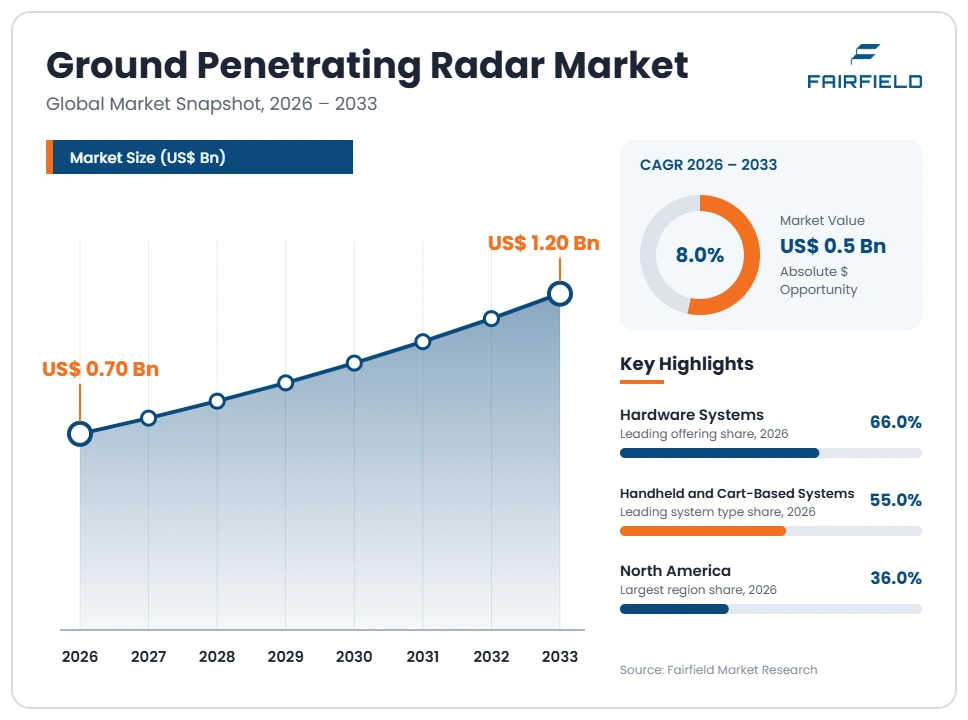
The global Ground Penetrating Radar market size is expected to be valued at US$ 0.70 billion in 2026 and projected to reach US$ 1.20 billion by 2033, growing at a CAGR of 8.0% between 2026 and 2033.
Between 2020 and 2025 the market grew at an estimated 6.9% CAGR, held back early by paused construction work and then lifted by infrastructure spending. Precise values are US$ 702 million in 2026 and US$ 1,203 million in 2033. The scope counts impulse and stepped-frequency instruments, antennas, processing and visualisation software, and survey services sold with them. Three forces carry the forecast: the cost of utility strikes during excavation, ageing road and bridge stock that needs non-destructive condition data, and procurement rules that now specify survey quality grades. Growth is steady rather than explosive, because this remains a small instrumentation market tied to construction and public works budgets.
Key Report Takeaways
- By Offering: Hardware systems held 66% share in 2026, while software and data processing is projected to expand at a 10.6% CAGR through 2033, driven by automated interpretation that reduces the skill barrier for field crews.
- By System Type: Handheld and cart-based systems held 55% share in 2026, while vehicle-mounted and multi-channel array systems are projected to expand at a 10.2% CAGR through 2033, as agencies survey road networks at traffic speed.
- By Application: Utility detection and mapping held 36% share in 2026, while transportation infrastructure assessment is projected to expand at a 9.4% CAGR through 2033, supported by bridge deck and pavement condition programmes.
- By End User: Construction and engineering services held 29% share in 2026, while transportation and highway agencies are projected to expand at a 9.6% CAGR through 2033, as asset management duties move toward measured rather than assumed condition.
- By Geography: North America held 36% share in 2026, while Asia Pacific is projected to expand at a 10.2% CAGR through 2033, helped by metro construction, buried utility programmes and expanding national road networks.
Global Ground Penetrating Radar Market Trends and Insights
Drivers Impact Analysis
Two forces account for most incremental demand for subsurface radar equipment, and both originate with asset owners rather than surveyors.
| Driver | Impact on CAGR Forecast | Geographic Relevance | Impact Timeline |
| Cost and liability of utility strikes during excavation | High | North America, Europe, Asia Pacific | Short term (≤2 years) |
| Non-destructive condition assessment of ageing transport assets | Medium | North America, Europe | Medium term (2–4 years) |
Utility Strike Costs Push Subsurface Radar Into Standard Pre-Excavation Practice
Utility strikes are the clearest commercial reason that contractors buy subsurface radar. A single damaged gas, fibre or high-voltage line generates direct repair costs, service outage penalties, project delay and, in severe cases, injury. Those consequences now exceed the price of a survey by a wide margin, so clients write detection work into contracts rather than leaving it to site judgement. That converts radar from an optional investigation tool into recurring, billable scope on almost every excavation project.
The mechanism is contractual and regulatory. Damage-prevention regimes and call-before-you-dig services identify asset owners but deliver record drawings of uneven accuracy, which still leaves crews digging blind. Specifications such as PAS 128 in the United Kingdom fill that gap by grading survey quality, so buyers can demand a defined detection level. Once a quality grade is specified, the contractor must own or hire compliant equipment.
Ageing Road and Bridge Stock Expands Radar Use in Condition Assessment Programmes
Transport asset owners are replacing visual inspection with measured subsurface data, and that lifts demand for higher-specification radar systems. Bridge decks, pavements and tunnel linings deteriorate internally long before surface distress appears, and coring gives only point samples. Network-level radar surveys produce continuous layer thickness, delamination and moisture indicators, which lets agencies schedule intervention by condition instead of by age. The purchase is usually a multi-channel array rather than a single-antenna unit, so revenue per sale is far higher.
The underlying change is in how public works budgets are justified. Asset management frameworks require owners to evidence deterioration rates and the cost of deferred maintenance. Standard methods such as ASTM D6432 give engineers a defensible basis for radar survey design and reporting, which makes the resulting data acceptable in funding submissions and in dispute resolution.
Restraints Impact Analysis
Two constraints keep adoption below what the safety case alone would justify.
| Restraint | Impact on CAGR Forecast | Geographic Relevance | Impact Timeline |
| Operator skill dependence and interpretation ambiguity | High | Global | Long term (≥4 years) |
| Signal attenuation in clay, saline and saturated ground | Medium | Asia Pacific, Latin America, Middle East & Africa | Long term (≥4 years) |
Operator Skill Dependence Limits Confidence in Ground Penetrating Radar Results
Interpretation skill, not equipment capability, is the main brake on wider adoption. Radar returns are indirect: an experienced operator reads hyperbolas, layer reflections and clutter, while an inexperienced one can miss a service or report one that is not there. Because clients judge the method by the worst survey they have received, poor results damage trust across the sector and push some buyers back toward trial pits and vacuum excavation for critical work.
The cost source is training and retention rather than hardware. Competent operators need field mentoring over months, and certification schemes carry fees plus unbillable time. Smaller surveying firms struggle to carry that overhead, so they bid lower-grade work and reuse staff across disciplines. The result is uneven delivery quality and slower replacement of ageing instruments, since under-skilled teams rarely justify investment in multi-channel systems.
Difficult Ground Conditions Reduce Radar Penetration and Survey Reliability
Soil conditions place a hard physical ceiling on where subsurface radar works well. Conductive clays, saline soils, reinforced concrete with dense steel and saturated ground all attenuate the signal, cutting usable depth from several metres to well under one. In those settings surveyors cannot guarantee detection, so clients either accept a lower confidence grade or commission complementary methods such as electromagnetic locating, which splits the available budget.
The cause is electromagnetic rather than commercial. Higher conductivity dissipates transmitted energy, and higher antenna frequencies that give fine resolution lose depth fastest, forcing a trade-off on every survey. Tropical and coastal regions carry a disproportionate share of these conditions, which is one reason equipment density in Latin America and parts of Asia Pacific remains below what construction volumes alone would suggest.
Market Opportunities
Automated Interpretation Software Opens a Recurring Revenue Pool in Subsurface Radar
Automated interpretation software is the largest untapped revenue pool in this market, because it attacks the skill constraint directly. Machine-assisted detection of hyperbolas, automatic layer picking and guided quality checks let a competent technician produce defensible deliverables faster. Vendors can price this as an annual subscription per seat rather than a one-time sale, which lifts lifetime revenue per customer well above the hardware margin and smooths earnings between equipment replacement cycles.
The buyers are utility survey contractors, engineering consultancies and transport agencies that process far more data than their senior staff can review. Demand is reinforced by graded specifications, since consistent, auditable processing is easier to evidence than individual judgement. Integration with geographic information systems and building information modelling platforms supports the shift, because clients increasingly want survey output delivered as asset records rather than as reports.
Multi-Channel Array Surveys Create a Network-Scale Mapping Revenue Pool
Network-scale subsurface mapping is a second emerging revenue pool, distinct from project-by-project investigation. Vehicle-mounted multi-channel arrays can map utilities or pavement structure across whole districts at traffic speed, producing a reusable dataset rather than a single site drawing. Cities and utilities can amortise that cost across many future projects, which changes the sale from a day rate to a programme contract worth considerably more.
Municipal authorities, water and energy utilities and national road operators create this demand, often alongside digital twin and underground asset register initiatives. The supporting development is improved positioning: combining array radar with global navigation satellite systems and inertial correction produces survey-grade coordinates that can be loaded directly into asset databases. Service providers with fleet capability, and manufacturers that lease arrays, are best positioned to capture the work.
Segment Analysis
- By Offering: Hardware Leads Revenue While Software and Processing Scale Fastest
Hardware systems generated 66% of revenue in 2026, since antennas, control units and carts remain the unavoidable capital purchase and carry the highest unit prices. Replacement cycles of roughly seven to ten years keep this base stable. Services, including contracted surveys, data processing and training, form the second pool and are often how smaller clients access the technology at all. Software and data processing is the fastest-growing offering at a 10.6% CAGR through 2033, as automated interpretation and cloud delivery convert one-off licences into subscriptions. The business implication is a gradual margin shift. Hardware competition is intense and specification-led, while software renewals carry higher gross margin and tie clients to a vendor ecosystem, so manufacturers are investing in processing platforms to defend account control.
- By System Type: Cart-Based Units Dominate as Multi-Channel Arrays Accelerate
Handheld and cart-based systems held 55% share in 2026, because they suit the concrete scanning and single-site utility work that makes up most daily survey demand. They are affordable, portable and usable by one operator. Borehole systems serve a small but technically demanding geotechnical and mining niche. Vehicle-mounted and multi-channel array systems are the fastest-growing configuration at a 10.2% CAGR through 2033, driven by road network and district-wide utility mapping that cannot be completed on foot. Arrays carry much higher selling prices and pull software and positioning hardware with them. For the broader market this widens the gap between small surveying firms buying single-antenna carts and specialist providers operating survey fleets, and it concentrates revenue growth with the latter group.
- By Application: Utility Mapping Leads While Transport Asset Assessment Grows Quickest
Utility detection and mapping accounted for 36% of 2026 revenue, the largest application because every excavation creates a potential strike and because the work repeats continuously across urban areas. Concrete and structural scanning follows, used before coring, cutting and anchoring. Geotechnical and geological survey, archaeology and forensics, and humanitarian demining complete the picture, each small but technically important. Transportation infrastructure assessment is the fastest-growing application at a 9.4% CAGR through 2033, supported by bridge deck and pavement condition programmes funded through national infrastructure budgets. The implication for vendors is that application breadth protects revenue during construction downturns. Public asset assessment work is budget-driven and counter-cyclical, which partially offsets the volatility of private construction demand that dominates utility locating.
- By End User: Engineering Contractors Lead and Transport Agencies Expand Fastest
Construction and engineering services held 29% of 2026 revenue, the largest end-user group because surveying contractors and civil engineering firms buy equipment in volume and replace it on short cycles. Utilities and telecommunications operators follow, scanning before maintenance and new connections. Oil, gas and mining operators, along with defence and public safety agencies, contribute specialised demand including demining and forensic search. Academic and research institutions remain modest buyers. Transportation and highway agencies are the fastest-growing end user at a 9.6% CAGR through 2033, as asset management duties shift toward measured condition data. This matters commercially because agencies procure through tenders with long qualification cycles, rewarding vendors that can evidence compliance with recognised survey standards and provide documented accuracy.
Geography Analysis
- Which Region Is Leading the Ground Penetrating Radar Market?
North America is leading the subsurface radar market with 36% share in 2026, supported by dense buried infrastructure, high strike liability and sustained federal and state infrastructure funding. The United States supplies most demand, with Canada contributing through pipeline, utility and municipal survey work. The 811 call-before-you-dig system and state damage-prevention laws make pre-excavation locating a legal routine, and radar is used where records prove unreliable. Equipment operation falls under Federal Communications Commission Part 15 rules for ultra-wideband devices, which gives manufacturers a settled compliance framework. The main barrier is a shortage of trained operators relative to project volume. The regional opportunity lies in bridge deck and pavement assessment, where multi-channel arrays replace lane-closure coring on busy routes.
- Europe Sets the Survey Quality Benchmark for Subsurface Radar Work
Europe holds 30% share in 2026, led by the United Kingdom, Germany, Italy, France and the Nordic countries. The region’s distinguishing feature is specification maturity. PAS 128 created a graded framework for utility detection, verification and location that clients now write into tender documents, which raises both survey quality and equipment requirements. Radio emissions are governed under ETSI EN 302 066, giving manufacturers a harmonised route to market. National underground asset register initiatives are pushing survey data toward shared digital records rather than project drawings. The constraint is fragmented procurement across municipalities, which slows large programme awards. The opportunity is archaeology and heritage work, where non-destructive investigation is often mandatory before development consent is granted.
- Which Region Is Growing Fastest in the Ground Penetrating Radar Market?
Asia Pacific is growing fastest at a 10.2% CAGR between 2026 and 2033, from a 24% share in 2026. China leads on volume through metro construction, urban utility corridors and expressway programmes, while India adds rapid growth from highway expansion and city water and sewer renewal. Japan, South Korea, Australia and Singapore buy higher-specification systems for tunnel inspection, pavement assessment and dense urban utility mapping. Rising labour costs and tighter construction safety enforcement both favour instrument-based detection over exploratory digging. Barriers include price-sensitive procurement that favours entry-level units, and difficult conductive soils in tropical zones. The opportunity is domestic manufacturing, as regional suppliers move from assembly toward their own antenna and processing development.
- Latin America Adopts Subsurface Radar Through Urban Utility Renewal
Latin America represents 5% share in 2026, with Brazil, Mexico, Chile, Colombia and Argentina forming the active market. Demand concentrates in large cities where ageing water, sewer and electrical networks are being renewed and where buried records are incomplete or lost. Mining operations in Chile and Peru add geotechnical survey work. Barriers are significant: constrained public capital spending, import duties and currency movements that raise instrument prices, limited local service support and a shallow pool of certified operators. Saturated and clay-rich soils in several areas also reduce achievable depth. The main opportunity is equipment rental and contracted survey services, which let municipalities and contractors access the method without capital approval, and which build the operator base over time.
- Middle East & Africa Uses Subsurface Radar on Major Project Corridors
Middle East & Africa accounts for 5% share in 2026, concentrated in the United Arab Emirates, Saudi Arabia, Qatar and South Africa. Large planned developments, new rail corridors and expanding utility networks in the Gulf states create demand for utility mapping before excavation, usually specified by international engineering consultancies working to recognised survey grades. In Africa, mining geophysics and humanitarian demining account for a meaningful share of deployed systems. Constraints include limited local technical support, long logistics chains for repair and calibration, highly variable soil conditions including saline sabkha ground, and project pipelines that move with commodity and oil revenue. The opportunity lies in giga-project procurement, where subsurface survey is now included in design-stage scope rather than added after a strike occurs.
Competitive Landscape
The subsurface radar market is moderately concentrated. A small group of long-established instrument manufacturers holds most of the professional hardware installed base, supported by decades of antenna design experience, field reputation and distributor networks. Below them sits a wider tier of regional manufacturers and specialist builders serving particular niches such as borehole logging, demining or low-cost concrete scanning. Consolidation has come mainly through larger surveying and geospatial groups absorbing radar specialists to complete positioning and measurement portfolios, rather than through radar makers merging with one another.
Competition rests on a consistent set of factors. Buyers compare depth and resolution performance for their ground conditions, antenna range, weight and ergonomics for single-operator use, positioning integration, and the quality of processing software. Service support and calibration turnaround matter heavily, because an instrument awaiting repair stops billable work. New entrants have arrived from two directions: software-first companies offering automated interpretation that runs on third-party data, and lower-cost manufacturers in Asia Pacific targeting the entry-level concrete scanning tier.
Strategic activity centres on capability building. Vendors have extended product lines from single-antenna carts into multi-channel arrays, added cloud processing and subscription analytics, and built closer integration with geographic information systems so survey output lands directly in client asset records. Several have expanded training and certification programmes, recognising that operator competence constrains their own sales. Rental and survey-as-a-service offerings have also widened access for customers unwilling to commit capital.
Strategic direction is converging on the deliverable rather than the device. Vendors increasingly sell verified subsurface information, backed by defined quality grades and auditable processing, with hardware positioned as one component of that outcome.
Recent Industry Developments
- 2019: ASTM International issued the current revision of ASTM D6432, the standard guide for using the surface ground penetrating radar method for subsurface investigation – giving engineers a citable basis for survey design, acquisition and reporting.
- 2014: The British Standards Institution published PAS 128, the specification for underground utility detection, verification and location – creating the graded quality framework that clients now write directly into survey tenders.
- March 2005: The Federal Communications Commission designated 811 as the national call-before-you-dig number in the United States – embedding pre-excavation locating in routine site practice and expanding the addressable survey base.
- February 2002: The Federal Communications Commission adopted its first ultra-wideband rules under Part 15 – legalising commercial subsurface radar operation in the United States and setting the emissions baseline manufacturers still design to.
Companies Covered in the Report
- Geophysical Survey Systems, Inc.
- IDS GeoRadar
- Guideline Geo AB
- Sensors & Software Inc.
- Leica Geosystems AG
- ImpulseRadar Sverige AB
- Screening Eagle Technologies
- US Radar, Inc.
- Radiodetection Ltd.
- Chemring Group PLC
- Utsi Electronics Ltd.
- 3d-Radar
Ground Penetrating Radar Market Report Scope
| Metric | Value |
| Study Period | 2020–2033 |
| Market Size 2026 | US$ 0.7 Billion |
| Market Size 2033 | US$ 1.2 Billion |
| CAGR 2026–2033 | 8.0% |
| Absolute Dollar Opportunity | US$ 0.5 Billion |
| Largest Market | North America (36% share in 2026) |
| Fastest-Growing Market | Asia Pacific (10.2% CAGR) |
| Market Concentration | Medium |
| Major Players | Geophysical Survey Systems, Inc., IDS GeoRadar, Leica Geosystems AG, Guideline Geo AB, Sensors & Software Inc. |
Ground Penetrating Radar Market Segmentation
Offering
- Hardware Systems
- Software and Data Processing
- Services
System Type
- Handheld and Cart-Based Systems
- Vehicle-Mounted and Multi-Channel Array Systems
- Borehole Systems
Application
- Utility Detection and Mapping
- Concrete and Structural Scanning
- Transportation Infrastructure Assessment
- Geotechnical and Geological Survey
- Archaeology and Forensics
- Military and Humanitarian Demining
End User
- Construction and Engineering Services
- Utilities and Telecommunications
- Transportation and Highway Agencies
- Oil, Gas and Mining
- Defence and Public Safety
- Academic and Research Institutions
Regions
- North America
- Europe
- Asia Pacific
- Latin America
- Middle East & Africa
- Executive Summary
- Global Ground Penetrating Radar Market Snapshot
- Future Projections
- Key Report Takeaways
- Regional Snapshot
- Market Overview
- Market Definition and Report Scope
- Historical Trends 2020–2025
- Market Dynamics
- Drivers
- Utility Strike Costs Push Subsurface Radar Into Standard Pre-Excavation Practice
- Ageing Road and Bridge Stock Expands Radar Use in Condition Assessment Programmes
- Restraints
- Operator Skill Dependence Limits Confidence in Ground Penetrating Radar Results
- Difficult Ground Conditions Reduce Radar Penetration and Survey Reliability
- Market Opportunities
- Automated Interpretation Software Opens a Recurring Revenue Pool in Subsurface Radar
- Multi-Channel Array Surveys Create a Network-Scale Mapping Revenue Pool
- Drivers
- Global Ground Penetrating Radar Market Outlook, 2020–2033
- Global Ground Penetrating Radar Market Outlook, by Offering, Value (US$ Billion), 2020–2033
- Hardware Systems
- Software and Data Processing
- Services
- Global Ground Penetrating Radar Market Outlook, by System Type, Value (US$ Billion), 2020–2033
- Handheld and Cart-Based Systems
- Vehicle-Mounted and Multi-Channel Array Systems
- Borehole Systems
- Global Ground Penetrating Radar Market Outlook, by Application, Value (US$ Billion), 2020–2033
- Utility Detection and Mapping
- Concrete and Structural Scanning
- Transportation Infrastructure Assessment
- Geotechnical and Geological Survey
- Archaeology and Forensics
- Military and Humanitarian Demining
- Global Ground Penetrating Radar Market Outlook, by End User, Value (US$ Billion), 2020–2033
- Construction and Engineering Services
- Utilities and Telecommunications
- Transportation and Highway Agencies
- Oil, Gas and Mining
- Defence and Public Safety
- Academic and Research Institutions
- Global Ground Penetrating Radar Market Outlook, by Region, Value (US$ Billion), 2020–2033
- North America
- Europe
- Asia Pacific
- Latin America
- Middle East & Africa
- Global Ground Penetrating Radar Market Outlook, by Offering, Value (US$ Billion), 2020–2033
- North America Ground Penetrating Radar Market Outlook, 2020–2033
- North America Ground Penetrating Radar Market Outlook, by Offering, Value (US$ Billion), 2020–2033
- Hardware Systems
- Software and Data Processing
- Services
- North America Ground Penetrating Radar Market Outlook, by System Type, Value (US$ Billion), 2020–2033
- Handheld and Cart-Based Systems
- Vehicle-Mounted and Multi-Channel Array Systems
- Borehole Systems
- North America Ground Penetrating Radar Market Outlook, by Application, Value (US$ Billion), 2020–2033
- Utility Detection and Mapping
- Concrete and Structural Scanning
- Transportation Infrastructure Assessment
- Geotechnical and Geological Survey
- Archaeology and Forensics
- Military and Humanitarian Demining
- North America Ground Penetrating Radar Market Outlook, by End User, Value (US$ Billion), 2020–2033
- Construction and Engineering Services
- Utilities and Telecommunications
- Transportation and Highway Agencies
- Oil, Gas and Mining
- Defence and Public Safety
- Academic and Research Institutions
- North America Ground Penetrating Radar Market Outlook, by Country, Value (US$ Billion), 2020–2033
- United States Ground Penetrating Radar Market Outlook, by Offering, 2020–2033
- United States Ground Penetrating Radar Market Outlook, by System Type, 2020–2033
- United States Ground Penetrating Radar Market Outlook, by Application, 2020–2033
- United States Ground Penetrating Radar Market Outlook, by End User, 2020–2033
- Canada Ground Penetrating Radar Market Outlook, by Offering, 2020–2033
- Canada Ground Penetrating Radar Market Outlook, by System Type, 2020–2033
- Canada Ground Penetrating Radar Market Outlook, by Application, 2020–2033
- Canada Ground Penetrating Radar Market Outlook, by End User, 2020–2033
- North America Ground Penetrating Radar Market Outlook, by Offering, Value (US$ Billion), 2020–2033
- Europe Ground Penetrating Radar Market Outlook, 2020–2033
- Europe Ground Penetrating Radar Market Outlook, by Offering, Value (US$ Billion), 2020–2033
- Hardware Systems
- Software and Data Processing
- Services
- Europe Ground Penetrating Radar Market Outlook, by System Type, Value (US$ Billion), 2020–2033
- Handheld and Cart-Based Systems
- Vehicle-Mounted and Multi-Channel Array Systems
- Borehole Systems
- Europe Ground Penetrating Radar Market Outlook, by Application, Value (US$ Billion), 2020–2033
- Utility Detection and Mapping
- Concrete and Structural Scanning
- Transportation Infrastructure Assessment
- Geotechnical and Geological Survey
- Archaeology and Forensics
- Military and Humanitarian Demining
- Europe Ground Penetrating Radar Market Outlook, by End User, Value (US$ Billion), 2020–2033
- Construction and Engineering Services
- Utilities and Telecommunications
- Transportation and Highway Agencies
- Oil, Gas and Mining
- Defence and Public Safety
- Academic and Research Institutions
- Europe Ground Penetrating Radar Market Outlook, by Country, Value (US$ Billion), 2020–2033
- United Kingdom Ground Penetrating Radar Market Outlook, by Offering, 2020–2033
- United Kingdom Ground Penetrating Radar Market Outlook, by System Type, 2020–2033
- United Kingdom Ground Penetrating Radar Market Outlook, by Application, 2020–2033
- United Kingdom Ground Penetrating Radar Market Outlook, by End User, 2020–2033
- Germany Ground Penetrating Radar Market Outlook, by Offering, 2020–2033
- Germany Ground Penetrating Radar Market Outlook, by System Type, 2020–2033
- Germany Ground Penetrating Radar Market Outlook, by Application, 2020–2033
- Germany Ground Penetrating Radar Market Outlook, by End User, 2020–2033
- Italy Ground Penetrating Radar Market Outlook, by Offering, 2020–2033
- Italy Ground Penetrating Radar Market Outlook, by System Type, 2020–2033
- Italy Ground Penetrating Radar Market Outlook, by Application, 2020–2033
- Italy Ground Penetrating Radar Market Outlook, by End User, 2020–2033
- France Ground Penetrating Radar Market Outlook, by Offering, 2020–2033
- France Ground Penetrating Radar Market Outlook, by System Type, 2020–2033
- France Ground Penetrating Radar Market Outlook, by Application, 2020–2033
- France Ground Penetrating Radar Market Outlook, by End User, 2020–2033
- Nordic countries Ground Penetrating Radar Market Outlook, by Offering, 2020–2033
- Nordic countries Ground Penetrating Radar Market Outlook, by System Type, 2020–2033
- Nordic countries Ground Penetrating Radar Market Outlook, by Application, 2020–2033
- Nordic countries Ground Penetrating Radar Market Outlook, by End User, 2020–2033
- Europe Ground Penetrating Radar Market Outlook, by Offering, Value (US$ Billion), 2020–2033
- Asia Pacific Ground Penetrating Radar Market Outlook, 2020–2033
- Asia Pacific Ground Penetrating Radar Market Outlook, by Offering, Value (US$ Billion), 2020–2033
- Hardware Systems
- Software and Data Processing
- Services
- Asia Pacific Ground Penetrating Radar Market Outlook, by System Type, Value (US$ Billion), 2020–2033
- Handheld and Cart-Based Systems
- Vehicle-Mounted and Multi-Channel Array Systems
- Borehole Systems
- Asia Pacific Ground Penetrating Radar Market Outlook, by Application, Value (US$ Billion), 2020–2033
- Utility Detection and Mapping
- Concrete and Structural Scanning
- Transportation Infrastructure Assessment
- Geotechnical and Geological Survey
- Archaeology and Forensics
- Military and Humanitarian Demining
- Asia Pacific Ground Penetrating Radar Market Outlook, by End User, Value (US$ Billion), 2020–2033
- Construction and Engineering Services
- Utilities and Telecommunications
- Transportation and Highway Agencies
- Oil, Gas and Mining
- Defence and Public Safety
- Academic and Research Institutions
- Asia Pacific Ground Penetrating Radar Market Outlook, by Country, Value (US$ Billion), 2020–2033
- China Ground Penetrating Radar Market Outlook, by Offering, 2020–2033
- China Ground Penetrating Radar Market Outlook, by System Type, 2020–2033
- China Ground Penetrating Radar Market Outlook, by Application, 2020–2033
- China Ground Penetrating Radar Market Outlook, by End User, 2020–2033
- India Ground Penetrating Radar Market Outlook, by Offering, 2020–2033
- India Ground Penetrating Radar Market Outlook, by System Type, 2020–2033
- India Ground Penetrating Radar Market Outlook, by Application, 2020–2033
- India Ground Penetrating Radar Market Outlook, by End User, 2020–2033
- Japan Ground Penetrating Radar Market Outlook, by Offering, 2020–2033
- Japan Ground Penetrating Radar Market Outlook, by System Type, 2020–2033
- Japan Ground Penetrating Radar Market Outlook, by Application, 2020–2033
- Japan Ground Penetrating Radar Market Outlook, by End User, 2020–2033
- South Korea Ground Penetrating Radar Market Outlook, by Offering, 2020–2033
- South Korea Ground Penetrating Radar Market Outlook, by System Type, 2020–2033
- South Korea Ground Penetrating Radar Market Outlook, by Application, 2020–2033
- South Korea Ground Penetrating Radar Market Outlook, by End User, 2020–2033
- Australia Ground Penetrating Radar Market Outlook, by Offering, 2020–2033
- Australia Ground Penetrating Radar Market Outlook, by System Type, 2020–2033
- Australia Ground Penetrating Radar Market Outlook, by Application, 2020–2033
- Australia Ground Penetrating Radar Market Outlook, by End User, 2020–2033
- Singapore Ground Penetrating Radar Market Outlook, by Offering, 2020–2033
- Singapore Ground Penetrating Radar Market Outlook, by System Type, 2020–2033
- Singapore Ground Penetrating Radar Market Outlook, by Application, 2020–2033
- Singapore Ground Penetrating Radar Market Outlook, by End User, 2020–2033
- Asia Pacific Ground Penetrating Radar Market Outlook, by Offering, Value (US$ Billion), 2020–2033
- Latin America Ground Penetrating Radar Market Outlook, 2020–2033
- Latin America Ground Penetrating Radar Market Outlook, by Offering, Value (US$ Billion), 2020–2033
- Hardware Systems
- Software and Data Processing
- Services
- Latin America Ground Penetrating Radar Market Outlook, by System Type, Value (US$ Billion), 2020–2033
- Handheld and Cart-Based Systems
- Vehicle-Mounted and Multi-Channel Array Systems
- Borehole Systems
- Latin America Ground Penetrating Radar Market Outlook, by Application, Value (US$ Billion), 2020–2033
- Utility Detection and Mapping
- Concrete and Structural Scanning
- Transportation Infrastructure Assessment
- Geotechnical and Geological Survey
- Archaeology and Forensics
- Military and Humanitarian Demining
- Latin America Ground Penetrating Radar Market Outlook, by End User, Value (US$ Billion), 2020–2033
- Construction and Engineering Services
- Utilities and Telecommunications
- Transportation and Highway Agencies
- Oil, Gas and Mining
- Defence and Public Safety
- Academic and Research Institutions
- Latin America Ground Penetrating Radar Market Outlook, by Country, Value (US$ Billion), 2020–2033
- Brazil Ground Penetrating Radar Market Outlook, by Offering, 2020–2033
- Brazil Ground Penetrating Radar Market Outlook, by System Type, 2020–2033
- Brazil Ground Penetrating Radar Market Outlook, by Application, 2020–2033
- Brazil Ground Penetrating Radar Market Outlook, by End User, 2020–2033
- Mexico Ground Penetrating Radar Market Outlook, by Offering, 2020–2033
- Mexico Ground Penetrating Radar Market Outlook, by System Type, 2020–2033
- Mexico Ground Penetrating Radar Market Outlook, by Application, 2020–2033
- Mexico Ground Penetrating Radar Market Outlook, by End User, 2020–2033
- Chile Ground Penetrating Radar Market Outlook, by Offering, 2020–2033
- Chile Ground Penetrating Radar Market Outlook, by System Type, 2020–2033
- Chile Ground Penetrating Radar Market Outlook, by Application, 2020–2033
- Chile Ground Penetrating Radar Market Outlook, by End User, 2020–2033
- Colombia Ground Penetrating Radar Market Outlook, by Offering, 2020–2033
- Colombia Ground Penetrating Radar Market Outlook, by System Type, 2020–2033
- Colombia Ground Penetrating Radar Market Outlook, by Application, 2020–2033
- Colombia Ground Penetrating Radar Market Outlook, by End User, 2020–2033
- Argentina Ground Penetrating Radar Market Outlook, by Offering, 2020–2033
- Argentina Ground Penetrating Radar Market Outlook, by System Type, 2020–2033
- Argentina Ground Penetrating Radar Market Outlook, by Application, 2020–2033
- Argentina Ground Penetrating Radar Market Outlook, by End User, 2020–2033
- Peru Ground Penetrating Radar Market Outlook, by Offering, 2020–2033
- Peru Ground Penetrating Radar Market Outlook, by System Type, 2020–2033
- Peru Ground Penetrating Radar Market Outlook, by Application, 2020–2033
- Peru Ground Penetrating Radar Market Outlook, by End User, 2020–2033
- Latin America Ground Penetrating Radar Market Outlook, by Offering, Value (US$ Billion), 2020–2033
- Middle East & Africa Ground Penetrating Radar Market Outlook, 2020–2033
- Middle East & Africa Ground Penetrating Radar Market Outlook, by Offering, Value (US$ Billion), 2020–2033
- Hardware Systems
- Software and Data Processing
- Services
- Middle East & Africa Ground Penetrating Radar Market Outlook, by System Type, Value (US$ Billion), 2020–2033
- Handheld and Cart-Based Systems
- Vehicle-Mounted and Multi-Channel Array Systems
- Borehole Systems
- Middle East & Africa Ground Penetrating Radar Market Outlook, by Application, Value (US$ Billion), 2020–2033
- Utility Detection and Mapping
- Concrete and Structural Scanning
- Transportation Infrastructure Assessment
- Geotechnical and Geological Survey
- Archaeology and Forensics
- Military and Humanitarian Demining
- Middle East & Africa Ground Penetrating Radar Market Outlook, by End User, Value (US$ Billion), 2020–2033
- Construction and Engineering Services
- Utilities and Telecommunications
- Transportation and Highway Agencies
- Oil, Gas and Mining
- Defence and Public Safety
- Academic and Research Institutions
- Middle East & Africa Ground Penetrating Radar Market Outlook, by Country, Value (US$ Billion), 2020–2033
- United Arab Emirates Ground Penetrating Radar Market Outlook, by Offering, 2020–2033
- United Arab Emirates Ground Penetrating Radar Market Outlook, by System Type, 2020–2033
- United Arab Emirates Ground Penetrating Radar Market Outlook, by Application, 2020–2033
- United Arab Emirates Ground Penetrating Radar Market Outlook, by End User, 2020–2033
- Saudi Arabia Ground Penetrating Radar Market Outlook, by Offering, 2020–2033
- Saudi Arabia Ground Penetrating Radar Market Outlook, by System Type, 2020–2033
- Saudi Arabia Ground Penetrating Radar Market Outlook, by Application, 2020–2033
- Saudi Arabia Ground Penetrating Radar Market Outlook, by End User, 2020–2033
- Qatar Ground Penetrating Radar Market Outlook, by Offering, 2020–2033
- Qatar Ground Penetrating Radar Market Outlook, by System Type, 2020–2033
- Qatar Ground Penetrating Radar Market Outlook, by Application, 2020–2033
- Qatar Ground Penetrating Radar Market Outlook, by End User, 2020–2033
- South Africa Ground Penetrating Radar Market Outlook, by Offering, 2020–2033
- South Africa Ground Penetrating Radar Market Outlook, by System Type, 2020–2033
- South Africa Ground Penetrating Radar Market Outlook, by Application, 2020–2033
- South Africa Ground Penetrating Radar Market Outlook, by End User, 2020–2033
- Middle East & Africa Ground Penetrating Radar Market Outlook, by Offering, Value (US$ Billion), 2020–2033
- Competitive Landscape
- Market Concentration and Industry Leaders
- Competitive Differentiation
- Strategic Moves and Market Direction
- Recent Industry Developments
- Company Profiles
- Geophysical Survey Systems, Inc.
- IDS GeoRadar
- Guideline Geo AB
- Sensors & Software Inc.
- Leica Geosystems AG
- ImpulseRadar Sverige AB
- Screening Eagle Technologies
- US Radar, Inc.
- Radiodetection Ltd.
- Chemring Group PLC
- Utsi Electronics Ltd.
- 3d-Radar
- Appendix
- Research Methodology
- Report Assumptions
- Acronyms and Abbreviations
Offering
- Hardware Systems
- Software and Data Processing
- Services
System Type
- Handheld and Cart-Based Systems
- Vehicle-Mounted and Multi-Channel Array Systems
- Borehole Systems
Application
- Utility Detection and Mapping
- Concrete and Structural Scanning
- Transportation Infrastructure Assessment
- Geotechnical and Geological Survey
- Archaeology and Forensics
- Military and Humanitarian Demining
End User
- Construction and Engineering Services
- Utilities and Telecommunications
- Transportation and Highway Agencies
- Oil, Gas and Mining
- Defence and Public Safety
- Academic and Research Institutions
Regions
- North America
- Europe
- Asia Pacific
- Latin America
- Middle East & Africa
Our Research Methodology
Considering the volatility of business today, traditional approaches to strategizing a game plan can be unfruitful if not detrimental. True ambiguity is no way to determine a forecast. A myriad of predetermined factors must be accounted for such as the degree of risk involved, the magnitude of circumstances, as well as conditions or consequences that are not known or unpredictable. To circumvent binary views that cast uncertainty, the application of market research intelligence to strategically posture, move, and enable actionable outcomes is necessary.
View Methodology
Quality Assured
Rigorous Validation Process

Confidentiality Assured
End-to-end Data Security

Custom Research Services
Tailored To Your Objectives
FAQs
The subsurface radar market is valued at US$ 0.70 billion, or US$ 702 million, in 2026, covering instruments, antennas, processing software and associated survey services.
The market is projected to reach US$ 1.20 billion by 2033 at an 8.0% CAGR, adding US$ 0.5 billion of absolute dollar opportunity.
Utility detection and mapping leads with 36% share in 2026, because every excavation carries strike risk and buried asset records are often incomplete.
Software and data processing is growing fastest at a 10.6% CAGR through 2033, as automated interpretation converts one-time licences into recurring subscriptions.
North America holds 36% share in 2026, supported by dense buried infrastructure, strike liability costs and sustained public infrastructure funding.
Related Reports
Fabric Filter Market Size, Share, Insights, Competitive Landscape, and Forecast 2026 to 2033
The global fabric filter market is valued at US$11.2 billion in 2026, reaching US$16.4 billion by 2033, growing at a 5.6% CAGR
Grow Lights Market Size, Share, Insights, Competitive Landscape, and Forecast 2026 to 2033
The global grow lights market is valued at US$4.1 billion in 2026, reaching US$7.7 billion by 2033, growing at a 9.4% CAGR
3D Machine Vision Market Size, Share, Insights, Competitive Landscape, and Forecast 2026 to 2033
The global 3D machine vision market is valued at US$9.10 billion in 2026, reaching US$22.30 billion by 2033, growing at a 13.7% CAGR
3D Laser Scanner Market Size, Share, Insights, Competitive Landscape, and Forecast 2026 to 2033
The global 3D laser scanner market is valued at US$2.00 billion in 2026, reaching US$3.66 billion by 2033, growing at a 9.0% CAGR
3D Concrete Printing Market Size, Share, Insights, Competitive Landscape, and Forecast 2026 to 2033
The global 3D concrete printing market is valued at US$0.30 billion in 2026, reaching US$1.20 billion by 2033, growing at a 21.9% CAGR
Elevator Maintenance Market Size, Share, Insights, Competitive Landscape, and Forecast 2026 to 2033
The global elevator maintenance market is valued at US$64.8 billion in 2026, reaching US$92.6 billion by 2033, growing at a 5.2% CAGR