



3D Machine Vision Market
3D Machine Vision Market Size, Share, Insights, Competitive Landscape, and Forecast 2026 to 2033
3D Machine Vision Market Size and Trend Analysis
How Fast Is the 3D Machine Vision Market Growing?
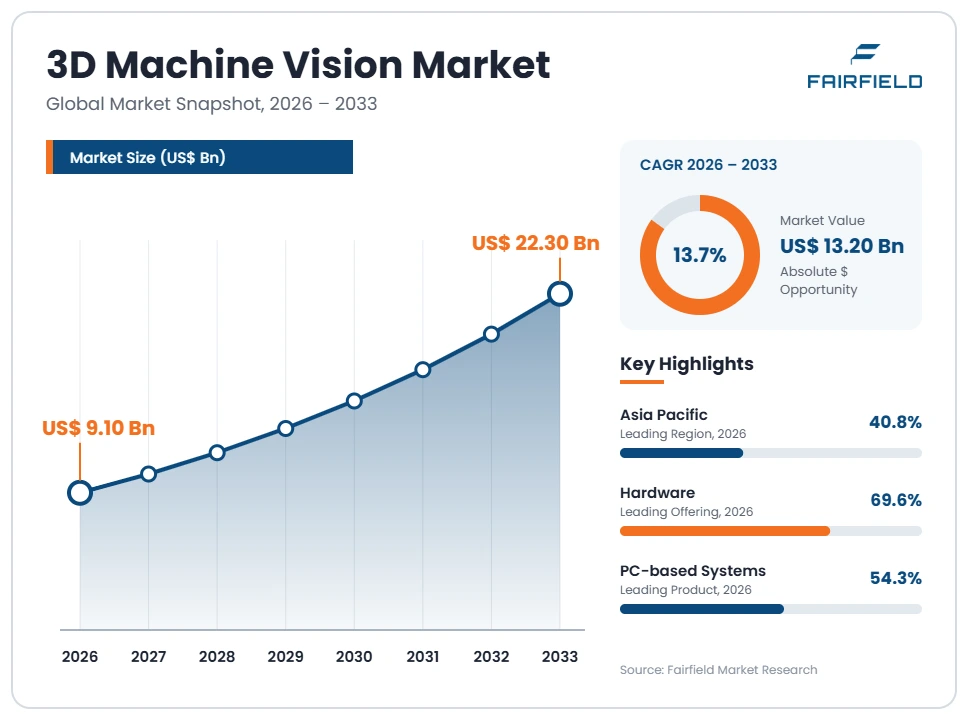
The global 3D machine vision market size is expected to be valued at US$ 9.10 billion in 2026 and projected to reach US$ 22.30 billion by 2033, growing at a CAGR of 13.7% between 2026 and 2033.
Between 2020 and 2025, the market grew at a CAGR of about 11.2%, as manufacturers automated inspection and robot handling to cope with labor shortages and rising quality demands. Three factors now drive growth: wider use of robots for bin picking, depalletizing, and assembly; strict inspection needs in electric vehicle batteries, semiconductors, and electronics; and AI software that makes 3D inspection easier to set up. The market is shifting from custom-engineered vision cells toward smart 3D cameras and sensors with built-in processing and deep learning tools.
Key Report Takeaways
- By Product: PC-based Systems held 54.3% share in 2026, while Smart Camera-based Systems are projected to expand at a 15.8% CAGR through 2033, driven by compact, easy-to-deploy inspection and robot guidance.
- By Offering: Hardware held 69.6% share in 2026, while Software is projected to expand at a 15.2% CAGR through 2033, driven by AI-based defect detection and 3D measurement tools.
- By Application: Quality Assurance & Inspection held 46.2% share in 2026, while Identification is projected to expand at a 15.4% CAGR through 2033, driven by traceability and package handling needs.
- By End Use: Automotive held 24.8% share in 2026, while Food & Beverage is projected to expand at a 15.9% CAGR through 2033, driven by automated packaging, bottling, and portion inspection.
- By Region: Asia Pacific held 40.8% share in 2026, while India is projected to expand at a 17.2% CAGR through 2033, driven by electronics, automotive, and warehouse automation investment.
Global 3D Machine Vision Market Trends and Insights
Drivers Impact Analysis
Two drivers carry the strongest influence on 3D machine vision demand during the forecast period.
| Driver | Impact on CAGR Forecast | Geographic Relevance | Impact Timeline |
| Robot guidance for bin picking, depalletizing, and assembly | High | Asia Pacific, North America, Europe | Medium term (2–4 years) |
| Precision inspection in EV batteries, semiconductors, and electronics | High | Asia Pacific, Europe, North America | Long term (≥4 years) |
Robot Guidance Is Driving 3D Machine Vision Demand in Factories and Warehouses
Robot guidance is the strongest driver of 3D machine vision demand in factories, warehouses, and logistics centers. Robots need depth data to locate, grasp, and place objects that are randomly positioned or mixed together.
The mechanism is 3D perception. Structured light, stereo, and time-of-flight cameras measure the shape and position of parts in bins, boxes on pallets, or parcels on conveyors. Vision software then calculates grasp points and sends coordinates to the robot. Labor shortages and e-commerce growth push companies to automate these tasks. In August 2025, OMRON partnered with KUKA to integrate its 3D vision sensors with KUKA’s bin-picking robots. In November 2025, Zivid introduced the Zivid 3 XL250 camera for depalletizing and large bin picking. These products make robotic handling practical for mixed and changing product loads.
Precision Inspection Is Expanding 3D Machine Vision Use in Advanced Manufacturing
Precision inspection requirements are expanding 3D machine vision use in electric vehicle batteries, semiconductors, electronics, and automotive production. Many defects, such as warpage, dents, height differences, and solder volume errors, cannot be detected reliably with 2D cameras alone.
The cause is rising product complexity and zero-defect expectations. Battery makers must check electrode alignment, weld seams, and cell dimensions. Electronics makers inspect solder joints, connector pins, and component height. Laser triangulation and structured light sensors measure surface shape at micron-level resolution and production line speed. In April 2024, Cognex launched the In-Sight L38, which combines AI, 2D, and 3D inspection in one system. Automotive suppliers also use 3D gauging for gap and flush, sealant beads, and machined parts. Inline 3D inspection reduces scrap, rework, and costly recalls across these industries.
Restraints Impact Analysis
Two restraints limit how quickly 3D machine vision reaches more users.
| Restraint | Impact on CAGR Forecast | Geographic Relevance | Impact Timeline |
| High system cost and integration complexity | Medium | Global, strongest among small and mid-sized manufacturers | Medium term (2–4 years) |
| Performance limits on reflective, transparent, and dark surfaces | Medium | Global | Short term (≤2 years) |
High System Costs and Integration Complexity Limit 3D Machine Vision Adoption
High system costs and integration complexity limit 3D machine vision adoption, especially among small and mid-sized manufacturers. A complete 3D vision cell can cost far more than a comparable 2D inspection station.
The specific cost sources are sensors, lighting, processing hardware, software licenses, and engineering work. 3D cameras with high resolution and speed carry premium prices. Integrators must calibrate sensors with robots, tune algorithms, and handle large point cloud datasets. Projects may take weeks to commission and require specialist skills that many plants lack. Each new product variant can require retuning. As a result, smaller manufacturers often delay adoption or limit 3D vision to critical steps. Shortages of trained vision engineers in Latin America, Africa, and parts of Asia Pacific add further delays and raise project risk.
Difficult Surfaces and Environments Constrain 3D Machine Vision Performance
Difficult surfaces and environments constrain 3D machine vision performance in many applications. Shiny metal, transparent plastic, glass, and very dark materials can scatter or absorb projected light, leaving gaps or noise in the 3D data.
The underlying cause is the physics of active 3D sensing. Structured light and laser triangulation depend on light reflecting predictably from surfaces. Reflective parts create false points, while transparent packaging may be invisible to sensors. Ambient light, vibration, dust, and steam on factory floors further reduce accuracy. Vendors offer multiple exposures, special filters, and AI-based filling of missing data, but these add cost and cycle time. Some applications still need careful lighting design or manual checks. These limits slow adoption in food, pharmaceutical, and metal processing lines where such surfaces are common and lighting is hard to control.
Market Opportunities
AI-Powered 3D Vision Software Opens a High-Margin Revenue Pool
AI-powered 3D vision software creates a high-margin revenue pool in the 3D machine vision market. Deep learning tools can detect defects, classify parts, and plan robot grasps without hand-written rules.
Vendors with strong software platforms can capture this opportunity. Pretrained models reduce the number of sample images needed, while no-code interfaces let factory engineers set up inspections themselves. Combining 2D and 3D data improves detection of subtle defects such as scratches on curved surfaces. Edge AI processors from NVIDIA and others run these models directly on cameras and controllers. In November 2025, Allied Vision introduced Alecs, an open smart camera built on the NVIDIA Jetson Orin NX module. Software subscriptions, updates, and analytics create recurring revenue beyond hardware sales and raise switching costs for customers.
Humanoid and Mobile Robots Create a New Revenue Pool for 3D Vision
Humanoid and mobile robots create a new revenue pool for 3D vision sensors and software. These robots need reliable depth perception to navigate, avoid obstacles, and handle objects in changing environments.
Companies that supply compact, low-power 3D cameras can capture this demand. Autonomous mobile robots in warehouses use 3D vision to detect pallets, shelves, and people. Humanoid robot developers in the United States, China, and Europe are building pilot fleets for factory and logistics work. In March 2026, Basler collaborated with Orbbec on integrated 3D vision systems for robotics and launched a stereo-based 3D vision solution. Robot makers, logistics operators, and automakers are the main customers. Volume production of robots could greatly expand unit demand for compact embedded 3D sensors and perception software.
Segment Analysis
- By Product: PC-based Systems Lead While Smart Camera-based Systems Grow Fastest
PC-based Systems held 54.3% share in 2026. These systems connect 3D cameras to industrial computers with powerful processors, which handle complex inspection, measurement, and robot guidance tasks. They are widely used in automotive, electronics, and battery plants where many sensors run on one line.
Smart Camera-based Systems are the fastest-growing product type, expanding at a 15.8% CAGR through 2033. Smart 3D cameras combine sensors, processing, and software in one compact unit. They are easier to install, need less wiring, and suit space-limited lines and robot arms. Built-in AI tools let users set up inspections without programming. Falling processor costs and improved edge AI chips make smart cameras capable of tasks that once required PCs. For the market, smart camera growth broadens adoption among small and mid-sized manufacturers.
- By Offering: Hardware Leads While Software Grows Fastest
Hardware held 69.6% share in 2026. Cameras, sensors, lighting, optics, frame grabbers, and processors represent most spending, because high-resolution 3D sensors and industrial-grade components carry high prices. Each automated line may need several sensors for different stations.
Software is the fastest-growing offering, expanding at a 15.2% CAGR through 2033. Customers need tools to process point clouds, measure features, detect defects, and plan robot paths. AI and deep learning capabilities increase software value, and vendors increasingly sell licenses and subscriptions. Software that works across camera brands appeals to integrators and large manufacturers. Integration and calibration services also add revenue. For the market, software growth shifts value toward recurring income and helps vendors differentiate beyond sensor specifications.
- By Application: Quality Assurance & Inspection Leads While Identification Grows Fastest
Quality Assurance & Inspection held 46.2% share in 2026. Manufacturers use 3D vision to check dimensions, surface defects, volume, and assembly completeness. Automotive, electronics, battery, and packaging lines depend on inline inspection to meet quality standards and reduce scrap.
Identification is the fastest-growing application, expanding at a 15.4% CAGR through 2033. 3D vision reads codes and markings on curved or uneven surfaces, identifies parcels by shape, and verifies parts in mixed loads. Traceability rules in automotive, pharmaceutical, and food sectors require accurate identification at every step. Logistics centers use 3D dimensioning and identification to sort parcels at high speed. Positioning and guidance and measurement remain important applications. For the market, identification growth links 3D vision to logistics and traceability budgets.
- By End Use: Automotive Leads While Food & Beverage Grows Fastest
Automotive held 24.8% share in 2026. Automakers and suppliers use 3D vision for body gap and flush checks, weld and sealant inspection, robot guidance, and battery module assembly. Electric vehicle production adds new inspection steps for battery cells, packs, and power electronics.
Food & Beverage is the fastest-growing end use, expanding at a 15.9% CAGR through 2033. Producers use 3D vision to inspect fill levels, seals, caps, and package shapes, and to measure portions of meat, fish, and baked goods. Robots guided by 3D cameras pick and pack irregular food items. Labor shortages and food safety rules support automation. Electronics, semiconductors, pharmaceuticals, and logistics are other important end uses. For the market, food and beverage growth extends 3D vision beyond traditional discrete manufacturing.
Geography Analysis
- North America Advances Robot Guidance and Logistics in the 3D Machine Vision Market
North America is a major market where warehouse automation, automotive production, and reshoring of manufacturing drive 3D vision demand. The United States has large e-commerce and parcel networks that use 3D vision for depalletizing, sorting, and dimensioning. Semiconductor and battery plants supported by federal incentives add new inspection needs. Cognex and Teledyne Technologies are based in the region, and many robotics startups develop humanoid and mobile robots. Canada and Mexico add demand from automotive and food processing. Persistent labor shortages make automation a priority for manufacturers and logistics operators. One opportunity is 3D vision for humanoid and mobile robots in logistics and manufacturing.
- Europe Combines Automotive and Industrial Automation Strength in the 3D Machine Vision Market
Europe is a large, mature market with strengths in automotive production, machinery, and industrial automation. Germany hosts Basler, SICK, and Isra Vision, part of Atlas Copco, along with leading automakers and robot makers. Italy and France use 3D vision in packaging, food processing, and aerospace. The Netherlands and Nordic countries have strong vision and robotics companies, including Zivid in Norway. Strict quality standards and high labor costs support automation. Key barriers include slower industrial output, high energy costs, and cautious capital spending. One opportunity is 3D inspection in battery gigafactories being built across the region.
- Which Region Is Leading the 3D Machine Vision Market?
Asia Pacific is leading the 3D machine vision market with a 40.8% share in 2026. China accounts for the largest national share, supported by electronics, electric vehicle, battery, and solar panel manufacturing at massive scale. Domestic vendors such as Hikrobot and Mech-Mind compete strongly on price. Japan hosts Keyence, OMRON, and Fanuc, and uses 3D vision in automotive and robotics. South Korea and Taiwan use precise 3D inspection in semiconductors, displays, and batteries. Government smart manufacturing programs support adoption. One change shaping the region is the rapid deployment of 3D vision-guided robots in electronics assembly.
- Which Country Is Growing Fastest in the 3D Machine Vision Market?
India is growing fastest in the 3D machine vision market at a 17.2% CAGR through 2033. The country is expanding electronics and smartphone manufacturing under the Production Linked Incentive scheme, which requires precise inspection and robot handling. Automotive and electric two-wheeler production is growing quickly, along with component suppliers. Rapid e-commerce growth is driving investment in warehouses and parcel sorting. Pharmaceutical makers need packaging inspection and serialization for traceability. Limited local vision expertise and strong cost sensitivity among smaller manufacturers remain barriers to faster adoption. One opportunity is affordable smart 3D cameras for mid-sized factories and warehouses.
- Latin America Expands 3D Machine Vision in Automotive and Food Processing
Latin America is an emerging region where automotive, food processing, and packaging industries drive 3D vision demand. Mexico hosts automotive and electronics plants serving the United States, which increasingly adopt 3D inspection and robot guidance. Brazil uses 3D vision in meat processing, beverages, and automotive production. Chile and Argentina apply vision in fruit sorting, wine bottling, and packaging. Key barriers include high import costs, currency volatility, and a limited number of local integrators. Many plants start with simpler 2D systems before upgrading to 3D inspection. One opportunity is nearshoring, which brings new automated factories into Mexico that need modern 3D inspection.
- Middle East & Africa Adopts 3D Machine Vision for Logistics and Industrial Diversification
Middle East & Africa is a developing region where logistics, industrial diversification, and food processing drive 3D vision demand. Saudi Arabia and the United Arab Emirates are building automated warehouses, ports, and factories under economic diversification programs. Oil, gas, and petrochemical plants use 3D inspection for maintenance. In Africa, South Africa applies machine vision in automotive, mining, and food processing. Key barriers include limited local manufacturing, high equipment costs, and few trained integrators. Airports and postal operators are also testing 3D parcel dimensioning. One opportunity is 3D vision in automated logistics hubs serving regional trade and e-commerce growth.
Competitive Landscape
The 3D machine vision market is moderately concentrated. Cognex, Keyence, Teledyne Technologies, Basler, and SICK hold strong positions through broad product lines and global sales networks. OMRON, LMI Technologies, part of TKH Group, Isra Vision, part of Atlas Copco, Zivid, and Photoneo compete in specialized 3D sensors and robot guidance. Chinese vendors such as Hikrobot and Mech-Mind are expanding rapidly with competitive pricing.
Companies compete on accuracy, speed, ease of use, software intelligence, robot compatibility, and price. Ease of setup has become a major differentiator for vendors, because many customers lack vision specialists. Large vendors offer complete portfolios of 2D and 3D cameras, smart sensors, and software, while specialists focus on high-performance 3D cameras for bin picking or inspection.
Strategic moves show how competition is changing. Cognex launched the In-Sight L38 in April 2024, combining AI, 2D, and 3D inspection. OMRON partnered with KUKA in August 2025 to integrate 3D vision with bin-picking robots. Allied Vision introduced the Alecs smart camera with NVIDIA processing in November 2025. Basler collaborated with Orbbec on 3D vision for robotics in March 2026. These moves show competition shifting toward AI-enabled, easy-to-deploy systems and partnerships with robot makers.
Three themes shape vendor strategy. First, companies are embedding AI and edge processing in cameras. Second, they are partnering with robot and automation companies. Third, they are actively targeting new markets such as logistics, food, and humanoid robots.
Recent Industry Developments
- March 2026: Basler collaborated with Orbbec on integrated 3D vision systems for robotics and launched a stereo-based 3D vision solution – strengthens its position in robot guidance.
- November 2025: Allied Vision introduced Alecs, an open smart camera built on NVIDIA Jetson Orin NX – brings edge AI to vision.
- August 2025: OMRON partnered with KUKA to integrate 3D vision sensors with bin-picking robots – simplifies robotic handling deployments.
- April 2024: Cognex launched the In-Sight L38, combining AI, 2D, and 3D inspection – makes 3D inspection easier to deploy.
Companies Covered in the Report
- Cognex
- Keyence
- Teledyne Technologies
- Basler
- SICK
- OMRON
- LMI Technologies (TKH Group)
- Isra Vision (Atlas Copco)
- Zivid
- Photoneo
- Allied Vision
- Hikrobot
- Mech-Mind Robotics
3D Machine Vision Market Report Scope
| Metric | Value |
| Study Period | 2020–2033 |
| Market Size 2026 | US$ 9.10 Billion |
| Market Size 2033 | US$ 22.30 Billion |
| CAGR 2026–2033 | 13.7% |
| Absolute Dollar Opportunity | US$ 13.20 Billion |
| Largest Market | Asia Pacific |
| Fastest-Growing Market | India |
| Market Concentration | Medium |
| Major Players | Cognex, Keyence, Teledyne Technologies, Basler, SICK |
3D Machine Vision Market Segmentation
Product
- PC-based Systems
- Smart Camera-based Systems
Offering
- Hardware
- Software
- Services
Application
- Quality Assurance & Inspection
- Positioning & Guidance
- Measurement
- Identification
End Use
- Automotive
- Electronics & Semiconductors
- Food & Beverage
- Pharmaceuticals
- Logistics & Warehousing
- Others
Regions
- North America
- Europe
- Asia Pacific
- Latin America
- Middle East & Africa
- Executive Summary
- Global 3D Machine Vision Market Snapshot
- Future Projections
- Key Report Takeaways
- Regional Snapshot
- Market Overview
- Market Definition and Report Scope
- Historical Trends 2020–2025
- Market Dynamics
- Drivers
- Robot Guidance Is Driving 3D Machine Vision Demand in Factories and Warehouses
- Precision Inspection Is Expanding 3D Machine Vision Use in Advanced Manufacturing
- Restraints
- High System Costs and Integration Complexity Limit 3D Machine Vision Adoption
- Difficult Surfaces and Environments Constrain 3D Machine Vision Performance
- Market Opportunities
- AI-Powered 3D Vision Software Opens a High-Margin Revenue Pool
- Humanoid and Mobile Robots Create a New Revenue Pool for 3D Vision
- Drivers
- Global 3D Machine Vision Market Outlook, 2020–2033
- Global 3D Machine Vision Market Outlook, by Product, Value (US$ Billion), 2020–2033
- PC-based Systems
- Smart Camera-based Systems
- Global 3D Machine Vision Market Outlook, by Offering, Value (US$ Billion), 2020–2033
- Hardware
- Software
- Services
- Global 3D Machine Vision Market Outlook, by Application, Value (US$ Billion), 2020–2033
- Quality Assurance & Inspection
- Positioning & Guidance
- Measurement
- Identification
- Global 3D Machine Vision Market Outlook, by End Use, Value (US$ Billion), 2020–2033
- Automotive
- Electronics & Semiconductors
- Food & Beverage
- Pharmaceuticals
- Logistics & Warehousing
- Others
- Global 3D Machine Vision Market Outlook, by Region, Value (US$ Billion), 2020–2033
- North America
- Europe
- Asia Pacific
- Latin America
- Middle East & Africa
- Global 3D Machine Vision Market Outlook, by Product, Value (US$ Billion), 2020–2033
- North America 3D Machine Vision Market Outlook, 2020–2033
- North America 3D Machine Vision Market Outlook, by Product, Value (US$ Billion), 2020–2033
- PC-based Systems
- Smart Camera-based Systems
- North America 3D Machine Vision Market Outlook, by Offering, Value (US$ Billion), 2020–2033
- Hardware
- Software
- Services
- North America 3D Machine Vision Market Outlook, by Application, Value (US$ Billion), 2020–2033
- Quality Assurance & Inspection
- Positioning & Guidance
- Measurement
- Identification
- North America 3D Machine Vision Market Outlook, by End Use, Value (US$ Billion), 2020–2033
- Automotive
- Electronics & Semiconductors
- Food & Beverage
- Pharmaceuticals
- Logistics & Warehousing
- Others
- North America 3D Machine Vision Market Outlook, by Country, Value (US$ Billion), 2020–2033
- United States 3D Machine Vision Market Outlook, by Product, 2020–2033
- United States 3D Machine Vision Market Outlook, by Offering, 2020–2033
- United States 3D Machine Vision Market Outlook, by Application, 2020–2033
- United States 3D Machine Vision Market Outlook, by End Use, 2020–2033
- Canada 3D Machine Vision Market Outlook, by Product, 2020–2033
- Canada 3D Machine Vision Market Outlook, by Offering, 2020–2033
- Canada 3D Machine Vision Market Outlook, by Application, 2020–2033
- Canada 3D Machine Vision Market Outlook, by End Use, 2020–2033
- Mexico 3D Machine Vision Market Outlook, by Product, 2020–2033
- Mexico 3D Machine Vision Market Outlook, by Offering, 2020–2033
- Mexico 3D Machine Vision Market Outlook, by Application, 2020–2033
- Mexico 3D Machine Vision Market Outlook, by End Use, 2020–2033
- North America 3D Machine Vision Market Outlook, by Product, Value (US$ Billion), 2020–2033
- Europe 3D Machine Vision Market Outlook, 2020–2033
- Europe 3D Machine Vision Market Outlook, by Product, Value (US$ Billion), 2020–2033
- PC-based Systems
- Smart Camera-based Systems
- Europe 3D Machine Vision Market Outlook, by Offering, Value (US$ Billion), 2020–2033
- Hardware
- Software
- Services
- Europe 3D Machine Vision Market Outlook, by Application, Value (US$ Billion), 2020–2033
- Quality Assurance & Inspection
- Positioning & Guidance
- Measurement
- Identification
- Europe 3D Machine Vision Market Outlook, by End Use, Value (US$ Billion), 2020–2033
- Automotive
- Electronics & Semiconductors
- Food & Beverage
- Pharmaceuticals
- Logistics & Warehousing
- Others
- Europe 3D Machine Vision Market Outlook, by Country, Value (US$ Billion), 2020–2033
- Germany 3D Machine Vision Market Outlook, by Product, 2020–2033
- Germany 3D Machine Vision Market Outlook, by Offering, 2020–2033
- Germany 3D Machine Vision Market Outlook, by Application, 2020–2033
- Germany 3D Machine Vision Market Outlook, by End Use, 2020–2033
- Italy 3D Machine Vision Market Outlook, by Product, 2020–2033
- Italy 3D Machine Vision Market Outlook, by Offering, 2020–2033
- Italy 3D Machine Vision Market Outlook, by Application, 2020–2033
- Italy 3D Machine Vision Market Outlook, by End Use, 2020–2033
- France 3D Machine Vision Market Outlook, by Product, 2020–2033
- France 3D Machine Vision Market Outlook, by Offering, 2020–2033
- France 3D Machine Vision Market Outlook, by Application, 2020–2033
- France 3D Machine Vision Market Outlook, by End Use, 2020–2033
- Netherlands 3D Machine Vision Market Outlook, by Product, 2020–2033
- Netherlands 3D Machine Vision Market Outlook, by Offering, 2020–2033
- Netherlands 3D Machine Vision Market Outlook, by Application, 2020–2033
- Netherlands 3D Machine Vision Market Outlook, by End Use, 2020–2033
- Nordic countries 3D Machine Vision Market Outlook, by Product, 2020–2033
- Nordic countries 3D Machine Vision Market Outlook, by Offering, 2020–2033
- Nordic countries 3D Machine Vision Market Outlook, by Application, 2020–2033
- Nordic countries 3D Machine Vision Market Outlook, by End Use, 2020–2033
- Norway 3D Machine Vision Market Outlook, by Product, 2020–2033
- Norway 3D Machine Vision Market Outlook, by Offering, 2020–2033
- Norway 3D Machine Vision Market Outlook, by Application, 2020–2033
- Norway 3D Machine Vision Market Outlook, by End Use, 2020–2033
- Europe 3D Machine Vision Market Outlook, by Product, Value (US$ Billion), 2020–2033
- Asia Pacific 3D Machine Vision Market Outlook, 2020–2033
- Asia Pacific 3D Machine Vision Market Outlook, by Product, Value (US$ Billion), 2020–2033
- PC-based Systems
- Smart Camera-based Systems
- Asia Pacific 3D Machine Vision Market Outlook, by Offering, Value (US$ Billion), 2020–2033
- Hardware
- Software
- Services
- Asia Pacific 3D Machine Vision Market Outlook, by Application, Value (US$ Billion), 2020–2033
- Quality Assurance & Inspection
- Positioning & Guidance
- Measurement
- Identification
- Asia Pacific 3D Machine Vision Market Outlook, by End Use, Value (US$ Billion), 2020–2033
- Automotive
- Electronics & Semiconductors
- Food & Beverage
- Pharmaceuticals
- Logistics & Warehousing
- Others
- Asia Pacific 3D Machine Vision Market Outlook, by Country, Value (US$ Billion), 2020–2033
- China 3D Machine Vision Market Outlook, by Product, 2020–2033
- China 3D Machine Vision Market Outlook, by Offering, 2020–2033
- China 3D Machine Vision Market Outlook, by Application, 2020–2033
- China 3D Machine Vision Market Outlook, by End Use, 2020–2033
- Japan 3D Machine Vision Market Outlook, by Product, 2020–2033
- Japan 3D Machine Vision Market Outlook, by Offering, 2020–2033
- Japan 3D Machine Vision Market Outlook, by Application, 2020–2033
- Japan 3D Machine Vision Market Outlook, by End Use, 2020–2033
- South Korea 3D Machine Vision Market Outlook, by Product, 2020–2033
- South Korea 3D Machine Vision Market Outlook, by Offering, 2020–2033
- South Korea 3D Machine Vision Market Outlook, by Application, 2020–2033
- South Korea 3D Machine Vision Market Outlook, by End Use, 2020–2033
- Taiwan 3D Machine Vision Market Outlook, by Product, 2020–2033
- Taiwan 3D Machine Vision Market Outlook, by Offering, 2020–2033
- Taiwan 3D Machine Vision Market Outlook, by Application, 2020–2033
- Taiwan 3D Machine Vision Market Outlook, by End Use, 2020–2033
- India 3D Machine Vision Market Outlook, by Product, 2020–2033
- India 3D Machine Vision Market Outlook, by Offering, 2020–2033
- India 3D Machine Vision Market Outlook, by Application, 2020–2033
- India 3D Machine Vision Market Outlook, by End Use, 2020–2033
- Asia Pacific 3D Machine Vision Market Outlook, by Product, Value (US$ Billion), 2020–2033
- Latin America 3D Machine Vision Market Outlook, 2020–2033
- Latin America 3D Machine Vision Market Outlook, by Product, Value (US$ Billion), 2020–2033
- PC-based Systems
- Smart Camera-based Systems
- Latin America 3D Machine Vision Market Outlook, by Offering, Value (US$ Billion), 2020–2033
- Hardware
- Software
- Services
- Latin America 3D Machine Vision Market Outlook, by Application, Value (US$ Billion), 2020–2033
- Quality Assurance & Inspection
- Positioning & Guidance
- Measurement
- Identification
- Latin America 3D Machine Vision Market Outlook, by End Use, Value (US$ Billion), 2020–2033
- Automotive
- Electronics & Semiconductors
- Food & Beverage
- Pharmaceuticals
- Logistics & Warehousing
- Others
- Latin America 3D Machine Vision Market Outlook, by Country, Value (US$ Billion), 2020–2033
- Mexico 3D Machine Vision Market Outlook, by Product, 2020–2033
- Mexico 3D Machine Vision Market Outlook, by Offering, 2020–2033
- Mexico 3D Machine Vision Market Outlook, by Application, 2020–2033
- Mexico 3D Machine Vision Market Outlook, by End Use, 2020–2033
- Brazil 3D Machine Vision Market Outlook, by Product, 2020–2033
- Brazil 3D Machine Vision Market Outlook, by Offering, 2020–2033
- Brazil 3D Machine Vision Market Outlook, by Application, 2020–2033
- Brazil 3D Machine Vision Market Outlook, by End Use, 2020–2033
- Chile 3D Machine Vision Market Outlook, by Product, 2020–2033
- Chile 3D Machine Vision Market Outlook, by Offering, 2020–2033
- Chile 3D Machine Vision Market Outlook, by Application, 2020–2033
- Chile 3D Machine Vision Market Outlook, by End Use, 2020–2033
- Argentina 3D Machine Vision Market Outlook, by Product, 2020–2033
- Argentina 3D Machine Vision Market Outlook, by Offering, 2020–2033
- Argentina 3D Machine Vision Market Outlook, by Application, 2020–2033
- Argentina 3D Machine Vision Market Outlook, by End Use, 2020–2033
- Latin America 3D Machine Vision Market Outlook, by Product, Value (US$ Billion), 2020–2033
- Middle East & Africa 3D Machine Vision Market Outlook, 2020–2033
- Middle East & Africa 3D Machine Vision Market Outlook, by Product, Value (US$ Billion), 2020–2033
- PC-based Systems
- Smart Camera-based Systems
- Middle East & Africa 3D Machine Vision Market Outlook, by Offering, Value (US$ Billion), 2020–2033
- Hardware
- Software
- Services
- Middle East & Africa 3D Machine Vision Market Outlook, by Application, Value (US$ Billion), 2020–2033
- Quality Assurance & Inspection
- Positioning & Guidance
- Measurement
- Identification
- Middle East & Africa 3D Machine Vision Market Outlook, by End Use, Value (US$ Billion), 2020–2033
- Automotive
- Electronics & Semiconductors
- Food & Beverage
- Pharmaceuticals
- Logistics & Warehousing
- Others
- Middle East & Africa 3D Machine Vision Market Outlook, by Country, Value (US$ Billion), 2020–2033
- Saudi Arabia 3D Machine Vision Market Outlook, by Product, 2020–2033
- Saudi Arabia 3D Machine Vision Market Outlook, by Offering, 2020–2033
- Saudi Arabia 3D Machine Vision Market Outlook, by Application, 2020–2033
- Saudi Arabia 3D Machine Vision Market Outlook, by End Use, 2020–2033
- United Arab Emirates 3D Machine Vision Market Outlook, by Product, 2020–2033
- United Arab Emirates 3D Machine Vision Market Outlook, by Offering, 2020–2033
- United Arab Emirates 3D Machine Vision Market Outlook, by Application, 2020–2033
- United Arab Emirates 3D Machine Vision Market Outlook, by End Use, 2020–2033
- South Africa 3D Machine Vision Market Outlook, by Product, 2020–2033
- South Africa 3D Machine Vision Market Outlook, by Offering, 2020–2033
- South Africa 3D Machine Vision Market Outlook, by Application, 2020–2033
- South Africa 3D Machine Vision Market Outlook, by End Use, 2020–2033
- Middle East & Africa 3D Machine Vision Market Outlook, by Product, Value (US$ Billion), 2020–2033
- Competitive Landscape
- Market Concentration and Industry Leaders
- Competitive Differentiation
- Strategic Moves and Market Direction
- Recent Industry Developments
- Company Profiles
- Cognex
- Keyence
- Teledyne Technologies
- Basler
- SICK
- OMRON
- LMI Technologies (TKH Group)
- Isra Vision (Atlas Copco)
- Zivid
- Photoneo
- Allied Vision
- Hikrobot
- Mech-Mind Robotics
- Appendix
- Research Methodology
- Report Assumptions
- Acronyms and Abbreviations
Product
- PC-based Systems
- Smart Camera-based Systems
Offering
- Hardware
- Software
- Services
Application
- Quality Assurance & Inspection
- Positioning & Guidance
- Measurement
- Identification
End Use
- Automotive
- Electronics & Semiconductors
- Food & Beverage
- Pharmaceuticals
- Logistics & Warehousing
- Others
Regions
- North America
- Europe
- Asia Pacific
- Latin America
- Middle East & Africa
Our Research Methodology
Considering the volatility of business today, traditional approaches to strategizing a game plan can be unfruitful if not detrimental. True ambiguity is no way to determine a forecast. A myriad of predetermined factors must be accounted for such as the degree of risk involved, the magnitude of circumstances, as well as conditions or consequences that are not known or unpredictable. To circumvent binary views that cast uncertainty, the application of market research intelligence to strategically posture, move, and enable actionable outcomes is necessary.
View Methodology
Quality Assured
Rigorous Validation Process

Confidentiality Assured
End-to-end Data Security

Custom Research Services
Tailored To Your Objectives
FAQs
The 3D machine vision market is valued at US$ 9.10 billion in 2026, led by quality inspection and robot guidance in manufacturing.
The market is projected to reach US$ 22.30 billion by 2033, growing at a 13.7% CAGR and adding US$ 13.20 billion.
Food & Beverage is growing fastest at a 15.9% CAGR through 2033, driven by automated packaging, bottling, and portion inspection.
India is growing fastest at a 17.2% CAGR through 2033, driven by electronics manufacturing, automotive production, and warehouse automation.
Asia Pacific holds the largest share at 40.8% in 2026, supported by electronics, battery, and electric vehicle manufacturing in China.
Related Reports
3D Laser Scanner Market Size, Share, Insights, Competitive Landscape, and Forecast 2026 to 2033
The global 3D laser scanner market is valued at US$2.00 billion in 2026, reaching US$3.66 billion by 2033, growing at a 9.0% CAGR
3D Concrete Printing Market Size, Share, Insights, Competitive Landscape, and Forecast 2026 to 2033
The global 3D concrete printing market is valued at US$0.30 billion in 2026, reaching US$1.20 billion by 2033, growing at a 21.9% CAGR
Elevator Maintenance Market Size, Share, Insights, Competitive Landscape, and Forecast 2026 to 2033
The global elevator maintenance market is valued at US$64.8 billion in 2026, reaching US$92.6 billion by 2033, growing at a 5.2% CAGR
Gas Insulated Power Equipment Market Size, Share, Insights, Competitive Landscape, and Forecast 2026 to 2033
The gas insulated power equipment market is valued at US$ 24.0 Bn in 2026 and is projected to reach US$ 40.5 Bn by 2033, growing at a CAGR of 7.8%
Chain Conveyors Market Size, Share, Insights, Competitive Landscape, and Forecast 2026 to 2033
The global chain conveyors market will grow from US$9.78 billion in 2026 to US$15.45 billion by 2033, at a CAGR of 6.75%, driven by industrial automation.
Reciprocating Plunger Pumps Market Size, Share, Insights, Competitive Landscape, and Forecast 2026 to 2033
The reciprocating plunger pumps market will grow from US$4.89 billion in 2026 to US$7.45 billion by 2033, at a CAGR of 6.2%.