



Warehouse Automation Market
Warehouse Automation Market Insights, Competitive Landscape, and Market Forecast - 2033
Global Warehouse Automation Market Forecast
The Warehouse Automation Market is expected to grow from USD 32.3 Billion in 2026 to USD 107.7 Billion by 2033, reflecting strong industry expansion and registering a CAGR of 18.7% during the forecast period from 2026 to 2033.
Warehouse Automation Market Summary: Key Insights & Trends
- Hardware dominates with over 65% share, driven by widespread adoption of AS/RS, conveyors, and robotic systems improving warehouse efficiency.
- Software emerges as the fastest-growing segment, enhancing real-time data visibility, energy efficiency, and seamless integration across warehouse operations.
- Retailers lead with over 55% share, as e-commerce and omnichannel fulfillment drive strong automation adoption for faster, more accurate order processing.
- Manufacturers and distributors show the fastest growth, leveraging automation for just-in-time operations, supply chain visibility, and cost optimization.
- E-Commerce holds over 35% application share, supported by high order volumes, same-day delivery trends, and large-scale deployment of autonomous robots.
- Pharmaceuticals emerge as the fastest-growing application, using automation to ensure traceability, cold-chain management, and regulatory compliance.
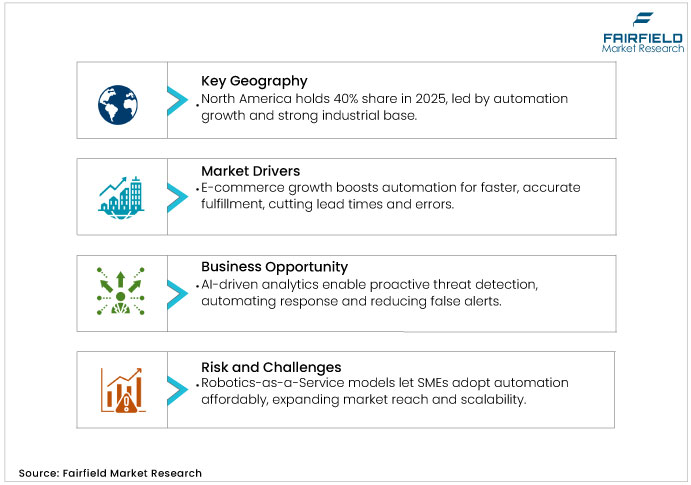
- North America leads with over 40% global share, backed by advanced logistics infrastructure, labor shortages, and heavy retail automation investments.
- Asia Pacific remains the fastest-growing region, driven by rapid industrialization, digital logistics adoption, and strong government automation initiatives.
Key Growth Drivers
- E-Commerce Growth Accelerates Adoption of Scalable Warehouse Automation Solutions Worldwide
E-commerce expansion drives necessitate rapid order processing and inventory management. Businesses face pressure to handle surging volumes, with online sales projected to influence 25% of global retail by 2030. Automation enables just-in-time fulfilment, reducing lead times from days to hours through robotic picking and conveyor systems. This shift not only boosts throughput but also enhances accuracy, minimizing errors that cost retailers up to 1.5% of revenue annually. In theory, e-commerce's network effects amplify automation's value, as platforms such as integrated marketplaces demand seamless backend synchronization. Government data from the U.S. Census Bureau highlights a 15% year-over-year increase in e-commerce shipments, underscoring how digital retail ecosystems compel warehouses to evolve beyond manual labor toward predictive analytics-driven operations. Ultimately, this driver positions automation as a competitive moat, allowing firms to capture market share in high-velocity sectors.
- Labor Shortages Propel Robotic Innovations in Modern Warehouse Automation Systems
Labor shortages in warehousing propel the warehouse automation market, as demographic shifts and high turnover rates strain traditional workforces. The U.S. Bureau of Labor Statistics reports over 7.2 million job openings in all sectors as of August 2025, with quit rates for transportation, warehousing, and utilities exceeding 1.9%. Automation counters this by deploying autonomous mobile robots (AMRs) and collaborative bots (cobots) that handle repetitive tasks, freeing humans for oversight roles. Theoretically, this aligns with labor economics principles, where technology augments human capital rather than displacing it entirely, potentially increasing productivity by 30-50% per shift. Industry associations note that skilled worker scarcity, exacerbated by aging populations in developed economies, accelerates ROI on automation investments within 18-24 months. By mitigating downtime and overtime costs, which can inflate operational expenses by 20%, this driver fosters a hybrid workforce model resilient to volatility.
Key Restraints
- High Upfront Automation Costs Restrict Adoption Among Mid-Tier Warehouse Operators
Elevated upfront costs deter widespread adoption, particularly for mid-tier operators. Robotic systems such as automated storage and retrieval setups demand investments exceeding US$1 million per installation, per equipment supplier disclosures. These barriers stem from customization needs and integration complexities, delaying breakeven periods to 2-3 years. Smaller entities often defer upgrades, perpetuating inefficiencies amid rising energy and compliance demands.
- Legacy Infrastructure Compatibility Issues Impede Seamless Warehouse Automation Integration
Compatibility issues with existing setups hinder the warehouse automation market's momentum, as retrofitting outdated facilities incurs unforeseen expenses. Legacy systems lack interoperability with modern IoT protocols, leading to 20-30% project overruns in data synchronization efforts. This restraint theoretically fragments the market, favoring greenfield developments over incremental upgrades and slowing diffusion in mature industrial bases.
Warehouse Automation Market Trends and Opportunities
- Robotics-as-a-Service Empowers SME Adoption and Expands Warehouse Automation Reach
Small and medium enterprises (SMEs) represent untapped potential in the warehouse automation market via subscription-based robotics services that democratize access. Traditional capex models exclude SMEs, but RaaS shifts costs to opex, enabling scalability without debt. Theoretically, this aligns with diffusion of innovations theory, where low-barrier entry accelerates technology spread across fragmented sectors. In Asia Pacific, similar models could capture 30% more market volume by 2030, as SMEs leverage cloud-integrated bots for agile fulfillment. This opportunity fosters ecosystem partnerships, where vendors co-develop modular solutions, ultimately expanding the market's base beyond large-scale deployers.
- Industrialization in Emerging Economies Drives Demand for Localized Warehouse Automation
Rapid industrialization in developing regions unlocks growth as nations such as India and Brazil modernize logistics amid urbanization. Government initiatives, such as India's National Logistics Policy, aim to cut costs by 10% through tech incentives, spurring 18% CAGR in automated warehousing. Theoretically, Porter's diamond model highlights how local factor conditions, abundant young labor paired with tech literacy, create competitive advantages for hybrid automation. South Korea's smart factory push, per Ministry of Trade data, integrates AI for 25% efficiency gains, inspiring regional replication. This opportunity theoretically bridges global divides, enabling knowledge transfer from mature markets to foster sustainable supply chains resilient to trade volatilities.
Segment-wise Trends & Analysis
- Hardware Leads While Software Rapidly Gains Ground in Warehouse Automation Landscape
Hardware dominates with over 65% share in 2025, valued at approximately US$16.3 billion, driven by demand for tangible assets such as AS/RS and conveyors. This leadership stems from hardware's direct impact on throughput, enabling 40% faster picking rates in high-volume settings. Competitive positioning favors incumbents with robust supply chains, as seen in vertically integrated firms controlling 70% of installations.
Software emerges as the fast-growing segment, projected to expand at a sustainable CAGR through 2032, fueled by AI enhancements in WMS. Underlying drivers include the need for data analytics to optimize hardware performance, reducing energy use by 15%. In competitive landscapes, agile software providers gain traction via APIs, challenging hardware giants and reshaping alliances in the warehouse automation market.
- Retailers Dominate as Manufacturers and Distributors Accelerate Warehouse Automation Adoption
Retailers lead by capturing over 55% share in 2025 at US$13.8 billion, propelled by e-commerce fulfillment pressures. This dominance arises from retailers' focus on velocity, where automation cuts order cycle times by 50%, per operational benchmarks. Leaders position via omnichannel integrations, holding 60% of retail deployments.
Manufacturers and distributors grow rapidly, driven by reshoring trends requiring just-in-time inventory. Key drivers encompass supply chain visibility, mitigating disruptions that cost 5-10% of GDP annually. Competitively, specialized automation tailors to B2B volumes, eroding retail exclusivity and diversifying the warehouse automation market.
- E-Commerce Leads Warehouse Automation While Pharmaceuticals Emerge as Key Growth Sector
E-Commerce commands over 35% share in the industry for 2025, anchored by same-day delivery mandates. Leadership reflects volume surges, with automation handling 70% of peak orders error-free. Top players dominate via scalable bots, securing 80% of e-tail contracts.
Pharmaceuticals surge as an emerging application at a sustainable CAGR, spurred by regulatory demands for traceability amid cold-chain complexities. Drivers include compliance with FDA guidelines, averting recalls that exceed US$10 million per incident. Competitive edges lie in precision tech, positioning niche vendors to penetrate the warehouse automation market's high-margin niches.
Regional Trends & Analysis
North America Leads Global Warehouse Automation with Strong Industrial and E-Commerce Base
North America dominates with over 40% global market share in 2025. The region's leadership stems from advanced industrial infrastructure, high labor costs driving automation adoption, and significant investments by e-commerce giants in fulfillment center modernization. The United States leads North American growth with established automation suppliers and favorable regulatory environments supporting technology deployment.
U.S. Warehouse Automation Market – 2025 Snapshot & Outlook
The U.S. market benefits from favorable demographic and economic conditions that accelerate automation adoption. Rising warehouse worker wages, which have increased over 15% in the past decade, combined with acute labor shortages create compelling economic justifications for automation investments. E-commerce giants Amazon and Walmart are driving market expansion through multi-billion-dollar automation programs, with Amazon's 750,000 deployed robots setting industry benchmarks for operational efficiency. Government infrastructure investments and favorable depreciation policies for automation equipment further support market growth across diverse industrial sectors.
Asia Pacific Emerges as Fastest-Growing Region in Warehouse Automation Industry
The Asia Pacific region represents the fastest-growing market globally, projected to reach US$40 billion by 2032. Regional growth is driven by rapid industrialization, expanding e-commerce penetration, and government initiatives supporting automation adoption across manufacturing and logistics sectors. China, Japan, and India lead regional development with significant investments in automation infrastructure and favourable policies encouraging technological modernization.
Japan Warehouse Automation Market – 2025 Snapshot & Outlook
Japan's market benefits from advanced manufacturing expertise and demographic pressures from an aging workforce that necessitates automation adoption. The country's leadership in robotics technology provides competitive advantages in developing sophisticated warehouse automation solutions. Major Japanese companies such as Daifuku and Yaskawa Electric Corporation maintain significant global market positions, leveraging domestic expertise to capture international opportunities in automated materials handling and robotic systems.
India Warehouse Automation Market – 2025 Snapshot & Outlook
India's market is experiencing explosive growth driven by the world's largest e-commerce expansion and government digitalization initiatives. The market is valued at US$0.56 billion in 2025 with projections for exceptional growth as online retail penetration accelerates across tier-2 and tier-3 cities. Leading e-commerce platforms including Amazon India, Flipkart, and BigBasket are investing heavily in automation to handle increasing order volumes and improve delivery capabilities. Government policies supporting manufacturing modernization and logistics infrastructure development create favorable conditions for sustained automation market expansion.
Europe Advances Sustainable and Intelligent Warehouse Automation Across Key Industries
Europe maintains steady warehouse automation growth driven by sustainability regulations, labor cost pressures, and advanced manufacturing requirements across automotive, pharmaceutical, and consumer goods sectors. The region emphasizes energy-efficient automation solutions and environmental compliance, creating opportunities for green technology providers. Germany leads European adoption with strong industrial automation expertise and favorable policies supporting Industry 4.0 initiatives.
Germany Warehouse Automation Market – 2025 Snapshot & Outlook
Germany's market leverages the country's advanced manufacturing capabilities and Industry 4.0 leadership to drive technological innovation. Strong automotive and industrial sectors create demand for sophisticated automation solutions, while favorable government policies support research and development investments. German companies such as SSI Schäfer maintain significant global market positions, combining domestic expertise with international expansion strategies.
U.K. Warehouse Automation Market – 2025 Snapshot & Outlook
The U.K.'s market benefits from Brexit-related supply chain optimization requirements and growing e-commerce penetration. Retailers are investing in automation to manage increased complexity from international trade regulations and delivery expectations. The country's advanced logistics infrastructure and favorable business environment support continued automation adoption across diverse industry sectors.
Competitive Landscape Analysis
The players in the warehouse automation industry are focusing on strategic partnerships to enhance integration capabilities. This approach counters fragmentation in supply chains, where 70% of firms report compatibility issues per industry filings. One partnership in 2024 between robotics firms boosted deployment speeds by 25%, illustrating scalability gains. Another event involved joint ventures for AI modules, addressing 15% of customization demands unmet by standalone offerings.
Rising raw material costs and stringent EU safety regulations will impact expenses and throughput in the warehouse automation market. Material prices surged 12% in 2024, per World Bank indices, pressuring hardware margins. New directives mandate 20% emission cuts by 2027, spurring R&D reallocations. Early movers will benefit from ecosystem lock-ins, while latecomers may face premium pricing penalties.
Key Companies
- ABB Ltd.
- Bastian Solution LLC
- Daifuku Co Ltd.
- FANUC Corporation
- Fetch Robotics Inc.
- Jungheinrich AG
- KUKA AG
- Omron Corporation
- SSI SCHAEFER Group
- Yaskawa Electric Corporation
Global Warehouse Automation Market Segmentation-
By Components
- Hardware
- Software
By End-user
- Retailers
- Manufacturers and distributors
By Application
- Automotive
- Food and beverage
- E-Commerce
- Pharmaceutical
- Others
By Region
- North America
- Europe
- Asia Pacific
- Latin America
- Middle East & Africa
- Executive Summary
- Global Warehouse Automation Market Snapshot
- Future Projections
- Key Market Trends
- Regional Snapshot, by Value, 2026
- Analyst Recommendations
- Market Overview
- Market Definitions and Segmentations
- Market Dynamics
- Drivers
- Restraints
- Market Opportunities
- Value Chain Analysis
- COVID-19 Impact Analysis
- Porter's Five Forces Analysis
- Impact of Russia-Ukraine Conflict
- PESTLE Analysis
- Regulatory Analysis
- Price Trend Analysis
- Current Prices and Future Projections, 2025-2033
- Price Impact Factors
- Global Warehouse Automation Market Outlook, 2020 - 2033
- Global Warehouse Automation Market Outlook, by Components, Value (US$ Bn), 2020-2033
- Hardware
- Software
- Global Warehouse Automation Market Outlook, by End-user, Value (US$ Bn), 2020-2033
- Retailers
- Manufacturers and distributors
- Global Warehouse Automation Market Outlook, by Application, Value (US$ Bn), 2020-2033
- Automotive
- Food and beverage
- E-Commerce
- Pharmaceutical
- Others
- Global Warehouse Automation Market Outlook, by Region, Value (US$ Bn), 2020-2033
- North America
- Europe
- Asia Pacific
- Latin America
- Middle East & Africa
- Global Warehouse Automation Market Outlook, by Components, Value (US$ Bn), 2020-2033
- North America Warehouse Automation Market Outlook, 2020 - 2033
- North America Warehouse Automation Market Outlook, by Components, Value (US$ Bn), 2020-2033
- Hardware
- Software
- North America Warehouse Automation Market Outlook, by End-user, Value (US$ Bn), 2020-2033
- Retailers
- Manufacturers and distributors
- North America Warehouse Automation Market Outlook, by Application, Value (US$ Bn), 2020-2033
- Automotive
- Food and beverage
- E-Commerce
- Pharmaceutical
- Others
- North America Warehouse Automation Market Outlook, by Country, Value (US$ Bn), 2020-2033
- U.S. Warehouse Automation Market Outlook, by Components, 2020-2033
- U.S. Warehouse Automation Market Outlook, by End-user, 2020-2033
- U.S. Warehouse Automation Market Outlook, by Application, 2020-2033
- Canada Warehouse Automation Market Outlook, by Components, 2020-2033
- Canada Warehouse Automation Market Outlook, by End-user, 2020-2033
- Canada Warehouse Automation Market Outlook, by Application, 2020-2033
- BPS Analysis/Market Attractiveness Analysis
- North America Warehouse Automation Market Outlook, by Components, Value (US$ Bn), 2020-2033
- Europe Warehouse Automation Market Outlook, 2020 - 2033
- Europe Warehouse Automation Market Outlook, by Components, Value (US$ Bn), 2020-2033
- Hardware
- Software
- Europe Warehouse Automation Market Outlook, by End-user, Value (US$ Bn), 2020-2033
- Retailers
- Manufacturers and distributors
- Europe Warehouse Automation Market Outlook, by Application, Value (US$ Bn), 2020-2033
- Automotive
- Food and beverage
- E-Commerce
- Pharmaceutical
- Others
- Europe Warehouse Automation Market Outlook, by Country, Value (US$ Bn), 2020-2033
- Germany Warehouse Automation Market Outlook, by Components, 2020-2033
- Germany Warehouse Automation Market Outlook, by End-user, 2020-2033
- Germany Warehouse Automation Market Outlook, by Application, 2020-2033
- Italy Warehouse Automation Market Outlook, by Components, 2020-2033
- Italy Warehouse Automation Market Outlook, by End-user, 2020-2033
- Italy Warehouse Automation Market Outlook, by Application, 2020-2033
- France Warehouse Automation Market Outlook, by Components, 2020-2033
- France Warehouse Automation Market Outlook, by End-user, 2020-2033
- France Warehouse Automation Market Outlook, by Application, 2020-2033
- U.K. Warehouse Automation Market Outlook, by Components, 2020-2033
- U.K. Warehouse Automation Market Outlook, by End-user, 2020-2033
- U.K. Warehouse Automation Market Outlook, by Application, 2020-2033
- Spain Warehouse Automation Market Outlook, by Components, 2020-2033
- Spain Warehouse Automation Market Outlook, by End-user, 2020-2033
- Spain Warehouse Automation Market Outlook, by Application, 2020-2033
- Russia Warehouse Automation Market Outlook, by Components, 2020-2033
- Russia Warehouse Automation Market Outlook, by End-user, 2020-2033
- Russia Warehouse Automation Market Outlook, by Application, 2020-2033
- Rest of Europe Warehouse Automation Market Outlook, by Components, 2020-2033
- Rest of Europe Warehouse Automation Market Outlook, by End-user, 2020-2033
- Rest of Europe Warehouse Automation Market Outlook, by Application, 2020-2033
- BPS Analysis/Market Attractiveness Analysis
- Europe Warehouse Automation Market Outlook, by Components, Value (US$ Bn), 2020-2033
- Asia Pacific Warehouse Automation Market Outlook, 2020 - 2033
- Asia Pacific Warehouse Automation Market Outlook, by Components, Value (US$ Bn), 2020-2033
- Hardware
- Software
- Asia Pacific Warehouse Automation Market Outlook, by End-user, Value (US$ Bn), 2020-2033
- Retailers
- Manufacturers and distributors
- Asia Pacific Warehouse Automation Market Outlook, by Application, Value (US$ Bn), 2020-2033
- Automotive
- Food and beverage
- E-Commerce
- Pharmaceutical
- Others
- Asia Pacific Warehouse Automation Market Outlook, by Country, Value (US$ Bn), 2020-2033
- China Warehouse Automation Market Outlook, by Components, 2020-2033
- China Warehouse Automation Market Outlook, by End-user, 2020-2033
- China Warehouse Automation Market Outlook, by Application, 2020-2033
- Japan Warehouse Automation Market Outlook, by Components, 2020-2033
- Japan Warehouse Automation Market Outlook, by End-user, 2020-2033
- Japan Warehouse Automation Market Outlook, by Application, 2020-2033
- South Korea Warehouse Automation Market Outlook, by Components, 2020-2033
- South Korea Warehouse Automation Market Outlook, by End-user, 2020-2033
- South Korea Warehouse Automation Market Outlook, by Application, 2020-2033
- India Warehouse Automation Market Outlook, by Components, 2020-2033
- India Warehouse Automation Market Outlook, by End-user, 2020-2033
- India Warehouse Automation Market Outlook, by Application, 2020-2033
- Southeast Asia Warehouse Automation Market Outlook, by Components, 2020-2033
- Southeast Asia Warehouse Automation Market Outlook, by End-user, 2020-2033
- Southeast Asia Warehouse Automation Market Outlook, by Application, 2020-2033
- Rest of SAO Warehouse Automation Market Outlook, by Components, 2020-2033
- Rest of SAO Warehouse Automation Market Outlook, by End-user, 2020-2033
- Rest of SAO Warehouse Automation Market Outlook, by Application, 2020-2033
- BPS Analysis/Market Attractiveness Analysis
- Asia Pacific Warehouse Automation Market Outlook, by Components, Value (US$ Bn), 2020-2033
- Latin America Warehouse Automation Market Outlook, 2020 - 2033
- Latin America Warehouse Automation Market Outlook, by Components, Value (US$ Bn), 2020-2033
- Hardware
- Software
- Latin America Warehouse Automation Market Outlook, by End-user, Value (US$ Bn), 2020-2033
- Retailers
- Manufacturers and distributors
- Latin America Warehouse Automation Market Outlook, by Application, Value (US$ Bn), 2020-2033
- Automotive
- Food and beverage
- E-Commerce
- Pharmaceutical
- Others
- Latin America Warehouse Automation Market Outlook, by Country, Value (US$ Bn), 2020-2033
- Brazil Warehouse Automation Market Outlook, by Components, 2020-2033
- Brazil Warehouse Automation Market Outlook, by End-user, 2020-2033
- Brazil Warehouse Automation Market Outlook, by Application, 2020-2033
- Mexico Warehouse Automation Market Outlook, by Components, 2020-2033
- Mexico Warehouse Automation Market Outlook, by End-user, 2020-2033
- Mexico Warehouse Automation Market Outlook, by Application, 2020-2033
- Argentina Warehouse Automation Market Outlook, by Components, 2020-2033
- Argentina Warehouse Automation Market Outlook, by End-user, 2020-2033
- Argentina Warehouse Automation Market Outlook, by Application, 2020-2033
- Rest of LATAM Warehouse Automation Market Outlook, by Components, 2020-2033
- Rest of LATAM Warehouse Automation Market Outlook, by End-user, 2020-2033
- Rest of LATAM Warehouse Automation Market Outlook, by Application, 2020-2033
- BPS Analysis/Market Attractiveness Analysis
- Latin America Warehouse Automation Market Outlook, by Components, Value (US$ Bn), 2020-2033
- Middle East & Africa Warehouse Automation Market Outlook, 2020 - 2033
- Middle East & Africa Warehouse Automation Market Outlook, by Components, Value (US$ Bn), 2020-2033
- Hardware
- Software
- Middle East & Africa Warehouse Automation Market Outlook, by End-user, Value (US$ Bn), 2020-2033
- Retailers
- Manufacturers and distributors
- Middle East & Africa Warehouse Automation Market Outlook, by Application, Value (US$ Bn), 2020-2033
- Automotive
- Food and beverage
- E-Commerce
- Pharmaceutical
- Others
- Middle East & Africa Warehouse Automation Market Outlook, by Country, Value (US$ Bn), 2020-2033
- GCC Warehouse Automation Market Outlook, by Components, 2020-2033
- GCC Warehouse Automation Market Outlook, by End-user, 2020-2033
- GCC Warehouse Automation Market Outlook, by Application, 2020-2033
- South Africa Warehouse Automation Market Outlook, by Components, 2020-2033
- South Africa Warehouse Automation Market Outlook, by End-user, 2020-2033
- South Africa Warehouse Automation Market Outlook, by Application, 2020-2033
- Egypt Warehouse Automation Market Outlook, by Components, 2020-2033
- Egypt Warehouse Automation Market Outlook, by End-user, 2020-2033
- Egypt Warehouse Automation Market Outlook, by Application, 2020-2033
- Nigeria Warehouse Automation Market Outlook, by Components, 2020-2033
- Nigeria Warehouse Automation Market Outlook, by End-user, 2020-2033
- Nigeria Warehouse Automation Market Outlook, by Application, 2020-2033
- Rest of Middle East Warehouse Automation Market Outlook, by Components, 2020-2033
- Rest of Middle East Warehouse Automation Market Outlook, by End-user, 2020-2033
- Rest of Middle East Warehouse Automation Market Outlook, by Application, 2020-2033
- BPS Analysis/Market Attractiveness Analysis
- Middle East & Africa Warehouse Automation Market Outlook, by Components, Value (US$ Bn), 2020-2033
- Competitive Landscape
- Company Vs Segment Heatmap
- Company Market Share Analysis, 2025
- Competitive Dashboard
- Company Profiles
- ABB Ltd.
- Company Overview
- Product Portfolio
- Financial Overview
- Business Strategies and Developments
- Bastian Solution LLC
- Daifuku Co Ltd.
- FANUC Corporation
- Fetch Robotics Inc.
- Jungheinrich AG
- KUKA AG
- Omron Corporation
- SSI SCHAEFER Group
- Yaskawa Electric Corporation
- ABB Ltd.
- Appendix
- Research Methodology
- Report Assumptions
- Acronyms and Abbreviations
|
BASE YEAR |
HISTORICAL DATA |
FORECAST PERIOD |
UNITS |
|||
 |
2025 |
 |
2020 - 2025 |
 |
2026 - 2033 |
Value: US$ Billion |
|
REPORT FEATURES |
DETAILS |
|
Components Coverage |
|
|
End User Coverage |
|
|
Application Coverage |
|
|
Geographical Coverage |
|
|
Leading Companies |
|
|
Report Highlights |
Market Estimates and Forecast, Market Dynamics, Industry Trends, Competition Landscape, Product-, Application-, Region-, Country-wise Trends & Analysis, COVID-19 Impact Analysis, Key Trends |
Our Research Methodology
Considering the volatility of business today, traditional approaches to strategizing a game plan can be unfruitful if not detrimental. True ambiguity is no way to determine a forecast. A myriad of predetermined factors must be accounted for such as the degree of risk involved, the magnitude of circumstances, as well as conditions or consequences that are not known or unpredictable. To circumvent binary views that cast uncertainty, the application of market research intelligence to strategically posture, move, and enable actionable outcomes is necessary.
View Methodology
Quality Assured
Rigorous Validation Process

Confidentiality Assured
End-to-end Data Security

Custom Research Services
Tailored To Your Objectives
FAQs
The Warehouse Automation market is expected to reach USD 32.3 billion in 2026.
The Warehouse Automation market is projected to grow at a CAGR of 18.7% between 2026 and 2033.
The Warehouse Automation market is driven by rapid e-commerce expansion, labor shortages, and increasing adoption of AI-powered robotics and warehouse management systems.
North America is the dominant region in the Warehouse Automation market.
ABB Ltd., Daifuku Co. Ltd., FANUC Corporation, KUKA AG, and SSI SCHAEFER Group are some of the leading industry players in the Warehouse Automation market.
Related Reports
Gas Insulated Power Equipment Market Size, Share, Insights, Competitive Landscape, and Forecast 2026 to 2033
The gas insulated power equipment market is valued at US$ 24.0 Bn in 2026 and is projected to reach US$ 40.5 Bn by 2033, growing at a CAGR of 7.8%
Chain Conveyors Market Size, Share, Insights, Competitive Landscape, and Forecast 2026 to 2033
The global chain conveyors market will grow from US$9.78 billion in 2026 to US$15.45 billion by 2033, at a CAGR of 6.75%, driven by industrial automation.
Reciprocating Plunger Pumps Market Size, Share, Insights, Competitive Landscape, and Forecast 2026 to 2033
The reciprocating plunger pumps market will grow from US$4.89 billion in 2026 to US$7.45 billion by 2033, at a CAGR of 6.2%.
Plastic Injection Molding Machine for MedTech Market Size, Share, Insights, Competitive Landscape, and Forecast 2026 to 2033
The plastic injection molding machine for MedTech market will grow from US$2.1 billion in 2026 to US$3.46 billion by 2033, at a CAGR of 7.4%.
Plastic Processing Machinery Market Size, Share, Insights, Competitive Landscape, and Forecast 2026 to 2033
The plastic processing machinery market will grow from US$38.5 billion in 2026 to US$55.3 billion by 2033, at a 5.3% CAGR, driven by industrial demand.
Padel Court Construction Market Size, Share, Insights, Competitive Landscape, and Market Forecast - 2033
The Padel Court Construction Market is projected to reach US$8.9 billion by 2033, growing at 13.8% CAGR from US$3.6 billion in 2026.