



Storage Water Heater Market
Storage Water Heater Market Insights, Competitive Landscape, and Market Forecast - 2033
Global Storage Water Heater Market Forecast
The Storage Water Heater Market is expected to grow from USD 23.4 Billion in 2026 to USD 35.9 Billion by 2033, reflecting strong industry expansion and registering a CAGR of 6.3% during the forecast period from 2026 to 2033.
Market Dynamics: Drivers, Restraints, and Opportunities Analysis
Market Drivers
- Urbanization and Infrastructure Expansion in Emerging Markets
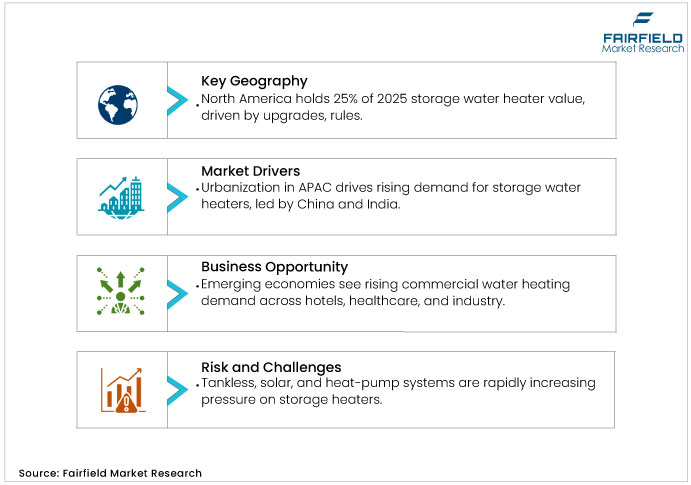
Rapid urbanization across Asia-Pacific, particularly in China and India, continues to fuel demand for water heating infrastructure, with UN-Habitat reporting ~2.2% annual urban population growth between 2020–2024 and continued expansion expected through 2032. This shift aligns with rising multifamily housing projects, where storage water heaters are standard, further reinforced by China’s Ministry of Housing and Urban-Rural Development energy-efficiency installation mandates.
In India, rising household disposable incomes-estimated at 6–8% annually across tier-1 and tier-2 cities per World Bank data-are accelerating adoption of mid-tier electric and gas storage systems. This trend is projected to add 2–2.5 percentage points to industry growth through 2032, with momentum concentrated in China, India, ASEAN, and sub-Saharan Africa, favoring manufacturers with localized supply chains while increasing competitive pressure for firms focused solely on mature markets.
- Energy Efficiency Regulation and Carbon Reduction Mandates
Regulatory frameworks across North America, Europe, and Asia-Pacific are enforcing mandatory energy efficiency and emissions compliance, directly shaping water heater specifications. The U.S. DOE’s 2023 update mandates improved insulation and lower standby heat loss for units manufactured from 2028, while the EU’s Ecodesign and Energy-Related Products Directive continue tightening requirements through 2030.
These regulations are reshaping competition by favoring manufacturers with smart controls, advanced insulation, and verifiable compliance capabilities, with compliance costs estimated at 3–5% of manufacturing expense. Companies integrating regulatory alignment into product design and supply chain execution are using compliance as a competitive barrier against low-cost producers unable to absorb added costs.
Market Restraints
- Raw Material Cost Volatility and Supply Chain Complexity
Storage water heater production depends on materials such as stainless steel, copper, advanced insulation, and electronic controls, creating vulnerability to commodity price fluctuations. Steel prices saw 35–45% volatility between 2022–2024, while copper costs tracked global construction and electrical infrastructure cycles, reducing margin stability.
This volatility is estimated to suppress growth by 0.5–1 percentage point annually, particularly affecting low-margin manufacturers in price-sensitive markets. Ongoing supply chain challenges-especially for specialized control systems-have extended component lead times by 6–9 months compared to pre-pandemic levels, limiting production scalability.
- Competitive Displacement Risk from Alternative Water Heating Technologies
While storage water heaters remain mature and widely adopted, displacement risk is rising from tankless, solar thermal, and heat pump alternatives. Tankless systems already hold 25–35% share in select developed markets such as Northern Europe and Japan, driven by efficiency gains and space constraints. Solar thermal-supported by declining costs and government incentives-is expanding across high-insolation regions including the Mediterranean, Middle East, southwestern United States, and India, where it is expected to reach 5–8% residential penetration by 2030.
Heat pump systems are gaining traction in Northern Europe and Japan, though adoption in storage water heater markets remains limited by cost and infrastructure needs. Collectively, these alternative technologies are projected to reduce storage water heater growth by 0.3–0.5 % points annually through targeted market share erosion in specific regions and demographic groups.
Market Opportunities
- Commercial Sector Expansion and Facility Modernization
Commercial water heating demand remains underserved across emerging economies, with applications spanning hospitality, healthcare, education, and industrial food and beverage facilities. Growth in hotel and resort development across Asia-Pacific, Africa, and Latin America is accelerating infrastructure requirements, while healthcare initiatives-such as India’s government-backed expansion and African hospital development-further elevate system demand.
Rising industrial processing linked to expanding middle-class consumption also drives demand for high-capacity systems, positioning the commercial segment for meaningful growth. This opportunity is projected to expand meaningfully by 2032, increasing its share of the total storage water heater market compared to current levels and favoring manufacturers with strong commercial-grade portfolios, robust technical service networks, and advanced integration capabilities.
- Digital Integration and Predictive Maintenance Service Models
Integration of cloud monitoring, IoT sensors, and analytics platforms is shifting water heater business models from one-time product sales toward recurring service ecosystems. Declining IoT sensor costs-down 40–50% between 2018–2024-and greater cloud accessibility are accelerating adoption of remote monitoring, predictive maintenance, and automated component management.
Manufacturers advancing proprietary analytics and service capabilities are benefiting from higher customer retention and switching barriers. This digitally enabled model is expected to generate an additional 3–5% margin uplift within 5–7 years, representing a US$ 600 million–1 billion opportunity by 2032 for companies achieving strong penetration in connected service offerings.
Segmentation Analysis: Category-Wise Strategic Assessment
- Capacity Segmentation Analysis
The 30–100 liter segment holds ~40% share of storage water heater market in 2025, valued at ~US$ 5.8 billion, driven by standard household usage in developed markets and rising urban demand in Asia-Pacific. This capacity range benefits from mature technology, strong distribution channels, and price-based competition, with demand linked to residential construction cycles and replacement activity. Leading players such as A.O. Smith and Rheem sustain share through scale advantages and established networks.
The 100–250 liter segment represents ~28–30% share and is expanding fastest, outpacing overall growth by 1.5–2 percentage points annually. Growth is influenced by rising multifamily developments and increasing commercial applications such as small hospitality, clinics, and education facilities. Success in this segment requires targeted channel strategies and differentiated positioning versus the more commoditized 30–100 liter category.
- Energy Source Segmentation Analysis
Electric water heaters hold ~60% share of storage water heater market in 2025, valued at ~US$ 8.6 billion, supported by widespread infrastructure access and strong residential replacement cycles. The segment remains highly fragmented with price-based competition and differentiation driven by efficiency upgrades, smart controls, and service offerings, though lower technology barriers continue contributing to margin compression.
Gas water heaters account for a significant proportion of the category and continue to grow at a pace above the broader industry average, supported by rising replacement demand, energy-efficiency upgrades, and strengthened adoption in both residential and commercial settings. Growth reflects favorable natural gas pricing and strong adoption in North America and parts of Europe, while electric systems maintain dominance across Asia-Pacific and Southern Europe, requiring geographically tailored strategies.
- End-Use Application Segmentation Analysis
Residential applications account for ~55% of storage water heater market share in 2025, valued at ~US$ 7.9 billion, supported by consistent demand across new housing construction and replacement cycles. This segment remains fragmented, with competition across retail, plumbing distribution, and e-commerce channels, where price sensitivity and brand familiarity help established players retain advantage.
Commercial applications form a substantial portion of total deployment and are currently the fastest-expanding segment, consistently outpacing residential adoption due to higher replacement urgency, regulatory compliance cycles, and sustained infrastructure investment. Expansion is driven by hospitality, healthcare, and education infrastructure growth in emerging markets and upgrade requirements in developed economies, with success dependent on technical sales, integration capabilities, and service support rather than consumer retail channels.
Regional Market Assessment: Strategic Geography Analysis
- North America: Mature Market Dynamics and Replacement-Cycle Leadership
North America represents ~25% of global storage water heater market value in 2025, estimated at ~US$ 3.6 billion, driven by mature adoption, high installation penetration, and replacement cycles linked to a 10–15-year product lifespan. Growth is further supported by renovation activity and regulatory efficiency standards, including U.S. DOE rules effective in 2028 that favor advanced insulation and smart controls.
Competition is led by established players such as Rheem Manufacturing, A.O. Smith, and Bradford White, where brand strength, reliability, and service matter more than price. Growth is replacement-driven rather than based on new installations, meaning strategic success depends on either premium technology differentiation or operational cost leadership, as middle-tier positioning faces margin pressure from scaled incumbents.
Europe: Regulatory Harmonization and Differentiated Market Dynamics
Europe holds an estimated ~US$ 2.9 billion of storage water heater market value in 2025, representing ~20% of global value and ranking second after North America. Germany accounts for ~25–30% and the U.K. ~10–15% of the regional value, reflecting differing regulatory and energy system dynamics, with EU Ecodesign and Energy Labeling Directives pushing higher efficiency standards. Northern markets emphasize high-efficiency and renewable-compatible systems, while Southern Europe shows lower storage heater penetration with higher solar thermal adoption.
Successful expansion requires country-specific strategies aligned to regulatory nuances, natural gas availability, renewable energy requirements, and pricing dynamics. Growth opportunities are strongest in regulated upgrade segments-such as commercial modernization and energy-efficiency retrofits-while the fragmented residential space favors entrenched regional players with localized distribution and service capability.
- Asia-Pacific: Differential Growth and Manufacturing-Driven Competitive Positioning
Asia-Pacific represents the largest regional growth engine with ~US$ 6.5 billion value in 2025, accounting for ~45% of global storage water heater market share and expanding at a robust CAGR through 2032. China contributes ~35–40% of regional value, efficiency mandates, and rising disposable income, while India holds ~12% share and is growing at a sustainable CAGR driven by middle-class expansion and infrastructure investment.
Regional manufacturing scale and supply chain maturity are reshaping competitive dynamics, with Chinese producers shifting from low-cost offerings toward efficiency-optimized, globally distributed portfolios. India is building export momentum into Southeast Asia and sub-Saharan Africa, while ASEAN remains an emerging multi-speed opportunity. Strategic focus should prioritize India and ASEAN, where consolidation is incomplete and competition less intense than China’s highly developed ecosystem.
Competitive Landscape: Market Structure and Strategic Positioning
The global storage water heater market reflects moderate consolidation, with multinational players such as Rheem Manufacturing, A.O. Smith, Ariston Thermo, and Bosch Thermotechnology holding ~35% combined share, primarily concentrated in developed markets. Regional brands such as Noritz and Paloma in Japan, Bajaj and Havells in India, and Haier and A.O. Smith operations in China sustain strong domestic presence through localized service and product customization.
Barriers to entry remain moderate due to technology standardization and required capital investment, yet geographic fragmentation limits scale advantages for global firms. Emerging markets continue to see new entrants, as logistics costs, regulatory variation, and lower brand establishment thresholds maintain opportunity for regional competitors relative to mature markets.
Key Players
- Smith Corporation
- Havells India Ltd.
- Hubbell Heaters
- Saudi Ceramics Company
- Linuo Ritter International Co., Ltd.
- Jaquar India
- Viessmann Group
- Vaillant Group
- Nihon Itomic Co., Ltd.
- Groupe Atlantic
Global Storage Water Heater Market Segmentation-
By Capacity:
- Less than 30 liters
- 30 liters to 100 liters
- 100 liters to 250 liters
- 250 liters to 400 liters
- More than 400 liters
By Energy Source:
- Electric
- Gas
By End Use:
- Residential
- Commercial
By Region:
- North America
- Latin America
- Europe
- Asia Pacific
- Middle East and Africa
- Executive Summary
- Global Storage Water Heater Market Snapshot
- Future Projections
- Key Market Trends
- Regional Snapshot, by Value, 2026
- Analyst Recommendations
- Market Overview
- Market Definitions and Segmentations
- Market Dynamics
- Drivers
- Restraints
- Market Opportunities
- Value Chain Analysis
- COVID-19 Impact Analysis
- Porter's Five Forces Analysis
- Impact of Russia-Ukraine Conflict
- PESTLE Analysis
- Regulatory Analysis
- Price Trend Analysis
- Current Prices and Future Projections, 2025-2033
- Price Impact Factors
- Global Storage Water Heater Market Outlook, 2020 - 2033
- Global Storage Water Heater Market Outlook, by Capacity, Value (US$ Bn), 2020-2033
- Less than 30 liters
- 30 liters to 100 liters
- 100 liters to 250 liters
- 250 liters to 400 liters
- More than 400 liters
- Global Storage Water Heater Market Outlook, by Energy Source, Value (US$ Bn), 2020-2033
- Electric
- Gas
- Global Storage Water Heater Market Outlook, by End Use, Value (US$ Bn), 2020-2033
- Residential
- Commercial
- Global Storage Water Heater Market Outlook, by Region, Value (US$ Bn), 2020-2033
- North America
- Europe
- Asia Pacific
- Latin America
- Middle East & Africa
- Global Storage Water Heater Market Outlook, by Capacity, Value (US$ Bn), 2020-2033
- North America Storage Water Heater Market Outlook, 2020 - 2033
- North America Storage Water Heater Market Outlook, by Capacity, Value (US$ Bn), 2020-2033
- Less than 30 liters
- 30 liters to 100 liters
- 100 liters to 250 liters
- 250 liters to 400 liters
- More than 400 liters
- North America Storage Water Heater Market Outlook, by Energy Source, Value (US$ Bn), 2020-2033
- Electric
- Gas
- North America Storage Water Heater Market Outlook, by End Use, Value (US$ Bn), 2020-2033
- Residential
- Commercial
- North America Storage Water Heater Market Outlook, by Country, Value (US$ Bn), 2020-2033
- U.S. Storage Water Heater Market Outlook, by Capacity, 2020-2033
- U.S. Storage Water Heater Market Outlook, by Energy Source, 2020-2033
- U.S. Storage Water Heater Market Outlook, by End Use, 2020-2033
- Canada Storage Water Heater Market Outlook, by Capacity, 2020-2033
- Canada Storage Water Heater Market Outlook, by Energy Source, 2020-2033
- Canada Storage Water Heater Market Outlook, by End Use, 2020-2033
- BPS Analysis/Market Attractiveness Analysis
- North America Storage Water Heater Market Outlook, by Capacity, Value (US$ Bn), 2020-2033
- Europe Storage Water Heater Market Outlook, 2020 - 2033
- Europe Storage Water Heater Market Outlook, by Capacity, Value (US$ Bn), 2020-2033
- Less than 30 liters
- 30 liters to 100 liters
- 100 liters to 250 liters
- 250 liters to 400 liters
- More than 400 liters
- Europe Storage Water Heater Market Outlook, by Energy Source, Value (US$ Bn), 2020-2033
- Electric
- Gas
- Europe Storage Water Heater Market Outlook, by End Use, Value (US$ Bn), 2020-2033
- Residential
- Commercial
- Europe Storage Water Heater Market Outlook, by Country, Value (US$ Bn), 2020-2033
- Germany Storage Water Heater Market Outlook, by Capacity, 2020-2033
- Germany Storage Water Heater Market Outlook, by Energy Source, 2020-2033
- Germany Storage Water Heater Market Outlook, by End Use, 2020-2033
- Italy Storage Water Heater Market Outlook, by Capacity, 2020-2033
- Italy Storage Water Heater Market Outlook, by Energy Source, 2020-2033
- Italy Storage Water Heater Market Outlook, by End Use, 2020-2033
- France Storage Water Heater Market Outlook, by Capacity, 2020-2033
- France Storage Water Heater Market Outlook, by Energy Source, 2020-2033
- France Storage Water Heater Market Outlook, by End Use, 2020-2033
- U.K. Storage Water Heater Market Outlook, by Capacity, 2020-2033
- U.K. Storage Water Heater Market Outlook, by Energy Source, 2020-2033
- U.K. Storage Water Heater Market Outlook, by End Use, 2020-2033
- Spain Storage Water Heater Market Outlook, by Capacity, 2020-2033
- Spain Storage Water Heater Market Outlook, by Energy Source, 2020-2033
- Spain Storage Water Heater Market Outlook, by End Use, 2020-2033
- Russia Storage Water Heater Market Outlook, by Capacity, 2020-2033
- Russia Storage Water Heater Market Outlook, by Energy Source, 2020-2033
- Russia Storage Water Heater Market Outlook, by End Use, 2020-2033
- Rest of Europe Storage Water Heater Market Outlook, by Capacity, 2020-2033
- Rest of Europe Storage Water Heater Market Outlook, by Energy Source, 2020-2033
- Rest of Europe Storage Water Heater Market Outlook, by End Use, 2020-2033
- BPS Analysis/Market Attractiveness Analysis
- Europe Storage Water Heater Market Outlook, by Capacity, Value (US$ Bn), 2020-2033
- Asia Pacific Storage Water Heater Market Outlook, 2020 - 2033
- Asia Pacific Storage Water Heater Market Outlook, by Capacity, Value (US$ Bn), 2020-2033
- Less than 30 liters
- 30 liters to 100 liters
- 100 liters to 250 liters
- 250 liters to 400 liters
- More than 400 liters
- Asia Pacific Storage Water Heater Market Outlook, by Energy Source, Value (US$ Bn), 2020-2033
- Electric
- Gas
- Asia Pacific Storage Water Heater Market Outlook, by End Use, Value (US$ Bn), 2020-2033
- Residential
- Commercial
- Asia Pacific Storage Water Heater Market Outlook, by Country, Value (US$ Bn), 2020-2033
- China Storage Water Heater Market Outlook, by Capacity, 2020-2033
- China Storage Water Heater Market Outlook, by Energy Source, 2020-2033
- China Storage Water Heater Market Outlook, by End Use, 2020-2033
- Japan Storage Water Heater Market Outlook, by Capacity, 2020-2033
- Japan Storage Water Heater Market Outlook, by Energy Source, 2020-2033
- Japan Storage Water Heater Market Outlook, by End Use, 2020-2033
- South Korea Storage Water Heater Market Outlook, by Capacity, 2020-2033
- South Korea Storage Water Heater Market Outlook, by Energy Source, 2020-2033
- South Korea Storage Water Heater Market Outlook, by End Use, 2020-2033
- India Storage Water Heater Market Outlook, by Capacity, 2020-2033
- India Storage Water Heater Market Outlook, by Energy Source, 2020-2033
- India Storage Water Heater Market Outlook, by End Use, 2020-2033
- Southeast Asia Storage Water Heater Market Outlook, by Capacity, 2020-2033
- Southeast Asia Storage Water Heater Market Outlook, by Energy Source, 2020-2033
- Southeast Asia Storage Water Heater Market Outlook, by End Use, 2020-2033
- Rest of SAO Storage Water Heater Market Outlook, by Capacity, 2020-2033
- Rest of SAO Storage Water Heater Market Outlook, by Energy Source, 2020-2033
- Rest of SAO Storage Water Heater Market Outlook, by End Use, 2020-2033
- BPS Analysis/Market Attractiveness Analysis
- Asia Pacific Storage Water Heater Market Outlook, by Capacity, Value (US$ Bn), 2020-2033
- Latin America Storage Water Heater Market Outlook, 2020 - 2033
- Latin America Storage Water Heater Market Outlook, by Capacity, Value (US$ Bn), 2020-2033
- Less than 30 liters
- 30 liters to 100 liters
- 100 liters to 250 liters
- 250 liters to 400 liters
- More than 400 liters
- Latin America Storage Water Heater Market Outlook, by Energy Source, Value (US$ Bn), 2020-2033
- Electric
- Gas
- Latin America Storage Water Heater Market Outlook, by End Use, Value (US$ Bn), 2020-2033
- Residential
- Commercial
- Latin America Storage Water Heater Market Outlook, by Country, Value (US$ Bn), 2020-2033
- Brazil Storage Water Heater Market Outlook, by Capacity, 2020-2033
- Brazil Storage Water Heater Market Outlook, by Energy Source, 2020-2033
- Brazil Storage Water Heater Market Outlook, by End Use, 2020-2033
- Mexico Storage Water Heater Market Outlook, by Capacity, 2020-2033
- Mexico Storage Water Heater Market Outlook, by Energy Source, 2020-2033
- Mexico Storage Water Heater Market Outlook, by End Use, 2020-2033
- Argentina Storage Water Heater Market Outlook, by Capacity, 2020-2033
- Argentina Storage Water Heater Market Outlook, by Energy Source, 2020-2033
- Argentina Storage Water Heater Market Outlook, by End Use, 2020-2033
- Rest of LATAM Storage Water Heater Market Outlook, by Capacity, 2020-2033
- Rest of LATAM Storage Water Heater Market Outlook, by Energy Source, 2020-2033
- Rest of LATAM Storage Water Heater Market Outlook, by End Use, 2020-2033
- BPS Analysis/Market Attractiveness Analysis
- Latin America Storage Water Heater Market Outlook, by Capacity, Value (US$ Bn), 2020-2033
- Middle East & Africa Storage Water Heater Market Outlook, 2020 - 2033
- Middle East & Africa Storage Water Heater Market Outlook, by Capacity, Value (US$ Bn), 2020-2033
- Less than 30 liters
- 30 liters to 100 liters
- 100 liters to 250 liters
- 250 liters to 400 liters
- More than 400 liters
- Middle East & Africa Storage Water Heater Market Outlook, by Energy Source, Value (US$ Bn), 2020-2033
- Electric
- Gas
- Middle East & Africa Storage Water Heater Market Outlook, by End Use, Value (US$ Bn), 2020-2033
- Residential
- Commercial
- Middle East & Africa Storage Water Heater Market Outlook, by Country, Value (US$ Bn), 2020-2033
- GCC Storage Water Heater Market Outlook, by Capacity, 2020-2033
- GCC Storage Water Heater Market Outlook, by Energy Source, 2020-2033
- GCC Storage Water Heater Market Outlook, by End Use, 2020-2033
- South Africa Storage Water Heater Market Outlook, by Capacity, 2020-2033
- South Africa Storage Water Heater Market Outlook, by Energy Source, 2020-2033
- South Africa Storage Water Heater Market Outlook, by End Use, 2020-2033
- Egypt Storage Water Heater Market Outlook, by Capacity, 2020-2033
- Egypt Storage Water Heater Market Outlook, by Energy Source, 2020-2033
- Egypt Storage Water Heater Market Outlook, by End Use, 2020-2033
- Nigeria Storage Water Heater Market Outlook, by Capacity, 2020-2033
- Nigeria Storage Water Heater Market Outlook, by Energy Source, 2020-2033
- Nigeria Storage Water Heater Market Outlook, by End Use, 2020-2033
- Rest of Middle East Storage Water Heater Market Outlook, by Capacity, 2020-2033
- Rest of Middle East Storage Water Heater Market Outlook, by Energy Source, 2020-2033
- Rest of Middle East Storage Water Heater Market Outlook, by End Use, 2020-2033
- BPS Analysis/Market Attractiveness Analysis
- Middle East & Africa Storage Water Heater Market Outlook, by Capacity, Value (US$ Bn), 2020-2033
- Competitive Landscape
- Company Vs Segment Heatmap
- Company Market Share Analysis, 2025
- Competitive Dashboard
- Company Profiles
- Smith Corporation
- Company Overview
- Product Portfolio
- Financial Overview
- Business Strategies and Developments
- Havells India Ltd.
- Hubbell Heaters
- Saudi Ceramics Company
- Linuo Ritter International Co., Ltd.
- Jaquar India
- Viessmann Group
- Vaillant Group
- Nihon Itomic Co., Ltd.
- Groupe Atlantic
- Smith Corporation
- Appendix
- Research Methodology
- Report Assumptions
- Acronyms and Abbreviations
|
BASE YEAR |
HISTORICAL DATA |
FORECAST PERIOD |
UNITS |
|||
 |
2025 |
 |
2020 - 2025 |
 |
2026 - 2033 |
Value: US$ Billion |
|
REPORT FEATURES |
DETAILS |
|
By Capacity Coverage |
|
|
By Energy Source Coverage |
|
|
By End Use Coverage |
|
|
Geographical Coverage |
|
|
Leading Companies |
|
|
Report Highlights |
Key Market Indicators, Macro-micro economic impact analysis, Technological Roadmap, Key Trends, Driver, Restraints, and Future Opportunities & Revenue Pockets, Porter’s 5 Forces Analysis, Historical Trend (2019-2024), Market Estimates and Forecast, Market Dynamics, Industry Trends, Competition Landscape, Category, Region, Country-wise Trends & Analysis, COVID-19 Impact Analysis (Demand and Supply Chain) |
Our Research Methodology
Considering the volatility of business today, traditional approaches to strategizing a game plan can be unfruitful if not detrimental. True ambiguity is no way to determine a forecast. A myriad of predetermined factors must be accounted for such as the degree of risk involved, the magnitude of circumstances, as well as conditions or consequences that are not known or unpredictable. To circumvent binary views that cast uncertainty, the application of market research intelligence to strategically posture, move, and enable actionable outcomes is necessary.
View Methodology
Quality Assured
Rigorous Validation Process

Confidentiality Assured
End-to-end Data Security

Custom Research Services
Tailored To Your Objectives
FAQs
The Storage Water Heater market size is valued at USD 23.4 billion in 2026.
The Storage Water Heater market is projected to grow at a CAGR of 6.3% through 2033.
The Storage Water Heater market growth is driven by rising residential construction, increasing demand for energy-efficient water heating solutions, and expanding commercial infrastructure.
Asia Pacific is the dominant region in the Storage Water Heater market.
Smith Corporation, Havells India Ltd., Viessmann Group, Vaillant Group, and Groupe Atlantic are some of the leading industry players in the Storage Water Heater market.
Related Reports
Built To Rent Residential Market Insights, Competitive Landscape, and Market Forecast 2033
Built to Rent Residential Market to reach USD 76.26 Bn by 2033, growing at 8.9% CAGR, driven by rental demand, housing affordability, and institutional investment.
Building Inspection Services Market Insights, Competitive Landscape, and Market Forecast 2033
Building Inspection Services Market to reach USD 23.93 Bn by 2033, growing at 6.7% CAGR, driven by aging buildings, safety regulations, and real estate demand.
Transformer Protection Equipment Market Forecast - 2033
The global transformer protection equipment market is set to reach US$ 8.66 billion by 2033, growing at a 6.4% CAGR from 2026-2033
Industrial Demand Response Management Systems Market Forecast - 2033
The global industrial demand response management systems market is set to reach US$ 6.81 billion by 2033, growing at an 11.4% CAGR from 2026-2033
Embroidery Machine Market Insights, Competitive Landscape, and Market Forecast 2033
The embroidery machines market will grow from USD 1.85 billion in 2026 to USD 2.64 billion by 2033, driven by customized and branded apparel demand.
Electric Vehicle CNC Turning Centers Market Insights, Competitive Landscape, and Market Forecast 2033
The electric vehicle CNC turning centers market is projected to rise from USD 1.35 billion in 2026 to USD 2.60 billion by 2033, driven by rising EV production.