



Asphalt Mixing Plants Market
Asphalt Mixing Plants Market Insights, Competitive Landscape, and Market Forecast - 2033
Global Asphalt Mixing Plants Market Forecast
The Asphalt Mixing Plants Market is expected to grow from USD 5542.1 Million in 2026 to USD 7342.3 Million by 2033, reflecting strong industry expansion and registering a CAGR of 4.1% during the forecast period from 2026 to 2033.
Market Dynamics: Drivers, Restraints, and Opportunities Analysis
Market Drivers
- Infrastructure Development and Urbanization Acceleration:
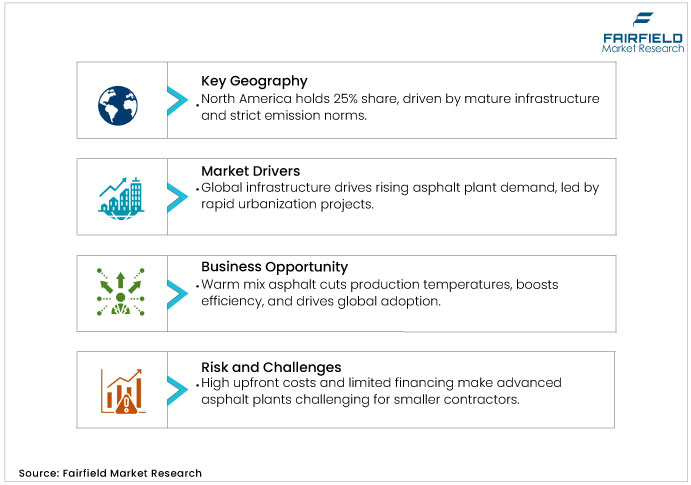
Global infrastructure investment programs continue to strengthen demand for asphalt mixing plants, especially in emerging economies undergoing rapid urbanization. Major government initiatives—including India’s Bharatmala Pariyojana with 34,800 km of highway targets and over US$100 billion investment—are accelerating procurement of high-capacity asphalt production systems. Increased construction activity in developing regions underscores the growing requirement for advanced and efficient plant technologies.
China’s Belt and Road Initiative further fuels market momentum, with large-scale construction activities and expanding project contracts across more than 150 participating countries in early 2025, driving widespread deployment of asphalt mixing plants. Suppliers offering technologically advanced, high-capacity equipment gain competitive advantages through government contracts and long-term service agreements, while those unable to meet procurement standards risk limited access in high-growth regions.
- Technological Advancement in Production Efficiency:
Continuous innovation in asphalt plant automation and digital control systems is improving efficiency and lowering operating costs. Real-time monitoring, predictive maintenance, and precise material mixing enhance output while reducing waste, with automation ensuring accurate material proportioning and optimized production cycles. Technological upgrades in burners, insulation, and heat recovery deliver 15–20% fuel savings, strengthening operational economics.
IoT connectivity, data analytics, and remote monitoring enable proactive maintenance, minimizing downtime and extending equipment lifespan. Companies adopting these advanced technologies gain competitive advantages through better production economics, consistent quality, and stronger environmental performance. Innovation-driven suppliers further differentiate with digital plant management capabilities and comprehensive service offerings.
Market Restraints
- High Capital Investment Requirements:
Asphalt mixing plant procurement demands substantial capital expenditure, often reaching multiple millions of dollars when factoring in installation, commissioning, and site preparation. High-priced advanced plants with RAP processing, emission control, and automation systems create barriers for small and medium contractors. In price-sensitive regions, limited project financing and economic uncertainty further delay investment cycles.
Ongoing operational expenses—including fuel, labor, and maintenance—significantly impact total cost of ownership, requiring careful financial analysis before purchasing. Procurement decisions depend heavily on equipment financing availability, government infrastructure budgets, and project award volumes. To overcome these restraints, suppliers provide financing partnerships, modular plant designs to reduce upfront investment, and lifecycle service contracts.
- Environmental Compliance and Emission Control Costs:
Stringent environmental regulations on air quality, noise, and emissions significantly increase compliance costs for asphalt plant operators. Meeting standards requires investments in fabric filters, scrubbers, and VOC reduction systems, along with continuous upgrades and operator training. Jurisdictional differences may also demand plant modifications to comply with varying regulatory frameworks.
Even the small emissions released after control processes must be continuously monitored and reported, adding to operational complexity. Regulatory uncertainty surrounding future emission limits and carbon pricing creates investment risk, slowing procurement in the asphalt mixing plant markets. Companies address these constraints through technology partnerships, cost-effective emission control solutions, and robust compliance management systems for multi-region operations.
Market Opportunities
- Warm Mix Asphalt Technology Adoption:
Warm mix asphalt (WMA) technologies enable production at temperatures 80–100°F lower than traditional hot mix asphalt, delivering 30–55% energy savings and substantial reductions in CO₂, SO₂, NOₓ, and total organic emissions. These benefits—lower energy use, improved workability, and enhanced pavement durability—are accelerating adoption across global road construction projects.
Rapid urbanization and infrastructure growth in Asia Pacific create strong opportunities for WMA-capable plant systems. Companies can capitalize by integrating WMA technologies, offering training programs, and partnering with government agencies supporting sustainable construction. Adoption requires licensing agreements, plant modifications for WMA additives, and demonstration projects to validate performance for cautious buyers.
- Emerging Market Infrastructure Development:
Rapid infrastructure expansion in developing economies is creating strong opportunities for asphalt mixing plant suppliers. Asia Pacific leads growth, with India expected to record a sustainable CAGR through 2035 under major programs such as Pradhan Mantri Gram Sadak Yojana and Bharatmala. China’s Belt and Road Initiative further boosts demand, generating substantial construction contracts across 150 participating countries in 2025.
Africa and the Middle East offer significant untapped potential as they expand transportation networks and pursue economic diversification. Mobile and modular plants gain strategic importance for remote and temporary projects in the asphalt mixing plant markets. However, adoption is influenced by local content rules, financing constraints, and the need for strong after-sales service and spare-parts networks.
Regional Market Assessment: Strategic Geography Analysis
- North America
North America, led by the U.S., accounts for 25% of global asphalt mixing plant value, reaching US$1.5 billion in 2025. The region’s maturity reflects established infrastructure, ongoing rehabilitation needs, strict emission-control regulations, and strong technological leadership in automation and digital plant management. Government funding sources, including the FHWA Highway Trust Fund and state programs, continue to support asphalt production demand.
Innovation in emissions control, automation, and sustainable production remains central as EPA and state regulations shape compliance requirements. asphalt mixing plants Market competition is defined by mature players, strict regulatory expectations, and operator focus on efficiency and advanced technology. Strategic priorities include technology differentiation, capital-efficient financing models, and robust service networks to support uptime and parts availability.
Europe
Europe shows strong geographic variation, with Germany, the UK, and France forming the region’s largest asphalt mixing plants market. EU sustainability directives, waste management rules, and circular economy principles drive competitive requirements focused on recycled content, emissions reduction, and high resource efficiency. This regulatory landscape increasingly favors plants with advanced RAP processing, WMA capabilities, and digitalized operations.
Germany’s move toward mandatory warm mix asphalt specifications highlights the region’s shift to low-emission production standards. Strategic expansion requires country-specific regulatory assessment, as EU directives are implemented differently across member states. Companies must align with evolving WMA and RAP specifications and collaborate with regional distributors experienced in navigating local regulatory frameworks.
- Asia Pacific
Asia Pacific is the largest regional asphalt mixing plants market, holding about 40% of global value, with China contributing 40–60% of the region’s share due to strong infrastructure spending, advanced plant design, and government-backed equipment manufacturing. Japan shows mature demand, while Southeast Asian and South Asian markets exhibit fast-rising growth fueled by expanding construction needs.
India is a major high-growth market, projected to grow at a sustainable CAGR through 2035, supported by Pradhan Mantri Gram Sadak Yojana, Bharatmala, and the US$1.33 trillion National Infrastructure Pipeline through 2025. Regional manufacturing strength and supply chain depth are reshaping global competitiveness, requiring companies to evaluate country-specific regulations, competition, and localization strategies for optimal market positioning.
Segmentation Analysis: Category-Wise Strategic Assessment
- By Process—Batch Mix Plants
Batch mix plants account for over 50% of global share, valued at US$3.1 billion in 2025, supported by superior mix flexibility and precise ingredient control. Demand is driven by high-specification infrastructure projects, regulatory quality needs, and contractor preference for batch-wise customization. Established players such as Ammann, Wirtgen, Marini, and Astec compete through advanced automation and emissions-compliance systems.
Continuous mix plants, though smaller in current share, register the fastest growth due to suitability for high-volume mega-infrastructure projects. Operators favor continuous production for better economics, supported by modern continuous process control technologies. This creates strong opportunities for manufacturers developing advanced continuous systems and high-capacity automation solutions.
- By Product—Hot Mix Plants
Hot mix plants hold over 80% of asphalt mixing plants market share, valued at US$4.7 billion in 2025, supported by long-established industry standards and regulatory frameworks favoring traditional hot mix production. Their dominance stems from decades of infrastructure specification alignment, mature supply chains, and widespread regulatory acceptance. Competition centers on emissions control, energy efficiency, and recycled material integration to meet rising sustainability demands.
Cold mix plants, though smaller in share, are growing rapidly, supported by road maintenance needs, rural development, and low-traffic construction applications. With the global cold mix market expanding at a sustainable CAGR, demand is rising due to lower energy use, reduced operating costs, and suitability for decentralized production. Companies must evaluate application suitability, regulatory acceptance, and operator readiness when comparing hot and cold mix strategies.
- By Plant Type—Stationary Plants
Stationary plants lead with over 60% of asphalt mixing plants market share, valued at US$3.5 billion in 2025, due to their suitability for large-scale, continuous asphalt production. Their dominance is driven by high-volume capacity, strong operational economics, and integration into major infrastructure such as highways, airports, and urban development. These plants provide the reliability and consistency required for long-duration, high-output projects.
Portable plants hold a smaller share but are growing rapidly as they support mobile projects, temporary sites, and emerging markets with limited permanent infrastructure. Their strengths include quick deployment, lower upfront investment, and flexibility across multiple project locations. Companies must evaluate project scale, geographic dispersion, and operator readiness when determining stationary versus portable plant strategies.
- By Capacity—Mid-Range Production Capacity (151-300 TPH)
The 151–300 TPH segment leads with over 40% of asphalt mixing plants market share, valued at US$2.4 billion in 2025, serving mid-to-large infrastructure projects in both developed and emerging markets. Its dominance reflects capacity suited for major highways, airports, and urban development while maintaining manageable operational complexity. This balance makes it a preferred choice over ultra-high-capacity systems.
The 51–150 TPH category is the fastest-growing segment, supported by emerging market road programs and distributed infrastructure development. Growth is driven by smaller contractor participation, lower capital requirements, and alignment with regional construction patterns. Companies must evaluate project scale, contractor capabilities, and market-specific infrastructure distribution when choosing optimal capacity positioning.
- By Application—Road Construction
Road construction accounts for about 50% of total demand, valued at US$2.9 billion in 2025, supported by global government investment in transportation infrastructure and strict road maintenance standards. Its dominance reflects the central role of roadway networks in economic connectivity, logistics efficiency, and continuous rehabilitation cycles. Consistent demand also stems from private contractors and replacement needs for aging road systems.
Bridge construction is the fastest-growing application, driven by expanding urban connectivity projects, climate-resilient infrastructure, and diversified national development programs. This segment requires specialized asphalt specifications for bridge decks and adherence to stricter structural regulations. Companies must assess application-specific production needs, regulatory frameworks, and operator skill requirements when targeting bridge-focused opportunities.
Competitive Landscape: Market Structure and Strategic Positioning
The asphalt mixing plants market shows moderate concentration, with MARINI, Ammann, Lintec, WIRTGEN, Astec, and Nikko holding about 30% of global share. Competition centers on RAP processing technology, emission control systems, automation, and strong lifecycle service networks. High entry barriers include capital-intensive manufacturing, technical expertise, regulatory compliance, and long-standing customer relationships.
Recent developments highlight the industry’s shift toward advanced, sustainable technologies—such as Ammann’s April 2024 Alpine Drum Mix plant delivering 300–600 TPH and 60% RAP capability. Astec’s March 2022 acquisition of MINDS Automation Group showcases consolidation toward cloud-based automation and digital plant management. Leading strategies emphasize sustainable innovation, acquisitions, customer partnerships, and end-to-end service offerings.
Key Players
- Ammann Group Holding AG
- Astec Industries, Inc.
- BENNINGHOVEN GmbH & Co. KG (Wirtgen Group)
- MARINI S.p.A. (Fayat Group)
- LINTEC & LINNHOFF Holdings Pte. Ltd.
- Nikko Co., Ltd.
- SPECO Ltd.
- NFLG (Fujian South Highway Machinery Co., Ltd.)
- Tietuo Machinery Co., Ltd. (TTM)
- Speedcrafts Limited
Global Asphalt Mixing Plants Market Segmentation-
By Process
- Batch Mix Plant
- Continuous Mix Plant
By Product
- Hot mix plant
- Cold mix plant
By Plant Type
- Stationary
- Portable
By Capacity
- Below 50 TPH
- 51 to 150 TPH
- 151 to 300 TPH
- Above 300 TPH
By Application
- Road Construction
- Parking Lots
- Pedestrian Paths
- Bridge
- Others
By Region
- North America
- Europe
- Asia Pacific
- Latin America
- Middle East & Africa
- Executive Summary
- Global Asphalt Mixing Plants Market Snapshot
- Future Projections
- Key Market Trends
- Regional Snapshot, by Value, 2026
- Analyst Recommendations
- Market Overview
- Market Definitions and Segmentations
- Market Dynamics
- Drivers
- Restraints
- Market Opportunities
- Value Chain Analysis
- COVID-19 Impact Analysis
- Porter's Five Forces Analysis
- Impact of Russia-Ukraine Conflict
- PESTLE Analysis
- Regulatory Analysis
- Price Trend Analysis
- Current Prices and Future Projections, 2025-2033
- Price Impact Factors
- Global Asphalt Mixing Plants Market Outlook, 2020 - 2033
- Global Asphalt Mixing Plants Market Outlook, by Process, Value (US$ Mn), 2020-2033
- Batch Mix Plant
- Continuous Mix Plant
- Global Asphalt Mixing Plants Market Outlook, by Product, Value (US$ Mn), 2020-2033
- Hot mix plant
- Cold mix plant
- Global Asphalt Mixing Plants Market Outlook, by Plant Type, Value (US$ Mn), 2020-2033
- Stationary
- Portable
- Global Asphalt Mixing Plants Market Outlook, by Capacity, Value (US$ Mn), 2020-2033
- Below 50 TPH
- 51 to 150 TPH
- 151 to 300 TPH
- Above 300 TPH
- Global Asphalt Mixing Plants Market Outlook, by Application, Value (US$ Mn), 2020-2033
- Road Construction
- Parking Lots
- Pedestrian Paths
- Bridge
- Others
- Global Asphalt Mixing Plants Market Outlook, by Region, Value (US$ Mn), 2020-2033
- North America
- Europe
- Asia Pacific
- Latin America
- Middle East & Africa
- Global Asphalt Mixing Plants Market Outlook, by Process, Value (US$ Mn), 2020-2033
- North America Asphalt Mixing Plants Market Outlook, 2020 - 2033
- North America Asphalt Mixing Plants Market Outlook, by Process, Value (US$ Mn), 2020-2033
- Batch Mix Plant
- Continuous Mix Plant
- North America Asphalt Mixing Plants Market Outlook, by Product, Value (US$ Mn), 2020-2033
- Hot mix plant
- Cold mix plant
- North America Asphalt Mixing Plants Market Outlook, by Plant Type, Value (US$ Mn), 2020-2033
- Stationary
- Portable
- North America Asphalt Mixing Plants Market Outlook, by Capacity, Value (US$ Mn), 2020-2033
- Below 50 TPH
- 51 to 150 TPH
- 151 to 300 TPH
- Above 300 TPH
- North America Asphalt Mixing Plants Market Outlook, by Application, Value (US$ Mn), 2020-2033
- Road Construction
- Parking Lots
- Pedestrian Paths
- Bridge
- Others
- North America Asphalt Mixing Plants Market Outlook, by Country, Value (US$ Mn), 2020-2033
- U.S. Asphalt Mixing Plants Market Outlook, by Process, 2020-2033
- U.S. Asphalt Mixing Plants Market Outlook, by Product, 2020-2033
- U.S. Asphalt Mixing Plants Market Outlook, by Plant Type, 2020-2033
- U.S. Asphalt Mixing Plants Market Outlook, by Capacity, 2020-2033
- U.S. Asphalt Mixing Plants Market Outlook, by Application, 2020-2033
- Canada Asphalt Mixing Plants Market Outlook, by Process, 2020-2033
- Canada Asphalt Mixing Plants Market Outlook, by Product, 2020-2033
- Canada Asphalt Mixing Plants Market Outlook, by Plant Type, 2020-2033
- Canada Asphalt Mixing Plants Market Outlook, by Capacity, 2020-2033
- Canada Asphalt Mixing Plants Market Outlook, by Application, 2020-2033
- BPS Analysis/Market Attractiveness Analysis
- North America Asphalt Mixing Plants Market Outlook, by Process, Value (US$ Mn), 2020-2033
- Europe Asphalt Mixing Plants Market Outlook, 2020 - 2033
- Europe Asphalt Mixing Plants Market Outlook, by Process, Value (US$ Mn), 2020-2033
- Batch Mix Plant
- Continuous Mix Plant
- Europe Asphalt Mixing Plants Market Outlook, by Product, Value (US$ Mn), 2020-2033
- Hot mix plant
- Cold mix plant
- Europe Asphalt Mixing Plants Market Outlook, by Plant Type, Value (US$ Mn), 2020-2033
- Stationary
- Portable
- Europe Asphalt Mixing Plants Market Outlook, by Capacity, Value (US$ Mn), 2020-2033
- Below 50 TPH
- 51 to 150 TPH
- 151 to 300 TPH
- Above 300 TPH
- Europe Asphalt Mixing Plants Market Outlook, by Application, Value (US$ Mn), 2020-2033
- Road Construction
- Parking Lots
- Pedestrian Paths
- Bridge
- Others
- Europe Asphalt Mixing Plants Market Outlook, by Country, Value (US$ Mn), 2020-2033
- Germany Asphalt Mixing Plants Market Outlook, by Process, 2020-2033
- Germany Asphalt Mixing Plants Market Outlook, by Product, 2020-2033
- Germany Asphalt Mixing Plants Market Outlook, by Plant Type, 2020-2033
- Germany Asphalt Mixing Plants Market Outlook, by Capacity, 2020-2033
- Germany Asphalt Mixing Plants Market Outlook, by Application, 2020-2033
- Italy Asphalt Mixing Plants Market Outlook, by Process, 2020-2033
- Italy Asphalt Mixing Plants Market Outlook, by Product, 2020-2033
- Italy Asphalt Mixing Plants Market Outlook, by Plant Type, 2020-2033
- Italy Asphalt Mixing Plants Market Outlook, by Capacity, 2020-2033
- Italy Asphalt Mixing Plants Market Outlook, by Application, 2020-2033
- France Asphalt Mixing Plants Market Outlook, by Process, 2020-2033
- France Asphalt Mixing Plants Market Outlook, by Product, 2020-2033
- France Asphalt Mixing Plants Market Outlook, by Plant Type, 2020-2033
- France Asphalt Mixing Plants Market Outlook, by Capacity, 2020-2033
- France Asphalt Mixing Plants Market Outlook, by Application, 2020-2033
- U.K. Asphalt Mixing Plants Market Outlook, by Process, 2020-2033
- U.K. Asphalt Mixing Plants Market Outlook, by Product, 2020-2033
- U.K. Asphalt Mixing Plants Market Outlook, by Plant Type, 2020-2033
- U.K. Asphalt Mixing Plants Market Outlook, by Capacity, 2020-2033
- U.K. Asphalt Mixing Plants Market Outlook, by Application, 2020-2033
- Spain Asphalt Mixing Plants Market Outlook, by Process, 2020-2033
- Spain Asphalt Mixing Plants Market Outlook, by Product, 2020-2033
- Spain Asphalt Mixing Plants Market Outlook, by Plant Type, 2020-2033
- Spain Asphalt Mixing Plants Market Outlook, by Capacity, 2020-2033
- Spain Asphalt Mixing Plants Market Outlook, by Application, 2020-2033
- Russia Asphalt Mixing Plants Market Outlook, by Process, 2020-2033
- Russia Asphalt Mixing Plants Market Outlook, by Product, 2020-2033
- Russia Asphalt Mixing Plants Market Outlook, by Plant Type, 2020-2033
- Russia Asphalt Mixing Plants Market Outlook, by Capacity, 2020-2033
- Russia Asphalt Mixing Plants Market Outlook, by Application, 2020-2033
- Rest of Europe Asphalt Mixing Plants Market Outlook, by Process, 2020-2033
- Rest of Europe Asphalt Mixing Plants Market Outlook, by Product, 2020-2033
- Rest of Europe Asphalt Mixing Plants Market Outlook, by Plant Type, 2020-2033
- Rest of Europe Asphalt Mixing Plants Market Outlook, by Capacity, 2020-2033
- Rest of Europe Asphalt Mixing Plants Market Outlook, by Application, 2020-2033
- BPS Analysis/Market Attractiveness Analysis
- Europe Asphalt Mixing Plants Market Outlook, by Process, Value (US$ Mn), 2020-2033
- Asia Pacific Asphalt Mixing Plants Market Outlook, 2020 - 2033
- Asia Pacific Asphalt Mixing Plants Market Outlook, by Process, Value (US$ Mn), 2020-2033
- Batch Mix Plant
- Continuous Mix Plant
- Asia Pacific Asphalt Mixing Plants Market Outlook, by Product, Value (US$ Mn), 2020-2033
- Hot mix plant
- Cold mix plant
- Asia Pacific Asphalt Mixing Plants Market Outlook, by Plant Type, Value (US$ Mn), 2020-2033
- Stationary
- Portable
- Asia Pacific Asphalt Mixing Plants Market Outlook, by Capacity, Value (US$ Mn), 2020-2033
- Below 50 TPH
- 51 to 150 TPH
- 151 to 300 TPH
- Above 300 TPH
- Asia Pacific Asphalt Mixing Plants Market Outlook, by Application, Value (US$ Mn), 2020-2033
- Road Construction
- Parking Lots
- Pedestrian Paths
- Bridge
- Others
- Asia Pacific Asphalt Mixing Plants Market Outlook, by Country, Value (US$ Mn), 2020-2033
- China Asphalt Mixing Plants Market Outlook, by Process, 2020-2033
- China Asphalt Mixing Plants Market Outlook, by Product, 2020-2033
- China Asphalt Mixing Plants Market Outlook, by Plant Type, 2020-2033
- China Asphalt Mixing Plants Market Outlook, by Capacity, 2020-2033
- China Asphalt Mixing Plants Market Outlook, by Application, 2020-2033
- Japan Asphalt Mixing Plants Market Outlook, by Process, 2020-2033
- Japan Asphalt Mixing Plants Market Outlook, by Product, 2020-2033
- Japan Asphalt Mixing Plants Market Outlook, by Plant Type, 2020-2033
- Japan Asphalt Mixing Plants Market Outlook, by Capacity, 2020-2033
- Japan Asphalt Mixing Plants Market Outlook, by Application, 2020-2033
- South Korea Asphalt Mixing Plants Market Outlook, by Process, 2020-2033
- South Korea Asphalt Mixing Plants Market Outlook, by Product, 2020-2033
- South Korea Asphalt Mixing Plants Market Outlook, by Plant Type, 2020-2033
- South Korea Asphalt Mixing Plants Market Outlook, by Capacity, 2020-2033
- South Korea Asphalt Mixing Plants Market Outlook, by Application, 2020-2033
- India Asphalt Mixing Plants Market Outlook, by Process, 2020-2033
- India Asphalt Mixing Plants Market Outlook, by Product, 2020-2033
- India Asphalt Mixing Plants Market Outlook, by Plant Type, 2020-2033
- India Asphalt Mixing Plants Market Outlook, by Capacity, 2020-2033
- India Asphalt Mixing Plants Market Outlook, by Application, 2020-2033
- Southeast Asia Asphalt Mixing Plants Market Outlook, by Process, 2020-2033
- Southeast Asia Asphalt Mixing Plants Market Outlook, by Product, 2020-2033
- Southeast Asia Asphalt Mixing Plants Market Outlook, by Plant Type, 2020-2033
- Southeast Asia Asphalt Mixing Plants Market Outlook, by Capacity, 2020-2033
- Southeast Asia Asphalt Mixing Plants Market Outlook, by Application, 2020-2033
- Rest of SAO Asphalt Mixing Plants Market Outlook, by Process, 2020-2033
- Rest of SAO Asphalt Mixing Plants Market Outlook, by Product, 2020-2033
- Rest of SAO Asphalt Mixing Plants Market Outlook, by Plant Type, 2020-2033
- Rest of SAO Asphalt Mixing Plants Market Outlook, by Capacity, 2020-2033
- Rest of SAO Asphalt Mixing Plants Market Outlook, by Application, 2020-2033
- BPS Analysis/Market Attractiveness Analysis
- Asia Pacific Asphalt Mixing Plants Market Outlook, by Process, Value (US$ Mn), 2020-2033
- Latin America Asphalt Mixing Plants Market Outlook, 2020 - 2033
- Latin America Asphalt Mixing Plants Market Outlook, by Process, Value (US$ Mn), 2020-2033
- Batch Mix Plant
- Continuous Mix Plant
- Latin America Asphalt Mixing Plants Market Outlook, by Product, Value (US$ Mn), 2020-2033
- Hot mix plant
- Cold mix plant
- Latin America Asphalt Mixing Plants Market Outlook, by Plant Type, Value (US$ Mn), 2020-2033
- Stationary
- Portable
- Latin America Asphalt Mixing Plants Market Outlook, by Capacity, Value (US$ Mn), 2020-2033
- Below 50 TPH
- 51 to 150 TPH
- 151 to 300 TPH
- Above 300 TPH
- Latin America Asphalt Mixing Plants Market Outlook, by Application, Value (US$ Mn), 2020-2033
- Road Construction
- Parking Lots
- Pedestrian Paths
- Bridge
- Others
- Latin America Asphalt Mixing Plants Market Outlook, by Country, Value (US$ Mn), 2020-2033
- Brazil Asphalt Mixing Plants Market Outlook, by Process, 2020-2033
- Brazil Asphalt Mixing Plants Market Outlook, by Product, 2020-2033
- Brazil Asphalt Mixing Plants Market Outlook, by Plant Type, 2020-2033
- Brazil Asphalt Mixing Plants Market Outlook, by Capacity, 2020-2033
- Brazil Asphalt Mixing Plants Market Outlook, by Application, 2020-2033
- Mexico Asphalt Mixing Plants Market Outlook, by Process, 2020-2033
- Mexico Asphalt Mixing Plants Market Outlook, by Product, 2020-2033
- Mexico Asphalt Mixing Plants Market Outlook, by Plant Type, 2020-2033
- Mexico Asphalt Mixing Plants Market Outlook, by Capacity, 2020-2033
- Mexico Asphalt Mixing Plants Market Outlook, by Application, 2020-2033
- Argentina Asphalt Mixing Plants Market Outlook, by Process, 2020-2033
- Argentina Asphalt Mixing Plants Market Outlook, by Product, 2020-2033
- Argentina Asphalt Mixing Plants Market Outlook, by Plant Type, 2020-2033
- Argentina Asphalt Mixing Plants Market Outlook, by Capacity, 2020-2033
- Argentina Asphalt Mixing Plants Market Outlook, by Application, 2020-2033
- Rest of LATAM Asphalt Mixing Plants Market Outlook, by Process, 2020-2033
- Rest of LATAM Asphalt Mixing Plants Market Outlook, by Product, 2020-2033
- Rest of LATAM Asphalt Mixing Plants Market Outlook, by Plant Type, 2020-2033
- Rest of LATAM Asphalt Mixing Plants Market Outlook, by Capacity, 2020-2033
- Rest of LATAM Asphalt Mixing Plants Market Outlook, by Application, 2020-2033
- BPS Analysis/Market Attractiveness Analysis
- Latin America Asphalt Mixing Plants Market Outlook, by Process, Value (US$ Mn), 2020-2033
- Middle East & Africa Asphalt Mixing Plants Market Outlook, 2020 - 2033
- Middle East & Africa Asphalt Mixing Plants Market Outlook, by Process, Value (US$ Mn), 2020-2033
- Batch Mix Plant
- Continuous Mix Plant
- Middle East & Africa Asphalt Mixing Plants Market Outlook, by Product, Value (US$ Mn), 2020-2033
- Hot mix plant
- Cold mix plant
- Middle East & Africa Asphalt Mixing Plants Market Outlook, by Plant Type, Value (US$ Mn), 2020-2033
- Stationary
- Portable
- Middle East & Africa Asphalt Mixing Plants Market Outlook, by Capacity, Value (US$ Mn), 2020-2033
- Below 50 TPH
- 51 to 150 TPH
- 151 to 300 TPH
- Above 300 TPH
- Middle East & Africa Asphalt Mixing Plants Market Outlook, by Application, Value (US$ Mn), 2020-2033
- Road Construction
- Parking Lots
- Pedestrian Paths
- Bridge
- Others
- Middle East & Africa Asphalt Mixing Plants Market Outlook, by Country, Value (US$ Mn), 2020-2033
- GCC Asphalt Mixing Plants Market Outlook, by Process, 2020-2033
- GCC Asphalt Mixing Plants Market Outlook, by Product, 2020-2033
- GCC Asphalt Mixing Plants Market Outlook, by Plant Type, 2020-2033
- GCC Asphalt Mixing Plants Market Outlook, by Capacity, 2020-2033
- GCC Asphalt Mixing Plants Market Outlook, by Application, 2020-2033
- South Africa Asphalt Mixing Plants Market Outlook, by Process, 2020-2033
- South Africa Asphalt Mixing Plants Market Outlook, by Product, 2020-2033
- South Africa Asphalt Mixing Plants Market Outlook, by Plant Type, 2020-2033
- South Africa Asphalt Mixing Plants Market Outlook, by Capacity, 2020-2033
- South Africa Asphalt Mixing Plants Market Outlook, by Application, 2020-2033
- Egypt Asphalt Mixing Plants Market Outlook, by Process, 2020-2033
- Egypt Asphalt Mixing Plants Market Outlook, by Product, 2020-2033
- Egypt Asphalt Mixing Plants Market Outlook, by Plant Type, 2020-2033
- Egypt Asphalt Mixing Plants Market Outlook, by Capacity, 2020-2033
- Egypt Asphalt Mixing Plants Market Outlook, by Application, 2020-2033
- Nigeria Asphalt Mixing Plants Market Outlook, by Process, 2020-2033
- Nigeria Asphalt Mixing Plants Market Outlook, by Product, 2020-2033
- Nigeria Asphalt Mixing Plants Market Outlook, by Plant Type, 2020-2033
- Nigeria Asphalt Mixing Plants Market Outlook, by Capacity, 2020-2033
- Nigeria Asphalt Mixing Plants Market Outlook, by Application, 2020-2033
- Rest of Middle East Asphalt Mixing Plants Market Outlook, by Process, 2020-2033
- Rest of Middle East Asphalt Mixing Plants Market Outlook, by Product, 2020-2033
- Rest of Middle East Asphalt Mixing Plants Market Outlook, by Plant Type, 2020-2033
- Rest of Middle East Asphalt Mixing Plants Market Outlook, by Capacity, 2020-2033
- Rest of Middle East Asphalt Mixing Plants Market Outlook, by Application, 2020-2033
- BPS Analysis/Market Attractiveness Analysis
- Middle East & Africa Asphalt Mixing Plants Market Outlook, by Process, Value (US$ Mn), 2020-2033
- Competitive Landscape
- Company Vs Segment Heatmap
- Company Market Share Analysis, 2025
- Competitive Dashboard
- Company Profiles
- Ammann Group Holding AG
- Company Overview
- Product Portfolio
- Financial Overview
- Business Strategies and Developments
- Astec Industries, Inc.
- BENNINGHOVEN GmbH & Co. KG (Wirtgen Group)
- MARINI S.p.A. (Fayat Group)
- LINTEC & LINNHOFF Holdings Pte. Ltd.
- Nikko Co., Ltd.
- SPECO Ltd.
- NFLG (Fujian South Highway Machinery Co., Ltd.)
- Tietuo Machinery Co., Ltd. (TTM)
- Speedcrafts Limited
- Ammann Group Holding AG
- Appendix
- Research Methodology
- Report Assumptions
- Acronyms and Abbreviations
|
BASE YEAR |
HISTORICAL DATA |
FORECAST PERIOD |
UNITS |
|||
 |
2025 |
 |
2020 - 2025 |
 |
2026 - 2033 |
Value: US$ Billion |
|
REPORT FEATURES |
DETAILS |
|
By Process Coverage |
|
|
By Product Coverage |
|
|
By Plant Type Coverage |
|
|
By Capacity Coverage |
|
|
By Application Coverage |
|
|
Geographical Coverage |
|
|
Leading Companies |
|
|
Report Highlights |
Key Market Indicators, Macro-micro economic impact analysis, Technological Roadmap, Key Trends, Driver, Restraints, and Future Opportunities & Revenue Pockets, Porter’s 5 Forces Analysis, Historical Trend (2019-2024), Market Estimates and Forecast, Market Dynamics, Industry Trends, Competition Landscape, Category, Region, Country-wise Trends & Analysis, COVID-19 Impact Analysis (Demand and Supply Chain) |
Our Research Methodology
Considering the volatility of business today, traditional approaches to strategizing a game plan can be unfruitful if not detrimental. True ambiguity is no way to determine a forecast. A myriad of predetermined factors must be accounted for such as the degree of risk involved, the magnitude of circumstances, as well as conditions or consequences that are not known or unpredictable. To circumvent binary views that cast uncertainty, the application of market research intelligence to strategically posture, move, and enable actionable outcomes is necessary.
View Methodology
Quality Assured
Rigorous Validation Process

Confidentiality Assured
End-to-end Data Security

Custom Research Services
Tailored To Your Objectives
FAQs
The Asphalt Mixing Plants market size is valued at USD 5,542.1 million in 2026.
The Asphalt Mixing Plants market is projected to grow at a CAGR of 4.1% by 2033.
The Asphalt Mixing Plants market growth is driven by rising road infrastructure investments, increasing highway construction activities, and growing demand for efficient asphalt production technologies.
Asia Pacific is the dominant region in the Asphalt Mixing Plants market.
Ammann Group Holding AG, Astec Industries, Inc., BENNINGHOVEN GmbH & Co. KG (Wirtgen Group), MARINI S.p.A. (Fayat Group), and LINTEC & LINNHOFF Holdings Pte. Ltd. are some of the leading industry players in the Asphalt Mixing Plants market.
Related Reports
3D Concrete Printing Market Size, Share, Insights, Competitive Landscape, and Forecast 2026 to 2033
The global 3D concrete printing market is valued at US$0.30 billion in 2026, reaching US$1.20 billion by 2033, growing at a 21.9% CAGR
Elevator Maintenance Market Size, Share, Insights, Competitive Landscape, and Forecast 2026 to 2033
The global elevator maintenance market is valued at US$64.8 billion in 2026, reaching US$92.6 billion by 2033, growing at a 5.2% CAGR
Gas Insulated Power Equipment Market Size, Share, Insights, Competitive Landscape, and Forecast 2026 to 2033
The gas insulated power equipment market is valued at US$ 24.0 Bn in 2026 and is projected to reach US$ 40.5 Bn by 2033, growing at a CAGR of 7.8%
Chain Conveyors Market Size, Share, Insights, Competitive Landscape, and Forecast 2026 to 2033
The global chain conveyors market will grow from US$9.78 billion in 2026 to US$15.45 billion by 2033, at a CAGR of 6.75%, driven by industrial automation.
Reciprocating Plunger Pumps Market Size, Share, Insights, Competitive Landscape, and Forecast 2026 to 2033
The reciprocating plunger pumps market will grow from US$4.89 billion in 2026 to US$7.45 billion by 2033, at a CAGR of 6.2%.
Plastic Injection Molding Machine for MedTech Market Size, Share, Insights, Competitive Landscape, and Forecast 2026 to 2033
The plastic injection molding machine for MedTech market will grow from US$2.1 billion in 2026 to US$3.46 billion by 2033, at a CAGR of 7.4%.