



Fabric Filter Market
Fabric Filter Market Size, Share, Insights, Competitive Landscape, and Forecast 2026 to 2033
Fabric Filter Market Size and Trend Analysis
How Big Is the Fabric Filter Market in 2026?
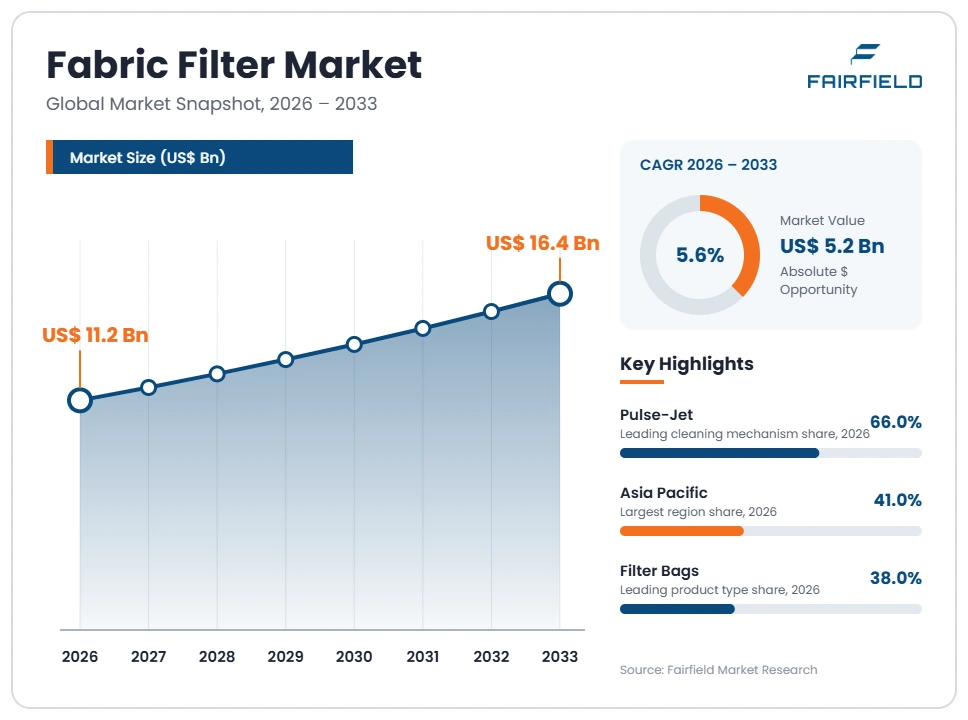
The global fabric filter market size is expected to be valued at US$ 11.2 billion in 2026 and projected to reach US$ 16.4 billion by 2033, growing at a CAGR of 5.6% between 2026 and 2033.
The market grew at roughly a 4.3% CAGR between 2020 and 2025, reaching about US$ 10.6 billion. This scope counts complete baghouse collectors, filter bags and cartridges, cages, cleaning hardware and installed-base service, because replacement media is the recurring revenue layer rather than a one-time sale. Three factors carry the forecast. Regulators in Europe, the United States and China keep lowering permitted dust loads, which favours fabric media over older electrostatic equipment. Waste incineration and cement capacity additions create new installations. Finally, a large installed base of ageing collectors needs rebag cycles every two to five years. Net direction is steady mid-single-digit growth, with consumables stabilising revenue when capital projects slow.
Key Report Takeaways
- By Product Type: Filter bags held 38% share in 2026, while filter cartridges are projected to expand at a 7.4% CAGR through 2033, driven by compact pleated designs that raise filtration area inside existing collector footprints.
- By Filter Media: Polyester held 31% share in 2026, while PTFE membrane laminates are projected to expand at an 8.6% CAGR through 2033, as surface filtration becomes the practical route to single-digit dust limits.
- By Cleaning Mechanism: Pulse-jet systems held 66% share in 2026, while hybrid electrostatic-fabric configurations are projected to expand at a 7.1% CAGR through 2033, because they reuse existing precipitator casings during retrofits.
- By End-Use Industry: Cement held 24% share in 2026, while waste incineration is projected to expand at an 8.3% CAGR through 2033, supported by strict dioxin and particulate limits on energy-from-waste plants.
- By Region: Asia Pacific held 41% share in 2026, while India is projected to expand at an 8.1% CAGR through 2033, reflecting revised thermal power and cement dust norms plus new steel capacity.
Global Fabric Filter Market Trends and Insights
Drivers Impact Analysis
Two forces account for most of the forecast growth in industrial dust collection equipment and media.
| Driver | Impact on CAGR Forecast | Geographic Relevance | Impact Timeline |
| Tightening particulate emission limits across major economies | High | Europe, North America, Asia Pacific | Long term (≥4 years) |
| Waste-to-energy build-out and cement kiln modernisation | Medium | Europe, Asia Pacific, Middle East & Africa | Medium term (2–4 years) |
Tightening Particulate Limits Make Fabric Filtration the Default Compliance Route for Industrial Plants
Stricter dust limits now push plant operators toward fabric filtration rather than electrostatic precipitation, and that shift is the single largest demand source. Permit conditions in several jurisdictions sit near the bottom of the achievable range, a level that surface-filtering media reaches far more reliably than charged-plate equipment. Operators therefore budget for baghouse conversions, higher-grade media and tighter monitoring rather than incremental tuning of legacy hardware.
The mechanism is regulatory. The European Union links permits to Best Available Techniques conclusions for large combustion plants, cement and waste incineration, each carrying binding dust ranges. The United States Environmental Protection Agency applies New Source Performance Standards and hazardous air pollutant rules to boilers and Portland cement kilns. China extended ultra-low emission requirements from coal power to steel and cement, which triggered one of the largest particulate control retrofit programmes ever undertaken.
Energy-from-Waste Plants and Cement Kiln Upgrades Add New Fabric Filter Installations
New waste incineration capacity and cement kiln modernisation are adding greenfield baghouse orders at a faster pace than general industrial construction. Both applications generate hot, chemically aggressive and variable dust loads, which rules out simpler abatement and makes a complete fabric filter plus sorbent injection the standard configuration. Each line typically needs several thousand bags, so a single project carries meaningful equipment and consumable value.
The causal chain runs through waste policy and cement decarbonisation. Landfill diversion targets push municipalities toward energy-from-waste, and those plants face combined dust, dioxin, mercury and acid gas limits. Cement producers switching to alternative fuels and higher clinker substitution change kiln gas chemistry, which usually forces a media upgrade. Alternative fuel handling also raises combustible dust exposure, bringing ATEX explosion protection requirements into the equipment specification.
Restraints Impact Analysis
Two constraints hold back faster expansion of the particulate emission control equipment base.
| Restraint | Impact on CAGR Forecast | Geographic Relevance | Impact Timeline |
| Coal-fired power retirements shrinking the legacy replacement bag base | Medium | North America, Europe | Long term (≥4 years) |
| High-temperature media cost and bag failure risk delaying upgrades | Medium | Global | Short term (≤2 years) |
Coal Power Retirements Shrink the Legacy Replacement Bag Base in Mature Markets
Coal plant closures are removing a reliable block of recurring filter bag demand in mature economies, and this is a genuine drag on the forecast. A single large coal unit can hold tens of thousands of bags on a multi-year change-out cycle, so each retirement permanently deletes that consumable stream. Utilities also defer rebagging on units with announced closure dates, which pulls revenue forward and then stops it.
The underlying cause is economic and structural rather than technical. Gas, wind and solar generation have displaced coal on cost in North America and much of Europe, while carbon pricing raises the operating burden on remaining units. Replacement demand does not transfer cleanly, because gas turbines need no fabric filtration. Growth therefore depends on waste incineration, steel, cement and chemicals absorbing the gap, which happens unevenly across countries and project cycles.
High-Grade Media Costs and Bag Failure Risk Delay Fabric Filter Upgrade Decisions
Upgrade decisions stall because high-performance media costs several times more than standard fabric, and plant managers weigh that against uncertain bag life. Hesitation lengthens sales cycles and pushes buyers toward minimum-specification polyester when a technically better option exists. The result is slower value growth than the volume trend alone would suggest.
The specific cost sources are the polymer and the finishing step. Polyphenylene sulphide, polyimide and expanded PTFE membrane laminates depend on specialty resin supply chains with few qualified producers, and membrane lamination adds a further processing stage. Installation is the second cost: a rebag needs a production outage, scaffolding and confined-space entry, so downtime often exceeds the media invoice. Premature failure from acid dew point attack, abrasion or poor cage condition then destroys the payback case entirely.
Market Opportunities
Replacement Media and Service Contracts Open a Recurring Aftermarket Revenue Pool
The installed base of operating collectors represents a large recurring revenue pool that is still served largely by low-margin spot purchasing. Bags are consumables with a two to five year life, so the aftermarket is structurally bigger than new equipment over any plant lifetime. Suppliers that convert spot buyers into multi-year performance contracts capture predictable revenue and shield themselves from capital spending cycles.
Capture favours vendors that combine media manufacturing with field service and monitoring. The buyers are cement, steel, power and waste plant maintenance teams, who are judged on unplanned outages rather than purchase price. Continuous emission monitoring, now mandated under most permit regimes, supplies the data that makes guaranteed-life contracts auditable. Differential pressure trending and bag leak detection let suppliers schedule change-outs before a compliance excursion, which is the commercial argument that justifies premium media.
Converting Ageing Electrostatic Precipitators Creates a Defined Retrofit Revenue Pool
Converting existing electrostatic precipitators into fabric filters is a distinct and quantifiable retrofit pool, separate from general demand growth. Thousands of precipitator casings installed decades ago can no longer meet current dust limits, yet the civil structure, ductwork and ash handling remain usable. Reusing that infrastructure cuts conversion cost well below a new standalone collector, which makes the economics work on plants with limited remaining life.
The demand comes from utilities, steelmakers and cement producers facing permit renewal with ageing abatement assets. Hybrid arrangements that keep the first precipitator fields and add pulse-jet compartments downstream are the common engineering answer, because they handle peak loads without a full rebuild. Engineering firms with structural assessment capability, rather than media suppliers alone, are positioned to lead these projects and attach long-term consumable supply afterwards.
Segment Analysis
- By Product Type: Filter Bags Dominate Revenue While Cartridges Scale Fastest
Filter bags held 38% of global revenue in 2026, because every operating baghouse consumes them repeatedly and large kilns or boilers hold thousands per unit. Their share reflects consumable economics rather than technical novelty, and it makes bag supply the most contested part of the value chain. Filter cartridges are the fastest-growing product type at a 7.4% CAGR to 2033. Pleated cartridges pack far more filtration area into a given volume, which suits plants that must raise capture efficiency without enlarging the collector house. Demand is strongest in metalworking, pharmaceuticals, battery materials and food processing, where floor space is constrained and dust is fine. Complete collector units, cages and pulse-jet valves make up the remainder. For suppliers, the implication is clear: equipment sales establish the position, but bag and cartridge replacement determines lifetime account value and margin stability.
- By Filter Media: Polyester Leads on Cost While PTFE Membrane Laminates Accelerate
Polyester accounted for 31% of media revenue in 2026, holding first place on installed cost and adequate performance below roughly 150 °C. It remains the default for woodworking, food, general manufacturing and many cement applications where gas temperature and acid content stay moderate. PTFE membrane laminates are expanding fastest at an 8.6% CAGR through 2033. A microporous membrane shifts collection from depth filtration to the fabric surface, which keeps residual dust emissions in the low single-digit milligram range and extends cleaning intervals. That capability matters where permit limits have been lowered toward the strictest end of the achievable range. Polyphenylene sulphide, polyimide, aramid and fibreglass serve hot or chemically aggressive streams between these extremes. The commercial consequence is a widening price spread, with media selection increasingly decided by compliance margin rather than by purchase price alone.
- By Cleaning Mechanism: Pulse-Jet Systems Hold the Base While Hybrid Configurations Advance
Pulse-jet cleaning represented 66% of installations in 2026, having displaced older designs in nearly all new orders. Compressed air pulses clean bags online, which allows smaller housings, higher air-to-cloth ratios and continuous operation without taking compartments offline. Hybrid electrostatic-fabric configurations grow fastest at a 7.1% CAGR to 2033. These designs retain the inlet fields of an existing precipitator for bulk removal and place fabric compartments downstream for final polishing, cutting both capital cost and bag loading. They have become the preferred answer where a plant must meet a tighter limit inside an existing footprint. Reverse-air and mechanical shaker systems continue only in legacy service and are not specified for new plants. For buyers, the practical takeaway is that cleaning system choice now follows the retrofit constraint rather than the dust characteristic alone.
- By End-Use Industry: Cement Anchors Demand While Waste Incineration Grows Quickest
Cement production generated 24% of demand in 2026, the largest single end use, because kilns, clinker coolers, raw mills and packing plants each require dedicated dust collection. Few industries carry as many separate collection points per site. Waste incineration is the fastest-growing application at an 8.3% CAGR through 2033. Energy-from-waste plants face simultaneous limits on dust, dioxins, mercury and acid gases, and the standard solution combines sorbent injection with a fabric filter that also acts as the reaction surface. Landfill diversion policy keeps new plants coming forward in Europe and across Asia Pacific. Power generation, iron and steel, chemicals, pharmaceuticals, food and mining account for the balance. The business implication is a gradual rebalancing of supplier revenue away from coal utilities toward process industries with more diverse and more frequently modified collection systems.
Geography Analysis
- North America Fabric Filter Demand Is Anchored in Federal Air Toxics Enforcement
North America held 22% of global revenue in 2026, with the United States accounting for most of it and Canada adding cement, aluminium and wood products demand. Federal rules do most of the work here. New Source Performance Standards, hazardous air pollutant limits for boilers and Portland cement kilns, and tightened filterable particulate requirements for coal-fired units all specify performance that favours fabric media. Combustible dust rules push food, grain, metal powder and battery material plants toward collectors with explosion protection. The main barrier is coal retirement, which deletes replacement bag volume faster than new industrial projects replace it. The regional opportunity sits in domestic manufacturing reshoring, particularly battery, semiconductor and metals plants whose fine process dusts require cartridge collectors and higher-grade media than traditional heavy industry specified.
- Europe Links Fabric Filter Investment Directly to Industrial Permit Renewals
Europe accounted for 24% of global revenue in 2026, led by Germany, Italy, France, Poland and the United Kingdom. Permitting drives spending more directly here than anywhere else. The Industrial Emissions Directive, revised in 2024, obliges operators to set limit values within Best Available Techniques ranges and pushes them toward the stricter end, so each permit renewal becomes a potential media upgrade. The Medium Combustion Plant Directive extended dust controls to smaller units between 1 MW and 50 MW, widening the addressable base. Energy-from-waste capacity continues to grow under landfill diversion policy. High industrial electricity costs and slow heavy industry output are the main restraints on capital projects. The clearest opportunity lies in cement and lime decarbonisation retrofits, where carbon capture trials change gas conditions and force new media qualification work.
- Which Region Is Leading the Fabric Filter Market?
Asia Pacific leads the fabric filter market with 41% revenue share in 2026, a position built on the sheer scale of its cement, steel and coal power capacity. China alone operates more clinker and crude steel capacity than the rest of the world combined, and its ultra-low emission programme required particulate abatement on a scale no other economy has attempted. That programme moved from coal power to steel and then cement, converting compliance into a sustained retrofit market. Japan, South Korea, Australia, Indonesia and Vietnam add waste incineration, mining and non-ferrous metals demand. Local media converters and collector fabricators supply much of the volume, which keeps pricing competitive and limits average selling prices. The region’s next phase is replacement-led, since equipment installed during the retrofit wave is now entering its second and third bag change cycle.
- Which Country Is Growing Fastest in the Fabric Filter Market?
India is the fastest-growing geography in the fabric filter market, expanding at an 8.1% CAGR between 2026 and 2033 from a comparatively small base. Three forces drive it. Revised dust standards for thermal power stations and cement plants are being enforced more consistently, which forces upgrades on equipment that previously operated at looser limits. Cement capacity continues to expand faster than in any other country, and each new line requires multiple collection points. Steel capacity additions under national production targets bring sinter plants, blast furnaces and electric arc furnaces that all need fume extraction. Domestic manufacturing of bags, cages and collectors keeps project costs accessible, while international suppliers compete at the high-temperature and membrane end. Enforcement consistency across states remains the principal uncertainty for suppliers planning capacity.
- Latin America Fabric Filter Uptake Tracks Cement and Mining Compliance Cycles
Latin America represented 6% of global revenue in 2026, concentrated in Brazil, Mexico, Chile and Peru. Cement production and mineral processing generate most of the demand, with copper smelting in Chile and Peru requiring high-temperature media that resists acidic gas streams. Environmental licensing has tightened at state and national level, and large mining operators apply internal standards that often exceed local limits because of international financing conditions. Currency volatility and project financing cost are the main barriers, frequently postponing capital upgrades and extending bag service life beyond recommended intervals. Import dependence for specialty media adds both cost and lead time. The clearest opportunity is in sugar, ethanol and biomass boiler fleets in Brazil, where fine ash and combustible dust handling create a steady, underserved requirement for compact collectors and replacement media.
- Middle East & Africa Fabric Filter Demand Builds Around New Cement and Metals Capacity
Middle East & Africa held 7% of global revenue in 2026, driven by Saudi Arabia, the United Arab Emirates, Egypt, Nigeria and South Africa. New cement lines and aluminium and steel capacity account for most installations, and because much of this equipment is recent, it is specified to international standards from the outset. Gulf industrial diversification programmes continue to add process plants that require dust collection as a permit condition. Barriers are significant: enforcement capacity varies widely across African markets, spare parts logistics are difficult, and skilled maintenance for pulse-jet valve and cage replacement is scarce outside major industrial centres. The opportunity lies in service-based supply models, where vendors provide monitored maintenance contracts instead of component sales, which suits operators with limited in-house abatement engineering capability.
Competitive Landscape
The fabric filter market is moderately concentrated, with a clear split between two supplier types. A small number of international groups, including Donaldson Company, Babcock & Wilcox, Camfil, Nederman Holding and FLSmidth, dominate large turnkey collector projects for utilities, cement and metals, where process guarantees and engineering liability matter. Below them sits a long tail of regional media converters and fabricators that compete on replacement bags and smaller industrial collectors. Concentration is therefore high in capital equipment and low in consumables, which explains why reported market shares vary so much depending on scope.
Competition rests on filtration performance guarantees, bag life, pressure drop and total cost of ownership rather than purchase price alone. Buyers increasingly ask suppliers to underwrite emission performance across a defined service period, which favours vendors that manufacture their own media. Parker Hannifin, Freudenberg Filtration Technologies, Testori and Sinoma Science & Technology compete strongly on media technology, while CECO Environmental and Thermax combine equipment with engineering services. New entrants arrive mainly from adjacent filtration and nonwovens manufacturing rather than from outside the sector.
Strategic activity concentrates on three areas. Suppliers extend backward into media and membrane production to protect aftermarket margin, expand field service networks to capture installed-base revenue, and add digital monitoring so that bag condition data supports performance contracting. Mitsubishi Heavy Industries and similar diversified engineering groups approach the market through complete flue gas treatment packages instead of standalone collectors.
Strategic direction across the sector points toward consumables, service and data rather than hardware volume. Vendors are repositioning around emission compliance assurance, which changes the customer conversation from equipment specification to guaranteed outcomes over a plant’s remaining operating life.
Recent Industry Developments
- April 2024: The European Union adopted Directive (EU) 2024/1785, revising the Industrial Emissions Directive, with permit limits required to sit toward the stricter end of Best Available Techniques ranges – raising the performance threshold that filter media must meet at every permit renewal.
- April 2024: The United States Environmental Protection Agency finalised amendments to the Mercury and Air Toxics Standards that lowered the filterable particulate matter limit for existing coal-fired units to 0.010 lb/MMBtu – a level generally reached with fabric filtration rather than electrostatic precipitation alone.
- October 2024: The European Union adopted Directive (EU) 2024/2881 on ambient air quality, moving interim limit values closer to World Health Organization guidance – strengthening the case for particulate abatement retrofits across member states.
- September 2021: The World Health Organization published revised global air quality guidelines, cutting the recommended annual PM2.5 level to 5 µg/m³ – the reference point now used in national clean air roadmaps across Asia Pacific.
- November 2015: The European Union adopted the Medium Combustion Plant Directive (EU) 2015/2193, extending dust limits to combustion plants between 1 MW and 50 MW – widening the addressable base for compact collectors beyond heavy industry.
Companies Covered in the Report
- Donaldson Company
- Babcock & Wilcox
- Camfil
- Nederman Holding
- Thermax
- FLSmidth
- Parker Hannifin
- CECO Environmental
- Mitsubishi Heavy Industries
- Freudenberg Filtration Technologies
- Testori
- Sinoma Science & Technology
Fabric Filter Market Report Scope
| Metric | Value |
| Study Period | 2020–2033 |
| Market Size 2026 | US$ 11.2 Billion |
| Market Size 2033 | US$ 16.4 Billion |
| CAGR 2026–2033 | 5.6% |
| Absolute Dollar Opportunity | US$ 5.2 Billion |
| Largest Market | Asia Pacific (41% share in 2026) |
| Fastest-Growing Market | India (8.1% CAGR, 2026–2033) |
| Market Concentration | Medium |
| Major Players | Donaldson Company, Babcock & Wilcox, Camfil, Nederman Holding, FLSmidth |
Fabric Filter Market Segmentation
Product Type
- Filter Bags
- Filter Cartridges
- Support Cages and Internals
- Pulse-Jet Valves and Controls
- Complete Collector Units
Filter Media
- Polyester
- Polyphenylene Sulphide
- Polyimide
- Aramid
- PTFE Membrane Laminates
- Fibreglass
Cleaning Mechanism
- Pulse-Jet
- Reverse Air
- Mechanical Shaker
- Hybrid Electrostatic-Fabric
End-Use Industry
- Cement
- Power Generation
- Iron and Steel
- Waste Incineration
- Chemicals and Pharmaceuticals
- Food and Beverage
- Mining and Minerals
Regions
- North America
- Europe
- Asia Pacific
- Latin America
- Middle East & Africa
- Executive Summary
- Global Fabric Filter Market Snapshot
- Future Projections
- Key Report Takeaways
- Regional Snapshot
- Market Overview
- Market Definition and Report Scope
- Historical Trends 2020–2025
- Market Dynamics
- Drivers
- Tightening Particulate Limits Make Fabric Filtration the Default Compliance Route for Industrial Plants
- Energy-from-Waste Plants and Cement Kiln Upgrades Add New Fabric Filter Installations
- Restraints
- Coal Power Retirements Shrink the Legacy Replacement Bag Base in Mature Markets
- High-Grade Media Costs and Bag Failure Risk Delay Fabric Filter Upgrade Decisions
- Market Opportunities
- Replacement Media and Service Contracts Open a Recurring Aftermarket Revenue Pool
- Converting Ageing Electrostatic Precipitators Creates a Defined Retrofit Revenue Pool
- Drivers
- Global Fabric Filter Market Outlook, 2020–2033
- Global Fabric Filter Market Outlook, by Product Type, Value (US$ Billion), 2020–2033
- Filter Bags
- Filter Cartridges
- Support Cages and Internals
- Pulse-Jet Valves and Controls
- Complete Collector Units
- Global Fabric Filter Market Outlook, by Filter Media, Value (US$ Billion), 2020–2033
- Polyester
- Polyphenylene Sulphide
- Polyimide
- Aramid
- PTFE Membrane Laminates
- Fibreglass
- Global Fabric Filter Market Outlook, by Cleaning Mechanism, Value (US$ Billion), 2020–2033
- Pulse-Jet
- Reverse Air
- Mechanical Shaker
- Hybrid Electrostatic-Fabric
- Global Fabric Filter Market Outlook, by End-Use Industry, Value (US$ Billion), 2020–2033
- Cement
- Power Generation
- Iron and Steel
- Waste Incineration
- Chemicals and Pharmaceuticals
- Food and Beverage
- Mining and Minerals
- Global Fabric Filter Market Outlook, by Region, Value (US$ Billion), 2020–2033
- North America
- Europe
- Asia Pacific
- Latin America
- Middle East & Africa
- Global Fabric Filter Market Outlook, by Product Type, Value (US$ Billion), 2020–2033
- North America Fabric Filter Market Outlook, 2020–2033
- North America Fabric Filter Market Outlook, by Product Type, Value (US$ Billion), 2020–2033
- Filter Bags
- Filter Cartridges
- Support Cages and Internals
- Pulse-Jet Valves and Controls
- Complete Collector Units
- North America Fabric Filter Market Outlook, by Filter Media, Value (US$ Billion), 2020–2033
- Polyester
- Polyphenylene Sulphide
- Polyimide
- Aramid
- PTFE Membrane Laminates
- Fibreglass
- North America Fabric Filter Market Outlook, by Cleaning Mechanism, Value (US$ Billion), 2020–2033
- Pulse-Jet
- Reverse Air
- Mechanical Shaker
- Hybrid Electrostatic-Fabric
- North America Fabric Filter Market Outlook, by End-Use Industry, Value (US$ Billion), 2020–2033
- Cement
- Power Generation
- Iron and Steel
- Waste Incineration
- Chemicals and Pharmaceuticals
- Food and Beverage
- Mining and Minerals
- North America Fabric Filter Market Outlook, by Country, Value (US$ Billion), 2020–2033
- United States Fabric Filter Market Outlook, by Product Type, 2020–2033
- United States Fabric Filter Market Outlook, by Filter Media, 2020–2033
- United States Fabric Filter Market Outlook, by Cleaning Mechanism, 2020–2033
- United States Fabric Filter Market Outlook, by End-Use Industry, 2020–2033
- Canada Fabric Filter Market Outlook, by Product Type, 2020–2033
- Canada Fabric Filter Market Outlook, by Filter Media, 2020–2033
- Canada Fabric Filter Market Outlook, by Cleaning Mechanism, 2020–2033
- Canada Fabric Filter Market Outlook, by End-Use Industry, 2020–2033
- North America Fabric Filter Market Outlook, by Product Type, Value (US$ Billion), 2020–2033
- Europe Fabric Filter Market Outlook, 2020–2033
- Europe Fabric Filter Market Outlook, by Product Type, Value (US$ Billion), 2020–2033
- Filter Bags
- Filter Cartridges
- Support Cages and Internals
- Pulse-Jet Valves and Controls
- Complete Collector Units
- Europe Fabric Filter Market Outlook, by Filter Media, Value (US$ Billion), 2020–2033
- Polyester
- Polyphenylene Sulphide
- Polyimide
- Aramid
- PTFE Membrane Laminates
- Fibreglass
- Europe Fabric Filter Market Outlook, by Cleaning Mechanism, Value (US$ Billion), 2020–2033
- Pulse-Jet
- Reverse Air
- Mechanical Shaker
- Hybrid Electrostatic-Fabric
- Europe Fabric Filter Market Outlook, by End-Use Industry, Value (US$ Billion), 2020–2033
- Cement
- Power Generation
- Iron and Steel
- Waste Incineration
- Chemicals and Pharmaceuticals
- Food and Beverage
- Mining and Minerals
- Europe Fabric Filter Market Outlook, by Country, Value (US$ Billion), 2020–2033
- Germany Fabric Filter Market Outlook, by Product Type, 2020–2033
- Germany Fabric Filter Market Outlook, by Filter Media, 2020–2033
- Germany Fabric Filter Market Outlook, by Cleaning Mechanism, 2020–2033
- Germany Fabric Filter Market Outlook, by End-Use Industry, 2020–2033
- Italy Fabric Filter Market Outlook, by Product Type, 2020–2033
- Italy Fabric Filter Market Outlook, by Filter Media, 2020–2033
- Italy Fabric Filter Market Outlook, by Cleaning Mechanism, 2020–2033
- Italy Fabric Filter Market Outlook, by End-Use Industry, 2020–2033
- France Fabric Filter Market Outlook, by Product Type, 2020–2033
- France Fabric Filter Market Outlook, by Filter Media, 2020–2033
- France Fabric Filter Market Outlook, by Cleaning Mechanism, 2020–2033
- France Fabric Filter Market Outlook, by End-Use Industry, 2020–2033
- Poland Fabric Filter Market Outlook, by Product Type, 2020–2033
- Poland Fabric Filter Market Outlook, by Filter Media, 2020–2033
- Poland Fabric Filter Market Outlook, by Cleaning Mechanism, 2020–2033
- Poland Fabric Filter Market Outlook, by End-Use Industry, 2020–2033
- United Kingdom Fabric Filter Market Outlook, by Product Type, 2020–2033
- United Kingdom Fabric Filter Market Outlook, by Filter Media, 2020–2033
- United Kingdom Fabric Filter Market Outlook, by Cleaning Mechanism, 2020–2033
- United Kingdom Fabric Filter Market Outlook, by End-Use Industry, 2020–2033
- Europe Fabric Filter Market Outlook, by Product Type, Value (US$ Billion), 2020–2033
- Asia Pacific Fabric Filter Market Outlook, 2020–2033
- Asia Pacific Fabric Filter Market Outlook, by Product Type, Value (US$ Billion), 2020–2033
- Filter Bags
- Filter Cartridges
- Support Cages and Internals
- Pulse-Jet Valves and Controls
- Complete Collector Units
- Asia Pacific Fabric Filter Market Outlook, by Filter Media, Value (US$ Billion), 2020–2033
- Polyester
- Polyphenylene Sulphide
- Polyimide
- Aramid
- PTFE Membrane Laminates
- Fibreglass
- Asia Pacific Fabric Filter Market Outlook, by Cleaning Mechanism, Value (US$ Billion), 2020–2033
- Pulse-Jet
- Reverse Air
- Mechanical Shaker
- Hybrid Electrostatic-Fabric
- Asia Pacific Fabric Filter Market Outlook, by End-Use Industry, Value (US$ Billion), 2020–2033
- Cement
- Power Generation
- Iron and Steel
- Waste Incineration
- Chemicals and Pharmaceuticals
- Food and Beverage
- Mining and Minerals
- Asia Pacific Fabric Filter Market Outlook, by Country, Value (US$ Billion), 2020–2033
- China Fabric Filter Market Outlook, by Product Type, 2020–2033
- China Fabric Filter Market Outlook, by Filter Media, 2020–2033
- China Fabric Filter Market Outlook, by Cleaning Mechanism, 2020–2033
- China Fabric Filter Market Outlook, by End-Use Industry, 2020–2033
- Japan Fabric Filter Market Outlook, by Product Type, 2020–2033
- Japan Fabric Filter Market Outlook, by Filter Media, 2020–2033
- Japan Fabric Filter Market Outlook, by Cleaning Mechanism, 2020–2033
- Japan Fabric Filter Market Outlook, by End-Use Industry, 2020–2033
- South Korea Fabric Filter Market Outlook, by Product Type, 2020–2033
- South Korea Fabric Filter Market Outlook, by Filter Media, 2020–2033
- South Korea Fabric Filter Market Outlook, by Cleaning Mechanism, 2020–2033
- South Korea Fabric Filter Market Outlook, by End-Use Industry, 2020–2033
- Australia Fabric Filter Market Outlook, by Product Type, 2020–2033
- Australia Fabric Filter Market Outlook, by Filter Media, 2020–2033
- Australia Fabric Filter Market Outlook, by Cleaning Mechanism, 2020–2033
- Australia Fabric Filter Market Outlook, by End-Use Industry, 2020–2033
- Indonesia Fabric Filter Market Outlook, by Product Type, 2020–2033
- Indonesia Fabric Filter Market Outlook, by Filter Media, 2020–2033
- Indonesia Fabric Filter Market Outlook, by Cleaning Mechanism, 2020–2033
- Indonesia Fabric Filter Market Outlook, by End-Use Industry, 2020–2033
- Vietnam Fabric Filter Market Outlook, by Product Type, 2020–2033
- Vietnam Fabric Filter Market Outlook, by Filter Media, 2020–2033
- Vietnam Fabric Filter Market Outlook, by Cleaning Mechanism, 2020–2033
- Vietnam Fabric Filter Market Outlook, by End-Use Industry, 2020–2033
- India Fabric Filter Market Outlook, by Product Type, 2020–2033
- India Fabric Filter Market Outlook, by Filter Media, 2020–2033
- India Fabric Filter Market Outlook, by Cleaning Mechanism, 2020–2033
- India Fabric Filter Market Outlook, by End-Use Industry, 2020–2033
- Asia Pacific Fabric Filter Market Outlook, by Product Type, Value (US$ Billion), 2020–2033
- Latin America Fabric Filter Market Outlook, 2020–2033
- Latin America Fabric Filter Market Outlook, by Product Type, Value (US$ Billion), 2020–2033
- Filter Bags
- Filter Cartridges
- Support Cages and Internals
- Pulse-Jet Valves and Controls
- Complete Collector Units
- Latin America Fabric Filter Market Outlook, by Filter Media, Value (US$ Billion), 2020–2033
- Polyester
- Polyphenylene Sulphide
- Polyimide
- Aramid
- PTFE Membrane Laminates
- Fibreglass
- Latin America Fabric Filter Market Outlook, by Cleaning Mechanism, Value (US$ Billion), 2020–2033
- Pulse-Jet
- Reverse Air
- Mechanical Shaker
- Hybrid Electrostatic-Fabric
- Latin America Fabric Filter Market Outlook, by End-Use Industry, Value (US$ Billion), 2020–2033
- Cement
- Power Generation
- Iron and Steel
- Waste Incineration
- Chemicals and Pharmaceuticals
- Food and Beverage
- Mining and Minerals
- Latin America Fabric Filter Market Outlook, by Country, Value (US$ Billion), 2020–2033
- Brazil Fabric Filter Market Outlook, by Product Type, 2020–2033
- Brazil Fabric Filter Market Outlook, by Filter Media, 2020–2033
- Brazil Fabric Filter Market Outlook, by Cleaning Mechanism, 2020–2033
- Brazil Fabric Filter Market Outlook, by End-Use Industry, 2020–2033
- Mexico Fabric Filter Market Outlook, by Product Type, 2020–2033
- Mexico Fabric Filter Market Outlook, by Filter Media, 2020–2033
- Mexico Fabric Filter Market Outlook, by Cleaning Mechanism, 2020–2033
- Mexico Fabric Filter Market Outlook, by End-Use Industry, 2020–2033
- Chile Fabric Filter Market Outlook, by Product Type, 2020–2033
- Chile Fabric Filter Market Outlook, by Filter Media, 2020–2033
- Chile Fabric Filter Market Outlook, by Cleaning Mechanism, 2020–2033
- Chile Fabric Filter Market Outlook, by End-Use Industry, 2020–2033
- Peru Fabric Filter Market Outlook, by Product Type, 2020–2033
- Peru Fabric Filter Market Outlook, by Filter Media, 2020–2033
- Peru Fabric Filter Market Outlook, by Cleaning Mechanism, 2020–2033
- Peru Fabric Filter Market Outlook, by End-Use Industry, 2020–2033
- Latin America Fabric Filter Market Outlook, by Product Type, Value (US$ Billion), 2020–2033
- Middle East & Africa Fabric Filter Market Outlook, 2020–2033
- Middle East & Africa Fabric Filter Market Outlook, by Product Type, Value (US$ Billion), 2020–2033
- Filter Bags
- Filter Cartridges
- Support Cages and Internals
- Pulse-Jet Valves and Controls
- Complete Collector Units
- Middle East & Africa Fabric Filter Market Outlook, by Filter Media, Value (US$ Billion), 2020–2033
- Polyester
- Polyphenylene Sulphide
- Polyimide
- Aramid
- PTFE Membrane Laminates
- Fibreglass
- Middle East & Africa Fabric Filter Market Outlook, by Cleaning Mechanism, Value (US$ Billion), 2020–2033
- Pulse-Jet
- Reverse Air
- Mechanical Shaker
- Hybrid Electrostatic-Fabric
- Middle East & Africa Fabric Filter Market Outlook, by End-Use Industry, Value (US$ Billion), 2020–2033
- Cement
- Power Generation
- Iron and Steel
- Waste Incineration
- Chemicals and Pharmaceuticals
- Food and Beverage
- Mining and Minerals
- Middle East & Africa Fabric Filter Market Outlook, by Country, Value (US$ Billion), 2020–2033
- Saudi Arabia Fabric Filter Market Outlook, by Product Type, 2020–2033
- Saudi Arabia Fabric Filter Market Outlook, by Filter Media, 2020–2033
- Saudi Arabia Fabric Filter Market Outlook, by Cleaning Mechanism, 2020–2033
- Saudi Arabia Fabric Filter Market Outlook, by End-Use Industry, 2020–2033
- United Arab Emirates Fabric Filter Market Outlook, by Product Type, 2020–2033
- United Arab Emirates Fabric Filter Market Outlook, by Filter Media, 2020–2033
- United Arab Emirates Fabric Filter Market Outlook, by Cleaning Mechanism, 2020–2033
- United Arab Emirates Fabric Filter Market Outlook, by End-Use Industry, 2020–2033
- Egypt Fabric Filter Market Outlook, by Product Type, 2020–2033
- Egypt Fabric Filter Market Outlook, by Filter Media, 2020–2033
- Egypt Fabric Filter Market Outlook, by Cleaning Mechanism, 2020–2033
- Egypt Fabric Filter Market Outlook, by End-Use Industry, 2020–2033
- Nigeria Fabric Filter Market Outlook, by Product Type, 2020–2033
- Nigeria Fabric Filter Market Outlook, by Filter Media, 2020–2033
- Nigeria Fabric Filter Market Outlook, by Cleaning Mechanism, 2020–2033
- Nigeria Fabric Filter Market Outlook, by End-Use Industry, 2020–2033
- South Africa Fabric Filter Market Outlook, by Product Type, 2020–2033
- South Africa Fabric Filter Market Outlook, by Filter Media, 2020–2033
- South Africa Fabric Filter Market Outlook, by Cleaning Mechanism, 2020–2033
- South Africa Fabric Filter Market Outlook, by End-Use Industry, 2020–2033
- Middle East & Africa Fabric Filter Market Outlook, by Product Type, Value (US$ Billion), 2020–2033
- Competitive Landscape
- Market Concentration and Industry Leaders
- Competitive Differentiation
- Strategic Moves and Market Direction
- Recent Industry Developments
- Company Profiles
- Donaldson Company
- Babcock & Wilcox
- Camfil
- Nederman Holding
- Thermax
- FLSmidth
- Parker Hannifin
- CECO Environmental
- Mitsubishi Heavy Industries
- Freudenberg Filtration Technologies
- Testori
- Sinoma Science & Technology
- Appendix
- Research Methodology
- Report Assumptions
- Acronyms and Abbreviations
Product Type
- Filter Bags
- Filter Cartridges
- Support Cages and Internals
- Pulse-Jet Valves and Controls
- Complete Collector Units
Filter Media
- Polyester
- Polyphenylene Sulphide
- Polyimide
- Aramid
- PTFE Membrane Laminates
- Fibreglass
Cleaning Mechanism
- Pulse-Jet
- Reverse Air
- Mechanical Shaker
- Hybrid Electrostatic-Fabric
End-Use Industry
- Cement
- Power Generation
- Iron and Steel
- Waste Incineration
- Chemicals and Pharmaceuticals
- Food and Beverage
- Mining and Minerals
Regions
- North America
- Europe
- Asia Pacific
- Latin America
- Middle East & Africa
Our Research Methodology
Considering the volatility of business today, traditional approaches to strategizing a game plan can be unfruitful if not detrimental. True ambiguity is no way to determine a forecast. A myriad of predetermined factors must be accounted for such as the degree of risk involved, the magnitude of circumstances, as well as conditions or consequences that are not known or unpredictable. To circumvent binary views that cast uncertainty, the application of market research intelligence to strategically posture, move, and enable actionable outcomes is necessary.
View Methodology
Quality Assured
Rigorous Validation Process

Confidentiality Assured
End-to-end Data Security

Custom Research Services
Tailored To Your Objectives
FAQs
The fabric filter market is valued at US$ 11.2 billion in 2026, covering collectors, bags, cartridges, cages, cleaning hardware and installed-base service worldwide.
The market is projected to reach US$ 16.4 billion by 2033, growing at a 5.6% CAGR and adding US$ 5.2 billion in absolute dollar opportunity.
Filter bags lead with 38% revenue share in 2026, because every operating collector consumes them repeatedly across two to five year replacement cycles.
PTFE membrane laminates grow fastest at an 8.6% CAGR to 2033, since surface filtration delivers the low residual dust levels that tightened permits now require.
Asia Pacific holds 41% share in 2026, supported by the concentration of cement, steel and coal power capacity requiring continuous particulate abatement.
Related Reports
Grow Lights Market Size, Share, Insights, Competitive Landscape, and Forecast 2026 to 2033
The global grow lights market is valued at US$4.1 billion in 2026, reaching US$7.7 billion by 2033, growing at a 9.4% CAGR
Ground Penetrating Radar Market Size, Share, Insights, Competitive Landscape, and Forecast 2026 to 2033
The global ground penetrating radar market is valued at US$0.70 billion in 2026, reaching US$1.20 billion by 2033, growing at an 8.0% CAGR
3D Machine Vision Market Size, Share, Insights, Competitive Landscape, and Forecast 2026 to 2033
The global 3D machine vision market is valued at US$9.10 billion in 2026, reaching US$22.30 billion by 2033, growing at a 13.7% CAGR
3D Laser Scanner Market Size, Share, Insights, Competitive Landscape, and Forecast 2026 to 2033
The global 3D laser scanner market is valued at US$2.00 billion in 2026, reaching US$3.66 billion by 2033, growing at a 9.0% CAGR
3D Concrete Printing Market Size, Share, Insights, Competitive Landscape, and Forecast 2026 to 2033
The global 3D concrete printing market is valued at US$0.30 billion in 2026, reaching US$1.20 billion by 2033, growing at a 21.9% CAGR
Elevator Maintenance Market Size, Share, Insights, Competitive Landscape, and Forecast 2026 to 2033
The global elevator maintenance market is valued at US$64.8 billion in 2026, reaching US$92.6 billion by 2033, growing at a 5.2% CAGR