



Grow Lights Market
Grow Lights Market Size, Share, Insights, Competitive Landscape, and Forecast 2026 to 2033
Grow Lights Market Size and Trend Analysis
Is the Horticultural Lighting Market Recovering After 2024?
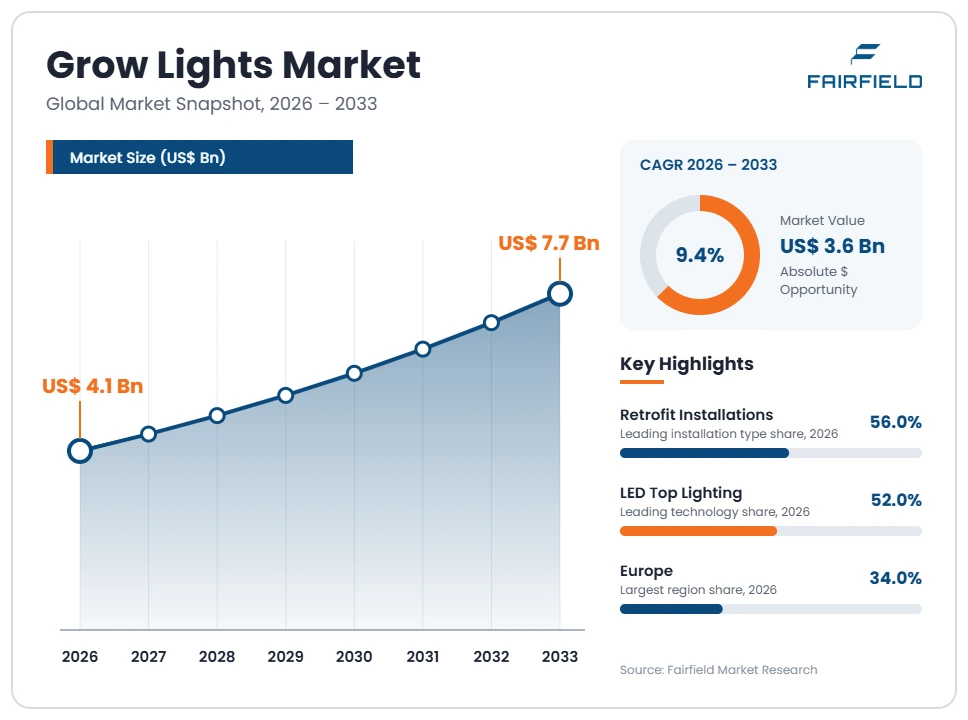
The global Grow Lights market size is expected to be valued at US$ 4.1 billion in 2026 and projected to reach US$ 7.7 billion by 2033, growing at a CAGR of 9.4% between 2026 and 2033.
Historical performance was uneven. The market grew at roughly 11% annually between 2020 and 2022, then contracted as vertical farming investment dried up, cannabis prices fell and energy costs squeezed growers, leaving the 2020–2025 CAGR near 5.8%. The forecast is therefore written as a recovery, not a continuation of the earlier boom. Three factors carry it: replacement of high-pressure sodium fixtures in commercial greenhouses, utility rebate programmes that improve project payback, and electricity prices that make efficacy the deciding purchase criterion. Growth is led by greenhouse retrofit work in established production regions rather than by new indoor facility construction.
Key Report Takeaways
- By Lighting Technology: LED top lighting held 52% share in 2026, while LED inter-lighting is projected to expand at a 14.3% CAGR through 2033, driven by high-wire tomato, pepper and cucumber crops that need light delivered within the canopy.
- By Cultivation Type: Greenhouses held 48% share in 2026, while indoor vertical farms are projected to expand at a 11.2% CAGR through 2033, rebounding from a sharply reduced base after widespread closures and cancelled facility builds.
- By Application: Fruits and vegetables held 33% share in 2026, while propagation and young plants is projected to expand at a 11.3% CAGR through 2033, as nurseries use controlled spectrum to standardise transplant quality.
- By Installation Type: Retrofit installations held 56% share in 2026, while new installations are projected to expand at a 10.1% CAGR through 2033, recovering slowly as greenhouse construction resumes in selected markets.
- By Geography: Europe held 34% share in 2026, while Asia Pacific is projected to expand at a 12.1% CAGR through 2033, supported by plant factory investment and government-backed food security programmes.
Global Grow Lights Market Trends and Insights
Drivers Impact Analysis
Two forces explain most of the forecast recovery in horticultural lighting demand, and both are economic rather than technological.
| Driver | Impact on CAGR Forecast | Geographic Relevance | Impact Timeline |
| Electricity cost pressure driving replacement of legacy fixtures | High | Europe, North America | Short term (≤2 years) |
| Utility rebate programmes improving project payback | Medium | North America | Medium term (2–4 years) |
Electricity Costs Make Fixture Efficacy the Deciding Factor in Grow Light Purchases
Energy is the dominant operating expense for lit cultivation, and that single fact drives most horticultural lighting purchases. A commercial greenhouse running supplemental light through winter spends more on electricity than on labour for that period. Replacing high-pressure sodium with high-efficacy LED fixtures cuts connected load materially for the same photosynthetic photon output, and growers can model payback from metered consumption rather than marketing claims. That makes efficacy, expressed in micromoles per joule, the specification that closes sales.
The causal mechanism runs through tariff structures as well as unit price. Many growers face demand charges and time-of-use pricing, so lower connected load reduces both energy and capacity costs. Dimming and spectrum control allow output to follow natural light and avoid peak periods. The same economics cut the other way, however, capping how much indoor growing is viable where power is expensive.
Utility Rebate Programmes Shorten Payback on Horticultural Lighting Retrofits
Utility efficiency rebates are a material part of project economics in horticultural lighting, not a marginal bonus. In many North American territories a rebate can offset a meaningful share of fixture cost, turning a payback period that growers consider unaffordable into one that passes investment approval. Because rebate eligibility is tied to listed product performance, the programmes also steer purchasing toward qualified fixtures and away from uncertified imports, which protects established manufacturers.
The mechanism is straightforward. Utilities face load growth and avoided-cost targets, and lit cultivation is an unusually concentrated, predictable load, so efficiency measures there are cheap to administer. The DesignLights Consortium Horticultural Technical Requirements and its qualified products list give programme administrators a single eligibility test. Manufacturers consequently design to those efficacy thresholds, and growers check the list before shortlisting suppliers.
Restraints Impact Analysis
Two constraints explain why the recovery is gradual and why forecasts from the previous investment cycle proved too high.
| Restraint | Impact on CAGR Forecast | Geographic Relevance | Impact Timeline |
| Contraction of vertical farming and cannabis cultivation demand | High | North America, Europe | Medium term (2–4 years) |
| Capital cost and financing constraints on grower retrofits | Medium | Global | Short term (≤2 years) |
Vertical Farming and Cannabis Contraction Removed a Large Block of Fixture Demand
The horticultural lighting market lost a substantial demand block when vertical farming contracted. After several years of heavy investment, a number of operators became insolvent, facilities were closed and announced builds were cancelled, because unit economics did not support the energy and capital intensity of stacked production for most crops. Cannabis cultivation lighting demand fell in parallel as wholesale prices collapsed in several mature markets, leaving growers unable to fund equipment replacement.
The underlying causes were financial. Vertical farms carried high electricity and labour cost per kilogram against commodity prices set by field and greenhouse produce, and rising interest rates ended the cheap capital that had funded expansion. In cannabis, licence oversupply pushed wholesale prices below production cost in several states and provinces. Secondary market fixtures from closed facilities also displaced some new equipment sales.
Capital Cost and Financing Limits Slow Greenhouse Lighting Retrofits
Capital availability, rather than willingness, limits the pace of lighting retrofits. A full greenhouse conversion involves fixtures, drivers, controls, electrical infrastructure upgrades and installation during a production gap, so the total project cost runs well above the fixture price list. Growers operating on thin produce margins often cannot finance it, and lenders have become more cautious toward controlled environment agriculture after recent sector losses.
The specific cost sources are often overlooked at quotation stage. Upgrading incoming supply capacity, switchgear and cabling can approach the cost of the fixtures themselves in older structures, and grid connection upgrades carry long utility lead times. Installation must fit between crop cycles, which adds schedule risk. These items, not the luminaires, are what commonly stall approval, which is why financing and as-a-service models are gaining attention.
Market Opportunities
Greenhouse Retrofit of Legacy Fixtures Opens the Largest Grow Light Revenue Pool
The installed base of high-pressure sodium fixtures in commercial greenhouses is the largest accessible revenue pool in horticultural lighting. Millions of legacy luminaires remain in service across established production regions, each a defined replacement opportunity with calculable energy savings. Unlike speculative new facilities, these sites already have crops, revenue and electrical infrastructure, so projects convert at a far higher rate. Retrofit work also pulls through controls, dimming and spectrum management hardware that carries better margin than the fixture alone.
Capture favours manufacturers with strong grower relationships, local installation partners and the ability to support rebate paperwork. Demand comes from tomato, pepper, cucumber and cut-flower producers in high-latitude regions where supplemental light is essential for winter production. Energy price volatility and utility incentive programmes both support the business case, and phased conversion lets growers spread capital across several seasons.
Lighting Control and Spectrum Management Create a Software and Services Revenue Pool
Controls, dimming and spectrum management form an emerging revenue pool distinct from fixture sales. Once a site is fitted with dimmable LED luminaires, growers can trade light against electricity price, shift output away from peak tariff windows and tune spectrum by crop stage. Selling that capability as control hardware plus software subscription creates recurring revenue from an installed base that would otherwise generate nothing until the next replacement cycle.
The customers are larger commercial greenhouse operators and research facilities with metered energy contracts and agronomy staff able to act on the data. Demand is reinforced by participation in demand response programmes, where growers are paid to reduce load at short notice. Integration with climate computers and crop registration systems supports adoption, since growers want lighting decisions made alongside temperature, humidity and irrigation rather than separately.
Segment Analysis
- By Lighting Technology: LED Top Lighting Leads While Inter-Lighting Advances Fastest
LED top lighting held 52% of 2026 revenue, because overhead arrays are the default configuration for both greenhouse supplemental lighting and indoor production, and because they are the direct replacement path for legacy fixtures. High-pressure sodium retains a meaningful installed base and continues to sell where capital is short, since purchase price remains lower despite poorer efficacy. Metal halide, fluorescent and induction now occupy small niches. LED inter-lighting is the fastest-growing technology at a 14.3% CAGR through 2033, as high-wire tomato, pepper and cucumber growers hang fixtures inside the canopy to light lower leaves that overhead systems cannot reach. The business implication is that technology share is no longer the interesting question. Competition has moved to efficacy, spectrum control, form factor and warranty terms within the LED category itself.
- By Cultivation Type: Greenhouses Hold the Base as Vertical Farms Rebuild Demand
Greenhouses accounted for 48% of 2026 revenue, the most resilient segment because supplemental lighting there improves yield and scheduling in an operation that already works economically with daylight. Indoor non-vertical growing in warehouses and container units follows, with research chambers and tissue culture facilities providing small but stable demand. Consumer and hobbyist growing contributes steady low-value volume. Indoor vertical farms are the fastest-growing cultivation type at a 11.2% CAGR through 2033, but from a sharply reduced base after closures and cancelled projects, and concentrated among surviving operators focused on leafy greens, herbs and propagation. For suppliers, the practical implication is to underwrite forecasts on greenhouse retrofit volume and treat vertical farming recovery as upside rather than as the base case.
- By Application: Fruit and Vegetable Growing Leads While Propagation Expands Quickest
Fruits and vegetables held 33% of 2026 revenue, led by tomato, pepper, cucumber and strawberry production in high-latitude greenhouses where winter light is the binding yield constraint. Floriculture and ornamentals follow, using photoperiod and supplemental lighting to hit fixed market dates. Leafy greens and microgreens sit mainly in indoor systems. Cannabis cultivation remains a significant application but has declined, as wholesale price collapse in several mature markets removed the margin that funded equipment upgrades. Propagation and young plants is the fastest-growing application at a 11.3% CAGR through 2033, since nurseries use controlled spectrum to standardise transplant quality and shorten rooting time. This segment matters commercially because propagation facilities are small, numerous and far less exposed to commodity price swings than finished-crop producers.
- By Installation Type: Retrofit Work Dominates While New Builds Slowly Recover
Retrofit installations represented 56% of 2026 revenue, confirming that this market now runs on replacement rather than expansion. Existing greenhouses carry large populations of ageing high-pressure sodium fixtures, and converting them requires no new structure, permit or land, which makes approval far easier than financing a new facility. Rebate programmes are also easiest to claim on measurable replacement savings. New installations are the faster-growing category at a 10.1% CAGR through 2033, recovering from a weak base as greenhouse construction resumes in selected markets and as food security programmes fund purpose-built facilities. The implication for manufacturers is operational. Retrofit demand arrives in small, dispersed projects that need local installation partners and fast quotation, whereas new builds are won through specification work with consultants years ahead of delivery.
Geography Analysis
- North America Converts Legacy Horticultural Fixtures Under Utility Rebate Programmes
North America holds 32% share in 2026, with the United States and Canada both active. Demand has rebalanced: cannabis cultivation lighting, once the fastest-growing source of orders, fell sharply as wholesale prices collapsed in several mature states and provinces, while greenhouse vegetable and propagation work held up better. Utility efficiency rebate programmes are the most distinctive regional feature, and eligibility is generally tied to listing on the DesignLights Consortium qualified products list, which concentrates sales among compliant manufacturers. Barriers include constrained grower financing and electrical service upgrade costs in older structures. The clear opportunity is conversion of the remaining high-pressure sodium installed base, where rebates and demand response participation together bring payback periods within the range growers will approve.
- Which Region Is Leading the Grow Lights Market?
Europe is leading the horticultural lighting market with 34% share in 2026, because it contains the world’s densest concentration of professional lit greenhouse production. The Netherlands is the centre of that activity, supported by Belgium, Germany, Poland, the United Kingdom and the Nordic countries, where short winter days make supplemental light essential for year-round tomato, pepper, cucumber and cut-flower supply. Energy price volatility following the gas supply shock accelerated conversion from high-pressure sodium to LED, since efficiency became a survival issue rather than an efficiency project. Regional ecodesign rules exempt horticultural light sources from general lighting requirements, keeping legacy lamps legally available. The constraint is high electricity cost, which led some growers to leave lights off for whole seasons.
- Which Region Is Growing Fastest in the Grow Lights Market?
Asia Pacific is growing fastest at a 12.1% CAGR between 2026 and 2033, from a 25% share in 2026. Japan and South Korea lead on plant factory deployment, where limited arable land and high produce prices support indoor production economics that fail elsewhere. China combines a large domestic fixture manufacturing base with rapid greenhouse modernisation and state support for protected cultivation. Australia and New Zealand add high-value glasshouse demand, while India and Southeast Asian markets remain early stage. Government food security programmes fund facility construction directly in several countries, which removes the financing barrier that slows growers elsewhere. The barrier is intense price competition among regional manufacturers, which compresses margins. The opportunity lies in export-grade fixtures meeting international efficacy and safety certification.
- Latin America Adds Horticultural Lighting in High-Value Export Crops
Latin America represents 5% share in 2026, concentrated in Mexico, Colombia, Brazil, Chile and Ecuador. Demand is narrower than elsewhere because abundant natural light reduces the need for supplemental lighting across much of the region. Where it is used, the application is specific: photoperiod control in the large cut-flower export sectors of Colombia and Ecuador, and supplemental lighting in protected berry and tomato production serving export markets. Barriers are substantial, including limited grower access to capital, import duties on fixtures, unreliable grid supply in rural growing areas and few local technical support networks. The opportunity is photoperiod lighting for floriculture, where modest fixture counts deliver precise control over flowering dates, making the investment case easier to approve than full supplemental installations.
- Middle East & Africa Links Controlled Environment Lighting to Food Security Plans
Middle East & Africa accounts for 4% share in 2026, the smallest region, led by the United Arab Emirates, Saudi Arabia, Qatar and Israel. Demand is policy-driven rather than market-driven, tied to national food security strategies that fund controlled environment agriculture to reduce produce imports. Israel contributes a strong research and agricultural technology base. In Africa, South Africa, Kenya and Morocco show early uptake in protected horticulture and floriculture export production. Barriers are serious: extreme cooling loads that raise total energy consumption well beyond the lighting itself, high electricity costs in several markets, limited technical service capacity and dependence on imported equipment. The opportunity lies in integrated projects where lighting, cooling and renewable generation are procured together, improving the overall energy case.
Competitive Landscape
The horticultural lighting market is moderately concentrated at the professional end and fragmented below it. A small number of global lighting groups hold most specification-led greenhouse business, supported by agronomy teams, light plan services, long warranties and relationships with greenhouse builders. Beneath that sits a wide field of specialist horticultural brands and a very long tail of low-cost manufacturers serving hobbyist and small indoor buyers. Recent years brought consolidation of a different kind than growth markets usually see: several vertical-farming-focused and cannabis-focused suppliers exited or were absorbed after demand fell, which removed capacity and steadied pricing for those that remained.
Competition is based on measurable performance and on confidence that a supplier will still exist to honour its warranty. Buyers compare photosynthetic photon efficacy, spectrum options, fixture lifetime and warranty length, ingress protection ratings for humid growing environments, dimming and control compatibility, and listing on qualified products lists that gate rebate eligibility. Agronomic support, including crop light plans and trial data, often decides large projects. New entrants have come mainly from component manufacturers moving downstream and from controls specialists adding lighting management software.
Strategic activity has focused on survival and consolidation rather than expansion. Vendors have narrowed product ranges, shifted emphasis from cannabis and vertical farming toward commercial greenhouse and propagation customers, added controls and service offerings, and built financing or as-a-service options to work around constrained grower capital.
Strategic direction now centres on energy outcomes. Suppliers increasingly position lighting as part of an energy management decision, combining fixtures, controls and tariff-aware operation rather than selling luminaires alone.
Recent Industry Developments
- November 2023: Parties to the Minamata Convention on Mercury agreed to phase out general-purpose fluorescent lamps by 2027 – narrowing the long-term outlook for mercury-containing lighting and reinforcing conversion to solid-state horticultural fixtures.
- January 2023: California brought its 2022 Building Energy Efficiency Standards into effect, including lighting provisions for controlled environment horticulture – making fixture efficiency a permitting requirement rather than a voluntary choice in the state.
- September 2021: The European Union Single Lighting Regulation began to apply, phasing out several conventional lamp types while exempting light sources designed for horticulture – preserving legacy lamp availability for growers during the transition to solid-state lighting.
- DesignLights Consortium Horticultural Technical Requirements: successive versions have raised the minimum photosynthetic photon efficacy needed for qualification – effectively setting the entry threshold for most North American utility rebate programmes.
Companies Covered in the Report
- Signify N.V.
- ams-OSRAM AG
- Heliospectra AB
- Gavita International B.V.
- Valoya Oy
- Fluence
- California LightWorks
- Hortilux Schréder B.V.
- Agrolux
- Thrive Agritech, Inc.
- Illumitex, Inc.
- Sananbio
Grow Lights Market Report Scope
| Metric | Value |
| Study Period | 2020–2033 |
| Market Size 2026 | US$ 4.1 Billion |
| Market Size 2033 | US$ 7.7 Billion |
| CAGR 2026–2033 | 9.4% |
| Absolute Dollar Opportunity | US$ 3.6 Billion |
| Largest Market | Europe (34% share in 2026) |
| Fastest-Growing Market | Asia Pacific (12.1% CAGR) |
| Market Concentration | Medium |
| Major Players | Signify N.V., ams-OSRAM AG, Heliospectra AB, Gavita International B.V., Valoya Oy |
Grow Lights Market Segmentation
Lighting Technology
- LED Top Lighting
- LED Inter-Lighting
- High-Pressure Sodium
- Metal Halide
- Fluorescent and Induction
Cultivation Type
- Greenhouses
- Indoor Vertical Farms
- Indoor Non-Vertical Facilities
- Research Chambers and Tissue Culture
- Consumer and Hobbyist Growing
Application
- Fruits and Vegetables
- Floriculture and Ornamentals
- Cannabis
- Leafy Greens and Microgreens
- Propagation and Young Plants
Installation Type
- Retrofit Installations
- New Installations
Regions
- North America
- Europe
- Asia Pacific
- Latin America
- Middle East & Africa
- Executive Summary
- Global Grow Lights Market Snapshot
- Future Projections
- Key Report Takeaways
- Regional Snapshot
- Market Overview
- Market Definition and Report Scope
- Historical Trends 2020–2025
- Market Dynamics
- Drivers
- Electricity Costs Make Fixture Efficacy the Deciding Factor in Grow Light Purchases
- Utility Rebate Programmes Shorten Payback on Horticultural Lighting Retrofits
- Restraints
- Vertical Farming and Cannabis Contraction Removed a Large Block of Fixture Demand
- Capital Cost and Financing Limits Slow Greenhouse Lighting Retrofits
- Market Opportunities
- Greenhouse Retrofit of Legacy Fixtures Opens the Largest Grow Light Revenue Pool
- Lighting Control and Spectrum Management Create a Software and Services Revenue Pool
- Drivers
- Global Grow Lights Market Outlook, 2020–2033
- Global Grow Lights Market Outlook, by Lighting Technology, Value (US$ Billion), 2020–2033
- LED Top Lighting
- LED Inter-Lighting
- High-Pressure Sodium
- Metal Halide
- Fluorescent and Induction
- Global Grow Lights Market Outlook, by Cultivation Type, Value (US$ Billion), 2020–2033
- Greenhouses
- Indoor Vertical Farms
- Indoor Non-Vertical Facilities
- Research Chambers and Tissue Culture
- Consumer and Hobbyist Growing
- Global Grow Lights Market Outlook, by Application, Value (US$ Billion), 2020–2033
- Fruits and Vegetables
- Floriculture and Ornamentals
- Cannabis
- Leafy Greens and Microgreens
- Propagation and Young Plants
- Global Grow Lights Market Outlook, by Installation Type, Value (US$ Billion), 2020–2033
- Retrofit Installations
- New Installations
- Global Grow Lights Market Outlook, by Region, Value (US$ Billion), 2020–2033
- North America
- Europe
- Asia Pacific
- Latin America
- Middle East & Africa
- Global Grow Lights Market Outlook, by Lighting Technology, Value (US$ Billion), 2020–2033
- North America Grow Lights Market Outlook, 2020–2033
- North America Grow Lights Market Outlook, by Lighting Technology, Value (US$ Billion), 2020–2033
- LED Top Lighting
- LED Inter-Lighting
- High-Pressure Sodium
- Metal Halide
- Fluorescent and Induction
- North America Grow Lights Market Outlook, by Cultivation Type, Value (US$ Billion), 2020–2033
- Greenhouses
- Indoor Vertical Farms
- Indoor Non-Vertical Facilities
- Research Chambers and Tissue Culture
- Consumer and Hobbyist Growing
- North America Grow Lights Market Outlook, by Application, Value (US$ Billion), 2020–2033
- Fruits and Vegetables
- Floriculture and Ornamentals
- Cannabis
- Leafy Greens and Microgreens
- Propagation and Young Plants
- North America Grow Lights Market Outlook, by Installation Type, Value (US$ Billion), 2020–2033
- Retrofit Installations
- New Installations
- North America Grow Lights Market Outlook, by Country, Value (US$ Billion), 2020–2033
- United States Grow Lights Market Outlook, by Lighting Technology, 2020–2033
- United States Grow Lights Market Outlook, by Cultivation Type, 2020–2033
- United States Grow Lights Market Outlook, by Application, 2020–2033
- United States Grow Lights Market Outlook, by Installation Type, 2020–2033
- Canada Grow Lights Market Outlook, by Lighting Technology, 2020–2033
- Canada Grow Lights Market Outlook, by Cultivation Type, 2020–2033
- Canada Grow Lights Market Outlook, by Application, 2020–2033
- Canada Grow Lights Market Outlook, by Installation Type, 2020–2033
- North America Grow Lights Market Outlook, by Lighting Technology, Value (US$ Billion), 2020–2033
- Europe Grow Lights Market Outlook, 2020–2033
- Europe Grow Lights Market Outlook, by Lighting Technology, Value (US$ Billion), 2020–2033
- LED Top Lighting
- LED Inter-Lighting
- High-Pressure Sodium
- Metal Halide
- Fluorescent and Induction
- Europe Grow Lights Market Outlook, by Cultivation Type, Value (US$ Billion), 2020–2033
- Greenhouses
- Indoor Vertical Farms
- Indoor Non-Vertical Facilities
- Research Chambers and Tissue Culture
- Consumer and Hobbyist Growing
- Europe Grow Lights Market Outlook, by Application, Value (US$ Billion), 2020–2033
- Fruits and Vegetables
- Floriculture and Ornamentals
- Cannabis
- Leafy Greens and Microgreens
- Propagation and Young Plants
- Europe Grow Lights Market Outlook, by Installation Type, Value (US$ Billion), 2020–2033
- Retrofit Installations
- New Installations
- Europe Grow Lights Market Outlook, by Country, Value (US$ Billion), 2020–2033
- Netherlands Grow Lights Market Outlook, by Lighting Technology, 2020–2033
- Netherlands Grow Lights Market Outlook, by Cultivation Type, 2020–2033
- Netherlands Grow Lights Market Outlook, by Application, 2020–2033
- Netherlands Grow Lights Market Outlook, by Installation Type, 2020–2033
- Belgium Grow Lights Market Outlook, by Lighting Technology, 2020–2033
- Belgium Grow Lights Market Outlook, by Cultivation Type, 2020–2033
- Belgium Grow Lights Market Outlook, by Application, 2020–2033
- Belgium Grow Lights Market Outlook, by Installation Type, 2020–2033
- Germany Grow Lights Market Outlook, by Lighting Technology, 2020–2033
- Germany Grow Lights Market Outlook, by Cultivation Type, 2020–2033
- Germany Grow Lights Market Outlook, by Application, 2020–2033
- Germany Grow Lights Market Outlook, by Installation Type, 2020–2033
- Poland Grow Lights Market Outlook, by Lighting Technology, 2020–2033
- Poland Grow Lights Market Outlook, by Cultivation Type, 2020–2033
- Poland Grow Lights Market Outlook, by Application, 2020–2033
- Poland Grow Lights Market Outlook, by Installation Type, 2020–2033
- United Kingdom Grow Lights Market Outlook, by Lighting Technology, 2020–2033
- United Kingdom Grow Lights Market Outlook, by Cultivation Type, 2020–2033
- United Kingdom Grow Lights Market Outlook, by Application, 2020–2033
- United Kingdom Grow Lights Market Outlook, by Installation Type, 2020–2033
- Nordic countries Grow Lights Market Outlook, by Lighting Technology, 2020–2033
- Nordic countries Grow Lights Market Outlook, by Cultivation Type, 2020–2033
- Nordic countries Grow Lights Market Outlook, by Application, 2020–2033
- Nordic countries Grow Lights Market Outlook, by Installation Type, 2020–2033
- Europe Grow Lights Market Outlook, by Lighting Technology, Value (US$ Billion), 2020–2033
- Asia Pacific Grow Lights Market Outlook, 2020–2033
- Asia Pacific Grow Lights Market Outlook, by Lighting Technology, Value (US$ Billion), 2020–2033
- LED Top Lighting
- LED Inter-Lighting
- High-Pressure Sodium
- Metal Halide
- Fluorescent and Induction
- Asia Pacific Grow Lights Market Outlook, by Cultivation Type, Value (US$ Billion), 2020–2033
- Greenhouses
- Indoor Vertical Farms
- Indoor Non-Vertical Facilities
- Research Chambers and Tissue Culture
- Consumer and Hobbyist Growing
- Asia Pacific Grow Lights Market Outlook, by Application, Value (US$ Billion), 2020–2033
- Fruits and Vegetables
- Floriculture and Ornamentals
- Cannabis
- Leafy Greens and Microgreens
- Propagation and Young Plants
- Asia Pacific Grow Lights Market Outlook, by Installation Type, Value (US$ Billion), 2020–2033
- Retrofit Installations
- New Installations
- Asia Pacific Grow Lights Market Outlook, by Country, Value (US$ Billion), 2020–2033
- Japan Grow Lights Market Outlook, by Lighting Technology, 2020–2033
- Japan Grow Lights Market Outlook, by Cultivation Type, 2020–2033
- Japan Grow Lights Market Outlook, by Application, 2020–2033
- Japan Grow Lights Market Outlook, by Installation Type, 2020–2033
- South Korea Grow Lights Market Outlook, by Lighting Technology, 2020–2033
- South Korea Grow Lights Market Outlook, by Cultivation Type, 2020–2033
- South Korea Grow Lights Market Outlook, by Application, 2020–2033
- South Korea Grow Lights Market Outlook, by Installation Type, 2020–2033
- China Grow Lights Market Outlook, by Lighting Technology, 2020–2033
- China Grow Lights Market Outlook, by Cultivation Type, 2020–2033
- China Grow Lights Market Outlook, by Application, 2020–2033
- China Grow Lights Market Outlook, by Installation Type, 2020–2033
- Australia Grow Lights Market Outlook, by Lighting Technology, 2020–2033
- Australia Grow Lights Market Outlook, by Cultivation Type, 2020–2033
- Australia Grow Lights Market Outlook, by Application, 2020–2033
- Australia Grow Lights Market Outlook, by Installation Type, 2020–2033
- New Zealand Grow Lights Market Outlook, by Lighting Technology, 2020–2033
- New Zealand Grow Lights Market Outlook, by Cultivation Type, 2020–2033
- New Zealand Grow Lights Market Outlook, by Application, 2020–2033
- New Zealand Grow Lights Market Outlook, by Installation Type, 2020–2033
- India Grow Lights Market Outlook, by Lighting Technology, 2020–2033
- India Grow Lights Market Outlook, by Cultivation Type, 2020–2033
- India Grow Lights Market Outlook, by Application, 2020–2033
- India Grow Lights Market Outlook, by Installation Type, 2020–2033
- Asia Pacific Grow Lights Market Outlook, by Lighting Technology, Value (US$ Billion), 2020–2033
- Latin America Grow Lights Market Outlook, 2020–2033
- Latin America Grow Lights Market Outlook, by Lighting Technology, Value (US$ Billion), 2020–2033
- LED Top Lighting
- LED Inter-Lighting
- High-Pressure Sodium
- Metal Halide
- Fluorescent and Induction
- Latin America Grow Lights Market Outlook, by Cultivation Type, Value (US$ Billion), 2020–2033
- Greenhouses
- Indoor Vertical Farms
- Indoor Non-Vertical Facilities
- Research Chambers and Tissue Culture
- Consumer and Hobbyist Growing
- Latin America Grow Lights Market Outlook, by Application, Value (US$ Billion), 2020–2033
- Fruits and Vegetables
- Floriculture and Ornamentals
- Cannabis
- Leafy Greens and Microgreens
- Propagation and Young Plants
- Latin America Grow Lights Market Outlook, by Installation Type, Value (US$ Billion), 2020–2033
- Retrofit Installations
- New Installations
- Latin America Grow Lights Market Outlook, by Country, Value (US$ Billion), 2020–2033
- Mexico Grow Lights Market Outlook, by Lighting Technology, 2020–2033
- Mexico Grow Lights Market Outlook, by Cultivation Type, 2020–2033
- Mexico Grow Lights Market Outlook, by Application, 2020–2033
- Mexico Grow Lights Market Outlook, by Installation Type, 2020–2033
- Colombia Grow Lights Market Outlook, by Lighting Technology, 2020–2033
- Colombia Grow Lights Market Outlook, by Cultivation Type, 2020–2033
- Colombia Grow Lights Market Outlook, by Application, 2020–2033
- Colombia Grow Lights Market Outlook, by Installation Type, 2020–2033
- Brazil Grow Lights Market Outlook, by Lighting Technology, 2020–2033
- Brazil Grow Lights Market Outlook, by Cultivation Type, 2020–2033
- Brazil Grow Lights Market Outlook, by Application, 2020–2033
- Brazil Grow Lights Market Outlook, by Installation Type, 2020–2033
- Chile Grow Lights Market Outlook, by Lighting Technology, 2020–2033
- Chile Grow Lights Market Outlook, by Cultivation Type, 2020–2033
- Chile Grow Lights Market Outlook, by Application, 2020–2033
- Chile Grow Lights Market Outlook, by Installation Type, 2020–2033
- Ecuador Grow Lights Market Outlook, by Lighting Technology, 2020–2033
- Ecuador Grow Lights Market Outlook, by Cultivation Type, 2020–2033
- Ecuador Grow Lights Market Outlook, by Application, 2020–2033
- Ecuador Grow Lights Market Outlook, by Installation Type, 2020–2033
- Latin America Grow Lights Market Outlook, by Lighting Technology, Value (US$ Billion), 2020–2033
- Middle East & Africa Grow Lights Market Outlook, 2020–2033
- Middle East & Africa Grow Lights Market Outlook, by Lighting Technology, Value (US$ Billion), 2020–2033
- LED Top Lighting
- LED Inter-Lighting
- High-Pressure Sodium
- Metal Halide
- Fluorescent and Induction
- Middle East & Africa Grow Lights Market Outlook, by Cultivation Type, Value (US$ Billion), 2020–2033
- Greenhouses
- Indoor Vertical Farms
- Indoor Non-Vertical Facilities
- Research Chambers and Tissue Culture
- Consumer and Hobbyist Growing
- Middle East & Africa Grow Lights Market Outlook, by Application, Value (US$ Billion), 2020–2033
- Fruits and Vegetables
- Floriculture and Ornamentals
- Cannabis
- Leafy Greens and Microgreens
- Propagation and Young Plants
- Middle East & Africa Grow Lights Market Outlook, by Installation Type, Value (US$ Billion), 2020–2033
- Retrofit Installations
- New Installations
- Middle East & Africa Grow Lights Market Outlook, by Country, Value (US$ Billion), 2020–2033
- United Arab Emirates Grow Lights Market Outlook, by Lighting Technology, 2020–2033
- United Arab Emirates Grow Lights Market Outlook, by Cultivation Type, 2020–2033
- United Arab Emirates Grow Lights Market Outlook, by Application, 2020–2033
- United Arab Emirates Grow Lights Market Outlook, by Installation Type, 2020–2033
- Saudi Arabia Grow Lights Market Outlook, by Lighting Technology, 2020–2033
- Saudi Arabia Grow Lights Market Outlook, by Cultivation Type, 2020–2033
- Saudi Arabia Grow Lights Market Outlook, by Application, 2020–2033
- Saudi Arabia Grow Lights Market Outlook, by Installation Type, 2020–2033
- Qatar Grow Lights Market Outlook, by Lighting Technology, 2020–2033
- Qatar Grow Lights Market Outlook, by Cultivation Type, 2020–2033
- Qatar Grow Lights Market Outlook, by Application, 2020–2033
- Qatar Grow Lights Market Outlook, by Installation Type, 2020–2033
- Israel Grow Lights Market Outlook, by Lighting Technology, 2020–2033
- Israel Grow Lights Market Outlook, by Cultivation Type, 2020–2033
- Israel Grow Lights Market Outlook, by Application, 2020–2033
- Israel Grow Lights Market Outlook, by Installation Type, 2020–2033
- South Africa Grow Lights Market Outlook, by Lighting Technology, 2020–2033
- South Africa Grow Lights Market Outlook, by Cultivation Type, 2020–2033
- South Africa Grow Lights Market Outlook, by Application, 2020–2033
- South Africa Grow Lights Market Outlook, by Installation Type, 2020–2033
- Kenya Grow Lights Market Outlook, by Lighting Technology, 2020–2033
- Kenya Grow Lights Market Outlook, by Cultivation Type, 2020–2033
- Kenya Grow Lights Market Outlook, by Application, 2020–2033
- Kenya Grow Lights Market Outlook, by Installation Type, 2020–2033
- Morocco Grow Lights Market Outlook, by Lighting Technology, 2020–2033
- Morocco Grow Lights Market Outlook, by Cultivation Type, 2020–2033
- Morocco Grow Lights Market Outlook, by Application, 2020–2033
- Morocco Grow Lights Market Outlook, by Installation Type, 2020–2033
- Middle East & Africa Grow Lights Market Outlook, by Lighting Technology, Value (US$ Billion), 2020–2033
- Competitive Landscape
- Market Concentration and Industry Leaders
- Competitive Differentiation
- Strategic Moves and Market Direction
- Recent Industry Developments
- Company Profiles
- Signify N.V.
- ams-OSRAM AG
- Heliospectra AB
- Gavita International B.V.
- Valoya Oy
- Fluence
- California LightWorks
- Hortilux Schréder B.V.
- Agrolux
- Thrive Agritech, Inc.
- Illumitex, Inc.
- Sananbio
- Appendix
- Research Methodology
- Report Assumptions
- Acronyms and Abbreviations
Lighting Technology
- LED Top Lighting
- LED Inter-Lighting
- High-Pressure Sodium
- Metal Halide
- Fluorescent and Induction
Cultivation Type
- Greenhouses
- Indoor Vertical Farms
- Indoor Non-Vertical Facilities
- Research Chambers and Tissue Culture
- Consumer and Hobbyist Growing
Application
- Fruits and Vegetables
- Floriculture and Ornamentals
- Cannabis
- Leafy Greens and Microgreens
- Propagation and Young Plants
Installation Type
- Retrofit Installations
- New Installations
Regions
- North America
- Europe
- Asia Pacific
- Latin America
- Middle East & Africa
Our Research Methodology
Considering the volatility of business today, traditional approaches to strategizing a game plan can be unfruitful if not detrimental. True ambiguity is no way to determine a forecast. A myriad of predetermined factors must be accounted for such as the degree of risk involved, the magnitude of circumstances, as well as conditions or consequences that are not known or unpredictable. To circumvent binary views that cast uncertainty, the application of market research intelligence to strategically posture, move, and enable actionable outcomes is necessary.
View Methodology
Quality Assured
Rigorous Validation Process

Confidentiality Assured
End-to-end Data Security

Custom Research Services
Tailored To Your Objectives
FAQs
The horticultural lighting market is valued at US$ 4.1 billion in 2026, covering fixtures, legacy lamp systems and the controls sold alongside them.
The market is projected to reach US$ 7.7 billion by 2033 at a 9.4% CAGR, adding US$ 3.6 billion of absolute dollar opportunity.
LED top lighting leads with 52% share in 2026, because overhead arrays are the default configuration and the direct replacement path for legacy fixtures.
LED inter-lighting is growing fastest at a 14.3% CAGR through 2033, as high-wire vegetable growers light lower canopy leaves that overhead fixtures miss.
Europe holds 34% share in 2026, because it contains the densest concentration of professional lit greenhouse production, centred on the Netherlands.
Related Reports
Fabric Filter Market Size, Share, Insights, Competitive Landscape, and Forecast 2026 to 2033
The global fabric filter market is valued at US$11.2 billion in 2026, reaching US$16.4 billion by 2033, growing at a 5.6% CAGR
Ground Penetrating Radar Market Size, Share, Insights, Competitive Landscape, and Forecast 2026 to 2033
The global ground penetrating radar market is valued at US$0.70 billion in 2026, reaching US$1.20 billion by 2033, growing at an 8.0% CAGR
3D Machine Vision Market Size, Share, Insights, Competitive Landscape, and Forecast 2026 to 2033
The global 3D machine vision market is valued at US$9.10 billion in 2026, reaching US$22.30 billion by 2033, growing at a 13.7% CAGR
3D Laser Scanner Market Size, Share, Insights, Competitive Landscape, and Forecast 2026 to 2033
The global 3D laser scanner market is valued at US$2.00 billion in 2026, reaching US$3.66 billion by 2033, growing at a 9.0% CAGR
3D Concrete Printing Market Size, Share, Insights, Competitive Landscape, and Forecast 2026 to 2033
The global 3D concrete printing market is valued at US$0.30 billion in 2026, reaching US$1.20 billion by 2033, growing at a 21.9% CAGR
Elevator Maintenance Market Size, Share, Insights, Competitive Landscape, and Forecast 2026 to 2033
The global elevator maintenance market is valued at US$64.8 billion in 2026, reaching US$92.6 billion by 2033, growing at a 5.2% CAGR