



Industrial Automation and Control System Market
Industrial Automation and Control System Market Size, Share, Insights, Competitive Landscape, and Forecast 2026 to 2033
Industrial Automation and Control System Market Size and Trend Analysis
How Fast Will the Industrial Control System Market Grow?
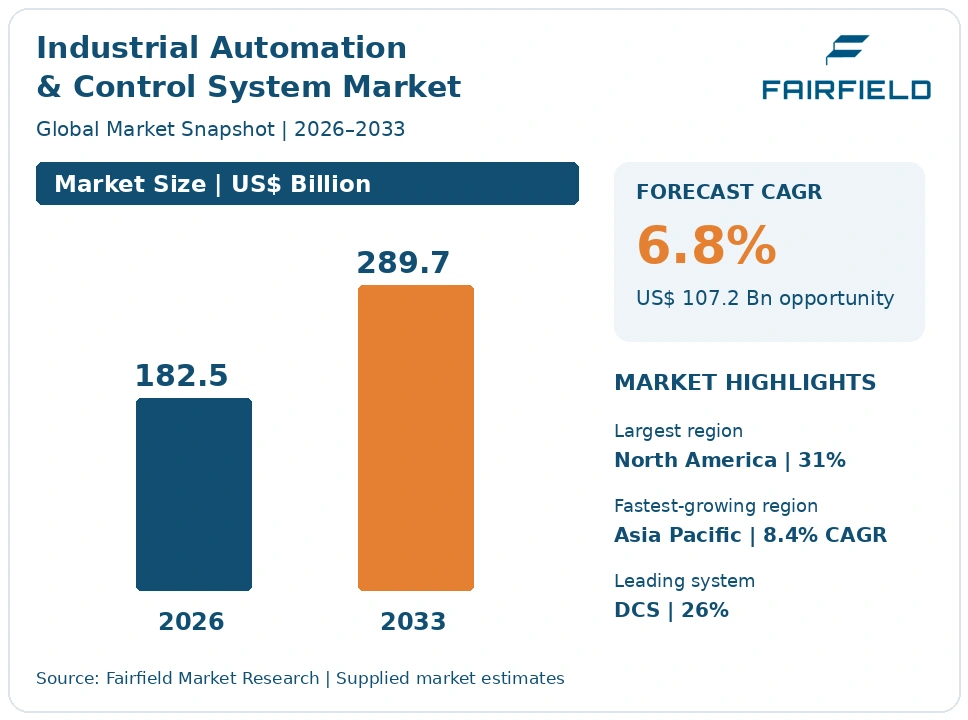
The global Industrial Automation and Control System market size is expected to be valued at US$ 182.5 billion in 2026 and projected to reach US$ 289.7 billion by 2033, growing at a CAGR of 6.8% between 2026 and 2033.
Between 2020 and 2025 the sector expanded at roughly a 5.2% CAGR, held back by deferred capital projects and long plant turnaround cycles. Three factors now lift the trajectory. First, security obligations under the IEC 62443 series and the NIS2 Directive are pulling controller and network refresh budgets forward. Second, a large installed base of distributed control systems commissioned in the 1990s and 2000s has passed its vendor support milestones. Third, process operators are standardising on open, modular architectures that make staged migration affordable. The direction of travel is a replacement-led market rather than a greenfield boom, with services and software taking a rising share of every project.
Key Report Takeaways
- By System Type: Distributed control systems held 26% share in 2026, while safety instrumented systems are projected to expand at a 9.1% CAGR through 2033, driven by stricter IEC 61511 safety lifecycle audits across refining and chemicals.
- By Offering: Hardware accounted for 55% of 2026 revenue, while services are projected to grow at an 8.6% CAGR through 2033, as operators outsource patch qualification, backup and secure remote access for control networks.
- By Deployment Mode: On-premise control retained 76% share in 2026, while cloud-enabled hybrid architectures are forecast to advance at a 13.1% CAGR through 2033, supported by edge devices that keep deterministic control inside the plant.
- By Industry Vertical: Oil and gas contributed 21% of 2026 spending, while pharmaceuticals is set to grow at an 8.8% CAGR through 2033, reflecting continuous manufacturing lines and data integrity obligations.
- By Geography: North America led with 31% share in 2026, while Asia Pacific is projected to rise at an 8.4% CAGR through 2033, as new chemical and semiconductor capacity enters commissioning.
Global Industrial Automation and Control System Market Trends and Insights
Drivers Impact Analysis
Two forces account for most of the incremental spending on plant control layers through 2033.
| Driver | Impact on CAGR Forecast | Geographic Relevance | Impact Timeline |
| Mandatory operational technology security obligations under IEC 62443 and NIS2 | High | Europe, North America | Medium term 2–4 years |
| Obsolescence of the legacy distributed control system and controller installed base | High | North America, Europe, Asia Pacific | Long term ≥4 years |
Security Certification Requirements Are Forcing Control System Upgrades in Regulated Plants
Security regulation has become the clearest budget trigger for control system upgrades. Plant owners in regulated sectors must now show auditable protection for the systems that run production, and unsupported controllers cannot pass that test. Asset owners therefore replace ageing equipment, segment networks and buy certified components, which turns a discretionary engineering project into a compliance obligation with a deadline attached.
The mechanism is certification. The IEC 62443 series defines security levels for products, systems and service providers, and conformity schemes now test suppliers against it. The NIS2 Directive (EU) 2022/2555 places manufacturing, chemicals, energy and water operators in scope as essential or important entities, with management accountability for risk measures. The Cyber Resilience Act, Regulation (EU) 2024/2847, extends duties to products with digital elements, so controllers and engineering software must ship with vulnerability handling. Buyers increasingly make certification a tender condition.
Ageing Distributed Control Systems Are Creating a Deep Migration and Replacement Pipeline
An ageing installed base is the second demand engine, and it is largely independent of new plant construction. Distributed control systems commissioned during the 1990s and 2000s are reaching the end of vendor support, spare boards come from brokers, and the engineers who know the original configuration are retiring. Operators replace these systems to protect availability rather than to add function, which makes this demand unusually resilient across the industrial cycle.
The mechanism is obsolescence risk converted into quantified downtime exposure. A single unplanned outage at a refinery or ethylene cracker can cost more than the migration itself, so reliability teams build staged replacement plans tied to turnarounds. Suppliers support this with marshalling cabinets, configuration conversion tools and keep-the-wiring migration kits that shorten cutover. ISA-95 integration models help preserve the production data interfaces that enterprise systems already consume, which lowers the total cost of change.
Restraints Impact Analysis
Two constraints cap how quickly replacement demand can convert into recognised revenue.
| Restraint | Impact on CAGR Forecast | Geographic Relevance | Impact Timeline |
| Shutdown windows and hot-cutover risk in continuous process plants | High | Global | Long term ≥4 years |
| Functional safety certification burden under IEC 61508 and IEC 61511 | Medium | Europe, North America, Middle East & Africa | Medium term 2–4 years |
Plant Turnaround Windows and Hot-Cutover Risk Slow Control System Replacement
Turnaround scheduling limits how quickly control systems can be replaced, whatever the budget. Continuous process plants open their equipment only every three to six years, and a control migration must fit inside that window alongside mechanical and inspection work. Projects that miss the window wait for the next cycle, which stretches supplier revenue recognition and keeps annual replacement rates in the low single digits.
The cost source is lost production during cutover, not the hardware itself. A mid-size chemical plant can forgo several million dollars of margin for each additional shutdown day, so engineering teams favour partial migrations that keep field wiring and existing input and output in place. Hot-cutover techniques reduce that risk but require redundant networks, extensive factory acceptance testing and loop-by-loop verification. Verifying several thousand control loops consumes specialist resources that are scarce in every region.
Functional Safety Certification Under IEC 61508 Raises Development and Verification Costs
Functional safety certification raises the cost of bringing control products to market and narrows the supplier field. Safety instrumented systems, safety controllers and certified instruments must be developed under a documented safety lifecycle, which adds years to release schedules. Smaller vendors struggle to absorb that overhead, so buyers in high-hazard industries face fewer credible options and firmer pricing on safety-rated equipment.
The specific cost is independent assessment and evidence production under IEC 61508, applied through IEC 61511 in the process industries. Suppliers must maintain failure mode data, proven-in-use records, systematic capability arguments and tool qualification, then repeat assessment after design changes. Operators carry a parallel burden covering safety integrity level verification, proof-test intervals and management of change records. These recurring engineering hours, rather than device prices, dominate the lifecycle cost of every safety loop.
Market Opportunities
Managed Operational Technology Security Services Open a Recurring Revenue Pool
Managed security services for operational technology open a revenue pool that sits outside the project cycle. Most plants cannot staff round-the-clock monitoring of control networks, yet they are now expected to detect and report incidents quickly. Subscription services covering asset inventory, vulnerability triage, patch qualification, backup and secure remote access convert one-off engineering work into multi-year contracts attached to the installed base.
Control suppliers, automation integrators and specialist security firms can all capture this pool, and demand comes from mid-size operators in chemicals, water utilities and food processing that lack internal teams. Incident reporting duties under the NIS2 Directive and vulnerability handling expectations under the Cyber Resilience Act give boards a documented reason to fund it. Delivery is supported by discovery tools that passively map controllers, firmware revisions and protocol traffic without disturbing deterministic control.
Modular Process Automation Based on NAMUR Open Architecture Creates a New Equipment Layer
Modular process automation creates a new equipment and licensing layer for control system suppliers. Instead of engineering every unit into one monolithic configuration, operators buy pre-automated skids that carry their own control logic and register with a plant orchestration layer. This shortens commissioning for small-batch chemical and pharmaceutical plants and creates demand for orchestration software, module interfaces and conformance testing that did not previously exist as products.
Skid builders, module vendors and process licensors are positioned to take the hardware share, while established automation suppliers sell the orchestration layer and integration services. Demand comes from specialty chemicals and pharmaceutical manufacturers that change product mix frequently. The NAMUR Open Architecture concept and the Module Type Package specification supply the interface definitions that make plug-and-produce practical, and ISA-95 keeps the resulting production data aligned with enterprise planning systems.
Segment Analysis
By System Type: Distributed Control Systems Lead While Safety Instrumented Systems Accelerate
Distributed control systems led with 26% share in 2026, reflecting their role as the backbone of continuous process plants. Refineries, ethylene crackers, power stations and large water treatment works need coordinated regulatory control across thousands of loops, and distributed architectures remain the only practical answer at that scale. Programmable logic controllers and supervisory control and data acquisition software follow, serving discrete lines, pipelines and dispersed utility assets. Safety instrumented systems are the fastest-growing type at a 9.1% CAGR to 2033, because IEC 61511 places explicit lifecycle duties on operators and audits now test proof-test records rather than installation certificates. Human-machine interface stations, industrial PCs and control-linked process instrumentation grow with the systems they serve. For suppliers, the implication is that safety and security content, not basic regulatory control, now carries the premium in process control tenders.
By Offering: Hardware Dominates Spending as Lifecycle Services Expand Fastest
Hardware captured 55% of 2026 revenue, since controllers, input and output modules, operator stations, network equipment and field devices still make up the bulk of a project bill of materials. Software accounts for a growing slice as engineering tools, historians, alarm management and asset performance applications become separately licensed products rather than bundled extras. Services are the fastest-growing offering at an 8.6% CAGR through 2033, led by migration engineering, security assessment and long-term lifecycle agreements that guarantee spare availability and firmware support. This matters commercially because service revenue is far less cyclical than capital equipment and ties the customer to one architecture for a decade or more. Suppliers increasingly price hardware competitively and recover margin through the engineering, licensing and support that follow, which changes how control system tenders should be evaluated.
By Deployment Mode: On-Premise Control Prevails While Cloud-Enabled Hybrid Architectures Scale
On-premise deployment held 76% share in 2026 because deterministic control cannot tolerate network latency or external dependency. Safety and regulatory functions stay inside the plant, usually on redundant controllers with local engineering workstations. Cloud-enabled hybrid architectures are the fastest-growing deployment mode at a 13.1% CAGR to 2033, applied to historian storage, analytics, remote engineering access and fleet-wide alarm benchmarking rather than closed-loop control. Edge devices sit between the two, running advanced control, inference and protocol translation close to the process while forwarding curated data upward. Adoption is strongest among operators running many similar assets, such as water utilities and dispersed gas processing sites. The practical implication is architectural: buyers now specify a data path and a security boundary in the tender, not only a controller family and an input and output count.
By Industry Vertical: Oil and Gas Holds the Largest Share as Pharmaceuticals Grows Quickest
Oil and gas accounted for 21% of 2026 spending, the largest vertical, supported by upstream processing, refining and midstream pipeline control where availability requirements justify premium systems. Chemicals and petrochemicals, power generation and utilities, and water and wastewater follow, each holding large populations of controllers that have outlived their support windows. Pharmaceuticals is the fastest-growing vertical at an 8.8% CAGR through 2033, driven by continuous manufacturing lines, single-use equipment trains and data integrity expectations that require validated control and electronic records. Food and beverage, metals and mining, and pulp and paper contribute steady replacement demand. The spread matters because qualification requirements differ sharply: a refinery buys safety integrity and availability, a pharmaceutical plant buys validation documentation and change control, and the two require different engineering organisations behind the same platform.
Geography Analysis
Which Region Is Leading the Industrial Automation and Control System Market?
North America leads with 31% share in 2026, supported by the largest installed base of ageing process control assets anywhere. The United States dominates, with Gulf Coast refining, a chemical build-out linked to low-cost feedstock, and extensive gas processing and pipeline infrastructure. Canada adds oil sands, mining and pulp operations with similar migration needs. Spending is weighted toward replacement and security rather than new capacity, since critical infrastructure guidance and insurer scrutiny have made control network segmentation a board-level item. Mexico contributes through refining and automotive process utilities. The change shaping the region is the convergence of safety and security programmes into one lifecycle, pushing operators to consolidate suppliers and buy longer support agreements instead of managing mixed legacy estates.
Europe Sets the Regulatory Agenda for Plant Control and Safety Systems
Europe holds 25% share in 2026 and sets much of the regulatory agenda for the sector. Germany, France, the Netherlands, Italy and the Nordic countries host dense chemical, pharmaceutical and pulp and paper clusters whose control estates are mature and well documented. The NIS2 Directive (EU) 2022/2555 brought many of these operators into scope as essential or important entities, and the Cyber Resilience Act adds product-level duties on their suppliers. Functional safety practice under IEC 61508 is deeply embedded, and NAMUR working groups shape process automation requirements well beyond the continent. High energy costs have slowed new chemical capacity, so demand is firmly replacement-led. The opportunity is modular automation, which suits the smaller, flexible specialty plants that current investment appetite favours.
Which Region Is Growing Fastest in the Industrial Automation and Control System Market?
Asia Pacific is growing fastest at an 8.4% CAGR to 2033, from 29% share in 2026. China drives base volume through petrochemical complexes, coal chemical plants and an expanding power fleet. India adds refinery expansion, fertiliser revamps and large water infrastructure programmes. Japan and South Korea contribute high-specification demand in semiconductors, fine chemicals and marine-linked process plants, where safety instrumented functions are standard. Much of this growth is genuinely new capacity rather than replacement, so projects start on current-generation architectures and skip several upgrade cycles. The main constraint is engineering capacity: commissioning schedules outrun the supply of qualified control engineers, which has encouraged standardised, pre-tested control modules and remote factory acceptance testing as ways to compress project schedules.
Latin America Builds Control System Demand Around Mining and Refining Assets
Latin America represents 7% of 2026 demand, concentrated in a small number of asset-heavy industries. Brazil leads with offshore production, refining and pulp mills, while Chile and Peru add copper concentrators and smelters where process control and safety systems protect high-value throughput. Mexico contributes refining and petrochemical modernisation. The principal barrier is funding stability, since currency movements and political cycles delay capital approvals, so operators stretch control system life well past vendor support and buy spares on secondary markets. Certified integrator capacity is thin outside major industrial centres, which raises project risk. The change worth watching is remote engineering support, which lets sites draw on specialists elsewhere and makes staged migration viable where a full on-site project team cannot be justified.
Middle East & Africa Invests in Control Systems for Petrochemical and Water Capacity
Middle East & Africa accounts for 8% of 2026 spending and grows at 7.5% through 2033, the second-fastest regional rate. Saudi Arabia, the United Arab Emirates and Qatar drive demand through gas processing, refining and petrochemical integration, where new complexes specify high-availability control and extensive safety instrumented functions from the outset. Egypt, Nigeria and South Africa add refining, fertiliser and mining-linked process control. Desalination and water reuse capacity is a distinctive source of demand across the Gulf. Barriers include reliance on imported engineering services and a shortage of locally certified technicians, which lengthens commissioning and raises lifecycle support costs. In-country value requirements are the change to watch, since they push suppliers to open local engineering centres and train national staff.
Competitive Landscape
The market is moderately concentrated. A small group of process automation suppliers holds the majority of distributed control system installations, because switching costs are extreme once a plant’s control logic, alarm database and operator training are built around one architecture. Below that tier, the programmable logic controller and supervisory software layers are more contested, with strong regional specialists in Japan, Germany and China. Consolidation has been steady rather than dramatic, concentrated in industrial software, simulation and security tooling rather than in core controller hardware.
Competition runs on lifecycle credibility more than on specifications. Buyers weigh guaranteed support horizons, the availability of certified migration paths from competing legacy systems, documented IEC 62443 conformity, functional safety certification, and the depth of local engineering coverage near the plant. Price matters mainly at the input and output level. New entrants arrive from adjacent directions: operational technology security specialists, edge computing vendors, and open automation initiatives that separate control applications from proprietary hardware.
Strategic activity concentrates on three areas. Suppliers are broadening software portfolios around historians, alarm management and asset performance so that recurring revenue grows faster than equipment sales. They are building certified security service practices to meet obligations that operators cannot staff internally. They are also investing in migration tooling that converts a competitor’s configuration, because displacement of an ageing installed base is the main source of market share movement in a replacement-led sector.
Strategic direction is converging on the same themes across the vendor group: longer support commitments, modular and standards-based architectures, software-defined control that decouples applications from controller hardware, and security embedded in the product rather than bolted on afterwards. Firms including ABB, Siemens, Emerson Electric, Honeywell International, Yokogawa Electric, Schneider Electric, Rockwell Automation and Mitsubishi Electric are visible across these themes in differing proportions.
Industrial Automation and Control System Industry Leaders
- Siemens
- ABB
- Emerson Electric
- Honeywell International
- Yokogawa Electric
Recent Industry Developments
January 2023: The NIS2 Directive (EU) 2022/2555 entered into force, widening cybersecurity obligations to manufacturing, chemicals, energy, water and other operators classed as essential or important entities – a direct expansion of the audited population for industrial control networks.
October 2024: The transposition deadline for the NIS2 Directive fell on 17 October 2024, obliging EU member states to write the risk management and incident reporting duties into national law – the point at which control network security moved from guidance to enforceable duty for in-scope plants.
December 2024: The Cyber Resilience Act, Regulation (EU) 2024/2847, entered into force, setting security requirements and vulnerability handling duties for products with digital elements – an obligation that reaches controllers, gateways and engineering software placed on the EU market.
Industrial Automation and Control System Market Report Scope
| Metric | Value |
| Study Period | 2020–2033 |
| Market Size 2026 | US$ 182.5 Billion |
| Market Size 2033 | US$ 289.7 Billion |
| CAGR 2026–2033 | 6.8% |
| Absolute Dollar Opportunity | US$ 107.2 Billion |
| Largest Market | North America (31% share in 2026) |
| Fastest-Growing Market | Asia Pacific (8.4% CAGR) |
| Market Concentration | Medium |
| Major Players | Siemens, ABB, Emerson Electric, Honeywell International, Schneider Electric |
This report covers the control layer of industrial automation: distributed control systems, programmable logic controllers, supervisory control and data acquisition, safety instrumented systems, human-machine interfaces, industrial PCs, control-linked process instrumentation, and the engineering, migration and cybersecurity services around them. Robotics, drives, machine vision and material handling are excluded and treated in the broader industrial automation study. The base year is 2025, with a 2026–2033 forecast expressed in US$ Billion.
Industrial Automation and Control System Market Segmentation
System Type
- Distributed Control Systems
- Programmable Logic Controllers
- Supervisory Control and Data Acquisition
- Safety Instrumented Systems
- Human-Machine Interface
- Industrial PCs
- Process Instrumentation
Offering
- Hardware
- Software
- Services
Deployment Mode
- On-Premise
- Edge-Based
- Cloud-Enabled Hybrid
Industry Vertical
- Oil and Gas
- Chemicals and Petrochemicals
- Power Generation and Utilities
- Water and Wastewater
- Pharmaceuticals
- Food and Beverage
- Metals and Mining
- Pulp and Paper
Regions
- North America
- Europe
- Asia Pacific
- Latin America
- Middle East & Africa
- Executive Summary
- Global Industrial Automation and Control System Market Snapshot
- Future Projections
- Key Report Takeaways
- Regional Snapshot
- Market Overview
- Market Definition and Report Scope
- Historical Trends 2020–2025
- Market Dynamics
- Drivers
- Security Certification Requirements Are Forcing Control System Upgrades in Regulated Plants
- Ageing Distributed Control Systems Are Creating a Deep Migration and Replacement Pipeline
- Restraints
- Plant Turnaround Windows and Hot-Cutover Risk Slow Control System Replacement
- Functional Safety Certification Under IEC 61508 Raises Development and Verification Costs
- Market Opportunities
- Managed Operational Technology Security Services Open a Recurring Revenue Pool
- Modular Process Automation Based on NAMUR Open Architecture Creates a New Equipment Layer
- Drivers
- Global Industrial Automation and Control System Market Outlook, 2020–2033
- Global Industrial Automation and Control System Market Outlook, by System Type, Value (US$ Billion), 2020–2033
- Distributed Control Systems
- Programmable Logic Controllers
- Supervisory Control and Data Acquisition
- Safety Instrumented Systems
- Human-Machine Interface
- Industrial PCs
- Process Instrumentation
- Global Industrial Automation and Control System Market Outlook, by Offering, Value (US$ Billion), 2020–2033
- Hardware
- Software
- Services
- Global Industrial Automation and Control System Market Outlook, by Deployment Mode, Value (US$ Billion), 2020–2033
- On-Premise
- Edge-Based
- Cloud-Enabled Hybrid
- Global Industrial Automation and Control System Market Outlook, by Industry Vertical, Value (US$ Billion), 2020–2033
- Oil and Gas
- Chemicals and Petrochemicals
- Power Generation and Utilities
- Water and Wastewater
- Pharmaceuticals
- Food and Beverage
- Metals and Mining
- Pulp and Paper
- Global Industrial Automation and Control System Market Outlook, by Region, Value (US$ Billion), 2020–2033
- North America
- Europe
- Asia Pacific
- Latin America
- Middle East & Africa
- Global Industrial Automation and Control System Market Outlook, by System Type, Value (US$ Billion), 2020–2033
- North America Industrial Automation and Control System Market Outlook, 2020–2033
- North America Industrial Automation and Control System Market Outlook, by System Type, Value (US$ Billion), 2020–2033
- Distributed Control Systems
- Programmable Logic Controllers
- Supervisory Control and Data Acquisition
- Safety Instrumented Systems
- Human-Machine Interface
- Industrial PCs
- Process Instrumentation
- North America Industrial Automation and Control System Market Outlook, by Offering, Value (US$ Billion), 2020–2033
- Hardware
- Software
- Services
- North America Industrial Automation and Control System Market Outlook, by Deployment Mode, Value (US$ Billion), 2020–2033
- On-Premise
- Edge-Based
- Cloud-Enabled Hybrid
- North America Industrial Automation and Control System Market Outlook, by Industry Vertical, Value (US$ Billion), 2020–2033
- Oil and Gas
- Chemicals and Petrochemicals
- Power Generation and Utilities
- Water and Wastewater
- Pharmaceuticals
- Food and Beverage
- Metals and Mining
- Pulp and Paper
- North America Industrial Automation and Control System Market Outlook, by Country, Value (US$ Billion), 2020–2033
- United States Industrial Automation and Control System Market Outlook, by System Type, 2020–2033
- United States Industrial Automation and Control System Market Outlook, by Offering, 2020–2033
- United States Industrial Automation and Control System Market Outlook, by Deployment Mode, 2020–2033
- United States Industrial Automation and Control System Market Outlook, by Industry Vertical, 2020–2033
- Canada Industrial Automation and Control System Market Outlook, by System Type, 2020–2033
- Canada Industrial Automation and Control System Market Outlook, by Offering, 2020–2033
- Canada Industrial Automation and Control System Market Outlook, by Deployment Mode, 2020–2033
- Canada Industrial Automation and Control System Market Outlook, by Industry Vertical, 2020–2033
- Mexico Industrial Automation and Control System Market Outlook, by System Type, 2020–2033
- Mexico Industrial Automation and Control System Market Outlook, by Offering, 2020–2033
- Mexico Industrial Automation and Control System Market Outlook, by Deployment Mode, 2020–2033
- Mexico Industrial Automation and Control System Market Outlook, by Industry Vertical, 2020–2033
- North America Industrial Automation and Control System Market Outlook, by System Type, Value (US$ Billion), 2020–2033
- Europe Industrial Automation and Control System Market Outlook, 2020–2033
- Europe Industrial Automation and Control System Market Outlook, by System Type, Value (US$ Billion), 2020–2033
- Distributed Control Systems
- Programmable Logic Controllers
- Supervisory Control and Data Acquisition
- Safety Instrumented Systems
- Human-Machine Interface
- Industrial PCs
- Process Instrumentation
- Europe Industrial Automation and Control System Market Outlook, by Offering, Value (US$ Billion), 2020–2033
- Hardware
- Software
- Services
- Europe Industrial Automation and Control System Market Outlook, by Deployment Mode, Value (US$ Billion), 2020–2033
- On-Premise
- Edge-Based
- Cloud-Enabled Hybrid
- Europe Industrial Automation and Control System Market Outlook, by Industry Vertical, Value (US$ Billion), 2020–2033
- Oil and Gas
- Chemicals and Petrochemicals
- Power Generation and Utilities
- Water and Wastewater
- Pharmaceuticals
- Food and Beverage
- Metals and Mining
- Pulp and Paper
- Europe Industrial Automation and Control System Market Outlook, by Country, Value (US$ Billion), 2020–2033
- Germany Industrial Automation and Control System Market Outlook, by System Type, 2020–2033
- Germany Industrial Automation and Control System Market Outlook, by Offering, 2020–2033
- Germany Industrial Automation and Control System Market Outlook, by Deployment Mode, 2020–2033
- Germany Industrial Automation and Control System Market Outlook, by Industry Vertical, 2020–2033
- France Industrial Automation and Control System Market Outlook, by System Type, 2020–2033
- France Industrial Automation and Control System Market Outlook, by Offering, 2020–2033
- France Industrial Automation and Control System Market Outlook, by Deployment Mode, 2020–2033
- France Industrial Automation and Control System Market Outlook, by Industry Vertical, 2020–2033
- Netherlands Industrial Automation and Control System Market Outlook, by System Type, 2020–2033
- Netherlands Industrial Automation and Control System Market Outlook, by Offering, 2020–2033
- Netherlands Industrial Automation and Control System Market Outlook, by Deployment Mode, 2020–2033
- Netherlands Industrial Automation and Control System Market Outlook, by Industry Vertical, 2020–2033
- Italy Industrial Automation and Control System Market Outlook, by System Type, 2020–2033
- Italy Industrial Automation and Control System Market Outlook, by Offering, 2020–2033
- Italy Industrial Automation and Control System Market Outlook, by Deployment Mode, 2020–2033
- Italy Industrial Automation and Control System Market Outlook, by Industry Vertical, 2020–2033
- Nordic countries Industrial Automation and Control System Market Outlook, by System Type, 2020–2033
- Nordic countries Industrial Automation and Control System Market Outlook, by Offering, 2020–2033
- Nordic countries Industrial Automation and Control System Market Outlook, by Deployment Mode, 2020–2033
- Nordic countries Industrial Automation and Control System Market Outlook, by Industry Vertical, 2020–2033
- Europe Industrial Automation and Control System Market Outlook, by System Type, Value (US$ Billion), 2020–2033
- Asia Pacific Industrial Automation and Control System Market Outlook, 2020–2033
- Asia Pacific Industrial Automation and Control System Market Outlook, by System Type, Value (US$ Billion), 2020–2033
- Distributed Control Systems
- Programmable Logic Controllers
- Supervisory Control and Data Acquisition
- Safety Instrumented Systems
- Human-Machine Interface
- Industrial PCs
- Process Instrumentation
- Asia Pacific Industrial Automation and Control System Market Outlook, by Offering, Value (US$ Billion), 2020–2033
- Hardware
- Software
- Services
- Asia Pacific Industrial Automation and Control System Market Outlook, by Deployment Mode, Value (US$ Billion), 2020–2033
- On-Premise
- Edge-Based
- Cloud-Enabled Hybrid
- Asia Pacific Industrial Automation and Control System Market Outlook, by Industry Vertical, Value (US$ Billion), 2020–2033
- Oil and Gas
- Chemicals and Petrochemicals
- Power Generation and Utilities
- Water and Wastewater
- Pharmaceuticals
- Food and Beverage
- Metals and Mining
- Pulp and Paper
- Asia Pacific Industrial Automation and Control System Market Outlook, by Country, Value (US$ Billion), 2020–2033
- China Industrial Automation and Control System Market Outlook, by System Type, 2020–2033
- China Industrial Automation and Control System Market Outlook, by Offering, 2020–2033
- China Industrial Automation and Control System Market Outlook, by Deployment Mode, 2020–2033
- China Industrial Automation and Control System Market Outlook, by Industry Vertical, 2020–2033
- India Industrial Automation and Control System Market Outlook, by System Type, 2020–2033
- India Industrial Automation and Control System Market Outlook, by Offering, 2020–2033
- India Industrial Automation and Control System Market Outlook, by Deployment Mode, 2020–2033
- India Industrial Automation and Control System Market Outlook, by Industry Vertical, 2020–2033
- Japan Industrial Automation and Control System Market Outlook, by System Type, 2020–2033
- Japan Industrial Automation and Control System Market Outlook, by Offering, 2020–2033
- Japan Industrial Automation and Control System Market Outlook, by Deployment Mode, 2020–2033
- Japan Industrial Automation and Control System Market Outlook, by Industry Vertical, 2020–2033
- South Korea Industrial Automation and Control System Market Outlook, by System Type, 2020–2033
- South Korea Industrial Automation and Control System Market Outlook, by Offering, 2020–2033
- South Korea Industrial Automation and Control System Market Outlook, by Deployment Mode, 2020–2033
- South Korea Industrial Automation and Control System Market Outlook, by Industry Vertical, 2020–2033
- Asia Pacific Industrial Automation and Control System Market Outlook, by System Type, Value (US$ Billion), 2020–2033
- Latin America Industrial Automation and Control System Market Outlook, 2020–2033
- Latin America Industrial Automation and Control System Market Outlook, by System Type, Value (US$ Billion), 2020–2033
- Distributed Control Systems
- Programmable Logic Controllers
- Supervisory Control and Data Acquisition
- Safety Instrumented Systems
- Human-Machine Interface
- Industrial PCs
- Process Instrumentation
- Latin America Industrial Automation and Control System Market Outlook, by Offering, Value (US$ Billion), 2020–2033
- Hardware
- Software
- Services
- Latin America Industrial Automation and Control System Market Outlook, by Deployment Mode, Value (US$ Billion), 2020–2033
- On-Premise
- Edge-Based
- Cloud-Enabled Hybrid
- Latin America Industrial Automation and Control System Market Outlook, by Industry Vertical, Value (US$ Billion), 2020–2033
- Oil and Gas
- Chemicals and Petrochemicals
- Power Generation and Utilities
- Water and Wastewater
- Pharmaceuticals
- Food and Beverage
- Metals and Mining
- Pulp and Paper
- Latin America Industrial Automation and Control System Market Outlook, by Country, Value (US$ Billion), 2020–2033
- Brazil Industrial Automation and Control System Market Outlook, by System Type, 2020–2033
- Brazil Industrial Automation and Control System Market Outlook, by Offering, 2020–2033
- Brazil Industrial Automation and Control System Market Outlook, by Deployment Mode, 2020–2033
- Brazil Industrial Automation and Control System Market Outlook, by Industry Vertical, 2020–2033
- Chile Industrial Automation and Control System Market Outlook, by System Type, 2020–2033
- Chile Industrial Automation and Control System Market Outlook, by Offering, 2020–2033
- Chile Industrial Automation and Control System Market Outlook, by Deployment Mode, 2020–2033
- Chile Industrial Automation and Control System Market Outlook, by Industry Vertical, 2020–2033
- Peru Industrial Automation and Control System Market Outlook, by System Type, 2020–2033
- Peru Industrial Automation and Control System Market Outlook, by Offering, 2020–2033
- Peru Industrial Automation and Control System Market Outlook, by Deployment Mode, 2020–2033
- Peru Industrial Automation and Control System Market Outlook, by Industry Vertical, 2020–2033
- Mexico Industrial Automation and Control System Market Outlook, by System Type, 2020–2033
- Mexico Industrial Automation and Control System Market Outlook, by Offering, 2020–2033
- Mexico Industrial Automation and Control System Market Outlook, by Deployment Mode, 2020–2033
- Mexico Industrial Automation and Control System Market Outlook, by Industry Vertical, 2020–2033
- Latin America Industrial Automation and Control System Market Outlook, by System Type, Value (US$ Billion), 2020–2033
- Middle East & Africa Industrial Automation and Control System Market Outlook, 2020–2033
- Middle East & Africa Industrial Automation and Control System Market Outlook, by System Type, Value (US$ Billion), 2020–2033
- Distributed Control Systems
- Programmable Logic Controllers
- Supervisory Control and Data Acquisition
- Safety Instrumented Systems
- Human-Machine Interface
- Industrial PCs
- Process Instrumentation
- Middle East & Africa Industrial Automation and Control System Market Outlook, by Offering, Value (US$ Billion), 2020–2033
- Hardware
- Software
- Services
- Middle East & Africa Industrial Automation and Control System Market Outlook, by Deployment Mode, Value (US$ Billion), 2020–2033
- On-Premise
- Edge-Based
- Cloud-Enabled Hybrid
- Middle East & Africa Industrial Automation and Control System Market Outlook, by Industry Vertical, Value (US$ Billion), 2020–2033
- Oil and Gas
- Chemicals and Petrochemicals
- Power Generation and Utilities
- Water and Wastewater
- Pharmaceuticals
- Food and Beverage
- Metals and Mining
- Pulp and Paper
- Middle East & Africa Industrial Automation and Control System Market Outlook, by Country, Value (US$ Billion), 2020–2033
- Saudi Arabia Industrial Automation and Control System Market Outlook, by System Type, 2020–2033
- Saudi Arabia Industrial Automation and Control System Market Outlook, by Offering, 2020–2033
- Saudi Arabia Industrial Automation and Control System Market Outlook, by Deployment Mode, 2020–2033
- Saudi Arabia Industrial Automation and Control System Market Outlook, by Industry Vertical, 2020–2033
- United Arab Emirates Industrial Automation and Control System Market Outlook, by System Type, 2020–2033
- United Arab Emirates Industrial Automation and Control System Market Outlook, by Offering, 2020–2033
- United Arab Emirates Industrial Automation and Control System Market Outlook, by Deployment Mode, 2020–2033
- United Arab Emirates Industrial Automation and Control System Market Outlook, by Industry Vertical, 2020–2033
- Qatar Industrial Automation and Control System Market Outlook, by System Type, 2020–2033
- Qatar Industrial Automation and Control System Market Outlook, by Offering, 2020–2033
- Qatar Industrial Automation and Control System Market Outlook, by Deployment Mode, 2020–2033
- Qatar Industrial Automation and Control System Market Outlook, by Industry Vertical, 2020–2033
- Egypt Industrial Automation and Control System Market Outlook, by System Type, 2020–2033
- Egypt Industrial Automation and Control System Market Outlook, by Offering, 2020–2033
- Egypt Industrial Automation and Control System Market Outlook, by Deployment Mode, 2020–2033
- Egypt Industrial Automation and Control System Market Outlook, by Industry Vertical, 2020–2033
- Nigeria Industrial Automation and Control System Market Outlook, by System Type, 2020–2033
- Nigeria Industrial Automation and Control System Market Outlook, by Offering, 2020–2033
- Nigeria Industrial Automation and Control System Market Outlook, by Deployment Mode, 2020–2033
- Nigeria Industrial Automation and Control System Market Outlook, by Industry Vertical, 2020–2033
- South Africa Industrial Automation and Control System Market Outlook, by System Type, 2020–2033
- South Africa Industrial Automation and Control System Market Outlook, by Offering, 2020–2033
- South Africa Industrial Automation and Control System Market Outlook, by Deployment Mode, 2020–2033
- South Africa Industrial Automation and Control System Market Outlook, by Industry Vertical, 2020–2033
- Middle East & Africa Industrial Automation and Control System Market Outlook, by System Type, Value (US$ Billion), 2020–2033
- Competitive Landscape
- Market Concentration and Industry Leaders
- Competitive Differentiation
- Strategic Moves and Market Direction
- Recent Industry Developments
- Company Profiles
- Siemens
- ABB
- Schneider Electric
- Emerson Electric
- Honeywell International
- Yokogawa Electric
- Rockwell Automation
- Mitsubishi Electric
- Omron
- Hitachi
- Valmet
- Azbil
- Toshiba
- Fuji Electric
- General Electric
- Appendix
- Research Methodology
- Report Assumptions
- Acronyms and Abbreviations
System Type
- Distributed Control Systems
- Programmable Logic Controllers
- Supervisory Control and Data Acquisition
- Safety Instrumented Systems
- Human-Machine Interface
- Industrial PCs
- Process Instrumentation
Offering
- Hardware
- Software
- Services
Deployment Mode
- On-Premise
- Edge-Based
- Cloud-Enabled Hybrid
Industry Vertical
- Oil and Gas
- Chemicals and Petrochemicals
- Power Generation and Utilities
- Water and Wastewater
- Pharmaceuticals
- Food and Beverage
- Metals and Mining
- Pulp and Paper
Regions
- North America
- Europe
- Asia Pacific
- Latin America
- Middle East & Africa
Our Research Methodology
Considering the volatility of business today, traditional approaches to strategizing a game plan can be unfruitful if not detrimental. True ambiguity is no way to determine a forecast. A myriad of predetermined factors must be accounted for such as the degree of risk involved, the magnitude of circumstances, as well as conditions or consequences that are not known or unpredictable. To circumvent binary views that cast uncertainty, the application of market research intelligence to strategically posture, move, and enable actionable outcomes is necessary.
View Methodology
Quality Assured
Rigorous Validation Process

Confidentiality Assured
End-to-end Data Security

Custom Research Services
Tailored To Your Objectives
FAQs
The market is valued at US$ 182.5 billion in 2026, covering control hardware, software and the engineering and security services that support plant control systems.
Revenue is projected to reach US$ 289.7 billion by 2033, a 6.8% CAGR that represents an absolute dollar opportunity of US$ 107.2 billion over the period.
Distributed control systems hold the largest share at 26% in 2026, because continuous process plants need coordinated regulatory control across many thousands of loops.
Cloud-enabled hybrid deployment grows fastest at a 13.1% CAGR, while Asia Pacific is the fastest-expanding region at an 8.4% CAGR through 2033.
Concentration is medium: a few process automation suppliers hold most distributed control system installations, while controller and supervisory software layers remain more contested.
Related Reports
Industrial Belt Scale Market Size, Share, Insights, Competitive Landscape, and Forecast 2026 to 2033
Industrial belt scale market to reach US$909.1 million by 2033 at 6.0% CAGR. Explore product types, accuracy classes, regional trends and key players.
Fabric Filter Market Size, Share, Insights, Competitive Landscape, and Forecast 2026 to 2033
The global fabric filter market is valued at US$11.2 billion in 2026, reaching US$16.4 billion by 2033, growing at a 5.6% CAGR
Grow Lights Market Size, Share, Insights, Competitive Landscape, and Forecast 2026 to 2033
The global grow lights market is valued at US$4.1 billion in 2026, reaching US$7.7 billion by 2033, growing at a 9.4% CAGR
Ground Penetrating Radar Market Size, Share, Insights, Competitive Landscape, and Forecast 2026 to 2033
The global ground penetrating radar market is valued at US$0.70 billion in 2026, reaching US$1.20 billion by 2033, growing at an 8.0% CAGR
3D Machine Vision Market Size, Share, Insights, Competitive Landscape, and Forecast 2026 to 2033
The global 3D machine vision market is valued at US$9.10 billion in 2026, reaching US$22.30 billion by 2033, growing at a 13.7% CAGR
3D Laser Scanner Market Size, Share, Insights, Competitive Landscape, and Forecast 2026 to 2033
The global 3D laser scanner market is valued at US$2.00 billion in 2026, reaching US$3.66 billion by 2033, growing at a 9.0% CAGR