



Industrial Boilers Market
Industrial Boilers Market Size, Share, Insights, Competitive Landscape, and Forecast 2026 to 2033
Industrial Boilers Market Size and Trend Analysis
What Is Driving Industrial Boiler Demand to 2033?
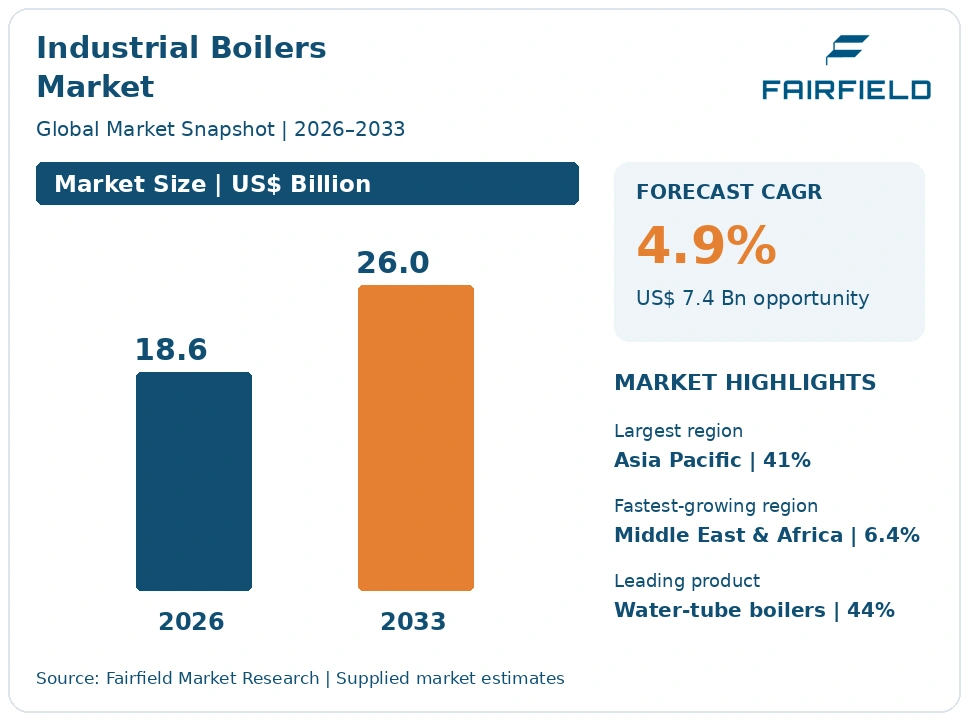
The global industrial boilers market size is expected to be valued at US$ 18.6 billion in 2026 and projected to reach US$ 26.0 billion by 2033, growing at a CAGR of 4.9% between 2026 and 2033.
Growth averaged about 3.4% a year between 2020 and 2025, held back by weak capital spending and a pandemic-era pause in factory construction. Three forces now lift the trend. Tightening emission limits force owners to replace or retrofit ageing combustion plant, industrial heat decarbonisation creates demand for electric, hydrogen-ready and biomass units, and steady manufacturing investment in Asia Pacific and the Gulf adds new steam capacity. Service and aftermarket revenue grows more reliably than new equipment sales. Overall direction is modest, compounding expansion, since boilers last decades and most markets still buy gas-fired units when total cost decides.
Key Report Takeaways
- By Product Type: Water-tube Boilers held 44% share in 2026, while Waste Heat Recovery Boilers & HRSGs are projected to expand at a 7.2% CAGR through 2033, driven by efficiency retrofits that capture process heat already leaving the stack.
- By Fuel Type: Natural Gas held 47% share in 2026, while Electricity & Hydrogen Blends are projected to expand at a 11.3% CAGR through 2033, as industrial sites test low-carbon steam without rebuilding their distribution networks.
- By Capacity: 10–50 MMBtu/hr units held 34% share in 2026, while Up to 10 MMBtu/hr units are projected to expand at a 6.3% CAGR through 2033, reflecting demand for packaged, skid-mounted plant with short installation times.
- By End-Use Industry: Chemicals & Petrochemicals held 24% share in 2026, while Food & Beverage is projected to expand at a 6.5% CAGR through 2033, because its low-temperature steam duties suit electrification and heat pump integration.
- By Geography: Asia Pacific held 41% share in 2026, while Middle East & Africa is projected to expand at a 6.4% CAGR through 2033, supported by refinery, fertiliser and desalination-linked industrial build-out.
Global Industrial Boilers Market Trends and Insights
Drivers Impact Analysis
The two drivers below exert the strongest pull on boiler replacement and retrofit spending through 2033.
| Driver | Impact on CAGR Forecast | Geographic Relevance | Impact Timeline |
| Tightening combustion emission limits and permit renewals | High | Europe, North America | Short term ≤2 years |
| Industrial heat decarbonisation and efficiency retrofit | Medium | Global | Long term ≥4 years |
Tighter Combustion Emission Limits Force Industrial Boiler Replacement and Retrofit
Air quality regulation is the most immediate reason operators buy new boiler plant. The Industrial Emissions Directive 2010/75/EU, revised by Directive (EU) 2024/1785, ties permits to Best Available Techniques conclusions with binding emission ranges for large combustion plant. In the United States, the US Environmental Protection Agency applies hazardous air pollutant standards and New Source Performance Standards to industrial, commercial and institutional boilers.
The mechanism is permit-driven rather than voluntary. When a permit comes up for renewal, an operator must meet current limits for nitrogen oxides, sulphur dioxide, carbon monoxide and particulates, and older units often cannot without major work. Owners then choose between low-nitrogen-oxide burner upgrades, flue gas treatment or outright replacement. The Medium Combustion Plant Directive (EU) 2015/2193 extends similar duties to plant between one and fifty megawatts, pulling thousands of mid-sized sites into the same replacement cycle.
Industrial Heat Decarbonisation Creates Demand for Electric and Hydrogen-Ready Steam Plant
Decarbonisation targets are changing what buyers specify, not just how much they spend. Manufacturers with science-based emission commitments now ask for electric boilers, hydrogen-ready burners, biomass conversion or heat pump integration when they renew steam capacity. These options cost more to install, so they raise average selling prices even where unit volumes stay flat, which lifts market value faster than shipment counts.
Carbon pricing supplies the financial logic. The EU Emissions Trading System charges industrial combustion for each tonne emitted, so the running-cost gap between gas and low-carbon steam narrows as allowance prices rise. Low and medium temperature duties below roughly 150 degrees Celsius are the first to switch, since heat pumps and electric resistance plant handle them efficiently. Hybrid installations that keep a gas boiler for peaks are the common transitional design.
Restraints Impact Analysis
Both restraints below slow the pace of change without reversing the long-term direction of the market.
| Restraint | Impact on CAGR Forecast | Geographic Relevance | Impact Timeline |
| Gas remains cheapest to buy and operate in most markets | High | Global | Long term ≥4 years |
| Slow replacement cycles and grid connection constraints | Medium | Europe, North America | Medium term 2–4 years |
Cheap Natural Gas Keeps Low-Carbon Industrial Boiler Alternatives on the Shelf
Gas-fired boilers remain the default purchase because they still win on total cost of ownership. A packaged gas unit costs less to buy, needs no electrical service upgrade, and delivers high-pressure steam that most process plants already rely on. Where gas is inexpensive, the payback case for electrification collapses, so sites renew like for like and defer low-carbon options until a permit or policy deadline forces the issue.
The cost comparison explains why. Industrial electricity usually trades at several times the price of natural gas per unit of delivered energy, and a boiler’s fuel bill dwarfs its purchase price across a twenty-year life. Biomass conversion adds fuel handling, storage, ash disposal and higher maintenance. Hydrogen supply at industrial volumes is scarce and expensive. Without carbon pricing or a direct subsidy, the economics favour the incumbent.
Decades-Long Asset Life and Grid Connection Delays Stretch Boiler Replacement Cycles
Boilers are bought once in a generation, which caps how quickly the installed base can change. A well-maintained water-tube unit runs for thirty to forty years, and operators extend life with tube renewal, refractory work and control upgrades rather than buying new. That behaviour pushes spending into the boiler aftermarket and service pool and keeps new-unit volumes stable, muting the effect of otherwise strong policy signals.
Infrastructure adds a second brake. An electric boiler of meaningful size needs a large new grid connection, and connection queues in several industrial regions now run for years. Site electrical rooms, transformers and cabling often need replacement too, and that work means process downtime. Steam distribution designed for high-pressure gas firing may also need rework, so the true project cost far exceeds the equipment quotation.
Market Opportunities
Boiler Service, Digital Monitoring and Aftermarket Contracts Open Recurring Revenue
The installed base is worth more than the new-equipment pipeline, and suppliers are learning to monetise it. Millions of operating boilers need burner tuning, water treatment, tube inspection, controls upgrades and statutory inspection under codes such as the ASME Boiler and Pressure Vessel Code Section I. Multi-year service contracts convert lumpy capital sales into predictable revenue with noticeably better margins than equipment supply.
Owners with limited in-house engineering create most of this demand, particularly food, pharmaceutical and institutional sites running a handful of units without a dedicated steam team. Connected sensors and remote diagnostics strengthen the offer, because efficiency drift, scaling and burner faults can be detected before they raise fuel bills. Suppliers that already hold the original equipment position are best placed, since they own the drawings, spare parts and compliance history customers depend on.
Waste Heat Recovery and Hybrid Steam Systems Create a Retrofit Project Pool
Recovering heat that already leaves the stack is the cheapest decarbonisation available, and it is widely untapped. Waste heat recovery boilers and heat recovery steam generators capture energy from furnaces, kilns, engines and turbines, cutting fuel use without changing the production process. Payback periods are often short, so projects clear investment committees that reject replacement of a functioning boiler.
Heavy industry supplies the demand, especially cement, steel, glass, refining and chemicals, where high-temperature exhaust streams are continuous and predictable. Engineering contractors and boiler suppliers with thermal design capability capture the work, frequently alongside economisers, condensate recovery and improved controls. Hybrid schemes that pair a heat pump or electric boiler with existing gas plant extend the same logic, letting sites cut emissions in stages while keeping firm steam capacity for peak loads.
Segment Analysis
By Product Type: Water-tube Units Lead While Heat Recovery Designs Gain Ground
Water-tube Boilers led product type with 44% share in 2026, because high-pressure, high-capacity steam generation in refining, chemicals, pulp and paper and power applications requires their design. They tolerate pressures and duties that fire-tube construction cannot reach, and they dominate large installations. Waste Heat Recovery Boilers & HRSGs form the fastest-growing product type at a 7.2% CAGR to 2033, as operators chase fuel savings available from exhaust streams they already produce. Fire-tube Boilers retain a strong position in food, textiles, pharmaceuticals and institutional heating, where packaged units install quickly and duties are moderate. Electric boilers remain a small share but grow quickly from a low base. The implication is that efficiency equipment, not conventional combustion capacity, is where incremental demand is concentrating.
By Fuel Type: Natural Gas Dominates as Electricity and Hydrogen Blends Scale Quickest
Natural Gas accounted for 47% of 2026 value, reflecting its low delivered cost, clean combustion relative to coal and oil, and compatibility with existing burner and control technology across most industrial regions. Electricity & Hydrogen Blends make up the fastest-growing fuel category at a 11.3% CAGR, driven by corporate emission targets, carbon pricing and hydrogen-ready burner specifications written into new tenders. Biomass & Waste-derived Fuels hold a solid position in pulp and paper, sugar processing and district heating, where fuel arrives as a process residue. Coal continues to decline under emission limits and financing restrictions, while oil-fired capacity persists mainly where gas networks are absent. Fuel choice increasingly follows regulation and local energy prices rather than equipment preference.
By Capacity: Mid-Range Units Lead While Small Packaged Boilers Expand Fastest
10–50 MMBtu/hr boilers led by capacity with 34% share in 2026, as this band matches the steam demand of typical food, chemical, textile and pharmaceutical plants. Units of this size are large enough to justify good controls and economisers, yet small enough to install without extensive civil works. Up to 10 MMBtu/hr units grow fastest at a 6.3% CAGR, helped by skid-mounted packaged designs, modular electric plant and institutional buildings replacing older heating equipment. Boilers above 100 MMBtu/hr remain tied to refining, large chemical complexes and district heating schemes, where project timing is lumpy. The trend toward smaller, distributed units reflects buyers favouring shorter installation, phased investment and the ability to match capacity closely to fluctuating production schedules.
By End-Use Industry: Chemicals Lead While Food and Beverage Plants Convert Fastest
Chemicals & Petrochemicals was the largest end-use industry at 24% share in 2026, since continuous processes need reliable high-pressure steam for reaction heating, stripping and distillation, often around the clock. Food & Beverage is the fastest-growing end-use industry at a 6.5% CAGR, because pasteurising, cleaning, drying and cooking duties sit at lower temperatures that electric boilers and heat pumps can serve economically. Pulp & Paper uses large recovery and biomass units, while refining relies on heat recovery steam generators. Pharmaceuticals demand clean steam with validated documentation and redundant capacity, which raises equipment value per installed megawatt. Textile processors need steady steam for dyeing and finishing. District heating and institutional buildings are converting steadily toward biomass and electric plant. Sector temperature profile, more than sector size, now determines how quickly a site can decarbonise its steam supply.
Geography Analysis
North America Replaces an Ageing Boiler Fleet Under Federal Air Standards
North America holds about 21% of 2026 revenue and grows near 3.6% annually, with the United States supplying most demand and Canada adding pulp, paper and heavy process load. The regional story is replacement rather than expansion, because much of the installed fleet dates from the 1970s and 1980s. Hazardous air pollutant standards for industrial, commercial and institutional boilers, together with New Source Performance Standards, push owners toward cleaner burners or new units at permit renewal. Inexpensive shale gas remains the main barrier to electrification, keeping payback periods long for low-carbon alternatives. The clearest opportunity sits in boiler aftermarket services and combined heat and power retrofits, where owners improve efficiency without replacing a serviceable asset.
Europe Sets the Regulatory Pace for Low-Emission Steam Generation
Europe represents roughly 22% of 2026 value and grows at about 4.3% a year, led by Germany, France, Italy, the Netherlands and the Nordic countries. Regulation is unusually demanding: the Industrial Emissions Directive 2010/75/EU, as revised by Directive (EU) 2024/1785, sets Best Available Techniques conclusions for large combustion plant, while the Medium Combustion Plant Directive (EU) 2015/2193 imposes limits and registration duties on plant between one and fifty megawatts. Design follows EN 12952 and EN 12953. Carbon costs under the EU Emissions Trading System strengthen the case for biomass conversion and electric steam. High industrial electricity prices are the main brake, so hybrid systems that keep gas capacity for peaks are the pragmatic choice for most sites.
Which Region Is Leading the Industrial Boilers Market?
Asia Pacific leads the industrial boilers market with 41% share in 2026, because it hosts the largest concentration of new manufacturing capacity anywhere. China dominates on installed volume across chemicals, textiles, food processing and paper, and also manufactures much of the world’s boiler equipment. India is the strongest growth engine within the region, supported by sustained industrial investment and a well-developed domestic supply base. Japan and South Korea contribute high-efficiency and heat recovery equipment. Coal-to-gas and coal-to-biomass conversion programmes in Chinese and Indian industrial clusters are reshaping fuel mix faster than in any other region. The main constraint is price competition, which compresses margins for international suppliers selling standard packaged units into local tenders.
Latin America Links Boiler Demand to Agro-Processing and Biomass Fuel
Latin America accounts for roughly 8% of 2026 revenue and should grow near 4.8% annually, with Brazil and Mexico as the principal markets. Sugar and ethanol mills, pulp and paper plants and food processors anchor demand, and many of them burn bagasse or wood residues, making biomass-fired units unusually common. Argentina, Chile and Colombia add smaller chemical, mining and beverage loads. Barriers are financial more than technical: high borrowing costs, currency volatility and uneven permit enforcement delay capital projects, so operators extend asset life through repair. The notable change is cogeneration, where mills size boilers to export surplus power to the grid, turning a steam asset into a second revenue stream.
Which Region Is Growing Fastest in the Industrial Boilers Market?
Middle East & Africa is the fastest-growing geography at a 6.4% CAGR between 2026 and 2033, from roughly 8% share in 2026. Saudi Arabia, the United Arab Emirates, Qatar and Egypt drive most of the increase through refinery, petrochemical, fertiliser and aluminium projects that need large steam and heat recovery capacity. Industrial diversification programmes continue to add food processing, pharmaceutical and building materials plants, each requiring mid-sized packaged units. South Africa, Nigeria and Morocco supply additional demand. Barriers remain significant: dependence on imported equipment, a thin local service base, and water scarcity that complicates boiler feedwater treatment. The emerging opportunity is solar thermal preheating paired with conventional plant, which cuts fuel use in high-irradiance locations.
Competitive Landscape
The industrial boilers market is moderately concentrated and splits clearly by equipment class. Large water-tube boilers, recovery boilers and heat recovery steam generators come from a small group of engineering companies able to carry project risk, provide code-stamped fabrication and support multi-year construction schedules. Packaged fire-tube and small electric boilers are far more fragmented, with strong regional manufacturers in China, India, Europe and North America competing on price, delivery time and local service coverage. Consolidation has been gradual, usually involving burner, controls or service businesses rather than whole boiler makers.
Competition rests on thermal efficiency, emission performance against prevailing limits, code compliance under the ASME Boiler and Pressure Vessel Code and EN 12952 or EN 12953, delivery lead time, and the density of the service network. Fuel flexibility has become a decisive specification, as buyers want units that can switch between gas, biomass and hydrogen blends later in life. New entrants are arriving from adjacent fields, including electric heating specialists, industrial heat pump manufacturers and controls and digital monitoring providers who attach to boilers others built.
Strategic activity concentrates on three fronts. Suppliers are extending hydrogen-ready and electric product lines to protect their position as fuel policy shifts, expanding service and spare parts coverage to capture recurring revenue from installed fleets, and adding local fabrication or assembly in growth markets to shorten lead times and reduce freight exposure. Partnerships between boiler makers and burner or controls specialists are common, since emission compliance depends on the combustion system as much as the pressure vessel.
Strategic direction across the sector favours flexibility over specialisation. Vendors are positioning as suppliers of complete industrial steam solutions rather than pressure vessels alone, combining equipment, controls, monitoring and decarbonisation advice.
Industrial Boilers Industry Leaders
- Bosch Industriekessel GmbH
- Mitsubishi Heavy Industries, Ltd.
- Babcock & Wilcox Enterprises, Inc.
- Thermax Limited
- Cleaver-Brooks, Inc.
Recent Industry Developments
January 2013: the US Environmental Protection Agency published final National Emission Standards for Hazardous Air Pollutants for industrial, commercial and institutional boilers at major sources – the rule, widely called Boiler MACT, still sets the replacement trigger for older American units.
November 2015: the European Union adopted the Medium Combustion Plant Directive (EU) 2015/2193 – it brought plant between one and fifty megawatts into a registration and emission limit regime for the first time.
January 2021: Phase 4 of the EU Emissions Trading System began – rising allowance costs for industrial combustion narrowed the operating cost gap between gas-fired steam and low-carbon alternatives.
April 2024: the European Union adopted Directive (EU) 2024/1785, revising the Industrial Emissions Directive 2010/75/EU – tighter permitting around Best Available Techniques ranges increases retrofit and replacement pressure on large combustion plant.
January 2025: Medium Combustion Plant Directive emission limits began applying to existing plant above 5 megawatts – thousands of mid-sized industrial and institutional sites reached their compliance deadline together.
Industrial Boilers Market Report Scope
| Metric | Value |
| Study Period | 2020–2033 |
| Market Size 2026 | US$ 18.6 Billion |
| Market Size 2033 | US$ 26.0 Billion |
| CAGR 2026–2033 | 4.9% |
| Absolute Dollar Opportunity | US$ 7.4 Billion |
| Largest Market | Asia Pacific (41% share in 2026) |
| Fastest-Growing Market | Middle East & Africa (6.4% CAGR) |
| Market Concentration | Medium |
| Major Players | Bosch Industriekessel GmbH, Mitsubishi Heavy Industries, Ltd., Babcock & Wilcox Enterprises, Inc., Thermax Limited, Cleaver-Brooks, Inc. |
This report covers steam and hot water generation equipment for industrial and institutional use. Included are fire-tube, water-tube and electric boilers, waste heat recovery boilers and heat recovery steam generators, biomass and waste-fired units, plus burners, controls, economisers and boiler service revenue. Power station utility boilers and domestic heating appliances are excluded. The base year is 2025 and the forecast period runs from 2026 to 2033, measured in US$ Billion.
Industrial Boilers Market Segmentation
Product Type
- Fire-tube Boilers
- Water-tube Boilers
- Electric Boilers
- Waste Heat Recovery Boilers & HRSGs
Fuel Type
- Natural Gas
- Coal
- Oil
- Biomass & Waste-derived Fuels
- Electricity & Hydrogen Blends
Capacity
- Up to 10 MMBtu/hr
- 10–50 MMBtu/hr
- 50–100 MMBtu/hr
- Above 100 MMBtu/hr
End-Use Industry
- Chemicals & Petrochemicals
- Food & Beverage
- Pulp & Paper
- Refining
- Textiles
- Pharmaceuticals
- District Heating & Institutional Buildings
Regions
- North America
- Europe
- Asia Pacific
- Latin America
- Middle East & Africa
- Executive Summary
- Global Industrial Boilers Market Snapshot
- Future Projections
- Key Report Takeaways
- Regional Snapshot
- Market Overview
- Market Definition and Report Scope
- Historical Trends 2020–2025
- Market Dynamics
- Drivers
- Tighter Combustion Emission Limits Force Industrial Boiler Replacement and Retrofit
- Industrial Heat Decarbonisation Creates Demand for Electric and Hydrogen-Ready Steam Plant
- Restraints
- Cheap Natural Gas Keeps Low-Carbon Industrial Boiler Alternatives on the Shelf
- Decades-Long Asset Life and Grid Connection Delays Stretch Boiler Replacement Cycles
- Market Opportunities
- Boiler Service, Digital Monitoring and Aftermarket Contracts Open Recurring Revenue
- Waste Heat Recovery and Hybrid Steam Systems Create a Retrofit Project Pool
- Drivers
- Global Industrial Boilers Market Outlook, 2020–2033
- Global Industrial Boilers Market Outlook, by Product Type, Value (US$ Billion), 2020–2033
- Fire-tube Boilers
- Water-tube Boilers
- Electric Boilers
- Waste Heat Recovery Boilers & HRSGs
- Global Industrial Boilers Market Outlook, by Fuel Type, Value (US$ Billion), 2020–2033
- Natural Gas
- Coal
- Oil
- Biomass & Waste-derived Fuels
- Electricity & Hydrogen Blends
- Global Industrial Boilers Market Outlook, by Capacity, Value (US$ Billion), 2020–2033
- Up to 10 MMBtu/hr
- 10–50 MMBtu/hr
- 50–100 MMBtu/hr
- Above 100 MMBtu/hr
- Global Industrial Boilers Market Outlook, by End-Use Industry, Value (US$ Billion), 2020–2033
- Chemicals & Petrochemicals
- Food & Beverage
- Pulp & Paper
- Refining
- Textiles
- Pharmaceuticals
- District Heating & Institutional Buildings
- Global Industrial Boilers Market Outlook, by Region, Value (US$ Billion), 2020–2033
- North America
- Europe
- Asia Pacific
- Latin America
- Middle East & Africa
- Global Industrial Boilers Market Outlook, by Product Type, Value (US$ Billion), 2020–2033
- North America Industrial Boilers Market Outlook, 2020–2033
- North America Industrial Boilers Market Outlook, by Product Type, Value (US$ Billion), 2020–2033
- Fire-tube Boilers
- Water-tube Boilers
- Electric Boilers
- Waste Heat Recovery Boilers & HRSGs
- North America Industrial Boilers Market Outlook, by Fuel Type, Value (US$ Billion), 2020–2033
- Natural Gas
- Coal
- Oil
- Biomass & Waste-derived Fuels
- Electricity & Hydrogen Blends
- North America Industrial Boilers Market Outlook, by Capacity, Value (US$ Billion), 2020–2033
- Up to 10 MMBtu/hr
- 10–50 MMBtu/hr
- 50–100 MMBtu/hr
- Above 100 MMBtu/hr
- North America Industrial Boilers Market Outlook, by End-Use Industry, Value (US$ Billion), 2020–2033
- Chemicals & Petrochemicals
- Food & Beverage
- Pulp & Paper
- Refining
- Textiles
- Pharmaceuticals
- District Heating & Institutional Buildings
- North America Industrial Boilers Market Outlook, by Country, Value (US$ Billion), 2020–2033
- United States Industrial Boilers Market Outlook, by Product Type, 2020–2033
- United States Industrial Boilers Market Outlook, by Fuel Type, 2020–2033
- United States Industrial Boilers Market Outlook, by Capacity, 2020–2033
- United States Industrial Boilers Market Outlook, by End-Use Industry, 2020–2033
- Canada Industrial Boilers Market Outlook, by Product Type, 2020–2033
- Canada Industrial Boilers Market Outlook, by Fuel Type, 2020–2033
- Canada Industrial Boilers Market Outlook, by Capacity, 2020–2033
- Canada Industrial Boilers Market Outlook, by End-Use Industry, 2020–2033
- North America Industrial Boilers Market Outlook, by Product Type, Value (US$ Billion), 2020–2033
- Europe Industrial Boilers Market Outlook, 2020–2033
- Europe Industrial Boilers Market Outlook, by Product Type, Value (US$ Billion), 2020–2033
- Fire-tube Boilers
- Water-tube Boilers
- Electric Boilers
- Waste Heat Recovery Boilers & HRSGs
- Europe Industrial Boilers Market Outlook, by Fuel Type, Value (US$ Billion), 2020–2033
- Natural Gas
- Coal
- Oil
- Biomass & Waste-derived Fuels
- Electricity & Hydrogen Blends
- Europe Industrial Boilers Market Outlook, by Capacity, Value (US$ Billion), 2020–2033
- Up to 10 MMBtu/hr
- 10–50 MMBtu/hr
- 50–100 MMBtu/hr
- Above 100 MMBtu/hr
- Europe Industrial Boilers Market Outlook, by End-Use Industry, Value (US$ Billion), 2020–2033
- Chemicals & Petrochemicals
- Food & Beverage
- Pulp & Paper
- Refining
- Textiles
- Pharmaceuticals
- District Heating & Institutional Buildings
- Europe Industrial Boilers Market Outlook, by Country, Value (US$ Billion), 2020–2033
- Germany Industrial Boilers Market Outlook, by Product Type, 2020–2033
- Germany Industrial Boilers Market Outlook, by Fuel Type, 2020–2033
- Germany Industrial Boilers Market Outlook, by Capacity, 2020–2033
- Germany Industrial Boilers Market Outlook, by End-Use Industry, 2020–2033
- France Industrial Boilers Market Outlook, by Product Type, 2020–2033
- France Industrial Boilers Market Outlook, by Fuel Type, 2020–2033
- France Industrial Boilers Market Outlook, by Capacity, 2020–2033
- France Industrial Boilers Market Outlook, by End-Use Industry, 2020–2033
- Italy Industrial Boilers Market Outlook, by Product Type, 2020–2033
- Italy Industrial Boilers Market Outlook, by Fuel Type, 2020–2033
- Italy Industrial Boilers Market Outlook, by Capacity, 2020–2033
- Italy Industrial Boilers Market Outlook, by End-Use Industry, 2020–2033
- Netherlands Industrial Boilers Market Outlook, by Product Type, 2020–2033
- Netherlands Industrial Boilers Market Outlook, by Fuel Type, 2020–2033
- Netherlands Industrial Boilers Market Outlook, by Capacity, 2020–2033
- Netherlands Industrial Boilers Market Outlook, by End-Use Industry, 2020–2033
- Nordic countries Industrial Boilers Market Outlook, by Product Type, 2020–2033
- Nordic countries Industrial Boilers Market Outlook, by Fuel Type, 2020–2033
- Nordic countries Industrial Boilers Market Outlook, by Capacity, 2020–2033
- Nordic countries Industrial Boilers Market Outlook, by End-Use Industry, 2020–2033
- Europe Industrial Boilers Market Outlook, by Product Type, Value (US$ Billion), 2020–2033
- Asia Pacific Industrial Boilers Market Outlook, 2020–2033
- Asia Pacific Industrial Boilers Market Outlook, by Product Type, Value (US$ Billion), 2020–2033
- Fire-tube Boilers
- Water-tube Boilers
- Electric Boilers
- Waste Heat Recovery Boilers & HRSGs
- Asia Pacific Industrial Boilers Market Outlook, by Fuel Type, Value (US$ Billion), 2020–2033
- Natural Gas
- Coal
- Oil
- Biomass & Waste-derived Fuels
- Electricity & Hydrogen Blends
- Asia Pacific Industrial Boilers Market Outlook, by Capacity, Value (US$ Billion), 2020–2033
- Up to 10 MMBtu/hr
- 10–50 MMBtu/hr
- 50–100 MMBtu/hr
- Above 100 MMBtu/hr
- Asia Pacific Industrial Boilers Market Outlook, by End-Use Industry, Value (US$ Billion), 2020–2033
- Chemicals & Petrochemicals
- Food & Beverage
- Pulp & Paper
- Refining
- Textiles
- Pharmaceuticals
- District Heating & Institutional Buildings
- Asia Pacific Industrial Boilers Market Outlook, by Country, Value (US$ Billion), 2020–2033
- China Industrial Boilers Market Outlook, by Product Type, 2020–2033
- China Industrial Boilers Market Outlook, by Fuel Type, 2020–2033
- China Industrial Boilers Market Outlook, by Capacity, 2020–2033
- China Industrial Boilers Market Outlook, by End-Use Industry, 2020–2033
- India Industrial Boilers Market Outlook, by Product Type, 2020–2033
- India Industrial Boilers Market Outlook, by Fuel Type, 2020–2033
- India Industrial Boilers Market Outlook, by Capacity, 2020–2033
- India Industrial Boilers Market Outlook, by End-Use Industry, 2020–2033
- Japan Industrial Boilers Market Outlook, by Product Type, 2020–2033
- Japan Industrial Boilers Market Outlook, by Fuel Type, 2020–2033
- Japan Industrial Boilers Market Outlook, by Capacity, 2020–2033
- Japan Industrial Boilers Market Outlook, by End-Use Industry, 2020–2033
- South Korea Industrial Boilers Market Outlook, by Product Type, 2020–2033
- South Korea Industrial Boilers Market Outlook, by Fuel Type, 2020–2033
- South Korea Industrial Boilers Market Outlook, by Capacity, 2020–2033
- South Korea Industrial Boilers Market Outlook, by End-Use Industry, 2020–2033
- Asia Pacific Industrial Boilers Market Outlook, by Product Type, Value (US$ Billion), 2020–2033
- Latin America Industrial Boilers Market Outlook, 2020–2033
- Latin America Industrial Boilers Market Outlook, by Product Type, Value (US$ Billion), 2020–2033
- Fire-tube Boilers
- Water-tube Boilers
- Electric Boilers
- Waste Heat Recovery Boilers & HRSGs
- Latin America Industrial Boilers Market Outlook, by Fuel Type, Value (US$ Billion), 2020–2033
- Natural Gas
- Coal
- Oil
- Biomass & Waste-derived Fuels
- Electricity & Hydrogen Blends
- Latin America Industrial Boilers Market Outlook, by Capacity, Value (US$ Billion), 2020–2033
- Up to 10 MMBtu/hr
- 10–50 MMBtu/hr
- 50–100 MMBtu/hr
- Above 100 MMBtu/hr
- Latin America Industrial Boilers Market Outlook, by End-Use Industry, Value (US$ Billion), 2020–2033
- Chemicals & Petrochemicals
- Food & Beverage
- Pulp & Paper
- Refining
- Textiles
- Pharmaceuticals
- District Heating & Institutional Buildings
- Latin America Industrial Boilers Market Outlook, by Country, Value (US$ Billion), 2020–2033
- Brazil Industrial Boilers Market Outlook, by Product Type, 2020–2033
- Brazil Industrial Boilers Market Outlook, by Fuel Type, 2020–2033
- Brazil Industrial Boilers Market Outlook, by Capacity, 2020–2033
- Brazil Industrial Boilers Market Outlook, by End-Use Industry, 2020–2033
- Mexico Industrial Boilers Market Outlook, by Product Type, 2020–2033
- Mexico Industrial Boilers Market Outlook, by Fuel Type, 2020–2033
- Mexico Industrial Boilers Market Outlook, by Capacity, 2020–2033
- Mexico Industrial Boilers Market Outlook, by End-Use Industry, 2020–2033
- Argentina Industrial Boilers Market Outlook, by Product Type, 2020–2033
- Argentina Industrial Boilers Market Outlook, by Fuel Type, 2020–2033
- Argentina Industrial Boilers Market Outlook, by Capacity, 2020–2033
- Argentina Industrial Boilers Market Outlook, by End-Use Industry, 2020–2033
- Chile Industrial Boilers Market Outlook, by Product Type, 2020–2033
- Chile Industrial Boilers Market Outlook, by Fuel Type, 2020–2033
- Chile Industrial Boilers Market Outlook, by Capacity, 2020–2033
- Chile Industrial Boilers Market Outlook, by End-Use Industry, 2020–2033
- Colombia Industrial Boilers Market Outlook, by Product Type, 2020–2033
- Colombia Industrial Boilers Market Outlook, by Fuel Type, 2020–2033
- Colombia Industrial Boilers Market Outlook, by Capacity, 2020–2033
- Colombia Industrial Boilers Market Outlook, by End-Use Industry, 2020–2033
- Latin America Industrial Boilers Market Outlook, by Product Type, Value (US$ Billion), 2020–2033
- Middle East & Africa Industrial Boilers Market Outlook, 2020–2033
- Middle East & Africa Industrial Boilers Market Outlook, by Product Type, Value (US$ Billion), 2020–2033
- Fire-tube Boilers
- Water-tube Boilers
- Electric Boilers
- Waste Heat Recovery Boilers & HRSGs
- Middle East & Africa Industrial Boilers Market Outlook, by Fuel Type, Value (US$ Billion), 2020–2033
- Natural Gas
- Coal
- Oil
- Biomass & Waste-derived Fuels
- Electricity & Hydrogen Blends
- Middle East & Africa Industrial Boilers Market Outlook, by Capacity, Value (US$ Billion), 2020–2033
- Up to 10 MMBtu/hr
- 10–50 MMBtu/hr
- 50–100 MMBtu/hr
- Above 100 MMBtu/hr
- Middle East & Africa Industrial Boilers Market Outlook, by End-Use Industry, Value (US$ Billion), 2020–2033
- Chemicals & Petrochemicals
- Food & Beverage
- Pulp & Paper
- Refining
- Textiles
- Pharmaceuticals
- District Heating & Institutional Buildings
- Middle East & Africa Industrial Boilers Market Outlook, by Country, Value (US$ Billion), 2020–2033
- Saudi Arabia Industrial Boilers Market Outlook, by Product Type, 2020–2033
- Saudi Arabia Industrial Boilers Market Outlook, by Fuel Type, 2020–2033
- Saudi Arabia Industrial Boilers Market Outlook, by Capacity, 2020–2033
- Saudi Arabia Industrial Boilers Market Outlook, by End-Use Industry, 2020–2033
- United Arab Emirates Industrial Boilers Market Outlook, by Product Type, 2020–2033
- United Arab Emirates Industrial Boilers Market Outlook, by Fuel Type, 2020–2033
- United Arab Emirates Industrial Boilers Market Outlook, by Capacity, 2020–2033
- United Arab Emirates Industrial Boilers Market Outlook, by End-Use Industry, 2020–2033
- Qatar Industrial Boilers Market Outlook, by Product Type, 2020–2033
- Qatar Industrial Boilers Market Outlook, by Fuel Type, 2020–2033
- Qatar Industrial Boilers Market Outlook, by Capacity, 2020–2033
- Qatar Industrial Boilers Market Outlook, by End-Use Industry, 2020–2033
- Egypt Industrial Boilers Market Outlook, by Product Type, 2020–2033
- Egypt Industrial Boilers Market Outlook, by Fuel Type, 2020–2033
- Egypt Industrial Boilers Market Outlook, by Capacity, 2020–2033
- Egypt Industrial Boilers Market Outlook, by End-Use Industry, 2020–2033
- South Africa Industrial Boilers Market Outlook, by Product Type, 2020–2033
- South Africa Industrial Boilers Market Outlook, by Fuel Type, 2020–2033
- South Africa Industrial Boilers Market Outlook, by Capacity, 2020–2033
- South Africa Industrial Boilers Market Outlook, by End-Use Industry, 2020–2033
- Nigeria Industrial Boilers Market Outlook, by Product Type, 2020–2033
- Nigeria Industrial Boilers Market Outlook, by Fuel Type, 2020–2033
- Nigeria Industrial Boilers Market Outlook, by Capacity, 2020–2033
- Nigeria Industrial Boilers Market Outlook, by End-Use Industry, 2020–2033
- Morocco Industrial Boilers Market Outlook, by Product Type, 2020–2033
- Morocco Industrial Boilers Market Outlook, by Fuel Type, 2020–2033
- Morocco Industrial Boilers Market Outlook, by Capacity, 2020–2033
- Morocco Industrial Boilers Market Outlook, by End-Use Industry, 2020–2033
- Middle East & Africa Industrial Boilers Market Outlook, by Product Type, Value (US$ Billion), 2020–2033
- Competitive Landscape
- Market Concentration and Industry Leaders
- Competitive Differentiation
- Strategic Moves and Market Direction
- Recent Industry Developments
- Company Profiles
- Bosch Industriekessel GmbH
- Mitsubishi Heavy Industries, Ltd.
- Babcock & Wilcox Enterprises, Inc.
- Thermax Limited
- Cleaver-Brooks, Inc.
- Siemens Energy AG
- Doosan Enerbility Co., Ltd.
- IHI Corporation
- Valmet Oyj
- ANDRITZ AG
- Forbes Marshall Pvt. Ltd.
- Miura Co., Ltd.
- Appendix
- Research Methodology
- Report Assumptions
- Acronyms and Abbreviations
Product Type
- Fire-tube Boilers
- Water-tube Boilers
- Electric Boilers
- Waste Heat Recovery Boilers & HRSGs
Fuel Type
- Natural Gas
- Coal
- Oil
- Biomass & Waste-derived Fuels
- Electricity & Hydrogen Blends
Capacity
- Up to 10 MMBtu/hr
- 10–50 MMBtu/hr
- 50–100 MMBtu/hr
- Above 100 MMBtu/hr
End-Use Industry
- Chemicals & Petrochemicals
- Food & Beverage
- Pulp & Paper
- Refining
- Textiles
- Pharmaceuticals
- District Heating & Institutional Buildings
Regions
- North America
- Europe
- Asia Pacific
- Latin America
- Middle East & Africa
Our Research Methodology
Considering the volatility of business today, traditional approaches to strategizing a game plan can be unfruitful if not detrimental. True ambiguity is no way to determine a forecast. A myriad of predetermined factors must be accounted for such as the degree of risk involved, the magnitude of circumstances, as well as conditions or consequences that are not known or unpredictable. To circumvent binary views that cast uncertainty, the application of market research intelligence to strategically posture, move, and enable actionable outcomes is necessary.
View Methodology
Quality Assured
Rigorous Validation Process

Confidentiality Assured
End-to-end Data Security

Custom Research Services
Tailored To Your Objectives
FAQs
The market is valued at US$ 18.6 billion in 2026, covering new boiler equipment, burners, controls, economisers and boiler service revenue worldwide.
Revenue is projected to reach US$ 26.0 billion by 2033 at a 4.9% CAGR, an absolute dollar opportunity of US$ 7.4 billion over the period.
Water-tube Boilers lead with 44% share in 2026, because high-pressure steam duties in refining, chemicals and pulp and paper require that design.
Middle East & Africa grows fastest at a 6.4% CAGR to 2033, driven by refinery, petrochemical, fertiliser and industrial diversification projects.
Concentration is medium, as large water-tube and recovery projects sit with few engineering firms while packaged boiler supply stays regionally fragmented.
Related Reports
Load Forecasting Solution Market Size, Share, Insights, Competitive Landscape, and Forecast 2026 to 2033
The load forecasting solution market is projected to reach US$3.0 billion by 2033. Explore demand by forecast horizon, deployment mode, and end user.
Enhanced Oil Recovery Market Size, Share, Insights, Competitive Landscape, and Forecast 2026 to 2033
The global enhanced oil recovery market is valued at US$46.5 billion in 2026, reaching US$58.9 billion by 2033, growing at a 3.43% CAGR
Biochar Gasification Market Size, Share, Insights, Competitive Landscape, and Forecast 2026 to 2033
The global biochar gasification market is valued at US$0.6 billion in 2026, reaching US$1.4 billion by 2033, growing at a 12.87% CAGR
AC-Coupled Energy Storage Inverter Market Size, Share, Insights, Competitive Landscape, and Forecast 2026 to 2033
The AC-coupled energy storage inverter market is forecast to grow from US$ 4.2 billion in 2026 to US$ 10.5 billion by 2033 at a 13.99% CAGR.
Steam Turbine Aftermarket Size, Share, Insights, Competitive Landscape, and Forecast 2026 to 2033
The Steam Turbine Aftermarket is projected to rise from US$ 4.56 billion in 2026 to US$ 6.29 billion by 2033 at a 4.7% CAGR. Explore key service trends.
Power EPC Market Size, Share, Insights, Competitive Landscape, and Forecast 2026 to 2033
Power EPC Market is projected to rise from US$ 780.56 billion in 2026 to US$ 1,220.97 billion by 2033 at a 6.6% CAGR. Explore generation and project trends.