



Interior Lighting Market
Interior Lighting Market Insights, Competitive Landscape, and Market Forecast - 2033
The Interior Lighting Market is valued at USD 79.4 Bn in 2026 and is projected to reach USD 114.8 Bn, growing at a CAGR of 5% by 2033.
Quick Report Digest
A Look Back and a Look Forward - Comparative Analysis
The desire for linked and automated lighting systems and more energy-efficient lighting solutions was primarily causing the market's revenue rise. Other significant factors boosting demand for interior lighting in commercial and residential buildings were better lighting distribution, increased workplace productivity, increased illumination quality, and a reduced carbon impact.
The market witnessed staggered growth during the historical period 2019 - 2024. An important aspect supporting the further rise of market revenue is the increasing initiatives by governments of various nations that concentrate attentively on minimising energy usage. Increasing public-private collaborations focusing on adopting energy-efficient lighting solutions further accelerates market revenue growth.
During the projected period, the worldwide interior lighting market is anticipated to increase in terms of revenue due to technological developments in lighting systems and the increasing deployment of smart lighting systems in residential and commercial buildings. Future advancements in interior lighting technologies are anticipated to be boosted by the growing demand for automated, linked lighting systems integrated with motion sensors in commercial and residential buildings.
Key Growth Determinants
- Technological Advancements as Smart Lighting and Integration
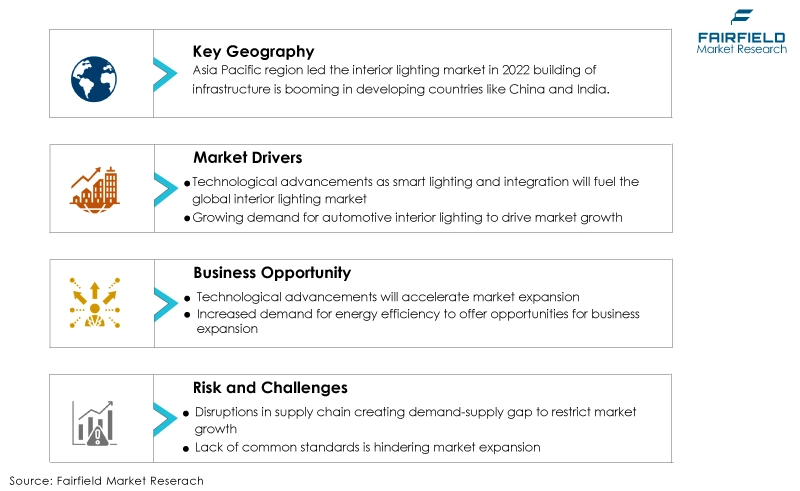
The ability of lights to connect with IoT devices and produce a variety of ambient lighting using only smartphones or tablets has increased their appeal and demand in both commercial and residential environments.
Smart lights can link to other devices by Wi-Fi, Bluetooth, SmartThings, Z-Wave, or ZigBee and can be muted with various color tones depending on the situation. They can also be controlled to turn on and off at specific times and measure their energy consumption. These numerous functions beyond illumination and the rising popularity of IoT devices and smart assistant platforms drive the market’s growth.
- Increase in Construction and Infrastructure Development
The worldwide construction industry is being driven by government spending on major infrastructure projects. Nearly 50% of the anticipated building spending is anticipated to come from nations like China, India, and the United States. The widespread success and potential benefits of the construction outsourcing model in the United States are a significant trend in the industry.
In addition, the advent of technology for the production of building construction materials is speeding up the construction process and giving the materials new strengths. As a result, the demand for interior lighting will increase with increased construction activity.
- Growing Demand for Automotive Interior Lighting
The use of interior lighting systems in the car sector has increased dramatically. Improved visibility inside automobiles, ambient lighting, and programmable lighting effects have emerged as major differentiators. The demand for cutting-edge lighting technology in car interiors is driven by interior lighting, improving the driving experience and adding a touch of luxury and beauty.
Additionally, improving driver pleasure, convenience, and safety is automotive interior illumination. Furthermore, it makes it easier for drivers to recognise the instrument cluster and dashboard when they are out at night. Moreover, it illuminates the passenger area to make it easier for people to read at night.
Major Growth Barriers
- Supply Chain Disruptions Leading to Demand-Supply Gap
As a result of a previous shutdown in China, the COVID-19 outbreak has had a substantial impact on the lighting industry's supply of electronic components. According to the lighting OEMs and integrators, most LED drivers, processors, and other electrical components are beginning to be in short supply.
As a result of this imbalance in supply and demand, lighting products are now more expensive. While there are immediate effects on the supply, the demand will experience severe effects for a longer period when forthcoming lighting projects are halted due to cost-cutting measures taken by businesses.
- Lack of Standardisation
The absence of universal standards is one of the interior lighting industry's biggest problems. There is a lack of clarity in the standards and regulations for LEDs and other light sources.
As a result, producers offer unique items that adhere to regulations specific to each region and nation. The absence of universal norms frequently makes the sector inefficient.
Key Trends and Opportunities to Look at
Strict laws and rising environmental concerns drive the demand for energy-efficient lighting solutions. Technology developments in lighting systems offer advantages like warm lighting, ambiance, and energy efficiency.
Manufacturers can take advantage of the opportunity by creating cutting-edge, environmentally friendly products that adhere to rules and satisfy the needs of customers who care about the environment.
- Technological Advancements
- Potential Opportunities for New Vendors
Lighting technologies like LED and OLED are advancing quickly, allowing manufacturers to offer more effective, long-lasting, personalised lighting options.
The advantages of OLED technology include higher contrast ratios, faster refresh rates, and sharper, more brilliant colors. These developments allow for the development of linked lighting, smart controls, and intelligent lighting systems, which enhance user experience and stimulate market expansion.
Lighting components are typically scarce because China's factories are overloaded, and the supply chain has been messed up. Since the entire value chain has collapsed, predicting when the supply will return to normal is difficult.
Given these elements, lighting manufacturers are considering importing parts from places like Hong Kong, Taiwan, and South Korea, creating enormous prospects for them.
How Does the Regulatory Scenario Shape this Industry?
Energy must be used sustainably and efficiently to reduce energy waste and carbon emissions, which are rising due to increased energy use. The production of electricity is responsible for roughly one-fourth of carbon emissions. Government efforts to reduce their carbon footprint have escalated in response to growing global warming and ozone depletion concerns. To reduce carbon emissions, governments all around the world are implementing strict rules.
The Energy Conservation (Amendment) Act 2022, which updates the 2001 Energy Conservation Act, was passed by both chambers of the Indian Parliament and went into effect on January 1, 2023. The amendment allows the federal government to designate a carbon emission-reduction trading system.
Governments are pushing citizens to save energy through several measures. For instance, the National Programme for LED-based Home and Street Lighting program of the Indian government aims to boost the use of LED lamps in homes and cities. The intention is to swap out existing lamps for these, which often consume more power.
Fairfield’s Ranking Board
Top Segments
The perimeter lighting segment dominated the market in 2025. Increased demand for comfort and safety and advancements in LED lighting technology, integrated LED lighting with energy efficiency and low maintenance requirements all drive the global segment for perimeter lighting systems. The demand for perimeter lighting systems is significantly fueled by
Furthermore, the wall grazing category is projected to experience the fastest market growth. For stone homes, wall grazing is a wise option. Closely spaced ground-level lights throughout the night can accentuate the angular, rough edges and produce a dramatic image. Wall grazing can highlight a brick wall's intricacies inside and outside.
- Residential User Will Surge Ahead
- Ambient Lighting Leads
- The Recessed Lighting Category Spearheads
In 2025, the residential user dominated the industry, which is anticipated to continue for the entire forecast period. The residential sector is expanding due to the growing number of global infrastructure projects.
The commercial user is anticipated to grow substantially throughout the projected period. The sector’s revenue growth is anticipated to be fueled by the rising need for more energy-efficient lighting systems, rapid infrastructure developments, and ongoing and upcoming smart city projects in developing nations.
The ambient lighting segment dominated the market in 2025. The sector for ambient lighting may see growth due to the increased need for creative lighting solutions that are both comfortable and efficient. These solutions are becoming increasingly popular as incandescent bulbs lose efficiency due to excessive heat emission, supporting the expansion of the interior lighting market.
The general lighting category is expected to experience the fastest growth within the forecast time frame. Urbanisation and an increase in households are the main trends propelling the general lighting sector’s expansion. The sector’s expansion is influenced by several variables, such as the falling cost of producing LEDs, the expanding use of energy-efficient lighting solutions, and the rising demand for LEDs from the automobile industry.
In 2025, the recessed lighting category led the market growth. The ability of these lights to fit into surfaces and their rising popularity in both the residential and commercial sectors can be credited with the market expansion. Residential buildings, hotels, retail showrooms, and businesses are driving the development of the need for recessed lighting.
Moreover, the track light category is expected to grow fastest in the interior lighting market during the forecast period. Since track lights are an excellent choice for evenly illuminating both indoor and outdoor environments, they are typically utilised in locations where the position of the light must be changed frequently and at various angles.
Regional Frontrunners
Asia Pacific Holds the Largest Revenue Share
Asia Pacific supplied the largest revenue share to the overall interior lighting market during the forecast period. The market for interior lighting in emerging nations is expanding due to increased residential and commercial buildings with improved energy-efficient solutions.
Another important element driving up demand for interior lighting is the increase in investment in the building sector to create modernised infrastructure and the rise of smart city initiatives in developing nations.
As living standards rise, consumer taste is steadily shifting towards more energy-efficient interior lighting and interior design. Interior lighting market expansion in the region is also being supported by strict GHG emission restrictions and attempts to reduce energy use.
North America Set for Significant Growth in Sales
The North American market is anticipated to register a much higher revenue share during the projected period than other regional markets. During the forecast period, significant players in the area, including Acuity Brands, Inc., Hubbell Incorporated, and General Electric Company, are anticipated to stimulate revenue growth in the interior lighting market.
Demand for interior lighting will continue to rise as more public-private collaborations are anticipated for deploying energy-efficient lighting solutions in the region. The market is growing as smart lighting systems are installed in more homes and businesses, and nations in the region emphasize lowering energy use and carbon emissions.
Fairfield’s Competitive Landscape Analysis
The interior lighting market is concentrated, with few significant companies present worldwide. The major firms are launching new items and enhancing their distribution networks to increase their global footprint. In addition, Fairfield Market Research anticipates that there will be further market consolidation during the next few years.
Who are the Leaders in Global Interior Lighting Space?
- Est Lights
- Russell Lighting
- ERCO GmbH
- Lena Lighting S.A.
- Kichler Lighting, LLC
- Trilux Gmbh
- Jaquar Group
- Wipro Lighting
- WLS Lighting Systems, Inc.
- Karice Lighting
- Signify
- Thorn Lighting Ltd.
- Hubbell Incorporated
- Osram Licht AG
- Acuity Brands, Inc.
An Expert’s Eye
Demand and Future Growth
As per Fairfield’s Analysis, the market is expected to develop due to continued technical advancements, such as smart lighting systems in office or residential buildings. The rising demand for ambient lighting may result in a growth in interior lighting, where recessed lighting is favoured in large quantities, increasing the need for interior lighting.
Furthermore, the growth and development of numerous interior lighting solutions have been considerably helped by technical advancements. However, because of the high initial cost due to supply chain disruption, the interior lighting industry is anticipated to encounter significant hurdles.
Supply Side of the Market
According to our analysis, the manufacturers active in the interior lighting industry are concentrating on improving lighting solutions by introducing new technologies in the LED and OLED sectors that will assist end users in working more effectively and efficiently.
For instance, in March 2022, Acuity Brands, Inc. introduced Verjure, a professional-grade horticulture LED lighting system that provides efficient and consistent performance for indoor horticulture applications. The Verjure Pro Series LED luminaires were developed utilising academic, plant-based research and are intended to promote all stages of plant growth, from veg to flower.
Manufacturers of interior lighting are developing technologically sophisticated models that incorporate IoT and AI to boost productivity, aesthetic appeal, and adaptability. As a result of growing environmental concerns, several businesses are also developing energy-efficient interior lighting solutions to support energy-saving measures. This can entail using eco-friendly materials, implementing energy-saving technologies, and optimising lighting designs.
Global Interior Lighting Market is Segmented as Below:
By Lighting Effect:
- Spotlighting
- Downlighting
- Uplighting
- Perimeter Lighting
- Others
By End Use:
- Residential
- Office Spaces
- Others
By Type:
- General Lighting
- Ambient Lighting
- Accent Lighting
- Others
By Product:
- Ceiling Lights
- Decorative Lamps
- Pendant Lights
- Wall Lights
- Track Lights
- Recessed and Surface-mounted Lights
- Chandeliers
- Others
By Geographic Coverage:
- North America
- Europe
- Asia Pacific
- Latin America
- Middle East & Africa
- Executive Summary
- Global Interior Lighting Market Snapshot
- Future Projections
- Key Market Trends
- Regional Snapshot, by Value, 2026
- Analyst Recommendations
- Market Overview
- Market Definitions and Segmentations
- Market Dynamics
- Drivers
- Restraints
- Market Opportunities
- Value Chain Analysis
- COVID-19 Impact Analysis
- Porter's Five Forces Analysis
- Impact of Russia-Ukraine Conflict
- PESTLE Analysis
- Regulatory Analysis
- Price Trend Analysis
- Current Prices and Future Projections, 2025-2033
- Price Impact Factors
- Global Interior Lighting Market Outlook, 2020 - 2033
- Global Interior Lighting Market Outlook, by Lighting Effect, Value (US$ Mn), 2020-2033
- Spotlighting
- Downlighting
- Uplighting
- Perimeter Lighting
- Others
- Global Interior Lighting Market Outlook, by End Use, Value (US$ Mn), 2020-2033
- Residential
- Office Spaces
- Others
- Global Interior Lighting Market Outlook, by Type, Value (US$ Mn), 2020-2033
- General Lighting
- Ambient Lighting
- Accent Lighting
- Others
- Global Interior Lighting Market Outlook, by Product, Value (US$ Mn), 2020-2033
- Ceiling Lights
- Decorative Lamps
- Pendant Lights
- Wall Lights
- Track Lights
- Recessed and Surface-mounted Lights
- Chandeliers
- Others
- Global Interior Lighting Market Outlook, by Region, Value (US$ Mn), 2020-2033
- North America
- Europe
- Asia Pacific
- Latin America
- Middle East & Africa
- Global Interior Lighting Market Outlook, by Lighting Effect, Value (US$ Mn), 2020-2033
- North America Interior Lighting Market Outlook, 2020 - 2033
- North America Interior Lighting Market Outlook, by Lighting Effect, Value (US$ Mn), 2020-2033
- Spotlighting
- Downlighting
- Uplighting
- Perimeter Lighting
- Others
- North America Interior Lighting Market Outlook, by End Use, Value (US$ Mn), 2020-2033
- Residential
- Office Spaces
- Others
- North America Interior Lighting Market Outlook, by Type, Value (US$ Mn), 2020-2033
- General Lighting
- Ambient Lighting
- Accent Lighting
- Others
- North America Interior Lighting Market Outlook, by Product, Value (US$ Mn), 2020-2033
- Ceiling Lights
- Decorative Lamps
- Pendant Lights
- Wall Lights
- Track Lights
- Recessed and Surface-mounted Lights
- Chandeliers
- Others
- North America Interior Lighting Market Outlook, by Country, Value (US$ Mn), 2020-2033
- U.S. Interior Lighting Market Outlook, by Lighting Effect, 2020-2033
- U.S. Interior Lighting Market Outlook, by End Use, 2020-2033
- U.S. Interior Lighting Market Outlook, by Type, 2020-2033
- U.S. Interior Lighting Market Outlook, by Product, 2020-2033
- Canada Interior Lighting Market Outlook, by Lighting Effect, 2020-2033
- Canada Interior Lighting Market Outlook, by End Use, 2020-2033
- Canada Interior Lighting Market Outlook, by Type, 2020-2033
- Canada Interior Lighting Market Outlook, by Product, 2020-2033
- BPS Analysis/Market Attractiveness Analysis
- North America Interior Lighting Market Outlook, by Lighting Effect, Value (US$ Mn), 2020-2033
- Europe Interior Lighting Market Outlook, 2020 - 2033
- Europe Interior Lighting Market Outlook, by Lighting Effect, Value (US$ Mn), 2020-2033
- Spotlighting
- Downlighting
- Uplighting
- Perimeter Lighting
- Others
- Europe Interior Lighting Market Outlook, by End Use, Value (US$ Mn), 2020-2033
- Residential
- Office Spaces
- Others
- Europe Interior Lighting Market Outlook, by Type, Value (US$ Mn), 2020-2033
- General Lighting
- Ambient Lighting
- Accent Lighting
- Others
- Europe Interior Lighting Market Outlook, by Product, Value (US$ Mn), 2020-2033
- Ceiling Lights
- Decorative Lamps
- Pendant Lights
- Wall Lights
- Track Lights
- Recessed and Surface-mounted Lights
- Chandeliers
- Others
- Europe Interior Lighting Market Outlook, by Country, Value (US$ Mn), 2020-2033
- Germany Interior Lighting Market Outlook, by Lighting Effect, 2020-2033
- Germany Interior Lighting Market Outlook, by End Use, 2020-2033
- Germany Interior Lighting Market Outlook, by Type, 2020-2033
- Germany Interior Lighting Market Outlook, by Product, 2020-2033
- Italy Interior Lighting Market Outlook, by Lighting Effect, 2020-2033
- Italy Interior Lighting Market Outlook, by End Use, 2020-2033
- Italy Interior Lighting Market Outlook, by Type, 2020-2033
- Italy Interior Lighting Market Outlook, by Product, 2020-2033
- France Interior Lighting Market Outlook, by Lighting Effect, 2020-2033
- France Interior Lighting Market Outlook, by End Use, 2020-2033
- France Interior Lighting Market Outlook, by Type, 2020-2033
- France Interior Lighting Market Outlook, by Product, 2020-2033
- U.K. Interior Lighting Market Outlook, by Lighting Effect, 2020-2033
- U.K. Interior Lighting Market Outlook, by End Use, 2020-2033
- U.K. Interior Lighting Market Outlook, by Type, 2020-2033
- U.K. Interior Lighting Market Outlook, by Product, 2020-2033
- Spain Interior Lighting Market Outlook, by Lighting Effect, 2020-2033
- Spain Interior Lighting Market Outlook, by End Use, 2020-2033
- Spain Interior Lighting Market Outlook, by Type, 2020-2033
- Spain Interior Lighting Market Outlook, by Product, 2020-2033
- Russia Interior Lighting Market Outlook, by Lighting Effect, 2020-2033
- Russia Interior Lighting Market Outlook, by End Use, 2020-2033
- Russia Interior Lighting Market Outlook, by Type, 2020-2033
- Russia Interior Lighting Market Outlook, by Product, 2020-2033
- Rest of Europe Interior Lighting Market Outlook, by Lighting Effect, 2020-2033
- Rest of Europe Interior Lighting Market Outlook, by End Use, 2020-2033
- Rest of Europe Interior Lighting Market Outlook, by Type, 2020-2033
- Rest of Europe Interior Lighting Market Outlook, by Product, 2020-2033
- BPS Analysis/Market Attractiveness Analysis
- Europe Interior Lighting Market Outlook, by Lighting Effect, Value (US$ Mn), 2020-2033
- Asia Pacific Interior Lighting Market Outlook, 2020 - 2033
- Asia Pacific Interior Lighting Market Outlook, by Lighting Effect, Value (US$ Mn), 2020-2033
- Spotlighting
- Downlighting
- Uplighting
- Perimeter Lighting
- Others
- Asia Pacific Interior Lighting Market Outlook, by End Use, Value (US$ Mn), 2020-2033
- Residential
- Office Spaces
- Others
- Asia Pacific Interior Lighting Market Outlook, by Type, Value (US$ Mn), 2020-2033
- General Lighting
- Ambient Lighting
- Accent Lighting
- Others
- Asia Pacific Interior Lighting Market Outlook, by Product, Value (US$ Mn), 2020-2033
- Ceiling Lights
- Decorative Lamps
- Pendant Lights
- Wall Lights
- Track Lights
- Recessed and Surface-mounted Lights
- Chandeliers
- Others
- Asia Pacific Interior Lighting Market Outlook, by Country, Value (US$ Mn), 2020-2033
- China Interior Lighting Market Outlook, by Lighting Effect, 2020-2033
- China Interior Lighting Market Outlook, by End Use, 2020-2033
- China Interior Lighting Market Outlook, by Type, 2020-2033
- China Interior Lighting Market Outlook, by Product, 2020-2033
- Japan Interior Lighting Market Outlook, by Lighting Effect, 2020-2033
- Japan Interior Lighting Market Outlook, by End Use, 2020-2033
- Japan Interior Lighting Market Outlook, by Type, 2020-2033
- Japan Interior Lighting Market Outlook, by Product, 2020-2033
- South Korea Interior Lighting Market Outlook, by Lighting Effect, 2020-2033
- South Korea Interior Lighting Market Outlook, by End Use, 2020-2033
- South Korea Interior Lighting Market Outlook, by Type, 2020-2033
- South Korea Interior Lighting Market Outlook, by Product, 2020-2033
- India Interior Lighting Market Outlook, by Lighting Effect, 2020-2033
- India Interior Lighting Market Outlook, by End Use, 2020-2033
- India Interior Lighting Market Outlook, by Type, 2020-2033
- India Interior Lighting Market Outlook, by Product, 2020-2033
- Southeast Asia Interior Lighting Market Outlook, by Lighting Effect, 2020-2033
- Southeast Asia Interior Lighting Market Outlook, by End Use, 2020-2033
- Southeast Asia Interior Lighting Market Outlook, by Type, 2020-2033
- Southeast Asia Interior Lighting Market Outlook, by Product, 2020-2033
- Rest of SAO Interior Lighting Market Outlook, by Lighting Effect, 2020-2033
- Rest of SAO Interior Lighting Market Outlook, by End Use, 2020-2033
- Rest of SAO Interior Lighting Market Outlook, by Type, 2020-2033
- Rest of SAO Interior Lighting Market Outlook, by Product, 2020-2033
- BPS Analysis/Market Attractiveness Analysis
- Asia Pacific Interior Lighting Market Outlook, by Lighting Effect, Value (US$ Mn), 2020-2033
- Latin America Interior Lighting Market Outlook, 2020 - 2033
- Latin America Interior Lighting Market Outlook, by Lighting Effect, Value (US$ Mn), 2020-2033
- Spotlighting
- Downlighting
- Uplighting
- Perimeter Lighting
- Others
- Latin America Interior Lighting Market Outlook, by End Use, Value (US$ Mn), 2020-2033
- Residential
- Office Spaces
- Others
- Latin America Interior Lighting Market Outlook, by Type, Value (US$ Mn), 2020-2033
- General Lighting
- Ambient Lighting
- Accent Lighting
- Others
- Latin America Interior Lighting Market Outlook, by Product, Value (US$ Mn), 2020-2033
- Ceiling Lights
- Decorative Lamps
- Pendant Lights
- Wall Lights
- Track Lights
- Recessed and Surface-mounted Lights
- Chandeliers
- Others
- Latin America Interior Lighting Market Outlook, by Country, Value (US$ Mn), 2020-2033
- Brazil Interior Lighting Market Outlook, by Lighting Effect, 2020-2033
- Brazil Interior Lighting Market Outlook, by End Use, 2020-2033
- Brazil Interior Lighting Market Outlook, by Type, 2020-2033
- Brazil Interior Lighting Market Outlook, by Product, 2020-2033
- Mexico Interior Lighting Market Outlook, by Lighting Effect, 2020-2033
- Mexico Interior Lighting Market Outlook, by End Use, 2020-2033
- Mexico Interior Lighting Market Outlook, by Type, 2020-2033
- Mexico Interior Lighting Market Outlook, by Product, 2020-2033
- Argentina Interior Lighting Market Outlook, by Lighting Effect, 2020-2033
- Argentina Interior Lighting Market Outlook, by End Use, 2020-2033
- Argentina Interior Lighting Market Outlook, by Type, 2020-2033
- Argentina Interior Lighting Market Outlook, by Product, 2020-2033
- Rest of LATAM Interior Lighting Market Outlook, by Lighting Effect, 2020-2033
- Rest of LATAM Interior Lighting Market Outlook, by End Use, 2020-2033
- Rest of LATAM Interior Lighting Market Outlook, by Type, 2020-2033
- Rest of LATAM Interior Lighting Market Outlook, by Product, 2020-2033
- BPS Analysis/Market Attractiveness Analysis
- Latin America Interior Lighting Market Outlook, by Lighting Effect, Value (US$ Mn), 2020-2033
- Middle East & Africa Interior Lighting Market Outlook, 2020 - 2033
- Middle East & Africa Interior Lighting Market Outlook, by Lighting Effect, Value (US$ Mn), 2020-2033
- Spotlighting
- Downlighting
- Uplighting
- Perimeter Lighting
- Others
- Middle East & Africa Interior Lighting Market Outlook, by End Use, Value (US$ Mn), 2020-2033
- Residential
- Office Spaces
- Others
- Middle East & Africa Interior Lighting Market Outlook, by Type, Value (US$ Mn), 2020-2033
- General Lighting
- Ambient Lighting
- Accent Lighting
- Others
- Middle East & Africa Interior Lighting Market Outlook, by Product, Value (US$ Mn), 2020-2033
- Ceiling Lights
- Decorative Lamps
- Pendant Lights
- Wall Lights
- Track Lights
- Recessed and Surface-mounted Lights
- Chandeliers
- Others
- Middle East & Africa Interior Lighting Market Outlook, by Country, Value (US$ Mn), 2020-2033
- GCC Interior Lighting Market Outlook, by Lighting Effect, 2020-2033
- GCC Interior Lighting Market Outlook, by End Use, 2020-2033
- GCC Interior Lighting Market Outlook, by Type, 2020-2033
- GCC Interior Lighting Market Outlook, by Product, 2020-2033
- South Africa Interior Lighting Market Outlook, by Lighting Effect, 2020-2033
- South Africa Interior Lighting Market Outlook, by End Use, 2020-2033
- South Africa Interior Lighting Market Outlook, by Type, 2020-2033
- South Africa Interior Lighting Market Outlook, by Product, 2020-2033
- Egypt Interior Lighting Market Outlook, by Lighting Effect, 2020-2033
- Egypt Interior Lighting Market Outlook, by End Use, 2020-2033
- Egypt Interior Lighting Market Outlook, by Type, 2020-2033
- Egypt Interior Lighting Market Outlook, by Product, 2020-2033
- Nigeria Interior Lighting Market Outlook, by Lighting Effect, 2020-2033
- Nigeria Interior Lighting Market Outlook, by End Use, 2020-2033
- Nigeria Interior Lighting Market Outlook, by Type, 2020-2033
- Nigeria Interior Lighting Market Outlook, by Product, 2020-2033
- Rest of Middle East Interior Lighting Market Outlook, by Lighting Effect, 2020-2033
- Rest of Middle East Interior Lighting Market Outlook, by End Use, 2020-2033
- Rest of Middle East Interior Lighting Market Outlook, by Type, 2020-2033
- Rest of Middle East Interior Lighting Market Outlook, by Product, 2020-2033
- BPS Analysis/Market Attractiveness Analysis
- Middle East & Africa Interior Lighting Market Outlook, by Lighting Effect, Value (US$ Mn), 2020-2033
- Competitive Landscape
- Company Vs Segment Heatmap
- Company Market Share Analysis, 2025
- Competitive Dashboard
- Company Profiles
- Est Lights
- Company Overview
- Product Portfolio
- Financial Overview
- Business Strategies and Developments
- Russell Lighting
- ERCO GmbH
- Lena Lighting S.A.
- Kichler Lighting, LLC
- Trilux Gmbh
- Jaquar Group
- Wipro Lighting
- WLS Lighting Systems, Inc.
- Karice Lighting
- Est Lights
- Appendix
- Research Methodology
- Report Assumptions
- Acronyms and Abbreviations
|
BASE YEAR |
HISTORICAL DATA |
FORECAST PERIOD |
UNITS |
|||
 |
2025 |
 |
2019 - 2024 |
 |
2026 - 2033 |
Value: US$ Billion |
|
REPORT FEATURES |
DETAILS |
|
Lighting Effect Coverage |
|
|
End Use Coverage |
|
|
Type Coverage |
|
|
Product Coverage |
|
|
Geographical Coverage |
|
|
Leading Companies |
|
|
Report Highlights |
Key Market Indicators, Macro-micro economic impact analysis, Technological Roadmap, Key Trends, Driver, Restraints, and Future Opportunities & Revenue Pockets, Porter’s 5 Forces Analysis, Historical Trend (2019-2021), Market Estimates and Forecast, Market Dynamics, Industry Trends, Competition Landscape, Category, Region, Country-wise Trends & Analysis, COVID-19 Impact Analysis (Demand and Supply Chain) |
Our Research Methodology
Considering the volatility of business today, traditional approaches to strategizing a game plan can be unfruitful if not detrimental. True ambiguity is no way to determine a forecast. A myriad of predetermined factors must be accounted for such as the degree of risk involved, the magnitude of circumstances, as well as conditions or consequences that are not known or unpredictable. To circumvent binary views that cast uncertainty, the application of market research intelligence to strategically posture, move, and enable actionable outcomes is necessary.
View Methodology
Quality Assured
Rigorous Validation Process

Confidentiality Assured
End-to-end Data Security

Custom Research Services
Tailored To Your Objectives
FAQs
The global interior lighting market achieved a market size of approximately USD 79.4 Bn in 2026 and is likely to reach a valuation of around USD 114.8 Bn toward the end of 2033.
The worldwide interior lighting market is projected to develop at an average CAGR of roughly 5% during the forecasted period, 2026 - 2033.
Asia Pacific holds the largest share of the global interior lighting market.
The major factors driving the expansion of this market are the government initiatives and policies for energy savings, the growing consumer preferences for better interior design with energy-efficient lighting systems, and the upcoming smart city projects in developing economies.
In 2025, the ambient lighting category held a significant share of the global market for interior lighting. On the other hand, recessed light products also constitute a major share in terms of revenue.
Related Reports
Cassava Bags Market
Cassava Bags Market USD 210.00 Million, projected to reach USD 607.97 Million by 2033, growing at a 16.4% CAGR during 2026–2033
Tinted Moisturizer Cream Market
The global tinted moisturizer cream market will reach US$ 3.79 Bn by 2033, growing at an 8.8% CAGR, driven by rising demand for multifunctional skincare
Corrugated Automotive Packaging Market
The global corrugated automotive packaging market will reach US$ 6.49 Bn by 2033, growing at 6.4% CAGR from 2026-2033, driven by automotive packaging demand
Beauty Subscription Market Insights, Competitive Landscape, and Market Forecast - 2033
The beauty subscription market reaches USD 7.25 Bn by 2033, up from USD 3.20 Bn in 2026, expanding at a 12.4% CAGR through 2033 as beauty demand grows
Pet Cosmetics Market Insights, Competitive Landscape, and Market Forecast 2033
Pet Cosmetics Market to reach USD 2.58 Bn by 2033, growing at 9.7% CAGR, driven by pet humanization, premium grooming, and product innovation trends.
Die Cast Toys Market Insights, Competitive Landscape, and Market Forecast - 2033
The global die cast toys market is valued at USD 3.60 Bn in 2026 and is projected to reach USD 5.31 Bn by 2033, growing at a CAGR of 5.7% during 2026-2033