



Knee High Boots Market
Knee High Boots Market Size, Share, Insights, Competitive Landscape, and Forecast 2026 to 2033
Knee High Boots Market Size and Trend Analysis
What Is the Growth Outlook for Knee High Boots?
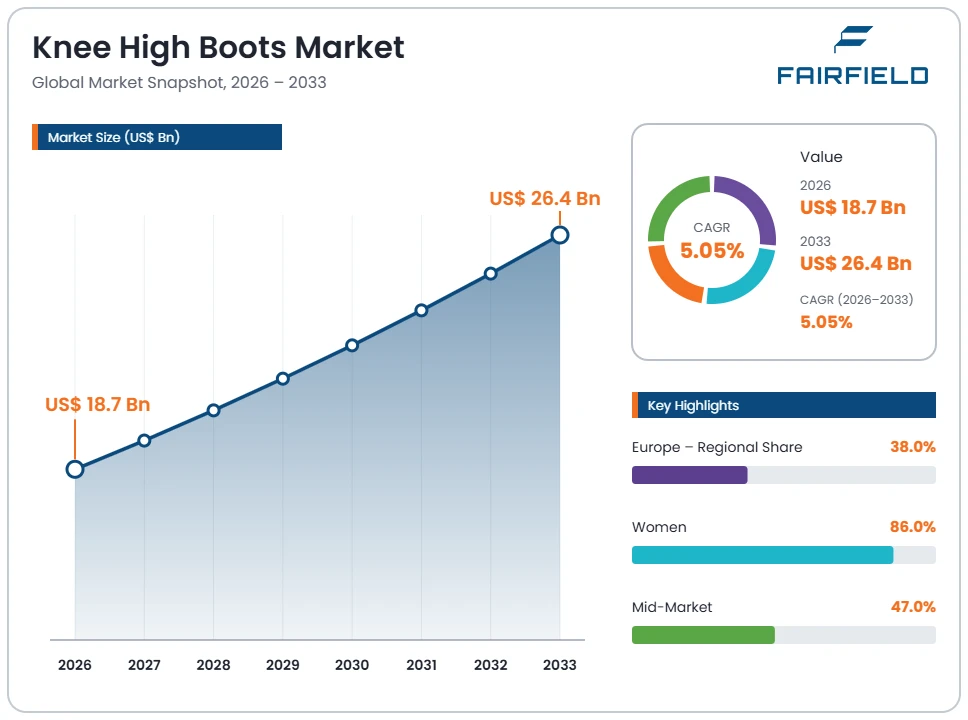
The global knee high boots market size is expected to be valued at US$ 18.7 billion in 2026 and projected to reach US$ 26.4 billion by 2033, growing at a CAGR of 5.05% between 2026 and 2033.
All values represent retail sales of knee-length and over-the-knee footwear across women’s, men’s and children’s ranges. Between 2020 and 2025 the category grew near 4.2% a year to roughly US$ 17.9 billion, recovering from a severe pandemic trough when occasion dressing collapsed. Three factors support the forecast: the return of tall-shaft silhouettes to seasonal collections, better calf-width grading that lifts online conversion, and premium repair and resale activity that extends product life. Growth is steady rather than rapid. Demand stays concentrated in a narrow autumn and winter window, so warmer seasons and mistimed buying decisions can erase a full year of category gains.
Key Report Takeaways
- By Product Type: Heeled Knee High Boots held 34% share in 2026, while Over-the-Knee Boots are projected to expand at a 6.4% CAGR through 2033, as tall-shaft styling returns across autumn and winter collections.
- By Material: Leather held 41% share in 2026, while Synthetic uppers in polyurethane and microfiber are projected to expand at a 6.1% CAGR through 2033, as hide costs and due diligence duties raise tanned leather prices.
- By End User: Women accounted for 86% share in 2026, while Men are projected to expand at a 6.9% CAGR through 2033, helped by tall equestrian-inspired styles entering mainstream menswear ranges.
- By Price Tier: Mid-Market held 47% share in 2026, while the Value tier is projected to expand at a 6.0% CAGR through 2033, as shoppers trade down on a garment they wear for only part of the year.
- By Distribution Channel: Specialty Footwear Stores held 29% share in 2026, while Online Retail is projected to expand at a 7.4% CAGR through 2033, supported by calf-measurement tools and free return shipping.
- By Geography: Europe held 38% share in 2026, while Asia Pacific is projected to expand at a 7.2% CAGR through 2033, driven by cold-season demand in China, Japan and South Korea.
Global Knee High Boots Market Trends and Insights
Drivers Impact Analysis
Two forces account for most of the forecast growth in tall-shaft footwear.
| Driver | Impact on CAGR Forecast | Geographic Relevance | Impact Timeline |
| Return of tall-shaft silhouettes to seasonal collections | High | Europe, North America | Short term ≤2 years |
| Calf-width grading and online fit measurement tools | Medium | Global | Medium term 2–4 years |
Tall-Shaft Silhouettes Returning to Seasonal Collections Lift Knee High Boots Sell-Through
The return of tall-shaft silhouettes to autumn and winter collections is the strongest demand signal in the category. Designers have moved attention back from ankle boots to knee-length and over-the-knee shapes, and that shift pulls through to mid-market and value ranges within two seasons. Full-price sell-through improves, which matters in a category where markdowns normally absorb much of the gross margin.
The mechanism is the standard fashion transmission chain. Runway and celebrity styling set the silhouette, press coverage and social feeds amplify it, and commercial buyers commit open-to-buy budgets for the following winter. Houses within Kering SA, LVMH Moët Hennessy Louis Vuitton SE and Prada S.p.A. influence the reference image, while Steve Madden, Ltd., Caleres, Inc. and Deichmann SE translate it into accessible price points that generate the volume. The cycle repeats reliably enough that buyers plan budgets around it.
Calf-Width Grading and Virtual Fit Tools Are Unlocking Online Knee High Boots Sales
Better calf-width grading is converting shoppers who previously refused to buy tall boots online. Knee-length footwear fails on calf circumference far more often than on foot length, and that single variable has historically driven return rates well above the footwear average. Brands offering narrow, standard, wide and extra-wide shafts report materially better keep rates, which makes online selling economic.
The change is a combination of pattern engineering and measurement guidance. Elasticated gussets, adjustable laces and rear zips widen the fit envelope without new lasts, while on-site measurement guides and photographic size references set expectations before purchase. Dr. Martens plc, Clarks and Duo Boots have built reputations on shaft fit options, and larger retailers now filter catalogues by calf width. Lower returns cut reverse logistics cost and release saleable stock back into the short winter selling window.
Restraints Impact Analysis
Two structural constraints limit margins and volume growth in knee-length footwear.
| Restraint | Impact on CAGR Forecast | Geographic Relevance | Impact Timeline |
| Hide, tanning and supply chain due diligence cost inflation | High | Europe, Asia Pacific | Medium term 2–4 years |
| Warm winters and narrow fashion windows stranding inventory | Medium | North America, Europe | Long term ≥4 years |
Hide Costs and Leather Due Diligence Duties Are Squeezing Knee High Boots Margins
Rising leather input costs compress margins more severely in knee high boots than in any other footwear shape. A tall shaft consumes roughly two to three times the hide area of an ankle boot, so every movement in hide and tanning prices is magnified. Brands that cannot pass this through either thin the leather, switch to synthetics, or accept lower gross margin.
The cost sources are specific. Cattle hide supply follows beef herd cycles rather than footwear demand, so availability is inelastic. Chrome tanning faces compliance costs under REACH restrictions on chromium VI in leather articles, and the European Union Deforestation Regulation obliges operators to collect geolocation data and file due diligence statements for cattle products. The Corporate Sustainability Due Diligence Directive adds audit obligations across tanning supply chains.
Warm Winters and Narrow Fashion Windows Leave Knee High Boots Stock Stranded
Seasonality is the category’s defining commercial risk, and it caps how aggressively retailers will buy. Knee high boots sell meaningfully for roughly four months a year in temperate markets. A mild autumn delays the first cold snap, shoppers skip the purchase entirely, and unsold stock carries into a clearance event or into the following year at a holding cost.
Two causes compound the problem. Weather variability has widened, so buying decisions taken nine months before the season rest on an unreliable assumption about temperature. Fashion cycles add a second timing risk, because a silhouette that reads current in one winter can look dated by the next. Tall boots are also expensive to warehouse and ship, since shaft height drives dimensional weight, carton size and shelf space. Carrying unsold pairs for a further twelve months therefore costs far more than it does in flat footwear.
Market Opportunities
Extended Calf-Width Ranges Open an Underserved Knee High Boots Revenue Pool
Extended calf-width ranges represent the clearest unserved revenue pool in tall footwear. A large share of adult shoppers cannot fasten a standard-shaft boot, and most abandon the category rather than search for alternatives. Brands that grade shafts properly capture full-price sales from buyers who are loyal, price-tolerant and rarely discount-driven, because substitutes are scarce.
Specialist retailers and direct-to-consumer brands are best placed to capture it, since the opportunity demands extra lasts, more stock keeping units and genuine fit advice rather than scale manufacturing. Demand comes from women aged 35 and above, from taller consumers, from shoppers with athletic calves and from buyers returning to the category after years of avoiding it. Online channels make the economics work, because a specialist can aggregate thin demand across a whole country without opening a single store.
Repair, Resale and Digital Product Passports Create Aftermarket Value in Knee High Boots
Aftermarket services are emerging as a second revenue stream around premium tall boots. Resoling, zip replacement, shaft stretching and leather restoration extend a product that customers already keep for several seasons, and authenticated resale returns value to brands that previously captured nothing after the first sale. Service revenue also arrives outside the narrow winter selling window.
Premium and luxury brands with owned retail networks can capture most of this pool, alongside independent cobblers and authenticated resale platforms. The customer is the repeat buyer of leather footwear who values durability over novelty and expects a boot to last several winters. The European Union Ecodesign for Sustainable Products Regulation and its Digital Product Passport will attach material and repair data to each pair, and Leather Working Group certification already supports verified provenance claims.
Segment Analysis
- By Product Type: Heeled Styles Lead While Over-the-Knee Shapes Gain Ground
Heeled Knee High Boots held 34% of category value in 2026, the largest product type share. The style spans office, evening and occasion wear, carries higher average selling prices than flat alternatives and suits the slim-shaft look that dominates mainstream collections. Flat Knee High Boots followed at 29%, and Riding Boots at 16%.
Over-the-Knee Boots are the fastest-growing type at a 6.4% CAGR to 2033, from a 21% base. The shape has returned to runway and celebrity styling, and improved stretch panels have made it wearable for buyers who previously found it restrictive.
The commercial implication is a wider assortment rather than a substitution. Retailers are carrying over-the-knee styles as statement pieces at higher prices while keeping heeled and flat knee-length boots as the dependable volume core of the autumn range.
- By Material: Leather Holds Premium Share as Synthetics Expand Fastest
Leather accounted for 41% of knee high boots value in 2026, the leading material. Buyers associate it with durability, shape retention and resale value, and it supports the premium pricing that funds specialist construction. Suede held 22%, prized for texture but vulnerable to winter salt and rain, while Textile and Knit uppers took 10%.
Synthetic uppers in polyurethane and microfiber are growing fastest at a 6.1% CAGR through 2033, from 27% of value. Hide cost inflation, deforestation due diligence duties and improved synthetic hand feel have narrowed the quality gap at mid and value price points.
For manufacturers this changes sourcing strategy. Many brands now run parallel leather and synthetic versions of the same last, protecting premium positioning while insulating entry ranges from volatile hide markets and tanning compliance costs.
- By End User: Women Dominate Volume While Men’s Tall Boots Grow Quickest
Women accounted for 86% of knee high boots sales in 2026, overwhelmingly the leading end user group. The shape is embedded in women’s autumn and winter wardrobes, pairs with skirts, dresses and slim trousers, and benefits from the widest assortment across every price tier. Children’s ranges held 5%, mostly weather-driven rather than fashion-driven.
Men represent the fastest-growing group at a 6.9% CAGR to 2033, from a 9% share. Equestrian-inspired and western-influenced tall boots have entered mainstream menswear, supported by heritage brands and by a broader relaxation of workplace dress codes.
The implication is incremental rather than transformative. Men’s tall boots remain a small specialist business, but they let brands extend existing lasts and leather programmes into a new buyer group without building a separate supply chain.
- By Price Tier: Mid-Market Carries the Volume While Value Ranges Accelerate
Mid-Market products held 47% of knee high boots value in 2026, the leading price tier. Shoppers accept a meaningful spend on a boot they expect to wear across several winters, and this tier balances leather quality, fit options and recognisable brand names. Premium and Luxury held 21%, concentrated in Italy and Spain manufacturing.
The Value tier is growing fastest at a 6.0% CAGR through 2033, from a 32% base. Pressure on discretionary budgets and the category’s limited wearing season push many buyers toward lower-cost synthetic alternatives they can replace as styles change.
This polarisation squeezes the middle. Mid-market brands are responding with extended fit ranges, repair services and verified leather sourcing, since those attributes justify the price gap that value competitors cannot easily close.
- By Distribution Channel: Specialty Stores Lead as Online Retail Sets the Pace
Specialty Footwear Stores held 29% of knee high boots sales in 2026, the leading channel. Fit assistance matters more here than in most footwear categories, and trying a shaft for calf comfort still favours physical retail. Department Stores took 19%, Brand-Owned Retail 17%, and Off-Price and Value Retail 11%.
Online Retail is the fastest-growing channel at a 7.4% CAGR to 2033, from a 24% base. Calf measurement guides, wide-shaft filters, detailed photography and free return shipping have cut the fit uncertainty that once blocked online purchase of tall boots.
The practical effect is a blended model. Brands increasingly use stores for fit discovery and online channels for repeat purchase and extended size ranges, which lets them carry wider shaft options without multiplying store inventory.
Geography Analysis
- North America Sustains Knee High Boots Volume Through Cold-Season Replacement Demand
North America held 31% of global knee high boots value in 2026, the second-largest regional position. The United States generates most of that total, with Canada contributing disproportionately high per-capita demand because of severe winters across its populated corridor.
Demand rests on replacement cycles rather than novelty. Snow, road salt and freeze-thaw conditions destroy leather shafts and soles, so buyers in northern states and provinces replace boots regularly. Department store consolidation has shifted sales toward specialty chains, brand websites and off-price retail, while western-influenced tall boots have widened the buyer base beyond classic city styling.
Tariffs on imported footwear are the main cost pressure, since almost all supply arrives from overseas factories. Brands are responding by diversifying sourcing countries and by shortening the time between design freeze and delivery.
- Which Region Is Leading the Knee High Boots Market?
Europe leads the knee high boots market with 38% of global value in 2026. Germany, the United Kingdom, France, Italy and Spain generate most sales, supported by long cold seasons, strong occasion dressing and a deep tradition of tall boot wearing.
The lead has manufacturing roots as well. Italian and Spanish footwear districts supply premium construction, pattern-making expertise and tanning capacity, which keeps design authority inside the region. Consumers also replace boots on a predictable winter cycle and accept higher price points for leather quality.
Regulation now shapes the regional agenda. The Deforestation Regulation, the Textile Labelling Regulation, footwear labelling rules under Directive 94/11/EC and the coming Digital Product Passport all raise documentation requirements, favouring brands with traceable tanneries and verified hide origins.
- Which Region Is Growing Fastest in the Knee High Boots Market?
Asia Pacific is the fastest-growing geography, expanding at a 7.2% CAGR between 2026 and 2033 from a 21% share in 2026. China, Japan, South Korea and Australia drive most of that growth, with northern China and Japan providing genuine cold-weather demand rather than purely fashion demand.
Several causes combine. Urban incomes are rising, winter fashion content circulates rapidly through social platforms, and the region hosts large-scale footwear manufacturing that shortens lead times for local brands. South Korea has particular influence on tall boot styling across neighbouring markets.
The change to watch is the premium shift. Domestic brands are moving up into leather construction and better shaft grading, competing directly with imported mid-market ranges instead of only undercutting them on price.
- Latin America Knee High Boots Demand Concentrates in Southern Winter Markets
Latin America accounted for 6% of global knee high boots value in 2026. Brazil is both the largest consumer market and a significant producer, with Argentina, Chile, Colombia and Mexico forming the remainder. Demand concentrates in temperate southern areas and in highland cities where winters are genuinely cold.
Barriers are meaningful. Import duties on finished footwear are high, currency volatility disrupts pricing, and discretionary spending contracts quickly during inflationary periods. Much of the population lives in climates where tall boots have little practical use, which caps the addressable base.
Local leather capacity is the regional advantage. Brazil has substantial cattle herds and established tanneries, so domestic brands can produce leather boots at prices imported ranges cannot match, provided they meet tightening traceability expectations from export customers.
- Middle East & Africa Knee High Boots Sales Track Travel Retail and Highland Winters
Middle East & Africa held 4% of global knee high boots value in 2026, the smallest regional share. The United Arab Emirates, Saudi Arabia, South Africa, Morocco and Turkey account for most activity, with South Africa and highland Morocco supplying genuine seasonal need.
Climate is the obvious constraint. Across most of the region, tall boots are an occasion or travel purchase rather than a winter necessity, so volumes depend on affluent consumers buying for trips to colder destinations. Import costs and limited specialty footwear retail further restrict range availability.
Luxury travel retail is the main opportunity. Premium malls in Dubai and Riyadh sell tall boots to residents and visitors ahead of overseas winters, and that channel supports higher average selling prices than the regional volume suggests.
Competitive Landscape
The knee high boots market is fragmented, with low concentration and no brand holding a dominant global share. Footwear remains a design-led business where consumer loyalty attaches to styling and fit rather than to scale, so hundreds of brands compete across price tiers. Ownership is more concentrated than brand count suggests, because groups such as Kering SA, LVMH Moët Hennessy Louis Vuitton SE, Capri Holdings Limited, Tapestry, Inc. and Caleres, Inc. hold portfolios of distinct labels. Private label from Deichmann SE and large general retailers occupies much of the value tier.
Competition turns on silhouette timing, shaft fit, leather quality and delivery accuracy into a short selling window. Price matters most in the value tier, while craftsmanship, last development and repairability dominate premium positioning. Newer entrants attack specific gaps rather than the whole category. Wide-calf specialists, vegan-material brands and direct-to-consumer labels built on a single hero boot have all taken share by solving a problem that broad-range competitors treat as marginal.
Strategic activity concentrates on supply chain control and sustainability credentials. Brands are consolidating tannery relationships to secure traceable hides, adding Leather Working Group certified suppliers, and bringing repair and resale services in-house. Several have shortened development calendars so that buying commitments can be made closer to the season, reducing the markdown risk that warm winters create.
Strategic direction is converging on durability and fit as commercial arguments rather than marketing claims. Vendors are investing in extended calf ranges, documented material origin and aftercare, because those capabilities support full-price selling in a category where seasonality and fashion cycles otherwise force heavy discounting.
Recent Industry Developments
- June 2023: The European Union Deforestation Regulation (EU) 2023/1115 entered into force, covering cattle products including hides and leather – it requires geolocation data and due diligence statements across tanning supply chains serving footwear brands.
- July 2024: The European Union Ecodesign for Sustainable Products Regulation (EU) 2024/1781 entered into force, establishing the framework for the Digital Product Passport – it sets the path toward mandatory material, durability and repair data on footwear.
- July 2024: The European Union Corporate Sustainability Due Diligence Directive (EU) 2024/1760 entered into force – it extends human rights and environmental due diligence duties to the tanning and leather processing chains used in boot production.
- December 2024: The European Union adopted a one-year postponement of the Deforestation Regulation application dates – it gave leather buyers additional time to build traceability systems before compliance obligations began to bite.
Companies Covered in the Report
- Dr. Martens plc
- Steve Madden, Ltd.
- Caleres, Inc.
- Wolverine World Wide, Inc.
- Genesco Inc.
- Tapestry, Inc.
- Capri Holdings Limited
- Kering SA
- LVMH Moët Hennessy Louis Vuitton SE
- Prada S.p.A.
- Salvatore Ferragamo S.p.A.
- Geox S.p.A.
- ECCO Sko A/S
- C. & J. Clark International Ltd
- Deichmann SE
Knee High Boots Market Report Scope
| Metric | Value |
| Study Period | 2020–2033 |
| Market Size 2026 | US$ 18.7 Billion |
| Market Size 2033 | US$ 26.4 Billion |
| CAGR 2026–2033 | 5.05% |
| Absolute Dollar Opportunity | US$ 7.7 Billion |
| Largest Market | Europe (38% share, 2026) |
| Fastest-Growing Market | Asia Pacific (7.2% CAGR) |
| Market Concentration | Low |
| Major Players | Dr. Martens plc, Steve Madden, Ltd., Caleres, Inc., Kering SA, ECCO Sko A/S |
Knee High Boots Market Segmentation
Product Type
- Heeled Knee High Boots
- Flat Knee High Boots
- Over-the-Knee Boots
- Riding Boots
Material
- Leather
- Suede
- Synthetic
- Textile and Knit
End User
- Women
- Men
- Children
Price Tier
- Value
- Mid-Market
- Premium and Luxury
Distribution Channel
- Specialty Footwear Stores
- Department Stores
- Brand-Owned Retail
- Online Retail
- Off-Price and Value Retail
Regions
- North America
- Europe
- Asia Pacific
- Latin America
- Middle East & Africa
- Executive Summary
- Global Knee High Boots Market Snapshot
- Market Size and Trend Analysis 2020–2033
- Historical Growth 2020–2025
- Base Year 2025
- Forecast Outlook 2026–2033
- Key Report Takeaways
- Market Overview
- Market Definition and Report Scope
- Market Dynamics
- Drivers
- Tall-Shaft Silhouettes Returning to Seasonal Collections Lift Knee High Boots Sell-Through
- Calf-Width Grading and Virtual Fit Tools Are Unlocking Online Knee High Boots Sales
- Restraints
- Hide Costs and Leather Due Diligence Duties Are Squeezing Knee High Boots Margins
- Warm Winters and Narrow Fashion Windows Leave Knee High Boots Stock Stranded
- Market Opportunities
- Extended Calf-Width Ranges Open an Underserved Knee High Boots Revenue Pool
- Repair, Resale and Digital Product Passports Create Aftermarket Value in Knee High Boots
- Drivers
- Segment Analysis
- By Product Type: Heeled Styles Lead While Over-the-Knee Shapes Gain Ground
- By Material: Leather Holds Premium Share as Synthetics Expand Fastest
- By End User: Women Dominate Volume While Men's Tall Boots Grow Quickest
- By Price Tier: Mid-Market Carries the Volume While Value Ranges Accelerate
- By Distribution Channel: Specialty Stores Lead as Online Retail Sets the Pace
- Global Knee High Boots Market Outlook, 2020–2033
- Global Knee High Boots Market Outlook, by Product Type, Value (US$ Billion), 2020–2033
- Heeled Knee High Boots
- Flat Knee High Boots
- Over-the-Knee Boots
- Riding Boots
- Global Knee High Boots Market Outlook, by Material, Value (US$ Billion), 2020–2033
- Leather
- Suede
- Synthetic
- Textile and Knit
- Global Knee High Boots Market Outlook, by End User, Value (US$ Billion), 2020–2033
- Women
- Men
- Children
- Global Knee High Boots Market Outlook, by Price Tier, Value (US$ Billion), 2020–2033
- Value
- Mid-Market
- Premium and Luxury
- Global Knee High Boots Market Outlook, by Distribution Channel, Value (US$ Billion), 2020–2033
- Specialty Footwear Stores
- Department Stores
- Brand-Owned Retail
- Online Retail
- Off-Price and Value Retail
- Global Knee High Boots Market Outlook, by Region, Value (US$ Billion), 2020–2033
- North America
- Europe
- Asia Pacific
- Latin America
- Middle East & Africa
- Global Knee High Boots Market Outlook, by Product Type, Value (US$ Billion), 2020–2033
- North America Knee High Boots Market Outlook, 2020–2033
- North America Sustains Knee High Boots Volume Through Cold-Season Replacement Demand
- North America Knee High Boots Market Outlook, by Product Type, Value (US$ Billion), 2020–2033
- Heeled Knee High Boots
- Flat Knee High Boots
- Over-the-Knee Boots
- Riding Boots
- North America Knee High Boots Market Outlook, by Material, Value (US$ Billion), 2020–2033
- Leather
- Suede
- Synthetic
- Textile and Knit
- North America Knee High Boots Market Outlook, by End User, Value (US$ Billion), 2020–2033
- Women
- Men
- Children
- North America Knee High Boots Market Outlook, by Price Tier, Value (US$ Billion), 2020–2033
- Value
- Mid-Market
- Premium and Luxury
- North America Knee High Boots Market Outlook, by Distribution Channel, Value (US$ Billion), 2020–2033
- Specialty Footwear Stores
- Department Stores
- Brand-Owned Retail
- Online Retail
- Off-Price and Value Retail
- North America Knee High Boots Market Outlook, by Country, Value (US$ Billion), 2020–2033
- United States Knee High Boots Market Outlook, by Product Type, 2020–2033
- United States Knee High Boots Market Outlook, by Material, 2020–2033
- United States Knee High Boots Market Outlook, by End User, 2020–2033
- United States Knee High Boots Market Outlook, by Price Tier, 2020–2033
- United States Knee High Boots Market Outlook, by Distribution Channel, 2020–2033
- Canada Knee High Boots Market Outlook, by Product Type, 2020–2033
- Canada Knee High Boots Market Outlook, by Material, 2020–2033
- Canada Knee High Boots Market Outlook, by End User, 2020–2033
- Canada Knee High Boots Market Outlook, by Price Tier, 2020–2033
- Canada Knee High Boots Market Outlook, by Distribution Channel, 2020–2033
- Europe Knee High Boots Market Outlook, 2020–2033
- Regional Market Leadership
- Europe Knee High Boots Market Outlook, by Product Type, Value (US$ Billion), 2020–2033
- Heeled Knee High Boots
- Flat Knee High Boots
- Over-the-Knee Boots
- Riding Boots
- Europe Knee High Boots Market Outlook, by Material, Value (US$ Billion), 2020–2033
- Leather
- Suede
- Synthetic
- Textile and Knit
- Europe Knee High Boots Market Outlook, by End User, Value (US$ Billion), 2020–2033
- Women
- Men
- Children
- Europe Knee High Boots Market Outlook, by Price Tier, Value (US$ Billion), 2020–2033
- Value
- Mid-Market
- Premium and Luxury
- Europe Knee High Boots Market Outlook, by Distribution Channel, Value (US$ Billion), 2020–2033
- Specialty Footwear Stores
- Department Stores
- Brand-Owned Retail
- Online Retail
- Off-Price and Value Retail
- Europe Knee High Boots Market Outlook, by Country, Value (US$ Billion), 2020–2033
- Germany Knee High Boots Market Outlook, by Product Type, 2020–2033
- Germany Knee High Boots Market Outlook, by Material, 2020–2033
- Germany Knee High Boots Market Outlook, by End User, 2020–2033
- Germany Knee High Boots Market Outlook, by Price Tier, 2020–2033
- Germany Knee High Boots Market Outlook, by Distribution Channel, 2020–2033
- United Kingdom Knee High Boots Market Outlook, by Product Type, 2020–2033
- United Kingdom Knee High Boots Market Outlook, by Material, 2020–2033
- United Kingdom Knee High Boots Market Outlook, by End User, 2020–2033
- United Kingdom Knee High Boots Market Outlook, by Price Tier, 2020–2033
- United Kingdom Knee High Boots Market Outlook, by Distribution Channel, 2020–2033
- France Knee High Boots Market Outlook, by Product Type, 2020–2033
- France Knee High Boots Market Outlook, by Material, 2020–2033
- France Knee High Boots Market Outlook, by End User, 2020–2033
- France Knee High Boots Market Outlook, by Price Tier, 2020–2033
- France Knee High Boots Market Outlook, by Distribution Channel, 2020–2033
- Italy Knee High Boots Market Outlook, by Product Type, 2020–2033
- Italy Knee High Boots Market Outlook, by Material, 2020–2033
- Italy Knee High Boots Market Outlook, by End User, 2020–2033
- Italy Knee High Boots Market Outlook, by Price Tier, 2020–2033
- Italy Knee High Boots Market Outlook, by Distribution Channel, 2020–2033
- Spain Knee High Boots Market Outlook, by Product Type, 2020–2033
- Spain Knee High Boots Market Outlook, by Material, 2020–2033
- Spain Knee High Boots Market Outlook, by End User, 2020–2033
- Spain Knee High Boots Market Outlook, by Price Tier, 2020–2033
- Spain Knee High Boots Market Outlook, by Distribution Channel, 2020–2033
- Asia Pacific Knee High Boots Market Outlook, 2020–2033
- Regional Growth Outlook
- Asia Pacific Knee High Boots Market Outlook, by Product Type, Value (US$ Billion), 2020–2033
- Heeled Knee High Boots
- Flat Knee High Boots
- Over-the-Knee Boots
- Riding Boots
- Asia Pacific Knee High Boots Market Outlook, by Material, Value (US$ Billion), 2020–2033
- Leather
- Suede
- Synthetic
- Textile and Knit
- Asia Pacific Knee High Boots Market Outlook, by End User, Value (US$ Billion), 2020–2033
- Women
- Men
- Children
- Asia Pacific Knee High Boots Market Outlook, by Price Tier, Value (US$ Billion), 2020–2033
- Value
- Mid-Market
- Premium and Luxury
- Asia Pacific Knee High Boots Market Outlook, by Distribution Channel, Value (US$ Billion), 2020–2033
- Specialty Footwear Stores
- Department Stores
- Brand-Owned Retail
- Online Retail
- Off-Price and Value Retail
- Asia Pacific Knee High Boots Market Outlook, by Country, Value (US$ Billion), 2020–2033
- China Knee High Boots Market Outlook, by Product Type, 2020–2033
- China Knee High Boots Market Outlook, by Material, 2020–2033
- China Knee High Boots Market Outlook, by End User, 2020–2033
- China Knee High Boots Market Outlook, by Price Tier, 2020–2033
- China Knee High Boots Market Outlook, by Distribution Channel, 2020–2033
- Japan Knee High Boots Market Outlook, by Product Type, 2020–2033
- Japan Knee High Boots Market Outlook, by Material, 2020–2033
- Japan Knee High Boots Market Outlook, by End User, 2020–2033
- Japan Knee High Boots Market Outlook, by Price Tier, 2020–2033
- Japan Knee High Boots Market Outlook, by Distribution Channel, 2020–2033
- South Korea Knee High Boots Market Outlook, by Product Type, 2020–2033
- South Korea Knee High Boots Market Outlook, by Material, 2020–2033
- South Korea Knee High Boots Market Outlook, by End User, 2020–2033
- South Korea Knee High Boots Market Outlook, by Price Tier, 2020–2033
- South Korea Knee High Boots Market Outlook, by Distribution Channel, 2020–2033
- Australia Knee High Boots Market Outlook, by Product Type, 2020–2033
- Australia Knee High Boots Market Outlook, by Material, 2020–2033
- Australia Knee High Boots Market Outlook, by End User, 2020–2033
- Australia Knee High Boots Market Outlook, by Price Tier, 2020–2033
- Australia Knee High Boots Market Outlook, by Distribution Channel, 2020–2033
- Latin America Knee High Boots Market Outlook, 2020–2033
- Latin America Knee High Boots Demand Concentrates in Southern Winter Markets
- Latin America Knee High Boots Market Outlook, by Product Type, Value (US$ Billion), 2020–2033
- Heeled Knee High Boots
- Flat Knee High Boots
- Over-the-Knee Boots
- Riding Boots
- Latin America Knee High Boots Market Outlook, by Material, Value (US$ Billion), 2020–2033
- Leather
- Suede
- Synthetic
- Textile and Knit
- Latin America Knee High Boots Market Outlook, by End User, Value (US$ Billion), 2020–2033
- Women
- Men
- Children
- Latin America Knee High Boots Market Outlook, by Price Tier, Value (US$ Billion), 2020–2033
- Value
- Mid-Market
- Premium and Luxury
- Latin America Knee High Boots Market Outlook, by Distribution Channel, Value (US$ Billion), 2020–2033
- Specialty Footwear Stores
- Department Stores
- Brand-Owned Retail
- Online Retail
- Off-Price and Value Retail
- Latin America Knee High Boots Market Outlook, by Country, Value (US$ Billion), 2020–2033
- Brazil Knee High Boots Market Outlook, by Product Type, 2020–2033
- Brazil Knee High Boots Market Outlook, by Material, 2020–2033
- Brazil Knee High Boots Market Outlook, by End User, 2020–2033
- Brazil Knee High Boots Market Outlook, by Price Tier, 2020–2033
- Brazil Knee High Boots Market Outlook, by Distribution Channel, 2020–2033
- Argentina Knee High Boots Market Outlook, by Product Type, 2020–2033
- Argentina Knee High Boots Market Outlook, by Material, 2020–2033
- Argentina Knee High Boots Market Outlook, by End User, 2020–2033
- Argentina Knee High Boots Market Outlook, by Price Tier, 2020–2033
- Argentina Knee High Boots Market Outlook, by Distribution Channel, 2020–2033
- Chile Knee High Boots Market Outlook, by Product Type, 2020–2033
- Chile Knee High Boots Market Outlook, by Material, 2020–2033
- Chile Knee High Boots Market Outlook, by End User, 2020–2033
- Chile Knee High Boots Market Outlook, by Price Tier, 2020–2033
- Chile Knee High Boots Market Outlook, by Distribution Channel, 2020–2033
- Colombia Knee High Boots Market Outlook, by Product Type, 2020–2033
- Colombia Knee High Boots Market Outlook, by Material, 2020–2033
- Colombia Knee High Boots Market Outlook, by End User, 2020–2033
- Colombia Knee High Boots Market Outlook, by Price Tier, 2020–2033
- Colombia Knee High Boots Market Outlook, by Distribution Channel, 2020–2033
- Mexico Knee High Boots Market Outlook, by Product Type, 2020–2033
- Mexico Knee High Boots Market Outlook, by Material, 2020–2033
- Mexico Knee High Boots Market Outlook, by End User, 2020–2033
- Mexico Knee High Boots Market Outlook, by Price Tier, 2020–2033
- Mexico Knee High Boots Market Outlook, by Distribution Channel, 2020–2033
- Middle East & Africa Knee High Boots Market Outlook, 2020–2033
- Middle East & Africa Knee High Boots Sales Track Travel Retail and Highland Winters
- Middle East & Africa Knee High Boots Market Outlook, by Product Type, Value (US$ Billion), 2020–2033
- Heeled Knee High Boots
- Flat Knee High Boots
- Over-the-Knee Boots
- Riding Boots
- Middle East & Africa Knee High Boots Market Outlook, by Material, Value (US$ Billion), 2020–2033
- Leather
- Suede
- Synthetic
- Textile and Knit
- Middle East & Africa Knee High Boots Market Outlook, by End User, Value (US$ Billion), 2020–2033
- Women
- Men
- Children
- Middle East & Africa Knee High Boots Market Outlook, by Price Tier, Value (US$ Billion), 2020–2033
- Value
- Mid-Market
- Premium and Luxury
- Middle East & Africa Knee High Boots Market Outlook, by Distribution Channel, Value (US$ Billion), 2020–2033
- Specialty Footwear Stores
- Department Stores
- Brand-Owned Retail
- Online Retail
- Off-Price and Value Retail
- Middle East & Africa Knee High Boots Market Outlook, by Country, Value (US$ Billion), 2020–2033
- United Arab Emirates Knee High Boots Market Outlook, by Product Type, 2020–2033
- United Arab Emirates Knee High Boots Market Outlook, by Material, 2020–2033
- United Arab Emirates Knee High Boots Market Outlook, by End User, 2020–2033
- United Arab Emirates Knee High Boots Market Outlook, by Price Tier, 2020–2033
- United Arab Emirates Knee High Boots Market Outlook, by Distribution Channel, 2020–2033
- Saudi Arabia Knee High Boots Market Outlook, by Product Type, 2020–2033
- Saudi Arabia Knee High Boots Market Outlook, by Material, 2020–2033
- Saudi Arabia Knee High Boots Market Outlook, by End User, 2020–2033
- Saudi Arabia Knee High Boots Market Outlook, by Price Tier, 2020–2033
- Saudi Arabia Knee High Boots Market Outlook, by Distribution Channel, 2020–2033
- South Africa Knee High Boots Market Outlook, by Product Type, 2020–2033
- South Africa Knee High Boots Market Outlook, by Material, 2020–2033
- South Africa Knee High Boots Market Outlook, by End User, 2020–2033
- South Africa Knee High Boots Market Outlook, by Price Tier, 2020–2033
- South Africa Knee High Boots Market Outlook, by Distribution Channel, 2020–2033
- Morocco Knee High Boots Market Outlook, by Product Type, 2020–2033
- Morocco Knee High Boots Market Outlook, by Material, 2020–2033
- Morocco Knee High Boots Market Outlook, by End User, 2020–2033
- Morocco Knee High Boots Market Outlook, by Price Tier, 2020–2033
- Morocco Knee High Boots Market Outlook, by Distribution Channel, 2020–2033
- Turkey Knee High Boots Market Outlook, by Product Type, 2020–2033
- Turkey Knee High Boots Market Outlook, by Material, 2020–2033
- Turkey Knee High Boots Market Outlook, by End User, 2020–2033
- Turkey Knee High Boots Market Outlook, by Price Tier, 2020–2033
- Turkey Knee High Boots Market Outlook, by Distribution Channel, 2020–2033
- Competitive Landscape
- Market Concentration and Supplier Participation
- Competitive Factors and Strategic Direction
- Recent Industry Developments
- EU Deforestation Regulation June 2023
- EU Ecodesign for Sustainable Products Regulation July 2024
- EU Corporate Sustainability Due Diligence Directive July 2024
- EU Deforestation Regulation Application Postponement December 2024
- Company Profiles
- Dr. Martens plc
- Steve Madden, Ltd.
- Caleres, Inc.
- Wolverine World Wide, Inc.
- Genesco Inc.
- Tapestry, Inc.
- Capri Holdings Limited
- Kering SA
- LVMH Moët Hennessy Louis Vuitton SE
- Prada S.p.A.
- Salvatore Ferragamo S.p.A.
- Geox S.p.A.
- ECCO Sko A/S
- C. & J. Clark International Ltd
- Deichmann SE
- Appendix
- Research Methodology
- Report Assumptions
- Acronyms and Abbreviations
Product Type
- Heeled Knee High Boots
- Flat Knee High Boots
- Over-the-Knee Boots
- Riding Boots
Material
- Leather
- Suede
- Synthetic
- Textile and Knit
End User
- Women
- Men
- Children
Price Tier
- Value
- Mid-Market
- Premium and Luxury
Distribution Channel
- Specialty Footwear Stores
- Department Stores
- Brand-Owned Retail
- Online Retail
- Off-Price and Value Retail
Regions
- North America
- Europe
- Asia Pacific
- Latin America
- Middle East & Africa
Our Research Methodology
Considering the volatility of business today, traditional approaches to strategizing a game plan can be unfruitful if not detrimental. True ambiguity is no way to determine a forecast. A myriad of predetermined factors must be accounted for such as the degree of risk involved, the magnitude of circumstances, as well as conditions or consequences that are not known or unpredictable. To circumvent binary views that cast uncertainty, the application of market research intelligence to strategically posture, move, and enable actionable outcomes is necessary.
View Methodology
Quality Assured
Rigorous Validation Process

Confidentiality Assured
End-to-end Data Security

Custom Research Services
Tailored To Your Objectives
FAQs
The knee high boots market is valued at US$ 18.7 billion in 2026, covering retail sales of knee-length and over-the-knee footwear worldwide.
The market is projected to reach US$ 26.4 billion by 2033 at a 5.05% CAGR, adding US$ 7.7 billion across the forecast period.
Heeled Knee High Boots lead with 34% share in 2026, supported by higher selling prices and use across office, evening and occasion wear.
Online Retail grows fastest at a 7.4% CAGR to 2033, as calf measurement tools and free returns reduce fit uncertainty for buyers.
Europe holds the largest share at 38% in 2026, with Asia Pacific expanding fastest at a 7.2% CAGR through 2033.
Related Reports
Drop Shipping Market Size, Share, Insights, Competitive Landscape, and Forecast 2026 to 2033
The global drop shipping market is valued at US$420.0 billion in 2026, reaching US$985.0 billion by 2033, growing at a 12.95% CAGR
Esports Arenas Market Size, Share, Insights, Competitive Landscape, and Forecast 2026 to 2033
Esports Arenas Market to reach US$6.5 Bn by 2033, growing at 14.0% CAGR, driven by esports events, venue upgrades, and broadcast infrastructure.
Automated Tape Application Systems (ATAS) Market Size, Share, Insights, Competitive Landscape, and Forecast 2026 to 2033
The Automated Tape Application Systems market, valued at US$ 0.46 billion in 2026, and projected to reach US$ 0.82 billion by 2033 at an 8.6% CAGR.
Surf Parks Market Size, Share, Insights, Competitive Landscape, and Forecast 2026 to 2033
Surf Parks Market to reach US$4.1 Bn by 2033, growing at 16.59% CAGR, driven by wave technology, resort development, and tourism investment.
Golf Simulator Lounges Market Size, Share, Insights, Competitive Landscape, and Forecast 2026 to 2033
Golf Simulator Lounges Market to reach US$14.8 Bn by 2033, growing at 13.24% CAGR, driven by indoor golf, memberships, and social play.
Biodegradable Electronics for Packaging Market Size, Share, Insights, Competitive Landscape, and Forecast 2026 to 2033
The biodegradable electronics for packaging market outlook for 2026, valued at US$ 0.46 billion, and explore growth to US$ 1.62 billion by 2033 at a 19.7% CAGR.