



Drop Shipping Market
Drop Shipping Market Size, Share, Insights, Competitive Landscape, and Forecast 2026 to 2033
Drop Shipping Market Size and Trend Analysis
How Fast Is the Drop Shipping Market Growing?
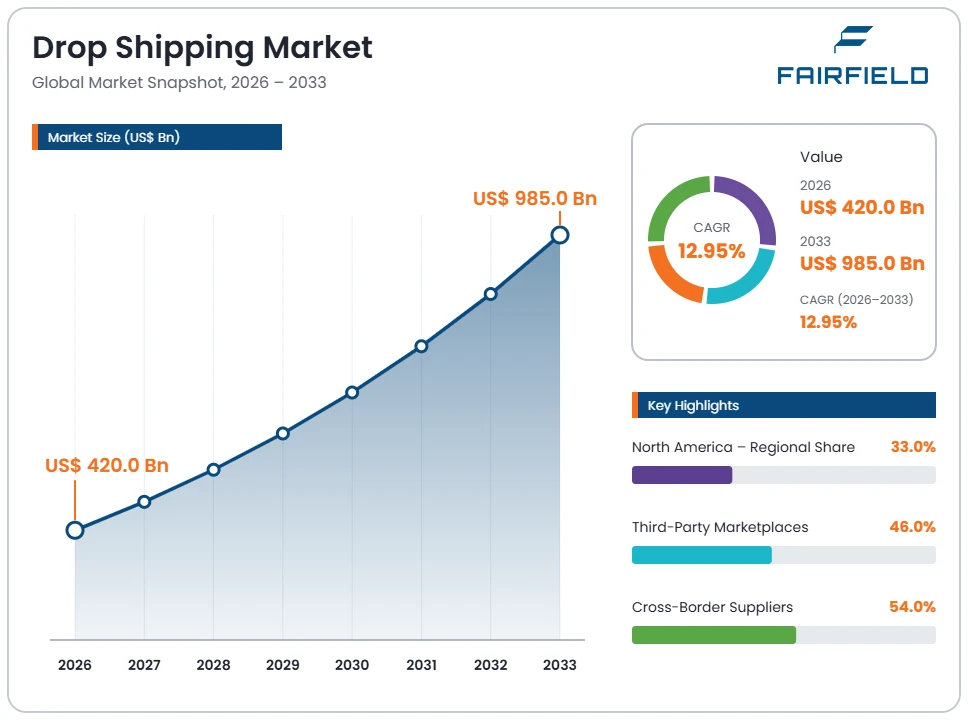
The global drop shipping market size is expected to be valued at US$ 420.0 billion in 2026 and projected to reach US$ 985.0 billion by 2033, growing at a CAGR of 12.95% between 2026 and 2033.
These figures measure gross merchandise value fulfilled through the model, not the smaller software and platform revenue layer. Between 2020 and 2025 that value compounded near 19.4% a year, reaching roughly US$ 372.0 billion. Three forces carried it: inexpensive storefront software, marketplace programmes that removed inventory risk, and social feeds that turned browsing into buying. Growth now moderates as import duty relief disappears, advertising costs climb and shoppers reject long transit times. The direction of travel favours fewer, larger operators selling curated assortments with committed delivery windows. Future value therefore comes from bigger baskets and repeat orders rather than from an endless supply of new sellers.
Key Report Takeaways
- By Product Category: Apparel and Footwear held 28% share in 2026, while Beauty and Personal Care is projected to expand at a 15.4% CAGR through 2033, helped by short-cycle colour cosmetics that ship as small, lightweight parcels.
- By Sales Channel: Third-Party Marketplaces held 46% share in 2026, while Social Commerce is projected to expand at an 18.2% CAGR through 2033, helped by in-app checkout that shortens the path from discovery to paid order.
- By Sourcing Model: Cross-Border Suppliers held 54% share in 2026, while Domestic Suppliers are projected to expand at a 14.6% CAGR through 2033, as duty relief on low-value imports disappears and buyers refuse long transit times.
- By End User: Small and Medium Enterprises held 44% share in 2026, while Large Retailers and Brands are projected to expand at a 15.1% CAGR through 2033, as extended-assortment programmes list supplier catalogues beside owned inventory.
- By Geography: North America held 33% of global gross merchandise value in 2026, while Asia Pacific is projected to expand at a 15.9% CAGR through 2033, supported by smartphone commerce in India, Indonesia and Vietnam.
Global Drop Shipping Market Trends and Insights
Drivers Impact Analysis
Two forces explain most of the forecast growth in inventory-free online retail.
| Driver | Impact on CAGR Forecast | Geographic Relevance | Impact Timeline |
| Social commerce checkout and creator-led selling | High | Asia Pacific, North America | Short term ≤2 years |
| Low-cost storefront and supplier-connector software | Medium | Global | Long term ≥4 years |
Social Commerce Checkout Is Pulling First-Time Buyers Into Drop Shipping Purchases
Social commerce checkout has become the fastest route into drop shipping, and it is lifting order counts across most categories. Shoppers buy without leaving the feed, which suits sellers who hold no stock and need conversion at the moment of discovery. Impulse items such as cosmetics, phone accessories and seasonal apparel convert well in this format.
The mechanism is a shorter path from attention to payment. In-app checkout removes the redirect to an external storefront, where many mobile sessions were lost. Creator affiliate links supply paid distribution without upfront media budgets, and platform catalogue tools pull supplier feeds straight into shoppable posts. Meta Platforms, Inc., TikTok and Pinterest, Inc. each operate merchant catalogue connections that read from storefront software, so a listing built on Shopify Inc. can reach a feed quickly.
Near-Zero Software Costs Keep Drop Shipping Seller Formation Running at High Volume
Cheap storefront and connector software keeps the barrier to entry close to zero, which sustains a constant inflow of new drop shipping sellers. A seller can open a hosted store, import a supplier catalogue and route orders automatically for a monthly fee smaller than one warehouse pallet charge. That economics explains why seller counts keep rising even as individual store survival rates stay low.
The causal change is the unbundling of retail infrastructure into subscription modules. Payments, hosting, catalogue sync, tax calculation and returns are now separate services with open interfaces. Connector applications distributed through the Shopify Inc. and BigCommerce Holdings, Inc. app stores map supplier stock and price fields to live listings, while Stripe, Inc. and PayPal Holdings, Inc. handle settlement. No capital commitment is required before the first order arrives.
Restraints Impact Analysis
Two structural constraints hold back margins and repeat purchase rates in inventory-free retail.
| Restraint | Impact on CAGR Forecast | Geographic Relevance | Impact Timeline |
| Loss of duty and VAT relief on low-value imports | High | North America, Europe | Short term ≤2 years |
| Long transit times and dependence on platform policy | Medium | Global | Medium term 2–4 years |
The End of Low-Value Import Relief Is Erasing the Drop Shipping Price Advantage
The collapse of low-value import relief removes the single largest cost advantage the model enjoyed, and it compresses already thin gross margins. Sellers that priced goods below local retail because parcels entered duty free and tax free now face duties, import value-added tax, brokerage fees and formal entry paperwork on each shipment. Many listings become unprofitable at their previous price points.
The cost source is specific and unavoidable. The European Union removed the low-value consignment VAT exemption in July 2021 and introduced the Import One-Stop Shop, so VAT applies from the first euro. The United States has withdrawn de minimis treatment under Section 321 of the Tariff Act for the shipment flows that carried most of this trade. Customs brokerage charges per parcel often exceed the item margin itself.
Long Transit Times and Platform Policy Dependence Cap Repeat Purchases in Drop Shipping
Delivery performance limits how often a drop shipping customer buys twice, which keeps acquisition costs permanently high. Cross-border parcels frequently take two to five weeks, while domestic retail has trained shoppers to expect two to three days. The resulting refund requests, chargebacks and negative reviews raise service costs and depress seller ratings.
Two causes sit underneath. Economy postal and consolidator lanes are chosen because airfreight destroys the margin, so slow transit is a pricing decision rather than an accident. Separately, sellers operate entirely on borrowed ground. Marketplace listing rules, advertising policies and payment reserve terms can change with little notice, and a single account suspension removes the whole revenue stream. The European Union Consumer Rights Directive also fixes withdrawal rights and delivery timescales that long lanes struggle to meet.
Market Opportunities
Domestic Supplier Networks Open a Paid Fast-Delivery Tier in Drop Shipping
Domestic supplier networks create a premium delivery tier that did not previously exist in inventory-free retail, and shoppers will pay for it. Sellers that route orders to in-country warehouses can promise two-day or three-day arrival, charge closer to mainstream retail prices and keep returns inside the same jurisdiction. Gross margin per order improves even though unit cost rises.
The buyers are repeat-purchase categories such as pet supplies, supplements, home textiles and replacement parts, where delivery certainty matters more than headline price. Sourcing platforms including Spocket and Syncee already filter supplier catalogues by warehouse country, and print-on-demand operators such as Printful Inc. and Printify, Inc. run regional production sites close to major demand centres. Third-party logistics providers supply the same capability to larger merchants. Regional fulfilment capacity, not catalogue size, is the asset that unlocks this revenue pool.
Compliance and Traceability Tools Create a Paid Software Layer Around Drop Shipping
Compliance tooling is emerging as a distinct paid layer around drop shipping, serving sellers that must now prove who made a product and who is responsible for it. Trader verification, responsible-person records, safety documentation and product passports were once ignored by small sellers. They are now conditions of listing, which creates recurring subscription revenue.
Software vendors, customs brokers and compliance agents can capture this pool. Demand comes from marketplace sellers in the European Union, where the Digital Services Act requires traders to be traceable and the General Product Safety Regulation requires a responsible economic operator established inside the bloc. Storefront platforms such as Wix.com Ltd. and BigCommerce Holdings, Inc. are natural distribution points, because the obligation attaches to every listing a seller publishes. Pricing is predictable, since charges scale with listing counts and shipment volumes rather than with volatile advertising spend.
Segment Analysis
- By Product Category: Apparel and Footwear Leads While Beauty and Personal Care Accelerates
Apparel and Footwear held 28% of drop shipping gross merchandise value in 2026, the largest share of any category. The position reflects enormous supplier catalogues, low unit weight, high style turnover and an acceptance among shoppers that fit may be imperfect at low price points. Consumer Electronics and Accessories followed with 21%, Home and Furniture with 17%.
Beauty and Personal Care is the fastest-growing category at a 15.4% CAGR to 2033. Colour cosmetics, nail products and hair tools suit creator-led selling, ship as small parcels and generate frequent repeat orders. Private-label filling services let sellers put their own brand on existing formulations without a factory.
The implication is a shift in category economics. Categories with repeat purchase behaviour now earn better lifetime value than one-off apparel sales, so assortment strategy is moving toward consumables.
- By Sales Channel: Marketplaces Hold the Volume as Social Commerce Sets the Pace
Third-Party Marketplaces accounted for 46% of drop shipping volume in 2026, the leading channel by a wide margin. Built-in traffic, trusted payment handling and established dispute processes let a new seller reach buyers without any marketing spend. Standalone Online Storefronts took 29%, and Business-to-Business Portals a further 9%.
Social Commerce is expanding fastest at an 18.2% CAGR through 2033. Feed-native checkout, live selling and affiliate commissions convert discovery into orders inside one application, which fits the model’s reliance on impulse demand rather than search intent.
For operators, the channel mix now determines cost structure. Marketplaces charge referral fees but supply demand, whereas social selling demands continuous content production. Most established sellers run both, treating marketplaces as a baseline and social channels as the growth engine.
- By Sourcing Model: Cross-Border Supply Dominates While Domestic Suppliers Close the Gap
Cross-Border Suppliers supplied 54% of drop shipping orders in 2026, still the dominant sourcing route. Chinese manufacturing clusters offer catalogue depth, low minimum order quantities and unit prices that no domestic alternative matches. Print-on-Demand Partners held 11% and Sourcing Agents and Agencies 8% of volume.
Domestic Suppliers are the fastest-growing route at a 14.6% CAGR to 2033, climbing from 27% of volume. The shift follows the withdrawal of duty and tax relief on low-value imports, which removed the landed-cost gap, and persistent customer complaints about multi-week transit.
The strategic consequence is a rebalancing rather than a reversal. Sellers increasingly split catalogues, keeping long-tail novelty items on cross-border lanes while moving bestsellers to in-country stock so that delivery promises stay credible.
- By End User: Small and Medium Enterprises Lead While Large Retailers Scale Fastest
Small and Medium Enterprises generated 44% of drop shipping gross merchandise value in 2026. These businesses have real brands, repeat customers and advertising budgets, yet avoid warehousing by routing orders to suppliers. Individual Sellers and Micro-Enterprises contributed 34%, a large but highly churn-prone group.
Large Retailers and Brands form the fastest-growing cohort at a 15.1% CAGR through 2033, from a 22% base. Established chains use supplier-shipped assortments to widen online ranges without capital tied up in slow-moving stock, a practice often described as extended assortment or endless aisle.
This matters competitively. When large retailers adopt supplier-direct shipping, they bring negotiated carrier rates, compliance teams and brand trust, raising the service standard that independent sellers must meet to stay visible.
Geography Analysis
- Which Region Is Leading the Drop Shipping Market?
North America leads the drop shipping market with 33% of global gross merchandise value in 2026. The United States supplies most of that total, supported by high card penetration, dense parcel networks and a large population of independent online sellers. Canada adds a smaller but mature base, and Mexico contributes rapidly rising cross-border volume.
Three causes sustain the lead. Average order values are high, advertising infrastructure is sophisticated, and marketplace seller programmes are deeply established. The Federal Trade Commission has also pressed income-claim cases under its Business Opportunity Rule against sellers of e-commerce automation services, which has pushed the market toward more credible operators.
The main change ahead is tariff exposure. With Section 321 relief withdrawn, regional sellers are relocating inventory into domestic third-party warehouses to protect delivery promises and landed cost.
- Europe Trades Volume Growth for Compliance Discipline in Drop Shipping
Europe holds 26% of global drop shipping value in 2026, the second-largest position, with Germany, the United Kingdom, France, Italy and Spain generating most activity. Consumers are experienced online buyers, but regulation now shapes who can sell and on what terms.
The compliance load is distinctive. Marketplaces must verify trader identity under the Digital Services Act, products need a responsible economic operator established in the bloc under the General Product Safety Regulation, and import VAT applies from the first euro through the Import One-Stop Shop. Withdrawal rights under the Consumer Rights Directive also raise return handling costs.
The resulting opportunity favours professional operators. Sellers able to document supply chains and offer local returns addresses win listing privileges that casual entrants cannot obtain, which steadily raises average order quality.
- Which Region Is Growing Fastest in the Drop Shipping Market?
Asia Pacific is growing fastest, at a 15.9% CAGR between 2026 and 2033, from a 30% share in 2026. India, Indonesia, Vietnam and the Philippines supply the momentum, while China remains the principal supplier base rather than the main demand centre. Japan, South Korea and Australia add high-value domestic demand.
Growth has clear causes. Smartphone-first shopping, live-stream selling and digital wallet adoption let new sellers reach buyers with almost no fixed cost. Domestic manufacturing clusters sit close to customers, so transit times inside the region are short and returns are manageable.
The change to watch is regional supplier localisation. Manufacturers are opening warehouses in Southeast Asia to serve nearby demand directly, shortening delivery and improving the economics of inventory-free selling.
- Latin America Builds Drop Shipping Volume on Instalment Payments and Marketplace Credit
Latin America accounts for 7% of global drop shipping value in 2026 and is expanding quickly from that modest base. Brazil and Mexico dominate activity, with Colombia, Chile and Argentina following. Marketplace instalment plans are decisive, because they let shoppers buy mid-priced goods they could not fund in one payment.
Barriers remain real. Import taxation on small parcels has tightened, customs clearance can be slow and unpredictable, and address quality in secondary cities raises failed delivery rates. Card fraud levels also push payment processors to hold seller reserves.
The opening lies in regional supply. Sellers sourcing from Brazilian and Mexican warehouses avoid customs delay entirely, which turns a logistics weakness into a service advantage against cross-border competitors.
- Middle East & Africa Drop Shipping Depends on Address Data and Cash Settlement
Middle East & Africa holds 4% of global drop shipping value in 2026, the smallest regional position but one with strong growth in specific markets. The United Arab Emirates, Saudi Arabia, Egypt, Nigeria and South Africa account for most volume, supported by young populations and rapid smartphone adoption.
Structural barriers are significant. Street addressing is incomplete in many cities, which forces carriers to call customers before delivery, and cash on delivery remains common. Cash settlement raises refusal rates and ties up seller working capital until parcels are reconciled.
Free zone logistics capacity is the main opportunity. Bonded warehouse space in Dubai and Riyadh lets sellers hold supplier stock near demand, cutting delivery from weeks to days and making card prepayment more acceptable to buyers.
Competitive Landscape
The drop shipping market is highly fragmented and concentration remains low. Millions of independent sellers operate storefronts, and no seller controls a meaningful share of global gross merchandise value. Concentration instead sits in the infrastructure layer, where a small group of storefront platforms, marketplaces and supplier networks intermediates most transactions. Shopify Inc., Amazon.com, Inc., eBay Inc., Alibaba Group Holding Limited and Walmart Inc. shape the rules that sellers must follow, while connector and sourcing applications compete in a crowded, low-switching-cost middle tier.
Competition among sellers turns on delivery speed, product curation, advertising efficiency and returns handling rather than on price alone. Among platforms and supplier networks, the real battleground is catalogue quality, inventory accuracy, order routing reliability and compliance tooling. New entrants arrive from two directions. Sourcing agencies in manufacturing regions now offer quality inspection, branded packaging and faster lanes, while print-on-demand providers such as Printful Inc. and Printify, Inc. compete on regional production capacity rather than catalogue breadth.
Strategic activity concentrates on removing the model’s weaknesses. Platforms are adding trader verification, product safety documentation and tax calculation so sellers can meet marketplace and customs obligations. Supplier networks are opening in-country warehouses to shorten transit, and payment providers are extending seller financing to cover the working capital gap created by duties payable at import. Each move addresses a specific failure point that previously drove customer complaints and account suspensions.
Strategic direction across the sector points the same way. Vendors are shifting from enabling maximum seller formation toward supporting fewer, more durable merchants with verified suppliers, local stock and transparent delivery promises. Compliance capability, once peripheral, has become a competitive feature that determines whether a seller can list at all in regulated markets.
Recent Industry Developments
- July 2021: The European Union VAT e-commerce package took effect, removing the low-value consignment import VAT exemption and introducing the Import One-Stop Shop – it ended the tax advantage that underpinned cross-border drop shipping pricing into the bloc.
- February 2024: The European Union Digital Services Act, Regulation (EU) 2022/2065, became fully applicable to all online intermediaries, including trader traceability duties for marketplaces – marketplaces must now verify seller identity before listings go live.
- December 2024: The European Union General Product Safety Regulation (EU) 2023/988 became applicable, requiring a responsible economic operator established in the bloc for products sold online – it bars anonymous cross-border listings in consumer goods categories.
- May 2025: The United States ended de minimis treatment under Section 321 of the Tariff Act for goods of China and Hong Kong origin – it removed duty-free entry for the parcel flows that carried most cross-border drop shipping volume.
Companies Covered in the Report
- Shopify Inc.
- Amazon.com, Inc.
- eBay Inc.
- Alibaba Group Holding Limited
- AliExpress
- Walmart Inc.
- Etsy, Inc.
- BigCommerce Holdings, Inc.
- Wix.com Ltd.
- Printful Inc.
- Printify, Inc.
- CJdropshipping
- Spocket
- Syncee
- Doba, Inc.
Drop Shipping Market Report Scope
| Metric | Value |
| Study Period | 2020–2033 |
| Market Size 2026 | US$ 420.0 Billion |
| Market Size 2033 | US$ 985.0 Billion |
| CAGR 2026–2033 | 12.95% |
| Absolute Dollar Opportunity | US$ 565.0 Billion |
| Largest Market | North America (33% share, 2026) |
| Fastest-Growing Market | Asia Pacific (15.9% CAGR) |
| Market Concentration | Low |
| Major Players | Shopify Inc., Amazon.com, Inc., Alibaba Group Holding Limited, Printful Inc., CJdropshipping |
Drop Shipping Market Segmentation
Product Category
- Apparel and Footwear
- Consumer Electronics and Accessories
- Home and Furniture
- Beauty and Personal Care
- Sports and Outdoor
- Toys, Pet and Other Products
Sales Channel
- Third-Party Marketplaces
- Standalone Online Storefronts
- Social Commerce
- Business-to-Business Portals
Sourcing Model
- Cross-Border Suppliers
- Domestic Suppliers
- Print-on-Demand Partners
- Sourcing Agents and Agencies
End User
- Individual Sellers and Micro-Enterprises
- Small and Medium Enterprises
- Large Retailers and Brands
Regions
- North America
- Europe
- Asia Pacific
- Latin America
- Middle East & Africa
- Executive Summary
- Global Drop Shipping Market Snapshot
- Market Size and Trend Analysis 2020–2033
- Historical Growth 2020–2025
- Base Year 2025
- Forecast Outlook 2026–2033
- Key Report Takeaways
- Market Overview
- Market Definition and Report Scope
- Market Dynamics
- Drivers
- Social Commerce Checkout Is Pulling First-Time Buyers Into Drop Shipping Purchases
- Near-Zero Software Costs Keep Drop Shipping Seller Formation Running at High Volume
- Restraints
- The End of Low-Value Import Relief Is Erasing the Drop Shipping Price Advantage
- Long Transit Times and Platform Policy Dependence Cap Repeat Purchases in Drop Shipping
- Market Opportunities
- Domestic Supplier Networks Open a Paid Fast-Delivery Tier in Drop Shipping
- Compliance and Traceability Tools Create a Paid Software Layer Around Drop Shipping
- Drivers
- Segment Analysis
- By Product Category: Apparel and Footwear Leads While Beauty and Personal Care Accelerates
- By Sales Channel: Marketplaces Hold the Volume as Social Commerce Sets the Pace
- By Sourcing Model: Cross-Border Supply Dominates While Domestic Suppliers Close the Gap
- By End User: Small and Medium Enterprises Lead While Large Retailers Scale Fastest
- Global Drop Shipping Market Outlook, 2020–2033
- Global Drop Shipping Market Outlook, by Product Category, Gross Merchandise Value (US$ Billion), 2020–2033
- Apparel and Footwear
- Consumer Electronics and Accessories
- Home and Furniture
- Beauty and Personal Care
- Sports and Outdoor
- Toys, Pet and Other Products
- Global Drop Shipping Market Outlook, by Sales Channel, Gross Merchandise Value (US$ Billion), 2020–2033
- Third-Party Marketplaces
- Standalone Online Storefronts
- Social Commerce
- Business-to-Business Portals
- Global Drop Shipping Market Outlook, by Sourcing Model, Gross Merchandise Value (US$ Billion), 2020–2033
- Cross-Border Suppliers
- Domestic Suppliers
- Print-on-Demand Partners
- Sourcing Agents and Agencies
- Global Drop Shipping Market Outlook, by End User, Gross Merchandise Value (US$ Billion), 2020–2033
- Individual Sellers and Micro-Enterprises
- Small and Medium Enterprises
- Large Retailers and Brands
- Global Drop Shipping Market Outlook, by Region, Gross Merchandise Value (US$ Billion), 2020–2033
- North America
- Europe
- Asia Pacific
- Latin America
- Middle East & Africa
- Global Drop Shipping Market Outlook, by Product Category, Gross Merchandise Value (US$ Billion), 2020–2033
- North America Drop Shipping Market Outlook, 2020–2033
- Regional Market Leadership
- North America Drop Shipping Market Outlook, by Product Category, Gross Merchandise Value (US$ Billion), 2020–2033
- Apparel and Footwear
- Consumer Electronics and Accessories
- Home and Furniture
- Beauty and Personal Care
- Sports and Outdoor
- Toys, Pet and Other Products
- North America Drop Shipping Market Outlook, by Sales Channel, Gross Merchandise Value (US$ Billion), 2020–2033
- Third-Party Marketplaces
- Standalone Online Storefronts
- Social Commerce
- Business-to-Business Portals
- North America Drop Shipping Market Outlook, by Sourcing Model, Gross Merchandise Value (US$ Billion), 2020–2033
- Cross-Border Suppliers
- Domestic Suppliers
- Print-on-Demand Partners
- Sourcing Agents and Agencies
- North America Drop Shipping Market Outlook, by End User, Gross Merchandise Value (US$ Billion), 2020–2033
- Individual Sellers and Micro-Enterprises
- Small and Medium Enterprises
- Large Retailers and Brands
- North America Drop Shipping Market Outlook, by Country, Gross Merchandise Value (US$ Billion), 2020–2033
- United States Drop Shipping Market Outlook, by Product Category, 2020–2033
- United States Drop Shipping Market Outlook, by Sales Channel, 2020–2033
- United States Drop Shipping Market Outlook, by Sourcing Model, 2020–2033
- United States Drop Shipping Market Outlook, by End User, 2020–2033
- Canada Drop Shipping Market Outlook, by Product Category, 2020–2033
- Canada Drop Shipping Market Outlook, by Sales Channel, 2020–2033
- Canada Drop Shipping Market Outlook, by Sourcing Model, 2020–2033
- Canada Drop Shipping Market Outlook, by End User, 2020–2033
- Mexico Drop Shipping Market Outlook, by Product Category, 2020–2033
- Mexico Drop Shipping Market Outlook, by Sales Channel, 2020–2033
- Mexico Drop Shipping Market Outlook, by Sourcing Model, 2020–2033
- Mexico Drop Shipping Market Outlook, by End User, 2020–2033
- Europe Drop Shipping Market Outlook, 2020–2033
- Europe Trades Volume Growth for Compliance Discipline in Drop Shipping
- Europe Drop Shipping Market Outlook, by Product Category, Gross Merchandise Value (US$ Billion), 2020–2033
- Apparel and Footwear
- Consumer Electronics and Accessories
- Home and Furniture
- Beauty and Personal Care
- Sports and Outdoor
- Toys, Pet and Other Products
- Europe Drop Shipping Market Outlook, by Sales Channel, Gross Merchandise Value (US$ Billion), 2020–2033
- Third-Party Marketplaces
- Standalone Online Storefronts
- Social Commerce
- Business-to-Business Portals
- Europe Drop Shipping Market Outlook, by Sourcing Model, Gross Merchandise Value (US$ Billion), 2020–2033
- Cross-Border Suppliers
- Domestic Suppliers
- Print-on-Demand Partners
- Sourcing Agents and Agencies
- Europe Drop Shipping Market Outlook, by End User, Gross Merchandise Value (US$ Billion), 2020–2033
- Individual Sellers and Micro-Enterprises
- Small and Medium Enterprises
- Large Retailers and Brands
- Europe Drop Shipping Market Outlook, by Country, Gross Merchandise Value (US$ Billion), 2020–2033
- Germany Drop Shipping Market Outlook, by Product Category, 2020–2033
- Germany Drop Shipping Market Outlook, by Sales Channel, 2020–2033
- Germany Drop Shipping Market Outlook, by Sourcing Model, 2020–2033
- Germany Drop Shipping Market Outlook, by End User, 2020–2033
- United Kingdom Drop Shipping Market Outlook, by Product Category, 2020–2033
- United Kingdom Drop Shipping Market Outlook, by Sales Channel, 2020–2033
- United Kingdom Drop Shipping Market Outlook, by Sourcing Model, 2020–2033
- United Kingdom Drop Shipping Market Outlook, by End User, 2020–2033
- France Drop Shipping Market Outlook, by Product Category, 2020–2033
- France Drop Shipping Market Outlook, by Sales Channel, 2020–2033
- France Drop Shipping Market Outlook, by Sourcing Model, 2020–2033
- France Drop Shipping Market Outlook, by End User, 2020–2033
- Italy Drop Shipping Market Outlook, by Product Category, 2020–2033
- Italy Drop Shipping Market Outlook, by Sales Channel, 2020–2033
- Italy Drop Shipping Market Outlook, by Sourcing Model, 2020–2033
- Italy Drop Shipping Market Outlook, by End User, 2020–2033
- Spain Drop Shipping Market Outlook, by Product Category, 2020–2033
- Spain Drop Shipping Market Outlook, by Sales Channel, 2020–2033
- Spain Drop Shipping Market Outlook, by Sourcing Model, 2020–2033
- Spain Drop Shipping Market Outlook, by End User, 2020–2033
- Asia Pacific Drop Shipping Market Outlook, 2020–2033
- Regional Growth Outlook
- Asia Pacific Drop Shipping Market Outlook, by Product Category, Gross Merchandise Value (US$ Billion), 2020–2033
- Apparel and Footwear
- Consumer Electronics and Accessories
- Home and Furniture
- Beauty and Personal Care
- Sports and Outdoor
- Toys, Pet and Other Products
- Asia Pacific Drop Shipping Market Outlook, by Sales Channel, Gross Merchandise Value (US$ Billion), 2020–2033
- Third-Party Marketplaces
- Standalone Online Storefronts
- Social Commerce
- Business-to-Business Portals
- Asia Pacific Drop Shipping Market Outlook, by Sourcing Model, Gross Merchandise Value (US$ Billion), 2020–2033
- Cross-Border Suppliers
- Domestic Suppliers
- Print-on-Demand Partners
- Sourcing Agents and Agencies
- Asia Pacific Drop Shipping Market Outlook, by End User, Gross Merchandise Value (US$ Billion), 2020–2033
- Individual Sellers and Micro-Enterprises
- Small and Medium Enterprises
- Large Retailers and Brands
- Asia Pacific Drop Shipping Market Outlook, by Country, Gross Merchandise Value (US$ Billion), 2020–2033
- India Drop Shipping Market Outlook, by Product Category, 2020–2033
- India Drop Shipping Market Outlook, by Sales Channel, 2020–2033
- India Drop Shipping Market Outlook, by Sourcing Model, 2020–2033
- India Drop Shipping Market Outlook, by End User, 2020–2033
- Indonesia Drop Shipping Market Outlook, by Product Category, 2020–2033
- Indonesia Drop Shipping Market Outlook, by Sales Channel, 2020–2033
- Indonesia Drop Shipping Market Outlook, by Sourcing Model, 2020–2033
- Indonesia Drop Shipping Market Outlook, by End User, 2020–2033
- Vietnam Drop Shipping Market Outlook, by Product Category, 2020–2033
- Vietnam Drop Shipping Market Outlook, by Sales Channel, 2020–2033
- Vietnam Drop Shipping Market Outlook, by Sourcing Model, 2020–2033
- Vietnam Drop Shipping Market Outlook, by End User, 2020–2033
- Philippines Drop Shipping Market Outlook, by Product Category, 2020–2033
- Philippines Drop Shipping Market Outlook, by Sales Channel, 2020–2033
- Philippines Drop Shipping Market Outlook, by Sourcing Model, 2020–2033
- Philippines Drop Shipping Market Outlook, by End User, 2020–2033
- China Drop Shipping Market Outlook, by Product Category, 2020–2033
- China Drop Shipping Market Outlook, by Sales Channel, 2020–2033
- China Drop Shipping Market Outlook, by Sourcing Model, 2020–2033
- China Drop Shipping Market Outlook, by End User, 2020–2033
- Japan Drop Shipping Market Outlook, by Product Category, 2020–2033
- Japan Drop Shipping Market Outlook, by Sales Channel, 2020–2033
- Japan Drop Shipping Market Outlook, by Sourcing Model, 2020–2033
- Japan Drop Shipping Market Outlook, by End User, 2020–2033
- South Korea Drop Shipping Market Outlook, by Product Category, 2020–2033
- South Korea Drop Shipping Market Outlook, by Sales Channel, 2020–2033
- South Korea Drop Shipping Market Outlook, by Sourcing Model, 2020–2033
- South Korea Drop Shipping Market Outlook, by End User, 2020–2033
- Australia Drop Shipping Market Outlook, by Product Category, 2020–2033
- Australia Drop Shipping Market Outlook, by Sales Channel, 2020–2033
- Australia Drop Shipping Market Outlook, by Sourcing Model, 2020–2033
- Australia Drop Shipping Market Outlook, by End User, 2020–2033
- Latin America Drop Shipping Market Outlook, 2020–2033
- Latin America Builds Drop Shipping Volume on Instalment Payments and Marketplace Credit
- Latin America Drop Shipping Market Outlook, by Product Category, Gross Merchandise Value (US$ Billion), 2020–2033
- Apparel and Footwear
- Consumer Electronics and Accessories
- Home and Furniture
- Beauty and Personal Care
- Sports and Outdoor
- Toys, Pet and Other Products
- Latin America Drop Shipping Market Outlook, by Sales Channel, Gross Merchandise Value (US$ Billion), 2020–2033
- Third-Party Marketplaces
- Standalone Online Storefronts
- Social Commerce
- Business-to-Business Portals
- Latin America Drop Shipping Market Outlook, by Sourcing Model, Gross Merchandise Value (US$ Billion), 2020–2033
- Cross-Border Suppliers
- Domestic Suppliers
- Print-on-Demand Partners
- Sourcing Agents and Agencies
- Latin America Drop Shipping Market Outlook, by End User, Gross Merchandise Value (US$ Billion), 2020–2033
- Individual Sellers and Micro-Enterprises
- Small and Medium Enterprises
- Large Retailers and Brands
- Latin America Drop Shipping Market Outlook, by Country, Gross Merchandise Value (US$ Billion), 2020–2033
- Brazil Drop Shipping Market Outlook, by Product Category, 2020–2033
- Brazil Drop Shipping Market Outlook, by Sales Channel, 2020–2033
- Brazil Drop Shipping Market Outlook, by Sourcing Model, 2020–2033
- Brazil Drop Shipping Market Outlook, by End User, 2020–2033
- Mexico Drop Shipping Market Outlook, by Product Category, 2020–2033
- Mexico Drop Shipping Market Outlook, by Sales Channel, 2020–2033
- Mexico Drop Shipping Market Outlook, by Sourcing Model, 2020–2033
- Mexico Drop Shipping Market Outlook, by End User, 2020–2033
- Colombia Drop Shipping Market Outlook, by Product Category, 2020–2033
- Colombia Drop Shipping Market Outlook, by Sales Channel, 2020–2033
- Colombia Drop Shipping Market Outlook, by Sourcing Model, 2020–2033
- Colombia Drop Shipping Market Outlook, by End User, 2020–2033
- Chile Drop Shipping Market Outlook, by Product Category, 2020–2033
- Chile Drop Shipping Market Outlook, by Sales Channel, 2020–2033
- Chile Drop Shipping Market Outlook, by Sourcing Model, 2020–2033
- Chile Drop Shipping Market Outlook, by End User, 2020–2033
- Argentina Drop Shipping Market Outlook, by Product Category, 2020–2033
- Argentina Drop Shipping Market Outlook, by Sales Channel, 2020–2033
- Argentina Drop Shipping Market Outlook, by Sourcing Model, 2020–2033
- Argentina Drop Shipping Market Outlook, by End User, 2020–2033
- Middle East & Africa Drop Shipping Market Outlook, 2020–2033
- Middle East & Africa Drop Shipping Depends on Address Data and Cash Settlement
- Middle East & Africa Drop Shipping Market Outlook, by Product Category, Gross Merchandise Value (US$ Billion), 2020–2033
- Apparel and Footwear
- Consumer Electronics and Accessories
- Home and Furniture
- Beauty and Personal Care
- Sports and Outdoor
- Toys, Pet and Other Products
- Middle East & Africa Drop Shipping Market Outlook, by Sales Channel, Gross Merchandise Value (US$ Billion), 2020–2033
- Third-Party Marketplaces
- Standalone Online Storefronts
- Social Commerce
- Business-to-Business Portals
- Middle East & Africa Drop Shipping Market Outlook, by Sourcing Model, Gross Merchandise Value (US$ Billion), 2020–2033
- Cross-Border Suppliers
- Domestic Suppliers
- Print-on-Demand Partners
- Sourcing Agents and Agencies
- Middle East & Africa Drop Shipping Market Outlook, by End User, Gross Merchandise Value (US$ Billion), 2020–2033
- Individual Sellers and Micro-Enterprises
- Small and Medium Enterprises
- Large Retailers and Brands
- Middle East & Africa Drop Shipping Market Outlook, by Country, Gross Merchandise Value (US$ Billion), 2020–2033
- United Arab Emirates Drop Shipping Market Outlook, by Product Category, 2020–2033
- United Arab Emirates Drop Shipping Market Outlook, by Sales Channel, 2020–2033
- United Arab Emirates Drop Shipping Market Outlook, by Sourcing Model, 2020–2033
- United Arab Emirates Drop Shipping Market Outlook, by End User, 2020–2033
- Saudi Arabia Drop Shipping Market Outlook, by Product Category, 2020–2033
- Saudi Arabia Drop Shipping Market Outlook, by Sales Channel, 2020–2033
- Saudi Arabia Drop Shipping Market Outlook, by Sourcing Model, 2020–2033
- Saudi Arabia Drop Shipping Market Outlook, by End User, 2020–2033
- Egypt Drop Shipping Market Outlook, by Product Category, 2020–2033
- Egypt Drop Shipping Market Outlook, by Sales Channel, 2020–2033
- Egypt Drop Shipping Market Outlook, by Sourcing Model, 2020–2033
- Egypt Drop Shipping Market Outlook, by End User, 2020–2033
- Nigeria Drop Shipping Market Outlook, by Product Category, 2020–2033
- Nigeria Drop Shipping Market Outlook, by Sales Channel, 2020–2033
- Nigeria Drop Shipping Market Outlook, by Sourcing Model, 2020–2033
- Nigeria Drop Shipping Market Outlook, by End User, 2020–2033
- South Africa Drop Shipping Market Outlook, by Product Category, 2020–2033
- South Africa Drop Shipping Market Outlook, by Sales Channel, 2020–2033
- South Africa Drop Shipping Market Outlook, by Sourcing Model, 2020–2033
- South Africa Drop Shipping Market Outlook, by End User, 2020–2033
- Competitive Landscape
- Market Concentration and Supplier Participation
- Competitive Factors and Strategic Direction
- Recent Industry Developments
- EU VAT E-commerce Package July 2021
- EU Digital Services Act Full Application February 2024
- EU General Product Safety Regulation Application December 2024
- U.S. Section 321 De Minimis Change for China and Hong Kong May 2025
- Company Profiles
- Shopify Inc.
- Amazon.com, Inc.
- eBay Inc.
- Alibaba Group Holding Limited
- AliExpress
- Walmart Inc.
- Etsy, Inc.
- BigCommerce Holdings, Inc.
- Wix.com Ltd.
- Printful Inc.
- Printify, Inc.
- CJdropshipping
- Spocket
- Syncee
- Doba, Inc.
- Appendix
- Research Methodology
- Report Assumptions
- Acronyms and Abbreviations
Product Category
- Apparel and Footwear
- Consumer Electronics and Accessories
- Home and Furniture
- Beauty and Personal Care
- Sports and Outdoor
- Toys, Pet and Other Products
Sales Channel
- Third-Party Marketplaces
- Standalone Online Storefronts
- Social Commerce
- Business-to-Business Portals
Sourcing Model
- Cross-Border Suppliers
- Domestic Suppliers
- Print-on-Demand Partners
- Sourcing Agents and Agencies
End User
- Individual Sellers and Micro-Enterprises
- Small and Medium Enterprises
- Large Retailers and Brands
Regions
- North America
- Europe
- Asia Pacific
- Latin America
- Middle East & Africa
Our Research Methodology
Considering the volatility of business today, traditional approaches to strategizing a game plan can be unfruitful if not detrimental. True ambiguity is no way to determine a forecast. A myriad of predetermined factors must be accounted for such as the degree of risk involved, the magnitude of circumstances, as well as conditions or consequences that are not known or unpredictable. To circumvent binary views that cast uncertainty, the application of market research intelligence to strategically posture, move, and enable actionable outcomes is necessary.
View Methodology
Quality Assured
Rigorous Validation Process

Confidentiality Assured
End-to-end Data Security

Custom Research Services
Tailored To Your Objectives
FAQs
The drop shipping market is valued at US$ 420.0 billion in 2026, measured as gross merchandise value fulfilled through supplier-direct shipping worldwide.
The market is projected to reach US$ 985.0 billion by 2033, growing at a 12.95% CAGR and adding US$ 565.0 billion over the forecast period.
Apparel and Footwear leads with 28% share in 2026, supported by deep supplier catalogues, low parcel weight and rapid style turnover among online shoppers.
Social Commerce is growing fastest at an 18.2% CAGR to 2033, because feed-native checkout converts product discovery into paid orders without leaving the application.
North America holds the largest share at 33% in 2026, led by the United States, with Asia Pacific growing fastest at a 15.9% CAGR.
Related Reports
Knee High Boots Market Size, Share, Insights, Competitive Landscape, and Forecast 2026 to 2033
The global knee high boots market is valued at US$18.7 billion in 2026, reaching US$26.4 billion by 2033, growing at a 5.05% CAGR
Esports Arenas Market Size, Share, Insights, Competitive Landscape, and Forecast 2026 to 2033
Esports Arenas Market to reach US$6.5 Bn by 2033, growing at 14.0% CAGR, driven by esports events, venue upgrades, and broadcast infrastructure.
Automated Tape Application Systems (ATAS) Market Size, Share, Insights, Competitive Landscape, and Forecast 2026 to 2033
The Automated Tape Application Systems market, valued at US$ 0.46 billion in 2026, and projected to reach US$ 0.82 billion by 2033 at an 8.6% CAGR.
Surf Parks Market Size, Share, Insights, Competitive Landscape, and Forecast 2026 to 2033
Surf Parks Market to reach US$4.1 Bn by 2033, growing at 16.59% CAGR, driven by wave technology, resort development, and tourism investment.
Golf Simulator Lounges Market Size, Share, Insights, Competitive Landscape, and Forecast 2026 to 2033
Golf Simulator Lounges Market to reach US$14.8 Bn by 2033, growing at 13.24% CAGR, driven by indoor golf, memberships, and social play.
Biodegradable Electronics for Packaging Market Size, Share, Insights, Competitive Landscape, and Forecast 2026 to 2033
The biodegradable electronics for packaging market outlook for 2026, valued at US$ 0.46 billion, and explore growth to US$ 1.62 billion by 2033 at a 19.7% CAGR.