



LED Interior Illumination Market
LED Interior Illumination Market Size, Share, Insights, Competitive Landscape, and Forecast 2026 to 2033
LED Interior Illumination Market Size and Trend Analysis
How Fast Is the LED Interior Illumination Market Growing?
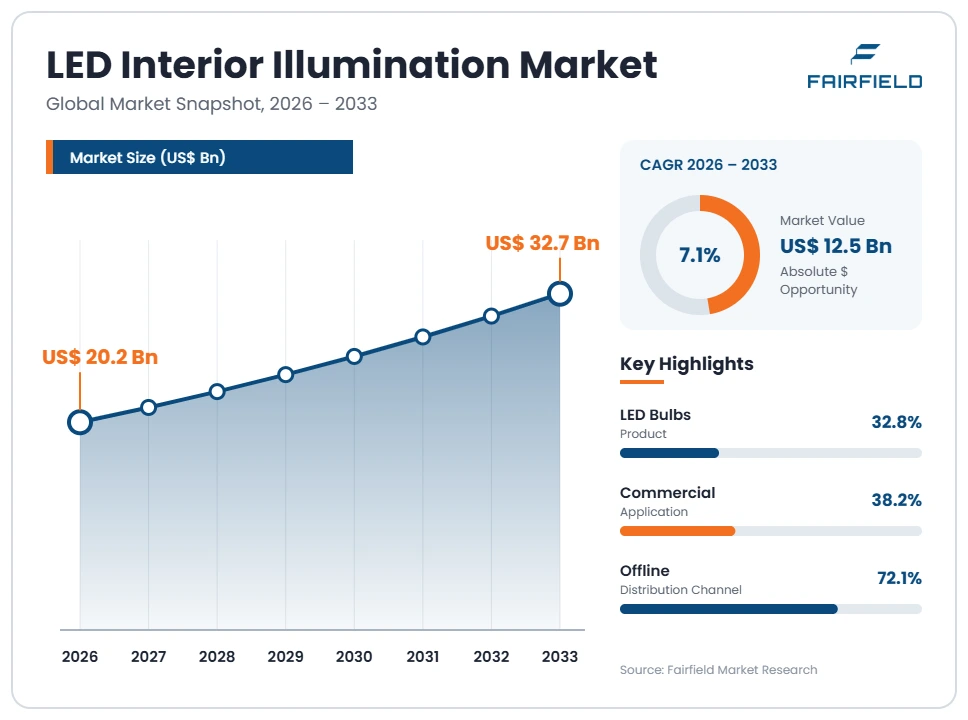
The global LED interior illumination market size is expected to be valued at US$ 20.2 billion in 2026 and projected to reach US$ 32.7 billion by 2033, growing at a CAGR of 7.1% between 2026 and 2033.
Between 2020 and 2025, the market grew at a CAGR of about 8.2%, rising from roughly US$ 12.6 billion to about US$ 18.7 billion, as governments phased out fluorescent and incandescent lamps, LED prices kept falling, and building owners upgraded lighting to cut energy bills. The LED interior illumination market covers LED bulbs, tubes, panels, downlights, strips, and luminaires, along with drivers and controls, used to light indoor spaces. These products serve homes, offices, shops, hotels, hospitals, schools, factories, and vehicle cabins, and they include smart and connected systems that adjust brightness and color. They are sold through electrical wholesalers, retailers, contractors, and online stores for new buildings and retrofits. In November 2026, Signify upgraded its Interact connected lighting system with AI and smart fault detection.
Key Report Takeaways
- By Product: LED Bulbs held about 32.8% share in 2025, while LED Strips are projected to expand at a 10.4% CAGR through 2033, driven by accent and cove lighting in homes, shops, and hotels, flexible installation, and smart color-changing features.
- By Application: Commercial held about 38.2% share in 2025, while Automotive is projected to expand at a 9.6% CAGR through 2033, driven by ambient cabin lighting in electric vehicles, premium interior design, and intelligent RGB LEDs that change color and brightness.
- By Distribution Channel: Offline held about 72.1% share in 2025, while Online is projected to expand at a 13.4% CAGR through 2033, driven by e-commerce growth, smart home product sales, easy price comparison, and direct-to-consumer brands.
- By Region: North America held about 32.4% share in 2025, while Asia Pacific is projected to expand at a 9.2% CAGR through 2033, driven by construction growth in China and India, energy efficiency programs, and large local production.
Global LED Interior Illumination Market Trends and Insights
Drivers Impact Analysis
Two drivers carry the strongest influence on LED interior illumination market demand during the forecast period.
| Driver | Impact on CAGR Forecast | Geographic Relevance | Impact Timeline |
| Energy efficiency rules and fluorescent phase-outs | High | Global, with focus on Europe and North America | Medium term (2-4 years) |
| Smart buildings and connected lighting | High | North America, Europe, Asia Pacific | Long term (≥4 years) |
Energy Efficiency Rules Are Driving the LED Interior Illumination Market
Energy efficiency rules and fluorescent phase-outs are the strongest drivers of the LED interior illumination market. Old lamps are being banned.
The mechanism is that LED lighting uses far less electricity than incandescent, halogen, and fluorescent lamps and lasts many times longer. The European Union has phased out most fluorescent tubes and compact fluorescent lamps under its mercury rules, and the United States has set efficiency standards that removed most incandescent bulbs. Many countries in Asia Pacific and Latin America have similar programs. Building owners upgrade to LEDs to cut energy costs and meet carbon targets. Lighting makes up a large share of building electricity use, so savings are significant. Utility rebates, green building codes, and energy performance certificates also push landlords and public agencies to replace old lamps quickly with efficient LED products.
Smart Buildings and Connected Lighting Are Expanding the LED Interior Illumination Market
Smart buildings and connected lighting are expanding the LED interior illumination market. Lighting is becoming part of building systems.
The cause is that connected LED luminaires with sensors, wireless controls, and software can dim lights when rooms are empty, adjust to daylight, track space use, and support building management. About 22% of the commercial installed base used smart LED fixtures in 2025. Signify launched next-generation Interact solutions at Light + Building 2026 and added AI fault detection in November 2026. Smart home brands such as Philips Hue and WiZ let users control color and scenes by phone or voice. These systems raise value per installation. Wireless controls also make retrofits easier, because new sensors and switches can be added without rewiring, which lowers project costs for older offices, schools, and hospitals.
Restraints Impact Analysis
Two restraints limit how quickly the LED interior illumination market grows.
| Restraint | Impact on CAGR Forecast | Geographic Relevance | Impact Timeline |
| Price erosion and intense competition | High | Global | Medium term (2-4 years) |
| Long product life and slow replacement | Medium | North America, Europe | Long term (≥4 years) |
Price Erosion and Competition Slow the LED Interior Illumination Market
Price erosion and intense competition slow the LED interior illumination market. LED products keep getting cheaper.
The problem is that hundreds of manufacturers, many based in China, produce LED bulbs, tubes, and panels at very low prices, and price wars reduce profit margins for all suppliers. Basic LED lamps have become commodity products, so retailers and contractors often choose the lowest price. Low-quality products with poor color, flicker, or short life can harm user trust. Tariffs on imported lighting products raise costs in some markets. These pressures limit value growth even as unit volumes rise, pushing suppliers toward smart systems and services. Large lighting firms have closed plants, cut jobs, and sold older lamp businesses to protect margins, while smaller makers compete mainly on price through online stores.
Long Product Life and Slow Replacement Restrict the LED Interior Illumination Market
Long product life and slow replacement restrict the LED interior illumination market. LEDs do not need frequent changing.
The constraint is that LED lamps and luminaires can last 25,000 to 50,000 hours or more, so once a building has switched to LEDs, it may not buy new lighting for many years. As the share of LED lighting in homes and offices rises in North America and Europe, the replacement market shrinks. Slower construction and high interest rates can also delay new projects. Some building owners are unwilling to pay for smart controls without clear savings. These factors limit future demand in mature markets. Suppliers must therefore rely more on new construction, smart upgrades, and design-led lighting, since simple lamp replacement no longer brings the steady yearly sales it once did.
Market Opportunities
Smart Lighting and LED-to-LED Renovation Open a Premium Revenue Pool
Smart lighting and LED-to-LED renovation open a premium revenue pool. Many early LED systems are now being upgraded.
The opportunity comes from replacing first-generation LED fixtures with more efficient, connected, and human-centric lighting that supports wellbeing and productivity. Signify promoted LED-to-LED renovation at EuroShop 2026. Smart lighting as a whole is growing at about 14.2% a year, much faster than the overall market. Lighting-as-a-service contracts, data from sensors, and integration with heating, cooling, and security systems create recurring revenue. Companies that offer connected luminaires, software, and services can earn higher margins than sellers of basic lamps. Circular lighting models that reuse fixtures, upgrade parts, and take back old products also help clients meet sustainability goals and build long-term relationships with suppliers.
Automotive and Asia Pacific Growth Create a Growth Revenue Pool
Automotive and Asia Pacific growth create a growth revenue pool. New uses for interior LEDs are expanding.
The opportunity reflects the rapid spread of ambient interior lighting in electric and premium vehicles, which use dozens of RGB LEDs to light dashboards, doors, footwells, and roofs. ams OSRAM integrated its OSIRE intelligent RGB LED into the NIO ES9. At the same time, new homes, offices, shops, and factories in China, India, Indonesia, and Vietnam are being fitted with LED lighting from the start. Companies that supply automotive-grade LEDs and affordable building fixtures can capture this growth. Government housing programs, smart city projects, and rising middle-class spending on home decor in the region add further demand, while local production keeps prices competitive for builders and households.
Segment Analysis
- By Product: LED Bulbs Lead While LED Strips Grow Fastest
LED Bulbs held about 32.8% share in 2025. LED bulbs replace incandescent and compact fluorescent lamps in standard sockets, making them the easiest and cheapest upgrade for homes, hotels, offices, and small businesses. Low prices, wide availability, and smart bulb options give this product the largest share.
LED Strips are the fastest-growing product, expanding at a 10.4% CAGR through 2033. Flexible strips are used for cove, cabinet, shelf, stair, and accent lighting, and many offer color changing and app control. They are popular in modern homes, retail displays, hotels, restaurants, and vehicle interiors. LED Panels, Downlights, Tubes, and Others form other segments. For the market, strip growth supports decorative and smart lighting sales and higher spending per room.
- By Application: Commercial Leads While Automotive Grows Fastest
Commercial held about 38.2% share in 2025. Offices, shops, hotels, hospitals, schools, and warehouses use large numbers of LED panels, downlights, and linear fixtures, often with smart controls to cut energy use. Long operating hours mean that energy savings from LEDs are largest in commercial buildings, and many companies use lighting upgrades to meet carbon targets. Retail stores also use LED lighting to highlight products and create attractive shopping spaces.
Automotive is the fastest-growing application, expanding at a 9.6% CAGR through 2033. Electric and premium vehicles use ambient LED lighting with many colors to improve comfort, style, and safety. Residential and Industrial form other segments. Automakers in China, Germany, and South Korea offer interior lighting with dozens or even hundreds of LEDs. Residential buyers use LED bulbs, downlights, and strips in living rooms, kitchens, and bedrooms, while industrial users need durable high-bay fixtures. For the market, automotive growth raises demand for high-value LEDs.
- By Distribution Channel: Offline Leads While Online Grows Fastest
Offline held about 72.1% share in 2025. Electrical wholesalers, lighting showrooms, home improvement stores, and contractors handle most commercial projects and many household purchases, offering advice, installation, and support. Large projects need lighting design, product samples, and on-site help, which favors offline channels and specialist distributors that can deliver complete lighting packages on time.
Online is the fastest-growing channel, expanding at a 13.4% CAGR through 2033. E-commerce platforms, brand websites, and smart home stores make it easy to compare prices and buy bulbs, strips, and smart lighting kits. Many direct-to-consumer brands sell smart bulbs and strips only online, often with subscription apps and voice control. For the market, online growth widens reach to homeowners and small businesses.
Geography Analysis
- Which Region Is Leading the LED Interior Illumination Market?
North America is leading the LED interior illumination market with about 32.4% share in 2025, worth about US$ 6.1 billion. The United States has strict lighting efficiency rules, a large commercial building stock, and strong demand for smart lighting and controls. Acuity, Signify through Cooper Lighting Solutions, Cree Lighting, and Hubbell are major suppliers. Utility rebates and state energy codes support LED upgrades in many buildings. Key barriers include tariffs on imports. Canada and Mexico add steady demand. One change shaping the region is growth in connected lighting and controls for offices, schools, and hospitals.
- LED Interior Illumination Market in Europe
Europe is a large LED interior illumination market. Germany, the United Kingdom, France, Italy, and the Netherlands have strict energy rules, and the European Union has phased out most fluorescent lamps. Signify, ams OSRAM, Zumtobel, Trilux, and Fagerhult are strong suppliers. Building renovation programs and carbon targets support upgrades to efficient lighting in offices, schools, and homes. Key barriers include slow construction and high energy costs for manufacturers in the region. Strong lighting design culture supports premium fixtures. One change shaping the region is LED-to-LED renovation with smart controls and circular products.
- Which Region Is Growing Fastest in the LED Interior Illumination Market?
Asia Pacific is the fastest-growing region in the LED interior illumination market, expanding at a 9.2% CAGR through 2033, and holds about 26.3% share. China is the world's largest producer of LED chips and fixtures, with brands such as Opple and NVC. India is growing quickly with government LED programs, smart city projects, and new construction, and Havells is a strong local supplier. Japan and South Korea add advanced LED technology from Nichia, Panasonic, and Samsung. Key barriers include price competition and low margins. One change shaping the region is smart home growth in large cities.
- LED Interior Illumination Market in Latin America
Latin America is a growing LED interior illumination market. Brazil, Mexico, Chile, and Colombia are replacing older lamps with LEDs to cut electricity costs, supported by efficiency labels and utility programs. New shopping centers, hotels, offices, and homes add steady demand. Imports from China supply many low-cost products sold through hardware stores and online shops. Key barriers include currency swings, high import duties, and strong price sensitivity among buyers. Rising use of smart home devices in large cities also supports connected bulbs and strips. One opportunity is affordable LED panels, bulbs, and strips for homes and small businesses.
- LED Interior Illumination Market in Middle East & Africa
Middle East & Africa is a developing LED interior illumination market. Saudi Arabia and the United Arab Emirates are building new cities, hotels, offices, airports, and shopping malls with modern LED lighting and smart controls for comfort and energy savings. South Africa, Egypt, and Nigeria are using LEDs to reduce power demand during electricity shortages and high power prices. Hotels and malls in Dubai and Riyadh use decorative lighting to attract visitors. Key barriers include low-quality imports, price competition, and limited local manufacturing. One opportunity is premium architectural and smart lighting for large new city and tourism projects.
Competitive Landscape
The LED interior illumination market is fragmented. Signify, Acuity, ams OSRAM, Cree Lighting, and Zumtobel are leading players, while Hubbell, Samsung, Panasonic, Nichia, Legrand, Havells, and Opple compete strongly. Signify is the largest supplier with about 8.4% share in 2025, followed by Acuity at about 6.2% and ams OSRAM at about 5.8%. Hundreds of smaller makers, many in China, supply many low-cost bulbs, tubes, panels, and strips through wholesalers, retailers, and online platforms, keeping strong pressure on prices.
Companies in this market mainly compete on energy efficiency, light quality, color rendering, product life, design, smart controls and software, compatibility with building systems, certifications, distribution reach, project support, warranty, and price. Strong and lasting relationships with lighting designers, contractors, wholesalers, and automakers are very important. Large suppliers also offer free design tools, energy audits, and financing to win major building projects, while chip makers compete on brightness, efficiency, and reliability.
Strategic moves show how competition is changing. Signify launched next-generation Interact solutions in March 2026, created the Xitanium driver brand in July 2026, and added AI fault detection in November 2026, while ams OSRAM reported growth in LED chips in November 2026. These moves show a clear shift toward software, services, and components with higher margins.
Three themes shape vendor strategy. First, suppliers are adding smart controls and software. Second, they are promoting renovation projects. Third, they are growing automotive LED sales.
LED Interior Illumination Market Industry Leaders
- Signify N.V.
- Acuity Inc.
- ams OSRAM AG
- Cree Lighting (IDEAL Industries)
- Zumtobel Group AG
Recent Industry Developments
- November 2026: ams OSRAM reported third-quarter 2026 revenues of EUR 829 million, with its Opto Semiconductors unit, which makes LEDs and lasers, growing 9% - signals stronger LED demand.
- November 2026: Signify upgraded its Interact intelligent lighting systems with AI and smart fault detection - adds predictive maintenance to connected lighting.
- July 2026: Signify announced it would elevate Xitanium to a standalone brand for its OEM LED drivers from August 2026 - strengthens its components business.
- March 2026: Signify introduced next-generation Interact solutions for intelligent buildings and cities at Light + Building 2026 in Frankfurt - expands smart building lighting.
Companies Covered in the Report
- Signify N.V.
- Acuity Inc.
- ams OSRAM AG
- Cree Lighting (IDEAL Industries)
- Zumtobel Group AG
- Hubbell Incorporated
- Samsung Electronics Co., Ltd.
- Panasonic Holdings Corporation
- Nichia Corporation
- Legrand SA
- Havells India Limited
- Opple Lighting Co., Ltd.
LED Interior Illumination Market Report Scope
| Metric | Value |
| Study Period | 2020-2033 |
| Market Size 2026 | US$ 20.2 Billion |
| Market Size 2033 | US$ 32.7 Billion |
| CAGR 2026-2033 | 7.1% |
| Absolute Dollar Opportunity | US$ 12.5 Billion |
| Largest Market | North America |
| Fastest-Growing Market | Asia Pacific |
| Market Concentration | Fragmented |
| Major Players | Signify N.V., Acuity Inc., ams OSRAM AG, Cree Lighting (IDEAL Industries), Zumtobel Group AG |
LED Interior Illumination Market Segmentation
Product
- LED Bulbs
- LED Strips
- LED Panels
- LED Downlights
- LED Tubes
- Others
Application
- Residential
- Commercial
- Industrial
- Automotive
Distribution Channel
- Offline
- Online
Regions
- North America
- Europe
- Asia Pacific
- Latin America
- Middle East & Africa
- Executive Summary
- LED Interior Illumination Market Snapshot
- Future Projections
- Key Market Trends
- Regional Snapshot
- Market Overview
- Market Definition and Report Scope
- Historical Market Trends
- Market Dynamics
- Drivers
- Energy Efficiency Rules Are Driving the LED Interior Illumination Market
- Smart Buildings and Connected Lighting Are Expanding the LED Interior Illumination Market
- Restraints
- Price Erosion and Competition Slow the LED Interior Illumination Market
- Long Product Life and Slow Replacement Restrict the LED Interior Illumination Market
- Market Opportunities
- Smart Lighting and LED-to-LED Renovation Open a Premium Revenue Pool
- Automotive and Asia Pacific Growth Create a Growth Revenue Pool
- Drivers
- Global LED Interior Illumination Market Outlook, 2020–2033
- Global LED Interior Illumination Market Outlook, by Product, Value (US$ Billion), 2020–2033
- LED Bulbs
- LED Strips
- LED Panels
- LED Downlights
- LED Tubes
- Others
- Global LED Interior Illumination Market Outlook, by Application, Value (US$ Billion), 2020–2033
- Residential
- Commercial
- Industrial
- Automotive
- Global LED Interior Illumination Market Outlook, by Distribution Channel, Value (US$ Billion), 2020–2033
- Offline
- Online
- Global LED Interior Illumination Market Outlook, by Region, Value (US$ Billion), 2020–2033
- North America
- Europe
- Asia Pacific
- Latin America
- Middle East & Africa
- Global LED Interior Illumination Market Outlook, by Product, Value (US$ Billion), 2020–2033
- North America LED Interior Illumination Market Outlook, 2020–2033
- North America LED Interior Illumination Market Outlook, by Product, Value (US$ Billion), 2020–2033
- LED Bulbs
- LED Strips
- LED Panels
- LED Downlights
- LED Tubes
- Others
- North America LED Interior Illumination Market Outlook, by Application, Value (US$ Billion), 2020–2033
- Residential
- Commercial
- Industrial
- Automotive
- North America LED Interior Illumination Market Outlook, by Distribution Channel, Value (US$ Billion), 2020–2033
- Offline
- Online
- North America LED Interior Illumination Market Outlook, by Country, Value (US$ Billion), 2020–2033
- United States LED Interior Illumination Market Outlook, by Product, 2020–2033
- United States LED Interior Illumination Market Outlook, by Application, 2020–2033
- United States LED Interior Illumination Market Outlook, by Distribution Channel, 2020–2033
- Canada LED Interior Illumination Market Outlook, by Product, 2020–2033
- Canada LED Interior Illumination Market Outlook, by Application, 2020–2033
- Canada LED Interior Illumination Market Outlook, by Distribution Channel, 2020–2033
- Mexico LED Interior Illumination Market Outlook, by Product, 2020–2033
- Mexico LED Interior Illumination Market Outlook, by Application, 2020–2033
- Mexico LED Interior Illumination Market Outlook, by Distribution Channel, 2020–2033
- North America LED Interior Illumination Market Outlook, by Product, Value (US$ Billion), 2020–2033
- Europe LED Interior Illumination Market Outlook, 2020–2033
- Europe LED Interior Illumination Market Outlook, by Product, Value (US$ Billion), 2020–2033
- LED Bulbs
- LED Strips
- LED Panels
- LED Downlights
- LED Tubes
- Others
- Europe LED Interior Illumination Market Outlook, by Application, Value (US$ Billion), 2020–2033
- Residential
- Commercial
- Industrial
- Automotive
- Europe LED Interior Illumination Market Outlook, by Distribution Channel, Value (US$ Billion), 2020–2033
- Offline
- Online
- Europe LED Interior Illumination Market Outlook, by Country, Value (US$ Billion), 2020–2033
- Germany LED Interior Illumination Market Outlook, by Product, 2020–2033
- Germany LED Interior Illumination Market Outlook, by Application, 2020–2033
- Germany LED Interior Illumination Market Outlook, by Distribution Channel, 2020–2033
- United Kingdom LED Interior Illumination Market Outlook, by Product, 2020–2033
- United Kingdom LED Interior Illumination Market Outlook, by Application, 2020–2033
- United Kingdom LED Interior Illumination Market Outlook, by Distribution Channel, 2020–2033
- France LED Interior Illumination Market Outlook, by Product, 2020–2033
- France LED Interior Illumination Market Outlook, by Application, 2020–2033
- France LED Interior Illumination Market Outlook, by Distribution Channel, 2020–2033
- Italy LED Interior Illumination Market Outlook, by Product, 2020–2033
- Italy LED Interior Illumination Market Outlook, by Application, 2020–2033
- Italy LED Interior Illumination Market Outlook, by Distribution Channel, 2020–2033
- Netherlands LED Interior Illumination Market Outlook, by Product, 2020–2033
- Netherlands LED Interior Illumination Market Outlook, by Application, 2020–2033
- Netherlands LED Interior Illumination Market Outlook, by Distribution Channel, 2020–2033
- Europe LED Interior Illumination Market Outlook, by Product, Value (US$ Billion), 2020–2033
- Asia Pacific LED Interior Illumination Market Outlook, 2020–2033
- Asia Pacific LED Interior Illumination Market Outlook, by Product, Value (US$ Billion), 2020–2033
- LED Bulbs
- LED Strips
- LED Panels
- LED Downlights
- LED Tubes
- Others
- Asia Pacific LED Interior Illumination Market Outlook, by Application, Value (US$ Billion), 2020–2033
- Residential
- Commercial
- Industrial
- Automotive
- Asia Pacific LED Interior Illumination Market Outlook, by Distribution Channel, Value (US$ Billion), 2020–2033
- Offline
- Online
- Asia Pacific LED Interior Illumination Market Outlook, by Country, Value (US$ Billion), 2020–2033
- China LED Interior Illumination Market Outlook, by Product, 2020–2033
- China LED Interior Illumination Market Outlook, by Application, 2020–2033
- China LED Interior Illumination Market Outlook, by Distribution Channel, 2020–2033
- India LED Interior Illumination Market Outlook, by Product, 2020–2033
- India LED Interior Illumination Market Outlook, by Application, 2020–2033
- India LED Interior Illumination Market Outlook, by Distribution Channel, 2020–2033
- Japan LED Interior Illumination Market Outlook, by Product, 2020–2033
- Japan LED Interior Illumination Market Outlook, by Application, 2020–2033
- Japan LED Interior Illumination Market Outlook, by Distribution Channel, 2020–2033
- South Korea LED Interior Illumination Market Outlook, by Product, 2020–2033
- South Korea LED Interior Illumination Market Outlook, by Application, 2020–2033
- South Korea LED Interior Illumination Market Outlook, by Distribution Channel, 2020–2033
- Asia Pacific LED Interior Illumination Market Outlook, by Product, Value (US$ Billion), 2020–2033
- Latin America LED Interior Illumination Market Outlook, 2020–2033
- Latin America LED Interior Illumination Market Outlook, by Product, Value (US$ Billion), 2020–2033
- LED Bulbs
- LED Strips
- LED Panels
- LED Downlights
- LED Tubes
- Others
- Latin America LED Interior Illumination Market Outlook, by Application, Value (US$ Billion), 2020–2033
- Residential
- Commercial
- Industrial
- Automotive
- Latin America LED Interior Illumination Market Outlook, by Distribution Channel, Value (US$ Billion), 2020–2033
- Offline
- Online
- Latin America LED Interior Illumination Market Outlook, by Country, Value (US$ Billion), 2020–2033
- Brazil LED Interior Illumination Market Outlook, by Product, 2020–2033
- Brazil LED Interior Illumination Market Outlook, by Application, 2020–2033
- Brazil LED Interior Illumination Market Outlook, by Distribution Channel, 2020–2033
- Mexico LED Interior Illumination Market Outlook, by Product, 2020–2033
- Mexico LED Interior Illumination Market Outlook, by Application, 2020–2033
- Mexico LED Interior Illumination Market Outlook, by Distribution Channel, 2020–2033
- Chile LED Interior Illumination Market Outlook, by Product, 2020–2033
- Chile LED Interior Illumination Market Outlook, by Application, 2020–2033
- Chile LED Interior Illumination Market Outlook, by Distribution Channel, 2020–2033
- Colombia LED Interior Illumination Market Outlook, by Product, 2020–2033
- Colombia LED Interior Illumination Market Outlook, by Application, 2020–2033
- Colombia LED Interior Illumination Market Outlook, by Distribution Channel, 2020–2033
- China LED Interior Illumination Market Outlook, by Product, 2020–2033
- China LED Interior Illumination Market Outlook, by Application, 2020–2033
- China LED Interior Illumination Market Outlook, by Distribution Channel, 2020–2033
- Latin America LED Interior Illumination Market Outlook, by Product, Value (US$ Billion), 2020–2033
- Middle East & Africa LED Interior Illumination Market Outlook, 2020–2033
- Middle East & Africa LED Interior Illumination Market Outlook, by Product, Value (US$ Billion), 2020–2033
- LED Bulbs
- LED Strips
- LED Panels
- LED Downlights
- LED Tubes
- Others
- Middle East & Africa LED Interior Illumination Market Outlook, by Application, Value (US$ Billion), 2020–2033
- Residential
- Commercial
- Industrial
- Automotive
- Middle East & Africa LED Interior Illumination Market Outlook, by Distribution Channel, Value (US$ Billion), 2020–2033
- Offline
- Online
- Middle East & Africa LED Interior Illumination Market Outlook, by Country, Value (US$ Billion), 2020–2033
- Saudi Arabia LED Interior Illumination Market Outlook, by Product, 2020–2033
- Saudi Arabia LED Interior Illumination Market Outlook, by Application, 2020–2033
- Saudi Arabia LED Interior Illumination Market Outlook, by Distribution Channel, 2020–2033
- United Arab Emirates LED Interior Illumination Market Outlook, by Product, 2020–2033
- United Arab Emirates LED Interior Illumination Market Outlook, by Application, 2020–2033
- United Arab Emirates LED Interior Illumination Market Outlook, by Distribution Channel, 2020–2033
- South Africa LED Interior Illumination Market Outlook, by Product, 2020–2033
- South Africa LED Interior Illumination Market Outlook, by Application, 2020–2033
- South Africa LED Interior Illumination Market Outlook, by Distribution Channel, 2020–2033
- Egypt LED Interior Illumination Market Outlook, by Product, 2020–2033
- Egypt LED Interior Illumination Market Outlook, by Application, 2020–2033
- Egypt LED Interior Illumination Market Outlook, by Distribution Channel, 2020–2033
- Nigeria LED Interior Illumination Market Outlook, by Product, 2020–2033
- Nigeria LED Interior Illumination Market Outlook, by Application, 2020–2033
- Nigeria LED Interior Illumination Market Outlook, by Distribution Channel, 2020–2033
- Middle East & Africa LED Interior Illumination Market Outlook, by Product, Value (US$ Billion), 2020–2033
- Competitive Landscape
- LED Interior Illumination Market Industry Leaders
- Recent Industry Developments
- Company Profiles
- Signify N.V.
- Acuity Inc.
- ams OSRAM AG
- Cree Lighting (IDEAL Industries)
- Zumtobel Group AG
- Hubbell Incorporated
- Samsung Electronics Co., Ltd.
- Panasonic Holdings Corporation
- Nichia Corporation
- Legrand SA
- Havells India Limited
- Opple Lighting Co., Ltd.
- Appendix
- Research Methodology
- Report Assumptions
- Acronyms and Abbreviations
Product
- LED Bulbs
- LED Strips
- LED Panels
- LED Downlights
- LED Tubes
- Others
Application
- Residential
- Commercial
- Industrial
- Automotive
Distribution Channel
- Offline
- Online
Regions
- North America
- Europe
- Asia Pacific
- Latin America
- Middle East & Africa
Our Research Methodology
Considering the volatility of business today, traditional approaches to strategizing a game plan can be unfruitful if not detrimental. True ambiguity is no way to determine a forecast. A myriad of predetermined factors must be accounted for such as the degree of risk involved, the magnitude of circumstances, as well as conditions or consequences that are not known or unpredictable. To circumvent binary views that cast uncertainty, the application of market research intelligence to strategically posture, move, and enable actionable outcomes is necessary.
View Methodology
Quality Assured
Rigorous Validation Process

Confidentiality Assured
End-to-end Data Security

Custom Research Services
Tailored To Your Objectives
FAQs
The global LED interior illumination market is expected to be valued at US$ 20.2 billion in 2026, driven by efficiency rules and smart lighting.
The market is projected to grow at a 7.1% CAGR from 2026 to 2033, reaching about US$ 32.7 billion by 2033.
North America leads with about 32.4% share, supported by strict efficiency rules, large commercial buildings, and strong smart lighting demand.
Asia Pacific is growing fastest at a 9.2% CAGR, driven by construction in China and India and large local LED production.
Key players include Signify, Acuity, ams OSRAM, Cree Lighting, and Zumtobel, competing on efficiency, light quality, smart controls, and price.
Related Reports
Europe Refurbished and Used Mobile Phones Market Size, Share, Insights, Competitive Landscape, and Forecast 2026 to 2033
Europe’s refurbished and used mobile phones market is projected to grow from US$26.8 billion in 2026 to US$55.3 billion by 2033 at a CAGR of 10.9%.
ESG Rating Services Market Size, Share, Insights, Competitive Landscape, and Forecast 2026 to 2033
The ESG rating services market is projected to grow from US$11.8 billion in 2026 to US$20.5 billion by 2033, registering a CAGR of 8.3% during the forecast period.
Console Game Market Size, Share, Insights, Competitive Landscape, and Forecast 2026 to 2033
The console game market is projected to grow from US$30.0 billion in 2026 to US$47.6 billion by 2033, registering a CAGR of 6.8% during the forecast period.
Cinema Ticketing Systems Market Size, Share, Insights, Competitive Landscape, and Forecast 2026 to 2033
The cinema ticketing systems market is projected to grow from US$3.90 billion in 2026 to US$7.80 billion by 2033, registering a CAGR of 10.4%.
RegTech Market Size, Share, Insights, Competitive Landscape, and Forecast 2026 to 2033
Explore the RegTech Market, valued at US$15.2 billion in 2026 and forecast to reach US$48.4 billion by 2033, growing at an 18.0% CAGR.
Robot Vacuum Cleaners Market Size, Share, Insights, Competitive Landscape, and Forecast 2026 to 2033
Robot vacuum cleaners market is projected to grow from US$12.4 billion in 2026 to US$29.5 billion by 2033, expanding at a CAGR of 13.2%.