



Limit Switch Market
Limit Switch Market Insights, Competitive Landscape, and Market Forecast - 2033
Global Limit Switch Market Forecast
The Limit Switch Market is expected to grow from USD 2.4 Billion in 2026 to USD 3.6 Billion by 2033, reflecting strong industry expansion and registering a CAGR of 6.1% during the forecast period from 2026 to 2033.
Quick Report Digest
- Global limit switch market size expects over 1.6x revenue expansion from 2024 to 2031.
- Growth drivers include increasing industrial automation, technological advancements, and stringent safety regulations.
- Key trends include integration of IoT and Industry 4.0 tech, focus on miniaturisation and energy efficiency, and expansion in emerging markets.
- Regulatory environment shapes market dynamics, emphasizing safety standards, environmental regulations, and industry-specific requirements.
- Top market segments include compact limit switches, hazardous location limit switches, and heavy-duty limit switches.
- Regional frontrunners are Asia Pacific, North America, and Europe, driven by industrial growth and safety regulations.
- Leading companies in the global limit switch market include Honeywell, Schneider Electric, ABB, Eaton, Siemens, and OMRON.
- Significant company developments include product innovations, strategic partnerships, and distribution agreements.
- Rising industrial automation, technological advancements, expansion into emerging markets, and focus on safety and compliance are key factors driving market growth.
- Market segmentation includes product types (compact, hazardous location, heavy-duty), operations, actuators, end uses, and regions.
A Look Back and a Look Forward - Comparative Analysis
The limit switch market experienced a positive trajectory from 2019 to 2023. This growth can likely be attributed to factors like increasing automation across industries and the rise of smart factories. Looking at the breakdown, heavy-duty precision and miniature enclosed reed switches were likely major contributors due to their suitability for demanding industrial environments.
Sectors like manufacturing and automotive likely led the application growth, driven by the need for precise positioning and control in production lines. However, the coming years (2024-2031) are expected to see an acceleration in this market. The continued expansion of automation, along with advancements in Internet of Things (IoT) integration, are expected to be key drivers.
Rising investments in renewable energy and growing demand for electric vehicles will likely create additional opportunities for limit switch application. The market is also anticipated to witness a surge in research and development, with a focus on miniaturisation, improved durability, and wireless connectivity. This will likely lead to the emergence of new players alongside established ones like ABB, Siemens, and Honeywell, further intensifying competition and innovation within the Limit Switch market.
Key Growth Determinants
Expanding Adoption of Industrial Automation
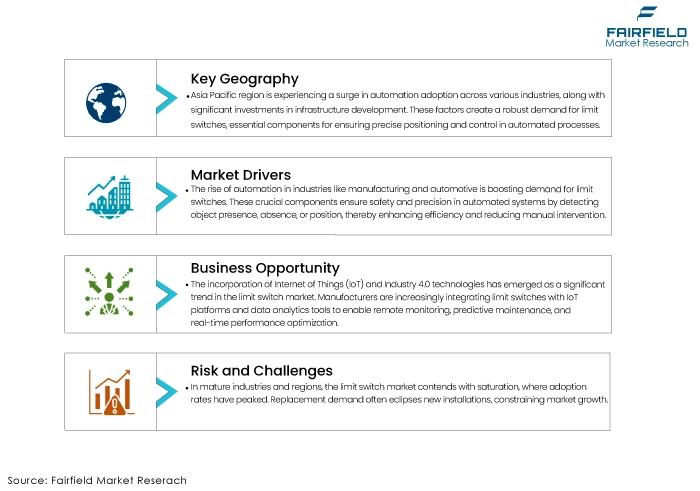
The increasing adoption of automated processes across various industries such as manufacturing, automotive, and packaging drives the demand for limit switches. These switches play a critical role in ensuring safety and precision in automated systems by detecting the presence, absence, or position of objects, thereby enhancing operational efficiency and reducing manual intervention.
Technological Advancements
Ongoing advancements in sensor technology, including the development of more robust and reliable limit switches with features like higher accuracy, longer lifespan, and enhanced connectivity, propel market growth. Integration of IoT capabilities and wireless communication further augments the functionality of limit switches, enabling remote monitoring and control, predictive maintenance, and real-time data analysis.
Safety and Compliance Regulations
Stringent safety regulations imposed by governments and industry standards regarding machine safety and personnel protection drive the demand for limit switches. These switches are integral components of safety systems, preventing accidents and ensuring compliance with regulatory requirements. The increasing emphasis on workplace safety and risk mitigation fuels the adoption of limit switches across diverse industrial sectors, thereby stimulating market growth.
Major Growth Barriers
Market Saturation
The limit switch market faces challenges associated with market saturation in mature industries and regions where adoption rates have plateaued. In these areas, the replacement demand may overshadow new installations, limiting overall market expansion.
Price Competition
Intense competition among market players often leads to price wars, particularly in commoditised segments of the limit switch market. Price pressures can erode profit margins and hinder investments in research and development, impacting product innovation and differentiation.
Impact of COVID-19
The COVID-19 pandemic has disrupted global supply chains, manufacturing operations, and project timelines, leading to project delays and cancellations in various industries. Uncertainties related to economic recovery and fluctuating demand across sectors further dampen market growth prospects, as businesses prioritise cost-cutting measures over capital expenditures on automation equipment like limit switches.
Key Trends and Opportunities to Look at
- Integration of IoT, and Industry 4.0 Technologies
The incorporation of Internet of Things (IoT), and Industry 4.0 technologies has emerged as a significant trend in the limit switch market. Manufacturers are increasingly integrating limit switches with IoT platforms and data analytics tools to enable remote monitoring, predictive maintenance, and real-time performance optimisation.
By connecting limit switches to centralised control systems, companies can enhance operational visibility, improve equipment uptime, and reduce maintenance costs through predictive analytics-driven maintenance scheduling. This trend aligns with the broader industry shift towards smart factories and connected industrial ecosystems, driving demand for advanced limit switches capable of seamless integration with digital infrastructure.
- Focus on Miniaturisation, and Energy Efficiency
Another notable trend in the limit switch market is the growing emphasis on miniaturisation and energy efficiency. As manufacturers seek to optimise space utilisation and reduce energy consumption in industrial equipment and machinery, there is a rising demand for compact, low-power limit switches with high sensitivity and precision.
Miniaturised limit switches offer advantages such as reduced footprint, simplified installation, and enhanced flexibility in design integration, making them particularly suitable for applications with space constraints or energy-saving requirements.
Additionally, advancements in materials and sensor technologies enable the development of energy-efficient limit switches that consume minimal power while maintaining reliable performance, catering to the sustainability goals of industries worldwide.
- Expansion in Developing Regions
One of the significant opportunities for limit switch market players lies in expanding their presence in emerging markets across Asia-Pacific, Latin America, and Africa. These regions are witnessing rapid industrialisation, driven by urbanisation, infrastructure development, and growing investments in manufacturing sectors.
As industries in these markets embrace automation and digitisation to improve productivity and competitiveness, there is a growing demand for reliable automation components like limit switches. By strategically targeting emerging markets and establishing local partnerships, manufacturers can capitalise on the burgeoning opportunities and gain a competitive edge in these high-growth regions.
How Does the Regulatory Scenario Shape this Industry?
The regulatory environment plays a critical role in shaping the Limit Switch market. Stringent safety standards, especially in developed nations, drive the demand for advanced limit switches with features like explosion-proof housing or self-diagnostics. These regulations ensure worker safety by preventing equipment malfunctions and enforcing safe operational boundaries.
Environmental regulations also play a part, influencing the materials and production processes used in limit switches. Restrictions on hazardous substances might push for eco-friendly alternatives, potentially affecting costs and functionalities. Additionally, regulations promoting energy efficiency can incentivise the use of limit switches that optimise power consumption within industrial setups.
Furthermore, industry-specific regulations dictate the type and functionalities of limit switches required. For instance, the food and beverage industry might require switches with specific washdown capabilities to maintain hygiene standards. Similarly, regulations in the medical device sector might emphasize biocompatibility or sterilisation resistance in the limit switches used within equipment.
The need to comply with these regulations can add to the overall cost of limit switches. Manufacturers might need to invest in certifications, testing procedures, and potentially redesign products to meet these requirements. This can impact market pricing and potentially lead to a consolidation towards established brands with a proven track record of compliance.
Fairfield’s Ranking Board
Top Segments
- Compact Limit Switches Continue to be the Preferred Choice
Compact limit switches represent a top-performing segment in the market due to their versatile applications and space-saving design. These switches are highly sought after in industries where space constraints are a concern, such as automotive assembly lines, conveyor systems, and packaging machinery. Their compact size allows for easy integration into equipment without compromising functionality or performance.
Furthermore, advancements in miniaturisation technology have enabled manufacturers to produce compact limit switches with enhanced sensing capabilities and durability, further driving their adoption across various industrial sectors. With the increasing trend towards automation and the need for smaller, more efficient components, compact limit switches are expected to continue experiencing robust demand, particularly in industries where precision and reliability are paramount.
- Critical Industry Verticals Drive Demand in Hazardous Location Limit Switches Segment
Hazardous location limit switches cater to industries operating in volatile environments where the presence of flammable gases, vapours, or combustible dusts poses a safety risk. These switches are designed to withstand harsh conditions, including extreme temperatures, corrosive substances, and potential explosive atmospheres, making them essential components in oil and gas facilities, chemical processing plants, and mining operations.
The stringent safety regulations governing hazardous environments drive the demand for specialised limit switches that ensure reliable operation and prevent potential hazards. With increased focus on worker safety and regulatory compliance, the market for hazardous location limit switches is expected to witness sustained growth, supported by ongoing industrial activities and investments in safety infrastructure.
- Heavy-Duty Limit Switches
Heavy-duty limit switches are integral components in industries requiring robust and durable equipment for continuous operation under demanding conditions. These switches are commonly utilised in heavy machinery, material handling equipment, and construction machinery, where they endure high mechanical stress, vibration, and harsh environmental factors. The reliability and longevity of heavy-duty limit switches are crucial for maintaining operational efficiency and preventing costly downtime in industrial settings.
Manufacturers are continually innovating to enhance the ruggedness and performance of these switches, incorporating features such as sealed enclosures, high-temperature resistance, and heavy-duty actuators to meet the evolving needs of industrial applications. As industries continue to invest in infrastructure development and machinery modernisation, the demand for heavy-duty limit switches is expected to remain strong, driven by their indispensable role in ensuring equipment safety and productivity.
Regional Frontrunners
- Asia Pacific Maintains a Dominant Position
In line with the exponential growth of industrial sectors in China, India, and Japan, the Asia Pacific limit switch market surges ahead with the largest share of the global limit switch market. This region is experiencing a surge in automation adoption across various industries, along with significant investments in infrastructure development. These factors create robust demand for limit switches, essential components for ensuring precise positioning and control in automated processes.
North America, and Europe Represent Mature Markets
North America, being a mature market for limit switches, maintains a steady demand fuelled by established industries like automotive, and manufacturing. However, due to market saturation in specific segments, growth is anticipated to be more incremental compared to the Asian subcontinent.
Driven by stringent safety regulations and a strong focus on industrial modernisation, Europe presents another significant market for limit switches. Here, the demand is expected to be particularly high for advanced safety-focused switches that comply with the latest regulations and ensure worker safety in industrial environments.
Fairfield’s Competitive Landscape Analysis
The competition landscape in the limit switch market is characterised by intense rivalry among key players striving to maintain their market positions and gain a competitive edge through innovation, strategic partnerships, and market expansion. Leading players in the industry include companies such as Omron Corporation, Honeywell International Inc., Schneider Electric SE, ABB Ltd., Eaton Corporation, and Panasonic Corporation.
These companies employ various growth strategies to enhance their market presence and drive business growth. Major strategies include product innovation and differentiation through the development of advanced and specialised limit switch solutions catering to diverse industry needs.
Additionally, strategic partnerships and collaborations with technology providers, system integrators, and end-users enable companies to expand their customer base and penetrate new markets. Furthermore, investments in research and development, along with a focus on mergers and acquisitions, facilitate market consolidation and bolster competitive advantage, allowing key players to capitalise on emerging opportunities and sustain growth in the dynamic limit switch market.
Who are the Leaders in Global Limit Switch Space?
- Honeywell International Inc
- Schneider Electric
- ABB
- Eaton
- Siemens
- OMRON Corporation
- Crouzet
- BERNSTEIN AG
- Rockwell Automation
- Panasonic
Global Limit Switch Market Segmentation
By Product Type:
- Compact Limit Switches
- Hazardous Location Limit Switches
- Heavy-Duty Limit Switches
By Operation:
- Momentary/Spring Return
- Non-return
By Actuator:
- Roller Actuated
- Plunger Actuated
- Lever Actuated
- Others
By End Use:
- Manufacturing Industry
- Metals & Mining Industry
- Process Industry
- Materials Handling and Transportation Industry
- Others
By Region:
- North America
- Europe
- Asia Pacific
- Latin America
- Middle East & Africa
- Executive Summary
- Global Limit Switch Market Snapshot
- Future Projections
- Key Market Trends
- Regional Snapshot, by Value, 2026
- Analyst Recommendations
- Market Overview
- Market Definitions and Segmentations
- Market Dynamics
- Drivers
- Restraints
- Market Opportunities
- Value Chain Analysis
- COVID-19 Impact Analysis
- Porter's Five Forces Analysis
- Impact of Russia-Ukraine Conflict
- PESTLE Analysis
- Regulatory Analysis
- Price Trend Analysis
- Current Prices and Future Projections, 2025-2033
- Price Impact Factors
- Global Limit Switch Market Outlook, 2020 - 2033
- Global Limit Switch Market Outlook, by Product Type, Value (US$ Bn), 2020-2033
- Compact Limit Switches
- Hazardous Location Limit Switches
- Heavy-Duty Limit Switches
- Global Limit Switch Market Outlook, by Operation, Value (US$ Bn), 2020-2033
- Momentary/Spring Return
- Non-return
- Global Limit Switch Market Outlook, by Actuator, Value (US$ Bn), 2020-2033
- Roller Actuated
- Plunger Actuated
- Lever Actuated
- Others
- Global Limit Switch Market Outlook, by End Use, Value (US$ Bn), 2020-2033
- Manufacturing Industry
- Metals & Mining Industry
- Process Industry
- Materials Handling and Transportation Industry
- Others
- Global Limit Switch Market Outlook, by Region, Value (US$ Bn), 2020-2033
- North America
- Europe
- Asia Pacific
- Latin America
- Middle East & Africa
- Global Limit Switch Market Outlook, by Product Type, Value (US$ Bn), 2020-2033
- North America Limit Switch Market Outlook, 2020 - 2033
- North America Limit Switch Market Outlook, by Product Type, Value (US$ Bn), 2020-2033
- Compact Limit Switches
- Hazardous Location Limit Switches
- Heavy-Duty Limit Switches
- North America Limit Switch Market Outlook, by Operation, Value (US$ Bn), 2020-2033
- Momentary/Spring Return
- Non-return
- North America Limit Switch Market Outlook, by Actuator, Value (US$ Bn), 2020-2033
- Roller Actuated
- Plunger Actuated
- Lever Actuated
- Others
- North America Limit Switch Market Outlook, by End Use, Value (US$ Bn), 2020-2033
- Manufacturing Industry
- Metals & Mining Industry
- Process Industry
- Materials Handling and Transportation Industry
- Others
- North America Limit Switch Market Outlook, by Country, Value (US$ Bn), 2020-2033
- U.S. Limit Switch Market Outlook, by Product Type, 2020-2033
- U.S. Limit Switch Market Outlook, by Operation, 2020-2033
- U.S. Limit Switch Market Outlook, by Actuator, 2020-2033
- U.S. Limit Switch Market Outlook, by End Use, 2020-2033
- Canada Limit Switch Market Outlook, by Product Type, 2020-2033
- Canada Limit Switch Market Outlook, by Operation, 2020-2033
- Canada Limit Switch Market Outlook, by Actuator, 2020-2033
- Canada Limit Switch Market Outlook, by End Use, 2020-2033
- BPS Analysis/Market Attractiveness Analysis
- North America Limit Switch Market Outlook, by Product Type, Value (US$ Bn), 2020-2033
- Europe Limit Switch Market Outlook, 2020 - 2033
- Europe Limit Switch Market Outlook, by Product Type, Value (US$ Bn), 2020-2033
- Compact Limit Switches
- Hazardous Location Limit Switches
- Heavy-Duty Limit Switches
- Europe Limit Switch Market Outlook, by Operation, Value (US$ Bn), 2020-2033
- Momentary/Spring Return
- Non-return
- Europe Limit Switch Market Outlook, by Actuator, Value (US$ Bn), 2020-2033
- Roller Actuated
- Plunger Actuated
- Lever Actuated
- Others
- Europe Limit Switch Market Outlook, by End Use, Value (US$ Bn), 2020-2033
- Manufacturing Industry
- Metals & Mining Industry
- Process Industry
- Materials Handling and Transportation Industry
- Others
- Europe Limit Switch Market Outlook, by Country, Value (US$ Bn), 2020-2033
- Germany Limit Switch Market Outlook, by Product Type, 2020-2033
- Germany Limit Switch Market Outlook, by Operation, 2020-2033
- Germany Limit Switch Market Outlook, by Actuator, 2020-2033
- Germany Limit Switch Market Outlook, by End Use, 2020-2033
- Italy Limit Switch Market Outlook, by Product Type, 2020-2033
- Italy Limit Switch Market Outlook, by Operation, 2020-2033
- Italy Limit Switch Market Outlook, by Actuator, 2020-2033
- Italy Limit Switch Market Outlook, by End Use, 2020-2033
- France Limit Switch Market Outlook, by Product Type, 2020-2033
- France Limit Switch Market Outlook, by Operation, 2020-2033
- France Limit Switch Market Outlook, by Actuator, 2020-2033
- France Limit Switch Market Outlook, by End Use, 2020-2033
- U.K. Limit Switch Market Outlook, by Product Type, 2020-2033
- U.K. Limit Switch Market Outlook, by Operation, 2020-2033
- U.K. Limit Switch Market Outlook, by Actuator, 2020-2033
- U.K. Limit Switch Market Outlook, by End Use, 2020-2033
- Spain Limit Switch Market Outlook, by Product Type, 2020-2033
- Spain Limit Switch Market Outlook, by Operation, 2020-2033
- Spain Limit Switch Market Outlook, by Actuator, 2020-2033
- Spain Limit Switch Market Outlook, by End Use, 2020-2033
- Russia Limit Switch Market Outlook, by Product Type, 2020-2033
- Russia Limit Switch Market Outlook, by Operation, 2020-2033
- Russia Limit Switch Market Outlook, by Actuator, 2020-2033
- Russia Limit Switch Market Outlook, by End Use, 2020-2033
- Rest of Europe Limit Switch Market Outlook, by Product Type, 2020-2033
- Rest of Europe Limit Switch Market Outlook, by Operation, 2020-2033
- Rest of Europe Limit Switch Market Outlook, by Actuator, 2020-2033
- Rest of Europe Limit Switch Market Outlook, by End Use, 2020-2033
- BPS Analysis/Market Attractiveness Analysis
- Europe Limit Switch Market Outlook, by Product Type, Value (US$ Bn), 2020-2033
- Asia Pacific Limit Switch Market Outlook, 2020 - 2033
- Asia Pacific Limit Switch Market Outlook, by Product Type, Value (US$ Bn), 2020-2033
- Compact Limit Switches
- Hazardous Location Limit Switches
- Heavy-Duty Limit Switches
- Asia Pacific Limit Switch Market Outlook, by Operation, Value (US$ Bn), 2020-2033
- Momentary/Spring Return
- Non-return
- Asia Pacific Limit Switch Market Outlook, by Actuator, Value (US$ Bn), 2020-2033
- Roller Actuated
- Plunger Actuated
- Lever Actuated
- Others
- Asia Pacific Limit Switch Market Outlook, by End Use, Value (US$ Bn), 2020-2033
- Manufacturing Industry
- Metals & Mining Industry
- Process Industry
- Materials Handling and Transportation Industry
- Others
- Asia Pacific Limit Switch Market Outlook, by Country, Value (US$ Bn), 2020-2033
- China Limit Switch Market Outlook, by Product Type, 2020-2033
- China Limit Switch Market Outlook, by Operation, 2020-2033
- China Limit Switch Market Outlook, by Actuator, 2020-2033
- China Limit Switch Market Outlook, by End Use, 2020-2033
- Japan Limit Switch Market Outlook, by Product Type, 2020-2033
- Japan Limit Switch Market Outlook, by Operation, 2020-2033
- Japan Limit Switch Market Outlook, by Actuator, 2020-2033
- Japan Limit Switch Market Outlook, by End Use, 2020-2033
- South Korea Limit Switch Market Outlook, by Product Type, 2020-2033
- South Korea Limit Switch Market Outlook, by Operation, 2020-2033
- South Korea Limit Switch Market Outlook, by Actuator, 2020-2033
- South Korea Limit Switch Market Outlook, by End Use, 2020-2033
- India Limit Switch Market Outlook, by Product Type, 2020-2033
- India Limit Switch Market Outlook, by Operation, 2020-2033
- India Limit Switch Market Outlook, by Actuator, 2020-2033
- India Limit Switch Market Outlook, by End Use, 2020-2033
- Southeast Asia Limit Switch Market Outlook, by Product Type, 2020-2033
- Southeast Asia Limit Switch Market Outlook, by Operation, 2020-2033
- Southeast Asia Limit Switch Market Outlook, by Actuator, 2020-2033
- Southeast Asia Limit Switch Market Outlook, by End Use, 2020-2033
- Rest of SAO Limit Switch Market Outlook, by Product Type, 2020-2033
- Rest of SAO Limit Switch Market Outlook, by Operation, 2020-2033
- Rest of SAO Limit Switch Market Outlook, by Actuator, 2020-2033
- Rest of SAO Limit Switch Market Outlook, by End Use, 2020-2033
- BPS Analysis/Market Attractiveness Analysis
- Asia Pacific Limit Switch Market Outlook, by Product Type, Value (US$ Bn), 2020-2033
- Latin America Limit Switch Market Outlook, 2020 - 2033
- Latin America Limit Switch Market Outlook, by Product Type, Value (US$ Bn), 2020-2033
- Compact Limit Switches
- Hazardous Location Limit Switches
- Heavy-Duty Limit Switches
- Latin America Limit Switch Market Outlook, by Operation, Value (US$ Bn), 2020-2033
- Momentary/Spring Return
- Non-return
- Latin America Limit Switch Market Outlook, by Actuator, Value (US$ Bn), 2020-2033
- Roller Actuated
- Plunger Actuated
- Lever Actuated
- Others
- Latin America Limit Switch Market Outlook, by End Use, Value (US$ Bn), 2020-2033
- Manufacturing Industry
- Metals & Mining Industry
- Process Industry
- Materials Handling and Transportation Industry
- Others
- Latin America Limit Switch Market Outlook, by Country, Value (US$ Bn), 2020-2033
- Brazil Limit Switch Market Outlook, by Product Type, 2020-2033
- Brazil Limit Switch Market Outlook, by Operation, 2020-2033
- Brazil Limit Switch Market Outlook, by Actuator, 2020-2033
- Brazil Limit Switch Market Outlook, by End Use, 2020-2033
- Mexico Limit Switch Market Outlook, by Product Type, 2020-2033
- Mexico Limit Switch Market Outlook, by Operation, 2020-2033
- Mexico Limit Switch Market Outlook, by Actuator, 2020-2033
- Mexico Limit Switch Market Outlook, by End Use, 2020-2033
- Argentina Limit Switch Market Outlook, by Product Type, 2020-2033
- Argentina Limit Switch Market Outlook, by Operation, 2020-2033
- Argentina Limit Switch Market Outlook, by Actuator, 2020-2033
- Argentina Limit Switch Market Outlook, by End Use, 2020-2033
- Rest of LATAM Limit Switch Market Outlook, by Product Type, 2020-2033
- Rest of LATAM Limit Switch Market Outlook, by Operation, 2020-2033
- Rest of LATAM Limit Switch Market Outlook, by Actuator, 2020-2033
- Rest of LATAM Limit Switch Market Outlook, by End Use, 2020-2033
- BPS Analysis/Market Attractiveness Analysis
- Latin America Limit Switch Market Outlook, by Product Type, Value (US$ Bn), 2020-2033
- Middle East & Africa Limit Switch Market Outlook, 2020 - 2033
- Middle East & Africa Limit Switch Market Outlook, by Product Type, Value (US$ Bn), 2020-2033
- Compact Limit Switches
- Hazardous Location Limit Switches
- Heavy-Duty Limit Switches
- Middle East & Africa Limit Switch Market Outlook, by Operation, Value (US$ Bn), 2020-2033
- Momentary/Spring Return
- Non-return
- Middle East & Africa Limit Switch Market Outlook, by Actuator, Value (US$ Bn), 2020-2033
- Roller Actuated
- Plunger Actuated
- Lever Actuated
- Others
- Middle East & Africa Limit Switch Market Outlook, by End Use, Value (US$ Bn), 2020-2033
- Manufacturing Industry
- Metals & Mining Industry
- Process Industry
- Materials Handling and Transportation Industry
- Others
- Middle East & Africa Limit Switch Market Outlook, by Country, Value (US$ Bn), 2020-2033
- GCC Limit Switch Market Outlook, by Product Type, 2020-2033
- GCC Limit Switch Market Outlook, by Operation, 2020-2033
- GCC Limit Switch Market Outlook, by Actuator, 2020-2033
- GCC Limit Switch Market Outlook, by End Use, 2020-2033
- South Africa Limit Switch Market Outlook, by Product Type, 2020-2033
- South Africa Limit Switch Market Outlook, by Operation, 2020-2033
- South Africa Limit Switch Market Outlook, by Actuator, 2020-2033
- South Africa Limit Switch Market Outlook, by End Use, 2020-2033
- Egypt Limit Switch Market Outlook, by Product Type, 2020-2033
- Egypt Limit Switch Market Outlook, by Operation, 2020-2033
- Egypt Limit Switch Market Outlook, by Actuator, 2020-2033
- Egypt Limit Switch Market Outlook, by End Use, 2020-2033
- Nigeria Limit Switch Market Outlook, by Product Type, 2020-2033
- Nigeria Limit Switch Market Outlook, by Operation, 2020-2033
- Nigeria Limit Switch Market Outlook, by Actuator, 2020-2033
- Nigeria Limit Switch Market Outlook, by End Use, 2020-2033
- Rest of Middle East Limit Switch Market Outlook, by Product Type, 2020-2033
- Rest of Middle East Limit Switch Market Outlook, by Operation, 2020-2033
- Rest of Middle East Limit Switch Market Outlook, by Actuator, 2020-2033
- Rest of Middle East Limit Switch Market Outlook, by End Use, 2020-2033
- BPS Analysis/Market Attractiveness Analysis
- Middle East & Africa Limit Switch Market Outlook, by Product Type, Value (US$ Bn), 2020-2033
- Competitive Landscape
- Company Vs Segment Heatmap
- Company Market Share Analysis, 2025
- Competitive Dashboard
- Company Profiles
- Honeywell International Inc
- Company Overview
- Product Portfolio
- Financial Overview
- Business Strategies and Developments
- Schneider Electric
- ABB
- Eaton
- Siemens
- OMRON Corporation
- Crouzet
- BERNSTEIN AG
- Rockwell Automation
- Panasonic
- Honeywell International Inc
- Appendix
- Research Methodology
- Report Assumptions
- Acronyms and Abbreviations
|
BASE YEAR |
HISTORICAL DATA |
FORECAST PERIOD |
UNITS |
|||
 |
2025 |
 |
2020 - 2025 |
 |
2026 - 2033 |
Value: US$ Billion |
|
REPORT FEATURES |
DETAILS |
|
Product Type Coverage |
|
|
Operation Coverage |
|
|
Actuator Coverage |
|
|
End Use Coverage |
|
|
Geographical Coverage |
|
|
Leading Companies |
|
|
Report Highlights |
Key Market Indicators, Macro-micro economic impact analysis, Technological Roadmap, Key Trends, Driver, Restraints, and Future Opportunities & Revenue Pockets, Porter’s 5 Forces Analysis, Historical Trend (2019-2021), Market Estimates and Forecast, Market Dynamics, Industry Trends, Competition Landscape, Category, Region, Country-wise Trends & Analysis, COVID-19 Impact Analysis (Demand and Supply Chain) |
Our Research Methodology
Considering the volatility of business today, traditional approaches to strategizing a game plan can be unfruitful if not detrimental. True ambiguity is no way to determine a forecast. A myriad of predetermined factors must be accounted for such as the degree of risk involved, the magnitude of circumstances, as well as conditions or consequences that are not known or unpredictable. To circumvent binary views that cast uncertainty, the application of market research intelligence to strategically posture, move, and enable actionable outcomes is necessary.
View Methodology
Quality Assured
Rigorous Validation Process

Confidentiality Assured
End-to-end Data Security

Custom Research Services
Tailored To Your Objectives
FAQs
The Limit Switch market size is USD 2.4 billion in 2026.
The Limit Switch market is projected to grow at a 6.1% CAGR by 2033.
The Limit Switch market growth drivers include increasing industrial automation, rising demand for safety and control systems, and expanding manufacturing activities.
Asia Pacific is the dominant region in the Limit Switch market.
Honeywell International Inc., Schneider Electric, ABB, Eaton, and Siemens are some of the leading industry players in the Limit Switch market.
Related Reports
Trash Rack Cleaning Machine Market
Trash Rack Cleaning Machine Market is valued at USD 620.00 Mn in 2026 and projected to reach USD 982.73 Mn by 2033, growing at a 6.8% CAGR.
Die-cut Box Market Insights, Competitive Landscape, and Market Forecast 2033
The die-cut box market is valued at USD 12.50 BN in 2026 and projected to reach USD 18.92 BN by 2033, growing at a CAGR of 6.1% during 2026-2033
Fragrance Emulsifier Market
Fragrance Emulsifier Market reaches USD 657.02 Million by 2033 from USD 420.00 Million in 2026, growing at a 6.6% CAGR during 2026-2033.
Crystal Barware Market Insights, Competitive Landscape, and Market Forecast 2033
The crystal barware market is valued at USD 780.00 million in 2026 and is projected to reach USD 1,236.34 million by 2033, expanding at a 6.8% CAGR
Griddles Market
Griddles Market is valued at USD 2.10 Billion in 2026 and projected to reach USD 3.03 Billion by 2033, growing at a 5.4% CAGR during 2026–2033.
Natural Disaster Detection IoT Market Insights, Competitive Landscape, and Market Forecast - 2033
The natural disaster detection IoT market is valued at USD 2.80 Bn in 2026 and projected to reach USD 9.40 Bn by 2033, expanding at a CAGR of 18.9%