



Die Cut Box Market
Die Cut Box Market Size, Share, Insights, Competitive Landscape, and Forecast 2026 to 2033
Report Overview
Die Cut Box Market Size and Trend Analysis
How Fast Will the Die Cut Box Market Grow?
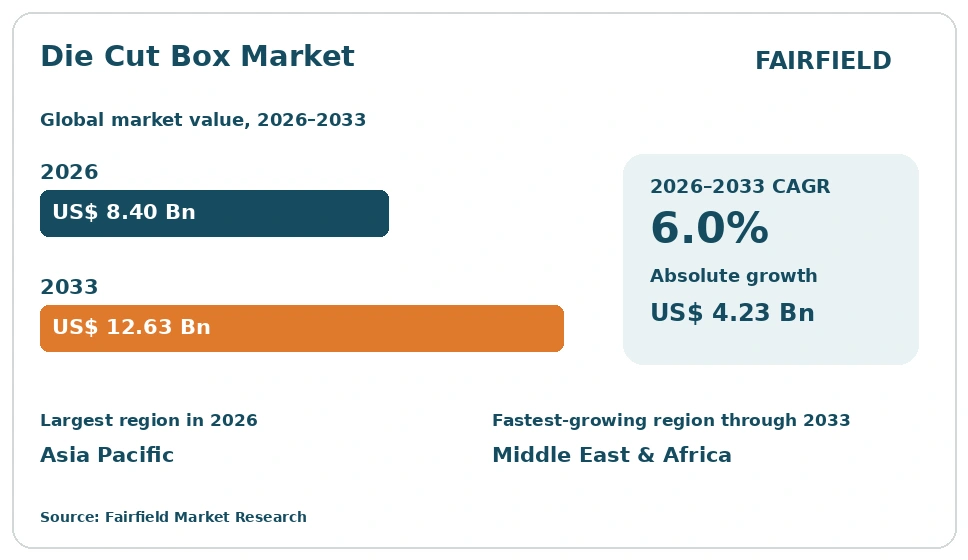
The global Die Cut Box market size is expected to be valued at US$ 8.4 billion in 2026 and projected to reach US$ 12.63 billion by 2033, growing at a CAGR of 6.0% between 2026 and 2033. Growth is anchored in e-commerce shipping, where right-sized custom mailers cut freight and void fill costs. Converters are adding rotary and flatbed die-cutting capacity to serve shorter, more frequent orders. Brand owners in cosmetics, food and electronics are using structural design and print to lift shelf and unboxing appeal. Demand is strongest where packaging must protect goods in transit and still present well at the shelf. The absolute dollar opportunity through 2033 stands at US$ 4.23 billion.
Key Report Takeaways
- By Box Style: die-cut mailer boxes led with 34.5% share in 2026, while retail-ready displays are projected to expand at a 7.4% CAGR through 2033, driven by grocery and discount chains cutting shelf-stocking labour.
- By Material: corrugated board held 56.8% share in 2026, while paperboard and boxboard are set to grow at a 6.9% CAGR through 2033, driven by brand owners replacing plastic clamshells with printed fibre cartons.
- By Printing Type: flexography led with 41.2% share in 2026, while digital printing is projected to advance at a 9.8% CAGR through 2033, driven by short-run, versioned and regionally personalised packaging orders.
- By End-use Industry: e-commerce and retail accounted for 29.4% share in 2026, while cosmetics and personal care is forecast to rise at an 8.1% CAGR through 2033, driven by premium rigid and window-cut carton formats.
- By Region: Asia Pacific led with 38.4% share in 2026, ahead of North America, Europe, Latin America and Middle East & Africa, while Middle East & Africa is projected to grow at a 7.4% CAGR through 2033, driven by new fulfilment capacity.
Market Trends and Insights
Market Growth Drivers
Right-Sizing of Parcel Shipments Lifts Custom Mailer Demand
Online order growth is the single largest pull on die-cut box demand. Retailers and fulfilment operators are replacing generic shipping cartons with custom-cut mailers matched to each product footprint. Smaller boxes cut dimensional weight charges, reduce void fill and lower damage rates in parcel networks. Because carriers price by volume as well as mass, every centimetre removed from a carton converts into freight savings.
The underlying trend is the industrialisation of short-run converting. Rotary die-cutters with quick-change tooling now handle frequent job changes that once made small orders uneconomic. Automated box-on-demand lines sit inside distribution centres, cutting and creasing board to order. Brand owners also treat the mailer as a marketing surface, which supports printed rather than plain stock. Together these shifts move volume from commodity slotted containers toward engineered die-cut formats across parcel-heavy categories.
Brand Differentiation Pushes Structural and Print Investment
Packaging has become a brand asset rather than a shipping cost, and that lifts die-cut box demand. Shaped mailers, window cut-outs, magnetic closures and fitted inserts let a product arrive looking considered. Cosmetics, premium food and consumer electronics buyers accept higher unit prices when packaging supports price positioning. The result is a steady migration from plain brown cartons toward printed, laminated and specially cut structures.
Behind this sits closer collaboration between brand design teams and converters. Structural designers now model cartons digitally, cut samples on tables and test them before tooling is committed. Litho-lamination and high-graphic flexography put photographic print onto corrugated board that once carried only simple marks. Social media unboxing has made the first open a visible moment, so packaging specifications increasingly carry marketing budget rather than procurement budget alone.
Restraints Impact Analysis of Market
Board and Energy Cost Volatility Compresses Converter Margins
Raw material and energy price swings restrain growth by squeezing converter profitability. Containerboard, boxboard and recovered fibre prices move sharply with mill capacity, export demand and collection rates. Die-cut box producers usually work on annual or quarterly contracts, so input increases cannot always be passed on quickly. When board costs rise, buyers postpone format changes and revert to standard cartons that need no new tooling.
Converting is also energy intensive. Corrugators, dryers and die-cutting presses consume substantial electricity and heat, and tariff volatility feeds directly into cost per thousand boxes. Smaller independent converters feel this most, since they lack integrated mill supply, long-term board contracts or hedging capacity. The pressure encourages consolidation and discourages investment in new die-cutting lines, which slows the pace at which capacity for complex formats expands.
Tooling Costs and Lead Times Limit Short-Run Economics
Tooling economics restrain adoption among smaller buyers. A traditional cutting die must be laser-cut, rule-set and proofed before production, and that cost is carried by a single stock-keeping unit. For low volumes the die charge can exceed the value of the boxes ordered. Buyers therefore standardise on existing dies, which caps the variety of shapes that actually reach the market.
Lead times compound the problem. Tool making, sampling and press trials can add weeks before first delivery, which does not suit fast product cycles or seasonal promotions. Storage, retrieval and maintenance of large die libraries add further overhead for converters that run thousands of active tools across many customer accounts. Although digital cutting tables address prototyping, their throughput remains below rotary presses, so the cost barrier persists for mid-volume production runs.
Market Opportunities
Digital Printing and Cutting Open Short-Run Packaging Revenue
Digital die-cutting and digital print create a genuinely new revenue pool in short-run packaging. Converters can accept orders of a few hundred boxes profitably, serving subscription brands, regional launches and seasonal campaigns that were previously unserved. Because no cutting die or printing plate is required, setup cost falls close to zero and changeover becomes a software task rather than a mechanical one.
This capability supports versioning and personalisation at scale. A single run can carry different languages, regional artwork or promotional codes without stopping the press. Web-to-pack ordering portals let small brands upload artwork, choose a structural template and receive proofs automatically. For converters, the attraction is margin: short-run work prices well above commodity corrugated. The opportunity is largest in cosmetics, speciality food and direct-to-consumer brands with frequent product change.
Plastic Substitution Expands Fibre-Based Inserts and Trays
Replacing plastic packaging components with fibre creates a durable opportunity for die-cut producers. Moulded or cut paperboard inserts, trays, dividers and clamshell alternatives can protect electronics, cosmetics and fresh produce without polymer film. Retailers setting recycled-content and recyclability targets increasingly specify mono-material fibre packs, which converts protective packaging spend from plastics suppliers to board converters.
Policy direction supports the shift. Packaging waste rules and extended producer responsibility schemes in several regions price non-recyclable formats higher, and kerbside systems already accept paper. Designers are responding with precisely cut locking tabs and folded cushions that hold products without glue, expanded foam or adhesive film. Scaling this work requires sustained investment in structural design capability, prototyping tables and tooling for complex cuts, which favours established converters that already run flatbed and rotary die-cutting assets.
Category-wise Insights
Why Do Die-Cut Mailer Boxes Lead the Market?
Die-cut mailer boxes lead because they match the economics of parcel shipping better than any other format, holding 34.5% share in 2026. The one-piece folding design needs no tape, folds flat for storage and can be sized precisely to the product. Folding cartons follow at 28.2%, with trays and inserts at 15.4%, retail-ready displays at 13.6% and rigid set-up boxes at 8.3%. Retail-ready displays are the fastest-growing style at a 7.4% CAGR through 2033, because grocers want cases that convert into shelf units without unpacking. Leadership and growth therefore sit in different places: mailers dominate installed volume through e-commerce, while shelf-ready formats grow faster from a smaller base in packaged food and household goods. For converters, this means investing in both high-throughput mailer lines and the more complex tooling that display work requires.
Corrugated Board Anchors Die-Cut Box Output
Corrugated board holds the largest material share at 56.8% in 2026, because flute structures deliver protection at low weight and cost. Paperboard and boxboard account for 27.3%, rigid greyboard laminates 10.4%, and plastic or speciality substrates 5.5%. Paperboard is the fastest-growing material at a 6.9% CAGR through 2033, helped by plastic substitution in cosmetics, confectionery and chilled food. Recycled content is now a routine specification rather than a premium option, and mills have widened recycled-fibre grades suitable for die-cutting without cracking at the crease. Lightweighting is the second force: brands want lower grammage without losing compression strength, which pushes demand toward better-engineered board rather than more board. The broader implication is that material choice has become a compliance and cost decision together, not purely a protection decision.
Which Printing Type Is Growing Fastest in Die-Cut Boxes?
Digital printing is the fastest-growing printing type at a 9.8% CAGR through 2033, though flexography still leads with 41.2% share in 2026. Litho-lamination holds 24.6%, offset 18.7%, digital 11.9% and unprinted stock 3.6%. Flexography leads on long runs because plate costs amortise across high volumes and water-based inks suit food contact. Digital grows faster because it removes plates entirely, making small batches, artwork versions and late design changes economic. Single-pass inkjet lines now print directly onto corrugated board at commercial speeds, narrowing the quality gap with litho-lamination. For brand owners this shortens the path from design approval to delivered packaging. For converters it shifts competition from price per thousand toward speed, colour consistency and the ability to handle many small jobs reliably.
E-Commerce and Retail Remain the Largest Buying Base
E-commerce and retail form the largest end-use industry with 29.4% share in 2026, reflecting the sheer parcel volume moving through fulfilment networks. Food and beverage follows at 26.1%, cosmetics and personal care at 14.8%, consumer electronics at 12.3%, healthcare and pharmaceuticals at 9.7%, and industrial and other uses at 7.7%. Cosmetics and personal care is the fastest-growing end use at an 8.1% CAGR through 2033, driven by premium presentation, gift sets and sampling programmes that favour shaped cartons with fitted inserts. Food and beverage demand is steadier, tied to grocery throughput and shelf-ready case formats. The practical signal for suppliers is that volume growth and value growth separate: parcel categories deliver scale, while beauty and speciality categories deliver margin through complexity and finishing.
Geography Analysis
North America Centres on Fulfilment-Driven Custom Packaging
North America holds 25.6% share in 2026 and is forecast to grow at a 5.2% CAGR through 2033. The United States dominates regional volume, with Canada and Mexico adding converting capacity tied to cross-border manufacturing. Demand concentrates around large fulfilment networks, where right-sizing programmes and automated box-on-demand equipment are already in routine use. Independent converters compete on design service and quick turnaround rather than price alone, serving direct-to-consumer brands clustered around major metropolitan areas. State-level recycled-content rules and extended producer responsibility programmes are prompting brand owners to review plastic components, which supports fibre-based inserts and trays. Growth is moderate because parcel volumes are maturing, so value gains come from format upgrades and higher print specification rather than sheer unit expansion.
Europe Advances on Packaging Regulation and Fibre Substitution
Europe accounts for 23.1% share in 2026 and a 4.9% CAGR through 2033, the slowest regional growth but the most regulation-led. Germany, Italy, France, Spain and Poland host dense converting networks serving food, beverage and industrial customers. Packaging waste and recyclability rules push brand owners toward mono-material fibre designs, which favours die-cut inserts over moulded plastics. Recovered paper collection rates are high, giving mills consistent recycled furnish for board grades used in die-cutting. Poland and other central European countries continue to attract new capacity because of lower conversion costs and proximity to western markets. Growth is restrained by mature retail volumes and energy costs, yet specification quality keeps rising, so value per box improves even where unit growth stays modest.
Which Region Is Leading the Die Cut Box Market?
Asia Pacific leads the market with 38.4% share in 2026, supported by the world’s largest concentration of packaging converting capacity. China, India, Japan, South Korea and Vietnam supply both domestic consumption and export packaging for electronics, apparel and household goods. Regional containerboard capacity has expanded steadily, giving converters local board supply rather than imports. Rapid online retail adoption in China and India keeps mailer volumes rising, while Japan contributes demand for precision cartons in cosmetics and confectionery. Manufacturing clusters place box plants close to assembly sites, which suits a product that is costly to ship empty. The region also grows quickly, at a 6.9% CAGR through 2033, as organised retail and urban middle-class spending widen the buyer base beyond export packaging alone.
Latin America Builds Capacity Around Food and Agricultural Exports
Latin America represents 7.3% share in 2026, expanding at a 6.2% CAGR through 2033. Brazil and Mexico account for most regional output, with Chile, Colombia and Argentina adding demand tied to fresh produce and protein exports. Agricultural shipping drives much of the volume, where ventilated and stacking-optimised die-cut trays protect fruit through long cold chains. Brazil benefits from established domestic pulp and paper production, giving converters reliable board supply. Growth in online retail across major cities is widening demand for printed mailers beyond industrial packaging. Currency volatility and import costs for converting equipment remain constraints, so investment tends to favour upgrading existing plants rather than greenfield lines. Even so, export packaging standards continue to pull specification quality upward across the region.
Which Region Is Growing Fastest in the Die Cut Box Market?
Middle East & Africa is growing fastest at a 7.4% CAGR through 2033, from a small 5.6% share in 2026. Saudi Arabia, the United Arab Emirates, Egypt and South Africa lead regional activity. Growth comes from new logistics and fulfilment infrastructure, as Gulf economies invest in non-oil sectors including retail, tourism and food processing. Local converting capacity is expanding to replace imported packaging, which previously carried high freight costs for a bulky product. Rising organised retail penetration in Egypt and South Africa supports shelf-ready and printed carton demand. A young, urbanising population with increasing online shopping adoption underpins mailer volumes. The base remains modest, so percentage growth outpaces absolute gains, but the region is the clearest expansion opportunity for converters seeking new capacity locations.
Competitive Landscape
The global die-cut box market is moderately fragmented. Large integrated producers with their own containerboard mills hold meaningful volume, yet thousands of regional and independent converters serve local customers who need short lead times and design support. Integration is the main structural divide: integrated groups compete on board security and cost through the cycle, while independents compete on service, flexibility and willingness to run complex jobs. Consolidation continues as mid-sized converters join larger networks seeking geographic coverage, but geography still limits concentration because empty boxes are expensive to ship far.
Competition centres on capability rather than price alone. Vendors differentiate through structural design teams, sampling tables, tooling libraries, print quality and the ability to hold tight registration on shaped cuts. Sustainability credentials now function as a qualifying requirement, covering recycled content, certified fibre, recyclability and plastic replacement. Automation matters too, since inline die-cutting, gluing and inspection determine cost per thousand on short runs. New entrants arrive mainly as digitally native packaging platforms that combine web ordering with digital print and cutting, serving small brands that traditional converters find uneconomic.
Strategic activity follows these themes. Converters add rotary and flatbed die-cutting capacity, invest in single-pass inkjet lines, extend structural design services and acquire regional plants to shorten delivery distances. Each move addresses a specific competitive need: capacity for volume security, digital print for short-run margin, design services for specification influence and local plants for freight economics. Partnerships with brand owners on plastic-replacement projects also matter, because they lock in specifications early.
The competitive direction is toward converters that can serve both ends of the order book, running efficient long volume and profitable short runs on the same site.
Industry Leaders
- International Paper Company
- Smurfit Westrock plc
- Mondi plc
- Graphic Packaging International, LLC
- Packaging Corporation of America
- Oji Holdings Corporation
- Sonoco Products Company
Companies Covered in the Report
- International Paper Company
- Smurfit Westrock plc
- Mondi plc
- Graphic Packaging International, LLC
- Packaging Corporation of America
- Sonoco Products Company
- Oji Holdings Corporation
- Nippon Paper Industries Co., Ltd.
- Rengo Co., Ltd.
- Stora Enso Oyj
- Cascades Inc.
- Pratt Industries, Inc.
- Georgia-Pacific LLC
- Klabin S.A.
- Huhtamaki Oyj
- Orora Limited
Die Cut Box Market Report Scope
The Die Cut Box market is segmented by box style, material, printing type, end-use industry and region.
| By Box Style | Die-Cut Mailer Boxes, Folding Cartons, Trays and Inserts, Retail-Ready Displays, Rigid Set-Up Boxes |
| By Material | Corrugated Board, Paperboard and Boxboard, Rigid Greyboard Laminates, Plastic and Speciality Substrates |
| By Printing Type | Flexography, Litho-Lamination, Offset, Digital Printing, Unprinted |
| By End-use Industry | E-Commerce and Retail, Food and Beverage, Cosmetics and Personal Care, Consumer Electronics, Healthcare and Pharmaceuticals, Industrial and Others |
| By Region | North America, Europe, Asia Pacific, Latin America, Middle East & Africa |
1. Executive Summary
1.1 Die Cut Box Market Snapshot
1.2 Future Projections
1.3 Key Industry Highlights
1.4 Geographical Snapshot
2. Market Overview
2.1 Market Definition and Segmentation
2.2 Market Dynamics
2.2.1 Drivers
2.2.1.1 Right-Sizing of Parcel Shipments Lifts Custom Mailer Demand
2.2.1.2 Brand Differentiation Pushes Structural and Print Investment
2.2.2 Restraints
2.2.2.1 Board and Energy Cost Volatility Compresses Converter Margins
2.2.2.2 Tooling Costs and Lead Times Limit Short-Run Economics
2.2.3 Market Opportunities
2.2.3.1 Digital Printing and Cutting Open Short-Run Packaging Revenue
2.2.3.2 Plastic Substitution Expands Fibre-Based Inserts and Trays
3. Global Die Cut Box Market Outlook, 2026–2033
3.1 Global Die Cut Box Market Outlook, by Box Style, Value (US$ Billion), 2026–2033
3.1.1 Die-Cut Mailer Boxes
3.1.2 Folding Cartons
3.1.3 Trays and Inserts
3.1.4 Retail-Ready Displays
3.1.5 Rigid Set-Up Boxes
3.2 Global Die Cut Box Market Outlook, by Material, Value (US$ Billion), 2026–2033
3.2.1 Corrugated Board
3.2.2 Paperboard and Boxboard
3.2.3 Rigid Greyboard Laminates
3.2.4 Plastic and Speciality Substrates
3.3 Global Die Cut Box Market Outlook, by Printing Type, Value (US$ Billion), 2026–2033
3.3.1 Flexography
3.3.2 Litho-Lamination
3.3.3 Offset
3.3.4 Digital Printing
3.3.5 Unprinted
3.4 Global Die Cut Box Market Outlook, by End-use Industry, Value (US$ Billion), 2026–2033
3.4.1 E-Commerce and Retail
3.4.2 Food and Beverage
3.4.3 Cosmetics and Personal Care
3.4.4 Consumer Electronics
3.4.5 Healthcare and Pharmaceuticals
3.4.6 Industrial and Others
3.5 Global Die Cut Box Market Outlook, by Region, Value (US$ Billion), 2026–2033
3.5.1 North America
3.5.2 Europe
3.5.3 Asia Pacific
3.5.4 Latin America
3.5.5 Middle East & Africa
4. North America Die Cut Box Market Outlook, 2026–2033
4.1 North America Die Cut Box Market Outlook, by Box Style, Value (US$ Billion), 2026–2033
4.1.1 Die-Cut Mailer Boxes
4.1.2 Folding Cartons
4.1.3 Trays and Inserts
4.1.4 Retail-Ready Displays
4.1.5 Rigid Set-Up Boxes
4.2 North America Die Cut Box Market Outlook, by Material, Value (US$ Billion), 2026–2033
4.2.1 Corrugated Board
4.2.2 Paperboard and Boxboard
4.2.3 Rigid Greyboard Laminates
4.2.4 Plastic and Speciality Substrates
4.3 North America Die Cut Box Market Outlook, by Printing Type, Value (US$ Billion), 2026–2033
4.3.1 Flexography
4.3.2 Litho-Lamination
4.3.3 Offset
4.3.4 Digital Printing
4.3.5 Unprinted
4.4 North America Die Cut Box Market Outlook, by End-use Industry, Value (US$ Billion), 2026–2033
4.4.1 E-Commerce and Retail
4.4.2 Food and Beverage
4.4.3 Cosmetics and Personal Care
4.4.4 Consumer Electronics
4.4.5 Healthcare and Pharmaceuticals
4.4.6 Industrial and Others
4.5 North America Die Cut Box Market Outlook, by Country, Value (US$ Billion), 2026–2033
4.5.1 United States Die Cut Box Market Outlook, by Box Style, 2026–2033
4.5.2 United States Die Cut Box Market Outlook, by Material, 2026–2033
4.5.3 United States Die Cut Box Market Outlook, by Printing Type, 2026–2033
4.5.4 United States Die Cut Box Market Outlook, by End-use Industry, 2026–2033
4.5.5 Canada Die Cut Box Market Outlook, by Box Style, 2026–2033
4.5.6 Canada Die Cut Box Market Outlook, by Material, 2026–2033
4.5.7 Canada Die Cut Box Market Outlook, by Printing Type, 2026–2033
4.5.8 Canada Die Cut Box Market Outlook, by End-use Industry, 2026–2033
4.5.9 Mexico Die Cut Box Market Outlook, by Box Style, 2026–2033
4.5.10 Mexico Die Cut Box Market Outlook, by Material, 2026–2033
4.5.11 Mexico Die Cut Box Market Outlook, by Printing Type, 2026–2033
4.5.12 Mexico Die Cut Box Market Outlook, by End-use Industry, 2026–2033
5. Europe Die Cut Box Market Outlook, 2026–2033
5.1 Europe Die Cut Box Market Outlook, by Box Style, Value (US$ Billion), 2026–2033
5.1.1 Die-Cut Mailer Boxes
5.1.2 Folding Cartons
5.1.3 Trays and Inserts
5.1.4 Retail-Ready Displays
5.1.5 Rigid Set-Up Boxes
5.2 Europe Die Cut Box Market Outlook, by Material, Value (US$ Billion), 2026–2033
5.2.1 Corrugated Board
5.2.2 Paperboard and Boxboard
5.2.3 Rigid Greyboard Laminates
5.2.4 Plastic and Speciality Substrates
5.3 Europe Die Cut Box Market Outlook, by Printing Type, Value (US$ Billion), 2026–2033
5.3.1 Flexography
5.3.2 Litho-Lamination
5.3.3 Offset
5.3.4 Digital Printing
5.3.5 Unprinted
5.4 Europe Die Cut Box Market Outlook, by End-use Industry, Value (US$ Billion), 2026–2033
5.4.1 E-Commerce and Retail
5.4.2 Food and Beverage
5.4.3 Cosmetics and Personal Care
5.4.4 Consumer Electronics
5.4.5 Healthcare and Pharmaceuticals
5.4.6 Industrial and Others
5.5 Europe Die Cut Box Market Outlook, by Country, Value (US$ Billion), 2026–2033
5.5.1 Germany Die Cut Box Market Outlook, by Box Style, 2026–2033
5.5.2 Germany Die Cut Box Market Outlook, by Material, 2026–2033
5.5.3 Germany Die Cut Box Market Outlook, by Printing Type, 2026–2033
5.5.4 Germany Die Cut Box Market Outlook, by End-use Industry, 2026–2033
5.5.5 Italy Die Cut Box Market Outlook, by Box Style, 2026–2033
5.5.6 Italy Die Cut Box Market Outlook, by Material, 2026–2033
5.5.7 Italy Die Cut Box Market Outlook, by Printing Type, 2026–2033
5.5.8 Italy Die Cut Box Market Outlook, by End-use Industry, 2026–2033
5.5.9 France Die Cut Box Market Outlook, by Box Style, 2026–2033
5.5.10 France Die Cut Box Market Outlook, by Material, 2026–2033
5.5.11 France Die Cut Box Market Outlook, by Printing Type, 2026–2033
5.5.12 France Die Cut Box Market Outlook, by End-use Industry, 2026–2033
5.5.13 Spain Die Cut Box Market Outlook, by Box Style, 2026–2033
5.5.14 Spain Die Cut Box Market Outlook, by Material, 2026–2033
5.5.15 Spain Die Cut Box Market Outlook, by Printing Type, 2026–2033
5.5.16 Spain Die Cut Box Market Outlook, by End-use Industry, 2026–2033
5.5.17 Poland Die Cut Box Market Outlook, by Box Style, 2026–2033
5.5.18 Poland Die Cut Box Market Outlook, by Material, 2026–2033
5.5.19 Poland Die Cut Box Market Outlook, by Printing Type, 2026–2033
5.5.20 Poland Die Cut Box Market Outlook, by End-use Industry, 2026–2033
6. Asia Pacific Die Cut Box Market Outlook, 2026–2033
6.1 Asia Pacific Die Cut Box Market Outlook, by Box Style, Value (US$ Billion), 2026–2033
6.1.1 Die-Cut Mailer Boxes
6.1.2 Folding Cartons
6.1.3 Trays and Inserts
6.1.4 Retail-Ready Displays
6.1.5 Rigid Set-Up Boxes
6.2 Asia Pacific Die Cut Box Market Outlook, by Material, Value (US$ Billion), 2026–2033
6.2.1 Corrugated Board
6.2.2 Paperboard and Boxboard
6.2.3 Rigid Greyboard Laminates
6.2.4 Plastic and Speciality Substrates
6.3 Asia Pacific Die Cut Box Market Outlook, by Printing Type, Value (US$ Billion), 2026–2033
6.3.1 Flexography
6.3.2 Litho-Lamination
6.3.3 Offset
6.3.4 Digital Printing
6.3.5 Unprinted
6.4 Asia Pacific Die Cut Box Market Outlook, by End-use Industry, Value (US$ Billion), 2026–2033
6.4.1 E-Commerce and Retail
6.4.2 Food and Beverage
6.4.3 Cosmetics and Personal Care
6.4.4 Consumer Electronics
6.4.5 Healthcare and Pharmaceuticals
6.4.6 Industrial and Others
6.5 Asia Pacific Die Cut Box Market Outlook, by Country, Value (US$ Billion), 2026–2033
6.5.1 China Die Cut Box Market Outlook, by Box Style, 2026–2033
6.5.2 China Die Cut Box Market Outlook, by Material, 2026–2033
6.5.3 China Die Cut Box Market Outlook, by Printing Type, 2026–2033
6.5.4 China Die Cut Box Market Outlook, by End-use Industry, 2026–2033
6.5.5 India Die Cut Box Market Outlook, by Box Style, 2026–2033
6.5.6 India Die Cut Box Market Outlook, by Material, 2026–2033
6.5.7 India Die Cut Box Market Outlook, by Printing Type, 2026–2033
6.5.8 India Die Cut Box Market Outlook, by End-use Industry, 2026–2033
6.5.9 Japan Die Cut Box Market Outlook, by Box Style, 2026–2033
6.5.10 Japan Die Cut Box Market Outlook, by Material, 2026–2033
6.5.11 Japan Die Cut Box Market Outlook, by Printing Type, 2026–2033
6.5.12 Japan Die Cut Box Market Outlook, by End-use Industry, 2026–2033
6.5.13 South Korea Die Cut Box Market Outlook, by Box Style, 2026–2033
6.5.14 South Korea Die Cut Box Market Outlook, by Material, 2026–2033
6.5.15 South Korea Die Cut Box Market Outlook, by Printing Type, 2026–2033
6.5.16 South Korea Die Cut Box Market Outlook, by End-use Industry, 2026–2033
6.5.17 Vietnam Die Cut Box Market Outlook, by Box Style, 2026–2033
6.5.18 Vietnam Die Cut Box Market Outlook, by Material, 2026–2033
6.5.19 Vietnam Die Cut Box Market Outlook, by Printing Type, 2026–2033
6.5.20 Vietnam Die Cut Box Market Outlook, by End-use Industry, 2026–2033
7. Latin America Die Cut Box Market Outlook, 2026–2033
7.1 Latin America Die Cut Box Market Outlook, by Box Style, Value (US$ Billion), 2026–2033
7.1.1 Die-Cut Mailer Boxes
7.1.2 Folding Cartons
7.1.3 Trays and Inserts
7.1.4 Retail-Ready Displays
7.1.5 Rigid Set-Up Boxes
7.2 Latin America Die Cut Box Market Outlook, by Material, Value (US$ Billion), 2026–2033
7.2.1 Corrugated Board
7.2.2 Paperboard and Boxboard
7.2.3 Rigid Greyboard Laminates
7.2.4 Plastic and Speciality Substrates
7.3 Latin America Die Cut Box Market Outlook, by Printing Type, Value (US$ Billion), 2026–2033
7.3.1 Flexography
7.3.2 Litho-Lamination
7.3.3 Offset
7.3.4 Digital Printing
7.3.5 Unprinted
7.4 Latin America Die Cut Box Market Outlook, by End-use Industry, Value (US$ Billion), 2026–2033
7.4.1 E-Commerce and Retail
7.4.2 Food and Beverage
7.4.3 Cosmetics and Personal Care
7.4.4 Consumer Electronics
7.4.5 Healthcare and Pharmaceuticals
7.4.6 Industrial and Others
7.5 Latin America Die Cut Box Market Outlook, by Country, Value (US$ Billion), 2026–2033
7.5.1 Brazil Die Cut Box Market Outlook, by Box Style, 2026–2033
7.5.2 Brazil Die Cut Box Market Outlook, by Material, 2026–2033
7.5.3 Brazil Die Cut Box Market Outlook, by Printing Type, 2026–2033
7.5.4 Brazil Die Cut Box Market Outlook, by End-use Industry, 2026–2033
7.5.5 Mexico Die Cut Box Market Outlook, by Box Style, 2026–2033
7.5.6 Mexico Die Cut Box Market Outlook, by Material, 2026–2033
7.5.7 Mexico Die Cut Box Market Outlook, by Printing Type, 2026–2033
7.5.8 Mexico Die Cut Box Market Outlook, by End-use Industry, 2026–2033
7.5.9 Chile Die Cut Box Market Outlook, by Box Style, 2026–2033
7.5.10 Chile Die Cut Box Market Outlook, by Material, 2026–2033
7.5.11 Chile Die Cut Box Market Outlook, by Printing Type, 2026–2033
7.5.12 Chile Die Cut Box Market Outlook, by End-use Industry, 2026–2033
7.5.13 Colombia Die Cut Box Market Outlook, by Box Style, 2026–2033
7.5.14 Colombia Die Cut Box Market Outlook, by Material, 2026–2033
7.5.15 Colombia Die Cut Box Market Outlook, by Printing Type, 2026–2033
7.5.16 Colombia Die Cut Box Market Outlook, by End-use Industry, 2026–2033
7.5.17 Argentina Die Cut Box Market Outlook, by Box Style, 2026–2033
7.5.18 Argentina Die Cut Box Market Outlook, by Material, 2026–2033
7.5.19 Argentina Die Cut Box Market Outlook, by Printing Type, 2026–2033
7.5.20 Argentina Die Cut Box Market Outlook, by End-use Industry, 2026–2033
8. Middle East & Africa Die Cut Box Market Outlook, 2026–2033
8.1 Middle East & Africa Die Cut Box Market Outlook, by Box Style, Value (US$ Billion), 2026–2033
8.1.1 Die-Cut Mailer Boxes
8.1.2 Folding Cartons
8.1.3 Trays and Inserts
8.1.4 Retail-Ready Displays
8.1.5 Rigid Set-Up Boxes
8.2 Middle East & Africa Die Cut Box Market Outlook, by Material, Value (US$ Billion), 2026–2033
8.2.1 Corrugated Board
8.2.2 Paperboard and Boxboard
8.2.3 Rigid Greyboard Laminates
8.2.4 Plastic and Speciality Substrates
8.3 Middle East & Africa Die Cut Box Market Outlook, by Printing Type, Value (US$ Billion), 2026–2033
8.3.1 Flexography
8.3.2 Litho-Lamination
8.3.3 Offset
8.3.4 Digital Printing
8.3.5 Unprinted
8.4 Middle East & Africa Die Cut Box Market Outlook, by End-use Industry, Value (US$ Billion), 2026–2033
8.4.1 E-Commerce and Retail
8.4.2 Food and Beverage
8.4.3 Cosmetics and Personal Care
8.4.4 Consumer Electronics
8.4.5 Healthcare and Pharmaceuticals
8.4.6 Industrial and Others
8.5 Middle East & Africa Die Cut Box Market Outlook, by Country, Value (US$ Billion), 2026–2033
8.5.1 Saudi Arabia Die Cut Box Market Outlook, by Box Style, 2026–2033
8.5.2 Saudi Arabia Die Cut Box Market Outlook, by Material, 2026–2033
8.5.3 Saudi Arabia Die Cut Box Market Outlook, by Printing Type, 2026–2033
8.5.4 Saudi Arabia Die Cut Box Market Outlook, by End-use Industry, 2026–2033
8.5.5 United Arab Emirates Die Cut Box Market Outlook, by Box Style, 2026–2033
8.5.6 United Arab Emirates Die Cut Box Market Outlook, by Material, 2026–2033
8.5.7 United Arab Emirates Die Cut Box Market Outlook, by Printing Type, 2026–2033
8.5.8 United Arab Emirates Die Cut Box Market Outlook, by End-use Industry, 2026–2033
8.5.9 Egypt Die Cut Box Market Outlook, by Box Style, 2026–2033
8.5.10 Egypt Die Cut Box Market Outlook, by Material, 2026–2033
8.5.11 Egypt Die Cut Box Market Outlook, by Printing Type, 2026–2033
8.5.12 Egypt Die Cut Box Market Outlook, by End-use Industry, 2026–2033
8.5.13 South Africa Die Cut Box Market Outlook, by Box Style, 2026–2033
8.5.14 South Africa Die Cut Box Market Outlook, by Material, 2026–2033
8.5.15 South Africa Die Cut Box Market Outlook, by Printing Type, 2026–2033
8.5.16 South Africa Die Cut Box Market Outlook, by End-use Industry, 2026–2033
9. Competitive Landscape
9.1 Industry Leaders
9.2 Company Profiles
9.2.1 International Paper Company
9.2.2 Smurfit Westrock plc
9.2.3 Mondi plc
9.2.4 Graphic Packaging International, LLC
9.2.5 Packaging Corporation of America
9.2.6 Sonoco Products Company
9.2.7 Oji Holdings Corporation
9.2.8 Nippon Paper Industries Co., Ltd.
9.2.9 Rengo Co., Ltd.
9.2.10 Stora Enso Oyj
9.2.11 Cascades Inc.
9.2.12 Pratt Industries, Inc.
9.2.13 Georgia-Pacific LLC
9.2.14 Klabin S.A.
9.2.15 Huhtamaki Oyj
9.2.16 Orora Limited
10. Appendix
10.1 Research Methodology
10.2 Report Assumptions
10.3 Acronyms and Abbreviations
| By Box Style | Die-Cut Mailer Boxes, Folding Cartons, Trays and Inserts, Retail-Ready Displays, Rigid Set-Up Boxes |
| By Material | Corrugated Board, Paperboard and Boxboard, Rigid Greyboard Laminates, Plastic and Speciality Substrates |
| By Printing Type | Flexography, Litho-Lamination, Offset, Digital Printing, Unprinted |
| By End-use Industry | E-Commerce and Retail, Food and Beverage, Cosmetics and Personal Care, Consumer Electronics, Healthcare and Pharmaceuticals, Industrial and Others |
| By Region | North America, Europe, Asia Pacific, Latin America, Middle East & Africa |
Our Research Methodology
Considering the volatility of business today, traditional approaches to strategizing a game plan can be unfruitful if not detrimental. True ambiguity is no way to determine a forecast. A myriad of predetermined factors must be accounted for such as the degree of risk involved, the magnitude of circumstances, as well as conditions or consequences that are not known or unpredictable. To circumvent binary views that cast uncertainty, the application of market research intelligence to strategically posture, move, and enable actionable outcomes is necessary.
View Methodology
Quality Assured
Rigorous Validation Process

Confidentiality Assured
End-to-end Data Security

Custom Research Services
Tailored To Your Objectives
FAQs
The market is valued at US$ 8.4 billion in 2026 and is projected to reach US$ 12.63 billion by 2033, growing at 6.0% annually.
Die-cut mailer boxes lead with 34.5% share in 2026, because one-piece folding designs suit parcel shipping and need no tape or void fill.
Digital printing grows fastest at a 9.8% CAGR through 2033, since it removes plate costs and makes short runs and artwork versioning economic.
Asia Pacific holds 38.4% share in 2026, supported by dense converting capacity, local board supply and rapid online retail growth across the region.
Yes, the market is moderately fragmented, with integrated mill-backed producers competing alongside many regional converters that win work through design service and short lead times.
Related Reports
Heating Radiator Market Size, Share, Insights, Competitive Landscape, and Forecast 2026 to 2033
The global heating radiator market is valued at US$8.4 billion in 2026, reaching US$12.0 billion by 2033, growing at a 5.2% CAGR
Fermenters Market Size, Share, Insights, Competitive Landscape, and Forecast 2026 to 2033
The global fermenters market is valued at US$2.0 billion in 2026, reaching US$2.87 billion by 2033, growing at a 5.3% CAGR
Diamond Tools Market Size, Share, Insights, Competitive Landscape, and Forecast 2026 to 2033
The global diamond tools market is valued at US$11.2 billion in 2026, reaching US$16.8 billion by 2033, growing at a 6.0% CAGR
CO2 Glass Tube Laser Market Size, Share, Insights, Competitive Landscape, and Forecast 2026 to 2033
The global CO2 glass tube laser market is valued at US$0.78 billion in 2026, reaching US$1.18 billion by 2033, growing at a 6.1% CAGR
Tray Dispenser Market Size, Share, Insights, Competitive Landscape, and Forecast 2026 to 2033
Explore the tray dispenser market outlook for 2026–2033, covering product types, capacities, end users, regional trends, and leading companies.
Pre-Engineered Buildings Market Size, Share, Insights, Competitive Landscape, and Forecast 2026 to 2033
The pre-engineered buildings market is projected to grow from US$22.4 billion in 2026 to US$43.1 billion by 2033 at a 9.8% CAGR.