



Fermenters Market
Fermenters Market Size, Share, Insights, Competitive Landscape, and Forecast 2026 to 2033
Fermenters Market Size and Trend Analysis
How Fast Is the Fermenters Market Growing?
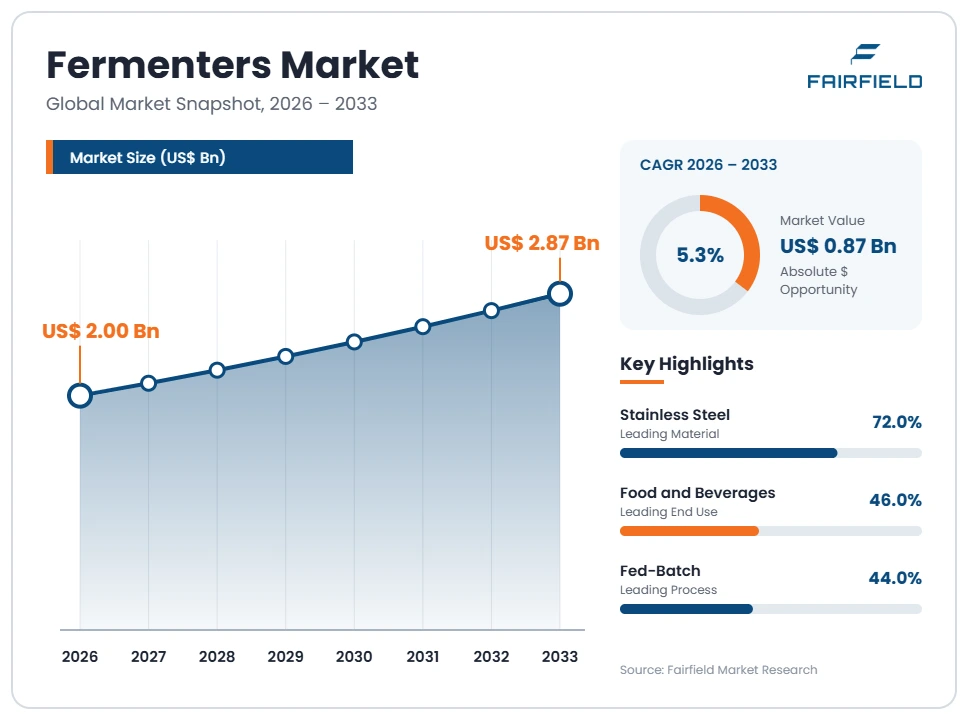
The global fermenters market size is expected to be valued at US$ 2.00 billion in 2026 and projected to reach US$ 2.87 billion by 2033, growing at a CAGR of 5.3% between 2026 and 2033.
Between 2020 and 2025, the market grew at a CAGR of about 4.6%, reaching about US$ 1.9 billion in 2025, as vaccine and biologics production expanded sharply in 2020 and 2021, then food, beverage, and precision fermentation projects kept demand rising while some startups struggled to raise funds. The fermenters market covers vessels and systems that grow microorganisms such as bacteria, yeast, and fungi under controlled conditions to make products. It includes laboratory, pilot, and industrial-scale fermenters, mainly stainless steel fermenters along with glass and single-use systems, with controls for temperature, oxygen, pH, and mixing. Fermenters operate in batch, fed-batch, and continuous modes and are used to produce beer, wine, dairy, enzymes, amino acids, vitamins, antibiotics, vaccines, biofuels, and alternative proteins. Growth comes from biotechnology, food innovation, and bio-based chemicals. In July 2026, GEA opened a biotechnology scale-up center in Sarstedt, Germany.
Key Report Takeaways
- By Process: Fed-Batch held about 44% share in 2025, while Continuous is projected to expand at a 6.4% CAGR through 2033, driven by higher productivity, smaller plant footprints, and steady output for enzymes, biofuels, and food ingredients.
- By Material: Stainless Steel held about 72% share in 2025, while Glass and Single-Use is projected to expand at a 6.6% CAGR through 2033, driven by laboratory research, process development, and flexible small-batch production.
- By End Use: Food and Beverages held about 46% share in 2025, while Pharmaceuticals is projected to expand at a 6.3% CAGR through 2033, driven by microbial biologics, vaccines, antibiotics, and plasmid DNA production for advanced therapies.
- By Region: North America held about 36% share in 2025, while Asia Pacific is projected to expand at a 6.8% CAGR through 2033, driven by biomanufacturing investment, food processing growth, and government biotech programs in China and India.
Global Fermenters Market Trends and Insights
Drivers Impact Analysis
Two drivers carry the strongest influence on fermenters market demand during the forecast period.
| Driver | Impact on CAGR Forecast | Geographic Relevance | Impact Timeline |
| Growth of biopharmaceuticals and industrial biotechnology | High | North America, Europe, Asia Pacific | Long term (≥4 years) |
| Precision fermentation and alternative proteins | Medium | North America, Europe | Medium term (2-4 years) |
Biotechnology Growth Is Driving the Fermenters Market
Growth of biopharmaceuticals and industrial biotechnology is the strongest driver of the fermenters market. Microbes make many modern products.
The mechanism is the wide use of microbial fermentation in manufacturing. Bacteria and yeast produce insulin, vaccines, enzymes, antibiotics, plasmid DNA for gene therapies, and many biologic drugs, and pharmaceutical companies are adding capacity to meet rising demand. Industrial biotechnology uses fermentation to make enzymes for detergents and food, amino acids for animal feed, vitamins, organic acids, and bio-based chemicals that replace petroleum products. Governments in the United States, China, India, and Europe are funding biomanufacturing to build supply security and support climate goals. Breweries, wineries, and dairy producers also replace and expand fermentation tanks. Each new plant and research lab needs fermenters, controls, and services. These trends support long-term demand.
Precision Fermentation Is Expanding the Fermenters Market
Precision fermentation and alternative proteins are expanding the fermenters market. Companies are making food ingredients with microbes.
The cause is demand for sustainable protein and ingredients. Precision fermentation uses engineered microbes to make specific proteins, such as whey, casein, egg white, and collagen, without animals, along with fats, sweeteners, and flavors. Startups and food companies need pilot and commercial fermenters to scale up, and capacity shortages have slowed the sector. In May 2025, Liberation Labs announced plans to produce Vivici’s dairy protein at a 600,000-liter plant in Richmond, Indiana. Contract manufacturers are adding capacity, and large dairy and food companies are partnering with startups to secure supply. Biomass fermentation using fungi to make protein-rich foods also needs large vessels. These trends expand sales of pilot and commercial systems.
Restraints Impact Analysis
Two restraints limit how quickly the fermenters market grows.
| Restraint | Impact on CAGR Forecast | Geographic Relevance | Impact Timeline |
| High capital costs and long payback periods | High | Global | Medium term (2-4 years) |
| Contamination risks and complex scale-up | Medium | Global | Long term (≥4 years) |
High Capital Costs Slow the Fermenters Market
High capital costs and long payback periods slow the fermenters market. Large fermentation plants are expensive to build.
The specific causes are costly equipment and uncertain returns. Industrial fermenters, downstream purification equipment, utilities, and clean rooms require large investments, and building a commercial plant can cost hundreds of millions of dollars. Startups in precision fermentation and bio-based chemicals have struggled to raise funding since 2022 as investors became more cautious, delaying or canceling some projects. Stainless steel and specialty alloy prices have risen, adding to equipment costs. Smaller food and beverage producers, including craft breweries, may delay upgrades when demand is weak. Long design, fabrication, and validation times push back the start of production. These factors slow growth, especially for new entrants without long-term customers or offtake agreements.
Scale-Up Challenges Restrict the Fermenters Market
Contamination risks and complex scale-up restrict the fermenters market. Moving from lab to factory is hard.
The underlying causes are technical difficulty and skills shortages. A process that works in a small fermenter may behave differently in large tanks because of changes in mixing, oxygen transfer, and heat removal. Contamination by unwanted microbes can ruin entire batches, causing lost product, cleaning downtime, and investigation costs, so strict hygiene and sterile design are essential. Few engineers and operators have experience in large-scale fermentation, and training takes years. Contamination remains a constant risk that can ruin entire batches. Downstream purification often costs more than the fermentation itself, and capacity for it is limited. Regulatory approval of novel food ingredients made by fermentation is slow in some regions. These factors restrict growth.
Market Opportunities
Contract and Shared Fermentation Capacity Opens a Fast-Growth Revenue Pool
Contract and shared fermentation capacity opens a fast-growth revenue pool in the fermenters market. Many companies cannot build their own plants.
Providers can capture this opportunity. Startups and mid-sized firms in food, chemicals, and pharmaceuticals need access to pilot and commercial fermenters without building plants themselves, and contract manufacturers and shared facilities fill this gap. New contract sites with hundreds of thousands of liters of capacity are opening in North America and Europe, and governments fund shared pilot plants. In July 2026, GEA opened a €4 million application and technology center in Sarstedt, Germany, with bioreactors from 50 to 500 liters for testing scale-up. Equipment makers that design modular, flexible fermenters and offer process support can win orders from contract manufacturers and research centers.
Automation and Digital Monitoring Create a Growth Revenue Pool
Automation and digital monitoring create a growth revenue pool in the fermenters market. Smarter fermenters improve yields.
Suppliers can capture this opportunity. Sensors, process analytics, digital twins, and AI-based control can keep fermentation conditions optimal, raise yields, and catch problems early. Automated fermenters reduce labor and errors, and data systems support regulatory compliance and batch records in pharmaceuticals. Inline sensors for biomass, glucose, and dissolved gases give real-time feedback. Older plants can be upgraded with new controls. Cloud dashboards let operators watch several plants from one location, and predictive maintenance reduces unplanned stops. Research labs use parallel mini-fermenters with automated sampling to test many conditions at once and speed up process development. Companies offering integrated hardware, software, and analytics can earn recurring revenue from subscriptions and upgrades.
Segment Analysis
- By Process: Fed-Batch Leads While Continuous Grows Fastest
Fed-Batch held about 44% share in 2025. In fed-batch fermentation, nutrients are added gradually during the run, which helps control growth and increase product yields, making it the most common method for producing enzymes, antibiotics, amino acids, and recombinant proteins. It balances productivity with process control and is widely used in both pharmaceutical and industrial plants.
Continuous is the fastest-growing process, expanding at a 6.4% CAGR through 2033. Continuous fermentation feeds nutrients and removes product steadily, allowing smaller plants to produce more output with consistent quality, and it suits biofuels, organic acids, and some food ingredients. Advances in sensors and control make long runs more reliable. Batch fermentation forms another segment, widely used in brewing and winemaking. For the market, continuous growth supports efficiency.
- By Material: Stainless Steel Leads While Glass and Single-Use Grows Fastest
Stainless Steel held about 72% share in 2025. Stainless steel fermenters are durable, easy to clean and sterilize, and can be built in very large sizes, making them standard in breweries, dairies, enzyme plants, and pharmaceutical factories. They can run for decades with proper maintenance.
Glass and Single-Use is the fastest-growing material, expanding at a 6.6% CAGR through 2033. Glass fermenters are used in laboratories and teaching, while single-use bag systems reduce cleaning and changeover time in process development and small-batch production. Research labs and contract developers are adding these systems to test many strains quickly. Single-use systems avoid cross-contamination between products and need less water and cleaning chemicals, which suits multi-product facilities. For the market, glass and single-use growth supports innovation.
- By End Use: Food and Beverages Leads While Pharmaceuticals Grows Fastest
Food and Beverages held about 46% share in 2025. Breweries, wineries, distilleries, dairies, bakeries, and food ingredient makers use fermenters for beer, wine, yogurt, cheese, and ingredients such as enzymes, flavors, and probiotics. Craft brewing and precision fermentation add new demand.
Pharmaceuticals is the fastest-growing end use, expanding at a 6.3% CAGR through 2033. Drug makers use microbial fermenters to produce insulin, vaccines, antibiotics, biologics, and plasmid DNA. Personal care, biofuels, chemicals, and academic research form other end uses. Biofuel plants use very large fermenters for ethanol, while personal care companies use fermentation for natural actives such as hyaluronic acid. Academic labs buy small benchtop systems for teaching and research. For the market, pharmaceutical growth adds high-value demand.
Geography Analysis
- Which Region Is Leading the Fermenters Market?
North America is leading the fermenters market with about 36% share in 2025. The United States has large pharmaceutical, biotechnology, brewing, and food ingredient industries, and is home to Thermo Fisher Scientific and many fermentation startups. Government programs support domestic biomanufacturing, and new contract fermentation sites are opening in Indiana and New York. Universities and research centers buy laboratory fermenters, and craft breweries add steady demand for tanks. Canada adds biotech, vaccine, and brewing demand. Key barriers include funding pressure on startups, high construction costs, and long permit times. One change shaping the region is the growth of contract fermentation capacity.
- Europe Shapes the Fermenters Market Through Biotechnology and Brewing
Europe is a major fermenters market. Germany, Denmark, the Netherlands, Switzerland, France, and Belgium host leading equipment makers such as Sartorius, Eppendorf, GEA, and Bioengineering AG, along with major enzyme and ingredient producers. Brewing and dairy industries are large users, and enzyme makers such as Novonesis run very large fermentation plants. Precision fermentation startups in the Netherlands, Finland, and Denmark are scaling up with support from public funds and shared pilot plants. Key barriers include high energy costs, slow novel food approvals, and limited commercial capacity. One opportunity is pilot and scale-up centers.
- Which Region Is Growing Fastest in the Fermenters Market?
Asia Pacific is growing fastest in the fermenters market, expanding at a 6.8% CAGR through 2033. China is the world’s largest producer of fermentation products such as amino acids, vitamins, and antibiotics, and it is investing heavily in biomanufacturing. India has growing pharmaceutical, vaccine, and enzyme industries, supported by government biotech programs. Japan and South Korea have advanced fermentation for food, amino acids, and drugs, while Singapore supports alternative protein startups, and Thailand and Indonesia are adding fermentation capacity for food and feed. Key barriers include price competition, quality differences, and export restrictions. One change shaping the region is government biomanufacturing policy.
- Latin America Grows the Fermenters Market Through Biofuels and Food
Latin America is a growing fermenters market. Brazil is one of the world’s largest producers of ethanol from sugarcane fermentation and has large brewing and food industries, while Mexico, Argentina, and Chile add large brewing, wine, and food demand. Biotech research is growing in Brazil and Argentina, and enzyme and yeast producers supply the large ethanol industry. Craft brewing is growing in Mexico and Chile. Key barriers include economic swings, currency changes, and reliance on imported equipment and spare parts. One opportunity is bio-based chemicals, enzymes, and food ingredients made from low-cost sugarcane feedstock.
- Middle East & Africa Builds the Fermenters Market Through Food Security and Pharma
Middle East & Africa is an emerging fermenters market. Saudi Arabia and the United Arab Emirates are investing heavily in food security, biotechnology, alternative proteins, and local pharmaceutical production, and South Africa has established brewing and biotech industries. Vaccine production projects in South Africa and Egypt add demand, and Israel has many precision fermentation startups. Brewing is a large and growing industry in Nigeria, Ethiopia, and Kenya, and governments are funding biotechnology research centers. Key barriers include limited technical skills, high costs, and reliance on imports. One opportunity is local vaccine and food ingredient production supported by national programs.
Competitive Landscape
The fermenters market is moderately fragmented. Sartorius, Thermo Fisher Scientific, GEA Group, Eppendorf, and Getinge (Applikon) are leading players, while Bioengineering AG, bbi-biotech, Electrolab Biotech, Pierre Guérin, ZETA Holding, CerCell, and Alfa Laval compete strongly. Life science companies lead in laboratory and pharmaceutical fermenters, process engineering firms supply large industrial systems, and many regional fabricators build tanks for breweries, dairies, and food plants.
Companies compete on reliability, sterility, scale range, automation and software, engineering support, delivery times, and price. Pharmaceutical customers need validated systems and documentation, while food and industrial buyers focus on large capacities and low operating costs. Suppliers that can support customers from laboratory to commercial scale gain long relationships, and service contracts and spare parts provide recurring revenue.
Strategic moves show how competition is changing. In May 2025, Liberation Labs agreed to produce Vivici’s dairy protein at a planned 600,000-liter plant in Indiana. In June 2025, it rebranded as Liberation Bioindustries ahead of commercial launch. In July 2026, GEA opened a biotechnology scale-up center in Sarstedt, Germany, with bioreactors from 50 to 500 liters. These moves show competition shifting toward scale-up services and precision fermentation.
Three themes shape vendor strategy. First, companies are building pilot and scale-up centers to win customers early. Second, they are adding automation and digital monitoring to fermenters. Third, they are expanding in Asia Pacific, where biomanufacturing investment is growing fastest.
Fermenters Market Industry Leaders
Sartorius Thermo Fisher Scientific GEA Group Eppendorf Getinge (Applikon)
Recent Industry Developments
- July 2026: GEA opened a €4 million biotechnology application and technology center in Sarstedt, Germany, with bioreactors from 50 to 500 liters for precision fermentation and cell cultivation scale-up - supports new producers in the fermenters market.
- June 2025: Liberation Labs rebranded as Liberation Bioindustries ahead of the commercial launch of its Richmond, Indiana, precision fermentation plant - signals growing commercial-scale capacity.
- May 2025: Liberation Labs and Vivici agreed to produce Vivici’s dairy protein at a planned 600,000-liter facility, with production slated to start in 2026 - shows rising demand for large fermenters.
Companies Covered in the Report
- Sartorius
- Thermo Fisher Scientific
- GEA Group
- Eppendorf
- Getinge (Applikon)
- Bioengineering AG
- bbi-biotech
- Electrolab Biotech
- Pierre Guérin
- ZETA Holding
- CerCell
- Alfa Laval
Fermenters Market Report Scope
| Metric | Value |
| Study Period | 2020-2033 |
| Market Size 2026 | US$ 2.00 Billion |
| Market Size 2033 | US$ 2.87 Billion |
| CAGR 2026-2033 | 5.3% |
| Absolute Dollar Opportunity | US$ 0.87 Billion |
| Largest Market | North America |
| Fastest-Growing Market | Asia Pacific |
| Market Concentration | Moderately Fragmented |
| Major Players | Sartorius, Thermo Fisher Scientific, GEA Group, Eppendorf, Getinge (Applikon) |
Fermenters Market Segmentation
- Executive Summary
- Fermenters Market Snapshot
- Future Projections
- Key Market Trends
- Regional Snapshot
- Market Overview
- Market Definition and Report Scope
- Historical Market Trends
- Market Dynamics
- Drivers
- Biotechnology Growth Is Driving the Fermenters Market
- Precision Fermentation Is Expanding the Fermenters Market
- Restraints
- High Capital Costs Slow the Fermenters Market
- Scale-Up Challenges Restrict the Fermenters Market
- Market Opportunities
- Contract and Shared Fermentation Capacity Opens a Fast-Growth Revenue Pool
- Automation and Digital Monitoring Create a Growth Revenue Pool
- Drivers
- Global Fermenters Market Outlook, 2020–2033
- Global Fermenters Market Outlook, by Process, Value (US$ Billion), 2020–2033
- Batch
- Fed-Batch
- Continuous
- Global Fermenters Market Outlook, by Material, Value (US$ Billion), 2020–2033
- Stainless Steel
- Glass and Single-Use
- Global Fermenters Market Outlook, by End Use, Value (US$ Billion), 2020–2033
- Food and Beverages
- Pharmaceuticals
- Personal Care
- Biofuels and Chemicals
- Others
- Global Fermenters Market Outlook, by Region, Value (US$ Billion), 2020–2033
- North America
- Europe
- Asia Pacific
- Latin America
- Middle East & Africa
- Global Fermenters Market Outlook, by Process, Value (US$ Billion), 2020–2033
- North America Fermenters Market Outlook, 2020–2033
- North America Fermenters Market Outlook, by Process, Value (US$ Billion), 2020–2033
- Batch
- Fed-Batch
- Continuous
- North America Fermenters Market Outlook, by Material, Value (US$ Billion), 2020–2033
- Stainless Steel
- Glass and Single-Use
- North America Fermenters Market Outlook, by End Use, Value (US$ Billion), 2020–2033
- Food and Beverages
- Pharmaceuticals
- Personal Care
- Biofuels and Chemicals
- Others
- North America Fermenters Market Outlook, by Country, Value (US$ Billion), 2020–2033
- United States Fermenters Market Outlook, by Process, 2020–2033
- United States Fermenters Market Outlook, by Material, 2020–2033
- United States Fermenters Market Outlook, by End Use, 2020–2033
- Canada Fermenters Market Outlook, by Process, 2020–2033
- Canada Fermenters Market Outlook, by Material, 2020–2033
- Canada Fermenters Market Outlook, by End Use, 2020–2033
- North America Fermenters Market Outlook, by Process, Value (US$ Billion), 2020–2033
- Europe Fermenters Market Outlook, 2020–2033
- Europe Fermenters Market Outlook, by Process, Value (US$ Billion), 2020–2033
- Batch
- Fed-Batch
- Continuous
- Europe Fermenters Market Outlook, by Material, Value (US$ Billion), 2020–2033
- Stainless Steel
- Glass and Single-Use
- Europe Fermenters Market Outlook, by End Use, Value (US$ Billion), 2020–2033
- Food and Beverages
- Pharmaceuticals
- Personal Care
- Biofuels and Chemicals
- Others
- Europe Fermenters Market Outlook, by Country, Value (US$ Billion), 2020–2033
- Germany Fermenters Market Outlook, by Process, 2020–2033
- Germany Fermenters Market Outlook, by Material, 2020–2033
- Germany Fermenters Market Outlook, by End Use, 2020–2033
- Denmark Fermenters Market Outlook, by Process, 2020–2033
- Denmark Fermenters Market Outlook, by Material, 2020–2033
- Denmark Fermenters Market Outlook, by End Use, 2020–2033
- Netherlands Fermenters Market Outlook, by Process, 2020–2033
- Netherlands Fermenters Market Outlook, by Material, 2020–2033
- Netherlands Fermenters Market Outlook, by End Use, 2020–2033
- Switzerland Fermenters Market Outlook, by Process, 2020–2033
- Switzerland Fermenters Market Outlook, by Material, 2020–2033
- Switzerland Fermenters Market Outlook, by End Use, 2020–2033
- France Fermenters Market Outlook, by Process, 2020–2033
- France Fermenters Market Outlook, by Material, 2020–2033
- France Fermenters Market Outlook, by End Use, 2020–2033
- Belgium Fermenters Market Outlook, by Process, 2020–2033
- Belgium Fermenters Market Outlook, by Material, 2020–2033
- Belgium Fermenters Market Outlook, by End Use, 2020–2033
- Finland Fermenters Market Outlook, by Process, 2020–2033
- Finland Fermenters Market Outlook, by Material, 2020–2033
- Finland Fermenters Market Outlook, by End Use, 2020–2033
- Europe Fermenters Market Outlook, by Process, Value (US$ Billion), 2020–2033
- Asia Pacific Fermenters Market Outlook, 2020–2033
- Asia Pacific Fermenters Market Outlook, by Process, Value (US$ Billion), 2020–2033
- Batch
- Fed-Batch
- Continuous
- Asia Pacific Fermenters Market Outlook, by Material, Value (US$ Billion), 2020–2033
- Stainless Steel
- Glass and Single-Use
- Asia Pacific Fermenters Market Outlook, by End Use, Value (US$ Billion), 2020–2033
- Food and Beverages
- Pharmaceuticals
- Personal Care
- Biofuels and Chemicals
- Others
- Asia Pacific Fermenters Market Outlook, by Country, Value (US$ Billion), 2020–2033
- China Fermenters Market Outlook, by Process, 2020–2033
- China Fermenters Market Outlook, by Material, 2020–2033
- China Fermenters Market Outlook, by End Use, 2020–2033
- India Fermenters Market Outlook, by Process, 2020–2033
- India Fermenters Market Outlook, by Material, 2020–2033
- India Fermenters Market Outlook, by End Use, 2020–2033
- Japan Fermenters Market Outlook, by Process, 2020–2033
- Japan Fermenters Market Outlook, by Material, 2020–2033
- Japan Fermenters Market Outlook, by End Use, 2020–2033
- South Korea Fermenters Market Outlook, by Process, 2020–2033
- South Korea Fermenters Market Outlook, by Material, 2020–2033
- South Korea Fermenters Market Outlook, by End Use, 2020–2033
- Singapore Fermenters Market Outlook, by Process, 2020–2033
- Singapore Fermenters Market Outlook, by Material, 2020–2033
- Singapore Fermenters Market Outlook, by End Use, 2020–2033
- Thailand Fermenters Market Outlook, by Process, 2020–2033
- Thailand Fermenters Market Outlook, by Material, 2020–2033
- Thailand Fermenters Market Outlook, by End Use, 2020–2033
- Indonesia Fermenters Market Outlook, by Process, 2020–2033
- Indonesia Fermenters Market Outlook, by Material, 2020–2033
- Indonesia Fermenters Market Outlook, by End Use, 2020–2033
- Asia Pacific Fermenters Market Outlook, by Process, Value (US$ Billion), 2020–2033
- Latin America Fermenters Market Outlook, 2020–2033
- Latin America Fermenters Market Outlook, by Process, Value (US$ Billion), 2020–2033
- Batch
- Fed-Batch
- Continuous
- Latin America Fermenters Market Outlook, by Material, Value (US$ Billion), 2020–2033
- Stainless Steel
- Glass and Single-Use
- Latin America Fermenters Market Outlook, by End Use, Value (US$ Billion), 2020–2033
- Food and Beverages
- Pharmaceuticals
- Personal Care
- Biofuels and Chemicals
- Others
- Latin America Fermenters Market Outlook, by Country, Value (US$ Billion), 2020–2033
- Brazil Fermenters Market Outlook, by Process, 2020–2033
- Brazil Fermenters Market Outlook, by Material, 2020–2033
- Brazil Fermenters Market Outlook, by End Use, 2020–2033
- Mexico Fermenters Market Outlook, by Process, 2020–2033
- Mexico Fermenters Market Outlook, by Material, 2020–2033
- Mexico Fermenters Market Outlook, by End Use, 2020–2033
- Argentina Fermenters Market Outlook, by Process, 2020–2033
- Argentina Fermenters Market Outlook, by Material, 2020–2033
- Argentina Fermenters Market Outlook, by End Use, 2020–2033
- Chile Fermenters Market Outlook, by Process, 2020–2033
- Chile Fermenters Market Outlook, by Material, 2020–2033
- Chile Fermenters Market Outlook, by End Use, 2020–2033
- Latin America Fermenters Market Outlook, by Process, Value (US$ Billion), 2020–2033
- Middle East & Africa Fermenters Market Outlook, 2020–2033
- Middle East & Africa Fermenters Market Outlook, by Process, Value (US$ Billion), 2020–2033
- Batch
- Fed-Batch
- Continuous
- Middle East & Africa Fermenters Market Outlook, by Material, Value (US$ Billion), 2020–2033
- Stainless Steel
- Glass and Single-Use
- Middle East & Africa Fermenters Market Outlook, by End Use, Value (US$ Billion), 2020–2033
- Food and Beverages
- Pharmaceuticals
- Personal Care
- Biofuels and Chemicals
- Others
- Middle East & Africa Fermenters Market Outlook, by Country, Value (US$ Billion), 2020–2033
- Saudi Arabia Fermenters Market Outlook, by Process, 2020–2033
- Saudi Arabia Fermenters Market Outlook, by Material, 2020–2033
- Saudi Arabia Fermenters Market Outlook, by End Use, 2020–2033
- United Arab Emirates Fermenters Market Outlook, by Process, 2020–2033
- United Arab Emirates Fermenters Market Outlook, by Material, 2020–2033
- United Arab Emirates Fermenters Market Outlook, by End Use, 2020–2033
- South Africa Fermenters Market Outlook, by Process, 2020–2033
- South Africa Fermenters Market Outlook, by Material, 2020–2033
- South Africa Fermenters Market Outlook, by End Use, 2020–2033
- Egypt Fermenters Market Outlook, by Process, 2020–2033
- Egypt Fermenters Market Outlook, by Material, 2020–2033
- Egypt Fermenters Market Outlook, by End Use, 2020–2033
- Israel Fermenters Market Outlook, by Process, 2020–2033
- Israel Fermenters Market Outlook, by Material, 2020–2033
- Israel Fermenters Market Outlook, by End Use, 2020–2033
- Nigeria Fermenters Market Outlook, by Process, 2020–2033
- Nigeria Fermenters Market Outlook, by Material, 2020–2033
- Nigeria Fermenters Market Outlook, by End Use, 2020–2033
- Ethiopia Fermenters Market Outlook, by Process, 2020–2033
- Ethiopia Fermenters Market Outlook, by Material, 2020–2033
- Ethiopia Fermenters Market Outlook, by End Use, 2020–2033
- Kenya Fermenters Market Outlook, by Process, 2020–2033
- Kenya Fermenters Market Outlook, by Material, 2020–2033
- Kenya Fermenters Market Outlook, by End Use, 2020–2033
- Middle East & Africa Fermenters Market Outlook, by Process, Value (US$ Billion), 2020–2033
- Competitive Landscape
- Fermenters Market Industry Leaders
- Recent Industry Developments
- Company Profiles
- Sartorius
- Thermo Fisher Scientific
- GEA Group
- Eppendorf
- Getinge (Applikon)
- Bioengineering AG
- bbi-biotech
- Electrolab Biotech
- Pierre Guérin
- ZETA Holding
- CerCell
- Alfa Laval
- Appendix
- Research Methodology
- Report Assumptions
- Acronyms and Abbreviations
Process
- Batch
- Fed-Batch
- Continuous
Material
- Stainless Steel
- Glass and Single-Use
End Use
- Food and Beverages
- Pharmaceuticals
- Personal Care
- Biofuels and Chemicals
- Others
Regions
- North America
- Europe
- Asia Pacific
- Latin America
- Middle East & Africa
Our Research Methodology
Considering the volatility of business today, traditional approaches to strategizing a game plan can be unfruitful if not detrimental. True ambiguity is no way to determine a forecast. A myriad of predetermined factors must be accounted for such as the degree of risk involved, the magnitude of circumstances, as well as conditions or consequences that are not known or unpredictable. To circumvent binary views that cast uncertainty, the application of market research intelligence to strategically posture, move, and enable actionable outcomes is necessary.
View Methodology
Quality Assured
Rigorous Validation Process

Confidentiality Assured
End-to-end Data Security

Custom Research Services
Tailored To Your Objectives
FAQs
The fermenters market is valued at US$ 2.00 billion in 2026, led by fed-batch processes, stainless steel, and North America.
The market is projected to reach US$ 2.87 billion by 2033, growing at a 5.3% CAGR and adding US$ 0.87 billion.
Pharmaceuticals is growing fastest at a 6.3% CAGR through 2033, driven by microbial biologics, vaccines, antibiotics, and plasmid DNA production.
Asia Pacific is growing fastest at a 6.8% CAGR through 2033, driven by biomanufacturing investment and biotech programs in China and India.
North America holds the largest share at about 36% in 2025, supported by pharmaceutical, biotech, brewing, and food ingredient industries.
Related Reports
Heating Radiator Market Size, Share, Insights, Competitive Landscape, and Forecast 2026 to 2033
The global heating radiator market is valued at US$8.4 billion in 2026, reaching US$12.0 billion by 2033, growing at a 5.2% CAGR
Diamond Tools Market Size, Share, Insights, Competitive Landscape, and Forecast 2026 to 2033
The global diamond tools market is valued at US$11.2 billion in 2026, reaching US$16.8 billion by 2033, growing at a 6.0% CAGR
CO2 Glass Tube Laser Market Size, Share, Insights, Competitive Landscape, and Forecast 2026 to 2033
The global CO2 glass tube laser market is valued at US$0.78 billion in 2026, reaching US$1.18 billion by 2033, growing at a 6.1% CAGR
Tray Dispenser Market Size, Share, Insights, Competitive Landscape, and Forecast 2026 to 2033
Explore the tray dispenser market outlook for 2026–2033, covering product types, capacities, end users, regional trends, and leading companies.
Die Cut Box Market Size, Share, Insights, Competitive Landscape, and Forecast 2026 to 2033
Explore the die cut box market outlook for 2026–2033, including box styles, materials, printing trends, regional demand, and competitive insights.
Pre-Engineered Buildings Market Size, Share, Insights, Competitive Landscape, and Forecast 2026 to 2033
The pre-engineered buildings market is projected to grow from US$22.4 billion in 2026 to US$43.1 billion by 2033 at a 9.8% CAGR.