



Heating Radiator Market
Heating Radiator Market Size, Share, Insights, Competitive Landscape, and Forecast 2026 to 2033
Heating Radiator Market Size and Trend Analysis
How Fast Will Heating Radiator Demand Grow Through 2033?
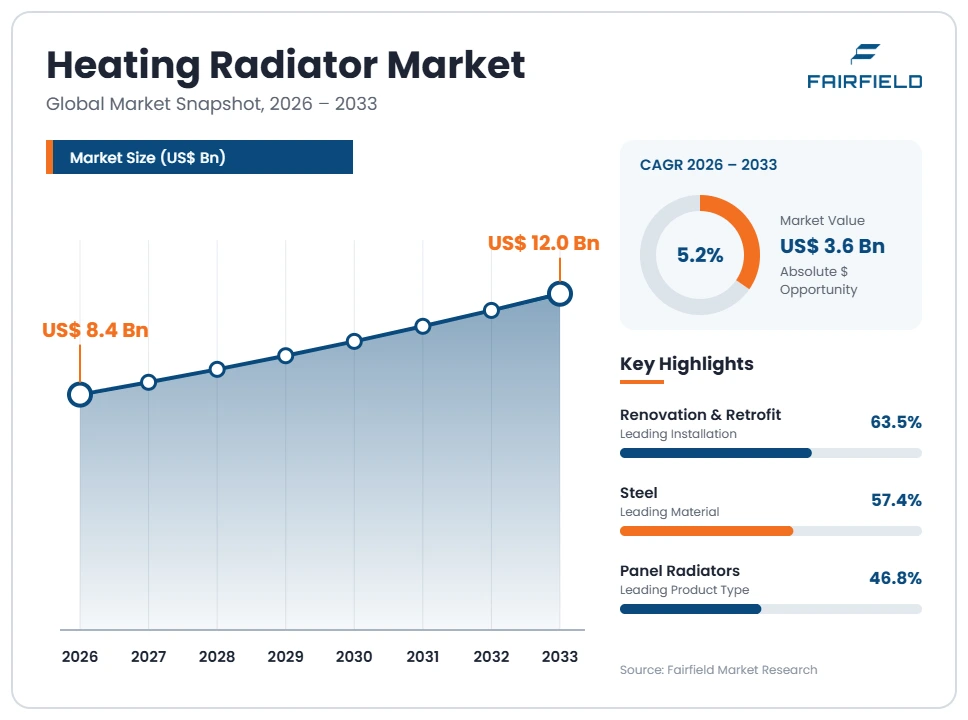
The global Heating Radiator market size is expected to be valued at US$ 8.4 billion in 2026 and projected to reach US$ 12.0 billion by 2033, growing at a CAGR of 5.2% between 2026 and 2033. Growth rests on the shift to low-temperature heating systems, where larger radiator surfaces let heat pumps operate efficiently at reduced flow temperatures. Building renovation programmes across Europe sustain steady replacement volumes, while rising residential construction in Asia Pacific and tighter energy codes add new installations. Between 2020 and 2025 the market expanded at roughly 3.8% a year, leaving an absolute dollar opportunity of US$ 3.6 billion over the forecast window.
Key Report Takeaways
- By Product Type: Panel radiators led with 46.8% share in 2026, while electric radiators are projected to expand at a 7.1% CAGR through 2033, driven by apartment retrofits where wet pipework cannot be extended economically.
- By Material: Steel accounted for 57.4% share in 2026, while aluminium is set to grow at a 6.6% CAGR through 2033, driven by its low water content and fast response in heat pump circuits.
- By Installation: Renovation and retrofit work held 63.5% share in 2026 and is also the quicker riser at a 5.8% CAGR through 2033, driven by boiler-to-heat-pump conversions that force radiator resizing.
- By End User: Residential buildings contributed 68.2% share in 2026, while commercial properties are forecast to advance at a 6.0% CAGR through 2033, driven by office and hotel refurbishment aimed at lower operating energy costs.
- By Region: Europe led with 48.6% share in 2026, while Asia Pacific is projected to expand at a 6.9% CAGR through 2033; North America, Latin America and Middle East & Africa together add steady replacement-led volume.
Global Heating Radiator Market Trends and Insights
Market Growth Drivers
Heat Pump Retrofits Are Reshaping Radiator Specification
The shift from gas boilers to heat pumps is now the strongest single pull on radiator demand. Heat pumps supply water at much lower flow temperatures, so older emitters cannot release enough heat into the room. Installers respond by fitting larger panel surfaces, double or triple convector models, or fan-assisted units. A simple like-for-like swap becomes a whole-house emitter upgrade, lifting average order value.
Manufacturers have reorganised catalogues around this reality. Output ratings are now published at low-temperature test conditions as well as traditional ones, so specifiers can compare emitters honestly. Product lines increasingly include high-output panels, low-water-content aluminium bodies and quiet electrically assisted convectors designed for heat pump circuits. Grant schemes for heat pumps indirectly fund emitter replacement, because a system only passes commissioning when the radiators are correctly sized.
Renovation Programmes and Tighter Energy Codes Lift Replacement Volumes
Most radiator sales come from buildings that already exist, and renovation policy is the lever that moves them. Energy performance rules for existing dwellings push owners toward deeper refurbishment rather than isolated repairs. When insulation, glazing and controls are upgraded together, heat loss falls and the heating circuit is rebalanced, which usually means new emitters. Public funding and low-cost finance shorten payback periods and bring these decisions forward.
The evidence shows up in product mix rather than volume. Demand tilts toward slimmer panels that suit insulated rooms, and toward thermostatic and smart valves that allow room-by-room control. Social housing and institutional estate owners buy in programme-sized batches, rewarding suppliers that hold stock and deliver to site schedules. District heating upgrades add a further layer of replacement work, since lower network temperatures require emitters matched to the new operating envelope.
Market Restraints
Underfloor Heating and Fan Coil Systems Compete for the Same Circuits
Radiators lose ground in buildings where the heat emitter can be chosen freely. New homes with well-insulated floors increasingly use underfloor loops, which run at even lower temperatures and free wall space. Apartment projects and offices often select fan coil units or ducted systems because the same equipment also provides cooling.
The competitive pressure is strongest in warmer climates and in new construction, where the cost of screed-embedded pipework is absorbed into the build programme. Summer cooling demand is rising in traditionally heating-led markets, which strengthens the case for a single reversible system. Radiator makers counter with hybrid approaches, including low-height skirting emitters and fan-assisted panels that respond quickly, yet these answer a narrower brief. Where a building needs both heating and cooling from one circuit, radiators remain at a structural disadvantage.
Raw Material Cost Swings and Freight Weight Compress Margins
Radiators are heavy, low-value-density goods built almost entirely from steel, aluminium or cast iron. Metal price swings therefore pass straight through to factory cost, and long order books make hedging difficult. Energy-intensive pressing, welding and powder coating add further exposure to electricity and gas tariffs. Because merchants resist frequent list price changes, manufacturers absorb part of any increase and margins compress.
Logistics compound the problem. A panel radiator occupies substantial volume for its value, so freight, palletisation and damage claims form a meaningful share of delivered cost. That limits how far product can travel economically and keeps production close to demand, which in turn caps the scale benefits available to any single plant. Smaller regional producers face the sharpest squeeze, since they lack the purchasing leverage and automated lines that help larger groups hold price.
Market Opportunities
Electric and Hybrid Radiators Unlock Buildings Without Wet Systems
Electric radiators open revenue in buildings where extending pipework is impractical or uneconomic. Converted apartments, extensions, holiday lets, small offices and off-gas rural properties often cannot justify a wet circuit. A self-contained electric panel installs in hours, needs no commissioning and carries a higher price per unit than its hydronic equivalent. As electricity grids decarbonise, direct electric heating also becomes defensible on carbon grounds in well-insulated spaces.
Product development is moving quickly in this space. Modern units combine thermal storage cores, open-window detection, occupancy sensing and app-based scheduling, which turns a commodity heater into a controllable asset. Dual-fuel towel radiators, which run on the heating circuit in winter and electrically in summer, have become a standard bathroom specification. Manufacturers also see a service opportunity, because connected controls create a direct relationship with the occupant.
Design-Led and Bathroom Radiators Lift Average Selling Prices
Design-led radiators turn a functional component into a visible part of the room, and buyers pay accordingly. Vertical columns, mirrored panels, coloured finishes and sculptural tube forms cost several times a basic white panel. Bathroom and towel radiators benefit from the same effect, since they are specified alongside tiles and sanitaryware rather than boilers. This lets manufacturers grow value even where installed unit numbers stay broadly flat.
The channel is shifting to support it. Showrooms, interior retailers and online configurators now present radiators as furniture, with room visualisers and made-to-order finishes. Short-run powder coating and flexible fabrication cells allow colour and size customisation without large minimum orders. Architects and interior designers increasingly influence selection, which rewards suppliers that publish technical data in design software formats. Hotel and boutique retail refurbishment provides a steady commercial outlet.
Segment Analysis
- Panel Radiators Carry the Volume While Electric Units Set the Pace
Panel radiators hold the largest position by product type, with 46.8% share in 2026. Pressed steel panels remain the default emitter in European and Asian wet systems because they are cheap to produce, simple to install and available in thousands of size and output combinations. Column radiators follow at 18.5%, supported by heritage refurbishment and the high surface area that suits low-temperature circuits, while towel radiators take 14.2% on bathroom renovation work. Growth leadership sits elsewhere. Electric radiators are projected to expand at a 7.1% CAGR through 2033, the quickest in the category, as apartment conversions and off-gas properties adopt self-contained units with smart controls. Designer models, at 11.0% share, grow at 6.0% on interior-led specification. For manufacturers the implication is clear: panel lines defend volume and absorb overhead, while electric and designer ranges carry the margin.
- Why Is Aluminium Gaining Ground Against Steel Radiators?
Aluminium is gaining ground because it holds little water and heats quickly, which suits low-temperature heat pump circuits. Even so, steel still dominates with 57.4% share in 2026, since pressed panels are the lowest-cost route to a given output and are backed by mature European manufacturing capacity. Aluminium is the fastest riser at a 6.6% CAGR through 2033, led by southern European and Asian producers of extruded and die-cast sections. Its light weight cuts freight and installation effort, and its rapid response works well with modulating controls. Cast iron holds 11.8% share on heritage and restoration work but grows slowly at 3.4%, while copper-aluminium composite emitters take 6.5% and grow at 6.2% in high-output applications. Material choice is becoming a system design decision rather than a procurement preference, and that shift favours suppliers with capability in more than one metal.
- Retrofit Work Now Sets Both the Scale and the Pace of Installations
Renovation and retrofit accounts for 63.5% of installations in 2026 and is also the faster-growing route at a 5.8% CAGR through 2033. Leadership and growth sit together here for a clear reason. The installed building stock in mature heating markets is far larger than annual new construction, so replacement cycles dominate volume. Energy upgrades then accelerate those cycles, because converting a boiler system to a heat pump usually forces emitters to be resized. New build contributes 36.5% share and grows more slowly at 4.2%, partly because underfloor heating wins a meaningful share of new homes. The practical implication is that distribution strength, stock availability and installer relationships matter more than project tendering. Suppliers that serve merchants, social housing programmes and retrofit contractors reach most of the addressable demand without competing on new construction schedules.
- Residential Demand Anchors the Market as Commercial Refurbishment Accelerates
Residential buildings account for 68.2% of demand in 2026, reflecting the sheer number of dwellings heated by hydronic systems across Europe and Asia Pacific. Homeowners and landlords replace radiators during renovations, bathroom projects and heating system upgrades, which keeps the base steady through economic cycles. Commercial property is the fastest-growing end user at a 6.0% CAGR through 2033. Offices, hotels and retail units are being refurbished to cut operating energy use and meet building performance requirements, and radiators are often retained because they cost less to replace than to remove. Institutional buildings hold 8.7% share and grow at 5.4%, supported by school and hospital estate programmes. The mix matters commercially: residential sales flow through merchants and retail channels, while commercial and institutional work arrives through contractors and specification teams.
Geography Analysis
- North America Leans on Replacement Demand in Older Housing Stock
North America holds 15.2% share in 2026 and grows at a 4.3% CAGR through 2033, the slowest of the five regions. Forced-air furnaces dominate the United States, so radiator demand concentrates in the older hydronic housing stock of the Northeast, the Midwest and eastern Canada. Steam and hot water systems in cities such as Boston, New York, Chicago and Montreal generate steady replacement work, much of it cast iron and column units in heritage buildings. Growth comes from two directions: cold-climate heat pump incentives that require higher-output emitters, and multi-family and institutional refurbishment where hydronic distribution already exists. Canadian provinces with abundant hydroelectric supply favour electric radiators. Supply is split between domestic producers and imports from Europe and Asia Pacific.
- Which Region Is Leading the Heating Radiator Market?
Europe leads the Heating Radiator market with 48.6% share in 2026, and it grows at a 4.6% CAGR through 2033. Hydronic heating is the regional norm, so almost every dwelling contains radiators that eventually need replacing. Germany, Italy, France, Poland, the United Kingdom and Turkey combine large installed bases with strong domestic manufacturing in steel panels and aluminium sections. Renovation policy is the key accelerator: energy performance rules for existing buildings, heat pump support schemes and district heating temperature reductions all trigger emitter upgrades. The region also sets the technical standard, because low-temperature output ratings and design-led ranges developed here are exported worldwide. Mature construction volumes cap growth, yet the replacement pool keeps European demand structurally large.
- Which Region Is Growing Fastest in the Heating Radiator Market?
Asia Pacific is the fastest-growing region, expanding at a 6.9% CAGR through 2033 from 24.5% share in 2026. China drives most of the volume, where northern urban centres rely on district heating and municipal programmes continue to convert coal boilers to cleaner sources, pushing radiator replacement across large apartment estates. South Korea and Japan add demand through apartment refurbishment and towel radiator adoption. India contributes a small but rising base in northern states and hill districts. Domestic manufacturing of steel panels and aluminium sections has scaled quickly, lowering prices and widening access. Rising household incomes, apartment construction and stricter urban air quality rules together explain why the region outgrows every other.
- Latin America Builds Radiator Demand in Its Southern Cone Markets
Latin America holds 6.3% share in 2026 and advances at a 5.0% CAGR through 2033. Demand concentrates in the Southern Cone, where Chile, Argentina, Uruguay and southern Brazil experience genuine heating seasons, while Mexico adds volume in its central highlands. Radiators compete with gas wall heaters and electric portables, so growth depends on middle-class housing that can justify a central system. Air quality rules in southern Chilean cities discourage wood burning and push households toward cleaner central heating, which supports radiator installation. Most product is imported from Europe, Turkey and China, with local assembly and distribution concentrated in a few metropolitan markets. Currency movements and import costs remain the main constraint on faster adoption.
- Middle East & Africa Demand Concentrates in Cooler Highland and Northern Markets
Middle East & Africa accounts for 5.4% share in 2026 and grows at a 5.6% CAGR through 2033. Heating demand is real but geographically narrow, centred on Iran, Iraq, the Levant, the coastal belt of North Africa and the highlands of South Africa, Ethiopia and Kenya. Gulf states install radiators mainly in mountain resorts and premium villas. Natural gas availability in several North African and Middle Eastern markets makes hydronic systems viable, while elsewhere electric radiators suit intermittent use. Growth follows residential construction, hotel development and rising expectations of indoor comfort. Supply depends heavily on imports, and distribution networks are still developing outside the main cities.
Competitive Landscape
The Heating Radiator market is moderately fragmented. A group of established European manufacturers holds the strongest positions in steel panel and designer products, while numerous regional producers serve local markets in Asia Pacific, Turkey and Latin America on cost and delivery. No single supplier approaches a dominant global share, because freight economics keep production close to demand. Ownership has steadily consolidated, with multi-brand groups assembling portfolios that span panels, columns, towel rails and controls. That pattern signals a maturing market where scale in purchasing, automation and distribution matters more than product novelty alone.
Competition now centres on performance at low flow temperatures. Vendors publish output ratings at heat pump operating conditions, invest in sizing software, and promote high-output and fan-assisted models that keep rooms warm without oversized surfaces. Material strategy is a second battleground, as aluminium and composite emitters challenge pressed steel on response time and weight. Design, finish range and lead time decide many residential projects, while recycled content, coating chemistry and product environmental declarations increasingly shape public sector tenders. Smart valve and control integration is drawing electronics-led entrants into a market long defined by metalworking.
Strategic activity follows the same logic. Groups add capacity and automation to protect cost position, acquire regional brands to secure distribution, and extend ranges into electric and hybrid emitters to reach buildings without wet circuits. Investment in short-run coating and made-to-order fabrication supports the premium design segment, where margins are strongest. Installer training and specification tools are treated as competitive infrastructure rather than marketing spend.
The direction of travel favours suppliers that can serve a decarbonising heating system end to end, combining proven low-temperature output, credible sustainability data, flexible manufacturing and dependable installer relationships.
Industry Leaders
- Zehnder Group AG
- Purmo Group Plc
- Stelrad Group plc
- Kermi GmbH
- Arbonia AG
- KORADO, a.s.
Companies Covered in the Report
- Zehnder Group AG
- Purmo Group Plc
- Stelrad Group plc
- Kermi GmbH
- Arbonia AG
- KORADO, a.s.
- IRSAP S.p.A.
- Fondital S.p.A.
- Radiatori 2000 S.p.A.
- Jaga NV
- Ferroli S.p.A.
- Quinn Radiators Ltd.
- Glen Dimplex Group
- De’Longhi Appliances S.r.l.
- Robert Bosch GmbH
Heating Radiator Market Report Scope
| Metric | Value |
| Study Period | 2020–2033 |
| Market Size 2026 | US$ 8.4 Billion |
| Market Size 2033 | US$ 12.0 Billion |
| CAGR 2026–2033 | 5.2% |
| Absolute Dollar Opportunity | US$ 3.6 Billion |
| Largest Market | Europe (48.6% share in 2026) |
| Fastest-Growing Market | Asia Pacific (6.9% CAGR 2026–2033) |
| Market Concentration | Moderately Fragmented |
| Major Players | Zehnder Group AG, Purmo Group Plc, Stelrad Group plc, Kermi GmbH, Arbonia AG |
Heating Radiator Market Segmentation
- Executive Summary
- Heating Radiator Market Snapshot
- Future Projections
- Key Market Trends
- Regional Snapshot
- Market Overview
- Market Definition and Report Scope
- Historical Market Trends
- Market Dynamics
- Drivers
- Heat Pump Retrofits Are Reshaping Radiator Specification
- Renovation Programmes and Tighter Energy Codes Lift Replacement Volumes
- Restraints
- Underfloor Heating and Fan Coil Systems Compete for the Same Circuits
- Raw Material Cost Swings and Freight Weight Compress Margins
- Market Opportunities
- Electric and Hybrid Radiators Unlock Buildings Without Wet Systems
- Design-Led and Bathroom Radiators Lift Average Selling Prices
- Drivers
- Global Heating Radiator Market Outlook, 2026–2033
- Global Heating Radiator Market Outlook, by Product Type, Value (US$ Billion), 2026–2033
- Panel Radiators
- Column Radiators
- Towel Radiators
- Designer Radiators
- Electric Radiators
- Global Heating Radiator Market Outlook, by Material, Value (US$ Billion), 2026–2033
- Steel
- Aluminium
- Cast Iron
- Copper-Aluminium Composite
- Global Heating Radiator Market Outlook, by Installation, Value (US$ Billion), 2026–2033
- New Build
- Renovation & Retrofit
- Global Heating Radiator Market Outlook, by End User, Value (US$ Billion), 2026–2033
- Residential
- Commercial
- Institutional
- Global Heating Radiator Market Outlook, by Region, Value (US$ Billion), 2026–2033
- North America
- Europe
- Asia Pacific
- Latin America
- Middle East & Africa
- Global Heating Radiator Market Outlook, by Product Type, Value (US$ Billion), 2026–2033
- North America Heating Radiator Market Outlook, 2026–2033
- North America Heating Radiator Market Outlook, by Product Type, Value (US$ Billion), 2026–2033
- Panel Radiators
- Column Radiators
- Towel Radiators
- Designer Radiators
- Electric Radiators
- North America Heating Radiator Market Outlook, by Material, Value (US$ Billion), 2026–2033
- Steel
- Aluminium
- Cast Iron
- Copper-Aluminium Composite
- North America Heating Radiator Market Outlook, by Installation, Value (US$ Billion), 2026–2033
- New Build
- Renovation & Retrofit
- North America Heating Radiator Market Outlook, by End User, Value (US$ Billion), 2026–2033
- Residential
- Commercial
- Institutional
- North America Heating Radiator Market Outlook, by Country, Value (US$ Billion), 2026–2033
- United States Heating Radiator Market Outlook, by Product Type, 2026–2033
- United States Heating Radiator Market Outlook, by Material, 2026–2033
- United States Heating Radiator Market Outlook, by Installation, 2026–2033
- United States Heating Radiator Market Outlook, by End User, 2026–2033
- Canada Heating Radiator Market Outlook, by Product Type, 2026–2033
- Canada Heating Radiator Market Outlook, by Material, 2026–2033
- Canada Heating Radiator Market Outlook, by Installation, 2026–2033
- Canada Heating Radiator Market Outlook, by End User, 2026–2033
- North America Heating Radiator Market Outlook, by Product Type, Value (US$ Billion), 2026–2033
- Europe Heating Radiator Market Outlook, 2026–2033
- Europe Heating Radiator Market Outlook, by Product Type, Value (US$ Billion), 2026–2033
- Panel Radiators
- Column Radiators
- Towel Radiators
- Designer Radiators
- Electric Radiators
- Europe Heating Radiator Market Outlook, by Material, Value (US$ Billion), 2026–2033
- Steel
- Aluminium
- Cast Iron
- Copper-Aluminium Composite
- Europe Heating Radiator Market Outlook, by Installation, Value (US$ Billion), 2026–2033
- New Build
- Renovation & Retrofit
- Europe Heating Radiator Market Outlook, by End User, Value (US$ Billion), 2026–2033
- Residential
- Commercial
- Institutional
- Europe Heating Radiator Market Outlook, by Country, Value (US$ Billion), 2026–2033
- Germany Heating Radiator Market Outlook, by Product Type, 2026–2033
- Germany Heating Radiator Market Outlook, by Material, 2026–2033
- Germany Heating Radiator Market Outlook, by Installation, 2026–2033
- Germany Heating Radiator Market Outlook, by End User, 2026–2033
- Italy Heating Radiator Market Outlook, by Product Type, 2026–2033
- Italy Heating Radiator Market Outlook, by Material, 2026–2033
- Italy Heating Radiator Market Outlook, by Installation, 2026–2033
- Italy Heating Radiator Market Outlook, by End User, 2026–2033
- France Heating Radiator Market Outlook, by Product Type, 2026–2033
- France Heating Radiator Market Outlook, by Material, 2026–2033
- France Heating Radiator Market Outlook, by Installation, 2026–2033
- France Heating Radiator Market Outlook, by End User, 2026–2033
- Poland Heating Radiator Market Outlook, by Product Type, 2026–2033
- Poland Heating Radiator Market Outlook, by Material, 2026–2033
- Poland Heating Radiator Market Outlook, by Installation, 2026–2033
- Poland Heating Radiator Market Outlook, by End User, 2026–2033
- United Kingdom Heating Radiator Market Outlook, by Product Type, 2026–2033
- United Kingdom Heating Radiator Market Outlook, by Material, 2026–2033
- United Kingdom Heating Radiator Market Outlook, by Installation, 2026–2033
- United Kingdom Heating Radiator Market Outlook, by End User, 2026–2033
- Turkey Heating Radiator Market Outlook, by Product Type, 2026–2033
- Turkey Heating Radiator Market Outlook, by Material, 2026–2033
- Turkey Heating Radiator Market Outlook, by Installation, 2026–2033
- Turkey Heating Radiator Market Outlook, by End User, 2026–2033
- Europe Heating Radiator Market Outlook, by Product Type, Value (US$ Billion), 2026–2033
- Asia Pacific Heating Radiator Market Outlook, 2026–2033
- Asia Pacific Heating Radiator Market Outlook, by Product Type, Value (US$ Billion), 2026–2033
- Panel Radiators
- Column Radiators
- Towel Radiators
- Designer Radiators
- Electric Radiators
- Asia Pacific Heating Radiator Market Outlook, by Material, Value (US$ Billion), 2026–2033
- Steel
- Aluminium
- Cast Iron
- Copper-Aluminium Composite
- Asia Pacific Heating Radiator Market Outlook, by Installation, Value (US$ Billion), 2026–2033
- New Build
- Renovation & Retrofit
- Asia Pacific Heating Radiator Market Outlook, by End User, Value (US$ Billion), 2026–2033
- Residential
- Commercial
- Institutional
- Asia Pacific Heating Radiator Market Outlook, by Country, Value (US$ Billion), 2026–2033
- China Heating Radiator Market Outlook, by Product Type, 2026–2033
- China Heating Radiator Market Outlook, by Material, 2026–2033
- China Heating Radiator Market Outlook, by Installation, 2026–2033
- China Heating Radiator Market Outlook, by End User, 2026–2033
- South Korea Heating Radiator Market Outlook, by Product Type, 2026–2033
- South Korea Heating Radiator Market Outlook, by Material, 2026–2033
- South Korea Heating Radiator Market Outlook, by Installation, 2026–2033
- South Korea Heating Radiator Market Outlook, by End User, 2026–2033
- Japan Heating Radiator Market Outlook, by Product Type, 2026–2033
- Japan Heating Radiator Market Outlook, by Material, 2026–2033
- Japan Heating Radiator Market Outlook, by Installation, 2026–2033
- Japan Heating Radiator Market Outlook, by End User, 2026–2033
- India Heating Radiator Market Outlook, by Product Type, 2026–2033
- India Heating Radiator Market Outlook, by Material, 2026–2033
- India Heating Radiator Market Outlook, by Installation, 2026–2033
- India Heating Radiator Market Outlook, by End User, 2026–2033
- Asia Pacific Heating Radiator Market Outlook, by Product Type, Value (US$ Billion), 2026–2033
- Latin America Heating Radiator Market Outlook, 2026–2033
- Latin America Heating Radiator Market Outlook, by Product Type, Value (US$ Billion), 2026–2033
- Panel Radiators
- Column Radiators
- Towel Radiators
- Designer Radiators
- Electric Radiators
- Latin America Heating Radiator Market Outlook, by Material, Value (US$ Billion), 2026–2033
- Steel
- Aluminium
- Cast Iron
- Copper-Aluminium Composite
- Latin America Heating Radiator Market Outlook, by Installation, Value (US$ Billion), 2026–2033
- New Build
- Renovation & Retrofit
- Latin America Heating Radiator Market Outlook, by End User, Value (US$ Billion), 2026–2033
- Residential
- Commercial
- Institutional
- Latin America Heating Radiator Market Outlook, by Country, Value (US$ Billion), 2026–2033
- Chile Heating Radiator Market Outlook, by Product Type, 2026–2033
- Chile Heating Radiator Market Outlook, by Material, 2026–2033
- Chile Heating Radiator Market Outlook, by Installation, 2026–2033
- Chile Heating Radiator Market Outlook, by End User, 2026–2033
- Argentina Heating Radiator Market Outlook, by Product Type, 2026–2033
- Argentina Heating Radiator Market Outlook, by Material, 2026–2033
- Argentina Heating Radiator Market Outlook, by Installation, 2026–2033
- Argentina Heating Radiator Market Outlook, by End User, 2026–2033
- Uruguay Heating Radiator Market Outlook, by Product Type, 2026–2033
- Uruguay Heating Radiator Market Outlook, by Material, 2026–2033
- Uruguay Heating Radiator Market Outlook, by Installation, 2026–2033
- Uruguay Heating Radiator Market Outlook, by End User, 2026–2033
- Brazil Heating Radiator Market Outlook, by Product Type, 2026–2033
- Brazil Heating Radiator Market Outlook, by Material, 2026–2033
- Brazil Heating Radiator Market Outlook, by Installation, 2026–2033
- Brazil Heating Radiator Market Outlook, by End User, 2026–2033
- Mexico Heating Radiator Market Outlook, by Product Type, 2026–2033
- Mexico Heating Radiator Market Outlook, by Material, 2026–2033
- Mexico Heating Radiator Market Outlook, by Installation, 2026–2033
- Mexico Heating Radiator Market Outlook, by End User, 2026–2033
- Turkey Heating Radiator Market Outlook, by Product Type, 2026–2033
- Turkey Heating Radiator Market Outlook, by Material, 2026–2033
- Turkey Heating Radiator Market Outlook, by Installation, 2026–2033
- Turkey Heating Radiator Market Outlook, by End User, 2026–2033
- China Heating Radiator Market Outlook, by Product Type, 2026–2033
- China Heating Radiator Market Outlook, by Material, 2026–2033
- China Heating Radiator Market Outlook, by Installation, 2026–2033
- China Heating Radiator Market Outlook, by End User, 2026–2033
- Latin America Heating Radiator Market Outlook, by Product Type, Value (US$ Billion), 2026–2033
- Middle East & Africa Heating Radiator Market Outlook, 2026–2033
- Middle East & Africa Heating Radiator Market Outlook, by Product Type, Value (US$ Billion), 2026–2033
- Panel Radiators
- Column Radiators
- Towel Radiators
- Designer Radiators
- Electric Radiators
- Middle East & Africa Heating Radiator Market Outlook, by Material, Value (US$ Billion), 2026–2033
- Steel
- Aluminium
- Cast Iron
- Copper-Aluminium Composite
- Middle East & Africa Heating Radiator Market Outlook, by Installation, Value (US$ Billion), 2026–2033
- New Build
- Renovation & Retrofit
- Middle East & Africa Heating Radiator Market Outlook, by End User, Value (US$ Billion), 2026–2033
- Residential
- Commercial
- Institutional
- Middle East & Africa Heating Radiator Market Outlook, by Country and Subregion, Value (US$ Billion), 2026–2033
- South Africa Heating Radiator Market Outlook, by Product Type, 2026–2033
- South Africa Heating Radiator Market Outlook, by Material, 2026–2033
- South Africa Heating Radiator Market Outlook, by Installation, 2026–2033
- South Africa Heating Radiator Market Outlook, by End User, 2026–2033
- Ethiopia Heating Radiator Market Outlook, by Product Type, 2026–2033
- Ethiopia Heating Radiator Market Outlook, by Material, 2026–2033
- Ethiopia Heating Radiator Market Outlook, by Installation, 2026–2033
- Ethiopia Heating Radiator Market Outlook, by End User, 2026–2033
- Kenya Heating Radiator Market Outlook, by Product Type, 2026–2033
- Kenya Heating Radiator Market Outlook, by Material, 2026–2033
- Kenya Heating Radiator Market Outlook, by Installation, 2026–2033
- Kenya Heating Radiator Market Outlook, by End User, 2026–2033
- Gulf states Heating Radiator Market Outlook, by Product Type, 2026–2033
- Gulf states Heating Radiator Market Outlook, by Material, 2026–2033
- Gulf states Heating Radiator Market Outlook, by Installation, 2026–2033
- Gulf states Heating Radiator Market Outlook, by End User, 2026–2033
- Middle East & Africa Heating Radiator Market Outlook, by Product Type, Value (US$ Billion), 2026–2033
- Competitive Landscape
- Industry Leaders
- Company Profiles
- Zehnder Group AG
- Purmo Group Plc
- Stelrad Group plc
- Kermi GmbH
- Arbonia AG
- KORADO, a.s.
- IRSAP S.p.A.
- Fondital S.p.A.
- Radiatori 2000 S.p.A.
- Jaga NV
- Ferroli S.p.A.
- Quinn Radiators Ltd.
- Glen Dimplex Group
- De'Longhi Appliances S.r.l.
- Robert Bosch GmbH
- Appendix
- Research Methodology
- Report Assumptions
- Acronyms and Abbreviations
Product Type
- Panel Radiators
- Column Radiators
- Towel Radiators
- Designer Radiators
- Electric Radiators
Material
- Steel
- Aluminium
- Cast Iron
- Copper-Aluminium Composite
Installation
- New Build
- Renovation & Retrofit
End User
- Residential
- Commercial
- Institutional
Region
- North America
- Europe
- Asia Pacific
- Latin America
- Middle East & Africa
Our Research Methodology
Considering the volatility of business today, traditional approaches to strategizing a game plan can be unfruitful if not detrimental. True ambiguity is no way to determine a forecast. A myriad of predetermined factors must be accounted for such as the degree of risk involved, the magnitude of circumstances, as well as conditions or consequences that are not known or unpredictable. To circumvent binary views that cast uncertainty, the application of market research intelligence to strategically posture, move, and enable actionable outcomes is necessary.
View Methodology
Quality Assured
Rigorous Validation Process

Confidentiality Assured
End-to-end Data Security

Custom Research Services
Tailored To Your Objectives
FAQs
The global Heating Radiator market is valued at US$ 8.4 billion in 2026, supported by renovation-led replacement demand and steady new residential construction worldwide.
The market is projected to reach US$ 12.0 billion by 2033, expanding at a 5.2% CAGR and creating an absolute opportunity of US$ 3.6 billion.
Panel radiators lead with 46.8% share in 2026, while electric radiators grow fastest at a 7.1% CAGR through 2033 across retrofit projects.
Europe holds 48.6% share in 2026, while Asia Pacific grows fastest at a 6.9% CAGR through 2033 on new residential construction.
The market is moderately fragmented, with established European manufacturers competing on low-temperature output, materials, design finishes and heat pump compatibility rather than price alone.
Related Reports
Fermenters Market Size, Share, Insights, Competitive Landscape, and Forecast 2026 to 2033
The global fermenters market is valued at US$2.0 billion in 2026, reaching US$2.87 billion by 2033, growing at a 5.3% CAGR
Diamond Tools Market Size, Share, Insights, Competitive Landscape, and Forecast 2026 to 2033
The global diamond tools market is valued at US$11.2 billion in 2026, reaching US$16.8 billion by 2033, growing at a 6.0% CAGR
CO2 Glass Tube Laser Market Size, Share, Insights, Competitive Landscape, and Forecast 2026 to 2033
The global CO2 glass tube laser market is valued at US$0.78 billion in 2026, reaching US$1.18 billion by 2033, growing at a 6.1% CAGR
Tray Dispenser Market Size, Share, Insights, Competitive Landscape, and Forecast 2026 to 2033
Explore the tray dispenser market outlook for 2026–2033, covering product types, capacities, end users, regional trends, and leading companies.
Die Cut Box Market Size, Share, Insights, Competitive Landscape, and Forecast 2026 to 2033
Explore the die cut box market outlook for 2026–2033, including box styles, materials, printing trends, regional demand, and competitive insights.
Pre-Engineered Buildings Market Size, Share, Insights, Competitive Landscape, and Forecast 2026 to 2033
The pre-engineered buildings market is projected to grow from US$22.4 billion in 2026 to US$43.1 billion by 2033 at a 9.8% CAGR.