



Diamond Tools Market
Diamond Tools Market Insights, Competitive Landscape, and Market Forecast - 2033
The Diamond Tools Market is expected to grow from USD 11.2 Billion in 2026 to USD 16.8 Billion by 2033, reflecting strong industry expansion and registering a CAGR of 6.2% during the forecast period from 2026 to 2033.
Quick Report Digest
- Growth of the market between 2019 and 2023 was driven by technological advancements, and the increasing demand for precision cutting in industries like automotive, aerospace, and construction.
- Factors fuelling future growth include continuous innovation in manufacturing technologies, automation, and efficiency demands in manufacturing processes.
- Emerging markets, particularly in Asia Pacific, offer significant growth opportunities due to rapid industrialisation and infrastructure development.
- Major growth determinants include technological advancements, increasing construction activities, and the growing automotive sector.
- Some of the key growth barriers include high initial investment, environmental concerns, and intense competition leading to price pressures.
- Key market trends include the adoption of Industry 4.0 technologies, the rise of synthetic diamonds, and expansion in emerging markets.
- Regulatory scenarios shape the industry through responsible diamond sourcing, safety standards, and trade restrictions.
- Fairfield's ranking board highlights top segments like abrasives, finishing-based, and lapping-based tools, with regional frontrunners in North America, Asia Pacific, and Europe.
- Leaders in the global diamond tools space include Hilti Group, Sumitomo Electric Industries, Husqvarna AB, and Saint-Gobain Abrasives Inc.
A Look Back and a Look Forward - Comparative Analysis
The diamond tools market experienced a period of growth between 2019 and 2023, driven by factors like advancements in technology and the increasing demand for precision cutting in industries like automotive, aerospace, and construction. This resulted in a preference for diamond tools, known for their unparalleled durability and cutting performance. The market was likely segmented by product type (solid vs. indexable), and application (metal fabrication, and construction).
Looking ahead to the 2024-2031 forecast, the diamond tools market is expected to continue expanding. Several forces are fuelling this optimism. Manufacturers are constantly innovating to create even more capable diamond cutting tools. Additionally, the rise of automation and the relentless pursuit of efficiency in manufacturing processes are expected to significantly increase demand for these tools.
Furthermore, regions like Asia Pacific, with its rapid industrialisation and growing infrastructure projects, are poised to be major contributors to market growth. Overall, the diamond tools market shows promise for sustained growth in the coming years, driven by technological advancements, efficiency demands, and a booming industrial sector, particularly in developing regions.
Key Growth Determinants
- Technological Advancements
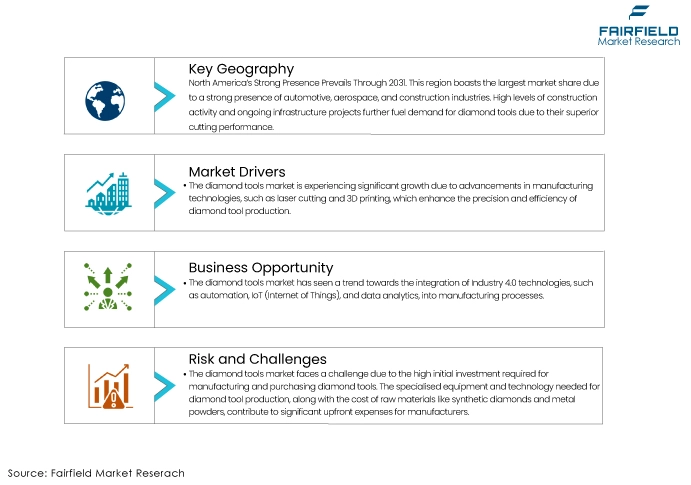
The diamond tools market is experiencing significant growth due to advancements in manufacturing technologies, such as laser cutting and 3D printing, which enhance the precision and efficiency of diamond tool production. These technologies enable the creation of diamond tools with superior durability, precision, and versatility, driving demand across various industries including construction, automotive, and aerospace.
- Momentous Construction Activities
With the global construction industry witnessing steady growth, there's a rising demand for diamond tools used in cutting, drilling, and grinding applications for materials like concrete, stone, and ceramics. Rapid urbanisation, infrastructure development projects, and the renovation sector are key drivers propelling the demand for diamond tools, particularly in emerging economies.
- Growth of Automotive Sector
The automotive industry's shift towards lightweight materials, such as carbon fibre composites and high-strength alloys, necessitates the use of diamond tools for precision machining and shaping. As automotive manufacturers strive for greater fuel efficiency and performance, the demand for diamond tools for machining engine components, body panels, and other critical parts is on the rise, fostering growth in the diamond tools market.
Major Growth Barriers
- High Initial Capital
The diamond tools market faces a challenge due to the high initial investment required for manufacturing and purchasing diamond tools. The specialised equipment and technology needed for diamond tool production, along with the cost of raw materials like synthetic diamonds and metal powders, contribute to significant upfront expenses for manufacturers. This can deter new entrants, and smaller players from entering the market and limit the expansion of existing businesses.
- Growing Environmental Concerns
Environmental regulations and concerns surrounding the extraction and processing of diamonds and other raw materials used in diamond tool manufacturing pose a restraint on market growth.
Sustainable sourcing practices and eco-friendly production methods are increasingly demanded by consumers and regulatory bodies, requiring diamond tool manufacturers to invest in environmentally responsible processes, which can add operational costs and complexity.
Key Trends and Opportunities to Look at
- Expansion of Industry 4.0
The diamond tools market has seen a trend towards the integration of Industry 4.0 technologies, such as automation, IoT (Internet of Things), and data analytics, into manufacturing processes. Diamond tool manufacturers are leveraging these technologies to optimise production efficiency, enhance product quality, and minimise downtime. For example, IoT sensors are being utilised to monitor tool performance in real-time, allowing for predictive maintenance and reducing the risk of unexpected tool failures.
Automation, including robotic systems for tasks like tool handling and quality inspection, is streamlining production processes, improving consistency, and reducing labour costs. Data analytics tools are being employed to analyse production data and optimise manufacturing parameters, leading to increased productivity and competitiveness in the market.
- The Rise of Synthetic Diamonds
Another notable trend in the diamond tools market is the increasing use of synthetic diamonds as an alternative to natural diamonds in tool manufacturing. Synthetic diamonds offer several advantages, including consistent quality, greater availability, and lower cost compared to natural diamonds.
Advancements in synthetic diamond production techniques, such as high-pressure high-temperature (HPHT) and chemical vapor deposition (CVD), have led to the development of high-quality diamond abrasives and cutting tools suitable for a wide range of applications.
As the demand for diamond tools continues to grow across industries like construction, automotive, and aerospace, the availability of high-performance synthetic diamonds presents significant opportunities for market players to expand their product offerings and capture new market segments.
- Unlocking Windows of Opportunity in Developing Markets
One of the biggest potential opportunities for diamond tools market players lies in expanding their presence in emerging markets, particularly in regions experiencing rapid industrialisation and infrastructure development. Countries in Asia Pacific, such as China, India, and southeast Asian nations, offer immense growth potential due to increasing construction activities, automotive production, and manufacturing sectors.
By establishing strategic partnerships, distribution networks, and localised manufacturing facilities in these markets, players can capitalise on growing demand for diamond tools and gain a competitive edge over rivals.
How Does the Regulatory Scenario Shape this Industry?
The regulatory environment significantly shapes the Diamond Tools Market. Stricter regulations on responsible diamond sourcing can affect the cost and availability of raw materials, potentially driving innovation in recycled diamond content or alternative super-abrasives. Safety standards for tool design, manufacturing, and user training can also be impacted, leading to safer tools but potentially higher production costs.
Similarly, regulations around worker safety and fair labour practices can increase production costs but also enhance the industry's reputation and attract skilled workers. Trade restrictions and quotas can influence global pricing and competition within the market.
Regulations governing used diamond tool disposal can create opportunities for companies specialising in recycling or developing eco-friendly disposal methods. In conclusion, regulations act as a double-edged sword. While they can increase costs and introduce challenges, they also push for advancements, ethical practices, and a more sustainable industry. Companies that can adapt and comply with these evolving regulations will likely be better positioned for long-term success.
Fairfield’s Ranking Board
Top Segments
- Synthetic Diamond Abrasive Type at the Forefront
Abrasives are a crucial component in diamond tools, and among them, synthetic diamonds stand out for their exceptional hardness, and durability. They dominate this segment due to their ability to withstand high pressures and temperatures, making them ideal for cutting and grinding hard materials like concrete, stone, and ceramics.
Manufacturers are increasingly focusing on developing advanced synthetic diamond abrasives with superior properties, such as enhanced thermal stability and wear resistance, to meet the growing demand for high-performance tools in industries like construction and automotive. The steady growth of these industries, coupled with ongoing technological advancements in synthetic diamond production, ensures the sustained dominance of synthetic diamond abrasives in the market.
- Polishing Pads and Discs Account for a Significant Market Share
The finishing-based segment of the diamond tools market caters to industries requiring precision, and high-quality surface finishing, such as electronics, optics, and aerospace. Diamond tools excel in providing impeccable surface finishes due to their unparalleled hardness, and abrasion resistance. Within this segment, polishing pads, and discs hold significant market share, especially in applications like semiconductor manufacturing, and optical lens production.
Manufacturers continually innovate to enhance the efficiency and precision of diamond-based finishing tools, incorporating advanced materials and design improvements. The increasing demand for precision-engineered components in various industries, driven by technological advancements and quality standards, ensures the continued growth and dominance of finishing-based diamond tools in the market.
- Diamond Pastes and Suspensions Rank Top by Lapping
Lapping is a precision finishing process used to achieve tight tolerances and exceptional surface flatness in critical components across industries like automotive, aerospace, and medical devices. Diamond lapping compounds and slurries are indispensable in this process due to their ability to achieve ultra-smooth surface finishes with minimal material removal. Within the lapping-based segment, diamond pastes and suspensions are widely preferred for their consistency, particle size distribution, and uniformity, enabling precise control over the lapping process.
As industries increasingly demand higher precision and tighter tolerances in their products, the demand for diamond lapping tools continues to grow. Manufacturers are investing in research and development to formulate advanced diamond lapping solutions tailored to specific industry requirements, ensuring the sustained dominance of diamond-based lapping tools in the market.
Regional Frontrunners
- North America to be the Strongest Regional Market
This region boasts the largest market share due to a strong presence of automotive, aerospace, and construction industries. High levels of construction activity and ongoing infrastructure projects further fuel demand for diamond tools due to their superior cutting performance. Additionally, government initiatives promoting infrastructure development contribute to market growth.
- Asia Pacific’s Growth Prospects Led by China, Japan, and India
This region is experiencing rapid industrialisation, and significant investments in infrastructure projects. This surge in industrial activity translates to a growing demand for efficient and precise cutting tools, making diamond tools a prime choice. China, Japan, and India are the key contributors in this region due to their flourishing manufacturing sectors.
- Europe Benefits from a Strong Focus on Precision Engineering
Europe has a well-established manufacturing base, and a long history of using diamond tools in various industries. The focus on precision engineering and adherence to strict safety standards make Europe a significant market for high-quality diamond tools. However, mature markets and potential regulations might limit the growth compared to the fast-paced Asia Pacific region.
Fairfield’s Competitive Landscape Analysis
The competition landscape of the diamond tools market is characterised by intense rivalry among key players striving to gain a competitive edge through innovation, strategic partnerships, and expansion into new markets. To maintain their competitive positions and drive growth, key players in the diamond tools market employ various strategies such as product innovation, where they focus on developing advanced diamond tools with enhanced durability, precision, and performance to meet evolving customer demands.
Additionally, strategic alliances and acquisitions are utilised to expand market reach, access new technologies, and strengthen competitive capabilities. Moreover, investments in research and development, along with marketing initiatives to promote product differentiation and brand recognition, are crucial growth strategies adopted by key companies to stay ahead in this dynamic and competitive market landscape.
Who are the Leaders in Global Diamond Tools Space
• Hilti Group
• Sumitomo Electric Industries, Ltd.
• Husqvarna AB
• Saint-Gobain Abrasives Inc
• Shinhan Diamond Industrial Co. Ltd
• Toolgal Degania Industrial Diamonds Ltd.
• Sanwa Diamond Tools
• Monte-Bianco Diamond Applications Co. Ltd.
• Shijiazhuang Kitsibo Tools Co., Ltd.
• Syntec Diamond Tools, Inc
Global Diamond Tools Market is Segmented as Below:
By Tool Type:
- Abrasives Type
- Finishing Based
- Lapping Based
- Drilling Tools
- Cutting Tools
- Sawing Tools
- Milling Tools
- Diamond Gauging Finger
- Files
By Manufacturing Method:
- Metal-bonded
- Resin-bonded
- Electroplated
By End use:
- Automotive
- Construction
- Glass
- Stone
- Ceramic
- Fabrication & General Manufacturing
- Healthcare & Pharmaceutical
- Aerospace & Defence
- Electronics & Semiconductor
By Region:
- North America
- Europe
- Asia Pacific
- Latin America
- Middles East & Africa
- Executive Summary
- Global Diamond Tools Market Snapshot
- Future Projections
- Key Market Trends
- Regional Snapshot, by Value, 2026
- Analyst Recommendations
- Market Overview
- Market Definitions and Segmentations
- Market Dynamics
- Drivers
- Restraints
- Market Opportunities
- Value Chain Analysis
- COVID-19 Impact Analysis
- Porter's Five Forces Analysis
- Impact of Russia-Ukraine Conflict
- PESTLE Analysis
- Regulatory Analysis
- Price Trend Analysis
- Current Prices and Future Projections, 2025-2033
- Price Impact Factors
- Global Diamond Tools Market Outlook, 2020 - 2033
- Global Diamond Tools Market Outlook, by Tool Type, Value (US$ Bn), 2020-2033
- Abrasives Type
- Finishing Based
- Lapping Based
- Drilling Tools
- Cutting Tools
- Sawing Tools
- Milling Tools
- Diamond Gauging Finger
- Files
- Global Diamond Tools Market Outlook, by Manufacturing Method, Value (US$ Bn), 2020-2033
- Metal-bonded
- Resin-bonded
- Electroplated
- Global Diamond Tools Market Outlook, by End use, Value (US$ Bn), 2020-2033
- Automotive
- Construction
- Glass
- Stone
- Ceramic
- Fabrication & General Manufacturing
- Healthcare & Pharmaceutical
- Aerospace & Defence
- Electronics & Semiconductor
- Global Diamond Tools Market Outlook, by Region, Value (US$ Bn), 2020-2033
- North America
- Europe
- Asia Pacific
- Latin America
- Middle East & Africa
- Global Diamond Tools Market Outlook, by Tool Type, Value (US$ Bn), 2020-2033
- North America Diamond Tools Market Outlook, 2020 - 2033
- North America Diamond Tools Market Outlook, by Tool Type, Value (US$ Bn), 2020-2033
- Abrasives Type
- Finishing Based
- Lapping Based
- Drilling Tools
- Cutting Tools
- Sawing Tools
- Milling Tools
- Diamond Gauging Finger
- Files
- North America Diamond Tools Market Outlook, by Manufacturing Method, Value (US$ Bn), 2020-2033
- Metal-bonded
- Resin-bonded
- Electroplated
- North America Diamond Tools Market Outlook, by End use, Value (US$ Bn), 2020-2033
- Automotive
- Construction
- Glass
- Stone
- Ceramic
- Fabrication & General Manufacturing
- Healthcare & Pharmaceutical
- Aerospace & Defence
- Electronics & Semiconductor
- North America Diamond Tools Market Outlook, by Country, Value (US$ Bn), 2020-2033
- U.S. Diamond Tools Market Outlook, by Tool Type, 2020-2033
- U.S. Diamond Tools Market Outlook, by Manufacturing Method, 2020-2033
- U.S. Diamond Tools Market Outlook, by End use, 2020-2033
- Canada Diamond Tools Market Outlook, by Tool Type, 2020-2033
- Canada Diamond Tools Market Outlook, by Manufacturing Method, 2020-2033
- Canada Diamond Tools Market Outlook, by End use, 2020-2033
- BPS Analysis/Market Attractiveness Analysis
- North America Diamond Tools Market Outlook, by Tool Type, Value (US$ Bn), 2020-2033
- Europe Diamond Tools Market Outlook, 2020 - 2033
- Europe Diamond Tools Market Outlook, by Tool Type, Value (US$ Bn), 2020-2033
- Abrasives Type
- Finishing Based
- Lapping Based
- Drilling Tools
- Cutting Tools
- Sawing Tools
- Milling Tools
- Diamond Gauging Finger
- Files
- Europe Diamond Tools Market Outlook, by Manufacturing Method, Value (US$ Bn), 2020-2033
- Metal-bonded
- Resin-bonded
- Electroplated
- Europe Diamond Tools Market Outlook, by End use, Value (US$ Bn), 2020-2033
- Automotive
- Construction
- Glass
- Stone
- Ceramic
- Fabrication & General Manufacturing
- Healthcare & Pharmaceutical
- Aerospace & Defence
- Electronics & Semiconductor
- Europe Diamond Tools Market Outlook, by Country, Value (US$ Bn), 2020-2033
- Germany Diamond Tools Market Outlook, by Tool Type, 2020-2033
- Germany Diamond Tools Market Outlook, by Manufacturing Method, 2020-2033
- Germany Diamond Tools Market Outlook, by End use, 2020-2033
- Italy Diamond Tools Market Outlook, by Tool Type, 2020-2033
- Italy Diamond Tools Market Outlook, by Manufacturing Method, 2020-2033
- Italy Diamond Tools Market Outlook, by End use, 2020-2033
- France Diamond Tools Market Outlook, by Tool Type, 2020-2033
- France Diamond Tools Market Outlook, by Manufacturing Method, 2020-2033
- France Diamond Tools Market Outlook, by End use, 2020-2033
- U.K. Diamond Tools Market Outlook, by Tool Type, 2020-2033
- U.K. Diamond Tools Market Outlook, by Manufacturing Method, 2020-2033
- U.K. Diamond Tools Market Outlook, by End use, 2020-2033
- Spain Diamond Tools Market Outlook, by Tool Type, 2020-2033
- Spain Diamond Tools Market Outlook, by Manufacturing Method, 2020-2033
- Spain Diamond Tools Market Outlook, by End use, 2020-2033
- Russia Diamond Tools Market Outlook, by Tool Type, 2020-2033
- Russia Diamond Tools Market Outlook, by Manufacturing Method, 2020-2033
- Russia Diamond Tools Market Outlook, by End use, 2020-2033
- Rest of Europe Diamond Tools Market Outlook, by Tool Type, 2020-2033
- Rest of Europe Diamond Tools Market Outlook, by Manufacturing Method, 2020-2033
- Rest of Europe Diamond Tools Market Outlook, by End use, 2020-2033
- BPS Analysis/Market Attractiveness Analysis
- Europe Diamond Tools Market Outlook, by Tool Type, Value (US$ Bn), 2020-2033
- Asia Pacific Diamond Tools Market Outlook, 2020 - 2033
- Asia Pacific Diamond Tools Market Outlook, by Tool Type, Value (US$ Bn), 2020-2033
- Abrasives Type
- Finishing Based
- Lapping Based
- Drilling Tools
- Cutting Tools
- Sawing Tools
- Milling Tools
- Diamond Gauging Finger
- Files
- Asia Pacific Diamond Tools Market Outlook, by Manufacturing Method, Value (US$ Bn), 2020-2033
- Metal-bonded
- Resin-bonded
- Electroplated
- Asia Pacific Diamond Tools Market Outlook, by End use, Value (US$ Bn), 2020-2033
- Automotive
- Construction
- Glass
- Stone
- Ceramic
- Fabrication & General Manufacturing
- Healthcare & Pharmaceutical
- Aerospace & Defence
- Electronics & Semiconductor
- Asia Pacific Diamond Tools Market Outlook, by Country, Value (US$ Bn), 2020-2033
- China Diamond Tools Market Outlook, by Tool Type, 2020-2033
- China Diamond Tools Market Outlook, by Manufacturing Method, 2020-2033
- China Diamond Tools Market Outlook, by End use, 2020-2033
- Japan Diamond Tools Market Outlook, by Tool Type, 2020-2033
- Japan Diamond Tools Market Outlook, by Manufacturing Method, 2020-2033
- Japan Diamond Tools Market Outlook, by End use, 2020-2033
- South Korea Diamond Tools Market Outlook, by Tool Type, 2020-2033
- South Korea Diamond Tools Market Outlook, by Manufacturing Method, 2020-2033
- South Korea Diamond Tools Market Outlook, by End use, 2020-2033
- India Diamond Tools Market Outlook, by Tool Type, 2020-2033
- India Diamond Tools Market Outlook, by Manufacturing Method, 2020-2033
- India Diamond Tools Market Outlook, by End use, 2020-2033
- Southeast Asia Diamond Tools Market Outlook, by Tool Type, 2020-2033
- Southeast Asia Diamond Tools Market Outlook, by Manufacturing Method, 2020-2033
- Southeast Asia Diamond Tools Market Outlook, by End use, 2020-2033
- Rest of SAO Diamond Tools Market Outlook, by Tool Type, 2020-2033
- Rest of SAO Diamond Tools Market Outlook, by Manufacturing Method, 2020-2033
- Rest of SAO Diamond Tools Market Outlook, by End use, 2020-2033
- BPS Analysis/Market Attractiveness Analysis
- Asia Pacific Diamond Tools Market Outlook, by Tool Type, Value (US$ Bn), 2020-2033
- Latin America Diamond Tools Market Outlook, 2020 - 2033
- Latin America Diamond Tools Market Outlook, by Tool Type, Value (US$ Bn), 2020-2033
- Abrasives Type
- Finishing Based
- Lapping Based
- Drilling Tools
- Cutting Tools
- Sawing Tools
- Milling Tools
- Diamond Gauging Finger
- Files
- Latin America Diamond Tools Market Outlook, by Manufacturing Method, Value (US$ Bn), 2020-2033
- Metal-bonded
- Resin-bonded
- Electroplated
- Latin America Diamond Tools Market Outlook, by End use, Value (US$ Bn), 2020-2033
- Automotive
- Construction
- Glass
- Stone
- Ceramic
- Fabrication & General Manufacturing
- Healthcare & Pharmaceutical
- Aerospace & Defence
- Electronics & Semiconductor
- Latin America Diamond Tools Market Outlook, by Country, Value (US$ Bn), 2020-2033
- Brazil Diamond Tools Market Outlook, by Tool Type, 2020-2033
- Brazil Diamond Tools Market Outlook, by Manufacturing Method, 2020-2033
- Brazil Diamond Tools Market Outlook, by End use, 2020-2033
- Mexico Diamond Tools Market Outlook, by Tool Type, 2020-2033
- Mexico Diamond Tools Market Outlook, by Manufacturing Method, 2020-2033
- Mexico Diamond Tools Market Outlook, by End use, 2020-2033
- Argentina Diamond Tools Market Outlook, by Tool Type, 2020-2033
- Argentina Diamond Tools Market Outlook, by Manufacturing Method, 2020-2033
- Argentina Diamond Tools Market Outlook, by End use, 2020-2033
- Rest of LATAM Diamond Tools Market Outlook, by Tool Type, 2020-2033
- Rest of LATAM Diamond Tools Market Outlook, by Manufacturing Method, 2020-2033
- Rest of LATAM Diamond Tools Market Outlook, by End use, 2020-2033
- BPS Analysis/Market Attractiveness Analysis
- Latin America Diamond Tools Market Outlook, by Tool Type, Value (US$ Bn), 2020-2033
- Middle East & Africa Diamond Tools Market Outlook, 2020 - 2033
- Middle East & Africa Diamond Tools Market Outlook, by Tool Type, Value (US$ Bn), 2020-2033
- Abrasives Type
- Finishing Based
- Lapping Based
- Drilling Tools
- Cutting Tools
- Sawing Tools
- Milling Tools
- Diamond Gauging Finger
- Files
- Middle East & Africa Diamond Tools Market Outlook, by Manufacturing Method, Value (US$ Bn), 2020-2033
- Metal-bonded
- Resin-bonded
- Electroplated
- Middle East & Africa Diamond Tools Market Outlook, by End use, Value (US$ Bn), 2020-2033
- Automotive
- Construction
- Glass
- Stone
- Ceramic
- Fabrication & General Manufacturing
- Healthcare & Pharmaceutical
- Aerospace & Defence
- Electronics & Semiconductor
- Middle East & Africa Diamond Tools Market Outlook, by Country, Value (US$ Bn), 2020-2033
- GCC Diamond Tools Market Outlook, by Tool Type, 2020-2033
- GCC Diamond Tools Market Outlook, by Manufacturing Method, 2020-2033
- GCC Diamond Tools Market Outlook, by End use, 2020-2033
- South Africa Diamond Tools Market Outlook, by Tool Type, 2020-2033
- South Africa Diamond Tools Market Outlook, by Manufacturing Method, 2020-2033
- South Africa Diamond Tools Market Outlook, by End use, 2020-2033
- Egypt Diamond Tools Market Outlook, by Tool Type, 2020-2033
- Egypt Diamond Tools Market Outlook, by Manufacturing Method, 2020-2033
- Egypt Diamond Tools Market Outlook, by End use, 2020-2033
- Nigeria Diamond Tools Market Outlook, by Tool Type, 2020-2033
- Nigeria Diamond Tools Market Outlook, by Manufacturing Method, 2020-2033
- Nigeria Diamond Tools Market Outlook, by End use, 2020-2033
- Rest of Middle East Diamond Tools Market Outlook, by Tool Type, 2020-2033
- Rest of Middle East Diamond Tools Market Outlook, by Manufacturing Method, 2020-2033
- Rest of Middle East Diamond Tools Market Outlook, by End use, 2020-2033
- BPS Analysis/Market Attractiveness Analysis
- Middle East & Africa Diamond Tools Market Outlook, by Tool Type, Value (US$ Bn), 2020-2033
- Competitive Landscape
- Company Vs Segment Heatmap
- Company Market Share Analysis, 2025
- Competitive Dashboard
- Company Profiles
- Hilti Group
- Company Overview
- Product Portfolio
- Financial Overview
- Business Strategies and Developments
- Sumitomo Electric Industries, Ltd.
- Husqvarna AB
- Saint-Gobain Abrasives Inc
- Shinhan Diamond Industrial Co. Ltd
- Toolgal Degania Industrial Diamonds Ltd.
- Sanwa Diamond Tools
- Monte-Bianco Diamond Applications Co. Ltd.
- Shijiazhuang Kitsibo Tools Co., Ltd.
- Syntec Diamond Tools, Inc
- Hilti Group
- Appendix
- Research Methodology
- Report Assumptions
- Acronyms and Abbreviations
|
BASE YEAR |
HISTORICAL DATA |
FORECAST PERIOD |
UNITS |
|||
 |
2025 |
 |
2020 - 2025 |
 |
2026 - 2033 |
Value: US$ Million |
Our Research Methodology
Considering the volatility of business today, traditional approaches to strategizing a game plan can be unfruitful if not detrimental. True ambiguity is no way to determine a forecast. A myriad of predetermined factors must be accounted for such as the degree of risk involved, the magnitude of circumstances, as well as conditions or consequences that are not known or unpredictable. To circumvent binary views that cast uncertainty, the application of market research intelligence to strategically posture, move, and enable actionable outcomes is necessary.
View Methodology
Quality Assured
Rigorous Validation Process

Confidentiality Assured
End-to-end Data Security

Custom Research Services
Tailored To Your Objectives
FAQs
Diamond tools are cutting, grinding, or drilling tools that use diamonds, either natural or synthetic, as abrasives due to their hardness and wear resistance.
Growth is driven by increasing demand in construction, automotive, and electronics industries, along with advancements in manufacturing technology.
Asia Pacific, North America, and Europe are leading the market due to their large construction activities and industrial manufacturing bases.
Major types include diamond saw blades, diamond grinding wheels, diamond drill bits, and diamond segments.
Challenges include high production costs, fluctuating raw material prices, and competition from alternative abrasive materials.
Related Reports
Slow Speed Shredding Machine Market
The global slow speed shredding machine market is set to reach US$ 1.23 Bn by 2033, growing at a 6.7% CAGR, driven by rising waste management needs
ORC Waste Heat to Power Market Insights, Competitive Landscape, and Market Forecast - 2033
The global ORC waste heat to power market is set to reach US$ 3.34 Bn by 2033, growing at an 8.8% CAGR, driven by rising demand for energy efficiency
Autonomous Farm Equipment Market Insights, Competitive Landscape, and Market Forecast - 2033
Autonomous Farm Equipment Market to reach USD 8.07 Bn by 2033, growing at 12.4% CAGR, driven by labor shortages, precision farming, and automation.
Oil & Gas Electric Submersible Pump Market Insights, Competitive Landscape, and Market Forecast 2033
The oil & gas electric submersible pump market is set to reach USD 13.29 Bn by 2033, driven by reliability upgrades, longer run life, and offshore growth
Waste Heat to Power Market Insights, Competitive Landscape, and Market Forecast 2033
Waste Heat to Power Market to grow from USD 8.40 Billion in 2026 to USD 13.14 Billion by 2033, expanding at a 6.6% CAGR during the forecast period.
Hydraulic Motors Market Insights, Competitive Landscape, and Market Forecast - 2033
Hydraulic Motors Market to reach USD 6.56 Bn by 2033, growing at 5.2% CAGR, driven by construction, agriculture, material handling, and infrastructure.