



CO2 Glass Tube Laser Market
CO2 Glass Tube Laser Market Size, Share, Insights, Competitive Landscape, and Forecast 2026 to 2033
CO2 Glass Tube Laser Market Size and Trend Analysis
How Fast Is the CO2 Glass Tube Laser Market Growing?
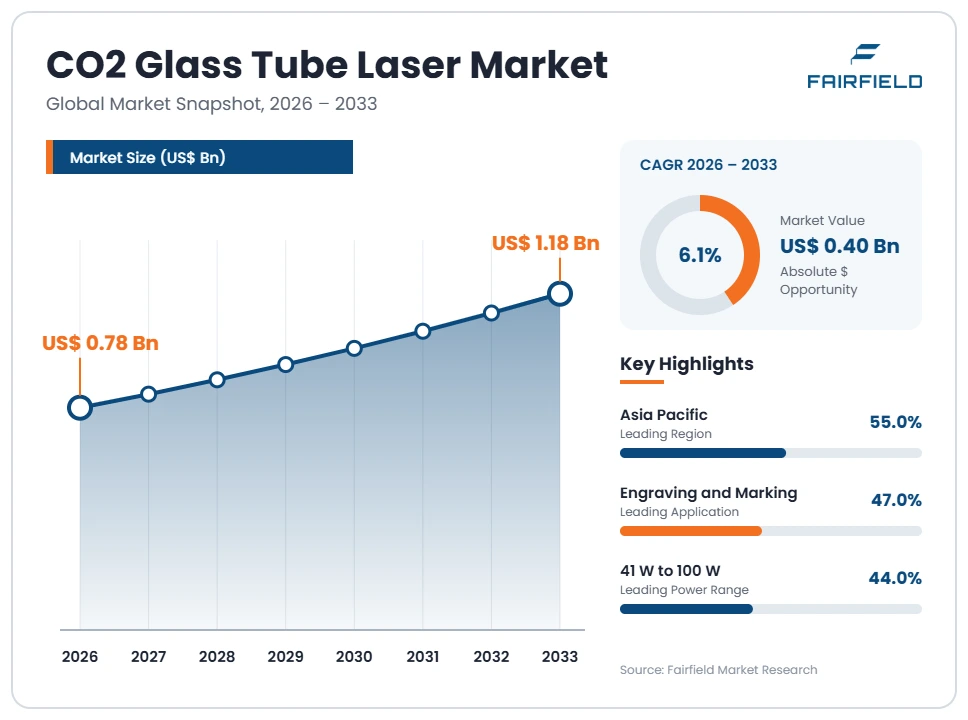
The global CO2 glass tube laser market size is expected to be valued at US$ 0.78 billion in 2026 and projected to reach US$ 1.18 billion by 2033, growing at a CAGR of 6.1% between 2026 and 2033.
Between 2020 and 2025, the market grew at a CAGR of about 5.6%, as home businesses, makers, and small workshops bought desktop laser engraving machines during the pandemic, then demand from signage, packaging, textiles, and education kept rising while price competition among Chinese producers intensified. The CO2 glass tube laser market covers carbon dioxide lasers that use sealed glass laser tubes filled with a gas mixture and excited by direct-current high voltage, along with the cutting and engraving machines built around them. Tubes typically range from about 40 W to 150 W or more and last several thousand hours before replacement. They cut and engrave wood, acrylic, leather, fabric, paper, rubber, glass, and stone, and mark coated metals. Glass tubes are much cheaper than metal RF-excited CO2 lasers. Growth comes from small business manufacturing, personalization, and signage. In October 2026, xTool launched its X1 platform with a 55 W CO2 module.
Key Report Takeaways
- By Power Range: 41 W to 100 W held about 44% share in 2025, while Above 100 W is projected to expand at a 6.8% CAGR through 2033, driven by faster cutting of thicker acrylic and wood in signage, furniture, and packaging workshops.
- By Application: Engraving and Marking held about 47% share in 2025, while Cutting is projected to expand at a 6.6% CAGR through 2033, driven by custom signage, packaging prototypes, model making, and textile and leather pattern cutting.
- By End User: Small Businesses and Workshops held about 40% share in 2025, while Hobbyists and Education is projected to expand at an 8.1% CAGR through 2033, driven by maker culture, school STEM labs, and affordable desktop machines.
- By Region: Asia Pacific held about 55% share in 2025, while India is projected to expand at a 7.6% CAGR through 2033, driven by growing signage, textile, and handicraft industries and rising small-scale manufacturing.
Global CO2 Glass Tube Laser Market Trends and Insights
Drivers Impact Analysis
Two drivers carry the strongest influence on CO2 glass tube laser market demand during the forecast period.
| Driver | Impact on CAGR Forecast | Geographic Relevance | Impact Timeline |
| Small business manufacturing and personalization | High | Global | Long term (≥4 years) |
| Low cost compared with RF metal tube lasers | Medium | Asia Pacific, Latin America, Middle East & Africa | Medium term (2-4 years) |
Small Business Demand Is Driving the CO2 Glass Tube Laser Market
Small business manufacturing and personalization are the strongest driver of the CO2 glass tube laser market. Many people now make products at home and in small shops.
The mechanism is the rise of custom, on-demand production. Online marketplaces such as Etsy and Amazon Handmade, along with social media shops, let small sellers offer personalized gifts, signs, jewelry, coasters, and leather goods, and CO2 glass tube lasers are the main tools for cutting and engraving these items. Sign makers, print shops, packaging designers, furniture makers, and model builders use them to produce parts quickly without molds or dies. Desktop machines from xTool, OMTech, Glowforge, and many Chinese brands have made lasers easy to use with cameras, software, and safety enclosures. Every machine needs replacement tubes every few years, creating steady demand. These trends support long-term growth.
Low Cost Is Expanding the CO2 Glass Tube Laser Market
Low cost compared with RF metal tube lasers is expanding the CO2 glass tube laser market. Glass tubes make lasers affordable.
The cause is the large price gap between laser types. A glass tube of similar power can cost a fraction of an RF-excited metal laser source, so machine builders in China can offer complete cutting and engraving systems at low prices. This opens laser processing to small factories, schools, and workshops in India, Indonesia, Vietnam, Brazil, Mexico, Egypt, and Nigeria. Replacement tubes are widely available online at low prices, and many users replace tubes themselves, keeping running costs down. Glass tube machines can also be repaired easily by local technicians, which suits markets with limited service networks. Machine builders keep adding higher-power tubes at prices that small factories can afford. These trends expand sales.
Restraints Impact Analysis
Two restraints limit how quickly the CO2 glass tube laser market grows.
| Restraint | Impact on CAGR Forecast | Geographic Relevance | Impact Timeline |
| Short tube life and lower precision than RF and fiber lasers | High | Global | Long term (≥4 years) |
| Price competition and safety concerns | Medium | Global | Medium term (2-4 years) |
Tube Limits Slow the CO2 Glass Tube Laser Market
Short tube life and lower precision than RF and fiber lasers slow the CO2 glass tube laser market. Glass tubes have trade-offs.
The specific causes are technical limits of DC glass tubes. Glass tubes typically last a few thousand hours, fade in power over time, and can crack from heat, shock, or poor cooling, so users must replace them regularly and maintain water chillers. Their beam quality and pulse speed are lower than RF metal tubes, which limits fine engraving detail and high-speed marking. Industrial users needing long life, fast pulses, and stable power often choose RF metal tubes or fiber lasers instead. Fiber and diode lasers are also improving and taking share in metal marking and low-power engraving. These factors slow growth in high-end industrial uses.
Competition and Safety Restrict the CO2 Glass Tube Laser Market
Price competition and safety concerns restrict the CO2 glass tube laser market. Many suppliers sell similar products.
The underlying causes are crowded markets and safety risks. Hundreds of Chinese tube and machine makers compete on price, keeping margins thin. Many buyers choose the cheapest option, which pushes suppliers to cut corners. Poor-quality tubes may fail early or lose power quickly, hurting buyer trust, and differences in tube ratings make it hard for buyers to compare products. Lasers can cause fires and eye injuries, and cutting some plastics releases toxic fumes that need filtration. Some countries are tightening safety rules and certification for consumer machines, raising costs for small brands. Shipping fragile glass tubes also leads to breakage and returns. Tariffs on Chinese machines raise prices in the United States. These factors restrict growth.
Market Opportunities
Smart Desktop Machines Open a Fast-Growth Revenue Pool
Smart desktop machines open a fast-growth revenue pool in the CO2 glass tube laser market. Makers want easy, safe, connected tools.
Machine makers can capture this opportunity. New desktop CO2 lasers include cameras for material alignment, automatic focusing, AI-assisted design tools, enclosed bodies with fire detection, and cloud software that makes laser work easy for beginners. In September 2025, xTool introduced its P3, an 80 W CO2 laser for small businesses, and in October 2026 it launched the modular X1 with a 55 W CO2 base module that can add diode, fiber, and UV lasers. Accessories such as rotary tools, conveyor feeders, and air filters add revenue. Online communities and design marketplaces keep users engaged. Companies combining reliable tubes with simple software can win loyal customers.
Education and Emerging Market Workshops Create a Growth Revenue Pool
Education and emerging market workshops create a growth revenue pool in the CO2 glass tube laser market. Many schools and small factories need affordable lasers.
Suppliers can capture this opportunity with affordable, safe machines and support. Schools, universities, and makerspaces use CO2 lasers to teach design, engineering, and art, and STEM programs are expanding worldwide with funding for digital fabrication labs. Small factories in India, Indonesia, and Brazil use affordable lasers for textiles, leather, footwear, and signage. Government programs in India and other countries that support small business manufacturing and vocational training add demand. Low running costs and easy maintenance make glass tube machines well suited to these settings and budgets. Companies offering training, local service, financing, and spare tubes can grow quickly in these fast-developing markets.
Segment Analysis
- By Power Range: 41 W to 100 W Leads While Above 100 W Grows Fastest
41 W to 100 W held about 44% share in 2025. This range covers most desktop and small workshop machines, balancing price, size, and the ability to cut wood and acrylic up to about 10 millimeters thick while producing fine engravings. It is the most popular choice for personalization businesses, schools, and sign makers, and tubes in this range are widely stocked.
Above 100 W is the fastest-growing power range, expanding at a 6.8% CAGR through 2033. Larger machines with 130 W to 150 W tubes cut thicker materials faster, suiting signage, furniture, packaging, and textile production. Up to 40 W tubes form another segment, used in entry-level engravers. For the market, high-power growth adds value per unit.
- By Application: Engraving and Marking Leads While Cutting Grows Fastest
Engraving and Marking held about 47% share in 2025. CO2 lasers engrave wood, leather, glass, stone, acrylic, and coated metals for personalized gifts, awards, labels, and decorations, and engraving makes up much of the work done by small businesses. Photo engraving and barcode marking on packaging add demand.
Cutting is the fastest-growing application, expanding at a 6.6% CAGR through 2033. Sign makers, packaging designers, model builders, and textile and leather producers use CO2 lasers to cut shapes precisely without tools or dies. Other applications include perforating, scoring, and kiss-cutting of labels. Cutting acrylic with a polished edge is a key strength of CO2 lasers compared with diode lasers. For the market, cutting growth supports larger machines.
- By End User: Small Businesses and Workshops Lead While Hobbyists and Education Grow Fastest
Small Businesses and Workshops held about 40% share in 2025. Personalization shops, sign makers, print shops, furniture workshops, and leather crafters rely on CO2 glass tube lasers to produce custom products on demand at low cost, often running one or two machines.
Hobbyists and Education is the fastest-growing end user, expanding at an 8.1% CAGR through 2033. Affordable desktop machines, online tutorials, and school STEM programs are bringing lasers to homes and classrooms. Industrial manufacturing forms another end user, including garment, shoe, packaging, and furniture factories that run machines for long shifts. Larger factories often choose RF lasers for critical lines but use glass tube machines for less demanding work. For the market, hobby and education growth widens the customer base.
Geography Analysis
- Why Is North America Important to the CO2 Glass Tube Laser Market?
North America is important to the CO2 glass tube laser market because it is a major market for desktop and small business lasers and home to leading machine brands. The United States has large maker, Etsy seller, sign, and education communities, and brands such as Glowforge, Epilog Laser, Boss Laser, Full Spectrum Laser, and OMTech serve these buyers. Many machines sold in the region use glass tubes made in China. Makerspaces and schools buy lasers for STEM programs. Canada and Mexico add demand. Key barriers include tariffs on Chinese machines and competition from diode and fiber lasers. One change shaping the region is the rise of smart desktop machines.
- Europe Shapes the CO2 Glass Tube Laser Market Through Signage and Crafts
Europe is a major CO2 glass tube laser market. Germany, the United Kingdom, France, Italy, and Poland have large sign-making, packaging, furniture, and craft industries, and Trotec and other premium brands serve industrial users with RF lasers while many small firms buy affordable glass tube machines. Schools, universities, and makerspaces are adding lasers to design and technology courses. Strict safety and product standards such as CE marking apply, and fume extraction is required in many workplaces. Key barriers include safety certification costs and competition from RF lasers. One opportunity is affordable, certified machines for small businesses and schools.
- Which Region Is Leading the CO2 Glass Tube Laser Market?
Asia Pacific is leading the CO2 glass tube laser market with about 55% share in 2025, and India is the fastest-growing country, expanding at a 7.6% CAGR through 2033. China is the world’s main producer of CO2 glass tubes and complete machines, with companies such as Reci, Yongli, EFR, and Han’s Laser, and large domestic demand from signage, textiles, and packaging. India has growing signage, textile, leather, and handicraft industries. Vietnam, Indonesia, and Bangladesh use lasers in garment production. Key barriers include price wars and quality gaps. One change shaping the region is the shift to smarter desktop machines.
- Latin America Grows the CO2 Glass Tube Laser Market Through Small Workshops
Latin America is a growing CO2 glass tube laser market. Brazil, Mexico, Argentina, Colombia, Peru, and Chile have many small sign shops, furniture makers, shoe workshops, and craft businesses that use affordable glass tube lasers, often imported directly from China through online marketplaces. Online sales and local distributors make machines and tubes easier to buy, and personalized gift businesses are growing through social media. Key barriers include import duties, currency swings, limited service, and few trained technicians. One opportunity is training, financing, and local support for small businesses and craft workshops. Suppliers that keep spare tubes in stock locally can win loyal repeat customers.
- Middle East & Africa Builds the CO2 Glass Tube Laser Market Through Signage and Crafts
Middle East & Africa is an emerging CO2 glass tube laser market. Saudi Arabia, the United Arab Emirates, and Egypt have growing signage, advertising, exhibition, and interior design industries, and South Africa, Nigeria, and Kenya have growing small business manufacturing. Gift, wedding, and event decoration businesses use CO2 lasers widely for wood and acrylic items, and distributors in Dubai supply machines and spare tubes across the region. Key barriers include limited technical service, high import costs, and reliance on imports. One opportunity is affordable machines for signage, events, and craft businesses in fast-growing cities. Vocational schools and maker spaces are also starting to buy entry-level machines.
Competitive Landscape
The CO2 glass tube laser market is highly fragmented. Beijing Reci Laser Technology, Han’s Laser Technology Industry Group, xTool, OMTech, and Epilog Laser are leading players, while Glowforge, Boss Laser, Trotec Laser, Wuhan Golden Laser, Jinan Bodor CNC Machine, Thunder Laser, and Full Spectrum Laser compete strongly. A small number of Chinese factories make most of the world’s glass laser tubes, while hundreds of machine builders assemble cutting and engraving systems, and Western brands focus on design, software, and support.
Companies compete on tube life and power stability, price, machine reliability, software ease of use, safety features, and customer service. Tube makers compete on lifetime and consistent output, while machine brands differentiate through cameras, autofocus, enclosed designs, and design software. Online sales, social media marketing, and user communities have become important channels for reaching hobbyists and small businesses.
Strategic moves show how competition is changing. In September 2025, xTool introduced its 80 W P3 CO2 laser for small businesses. In November 2025, Luxinar introduced the SR 25 AOM sealed CO2 source, showing competition from RF lasers in industrial marking. In October 2026, xTool launched the modular X1 with a 55 W CO2 base module. These moves show competition shifting toward smart, multi-laser desktop machines.
Three themes shape vendor strategy. First, companies are adding automation, cameras, and AI design tools to desktop machines. Second, they are combining CO2 with diode, fiber, and UV modules. Third, they are expanding in Asia Pacific and other emerging markets where small workshops are growing.
CO2 Glass Tube Laser Market Industry Leaders
Beijing Reci Laser Technology Han’s Laser Technology Industry Group xTool OMTech Epilog Laser
Recent Industry Developments
- October 2026: xTool launched the X1, an upgradable laser platform with a 55 W CO2 base module and optional diode, fiber, MOPA, and UV modules, starting at US$ 3,399 - expands smart laser engraving machines in the CO2 glass tube laser market.
- November 2025: Luxinar introduced the SR 25 AOM sealed CO2 laser source for industrial marking - shows competition from RF metal tube lasers for high-speed uses.
- September 2025: xTool introduced the P3, an 80 W CO2 laser cutter for professionals and small businesses, ahead of IFA 2025 - adds higher-power desktop machines.
Companies Covered in the Report
- Beijing Reci Laser Technology
- Han’s Laser Technology Industry Group
- xTool
- OMTech
- Epilog Laser
- Glowforge
- Boss Laser
- Trotec Laser
- Wuhan Golden Laser
- Jinan Bodor CNC Machine
- Thunder Laser
- Full Spectrum Laser
CO2 Glass Tube Laser Market Report Scope
| Metric | Value |
| Study Period | 2020-2033 |
| Market Size 2026 | US$ 0.78 Billion |
| Market Size 2033 | US$ 1.18 Billion |
| CAGR 2026-2033 | 6.1% |
| Absolute Dollar Opportunity | US$ 0.40 Billion |
| Largest Market | Asia Pacific |
| Fastest-Growing Market | India |
| Market Concentration | Highly Fragmented |
| Major Players | Beijing Reci Laser Technology, Han’s Laser Technology Industry Group, xTool, OMTech, Epilog Laser |
CO2 Glass Tube Laser Market Segmentation
- Executive Summary
- CO2 Glass Tube Laser Market Snapshot
- Future Projections
- Key Market Trends
- Regional Snapshot
- Market Overview
- Market Definition and Report Scope
- Historical Market Trends
- Market Dynamics
- Drivers
- Small Business Demand Is Driving the CO2 Glass Tube Laser Market
- Low Cost Is Expanding the CO2 Glass Tube Laser Market
- Restraints
- Tube Limits Slow the CO2 Glass Tube Laser Market
- Competition and Safety Restrict the CO2 Glass Tube Laser Market
- Market Opportunities
- Smart Desktop Machines Open a Fast-Growth Revenue Pool
- Education and Emerging Market Workshops Create a Growth Revenue Pool
- Drivers
- Global CO2 Glass Tube Laser Market Outlook, 2020–2033
- Global CO2 Glass Tube Laser Market Outlook, by Power Range, Value (US$ Billion), 2020–2033
- Up to 40 W
- 41 W to 100 W
- Above 100 W
- Global CO2 Glass Tube Laser Market Outlook, by Application, Value (US$ Billion), 2020–2033
- Engraving and Marking
- Cutting
- Others
- Global CO2 Glass Tube Laser Market Outlook, by End User, Value (US$ Billion), 2020–2033
- Small Businesses and Workshops
- Industrial Manufacturing
- Hobbyists and Education
- Global CO2 Glass Tube Laser Market Outlook, by Region, Value (US$ Billion), 2020–2033
- North America
- Europe
- Asia Pacific
- Latin America
- Middle East & Africa
- Global CO2 Glass Tube Laser Market Outlook, by Power Range, Value (US$ Billion), 2020–2033
- North America CO2 Glass Tube Laser Market Outlook, 2020–2033
- North America CO2 Glass Tube Laser Market Outlook, by Power Range, Value (US$ Billion), 2020–2033
- Up to 40 W
- 41 W to 100 W
- Above 100 W
- North America CO2 Glass Tube Laser Market Outlook, by Application, Value (US$ Billion), 2020–2033
- Engraving and Marking
- Cutting
- Others
- North America CO2 Glass Tube Laser Market Outlook, by End User, Value (US$ Billion), 2020–2033
- Small Businesses and Workshops
- Industrial Manufacturing
- Hobbyists and Education
- North America CO2 Glass Tube Laser Market Outlook, by Country, Value (US$ Billion), 2020–2033
- United States CO2 Glass Tube Laser Market Outlook, by Power Range, 2020–2033
- United States CO2 Glass Tube Laser Market Outlook, by Application, 2020–2033
- United States CO2 Glass Tube Laser Market Outlook, by End User, 2020–2033
- China CO2 Glass Tube Laser Market Outlook, by Power Range, 2020–2033
- China CO2 Glass Tube Laser Market Outlook, by Application, 2020–2033
- China CO2 Glass Tube Laser Market Outlook, by End User, 2020–2033
- Canada CO2 Glass Tube Laser Market Outlook, by Power Range, 2020–2033
- Canada CO2 Glass Tube Laser Market Outlook, by Application, 2020–2033
- Canada CO2 Glass Tube Laser Market Outlook, by End User, 2020–2033
- Mexico CO2 Glass Tube Laser Market Outlook, by Power Range, 2020–2033
- Mexico CO2 Glass Tube Laser Market Outlook, by Application, 2020–2033
- Mexico CO2 Glass Tube Laser Market Outlook, by End User, 2020–2033
- North America CO2 Glass Tube Laser Market Outlook, by Power Range, Value (US$ Billion), 2020–2033
- Europe CO2 Glass Tube Laser Market Outlook, 2020–2033
- Europe CO2 Glass Tube Laser Market Outlook, by Power Range, Value (US$ Billion), 2020–2033
- Up to 40 W
- 41 W to 100 W
- Above 100 W
- Europe CO2 Glass Tube Laser Market Outlook, by Application, Value (US$ Billion), 2020–2033
- Engraving and Marking
- Cutting
- Others
- Europe CO2 Glass Tube Laser Market Outlook, by End User, Value (US$ Billion), 2020–2033
- Small Businesses and Workshops
- Industrial Manufacturing
- Hobbyists and Education
- Europe CO2 Glass Tube Laser Market Outlook, by Country, Value (US$ Billion), 2020–2033
- Germany CO2 Glass Tube Laser Market Outlook, by Power Range, 2020–2033
- Germany CO2 Glass Tube Laser Market Outlook, by Application, 2020–2033
- Germany CO2 Glass Tube Laser Market Outlook, by End User, 2020–2033
- United Kingdom CO2 Glass Tube Laser Market Outlook, by Power Range, 2020–2033
- United Kingdom CO2 Glass Tube Laser Market Outlook, by Application, 2020–2033
- United Kingdom CO2 Glass Tube Laser Market Outlook, by End User, 2020–2033
- France CO2 Glass Tube Laser Market Outlook, by Power Range, 2020–2033
- France CO2 Glass Tube Laser Market Outlook, by Application, 2020–2033
- France CO2 Glass Tube Laser Market Outlook, by End User, 2020–2033
- Italy CO2 Glass Tube Laser Market Outlook, by Power Range, 2020–2033
- Italy CO2 Glass Tube Laser Market Outlook, by Application, 2020–2033
- Italy CO2 Glass Tube Laser Market Outlook, by End User, 2020–2033
- Poland CO2 Glass Tube Laser Market Outlook, by Power Range, 2020–2033
- Poland CO2 Glass Tube Laser Market Outlook, by Application, 2020–2033
- Poland CO2 Glass Tube Laser Market Outlook, by End User, 2020–2033
- Europe CO2 Glass Tube Laser Market Outlook, by Power Range, Value (US$ Billion), 2020–2033
- Asia Pacific CO2 Glass Tube Laser Market Outlook, 2020–2033
- Asia Pacific CO2 Glass Tube Laser Market Outlook, by Power Range, Value (US$ Billion), 2020–2033
- Up to 40 W
- 41 W to 100 W
- Above 100 W
- Asia Pacific CO2 Glass Tube Laser Market Outlook, by Application, Value (US$ Billion), 2020–2033
- Engraving and Marking
- Cutting
- Others
- Asia Pacific CO2 Glass Tube Laser Market Outlook, by End User, Value (US$ Billion), 2020–2033
- Small Businesses and Workshops
- Industrial Manufacturing
- Hobbyists and Education
- Asia Pacific CO2 Glass Tube Laser Market Outlook, by Country, Value (US$ Billion), 2020–2033
- India CO2 Glass Tube Laser Market Outlook, by Power Range, 2020–2033
- India CO2 Glass Tube Laser Market Outlook, by Application, 2020–2033
- India CO2 Glass Tube Laser Market Outlook, by End User, 2020–2033
- China CO2 Glass Tube Laser Market Outlook, by Power Range, 2020–2033
- China CO2 Glass Tube Laser Market Outlook, by Application, 2020–2033
- China CO2 Glass Tube Laser Market Outlook, by End User, 2020–2033
- Vietnam CO2 Glass Tube Laser Market Outlook, by Power Range, 2020–2033
- Vietnam CO2 Glass Tube Laser Market Outlook, by Application, 2020–2033
- Vietnam CO2 Glass Tube Laser Market Outlook, by End User, 2020–2033
- Indonesia CO2 Glass Tube Laser Market Outlook, by Power Range, 2020–2033
- Indonesia CO2 Glass Tube Laser Market Outlook, by Application, 2020–2033
- Indonesia CO2 Glass Tube Laser Market Outlook, by End User, 2020–2033
- Bangladesh CO2 Glass Tube Laser Market Outlook, by Power Range, 2020–2033
- Bangladesh CO2 Glass Tube Laser Market Outlook, by Application, 2020–2033
- Bangladesh CO2 Glass Tube Laser Market Outlook, by End User, 2020–2033
- Asia Pacific CO2 Glass Tube Laser Market Outlook, by Power Range, Value (US$ Billion), 2020–2033
- Latin America CO2 Glass Tube Laser Market Outlook, 2020–2033
- Latin America CO2 Glass Tube Laser Market Outlook, by Power Range, Value (US$ Billion), 2020–2033
- Up to 40 W
- 41 W to 100 W
- Above 100 W
- Latin America CO2 Glass Tube Laser Market Outlook, by Application, Value (US$ Billion), 2020–2033
- Engraving and Marking
- Cutting
- Others
- Latin America CO2 Glass Tube Laser Market Outlook, by End User, Value (US$ Billion), 2020–2033
- Small Businesses and Workshops
- Industrial Manufacturing
- Hobbyists and Education
- Latin America CO2 Glass Tube Laser Market Outlook, by Country, Value (US$ Billion), 2020–2033
- Brazil CO2 Glass Tube Laser Market Outlook, by Power Range, 2020–2033
- Brazil CO2 Glass Tube Laser Market Outlook, by Application, 2020–2033
- Brazil CO2 Glass Tube Laser Market Outlook, by End User, 2020–2033
- Mexico CO2 Glass Tube Laser Market Outlook, by Power Range, 2020–2033
- Mexico CO2 Glass Tube Laser Market Outlook, by Application, 2020–2033
- Mexico CO2 Glass Tube Laser Market Outlook, by End User, 2020–2033
- Argentina CO2 Glass Tube Laser Market Outlook, by Power Range, 2020–2033
- Argentina CO2 Glass Tube Laser Market Outlook, by Application, 2020–2033
- Argentina CO2 Glass Tube Laser Market Outlook, by End User, 2020–2033
- Colombia CO2 Glass Tube Laser Market Outlook, by Power Range, 2020–2033
- Colombia CO2 Glass Tube Laser Market Outlook, by Application, 2020–2033
- Colombia CO2 Glass Tube Laser Market Outlook, by End User, 2020–2033
- Peru CO2 Glass Tube Laser Market Outlook, by Power Range, 2020–2033
- Peru CO2 Glass Tube Laser Market Outlook, by Application, 2020–2033
- Peru CO2 Glass Tube Laser Market Outlook, by End User, 2020–2033
- Chile CO2 Glass Tube Laser Market Outlook, by Power Range, 2020–2033
- Chile CO2 Glass Tube Laser Market Outlook, by Application, 2020–2033
- Chile CO2 Glass Tube Laser Market Outlook, by End User, 2020–2033
- China CO2 Glass Tube Laser Market Outlook, by Power Range, 2020–2033
- China CO2 Glass Tube Laser Market Outlook, by Application, 2020–2033
- China CO2 Glass Tube Laser Market Outlook, by End User, 2020–2033
- Latin America CO2 Glass Tube Laser Market Outlook, by Power Range, Value (US$ Billion), 2020–2033
- Middle East & Africa CO2 Glass Tube Laser Market Outlook, 2020–2033
- Middle East & Africa CO2 Glass Tube Laser Market Outlook, by Power Range, Value (US$ Billion), 2020–2033
- Up to 40 W
- 41 W to 100 W
- Above 100 W
- Middle East & Africa CO2 Glass Tube Laser Market Outlook, by Application, Value (US$ Billion), 2020–2033
- Engraving and Marking
- Cutting
- Others
- Middle East & Africa CO2 Glass Tube Laser Market Outlook, by End User, Value (US$ Billion), 2020–2033
- Small Businesses and Workshops
- Industrial Manufacturing
- Hobbyists and Education
- Middle East & Africa CO2 Glass Tube Laser Market Outlook, by Country, Value (US$ Billion), 2020–2033
- Saudi Arabia CO2 Glass Tube Laser Market Outlook, by Power Range, 2020–2033
- Saudi Arabia CO2 Glass Tube Laser Market Outlook, by Application, 2020–2033
- Saudi Arabia CO2 Glass Tube Laser Market Outlook, by End User, 2020–2033
- United Arab Emirates CO2 Glass Tube Laser Market Outlook, by Power Range, 2020–2033
- United Arab Emirates CO2 Glass Tube Laser Market Outlook, by Application, 2020–2033
- United Arab Emirates CO2 Glass Tube Laser Market Outlook, by End User, 2020–2033
- Egypt CO2 Glass Tube Laser Market Outlook, by Power Range, 2020–2033
- Egypt CO2 Glass Tube Laser Market Outlook, by Application, 2020–2033
- Egypt CO2 Glass Tube Laser Market Outlook, by End User, 2020–2033
- South Africa CO2 Glass Tube Laser Market Outlook, by Power Range, 2020–2033
- South Africa CO2 Glass Tube Laser Market Outlook, by Application, 2020–2033
- South Africa CO2 Glass Tube Laser Market Outlook, by End User, 2020–2033
- Nigeria CO2 Glass Tube Laser Market Outlook, by Power Range, 2020–2033
- Nigeria CO2 Glass Tube Laser Market Outlook, by Application, 2020–2033
- Nigeria CO2 Glass Tube Laser Market Outlook, by End User, 2020–2033
- Kenya CO2 Glass Tube Laser Market Outlook, by Power Range, 2020–2033
- Kenya CO2 Glass Tube Laser Market Outlook, by Application, 2020–2033
- Kenya CO2 Glass Tube Laser Market Outlook, by End User, 2020–2033
- Middle East & Africa CO2 Glass Tube Laser Market Outlook, by Power Range, Value (US$ Billion), 2020–2033
- Competitive Landscape
- CO2 Glass Tube Laser Market Industry Leaders
- Recent Industry Developments
- Company Profiles
- Beijing Reci Laser Technology
- Han's Laser Technology Industry Group
- xTool
- OMTech
- Epilog Laser
- Glowforge
- Boss Laser
- Trotec Laser
- Wuhan Golden Laser
- Jinan Bodor CNC Machine
- Thunder Laser
- Full Spectrum Laser
- Appendix
- Research Methodology
- Report Assumptions
- Acronyms and Abbreviations
Power Range
- Up to 40 W
- 41 W to 100 W
- Above 100 W
Application
- Engraving and Marking
- Cutting
- Others
End User
- Small Businesses and Workshops
- Industrial Manufacturing
- Hobbyists and Education
Regions
- North America
- Europe
- Asia Pacific
- Latin America
- Middle East & Africa
Our Research Methodology
Considering the volatility of business today, traditional approaches to strategizing a game plan can be unfruitful if not detrimental. True ambiguity is no way to determine a forecast. A myriad of predetermined factors must be accounted for such as the degree of risk involved, the magnitude of circumstances, as well as conditions or consequences that are not known or unpredictable. To circumvent binary views that cast uncertainty, the application of market research intelligence to strategically posture, move, and enable actionable outcomes is necessary.
View Methodology
Quality Assured
Rigorous Validation Process

Confidentiality Assured
End-to-end Data Security

Custom Research Services
Tailored To Your Objectives
FAQs
The CO2 glass tube laser market is valued at US$ 0.78 billion in 2026, led by mid-power machines and Asia Pacific.
The market is projected to reach US$ 1.18 billion by 2033, growing at a 6.1% CAGR and adding US$ 0.40 billion.
Hobbyists and education are growing fastest at an 8.1% CAGR through 2033, driven by maker culture, STEM labs, and affordable desktop machines.
India is growing fastest at a 7.6% CAGR through 2033, driven by signage, textile, and handicraft industries and small-scale manufacturing.
Asia Pacific holds the largest share at about 55% in 2025, supported by tube and machine production and strong demand in China.
Related Reports
Heating Radiator Market Size, Share, Insights, Competitive Landscape, and Forecast 2026 to 2033
The global heating radiator market is valued at US$8.4 billion in 2026, reaching US$12.0 billion by 2033, growing at a 5.2% CAGR
Fermenters Market Size, Share, Insights, Competitive Landscape, and Forecast 2026 to 2033
The global fermenters market is valued at US$2.0 billion in 2026, reaching US$2.87 billion by 2033, growing at a 5.3% CAGR
Diamond Tools Market Size, Share, Insights, Competitive Landscape, and Forecast 2026 to 2033
The global diamond tools market is valued at US$11.2 billion in 2026, reaching US$16.8 billion by 2033, growing at a 6.0% CAGR
Tray Dispenser Market Size, Share, Insights, Competitive Landscape, and Forecast 2026 to 2033
Explore the tray dispenser market outlook for 2026–2033, covering product types, capacities, end users, regional trends, and leading companies.
Die Cut Box Market Size, Share, Insights, Competitive Landscape, and Forecast 2026 to 2033
Explore the die cut box market outlook for 2026–2033, including box styles, materials, printing trends, regional demand, and competitive insights.
Pre-Engineered Buildings Market Size, Share, Insights, Competitive Landscape, and Forecast 2026 to 2033
The pre-engineered buildings market is projected to grow from US$22.4 billion in 2026 to US$43.1 billion by 2033 at a 9.8% CAGR.