



Laser Processing Market
Laser Processing Market Size, Share, Insights, Competitive Landscape, and Forecast 2026 to 2033
Laser Processing Market Size and Trend Analysis
How Fast Is the Laser Processing Market Growing?
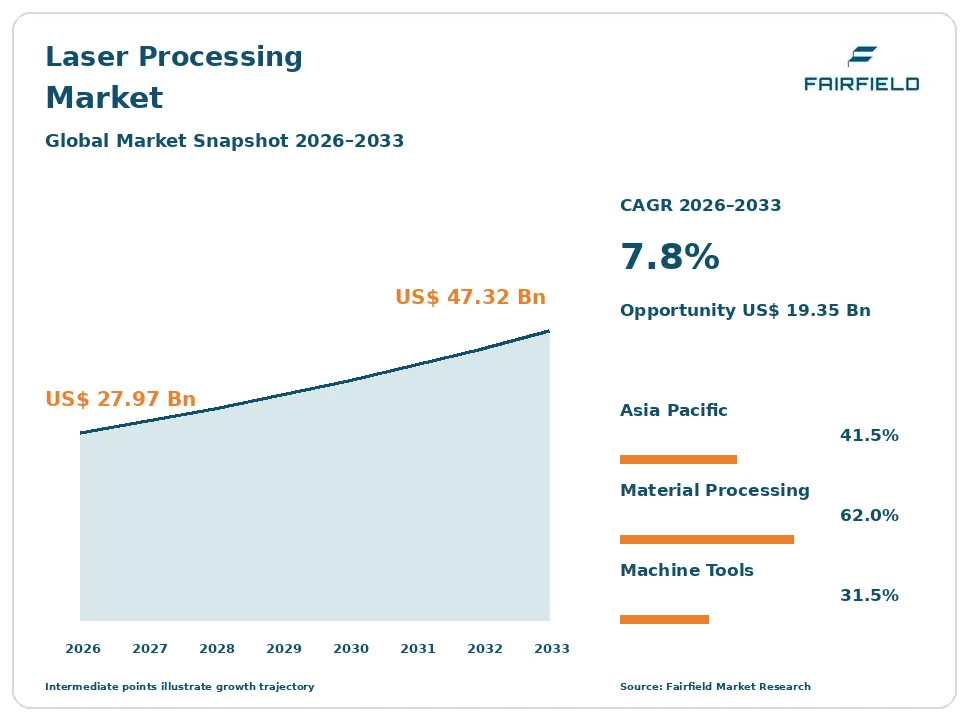
The global laser processing market size is expected to be valued at US$ 27.97 billion in 2026 and projected to reach US$ 47.32 billion by 2033, growing at a CAGR of 7.8% between 2026 and 2033.
Between 2020 and 2025, the market grew at a CAGR of about 6.4%, recovering quickly after the pandemic as factories invested in automation and electric vehicle production. Laser processing uses focused light to cut, weld, mark, drill, and engrave metals, plastics, glass, and semiconductors with high precision and little waste. Three factors now drive growth: demand for laser cutting and laser welding in automotive and battery manufacturing, rising use of micro-processing in electronics and semiconductors, and the falling cost and rising power of fiber lasers. The market is shifting toward high-power fiber cutters above 20 kW, ultrafast lasers for fine work on chips and displays, and smart machines linked to factory software. New launches in 2026, such as laser cutters from Mazak Optonics and HSG Laser, show strong competition on speed and price.
Key Report Takeaways
- By Laser Type: Gas Lasers held 38.0% share in 2026, while Solid-State Lasers are projected to expand at a 9.1% CAGR through 2033, driven by the fast adoption of high-power fiber lasers in metal cutting.
- By Process: Material Processing held 62.0% share in 2026, while Micro-Processing is projected to expand at a 9.6% CAGR through 2033, driven by semiconductor, display, and medical device production.
- By Application: Machine Tools held 31.5% share in 2026, while Electronics and Microelectronics are projected to expand at a 9.4% CAGR through 2033, driven by advanced chip packaging and smartphone manufacturing.
- By Region: Asia Pacific held 41.5% share in 2026, while Europe is projected to expand at an 8.6% CAGR through 2033, driven by electric vehicle, battery, and industrial automation investment.
Global Laser Processing Market Trends and Insights
Drivers Impact Analysis
| Driver | Impact on CAGR Forecast | Geographic Relevance | Impact Timeline |
| Electric vehicle and battery manufacturing | High | Asia Pacific, Europe, North America | Medium term (2-4 years) |
| Growth of electronics and semiconductor production | High | Asia Pacific, North America | Long term (≥4 years) |
Two drivers carry the strongest influence on laser processing demand during the forecast period.
Electric Vehicle Production Is Driving the Laser Processing Market
Electric vehicle and battery manufacturing is the strongest driver of the laser processing market. Lasers are essential for building car bodies, motors, and batteries.
The mechanism is the need for precise, fast, and clean joining and cutting. Battery cells, modules, and packs require thousands of welds between thin, different metals, such as copper and aluminum, and laser welding handles these without damaging heat-sensitive parts. Car makers use laser cutting for lightweight high-strength steel and aluminum body parts. ArcelorMittal has worked with TRUMPF on laser-cut and laser-welded hot-stamped parts for cars. Electric motor makers use lasers to cut and weld hairpin windings. Battery plants are being built across China, Germany, Hungary, the United States, and South Korea. These factors create steady demand for high-power laser systems.
Electronics Growth Is Expanding the Laser Processing Market
The growth of electronics and semiconductor production is expanding the laser processing market. Smaller and more complex devices need finer tools.
The cause is the shrinking size of electronic parts. Micro-processing with short-pulse and ultrafast lasers can drill tiny holes in circuit boards, cut thin glass for phone screens, and separate chips from wafers without cracks. Advanced chip packaging for AI processors uses lasers for drilling, marking, and debonding. Governments in the United States, Japan, South Korea, Taiwan, and Europe are funding new chip plants. Medical device makers use lasers to cut stents and mark instruments. JEOL and Hamamatsu Photonics launched a microscope with built-in laser processing in 2026. These trends widen laser use in high-value industries.
Restraints Impact Analysis
| Restraint | Impact on CAGR Forecast | Geographic Relevance | Impact Timeline |
| High capital costs for advanced systems | High | Global | Short term (≤2 years) |
| Price competition and industrial demand cycles | Medium | Asia Pacific, Europe | Medium term (2-4 years) |
Two restraints limit how quickly the laser processing market grows.
High Capital Costs Slow the Laser Processing Market
High capital costs for advanced systems slow the laser processing market. High-power and ultrafast laser machines are expensive.
The specific causes are equipment and operating costs. A high-power fiber laser cutting system with automation can cost several hundred thousand dollars, and ultrafast systems for microelectronics cost more. Small and medium-sized workshops often cannot afford them without financing. Machines also need skilled operators, safety enclosures, fume extraction, cooling systems, and regular maintenance. High interest rates since 2022 have made borrowing more expensive. Some manufacturers still use older methods, such as stamping, plasma cutting, and mechanical drilling, which have lower upfront costs. Training staff to program and maintain laser systems takes time, and downtime is costly for small shops. These factors slow adoption among smaller businesses and in developing countries.
Price Competition Restricts the Laser Processing Market
Price competition and industrial demand cycles restrict the laser processing market. Many suppliers compete for the same buyers.
The underlying causes are fast-growing Chinese competition and changing factory investment. Chinese makers such as Han’s Laser Technology, HSG Laser, and Raycus sell fiber lasers and cutters at much lower prices, pushing down margins for Western and Japanese firms. Demand for laser machines follows industrial cycles, and slowdowns in car production or electronics can delay orders. Weak demand in Germany’s machinery sector and trade tensions between the United States and China have affected sales. Tariffs raise costs for imported parts. Rapid technology change also shortens product life cycles, forcing frequent investment in new models. These factors limit revenue growth even when unit demand rises.
Market Opportunities
Ultrafast Lasers Open a High-Value Revenue Pool
Ultrafast lasers open a high-value revenue pool in the laser processing market. These lasers use extremely short pulses to remove material without heat damage.
Laser makers with advanced pulse technology and application labs can capture this opportunity. Ultrafast lasers work on glass, ceramics, polymers, and semiconductors that standard lasers can damage. They are used to make smartphone displays, solar cells, medical stents, and advanced chip packages. Demand from AI chip packaging, such as glass substrates and through-glass vias, is growing fast. Coherent, TRUMPF, and IPG Photonics offer ultrafast lasers. These systems carry higher prices and margins than standard cutters. Service and process development add recurring revenue. Solar cell makers also use ultrafast lasers for new high-efficiency cell designs, adding another fast-growing customer group.
Automation and Smart Factories Create a Productivity Revenue Pool
Automation and smart factories create a productivity revenue pool in the laser processing market. Manufacturers want machines that run with little human supervision.
Suppliers offering automated loading, sorting, and software can capture this opportunity. Labor shortages and rising wages in Europe, North America, and Japan push workshops to buy laser cutters with automatic sheet loading and part sorting. Machines connected to factory software can schedule jobs, monitor performance, and predict maintenance needs. AI tools help adjust cutting settings for different materials. Bystronic, TRUMPF, and Amada sell automated cutting cells. Automation packages raise the value of each machine sale. Software subscriptions and remote monitoring services create recurring income. Suppliers that offer complete cells, including lasers, robots, and software, can build long-term relationships with customers.
Segment Analysis
By Laser Type: Gas Lasers Lead While Solid-State Lasers Grow Fastest
Gas Lasers held 38.0% share in 2026, reflecting a large installed base. CO2 lasers, the main type of gas laser, are widely used for cutting and engraving non-metals such as wood, acrylic, textiles, paper, and plastics, and for some thick metal cutting. They are well established in signage, packaging, furniture, and textile production, where low cost and smooth edges matter. Epilog Laser, Universal Laser Systems, and Coherent supply CO2 systems.
Solid-State Lasers are the fastest-growing type, expanding at a 9.1% CAGR through 2033. This group includes fiber lasers, disk lasers, and diode lasers, which offer high efficiency, low maintenance, and strong performance on metals. IPG Photonics, TRUMPF, and Raycus lead in fiber and disk lasers. For the market, this growth replaces older CO2 cutters in metal workshops.
By Process: Material Processing Leads While Micro-Processing Grows Fastest
Material Processing held 62.0% share in 2026. This includes laser cutting, laser welding, drilling, and marking of sheet metal, tubes, and parts for cars, machinery, construction, and appliances. High-power fiber cutters dominate this segment, and demand rises with factory investment.
Micro-Processing is the fastest-growing process, expanding at a 9.6% CAGR through 2033. Micro-processing shapes very small features in chips, displays, circuit boards, and medical devices with high accuracy. Ultrafast lasers are the main tools. Medical device makers and electronics firms in South Korea, Taiwan, and Japan are major buyers. Micro-processing systems sell at much higher prices than standard cutters. For the market, this growth adds high-value systems.
By Application: Machine Tools Lead While Electronics and Microelectronics Grow Fastest
Machine Tools held 31.5% share in 2026. Laser cutting and welding machines are core equipment in metal fabrication shops and industrial plants. TRUMPF, Bystronic, Amada, Yamazaki Mazak, and Han’s Laser Technology sell large volumes of these systems.
Electronics and Microelectronics are the fastest-growing application, expanding at a 9.4% CAGR through 2033. Lasers cut, drill, mark, and repair parts for smartphones, chips, and displays. New chip plants and advanced packaging lines in several countries raise demand. Automotive, medical, and aerospace applications also grow steadily. Battery and motor production for electric vehicles makes automotive one of the most dynamic areas, while aerospace uses lasers for engine parts and drilling cooling holes. For the market, electronics growth adds precision demand.
Geography Analysis
North America Advances the Laser Processing Market Through Reshoring
North America is a major laser processing market. The United States has strong demand from aerospace, defense, medical devices, automotive, and semiconductor production, and government funding for chip plants and reshoring adds new factories in Arizona, Texas, and Ohio. IPG Photonics, Coherent, and MKS Instruments are based here. Mazak Optonics launched its OPTONICS brand for lower-cost laser cutters in the United States in 2026. Mexico and Canada add automotive and aerospace demand. Defense spending supports laser use in aircraft and missile production. Key barriers include skilled labor shortages and high costs. One change shaping the region is automated cutting cells.
Which Region Is Growing Fastest in the Laser Processing Market?
Europe is growing fastest in the laser processing market at an 8.6% CAGR through 2033. Germany hosts TRUMPF, Jenoptik, and Rofin, while Switzerland hosts Bystronic and Italy has strong machine tool makers. Electric vehicle and battery plants, along with car part suppliers, in Germany, Hungary, Poland, Sweden, and France need laser welding. EU funding for chip production, defense, and renewable energy equipment adds new demand for laser systems. Labor shortages push workshops toward automated laser systems. Key barriers include high energy costs and weak machinery demand. One change shaping the region is battery plant investment.
Which Region Is Leading the Laser Processing Market?
Asia Pacific is leading the laser processing market with a 41.5% share in 2026. China is the largest single market, with huge metal fabrication, electronics, and battery industries, and local makers such as Han’s Laser Technology, HSG Laser, and Raycus. Japan hosts Amada, Yamazaki Mazak, and Hamamatsu Photonics. South Korea and Taiwan lead in chips and displays. India is growing fast as electronics and auto plants expand under government incentive programs. Vietnam and Thailand are attracting electronics factories. Key barriers include price wars. One change shaping the region is exports of Chinese machines.
Latin America Grows the Laser Processing Market Through Manufacturing Investment
Latin America is a growing laser processing market. Brazil has automotive, agricultural machinery, and metal fabrication industries that use laser cutters, and Mexico is attracting car and electronics plants as companies move production closer to the United States. Argentina, Chile, and Colombia use lasers in metalworking, signage, and mining equipment repair. Chinese laser cutters have become popular because of their lower prices, while European and Japanese brands serve high-end buyers. Distributors offer financing to help small workshops buy machines. Key barriers include high import costs and economic swings. One opportunity is lower-cost fiber cutters for small workshops.
Middle East & Africa Expands the Laser Processing Market Through Industrial Diversification
Middle East & Africa is an emerging laser processing market. Saudi Arabia and the United Arab Emirates are building manufacturing, defense, and construction industries as part of economic diversification plans. Israel has strong electronics and defense sectors. South Africa and Egypt use lasers in automotive and metal fabrication, and Morocco is growing as a car manufacturing hub. Large construction projects in Saudi Arabia need cut steel and signage. Many machines are imported from China and Europe through local distributors. Key barriers include limited skilled workers and service networks. One opportunity is local metal fabrication for construction, defense, and energy projects across the region.
Competitive Landscape
The laser processing market is moderately concentrated. TRUMPF, Han’s Laser Technology, IPG Photonics, Coherent, Bystronic, Amada, and Yamazaki Mazak are leading suppliers of lasers and laser machines. Chinese firms such as HSG Laser and Raycus are growing quickly, while specialists such as Epilog Laser, Universal Laser Systems, MKS Instruments, and Hamamatsu Photonics serve marking, engraving, and precision niches.
Companies compete on laser power, cutting speed, precision, reliability, automation, software, service, financing options, and price. Western and Japanese makers focus on high-end systems and service, while Chinese makers compete on price and fast delivery. Vertical integration, where companies make both laser sources and machines, helps control costs. Large firms also acquire software, optics, and automation companies to offer complete solutions. Service networks and training are key to keeping customers loyal, since machines run for many years. Chinese firms are expanding their sales and service networks in Europe and Latin America.
Strategic moves show how competition is changing. In January 2025, ArcelorMittal worked with TRUMPF on laser-processed automotive parts. In March 2026, Mazak Optonics launched its OPTONICS brand in the United States. In May 2026, HSG Laser introduced its GT Series cutter, and JEOL launched the LazEdge system with Hamamatsu Photonics. These moves show competition shifting toward faster, lower-cost cutters and precision tools.
Three themes shape vendor strategy. First, companies are raising laser power for faster cutting. Second, they are adding automation and software. Third, they are entering new price tiers with affordable brands.
Laser Processing Market Industry Leaders
- TRUMPF
- Han’s Laser Technology
- IPG Photonics
- Coherent
- Bystronic
Recent Industry Developments
- May 2026: HSG Laser introduced its GT Series high-speed laser cutter, claiming up to 45% higher processing efficiency - raises the speed bar in metal cutting.
- May 2026: JEOL launched the LazEdge SEM system with an integrated laser processing unit developed with Hamamatsu Photonics - brings micro-processing into electron microscopy.
- March 2026: Mazak Optonics launched its OPTONICS brand in the United States, including the Lz Series 2D fiber laser cutters - targets workshops seeking affordable laser cutting.
- January 2025: ArcelorMittal partnered with TRUMPF on laser-cut and laser-welded hot-stamped automotive parts - supports lightweight vehicle production.
Companies Covered in the Report
- TRUMPF
- Han’s Laser Technology
- IPG Photonics
- Coherent
- Bystronic
- Amada
- Yamazaki Mazak
- HSG Laser
- Raycus
- MKS Instruments
- Hamamatsu Photonics
- Epilog Laser
Laser Processing Market Report Scope
This report covers laser processing systems and laser sources, including gas, solid-state, fiber, and other lasers, used for material processing and micro-processing in machine tools, electronics and microelectronics, automotive, medical, aerospace, and other applications. It includes cutting, welding, drilling, marking, and engraving. The base year is 2025, and the forecast period runs from 2026 to 2033. All values are expressed in US$ Billion.
Laser Type
- Gas Lasers
- Solid-State Lasers
- Other Lasers
Process
- Material Processing
- Micro-Processing
- Marking and Engraving
Application
- Machine Tools
- Electronics and Microelectronics
- Automotive
- Medical
- Aerospace and Defense
- Others
Regions
- North America
- Europe
- Asia Pacific
- Latin America
- Middle East & Africa
Key Questions Answered in the Report
How big is the laser processing market in 2026?
The laser processing market is valued at US$ 27.97 billion in 2026, led by material processing and Asia Pacific.
What is the laser processing market forecast to 2033?
The market is projected to reach US$ 47.32 billion by 2033, growing at a 7.8% CAGR and adding US$ 19.35 billion.
Which process is growing fastest in the laser processing market?
Micro-processing is growing fastest at a 9.6% CAGR through 2033, driven by semiconductor, display, and medical device production.
Which region is growing fastest in the laser processing market?
Europe is growing fastest at an 8.6% CAGR through 2033, driven by electric vehicle, battery, chip, and automation investment.
Which region holds the largest laser processing market share?
Asia Pacific holds the largest share at 41.5% in 2026, supported by China’s large fabrication, electronics, and battery industries.
1. Executive Summary
1.1. Global Laser Processing Market Snapshot
1.2. Future Projections
1.3. Key Report Takeaways
1.4. Regional Snapshot
2. Market Overview
2.1. Market Definition and Report Scope
2.2. Historical Trends 2020–2025
2.3. Market Dynamics
2.3.1. Drivers
2.3.1.1. Electric Vehicle Production Is Driving the Laser Processing Market
2.3.1.2. Electronics Growth Is Expanding the Laser Processing Market
2.3.2. Restraints
2.3.2.1. High Capital Costs Slow the Laser Processing Market
2.3.2.2. Price Competition Restricts the Laser Processing Market
2.3.3. Market Opportunities
2.3.3.1. Ultrafast Lasers Open a High-Value Revenue Pool
2.3.3.2. Automation and Smart Factories Create a Productivity Revenue Pool
3. Global Laser Processing Market Outlook, 2020-2033
3.1. Global Laser Processing Market Outlook, by Laser Type, Value (US$ Billion), 2020-2033
3.1.1. Gas Lasers
3.1.2. Solid-State Lasers
3.1.3. Other Lasers
3.2. Global Laser Processing Market Outlook, by Process, Value (US$ Billion), 2020-2033
3.2.1. Material Processing
3.2.2. Micro-Processing
3.2.3. Marking and Engraving
3.3. Global Laser Processing Market Outlook, by Application, Value (US$ Billion), 2020-2033
3.3.1. Machine Tools
3.3.2. Electronics and Microelectronics
3.3.3. Automotive
3.3.4. Medical
3.3.5. Aerospace and Defense
3.3.6. Others
3.4. Global Laser Processing Market Outlook, by Region, Value (US$ Billion), 2020-2033
3.4.1. North America
3.4.2. Europe
3.4.3. Asia Pacific
3.4.4. Latin America
3.4.5. Middle East & Africa
4. North America Laser Processing Market Outlook, 2020-2033
4.1. North America Laser Processing Market Outlook, by Laser Type, Value (US$ Billion), 2020-2033
4.1.1. Gas Lasers
4.1.2. Solid-State Lasers
4.1.3. Other Lasers
4.2. North America Laser Processing Market Outlook, by Process, Value (US$ Billion), 2020-2033
4.2.1. Material Processing
4.2.2. Micro-Processing
4.2.3. Marking and Engraving
4.3. North America Laser Processing Market Outlook, by Application, Value (US$ Billion), 2020-2033
4.3.1. Machine Tools
4.3.2. Electronics and Microelectronics
4.3.3. Automotive
4.3.4. Medical
4.3.5. Aerospace and Defense
4.3.6. Others
4.4. North America Laser Processing Market Outlook, by Country, Value (US$ Billion), 2020-2033
4.4.1. United States Laser Processing Market Outlook, by Laser Type, 2020-2033
4.4.2. United States Laser Processing Market Outlook, by Process, 2020-2033
4.4.3. United States Laser Processing Market Outlook, by Application, 2020-2033
4.4.4. Mexico Laser Processing Market Outlook, by Laser Type, 2020-2033
4.4.5. Mexico Laser Processing Market Outlook, by Process, 2020-2033
4.4.6. Mexico Laser Processing Market Outlook, by Application, 2020-2033
4.4.7. Canada Laser Processing Market Outlook, by Laser Type, 2020-2033
4.4.8. Canada Laser Processing Market Outlook, by Process, 2020-2033
4.4.9. Canada Laser Processing Market Outlook, by Application, 2020-2033
5. Europe Laser Processing Market Outlook, 2020-2033
5.1. Europe Laser Processing Market Outlook, by Laser Type, Value (US$ Billion), 2020-2033
5.1.1. Gas Lasers
5.1.2. Solid-State Lasers
5.1.3. Other Lasers
5.2. Europe Laser Processing Market Outlook, by Process, Value (US$ Billion), 2020-2033
5.2.1. Material Processing
5.2.2. Micro-Processing
5.2.3. Marking and Engraving
5.3. Europe Laser Processing Market Outlook, by Application, Value (US$ Billion), 2020-2033
5.3.1. Machine Tools
5.3.2. Electronics and Microelectronics
5.3.3. Automotive
5.3.4. Medical
5.3.5. Aerospace and Defense
5.3.6. Others
5.4. Europe Laser Processing Market Outlook, by Country, Value (US$ Billion), 2020-2033
5.4.1. Germany Laser Processing Market Outlook, by Laser Type, 2020-2033
5.4.2. Germany Laser Processing Market Outlook, by Process, 2020-2033
5.4.3. Germany Laser Processing Market Outlook, by Application, 2020-2033
5.4.4. Switzerland Laser Processing Market Outlook, by Laser Type, 2020-2033
5.4.5. Switzerland Laser Processing Market Outlook, by Process, 2020-2033
5.4.6. Switzerland Laser Processing Market Outlook, by Application, 2020-2033
5.4.7. Italy Laser Processing Market Outlook, by Laser Type, 2020-2033
5.4.8. Italy Laser Processing Market Outlook, by Process, 2020-2033
5.4.9. Italy Laser Processing Market Outlook, by Application, 2020-2033
5.4.10. Hungary Laser Processing Market Outlook, by Laser Type, 2020-2033
5.4.11. Hungary Laser Processing Market Outlook, by Process, 2020-2033
5.4.12. Hungary Laser Processing Market Outlook, by Application, 2020-2033
5.4.13. Poland Laser Processing Market Outlook, by Laser Type, 2020-2033
5.4.14. Poland Laser Processing Market Outlook, by Process, 2020-2033
5.4.15. Poland Laser Processing Market Outlook, by Application, 2020-2033
5.4.16. Sweden Laser Processing Market Outlook, by Laser Type, 2020-2033
5.4.17. Sweden Laser Processing Market Outlook, by Process, 2020-2033
5.4.18. Sweden Laser Processing Market Outlook, by Application, 2020-2033
5.4.19. France Laser Processing Market Outlook, by Laser Type, 2020-2033
5.4.20. France Laser Processing Market Outlook, by Process, 2020-2033
5.4.21. France Laser Processing Market Outlook, by Application, 2020-2033
6. Asia Pacific Laser Processing Market Outlook, 2020-2033
6.1. Asia Pacific Laser Processing Market Outlook, by Laser Type, Value (US$ Billion), 2020-2033
6.1.1. Gas Lasers
6.1.2. Solid-State Lasers
6.1.3. Other Lasers
6.2. Asia Pacific Laser Processing Market Outlook, by Process, Value (US$ Billion), 2020-2033
6.2.1. Material Processing
6.2.2. Micro-Processing
6.2.3. Marking and Engraving
6.3. Asia Pacific Laser Processing Market Outlook, by Application, Value (US$ Billion), 2020-2033
6.3.1. Machine Tools
6.3.2. Electronics and Microelectronics
6.3.3. Automotive
6.3.4. Medical
6.3.5. Aerospace and Defense
6.3.6. Others
6.4. Asia Pacific Laser Processing Market Outlook, by Country, Value (US$ Billion), 2020-2033
6.4.1. China Laser Processing Market Outlook, by Laser Type, 2020-2033
6.4.2. China Laser Processing Market Outlook, by Process, 2020-2033
6.4.3. China Laser Processing Market Outlook, by Application, 2020-2033
6.4.4. Japan Laser Processing Market Outlook, by Laser Type, 2020-2033
6.4.5. Japan Laser Processing Market Outlook, by Process, 2020-2033
6.4.6. Japan Laser Processing Market Outlook, by Application, 2020-2033
6.4.7. South Korea Laser Processing Market Outlook, by Laser Type, 2020-2033
6.4.8. South Korea Laser Processing Market Outlook, by Process, 2020-2033
6.4.9. South Korea Laser Processing Market Outlook, by Application, 2020-2033
6.4.10. Taiwan Laser Processing Market Outlook, by Laser Type, 2020-2033
6.4.11. Taiwan Laser Processing Market Outlook, by Process, 2020-2033
6.4.12. Taiwan Laser Processing Market Outlook, by Application, 2020-2033
6.4.13. India Laser Processing Market Outlook, by Laser Type, 2020-2033
6.4.14. India Laser Processing Market Outlook, by Process, 2020-2033
6.4.15. India Laser Processing Market Outlook, by Application, 2020-2033
6.4.16. Vietnam Laser Processing Market Outlook, by Laser Type, 2020-2033
6.4.17. Vietnam Laser Processing Market Outlook, by Process, 2020-2033
6.4.18. Vietnam Laser Processing Market Outlook, by Application, 2020-2033
6.4.19. Thailand Laser Processing Market Outlook, by Laser Type, 2020-2033
6.4.20. Thailand Laser Processing Market Outlook, by Process, 2020-2033
6.4.21. Thailand Laser Processing Market Outlook, by Application, 2020-2033
7. Latin America Laser Processing Market Outlook, 2020-2033
7.1. Latin America Laser Processing Market Outlook, by Laser Type, Value (US$ Billion), 2020-2033
7.1.1. Gas Lasers
7.1.2. Solid-State Lasers
7.1.3. Other Lasers
7.2. Latin America Laser Processing Market Outlook, by Process, Value (US$ Billion), 2020-2033
7.2.1. Material Processing
7.2.2. Micro-Processing
7.2.3. Marking and Engraving
7.3. Latin America Laser Processing Market Outlook, by Application, Value (US$ Billion), 2020-2033
7.3.1. Machine Tools
7.3.2. Electronics and Microelectronics
7.3.3. Automotive
7.3.4. Medical
7.3.5. Aerospace and Defense
7.3.6. Others
7.4. Latin America Laser Processing Market Outlook, by Country, Value (US$ Billion), 2020-2033
7.4.1. Brazil Laser Processing Market Outlook, by Laser Type, 2020-2033
7.4.2. Brazil Laser Processing Market Outlook, by Process, 2020-2033
7.4.3. Brazil Laser Processing Market Outlook, by Application, 2020-2033
7.4.4. Mexico Laser Processing Market Outlook, by Laser Type, 2020-2033
7.4.5. Mexico Laser Processing Market Outlook, by Process, 2020-2033
7.4.6. Mexico Laser Processing Market Outlook, by Application, 2020-2033
7.4.7. Argentina Laser Processing Market Outlook, by Laser Type, 2020-2033
7.4.8. Argentina Laser Processing Market Outlook, by Process, 2020-2033
7.4.9. Argentina Laser Processing Market Outlook, by Application, 2020-2033
7.4.10. Chile Laser Processing Market Outlook, by Laser Type, 2020-2033
7.4.11. Chile Laser Processing Market Outlook, by Process, 2020-2033
7.4.12. Chile Laser Processing Market Outlook, by Application, 2020-2033
7.4.13. Colombia Laser Processing Market Outlook, by Laser Type, 2020-2033
7.4.14. Colombia Laser Processing Market Outlook, by Process, 2020-2033
7.4.15. Colombia Laser Processing Market Outlook, by Application, 2020-2033
8. Middle East & Africa Laser Processing Market Outlook, 2020-2033
8.1. Middle East & Africa Laser Processing Market Outlook, by Laser Type, Value (US$ Billion), 2020-2033
8.1.1. Gas Lasers
8.1.2. Solid-State Lasers
8.1.3. Other Lasers
8.2. Middle East & Africa Laser Processing Market Outlook, by Process, Value (US$ Billion), 2020-2033
8.2.1. Material Processing
8.2.2. Micro-Processing
8.2.3. Marking and Engraving
8.3. Middle East & Africa Laser Processing Market Outlook, by Application, Value (US$ Billion), 2020-2033
8.3.1. Machine Tools
8.3.2. Electronics and Microelectronics
8.3.3. Automotive
8.3.4. Medical
8.3.5. Aerospace and Defense
8.3.6. Others
8.4. Middle East & Africa Laser Processing Market Outlook, by Country, Value (US$ Billion), 2020-2033
8.4.1. Saudi Arabia Laser Processing Market Outlook, by Laser Type, 2020-2033
8.4.2. Saudi Arabia Laser Processing Market Outlook, by Process, 2020-2033
8.4.3. Saudi Arabia Laser Processing Market Outlook, by Application, 2020-2033
8.4.4. United Arab Emirates Laser Processing Market Outlook, by Laser Type, 2020-2033
8.4.5. United Arab Emirates Laser Processing Market Outlook, by Process, 2020-2033
8.4.6. United Arab Emirates Laser Processing Market Outlook, by Application, 2020-2033
8.4.7. Israel Laser Processing Market Outlook, by Laser Type, 2020-2033
8.4.8. Israel Laser Processing Market Outlook, by Process, 2020-2033
8.4.9. Israel Laser Processing Market Outlook, by Application, 2020-2033
8.4.10. South Africa Laser Processing Market Outlook, by Laser Type, 2020-2033
8.4.11. South Africa Laser Processing Market Outlook, by Process, 2020-2033
8.4.12. South Africa Laser Processing Market Outlook, by Application, 2020-2033
8.4.13. Egypt Laser Processing Market Outlook, by Laser Type, 2020-2033
8.4.14. Egypt Laser Processing Market Outlook, by Process, 2020-2033
8.4.15. Egypt Laser Processing Market Outlook, by Application, 2020-2033
8.4.16. Morocco Laser Processing Market Outlook, by Laser Type, 2020-2033
8.4.17. Morocco Laser Processing Market Outlook, by Process, 2020-2033
8.4.18. Morocco Laser Processing Market Outlook, by Application, 2020-2033
9. Competitive Landscape
9.1. Market Concentration and Industry Leaders
9.2. Competitive Differentiation
9.3. Strategic Moves and Market Direction
9.4. Recent Industry Developments
9.5. Company Profiles
9.5.1. TRUMPF
9.5.2. Han's Laser Technology
9.5.3. IPG Photonics
9.5.4. Coherent
9.5.5. Bystronic
9.5.6. Amada
9.5.7. Yamazaki Mazak
9.5.8. HSG Laser
9.5.9. Raycus
9.5.10. MKS Instruments
9.5.11. Hamamatsu Photonics
9.5.12. Epilog Laser
10. Appendix
10.1. Research Methodology
10.2. Report Assumptions
10.3. Acronyms and Abbreviations
| Laser Type | Gas Lasers, Solid-State Lasers, Other Lasers |
| Process | Material Processing, Micro-Processing, Marking and Engraving |
| Application | Machine Tools, Electronics and Microelectronics, Automotive, Medical, Aerospace and Defense, Others |
| Regions | North America, Europe, Asia Pacific, Latin America, Middle East & Africa |
Our Research Methodology
Considering the volatility of business today, traditional approaches to strategizing a game plan can be unfruitful if not detrimental. True ambiguity is no way to determine a forecast. A myriad of predetermined factors must be accounted for such as the degree of risk involved, the magnitude of circumstances, as well as conditions or consequences that are not known or unpredictable. To circumvent binary views that cast uncertainty, the application of market research intelligence to strategically posture, move, and enable actionable outcomes is necessary.
View Methodology
Quality Assured
Rigorous Validation Process

Confidentiality Assured
End-to-end Data Security

Custom Research Services
Tailored To Your Objectives
FAQs
The laser processing market is valued at US$ 27.97 billion in 2026, led by material processing and Asia Pacific.
The market is projected to reach US$ 47.32 billion by 2033, growing at a 7.8% CAGR and adding US$ 19.35 billion.
Micro-processing is growing fastest at a 9.6% CAGR through 2033, driven by semiconductor, display, and medical device production.
Europe is growing fastest at an 8.6% CAGR through 2033, driven by electric vehicle, battery, chip, and automation investment.
Asia Pacific holds the largest share at 41.5% in 2026, supported by China’s large fabrication, electronics, and battery industries.
Related Reports
Contact Center as a Service Market Size, Share, Insights, Competitive Landscape, and Forecast 2026 to 2033
Explore the contact center as a service market outlook for 2026–2033, including cloud deployment, AI tooling, regional trends, and competitive insights.
Affiliate Software Market Size, Share, Insights, Competitive Landscape, and Forecast 2026 to 2033
Explore the affiliate software market outlook for 2026–2033, including tracking tools, payout trends, regional insights, and competitive analysis.
Mobile Wallet Market Size, Share, Insights, Competitive Landscape, and Forecast 2026 to 2033
The global mobile wallet market is valued at US$8.3 billion in 2026, reaching US$38.5 billion by 2033, growing at a 24.5% CAGR
Microwave Devices Market Size, Share, Insights, Competitive Landscape, and Forecast 2026 to 2033
The global microwave devices market is valued at US$8.4 billion in 2026, reaching US$14.2 billion by 2033, growing at a 7.8% CAGR
LED Drivers and Power Supplies for Horticulture Market Size, Share, Insights, Competitive Landscape, and Forecast 2026 to 2033
The global LED drivers and power supplies for horticulture market is valued at US$1.15 billion in 2026, reaching US$2.51 billion by 2033, growing at an 11.8% CAGR
Inkjet Printers Market Size, Share, Insights, Competitive Landscape, and Forecast 2026 to 2033
The global inkjet printers market is valued at US$50.4 billion in 2026, reaching US$58.8 billion by 2033, growing at a 2.2% CAGR