



Liposome Drug Delivery Market
Liposome Drug Delivery Market Size, Share, Insights, Competitive Landscape, and Forecast 2026 to 2033
Liposome Drug Delivery Market
Liposome Drug Delivery Market Size and Trend Analysis
How Fast Is the Liposome Drug Delivery Market Growing?
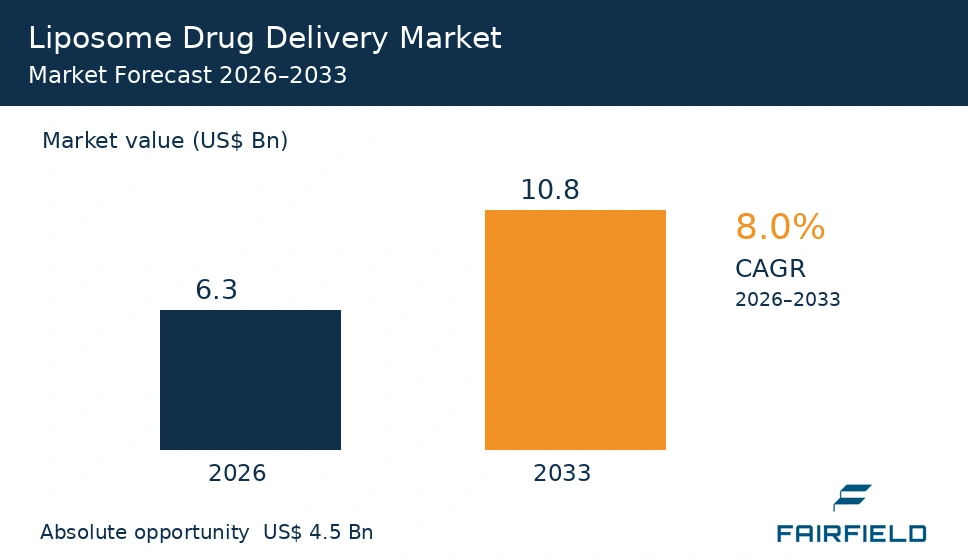
The global liposome drug delivery market size is expected to be valued at US$ 6.3 billion in 2026 and projected to reach US$ 10.8 billion by 2033, growing at a CAGR of 8.0% between 2026 and 2033.
Between 2020 and 2025, the market grew at a CAGR of about 6.3%, rising from roughly US$ 4.3 billion to about US$ 5.8 billion, as cancer rates kept rising, liposomal antifungal demand jumped during the pandemic years, and long-acting liposomal pain drugs gained wide use after surgery. The liposome drug delivery market covers medicines packed inside liposomes, which are tiny spheres made of lipid layers that carry a drug through the body and release it in a controlled way. Key products include liposomal doxorubicin, paclitaxel, irinotecan, amphotericin B, and bupivacaine, used in cancer care, fungal infections, pain management, and vaccines. These medicines are given mainly in hospitals and specialty clinics. In August 2026, Evonik announced a new manufacturing facility in Canada for lipid-based drug products.
Key Report Takeaways
-
By Product Type: Liposomal Doxorubicin held about 29% share in 2025, while Liposomal Paclitaxel is projected to expand at a 10.2% CAGR through 2033, driven by strong cancer drug demand in China, fewer side effects than standard paclitaxel, and new approvals.
-
By Application: Oncology held about 56% share in 2025, while Pain Management is projected to expand at a 9.6% CAGR through 2033, driven by long-acting liposomal bupivacaine after surgery, efforts to cut opioid use, and new outpatient procedures.
-
By End User: Hospitals held about 61% share in 2025, while Specialty Clinics are projected to expand at a 9.0% CAGR through 2033, driven by more cancer infusion centers, outpatient surgery centers, and a shift of care outside large hospitals.
-
By Region: North America held about 42% share in 2025, while Asia Pacific is projected to expand at a 9.8% CAGR through 2033, driven by large patient numbers in China and India, local liposome makers, and growing cancer care budgets.
Global Liposome Drug Delivery Market Trends and Insights
Drivers Impact Analysis
Two drivers carry the strongest influence on liposome drug delivery market demand during the forecast period.
| Driver | Impact on CAGR Forecast | Geographic Relevance | Impact Timeline |
| Rising cancer burden and need for safer chemotherapy | High | Global, with focus on North America and Asia Pacific | Long term (≥4 years) |
| Growth of long-acting liposomal pain and antifungal drugs | Medium | North America, Europe | Medium term (2-4 years) |
Rising Cancer Burden Is Driving the Liposome Drug Delivery Market
The rising cancer burden and the need for safer chemotherapy are the strongest drivers of the liposome drug delivery market. More patients need cancer drugs that harm healthy tissue less.
The mechanism is that about 20 million new cancer cases are diagnosed worldwide each year, and the number keeps rising because of aging populations and lifestyle changes. Liposomes keep cancer drugs in the blood longer and help them build up in tumors, which lowers heart damage, hair loss, and other side effects. Liposomal doxorubicin is used for ovarian cancer, breast cancer, and multiple myeloma, while liposomal irinotecan from Ipsen treats pancreatic cancer and liposomal daunorubicin and cytarabine from Jazz Pharmaceuticals treats a type of leukemia. Doctors in China use liposomal paclitaxel widely. These benefits support steady demand and higher prices than standard drugs.
Long-Acting Pain and Antifungal Drugs Are Expanding the Liposome Drug Delivery Market
The growth of long-acting liposomal pain and antifungal drugs is expanding the liposome drug delivery market. Liposomes are proving useful well beyond cancer.
The cause is that liposomal bupivacaine from Pacira BioSciences releases a numbing drug slowly over several days after surgery, which helps hospitals reduce opioid use and shorten hospital stays. Liposomal amphotericin B from Gilead Sciences treats serious fungal infections with less kidney damage than older forms, and demand rose sharply during outbreaks of fungal infections linked to the pandemic in India. Generic versions from Sun Pharma and Taiwan Liposome Company are widening access. The United States has also passed rules that support payment for non-opioid pain drugs used in outpatient surgery. These products bring steady and repeat demand across many hospitals, cancer centers, and outpatient surgery centers.
Restraints Impact Analysis
Two restraints limit how quickly the liposome drug delivery market grows.
| Restraint | Impact on CAGR Forecast | Geographic Relevance | Impact Timeline |
| Complex manufacturing and quality risks | High | Global | Long term (≥4 years) |
| High prices, generic pressure, and regulatory hurdles | Medium | North America, Europe, Asia Pacific | Medium term (2-4 years) |
Complex Manufacturing Slows the Liposome Drug Delivery Market
Complex manufacturing and quality risks slow the liposome drug delivery market. Liposomes are hard to make at large scale.
The problem is that liposome products need tight control of particle size, drug loading, lipid quality, sterility, and stability, and small changes in the process can change how the drug works in the body. Only a small number of plants worldwide can make these products under good manufacturing practice rules. Supply problems have caused shortages, such as the liposomal doxorubicin shortage in the United States more than a decade ago. In May 2026, Sun Pharma recalled one batch of liposomal doxorubicin in the United States after finding possible glass particles. High-quality lipids are costly and come from few suppliers. These limits raise costs, slow launches, and can disrupt supply for patients.
High Prices and Regulatory Hurdles Restrict the Liposome Drug Delivery Market
High prices, generic pressure, and regulatory hurdles restrict the liposome drug delivery market. Costs and rules shape how fast new products reach patients.
The constraint is that branded liposomal drugs can cost many times more than standard versions, which limits use in lower-income countries and pushes payers to restrict use in richer ones. Generic liposome products face strict proof-of-sameness tests, which take time and money and limit the number of competitors. When generics do enter, prices fall quickly and branded sales drop. Regulators in the United States, Europe, and China require detailed testing of particle size and drug release. Patent disputes also delay some launches. These factors slow value growth even as patient numbers rise. Price controls in China and tender systems in Europe add further pressure on margins.
Market Opportunities
Next-Generation Targeted Liposomes Open a Premium Revenue Pool
Next-generation targeted liposomes open a premium revenue pool. New designs can deliver drugs more precisely.
The opportunity comes from liposomes that carry antibodies or other targeting molecules on their surface, liposomes that release drugs in response to heat or acid, and liposomes that carry two drugs in a fixed ratio, like Jazz Pharmaceuticals' Vyxeos. Companies are also testing liposomes for gene therapy, immune-boosting drugs, eye diseases, and inhaled antibiotics for lung infections. Lipid nanoparticles used in messenger RNA vaccines share the same science and supply chain, so investment in one area helps the other. Companies that combine strong lipid chemistry with good clinical data can win premium prices and long patent protection for new medicines in cancer and rare diseases, while licensing deals with larger drug companies can bring early income.
Asia Pacific and Contract Manufacturing Create a Growth Revenue Pool
Asia Pacific and contract manufacturing create a growth revenue pool. Local makers and outsourcing partners are expanding capacity.
The opportunity reflects rising cancer rates and growing health budgets in China, India, Japan, and South Korea, along with strong local makers such as CSPC Pharmaceutical Group, Luye Pharma, and Fosun Pharma. Generic liposome products from India and Taiwan are reaching new markets. At the same time, drug companies are outsourcing complex lipid-based manufacturing to specialist partners. Evonik announced a new facility in Vancouver in August 2026 with more than three times the capacity of its current site. Companies that offer affordable generics, local production, and contract development services can capture this growth across many countries and treatment areas, and long-term supply contracts with drug companies can bring steady income for years.
Segment Analysis
By Product Type: Liposomal Doxorubicin Leads While Liposomal Paclitaxel Grows Fastest
Liposomal Doxorubicin held about 29% share in 2025. It is one of the oldest and most widely used liposome products, approved for ovarian cancer, multiple myeloma, and Kaposi sarcoma, with branded and generic versions sold by Baxter, Sun Pharma, CSPC, and others. Its use across many cancers and countries gives it the largest share.
Liposomal Paclitaxel is the fastest-growing product type, expanding at a 10.2% CAGR through 2033. It is widely used in China, where Luye Pharma's product is a leading cancer drug, and it causes fewer allergic reactions than standard paclitaxel. Liposomal Irinotecan, Liposomal Amphotericin B, Liposomal Bupivacaine, and Others form other segments. For the market, paclitaxel growth strengthens the role of Asia Pacific.
By Application: Oncology Leads While Pain Management Grows Fastest
Oncology held about 56% share in 2025. Liposomal doxorubicin, paclitaxel, irinotecan, vincristine, and daunorubicin with cytarabine are used to treat many solid tumors and blood cancers, and cancer drugs carry high prices. Hospitals and cancer centers use these products in standard treatment plans, giving oncology the largest share.
Pain Management is the fastest-growing application, expanding at a 9.6% CAGR through 2033. Long-acting liposomal bupivacaine helps control pain for several days after knee, hip, and other surgeries, which reduces opioid use and supports faster recovery. Fungal Infections, Vaccines, and Others form other segments. Liposomal amphotericin B remains vital for serious fungal infections in hospitals, and liposome-based vaccines are being studied. For the market, pain management growth widens use beyond cancer care.
By End User: Hospitals Lead While Specialty Clinics Grow Fastest
Hospitals held about 61% share in 2025. Most liposome drugs are given by infusion or injection under medical supervision, and hospitals treat most patients with cancer and serious fungal infections. Hospital pharmacies also manage the cold storage and careful handling these products need, giving hospitals the largest share.
Specialty Clinics are the fastest-growing end user, expanding at a 9.0% CAGR through 2033. Cancer infusion centers and outpatient surgery centers are treating more patients outside large hospitals, often at lower cost. Research Institutes and Pharmaceutical and Biotechnology Companies form other segments, using liposomes for drug research. Drug companies also use liposomes in early research to test new medicines and delivery methods. For the market, clinic growth supports wider patient access and lower treatment costs.
Geography Analysis
Which Region Is Leading the Liposome Drug Delivery Market?
North America is leading the liposome drug delivery market with about 42% share in 2025. The United States has high cancer drug spending, strong insurance coverage, and fast adoption of branded liposome products such as Onivyde, Vyxeos, AmBisome, and Exparel. Pacira BioSciences, Gilead Sciences, and Jazz Pharmaceuticals have major operations in the country. The US Food and Drug Administration has approved more liposome products than any other regulator. Canada is gaining new manufacturing capacity. Key barriers include high prices and payer limits. One change shaping the region is support for non-opioid pain drugs.
Liposome Drug Delivery Market in Europe
Europe is a large and mature liposome drug delivery market. Germany, France, the United Kingdom, Italy, and Spain have strong cancer care systems that cover liposomal doxorubicin, irinotecan, and amphotericin B. Ipsen in France and Evonik in Germany are major suppliers, and several contract makers in the region produce lipids and finished products. The European Medicines Agency has detailed guidance for liposome products. Key barriers include tight health budgets and tender pricing. Generic entry is lowering prices, which helps more patients get treatment in public hospitals. One change shaping the region is wider use of generic versions.
Which Region Is Growing Fastest in the Liposome Drug Delivery Market?
Asia Pacific is the fastest-growing region in the liposome drug delivery market, expanding at a 9.8% CAGR through 2033. China has a large and growing market for liposomal paclitaxel and doxorubicin, led by Luye Pharma, CSPC, and Fosun Pharma. India is a major maker of generic liposome products and saw huge demand for liposomal amphotericin B during fungal infection outbreaks. Japan, South Korea, and Taiwan have strong research, clinical trials, and manufacturing. Key barriers include price controls and volume-based buying programs in China. One change shaping the region is local liposome production.
Liposome Drug Delivery Market in Latin America
Latin America is a growing liposome drug delivery market with rising cancer rates. Brazil, Mexico, Argentina, and Colombia are expanding cancer care in public and private hospitals, and use of liposomal doxorubicin and amphotericin B is increasing in large cities. Generic products from India and other countries help lower costs for public health systems. Private hospitals adopt newer branded products for patients with good insurance. Cancer screening programs are also finding more patients earlier. Key barriers include economic swings, currency changes, and slow drug approvals. One opportunity is affordable generic liposome products supplied through large public health tenders.
Liposome Drug Delivery Market in Middle East & Africa
Middle East & Africa is a developing liposome drug delivery market with rising needs. Saudi Arabia, the United Arab Emirates, Qatar, and Israel are investing in modern cancer centers and adopting branded liposome drugs. South Africa, Egypt, and Nigeria have growing needs for cancer and fungal infection treatment, but many patients still receive standard drugs because of cost. Cold storage and supply chains are a challenge in remote areas and hot climates. Key barriers include high prices and limited access in rural areas. One opportunity is generic liposomal amphotericin B for serious infections in public hospitals.
Competitive Landscape
The liposome drug delivery market is moderately consolidated. Gilead Sciences, Pacira BioSciences, Ipsen, Jazz Pharmaceuticals, and Sun Pharma are leading players, while Baxter, Luye Pharma, CSPC, Taiwan Liposome Company, Evonik, Fosun Pharma, and Teva compete strongly. Branded leaders each own a key product in a distinct area, such as antifungal care, pain after surgery, pancreatic cancer, or leukemia, which limits direct competition between them. Generic makers from India, China, and Taiwan compete on price for older products such as liposomal doxorubicin and amphotericin B.
Companies mainly compete on clinical results, safety, side-effect profiles, manufacturing quality, supply reliability, particle size control, proof of sameness for generics, patent protection, regulatory approvals, hospital formulary access, pricing, and support for doctors and pharmacists. Strong lipid supply and in-house manufacturing are major advantages because only a few plants can make these products well. Contract makers such as Evonik help smaller companies bring new liposome drugs to market.
Strategic moves show how competition is changing. Ipsen widened Onivyde use to first-line pancreatic cancer in February 2024, Sun Pharma recalled a liposomal doxorubicin batch in May 2026, and Evonik announced its new Vancouver facility in August 2026. These moves show both the strong growth potential and the strict quality demands of the market, and they suggest that capacity and compliance will matter more.
Three themes shape vendor strategy. First, suppliers are expanding approved uses. Second, they are adding manufacturing capacity. Third, they are launching generic versions.
Liposome Drug Delivery Market Industry Leaders
- Gilead Sciences, Inc.
- Pacira BioSciences, Inc.
- Ipsen S.A.
- Jazz Pharmaceuticals plc
- Sun Pharmaceutical Industries Ltd.
Recent Industry Developments
-
August 2026: Evonik announced investment in a new good manufacturing practice facility for lipid-based drug products in Vancouver, Canada, with more than three times the capacity of its current site - expands outsourced liposome and lipid nanoparticle capacity.
-
May 2026: Sun Pharma voluntarily recalled one batch of doxorubicin hydrochloride liposome injection in the United States after finding possible glass particles - highlights the quality risks of complex liposome manufacturing.
-
February 2024: Ipsen received US Food and Drug Administration approval for Onivyde in the NALIRIFOX regimen as a first-line treatment for metastatic pancreatic cancer - widens use of liposomal irinotecan.
Companies Covered in the Report
-
Gilead Sciences, Inc.
-
Pacira BioSciences, Inc.
-
Ipsen S.A.
-
Jazz Pharmaceuticals plc
-
Sun Pharmaceutical Industries Ltd.
-
Baxter International Inc.
-
Luye Pharma Group Ltd.
-
CSPC Pharmaceutical Group Limited
-
Taiwan Liposome Company, Ltd.
-
Evonik Industries AG
-
Shanghai Fosun Pharmaceutical (Group) Co., Ltd.
-
Teva Pharmaceutical Industries Ltd.
Liposome Drug Delivery Market Report Scope
This report covers the global liposome drug delivery market, including liposomal doxorubicin, paclitaxel, irinotecan, amphotericin B, bupivacaine, and other products, used in oncology, fungal infections, pain management, vaccines, and other applications, by hospitals, specialty clinics, research institutes, and pharmaceutical and biotechnology companies, across North America, Europe, Asia Pacific, Latin America, and Middle East & Africa. The base year is 2025, and the forecast period runs from 2026 to 2033.
| Product Type | Liposomal Doxorubicin, Liposomal Paclitaxel, Liposomal Irinotecan, Liposomal Amphotericin B, Liposomal Bupivacaine, Others |
| Application | Oncology, Fungal Infections, Pain Management, Vaccines, Others |
| End User | Hospitals, Specialty Clinics, Research Institutes, Pharmaceutical and Biotechnology Companies |
| Regions | North America, Europe, Asia Pacific, Latin America, Middle East & Africa |
1. Executive Summary
1.1 Liposome Drug Delivery Market Snapshot
1.2 Future Projections
1.3 Key Market Trends
1.4 Regional Snapshot
2. Market Overview
2.1 Market Definition and Report Scope
2.2 Historical Market Trends
2.3 Market Dynamics
2.3.1 Drivers
2.3.1.1 Rising Cancer Burden Is Driving the Liposome Drug Delivery Market
2.3.1.2 Long-Acting Pain and Antifungal Drugs Are Expanding the Liposome Drug Delivery Market
2.3.2 Restraints
2.3.2.1 Complex Manufacturing Slows the Liposome Drug Delivery Market
2.3.2.2 High Prices and Regulatory Hurdles Restrict the Liposome Drug Delivery Market
2.3.3 Market Opportunities
2.3.3.1 Next-Generation Targeted Liposomes Open a Premium Revenue Pool
2.3.3.2 Asia Pacific and Contract Manufacturing Create a Growth Revenue Pool
3. Global Liposome Drug Delivery Market Outlook, 2020–2033
3.1 Global Liposome Drug Delivery Market Outlook, by Product Type, Value (US$ Billion), 2020–2033
3.1.1 Liposomal Doxorubicin
3.1.2 Liposomal Paclitaxel
3.1.3 Liposomal Irinotecan
3.1.4 Liposomal Amphotericin B
3.1.5 Liposomal Bupivacaine
3.1.6 Others
3.2 Global Liposome Drug Delivery Market Outlook, by Application, Value (US$ Billion), 2020–2033
3.2.1 Oncology
3.2.2 Fungal Infections
3.2.3 Pain Management
3.2.4 Vaccines
3.2.5 Others
3.3 Global Liposome Drug Delivery Market Outlook, by End User, Value (US$ Billion), 2020–2033
3.3.1 Hospitals
3.3.2 Specialty Clinics
3.3.3 Research Institutes
3.3.4 Pharmaceutical and Biotechnology Companies
3.4 Global Liposome Drug Delivery Market Outlook, by Region, Value (US$ Billion), 2020–2033
3.4.1 North America
3.4.2 Europe
3.4.3 Asia Pacific
3.4.4 Latin America
3.4.5 Middle East & Africa
4. North America Liposome Drug Delivery Market Outlook, 2020–2033
4.1 North America Liposome Drug Delivery Market Outlook, by Product Type, Value (US$ Billion), 2020–2033
4.1.1 Liposomal Doxorubicin
4.1.2 Liposomal Paclitaxel
4.1.3 Liposomal Irinotecan
4.1.4 Liposomal Amphotericin B
4.1.5 Liposomal Bupivacaine
4.1.6 Others
4.2 North America Liposome Drug Delivery Market Outlook, by Application, Value (US$ Billion), 2020–2033
4.2.1 Oncology
4.2.2 Fungal Infections
4.2.3 Pain Management
4.2.4 Vaccines
4.2.5 Others
4.3 North America Liposome Drug Delivery Market Outlook, by End User, Value (US$ Billion), 2020–2033
4.3.1 Hospitals
4.3.2 Specialty Clinics
4.3.3 Research Institutes
4.3.4 Pharmaceutical and Biotechnology Companies
4.4 North America Liposome Drug Delivery Market Outlook, by Country, Value (US$ Billion), 2020–2033
4.4.1 United States Liposome Drug Delivery Market Outlook, by Product Type, 2020–2033
4.4.2 United States Liposome Drug Delivery Market Outlook, by Application, 2020–2033
4.4.3 United States Liposome Drug Delivery Market Outlook, by End User, 2020–2033
4.4.4 Canada Liposome Drug Delivery Market Outlook, by Product Type, 2020–2033
4.4.5 Canada Liposome Drug Delivery Market Outlook, by Application, 2020–2033
4.4.6 Canada Liposome Drug Delivery Market Outlook, by End User, 2020–2033
5. Europe Liposome Drug Delivery Market Outlook, 2020–2033
5.1 Europe Liposome Drug Delivery Market Outlook, by Product Type, Value (US$ Billion), 2020–2033
5.1.1 Liposomal Doxorubicin
5.1.2 Liposomal Paclitaxel
5.1.3 Liposomal Irinotecan
5.1.4 Liposomal Amphotericin B
5.1.5 Liposomal Bupivacaine
5.1.6 Others
5.2 Europe Liposome Drug Delivery Market Outlook, by Application, Value (US$ Billion), 2020–2033
5.2.1 Oncology
5.2.2 Fungal Infections
5.2.3 Pain Management
5.2.4 Vaccines
5.2.5 Others
5.3 Europe Liposome Drug Delivery Market Outlook, by End User, Value (US$ Billion), 2020–2033
5.3.1 Hospitals
5.3.2 Specialty Clinics
5.3.3 Research Institutes
5.3.4 Pharmaceutical and Biotechnology Companies
5.4 Europe Liposome Drug Delivery Market Outlook, by Country, Value (US$ Billion), 2020–2033
5.4.1 Germany Liposome Drug Delivery Market Outlook, by Product Type, 2020–2033
5.4.2 Germany Liposome Drug Delivery Market Outlook, by Application, 2020–2033
5.4.3 Germany Liposome Drug Delivery Market Outlook, by End User, 2020–2033
5.4.4 France Liposome Drug Delivery Market Outlook, by Product Type, 2020–2033
5.4.5 France Liposome Drug Delivery Market Outlook, by Application, 2020–2033
5.4.6 France Liposome Drug Delivery Market Outlook, by End User, 2020–2033
5.4.7 United Kingdom Liposome Drug Delivery Market Outlook, by Product Type, 2020–2033
5.4.8 United Kingdom Liposome Drug Delivery Market Outlook, by Application, 2020–2033
5.4.9 United Kingdom Liposome Drug Delivery Market Outlook, by End User, 2020–2033
5.4.10 Italy Liposome Drug Delivery Market Outlook, by Product Type, 2020–2033
5.4.11 Italy Liposome Drug Delivery Market Outlook, by Application, 2020–2033
5.4.12 Italy Liposome Drug Delivery Market Outlook, by End User, 2020–2033
5.4.13 Spain Liposome Drug Delivery Market Outlook, by Product Type, 2020–2033
5.4.14 Spain Liposome Drug Delivery Market Outlook, by Application, 2020–2033
5.4.15 Spain Liposome Drug Delivery Market Outlook, by End User, 2020–2033
6. Asia Pacific Liposome Drug Delivery Market Outlook, 2020–2033
6.1 Asia Pacific Liposome Drug Delivery Market Outlook, by Product Type, Value (US$ Billion), 2020–2033
6.1.1 Liposomal Doxorubicin
6.1.2 Liposomal Paclitaxel
6.1.3 Liposomal Irinotecan
6.1.4 Liposomal Amphotericin B
6.1.5 Liposomal Bupivacaine
6.1.6 Others
6.2 Asia Pacific Liposome Drug Delivery Market Outlook, by Application, Value (US$ Billion), 2020–2033
6.2.1 Oncology
6.2.2 Fungal Infections
6.2.3 Pain Management
6.2.4 Vaccines
6.2.5 Others
6.3 Asia Pacific Liposome Drug Delivery Market Outlook, by End User, Value (US$ Billion), 2020–2033
6.3.1 Hospitals
6.3.2 Specialty Clinics
6.3.3 Research Institutes
6.3.4 Pharmaceutical and Biotechnology Companies
6.4 Asia Pacific Liposome Drug Delivery Market Outlook, by Country, Value (US$ Billion), 2020–2033
6.4.1 China Liposome Drug Delivery Market Outlook, by Product Type, 2020–2033
6.4.2 China Liposome Drug Delivery Market Outlook, by Application, 2020–2033
6.4.3 China Liposome Drug Delivery Market Outlook, by End User, 2020–2033
6.4.4 India Liposome Drug Delivery Market Outlook, by Product Type, 2020–2033
6.4.5 India Liposome Drug Delivery Market Outlook, by Application, 2020–2033
6.4.6 India Liposome Drug Delivery Market Outlook, by End User, 2020–2033
6.4.7 Japan Liposome Drug Delivery Market Outlook, by Product Type, 2020–2033
6.4.8 Japan Liposome Drug Delivery Market Outlook, by Application, 2020–2033
6.4.9 Japan Liposome Drug Delivery Market Outlook, by End User, 2020–2033
6.4.10 South Korea Liposome Drug Delivery Market Outlook, by Product Type, 2020–2033
6.4.11 South Korea Liposome Drug Delivery Market Outlook, by Application, 2020–2033
6.4.12 South Korea Liposome Drug Delivery Market Outlook, by End User, 2020–2033
6.4.13 Taiwan Liposome Drug Delivery Market Outlook, by Product Type, 2020–2033
6.4.14 Taiwan Liposome Drug Delivery Market Outlook, by Application, 2020–2033
6.4.15 Taiwan Liposome Drug Delivery Market Outlook, by End User, 2020–2033
7. Latin America Liposome Drug Delivery Market Outlook, 2020–2033
7.1 Latin America Liposome Drug Delivery Market Outlook, by Product Type, Value (US$ Billion), 2020–2033
7.1.1 Liposomal Doxorubicin
7.1.2 Liposomal Paclitaxel
7.1.3 Liposomal Irinotecan
7.1.4 Liposomal Amphotericin B
7.1.5 Liposomal Bupivacaine
7.1.6 Others
7.2 Latin America Liposome Drug Delivery Market Outlook, by Application, Value (US$ Billion), 2020–2033
7.2.1 Oncology
7.2.2 Fungal Infections
7.2.3 Pain Management
7.2.4 Vaccines
7.2.5 Others
7.3 Latin America Liposome Drug Delivery Market Outlook, by End User, Value (US$ Billion), 2020–2033
7.3.1 Hospitals
7.3.2 Specialty Clinics
7.3.3 Research Institutes
7.3.4 Pharmaceutical and Biotechnology Companies
7.4 Latin America Liposome Drug Delivery Market Outlook, by Country, Value (US$ Billion), 2020–2033
7.4.1 Brazil Liposome Drug Delivery Market Outlook, by Product Type, 2020–2033
7.4.2 Brazil Liposome Drug Delivery Market Outlook, by Application, 2020–2033
7.4.3 Brazil Liposome Drug Delivery Market Outlook, by End User, 2020–2033
7.4.4 Mexico Liposome Drug Delivery Market Outlook, by Product Type, 2020–2033
7.4.5 Mexico Liposome Drug Delivery Market Outlook, by Application, 2020–2033
7.4.6 Mexico Liposome Drug Delivery Market Outlook, by End User, 2020–2033
7.4.7 Argentina Liposome Drug Delivery Market Outlook, by Product Type, 2020–2033
7.4.8 Argentina Liposome Drug Delivery Market Outlook, by Application, 2020–2033
7.4.9 Argentina Liposome Drug Delivery Market Outlook, by End User, 2020–2033
7.4.10 Colombia Liposome Drug Delivery Market Outlook, by Product Type, 2020–2033
7.4.11 Colombia Liposome Drug Delivery Market Outlook, by Application, 2020–2033
7.4.12 Colombia Liposome Drug Delivery Market Outlook, by End User, 2020–2033
7.4.13 India Liposome Drug Delivery Market Outlook, by Product Type, 2020–2033
7.4.14 India Liposome Drug Delivery Market Outlook, by Application, 2020–2033
7.4.15 India Liposome Drug Delivery Market Outlook, by End User, 2020–2033
8. Middle East & Africa Liposome Drug Delivery Market Outlook, 2020–2033
8.1 Middle East & Africa Liposome Drug Delivery Market Outlook, by Product Type, Value (US$ Billion), 2020–2033
8.1.1 Liposomal Doxorubicin
8.1.2 Liposomal Paclitaxel
8.1.3 Liposomal Irinotecan
8.1.4 Liposomal Amphotericin B
8.1.5 Liposomal Bupivacaine
8.1.6 Others
8.2 Middle East & Africa Liposome Drug Delivery Market Outlook, by Application, Value (US$ Billion), 2020–2033
8.2.1 Oncology
8.2.2 Fungal Infections
8.2.3 Pain Management
8.2.4 Vaccines
8.2.5 Others
8.3 Middle East & Africa Liposome Drug Delivery Market Outlook, by End User, Value (US$ Billion), 2020–2033
8.3.1 Hospitals
8.3.2 Specialty Clinics
8.3.3 Research Institutes
8.3.4 Pharmaceutical and Biotechnology Companies
8.4 Middle East & Africa Liposome Drug Delivery Market Outlook, by Country, Value (US$ Billion), 2020–2033
8.4.1 Saudi Arabia Liposome Drug Delivery Market Outlook, by Product Type, 2020–2033
8.4.2 Saudi Arabia Liposome Drug Delivery Market Outlook, by Application, 2020–2033
8.4.3 Saudi Arabia Liposome Drug Delivery Market Outlook, by End User, 2020–2033
8.4.4 United Arab Emirates Liposome Drug Delivery Market Outlook, by Product Type, 2020–2033
8.4.5 United Arab Emirates Liposome Drug Delivery Market Outlook, by Application, 2020–2033
8.4.6 United Arab Emirates Liposome Drug Delivery Market Outlook, by End User, 2020–2033
8.4.7 Qatar Liposome Drug Delivery Market Outlook, by Product Type, 2020–2033
8.4.8 Qatar Liposome Drug Delivery Market Outlook, by Application, 2020–2033
8.4.9 Qatar Liposome Drug Delivery Market Outlook, by End User, 2020–2033
8.4.10 Israel Liposome Drug Delivery Market Outlook, by Product Type, 2020–2033
8.4.11 Israel Liposome Drug Delivery Market Outlook, by Application, 2020–2033
8.4.12 Israel Liposome Drug Delivery Market Outlook, by End User, 2020–2033
8.4.13 South Africa Liposome Drug Delivery Market Outlook, by Product Type, 2020–2033
8.4.14 South Africa Liposome Drug Delivery Market Outlook, by Application, 2020–2033
8.4.15 South Africa Liposome Drug Delivery Market Outlook, by End User, 2020–2033
8.4.16 Egypt Liposome Drug Delivery Market Outlook, by Product Type, 2020–2033
8.4.17 Egypt Liposome Drug Delivery Market Outlook, by Application, 2020–2033
8.4.18 Egypt Liposome Drug Delivery Market Outlook, by End User, 2020–2033
8.4.19 Nigeria Liposome Drug Delivery Market Outlook, by Product Type, 2020–2033
8.4.20 Nigeria Liposome Drug Delivery Market Outlook, by Application, 2020–2033
8.4.21 Nigeria Liposome Drug Delivery Market Outlook, by End User, 2020–2033
9. Competitive Landscape
9.1 Liposome Drug Delivery Market Industry Leaders
9.2 Recent Industry Developments
9.3 Company Profiles
9.3.1 Gilead Sciences, Inc.
9.3.2 Pacira BioSciences, Inc.
9.3.3 Ipsen S.A.
9.3.4 Jazz Pharmaceuticals plc
9.3.5 Sun Pharmaceutical Industries Ltd.
9.3.6 Baxter International Inc.
9.3.7 Luye Pharma Group Ltd.
9.3.8 CSPC Pharmaceutical Group Limited
9.3.9 Taiwan Liposome Company, Ltd.
9.3.10 Evonik Industries AG
9.3.11 Shanghai Fosun Pharmaceutical (Group) Co., Ltd.
9.3.12 Teva Pharmaceutical Industries Ltd.
10. Appendix
10.1 Research Methodology
10.2 Report Assumptions
10.3 Acronyms and Abbreviations
| Product Type | Liposomal Doxorubicin, Liposomal Paclitaxel, Liposomal Irinotecan, Liposomal Amphotericin B, Liposomal Bupivacaine, Others |
| Application | Oncology, Fungal Infections, Pain Management, Vaccines, Others |
| End User | Hospitals, Specialty Clinics, Research Institutes, Pharmaceutical and Biotechnology Companies |
| Regions | North America, Europe, Asia Pacific, Latin America, Middle East & Africa |
Our Research Methodology
Considering the volatility of business today, traditional approaches to strategizing a game plan can be unfruitful if not detrimental. True ambiguity is no way to determine a forecast. A myriad of predetermined factors must be accounted for such as the degree of risk involved, the magnitude of circumstances, as well as conditions or consequences that are not known or unpredictable. To circumvent binary views that cast uncertainty, the application of market research intelligence to strategically posture, move, and enable actionable outcomes is necessary.
View Methodology
Quality Assured
Rigorous Validation Process

Confidentiality Assured
End-to-end Data Security

Custom Research Services
Tailored To Your Objectives
FAQs
The global liposome drug delivery market is expected to be valued at US$ 6.3 billion in 2026, driven by cancer and pain use.
The market is projected to grow at an 8.0% CAGR from 2026 to 2033, reaching about US$ 10.8 billion by 2033.
North America leads with about 42% share, supported by high cancer drug spending, strong insurance coverage, and many branded liposome products.
Asia Pacific is growing fastest at a 9.8% CAGR, driven by large patient numbers in China and India and local production.
Key players include Gilead Sciences, Pacira BioSciences, Ipsen, Jazz Pharmaceuticals, and Sun Pharma, competing on clinical data, quality, and price.
Related Reports
Oncolytic Viral Therapy Market Size, Share, Insights, Competitive Landscape, and Forecast 2026 to 2033
The oncolytic viral therapy market is projected to grow from US$297.8 million in 2026 to US$1,157.3 million by 2033, registering a CAGR of 21.4%.
Animal Artificial Insemination Market Size, Share, Insights, Competitive Landscape, and Forecast 2026 to 2033
The animal artificial insemination market is projected to grow from US$5.2 billion in 2026 to US$7.98 billion by 2033, registering a CAGR of 6.3%.
Vaccines Market Size, Share, Insights, Competitive Landscape, and Forecast 2026 to 2033
The global vaccines market is valued at US$76.8 billion in 2026, reaching US$117.0 billion by 2033, growing at a 6.2% CAGR
Recombinant DNA Technology Market Size, Share, Insights, Competitive Landscape, and Forecast 2026 to 2033
Explore the Recombinant DNA Technology Market, valued at US$9.8 billion in 2026 and forecast at US$20.9 billion by 2033, growing at an 11.4% CAGR.
Endotoxin Testing Market Size, Share, Insights, Competitive Landscape, and Forecast 2026 to 2033
Explore the Endotoxin Testing Market, valued at US$1.5 billion in 2026 and forecast to reach US$2.9 billion by 2033, growing at a 9.9% CAGR.
Candidiasis Treatment Market Size, Share, Insights, Competitive Landscape, and Forecast 2026 to 2033
Explore the Candidiasis Treatment Market, valued at US$3.4 billion in 2026 and forecast to reach US$4.5 billion by 2033, growing at a 4.1% CAGR.