



Live Streaming Market
Live Streaming Market Insights, Competitive Landscape, and Market Forecast - 2033
The Live Streaming Market is projected to grow from USD 97.5 billion in 2026 to USD 429.7 billion by 2033, registering a CAGR of 23.6%.
- The live streaming market is thriving due to increasing internet accessibility, technological advancements, and rising demand for real-time content. With the proliferation of smartphones and high-speed internet, users can easily engage with live content, fostering a dynamic and interactive online experience across various sectors, including entertainment, gaming, education, and business.
- Another major market trend expected to fuel the growth of the live-streaming market is the rapidly expanding media and entertainment industry. The market is also predicted to profit from the expanding worldwide enterprise industries.
- Platform solutions dominate the live streaming market by offering comprehensive, end-to-end services. With user-friendly interfaces, broad audience reach, and robust infrastructure, platforms like Twitch, YouTube Live, and Facebook Live provide interactive features and diverse content types. The network effect solidifies their largest market share, attracting both content creators and audiences.
- The business-to-business (B2B) offering model leads the live streaming market, offering tailored, scalable solutions for enterprises and organisations. B2B models provide robust infrastructure, advanced features, and secure access controls, making them preferable for businesses with specific requirements. Their ability to cater to diverse industry needs solidifies their largest market share.
- Audio streaming dominates the live streaming market by offering versatile content like podcasts and music. With accessibility, ease of production, and diverse content categories, audio streaming platforms led by leaders like Spotify, and Apple Music attract a broad audience. Their widespread popularity and user-friendly features contribute to capturing the largest market share.
- Enterprises lead the live streaming market due to the adoption of live streaming for corporate communication, webinars, and training. The demand for customised, secure solutions and the integration of live streaming into business processes contribute to their dominance. Enterprises' substantial use across various sectors solidifies their largest market share.
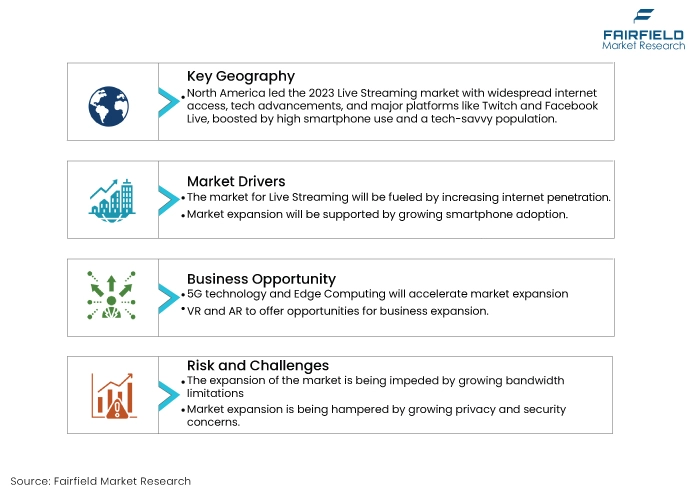
- North America dominates the live streaming market due to widespread internet access, technological advancements, and a flourishing entertainment industry. Hosting major platforms like Twitch, YouTube Live, and Facebook Live, the region benefits from high smartphone penetration and a tech-savvy population, solidifying its largest market share in the dynamic live streaming industry.
- The Asia Pacific region experiences the highest CAGR in the live streaming market due to increasing internet penetration, a diverse population, and a growing tech-savvy demographic. Mobile device popularity, the rise of online gaming, and a vibrant entertainment industry contribute to the region's rapid growth, making it a key driver in the live-streaming landscape.
- Increasing Internet Penetration
- Mounting Smartphone Adoption
- Thriving Technology Trends
- Growing Bandwidth Limitations
- Growing Privacy and Security Concerns
- 5G Technology
- EDGE Computing
- Virtual and Augmented Reality (VR/AR)
- Platforms Category Continues to Dominate over Other Segments
- B2B Offering Model to Surge Ahead
- Audio Streaming Maintains the Leading Position
A Look Back and a Look Forward - Comparative Analysis
The live streaming market is experiencing rapid growth due to increasing internet accessibility, advancements in technology, and rising demand for real-time content. With the proliferation of smartphones and high-speed internet, users can easily engage with live content, fostering a dynamic and interactive online experience.
Additionally, the market benefits from the popularity of live events, gaming, and social media platforms, creating diverse opportunities for content creators and attracting a broad audience, contributing to the sector's continuous expansion.
The market witnessed staggered growth during the historical period 2018 – 2022. This is due to the substantial growth of the major end-use application sectors such as enetrprises, media & entertainment, and education & e-Learning Industry. However, in some applications, the demand for Live Streaming has increased, including sports & gaming industry, government, and fitness industry.
The future of the live streaming market looks promising as technological innovations, 5G expansion, and augmented reality (AR) integration enhance user experiences. Increasing demand for live content across diverse sectors, including gaming, sports, education, and business, will drive market growth.
Personalised and interactive features, along with monetisation strategies, are likely to evolve, attracting more content creators. As the market continues to expand globally, collaborations, improved infrastructure, and enhanced content quality will contribute to sustained growth in the live streaming industry.
Key Growth Determinants
Increasing internet penetration is a critical driver for the live streaming market due to its direct impact on accessibility and user experience. As more regions gain access to high-speed internet, users can seamlessly engage with live streaming content, eliminating barriers such as buffering and low-quality streams. This widespread connectivity enables a broader audience reach, fostering the global expansion of live streaming platforms.
Moreover, improved internet infrastructure supports higher resolutions, reducing latency and enhancing the overall quality of live broadcasts. The combination of accessibility and enhanced user experience propels the adoption of live streaming across diverse sectors, including entertainment, education, gaming, and business, driving the market's sustained growth.
The surge in smartphone adoption significantly propels the live streaming market by providing a ubiquitous platform for content consumption. With an increasing number of users relying on smartphones as their primary digital device, live streaming platforms benefit from a massive and diverse audience. Smartphones offer convenience, enabling users to access live content anytime, anywhere.
User-friendly interfaces, mobile apps, and seamless integration with social media platforms make live Streaming easily accessible. The portability and versatility of smartphones also empower content creators, facilitating on-the-go live broadcasts. As a result, the rise in smartphone adoption not only expands the potential audience base but also amplifies the overall impact and reach of live streaming content across various industries.
Technological advancements are a driving force behind the live streaming market, enhancing the overall user experience and expanding the capabilities of live streaming platforms. Innovations in compression algorithms optimise bandwidth usage, ensuring smoother streaming and reduced latency. Integration of augmented reality (AR), and virtual reality (VR) technologies elevates content quality, providing immersive and interactive experiences.
These advancements not only attract and retain audiences but also open new avenues for creative content production. Additionally, continuous improvements in streaming technologies contribute to better video resolutions and adaptive streaming, accommodating varying network conditions. As live streaming platforms leverage cutting-edge technologies, users enjoy richer, more engaging content, fostering sustained growth and innovation in the dynamic landscape of the live streaming market.
Major Growth Barriers
Growing bandwidth limitations pose a challenge to the live streaming market by impeding the seamless delivery of high-quality content. In regions with inadequate internet infrastructure or during peak usage times, users may experience buffering and disruptions, leading to a suboptimal viewing experience.
This limitation hampers the market's potential reach and audience engagement, impacting both user satisfaction and the ability of live streaming platforms to deliver consistent, reliable services. Addressing this challenge requires infrastructure improvements and technological solutions to ensure uninterrupted, high-speed internet access for a broader audience base.
The growing privacy and security concerns present a challenge to the live streaming market as users share real-time content, raising apprehensions about data breaches, unauthorised access, and online harassment. Addressing these concerns is crucial to maintaining user trust and platform integrity.
Platforms must implement robust security measures, adhere to privacy regulations, and develop effective content moderation strategies to mitigate risks. Failure to adequately address these challenges can result in reputational damage, legal repercussions, and a decline in user confidence, impacting the growth and sustainability of the live streaming industry.
Key Trends and Opportunities to Look at
The rollout of 5G networks enables faster and more reliable internet connections, reducing latency and enhancing the quality of live streaming on mobile devices.
Edge computing brings processing power closer to the user, reducing latency and enabling smoother live streaming experiences by processing data closer to the source.
Integration of VR and AR technologies enhances interactivity and immersion, providing new possibilities for live streaming experiences, especially in gaming, events, and virtual concerts.
How Does the Regulatory Scenario Shape this Industry?
Regulatory frameworks for the live streaming market vary globally, impacting content, privacy, and data handling. In the United States, the Federal Communications Commission (FCC) oversees certain aspects. The European Union has data protection regulations like GDPR affecting user privacy. In China, the Cyberspace Administration regulates online content. India has guidelines under the IT Act and intermediary liability rules.
These regulations influence platform policies, content moderation, and user data protection. Local changes, such as China's increased scrutiny of live-streaming platforms or the EU's ongoing efforts in digital regulation, can shape industry practices. Compliance with these regulations is crucial for market players to navigate legal landscapes and maintain user trust in different regions.
Fairfield’s Ranking Board
Top Segments
Platform solutions dominate the live streaming market due to their comprehensive offerings. These solutions provide end-to-end services, including content creation, delivery, and monetisation features, making them attractive for content creators and businesses. Popular platforms such as Twitch, YouTube Live, and Facebook Live offer user-friendly interfaces, extensive audience reach, and robust infrastructure. Their ability to integrate interactive features, support various content types, and provide monetisation options positions them as preferred choices.
The network effect further strengthens their dominance as more users and content creators gravitate toward established platforms, solidifying their largest market share in the live-streaming industry. Video production and content creation services in the live streaming market are experiencing the highest CAGR due to the increasing demand for high-quality and engaging content.
As businesses and content creators seek to stand out in a competitive landscape, there's a growing reliance on professional video production services to enhance production values. The rise of diverse content genres, including gaming, events, and educational content, further fuels this demand. Additionally, evolving technologies, such as virtual and augmented reality, contribute to the expansion of video production services, making them a key driver of growth in the live-streaming industry.
The business-to-business (B2B) offering model dominates the live streaming market due to its appeal to enterprises and organisations seeking customisable, scalable, and feature-rich solutions. B2B models provide tailored live-streaming services for corporate events, webinars, and training sessions. These solutions often offer advanced features such as analytics, branding options, and secure access controls, making them preferable for businesses with specific requirements.
The B2B model's ability to cater to diverse industry needs and provide robust infrastructure positions it as a leader, capturing the largest market share in the live-streaming industry. The business-to-consumer (B2C) offering model is experiencing the highest CAGR in the live streaming market due to the surge in individual content creators, influencers, and small businesses leveraging live streaming for direct consumer engagement.
B2C models provide accessible platforms with user-friendly interfaces, enabling seamless content creation and monetisation. The rise of diverse content genres, including gaming, lifestyle, and entertainment, amplifies the demand for B2C solutions, attracting a broad user base. The model's simplicity, coupled with the increasing popularity of individual content creators, contributes to its rapid growth in the dynamic live-streaming industry.
Audio streaming has captured the largest market share in the live streaming market due to its versatility and widespread adoption. Podcasts, music streaming, and live radio contribute to the popularity of audio content. The format offers convenience for users who can consume content on the go, even with limited bandwidth.
Additionally, audio streaming platforms often provide diverse monetisation options, attracting content creators. The accessibility, ease of production, and diverse content categories contribute to the dominant position of Audio Streaming in the market, making it a preferred choice for both creators and audiences.
Game streaming is experiencing the highest CAGR in the live streaming market due to the booming gaming industry and the rise of esports. The popularity of platforms like Twitch, and YouTube Gaming, coupled with the increasing number of gamers and gaming content creators, fuels this growth.
Game streaming provides interactive and engaging content, attracting a dedicated and global audience. Innovations in technology, such as cloud gaming and augmented reality features, further enhance the gaming live streaming experience, contributing to its rapid and sustained expansion in the dynamic live streaming landscape.
Regional Frontrunners
North America at the Forefront of Revenue Generation
North America has captured the largest market share in the live streaming market due to factors such as widespread internet access, technological advancements, and a thriving entertainment industry. The region hosts major live streaming platforms, including Twitch, YouTube Live, and Facebook Live, contributing to a robust ecosystem. High smartphone penetration, a tech-savvy population, and a strong culture of content creation have further propelled North America's dominance.
Additionally, the presence of major esports events and collaborations with celebrities and influencers adds to the popularity of live Streaming. The region's mature digital infrastructure and large user base make North America a focal point for live streaming market growth and innovation.
Asia Pacific Reflects Massive Market Potential
The Asia Pacific region is experiencing the highest CAGR in the live streaming market due to factors such as increasing internet penetration, a large and diverse population, and a growing tech-savvy youth demographic. The popularity of mobile devices, particularly smartphones, and the rise of online gaming and social media contribute to the surge in live streaming adoption.
Additionally, the region's vibrant entertainment industry, cultural events, and the emergence of local content creators fuel the demand. With a dynamic and rapidly expanding digital landscape, Asia Pacific presents significant growth opportunities for live streaming platforms, driving its highest CAGR in the market.
Fairfield’s Competitive Landscape Analysis
The live streaming market features a highly competitive landscape with key players such as Twitch (Amazon), YouTube Live (Google), and Facebook Live (Meta). These platforms dominate due to their extensive user bases and comprehensive offerings.
Other competitors like Vimeo, Dailymotion, and emerging players focus on niche markets or unique features. Continuous technological innovations, partnerships, and the global expansion of content creators drive the industry's dynamism. As the market evolves, competition intensifies, fostering innovation and diverse monetisation strategies across the competitive landscape.
Who are the Leaders in the Global Live Streaming Space?
• Dacast, Inc.
• Empire Video Productions LLC
• Flux Broadcast Ltd.
• Huya Inc.
• International Business Machines Corporation
• Meta
• Pluto Inc.
• TikTok Inc.
• Twitch Interactive, Inc.
• Vimeo, Inc.
Market Segmentation:
By Component
• Platforms
• Services
By Type
• Audio Streaming
• Video Streaming
By Revenue Model
• Ad-Supported
• Subscription-Based
• Pay-Per-View
By End Use
• Gaming
• Media & Entertainment
• Education & Professional
• Sports
• News & Events
• Others
By Geography
• North America
• Europe
• Asia Pacific
• Latin America
• Middle East & Africa
- Executive Summary
- Global Live Streaming Market Snapshot
- Future Projections
- Key Market Trends
- Regional Snapshot, by Value, 2026
- Analyst Recommendations
- Market Overview
- Market Definitions and Segmentations
- Market Dynamics
- Drivers
- Restraints
- Market Opportunities
- Value Chain Analysis
- COVID-19 Impact Analysis
- Porter's Five Forces Analysis
- Impact of Russia-Ukraine Conflict
- PESTLE Analysis
- Regulatory Analysis
- Price Trend Analysis
- Current Prices and Future Projections, 2025-2033
- Price Impact Factors
- Global Live Streaming Market Outlook, 2020 - 2033
- Global Live Streaming Market Outlook, by Component, Value (US$ Bn), 2020-2033
- Platforms
- Services
- Global Live Streaming Market Outlook, by Type, Value (US$ Bn), 2020-2033
- Audio Streaming
- Video Streaming
- Global Live Streaming Market Outlook, by Revenue Model, Value (US$ Bn), 2020-2033
- Ad-Supported
- Subscription-Based
- Pay-Per-View
- Global Live Streaming Market Outlook, by End Use, Value (US$ Bn), 2020-2033
- Gaming
- Media & Entertainment
- Education & Professional
- Sports
- News & Events
- Others
- Global Live Streaming Market Outlook, by Region, Value (US$ Bn), 2020-2033
- North America
- Europe
- Asia Pacific
- Latin America
- Middle East & Africa
- Global Live Streaming Market Outlook, by Component, Value (US$ Bn), 2020-2033
- North America Live Streaming Market Outlook, 2020 - 2033
- North America Live Streaming Market Outlook, by Component, Value (US$ Bn), 2020-2033
- Platforms
- Services
- North America Live Streaming Market Outlook, by Type, Value (US$ Bn), 2020-2033
- Audio Streaming
- Video Streaming
- North America Live Streaming Market Outlook, by Revenue Model, Value (US$ Bn), 2020-2033
- Ad-Supported
- Subscription-Based
- Pay-Per-View
- North America Live Streaming Market Outlook, by End Use, Value (US$ Bn), 2020-2033
- Gaming
- Media & Entertainment
- Education & Professional
- Sports
- News & Events
- Others
- North America Live Streaming Market Outlook, by Country, Value (US$ Bn), 2020-2033
- U.S. Live Streaming Market Outlook, by Component, 2020-2033
- U.S. Live Streaming Market Outlook, by Type, 2020-2033
- U.S. Live Streaming Market Outlook, by Revenue Model, 2020-2033
- U.S. Live Streaming Market Outlook, by End Use, 2020-2033
- Canada Live Streaming Market Outlook, by Component, 2020-2033
- Canada Live Streaming Market Outlook, by Type, 2020-2033
- Canada Live Streaming Market Outlook, by Revenue Model, 2020-2033
- Canada Live Streaming Market Outlook, by End Use, 2020-2033
- BPS Analysis/Market Attractiveness Analysis
- North America Live Streaming Market Outlook, by Component, Value (US$ Bn), 2020-2033
- Europe Live Streaming Market Outlook, 2020 - 2033
- Europe Live Streaming Market Outlook, by Component, Value (US$ Bn), 2020-2033
- Platforms
- Services
- Europe Live Streaming Market Outlook, by Type, Value (US$ Bn), 2020-2033
- Audio Streaming
- Video Streaming
- Europe Live Streaming Market Outlook, by Revenue Model, Value (US$ Bn), 2020-2033
- Ad-Supported
- Subscription-Based
- Pay-Per-View
- Europe Live Streaming Market Outlook, by End Use, Value (US$ Bn), 2020-2033
- Gaming
- Media & Entertainment
- Education & Professional
- Sports
- News & Events
- Others
- Europe Live Streaming Market Outlook, by Country, Value (US$ Bn), 2020-2033
- Germany Live Streaming Market Outlook, by Component, 2020-2033
- Germany Live Streaming Market Outlook, by Type, 2020-2033
- Germany Live Streaming Market Outlook, by Revenue Model, 2020-2033
- Germany Live Streaming Market Outlook, by End Use, 2020-2033
- Italy Live Streaming Market Outlook, by Component, 2020-2033
- Italy Live Streaming Market Outlook, by Type, 2020-2033
- Italy Live Streaming Market Outlook, by Revenue Model, 2020-2033
- Italy Live Streaming Market Outlook, by End Use, 2020-2033
- France Live Streaming Market Outlook, by Component, 2020-2033
- France Live Streaming Market Outlook, by Type, 2020-2033
- France Live Streaming Market Outlook, by Revenue Model, 2020-2033
- France Live Streaming Market Outlook, by End Use, 2020-2033
- U.K. Live Streaming Market Outlook, by Component, 2020-2033
- U.K. Live Streaming Market Outlook, by Type, 2020-2033
- U.K. Live Streaming Market Outlook, by Revenue Model, 2020-2033
- U.K. Live Streaming Market Outlook, by End Use, 2020-2033
- Spain Live Streaming Market Outlook, by Component, 2020-2033
- Spain Live Streaming Market Outlook, by Type, 2020-2033
- Spain Live Streaming Market Outlook, by Revenue Model, 2020-2033
- Spain Live Streaming Market Outlook, by End Use, 2020-2033
- Russia Live Streaming Market Outlook, by Component, 2020-2033
- Russia Live Streaming Market Outlook, by Type, 2020-2033
- Russia Live Streaming Market Outlook, by Revenue Model, 2020-2033
- Russia Live Streaming Market Outlook, by End Use, 2020-2033
- Rest of Europe Live Streaming Market Outlook, by Component, 2020-2033
- Rest of Europe Live Streaming Market Outlook, by Type, 2020-2033
- Rest of Europe Live Streaming Market Outlook, by Revenue Model, 2020-2033
- Rest of Europe Live Streaming Market Outlook, by End Use, 2020-2033
- BPS Analysis/Market Attractiveness Analysis
- Europe Live Streaming Market Outlook, by Component, Value (US$ Bn), 2020-2033
- Asia Pacific Live Streaming Market Outlook, 2020 - 2033
- Asia Pacific Live Streaming Market Outlook, by Component, Value (US$ Bn), 2020-2033
- Platforms
- Services
- Asia Pacific Live Streaming Market Outlook, by Type, Value (US$ Bn), 2020-2033
- Audio Streaming
- Video Streaming
- Asia Pacific Live Streaming Market Outlook, by Revenue Model, Value (US$ Bn), 2020-2033
- Ad-Supported
- Subscription-Based
- Pay-Per-View
- Asia Pacific Live Streaming Market Outlook, by End Use, Value (US$ Bn), 2020-2033
- Gaming
- Media & Entertainment
- Education & Professional
- Sports
- News & Events
- Others
- Asia Pacific Live Streaming Market Outlook, by Country, Value (US$ Bn), 2020-2033
- China Live Streaming Market Outlook, by Component, 2020-2033
- China Live Streaming Market Outlook, by Type, 2020-2033
- China Live Streaming Market Outlook, by Revenue Model, 2020-2033
- China Live Streaming Market Outlook, by End Use, 2020-2033
- Japan Live Streaming Market Outlook, by Component, 2020-2033
- Japan Live Streaming Market Outlook, by Type, 2020-2033
- Japan Live Streaming Market Outlook, by Revenue Model, 2020-2033
- Japan Live Streaming Market Outlook, by End Use, 2020-2033
- South Korea Live Streaming Market Outlook, by Component, 2020-2033
- South Korea Live Streaming Market Outlook, by Type, 2020-2033
- South Korea Live Streaming Market Outlook, by Revenue Model, 2020-2033
- South Korea Live Streaming Market Outlook, by End Use, 2020-2033
- India Live Streaming Market Outlook, by Component, 2020-2033
- India Live Streaming Market Outlook, by Type, 2020-2033
- India Live Streaming Market Outlook, by Revenue Model, 2020-2033
- India Live Streaming Market Outlook, by End Use, 2020-2033
- Southeast Asia Live Streaming Market Outlook, by Component, 2020-2033
- Southeast Asia Live Streaming Market Outlook, by Type, 2020-2033
- Southeast Asia Live Streaming Market Outlook, by Revenue Model, 2020-2033
- Southeast Asia Live Streaming Market Outlook, by End Use, 2020-2033
- Rest of SAO Live Streaming Market Outlook, by Component, 2020-2033
- Rest of SAO Live Streaming Market Outlook, by Type, 2020-2033
- Rest of SAO Live Streaming Market Outlook, by Revenue Model, 2020-2033
- Rest of SAO Live Streaming Market Outlook, by End Use, 2020-2033
- BPS Analysis/Market Attractiveness Analysis
- Asia Pacific Live Streaming Market Outlook, by Component, Value (US$ Bn), 2020-2033
- Latin America Live Streaming Market Outlook, 2020 - 2033
- Latin America Live Streaming Market Outlook, by Component, Value (US$ Bn), 2020-2033
- Platforms
- Services
- Latin America Live Streaming Market Outlook, by Type, Value (US$ Bn), 2020-2033
- Audio Streaming
- Video Streaming
- Latin America Live Streaming Market Outlook, by Revenue Model, Value (US$ Bn), 2020-2033
- Ad-Supported
- Subscription-Based
- Pay-Per-View
- Latin America Live Streaming Market Outlook, by End Use, Value (US$ Bn), 2020-2033
- Gaming
- Media & Entertainment
- Education & Professional
- Sports
- News & Events
- Others
- Latin America Live Streaming Market Outlook, by Country, Value (US$ Bn), 2020-2033
- Brazil Live Streaming Market Outlook, by Component, 2020-2033
- Brazil Live Streaming Market Outlook, by Type, 2020-2033
- Brazil Live Streaming Market Outlook, by Revenue Model, 2020-2033
- Brazil Live Streaming Market Outlook, by End Use, 2020-2033
- Mexico Live Streaming Market Outlook, by Component, 2020-2033
- Mexico Live Streaming Market Outlook, by Type, 2020-2033
- Mexico Live Streaming Market Outlook, by Revenue Model, 2020-2033
- Mexico Live Streaming Market Outlook, by End Use, 2020-2033
- Argentina Live Streaming Market Outlook, by Component, 2020-2033
- Argentina Live Streaming Market Outlook, by Type, 2020-2033
- Argentina Live Streaming Market Outlook, by Revenue Model, 2020-2033
- Argentina Live Streaming Market Outlook, by End Use, 2020-2033
- Rest of LATAM Live Streaming Market Outlook, by Component, 2020-2033
- Rest of LATAM Live Streaming Market Outlook, by Type, 2020-2033
- Rest of LATAM Live Streaming Market Outlook, by Revenue Model, 2020-2033
- Rest of LATAM Live Streaming Market Outlook, by End Use, 2020-2033
- BPS Analysis/Market Attractiveness Analysis
- Latin America Live Streaming Market Outlook, by Component, Value (US$ Bn), 2020-2033
- Middle East & Africa Live Streaming Market Outlook, 2020 - 2033
- Middle East & Africa Live Streaming Market Outlook, by Component, Value (US$ Bn), 2020-2033
- Platforms
- Services
- Middle East & Africa Live Streaming Market Outlook, by Type, Value (US$ Bn), 2020-2033
- Audio Streaming
- Video Streaming
- Middle East & Africa Live Streaming Market Outlook, by Revenue Model, Value (US$ Bn), 2020-2033
- Ad-Supported
- Subscription-Based
- Pay-Per-View
- Middle East & Africa Live Streaming Market Outlook, by End Use, Value (US$ Bn), 2020-2033
- Gaming
- Media & Entertainment
- Education & Professional
- Sports
- News & Events
- Others
- Middle East & Africa Live Streaming Market Outlook, by Country, Value (US$ Bn), 2020-2033
- GCC Live Streaming Market Outlook, by Component, 2020-2033
- GCC Live Streaming Market Outlook, by Type, 2020-2033
- GCC Live Streaming Market Outlook, by Revenue Model, 2020-2033
- GCC Live Streaming Market Outlook, by End Use, 2020-2033
- South Africa Live Streaming Market Outlook, by Component, 2020-2033
- South Africa Live Streaming Market Outlook, by Type, 2020-2033
- South Africa Live Streaming Market Outlook, by Revenue Model, 2020-2033
- South Africa Live Streaming Market Outlook, by End Use, 2020-2033
- Egypt Live Streaming Market Outlook, by Component, 2020-2033
- Egypt Live Streaming Market Outlook, by Type, 2020-2033
- Egypt Live Streaming Market Outlook, by Revenue Model, 2020-2033
- Egypt Live Streaming Market Outlook, by End Use, 2020-2033
- Nigeria Live Streaming Market Outlook, by Component, 2020-2033
- Nigeria Live Streaming Market Outlook, by Type, 2020-2033
- Nigeria Live Streaming Market Outlook, by Revenue Model, 2020-2033
- Nigeria Live Streaming Market Outlook, by End Use, 2020-2033
- Rest of Middle East Live Streaming Market Outlook, by Component, 2020-2033
- Rest of Middle East Live Streaming Market Outlook, by Type, 2020-2033
- Rest of Middle East Live Streaming Market Outlook, by Revenue Model, 2020-2033
- Rest of Middle East Live Streaming Market Outlook, by End Use, 2020-2033
- BPS Analysis/Market Attractiveness Analysis
- Middle East & Africa Live Streaming Market Outlook, by Component, Value (US$ Bn), 2020-2033
- Competitive Landscape
- Company Vs Segment Heatmap
- Company Market Share Analysis, 2025
- Competitive Dashboard
- Company Profiles
- Dacast, Inc.
- Company Overview
- Product Portfolio
- Financial Overview
- Business Strategies and Developments
- Empire Video Productions LLC
- Flux Broadcast Ltd.
- Huya Inc.
- International Business Machines Corporation
- Meta
- Pluto Inc.
- TikTok Inc.
- Twitch Interactive, Inc.
- Vimeo, Inc.
- Dacast, Inc.
- Appendix
- Research Methodology
- Report Assumptions
- Acronyms and Abbreviations
|
BASE YEAR |
HISTORICAL DATA |
FORECAST PERIOD |
UNITS |
|||
 |
2025 |
 |
2020 - 2025 |
 |
2026 - 2033 |
Value: US$ Million |
Our Research Methodology
Considering the volatility of business today, traditional approaches to strategizing a game plan can be unfruitful if not detrimental. True ambiguity is no way to determine a forecast. A myriad of predetermined factors must be accounted for such as the degree of risk involved, the magnitude of circumstances, as well as conditions or consequences that are not known or unpredictable. To circumvent binary views that cast uncertainty, the application of market research intelligence to strategically posture, move, and enable actionable outcomes is necessary.
View Methodology
Quality Assured
Rigorous Validation Process

Confidentiality Assured
End-to-end Data Security

Custom Research Services
Tailored To Your Objectives
FAQs
The Live Streaming market size is USD 97.5 billion in 2026.
The Live Streaming market is projected to grow at a 23.6% CAGR by 2033.
The Live Streaming market growth drivers include rising smartphone adoption, high-speed internet penetration, and increasing social media engagement.
Asia Pacific is a dominating region for the Live Streaming market.
YouTube (Google), Twitch (Amazon), Meta (Facebook Live), TikTok, and Instagram are some leading industry players in the Live Streaming market.
Related Reports
Intelligent Power Module for AWHP Market Size, Share, Insights, Competitive Landscape, and Forecast 2026 to 2033
Intelligent Power Module for AWHP market is projected to grow from US$0.89 billion in 2026 to US$2.34 billion by 2033, at a CAGR of 14.8%.
LTE & 5G NR-based CBRS Networks Market Size, Share, Insights, Competitive Landscape, and Forecast 2026 to 2033
The LTE & 5G NR-based CBRS Networks market in 2026, valued at US$ 3.4 billion and projected to reach US$ 13.2 billion by 2033, growing at a 21.4% CAGR.
GPS Player Tracking Systems Market Size, Share, Insights, Competitive Landscape, and Forecast 2026 to 2033
GPS Player Tracking Systems Market to reach US$3.3 Bn by 2033, growing at 12.5% CAGR, driven by sports analytics,and performance monitoring.
Smart Watch and Smart Ring LED Market Size, Share, Insights, Competitive Landscape, and Forecast 2026 to 2033
The global smartwatch and smart ring LED market will reach US$ 8.00 Bn by 2033, growing at 15.6% CAGR, driven by wearable adoption and health monitoring
Data Center LV/MV Power Distribution Market Size, Share, Insights, Competitive Landscape, and Forecast 2026 to 2033
The global data center LV/MV power distribution market will reach US$ 62.0 Bn by 2033, growing at 11.8% CAGR, driven by data center demand and AI growth
Perimeter Sensing Satellites Market Size, Share, Insights, Competitive Landscape, and Forecast 2026 to 2033
The blue GIS technologies market is projected to reach US$9.7592 billion by 2033, growing at a 12.8% CAGR from US$4.2 billion in 2026