



Location-Based VR Entertainment (LBE) Market
Location Based Vr Entertainment Lbe Market Insights, Competitive Landscape, and Market Forecast - 2033
The Location-Based VR Entertainment (LBE) Market is set for substantial growth, expanding from USD 5.9 billion in 2026 to USD 19 billion by 2033, driven by rising demand for immersive gaming, virtual reality attractions, and interactive entertainment experiences, while registering a CAGR of 18.2% during the forecast period.
Location-Based VR Entertainment (LBE) Market Insights
A Look Back and a Look Forward - Comparative Analysis
The location-based VR entertainment (LBE) market has shown notable growth leading up to 2023 driven by advancements in VR technology and increasing consumer demand for immersive experiences. Pre-2023, the market was characterized by the emergence of innovative venues and attractions that combined physical and virtual elements attracting a diverse audience. The rise of social media also played a crucial role, as users shared their experiences, creating buzz and encouraging more visitors.
The LBE market is projected to expand at an impressive rate of 37.7% during the forecast period, fueled by several key trends and factors. One key trend is integrating social experiences within VR environments, enhancing user engagement, and encouraging repeat visits.
The expansion into educational and training applications presents several location-based VR entertainment (LBE) market opportunities as institutions seek immersive solutions for skill development. The increasing availability of high-quality VR hardware and software along with the growing interest in multiplayer experiences further supports market growth.
As LBE venues continue to innovate and diversify their offerings, they are well-positioned to capitalize on these trends ensuring sustained expansion in the coming years.
Key Growth Determinants
- Technological Advancements
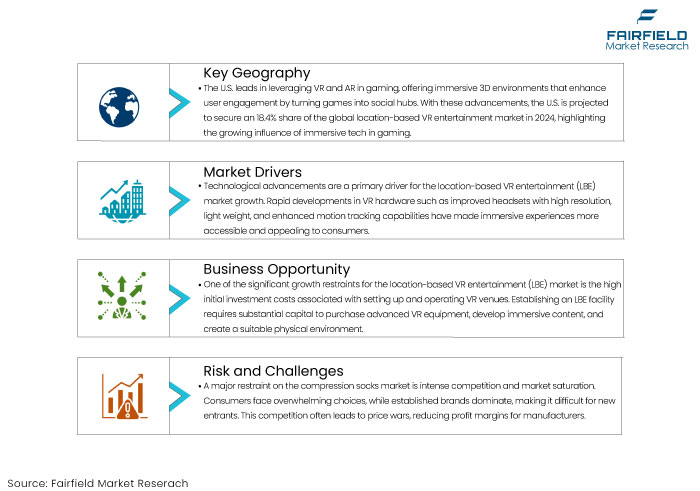
Technological advancements are a primary driver for the location-based VR entertainment (LBE) market growth. Rapid developments in VR hardware such as improved headsets with high resolution, light weight, and enhanced motion tracking capabilities have made immersive experiences more accessible and appealing to consumers.
Integrating haptic feedback devices further enriches user engagement allowing individuals to feel physical sensations during their virtual experiences, heightening realism. Additionally, advancements in software including more sophisticated gaming engines and artificial intelligence enable the creation of complex, and interactive environments that captivate audience. As these technologies evolve, they pave the way for innovative applications in LBE, attracting a broader demographic, from casual gamers to thrill-seekers.
- Rising Consumer Demand for Unique Experiences
The growing consumer demand for unique and immersive entertainment experiences is another significant driver propelling location-based VR entertainment (LBE) market. As people seek novel forms of leisure, traditional entertainment options such as movies and theme parks are increasingly being supplemented by immersive experiences that offer interactive opportunities.
LBE venues such as VR arcades and escape rooms provide an escape from everyday life, allowing customers to engage in experiences that are both entertaining and memorable. This shift in consumer preferences reflects a broad trend toward experiential consumption, where individuals value experiences over material goods.
As LBE venues continue to innovate and offer diverse, high-quality experiences, they are well-positioned to capitalize on this growing consumer trend ensuring sustained market growth.
- Increased Investment in the Sector
Increased investment in the location-based VR entertainment (LBE) market is a critical growth driver reflecting a growing recognition of its potential within the broad entertainment landscape. Venture capitalists, entertainment companies, and technology firms are pouring resources into the development of LBE venues, technologies, and content.
Partnerships between technology providers and entertainment operators are becoming more common, fostering collaboration and innovation. These investments enhance the quality of offerings and facilitate the introduction of new concepts such as multi-sensory experiences and theme park integrations.
Government support through grants or incentives for tech-driven entertainment ventures can further stimulate the sector. As a result, increased investment is vital to driving innovation, expanding market reach, and ensuring the long-term viability of the LBE market.
Key Growth Barriers
- High Initial Investment Costs
One of the significant growth restraints for the location-based VR entertainment (LBE) market is the high initial investment costs associated with setting up and operating VR venues. Establishing an LBE facility requires substantial capital to purchase advanced VR equipment, develop immersive content, and create a suitable physical environment. This includes costs for high-quality VR headsets, motion tracking systems, and other hardware that can provide a seamless experience.
Ongoing expenses such as maintenance, software updates, and staffing further strain financial resources. As a result, the high financial barrier may deter investment in the sector, slowing overall growth and innovation.
Without a diverse range of operators, the market may struggle to reach its full potential, impacting the variety of experiences available to consumers and hindering the overall development of the LBE landscape.
- Regulatory Challenges
Regulatory challenges also pose a significant restraint on the growth of the location-based VR entertainment (LBE) market. As the industry evolves, governments and regulatory bodies are increasingly focused on establishing guidelines to ensure safety, privacy, and consumer protection.
Compliance with regulations can be complex and costly for LBE operators. Furthermore, data privacy laws such as the General Data Protection Regulation (GDPR) necessitate that operators handle user data responsibly adding another layer of complexity and potential liability.
Regulatory hurdles can deter new entrants and slow down the expansion of existing businesses, as operators must allocate resources to navigate compliance rather than focusing on innovation and customer experience. Consequently, while regulations are essential for consumer safety, they can inadvertently stifle growth in the LBE market.
Location-Based VR Entertainment (LBE) Market Trends and Opportunities
- Integration of Social Experiences
A prominent trend in the industry is the integration of social experiences within virtual environments. As consumers increasingly seek out shared experiences, LBE venues are evolving to facilitate social interactions among participants. This trend is driven by the understanding that immersive entertainment is often enjoyable when shared with friends or family.
Venues are incorporating multiplayer games, collaborative challenges, and social spaces where users can interact before and after their VR experiences. Additionally, the rise of social media has amplified this trend as users are motivated to capture and share their experiences online, further promoting the venue and location-based VR entertainment (LBE) market value.
- Use in Educational and Training Applications
Several location-based VR entertainment (LBE) market opportunities lie in the expansion into educational and training applications. As educational institutions and businesses increasingly recognize the value of immersive learning experiences, LBE venues can leverage their technology to offer specialized programs. This could include VR simulations for training in fields such as healthcare, aviation, and emergency response, where realistic scenarios can enhance skill development and retention.
Educational institutions can partner with LBE operators to create field trips or interactive learning experiences that engage students in a unique way.
How Does Regulatory Scenario Shape this Industry?
The regulatory landscape is playing a crucial role in shaping the location-based VR entertainment (LBE) market growth. As this sector grows, governments and regulatory bodies are increasingly focusing on establishing guidelines to ensure safety, privacy, and consumer protection.
One significant aspect is the safety regulations concerning the use of VR equipment in public spaces. These regulations aim to mitigate risks associated with physical injuries and ensure that venues are equipped to handle emergencies effectively. Compliance with these safety standards is essential for LBE operators to maintain their licenses and avoid legal liabilities.
As per the location-based VR entertainment (LBE) market analysis, data privacy laws are becoming more stringent particularly with the collection of user data in VR experiences. Operators must navigate regulations like the General Data Protection Regulation (GDPR) in Europe, which mandates transparency in data handling and user consent. This has led to increased operational costs as businesses invest in compliance measures.
The intellectual property rights surrounding VR content are also under scrutiny, influencing how companies develop and distribute their offerings. As the market evolves, regulatory frameworks will likely to adapt impacting innovation and investment in the LBE sector.
Segments Covered in the Report
Hardware Segment to Stand Out in the Market
Hardware is vital for location-based VR systems as it creates the immersive environments that distinguish them from standard VR experiences. This hardware generates sensations that engage the user's emotions and senses.
Sensors track user movements such as button presses, controller actions, and eye movements to enhance interaction. Consequently, based on component, hardware segment dominates the location-based VR entertainment (LBE) market and is expected to account for an impressive 68.5% share. This emphasizes the importance of advanced technology in delivering compelling and immersive experiences in location-based virtual reality.
Amusement Parks to Lead the Market
During the forecast period, the amusement parks segment is leading end user that is expected to dominate the location-based VR entertainment (LBE) market. This category encompasses virtual galleries, theaters, cinemas, theme parks, and museums, allowing users to interact with pristine museum artifacts through VR technology.
Renowned masterpieces like Michelangelo's David and the Head of Nefertiti have been virtualized, enabling users to "touch" them using specially designed gloves that simulate different materials and provide haptic feedback. This innovative approach offers a unique experience particularly for individuals who are blind or have limited vision enhancing accessibility to cultural experiences.
Regional Analysis
The United States Turns Lucrative Accounting for 18.4% Market Share
The entertainment and gaming industries have been at the forefront in the United States by leveraging VR and AR. It offers crafting unparalleled gaming experiences only made possible by these cutting-edge technologies.
Players can now engage in interactive 3D environments, transforming games into social hubs reminiscent of chat rooms. This social dimension has significantly boosted user engagement. Consequently, the United States is projected to emerge as a global leader in the location-based VR entertainment (LBE) market securing an impressive 18.4% share in 2024. These developments underscore the increasing role of immersive technology in shaping the future of gaming and entertainment.
India Set to Dominate the Market Capturing Healthy CAGR of 30.3%
Virtual reality (VR) is gaining traction in India due to its notable educational benefits. VR offers significant advantages in training and education by simulating real-world environments. Imagine geography lessons featuring virtual field trips and interactive timelines that bring historical events to life.
VR and AR technologies make traditional content engaging and memorable enhancing student motivation and curiosity. As a result, India market is projected to experience remarkable growth, with an estimated healthy CAGR of 30.3% during the forecast period. This transformation highlights the potential of immersive technologies to revolutionize educational experiences.
Fairfield’s Competitive Landscape Analysis
The location-based VR entertainment (LBE) market is characterized by intense competition among various players striving to innovate and capture market share. Companies like The VOID known for its immersive VR experiences have expanded their offerings by launching new attractions that blend physical and virtual elements. In 2023, The VOID introduced a groundbreaking experience called "Star Wars: Secrets of the Empire," which allows participants to engage in a fully immersive narrative while interacting with physical props.
Key Market Companies
• HTC Vive (HTC Corporation
• Oculus VR (Meta)
• Hologate
• Survios Inc.
• The Void LLC
• VRstudios Inc.
• Zero Latency VR
• Exit Reality VR
• Positron
• Others
Market Segmenatation:
By Component:
• Hardware
• Head-Mount Displays
• Sensors
• Head-Up Displays
• Cameras
• Others
• Software
• Services
By Technology:
• 2D
• 3D
• Cloud-Merged Reality
By End User:
• Amusement Parks
• Theme Parks
• Arcade Studios
• 4D Films
• Others
By Region:
• North America
• Latin America
• Europe
• East Asia
• South Asia Pacific
• Middle East and Africa
- Executive Summary
- Global Location Based Vr Entertainment Lbe Market Snapshot
- Future Projections
- Key Market Trends
- Regional Snapshot, by Value, 2026
- Analyst Recommendations
- Market Overview
- Market Definitions and Segmentations
- Market Dynamics
- Drivers
- Restraints
- Market Opportunities
- Value Chain Analysis
- COVID-19 Impact Analysis
- Porter's Five Forces Analysis
- Impact of Russia-Ukraine Conflict
- PESTLE Analysis
- Regulatory Analysis
- Price Trend Analysis
- Current Prices and Future Projections, 2025-2033
- Price Impact Factors
- Global Location Based Vr Entertainment Lbe Market Outlook, 2020 - 2033
- Global Location Based Vr Entertainment Lbe Market Outlook, by Component, Value (US$ Bn), 2020-2033
- Hardware
- Head-Mount Displays
- Sensors
- Head-Up Displays
- Cameras
- Others
- Software
- Services
- Hardware
- Global Location Based Vr Entertainment Lbe Market Outlook, by Technology, Value (US$ Bn), 2020-2033
- 2D
- 3D
- Cloud-Merged Reality
- Global Location Based Vr Entertainment Lbe Market Outlook, by End User, Value (US$ Bn), 2020-2033
- Amusement Parks
- Theme Parks
- Arcade Studios
- 4D Films
- Others
- Global Location Based Vr Entertainment Lbe Market Outlook, by Region, Value (US$ Bn), 2020-2033
- North America
- Europe
- Asia Pacific
- Latin America
- Middle East & Africa
- Global Location Based Vr Entertainment Lbe Market Outlook, by Component, Value (US$ Bn), 2020-2033
- North America Location Based Vr Entertainment Lbe Market Outlook, 2020 - 2033
- North America Location Based Vr Entertainment Lbe Market Outlook, by Component, Value (US$ Bn), 2020-2033
- Hardware
- Head-Mount Displays
- Sensors
- Head-Up Displays
- Cameras
- Others
- Software
- Services
- Hardware
- North America Location Based Vr Entertainment Lbe Market Outlook, by Technology, Value (US$ Bn), 2020-2033
- 2D
- 3D
- Cloud-Merged Reality
- North America Location Based Vr Entertainment Lbe Market Outlook, by End User, Value (US$ Bn), 2020-2033
- Amusement Parks
- Theme Parks
- Arcade Studios
- 4D Films
- Others
- North America Location Based Vr Entertainment Lbe Market Outlook, by Country, Value (US$ Bn), 2020-2033
- U.S. Location Based Vr Entertainment Lbe Market Outlook, by Component, 2020-2033
- U.S. Location Based Vr Entertainment Lbe Market Outlook, by Technology, 2020-2033
- U.S. Location Based Vr Entertainment Lbe Market Outlook, by End User, 2020-2033
- Canada Location Based Vr Entertainment Lbe Market Outlook, by Component, 2020-2033
- Canada Location Based Vr Entertainment Lbe Market Outlook, by Technology, 2020-2033
- Canada Location Based Vr Entertainment Lbe Market Outlook, by End User, 2020-2033
- BPS Analysis/Market Attractiveness Analysis
- North America Location Based Vr Entertainment Lbe Market Outlook, by Component, Value (US$ Bn), 2020-2033
- Europe Location Based Vr Entertainment Lbe Market Outlook, 2020 - 2033
- Europe Location Based Vr Entertainment Lbe Market Outlook, by Component, Value (US$ Bn), 2020-2033
- Hardware
- Head-Mount Displays
- Sensors
- Head-Up Displays
- Cameras
- Others
- Software
- Services
- Hardware
- Europe Location Based Vr Entertainment Lbe Market Outlook, by Technology, Value (US$ Bn), 2020-2033
- 2D
- 3D
- Cloud-Merged Reality
- Europe Location Based Vr Entertainment Lbe Market Outlook, by End User, Value (US$ Bn), 2020-2033
- Amusement Parks
- Theme Parks
- Arcade Studios
- 4D Films
- Others
- Europe Location Based Vr Entertainment Lbe Market Outlook, by Country, Value (US$ Bn), 2020-2033
- Germany Location Based Vr Entertainment Lbe Market Outlook, by Component, 2020-2033
- Germany Location Based Vr Entertainment Lbe Market Outlook, by Technology, 2020-2033
- Germany Location Based Vr Entertainment Lbe Market Outlook, by End User, 2020-2033
- Italy Location Based Vr Entertainment Lbe Market Outlook, by Component, 2020-2033
- Italy Location Based Vr Entertainment Lbe Market Outlook, by Technology, 2020-2033
- Italy Location Based Vr Entertainment Lbe Market Outlook, by End User, 2020-2033
- France Location Based Vr Entertainment Lbe Market Outlook, by Component, 2020-2033
- France Location Based Vr Entertainment Lbe Market Outlook, by Technology, 2020-2033
- France Location Based Vr Entertainment Lbe Market Outlook, by End User, 2020-2033
- U.K. Location Based Vr Entertainment Lbe Market Outlook, by Component, 2020-2033
- U.K. Location Based Vr Entertainment Lbe Market Outlook, by Technology, 2020-2033
- U.K. Location Based Vr Entertainment Lbe Market Outlook, by End User, 2020-2033
- Spain Location Based Vr Entertainment Lbe Market Outlook, by Component, 2020-2033
- Spain Location Based Vr Entertainment Lbe Market Outlook, by Technology, 2020-2033
- Spain Location Based Vr Entertainment Lbe Market Outlook, by End User, 2020-2033
- Russia Location Based Vr Entertainment Lbe Market Outlook, by Component, 2020-2033
- Russia Location Based Vr Entertainment Lbe Market Outlook, by Technology, 2020-2033
- Russia Location Based Vr Entertainment Lbe Market Outlook, by End User, 2020-2033
- Rest of Europe Location Based Vr Entertainment Lbe Market Outlook, by Component, 2020-2033
- Rest of Europe Location Based Vr Entertainment Lbe Market Outlook, by Technology, 2020-2033
- Rest of Europe Location Based Vr Entertainment Lbe Market Outlook, by End User, 2020-2033
- BPS Analysis/Market Attractiveness Analysis
- Europe Location Based Vr Entertainment Lbe Market Outlook, by Component, Value (US$ Bn), 2020-2033
- Asia Pacific Location Based Vr Entertainment Lbe Market Outlook, 2020 - 2033
- Asia Pacific Location Based Vr Entertainment Lbe Market Outlook, by Component, Value (US$ Bn), 2020-2033
- Hardware
- Head-Mount Displays
- Sensors
- Head-Up Displays
- Cameras
- Others
- Software
- Services
- Hardware
- Asia Pacific Location Based Vr Entertainment Lbe Market Outlook, by Technology, Value (US$ Bn), 2020-2033
- 2D
- 3D
- Cloud-Merged Reality
- Asia Pacific Location Based Vr Entertainment Lbe Market Outlook, by End User, Value (US$ Bn), 2020-2033
- Amusement Parks
- Theme Parks
- Arcade Studios
- 4D Films
- Others
- Asia Pacific Location Based Vr Entertainment Lbe Market Outlook, by Country, Value (US$ Bn), 2020-2033
- China Location Based Vr Entertainment Lbe Market Outlook, by Component, 2020-2033
- China Location Based Vr Entertainment Lbe Market Outlook, by Technology, 2020-2033
- China Location Based Vr Entertainment Lbe Market Outlook, by End User, 2020-2033
- Japan Location Based Vr Entertainment Lbe Market Outlook, by Component, 2020-2033
- Japan Location Based Vr Entertainment Lbe Market Outlook, by Technology, 2020-2033
- Japan Location Based Vr Entertainment Lbe Market Outlook, by End User, 2020-2033
- South Korea Location Based Vr Entertainment Lbe Market Outlook, by Component, 2020-2033
- South Korea Location Based Vr Entertainment Lbe Market Outlook, by Technology, 2020-2033
- South Korea Location Based Vr Entertainment Lbe Market Outlook, by End User, 2020-2033
- India Location Based Vr Entertainment Lbe Market Outlook, by Component, 2020-2033
- India Location Based Vr Entertainment Lbe Market Outlook, by Technology, 2020-2033
- India Location Based Vr Entertainment Lbe Market Outlook, by End User, 2020-2033
- Southeast Asia Location Based Vr Entertainment Lbe Market Outlook, by Component, 2020-2033
- Southeast Asia Location Based Vr Entertainment Lbe Market Outlook, by Technology, 2020-2033
- Southeast Asia Location Based Vr Entertainment Lbe Market Outlook, by End User, 2020-2033
- Rest of SAO Location Based Vr Entertainment Lbe Market Outlook, by Component, 2020-2033
- Rest of SAO Location Based Vr Entertainment Lbe Market Outlook, by Technology, 2020-2033
- Rest of SAO Location Based Vr Entertainment Lbe Market Outlook, by End User, 2020-2033
- BPS Analysis/Market Attractiveness Analysis
- Asia Pacific Location Based Vr Entertainment Lbe Market Outlook, by Component, Value (US$ Bn), 2020-2033
- Latin America Location Based Vr Entertainment Lbe Market Outlook, 2020 - 2033
- Latin America Location Based Vr Entertainment Lbe Market Outlook, by Component, Value (US$ Bn), 2020-2033
- Hardware
- Head-Mount Displays
- Sensors
- Head-Up Displays
- Cameras
- Others
- Software
- Services
- Hardware
- Latin America Location Based Vr Entertainment Lbe Market Outlook, by Technology, Value (US$ Bn), 2020-2033
- 2D
- 3D
- Cloud-Merged Reality
- Latin America Location Based Vr Entertainment Lbe Market Outlook, by End User, Value (US$ Bn), 2020-2033
- Amusement Parks
- Theme Parks
- Arcade Studios
- 4D Films
- Others
- Latin America Location Based Vr Entertainment Lbe Market Outlook, by Country, Value (US$ Bn), 2020-2033
- Brazil Location Based Vr Entertainment Lbe Market Outlook, by Component, 2020-2033
- Brazil Location Based Vr Entertainment Lbe Market Outlook, by Technology, 2020-2033
- Brazil Location Based Vr Entertainment Lbe Market Outlook, by End User, 2020-2033
- Mexico Location Based Vr Entertainment Lbe Market Outlook, by Component, 2020-2033
- Mexico Location Based Vr Entertainment Lbe Market Outlook, by Technology, 2020-2033
- Mexico Location Based Vr Entertainment Lbe Market Outlook, by End User, 2020-2033
- Argentina Location Based Vr Entertainment Lbe Market Outlook, by Component, 2020-2033
- Argentina Location Based Vr Entertainment Lbe Market Outlook, by Technology, 2020-2033
- Argentina Location Based Vr Entertainment Lbe Market Outlook, by End User, 2020-2033
- Rest of LATAM Location Based Vr Entertainment Lbe Market Outlook, by Component, 2020-2033
- Rest of LATAM Location Based Vr Entertainment Lbe Market Outlook, by Technology, 2020-2033
- Rest of LATAM Location Based Vr Entertainment Lbe Market Outlook, by End User, 2020-2033
- BPS Analysis/Market Attractiveness Analysis
- Latin America Location Based Vr Entertainment Lbe Market Outlook, by Component, Value (US$ Bn), 2020-2033
- Middle East & Africa Location Based Vr Entertainment Lbe Market Outlook, 2020 - 2033
- Middle East & Africa Location Based Vr Entertainment Lbe Market Outlook, by Component, Value (US$ Bn), 2020-2033
- Hardware
- Head-Mount Displays
- Sensors
- Head-Up Displays
- Cameras
- Others
- Software
- Services
- Hardware
- Middle East & Africa Location Based Vr Entertainment Lbe Market Outlook, by Technology, Value (US$ Bn), 2020-2033
- 2D
- 3D
- Cloud-Merged Reality
- Middle East & Africa Location Based Vr Entertainment Lbe Market Outlook, by End User, Value (US$ Bn), 2020-2033
- Amusement Parks
- Theme Parks
- Arcade Studios
- 4D Films
- Others
- Middle East & Africa Location Based Vr Entertainment Lbe Market Outlook, by Country, Value (US$ Bn), 2020-2033
- GCC Location Based Vr Entertainment Lbe Market Outlook, by Component, 2020-2033
- GCC Location Based Vr Entertainment Lbe Market Outlook, by Technology, 2020-2033
- GCC Location Based Vr Entertainment Lbe Market Outlook, by End User, 2020-2033
- South Africa Location Based Vr Entertainment Lbe Market Outlook, by Component, 2020-2033
- South Africa Location Based Vr Entertainment Lbe Market Outlook, by Technology, 2020-2033
- South Africa Location Based Vr Entertainment Lbe Market Outlook, by End User, 2020-2033
- Egypt Location Based Vr Entertainment Lbe Market Outlook, by Component, 2020-2033
- Egypt Location Based Vr Entertainment Lbe Market Outlook, by Technology, 2020-2033
- Egypt Location Based Vr Entertainment Lbe Market Outlook, by End User, 2020-2033
- Nigeria Location Based Vr Entertainment Lbe Market Outlook, by Component, 2020-2033
- Nigeria Location Based Vr Entertainment Lbe Market Outlook, by Technology, 2020-2033
- Nigeria Location Based Vr Entertainment Lbe Market Outlook, by End User, 2020-2033
- Rest of Middle East Location Based Vr Entertainment Lbe Market Outlook, by Component, 2020-2033
- Rest of Middle East Location Based Vr Entertainment Lbe Market Outlook, by Technology, 2020-2033
- Rest of Middle East Location Based Vr Entertainment Lbe Market Outlook, by End User, 2020-2033
- BPS Analysis/Market Attractiveness Analysis
- Middle East & Africa Location Based Vr Entertainment Lbe Market Outlook, by Component, Value (US$ Bn), 2020-2033
- Competitive Landscape
- Company Vs Segment Heatmap
- Company Market Share Analysis, 2025
- Competitive Dashboard
- Company Profiles
- HTC Vive (HTC Corporation
- Company Overview
- Product Portfolio
- Financial Overview
- Business Strategies and Developments
- Oculus VR (Meta)
- Hologate
- Survios Inc.
- The Void LLC
- VRstudios Inc.
- Zero Latency VR
- Exit Reality VR
- Positron
- Others
- HTC Vive (HTC Corporation
- Appendix
- Research Methodology
- Report Assumptions
- Acronyms and Abbreviations
|
BASE YEAR |
HISTORICAL DATA |
FORECAST PERIOD |
UNITS |
|||
 |
2025 |
 |
2020 - 2025 |
 |
2026 - 2033 |
Value: US$ Million |
Our Research Methodology
Considering the volatility of business today, traditional approaches to strategizing a game plan can be unfruitful if not detrimental. True ambiguity is no way to determine a forecast. A myriad of predetermined factors must be accounted for such as the degree of risk involved, the magnitude of circumstances, as well as conditions or consequences that are not known or unpredictable. To circumvent binary views that cast uncertainty, the application of market research intelligence to strategically posture, move, and enable actionable outcomes is necessary.
View Methodology
Quality Assured
Rigorous Validation Process

Confidentiality Assured
End-to-end Data Security

Custom Research Services
Tailored To Your Objectives
FAQs
The Location-Based VR Entertainment (LBE) Market size is valued at USD 5.9 billion in 2026.
The Location-Based VR Entertainment (LBE) Market is projected to grow at a CAGR of 18.2% through 2033.
Market growth is driven by increasing demand for immersive experiences, advancements in VR technology, and rising investments in entertainment venues.
North America is the dominant regional market for Location-Based VR Entertainment (LBE).
The VOID, Sandbox VR, Dreamscape Immersive, Zero Latency, and VRstudios are some leading industry players in the Location-Based VR Entertainment (LBE) Market.
Related Reports
Building Information Modeling Market Size, Share, Insights, Competitive Landscape, and Forecast 2026 to 2033
The building information modeling market is set to reach US$29.8 Bn by 2033, growing at a 14.3% CAGR from US$11.7 Bn in 2026, driven by digital construction
Smart Water Meter Market Size, Share, Insights, Competitive Landscape, and Forecast 2026 to 2033
The smart water meter market is projected to grow from US$7.8 billion in 2026 to US$15.4 billion by 2033, at a 10.2% CAGR
Battery Leasing-as-a-Service Insights, Competitive Landscape, and Market Forecast 2026 to 2033
Battery Leasing-as-a-Service Market to reach US$11.5 Bn by 2033, growing at 22.4% CAGR, driven by EV adoption, battery swapping, and fleet electrification.
Commercial Small Launch Rockets Market Insights, Competitive Landscape, and Market Forecast 2033
The commercial small launch rockets market to reach USD 8.99 Bn by 2033 from USD 2.60 Bn in 2026, growing at 19.4% CAGR, driven by rising satellite launches
3D Printed Satellite Market Insights, Competitive Landscape, and Market Forecast 2033
The global 3D printed satellite market will reach USD 3,030.77 million by 2033, growing at a 23.8% CAGR from USD 680.00 million in 2026
VLEO Satellite Platforms Market Insights, Competitive Landscape, and Market Forecast 2033
The global VLEO satellite platforms market will reach USD 5.67 billion by 2033, growing at a 26.4% CAGR from USD 1.10 billion in 2026