



Low Density Polyethylene Market
Low Density Polyethylene Market Insights, Competitive Landscape, and Market Forecast - 2033
The Low Density Polyethylene Market is valued at USD 41.2 Bn in 2026 and is projected to reach USD 56.1 Bn, growing at a CAGR of 5% by 2033.
Low Density Polyethylene Market Insights
- Blow-molded LDPE ensures durable, lightweight containers due to its excellent strength-to-weight ratio, helping enhance product shelf life and reduce transportation costs.
- LDPE films serve widely in agriculture as mulch, greenhouse covers, and silage films, offering moisture retention, weed control, and improved crop yields.
- Injection-molded LDPE delivers superior insulation, flexibility, and chemical resistance, making it ideal for manufacturing wire coatings and electronic components.
- LDPE sheets provide effective moisture barriers, vapor protection, and thermal insulation, making them essential for modern building and infrastructure projects.
Key Growth Determinants
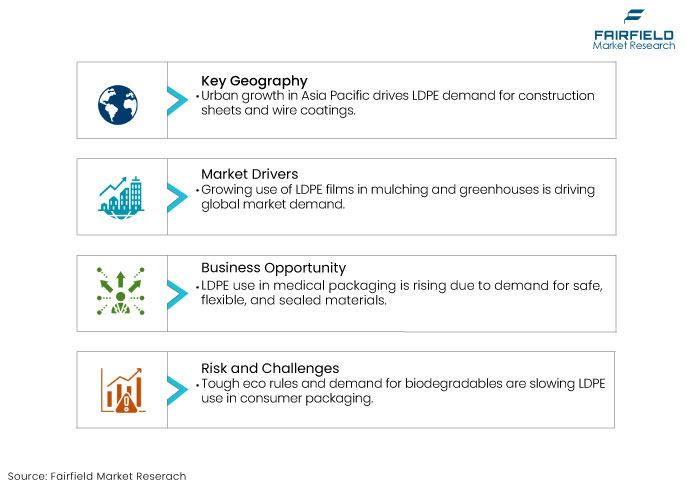
- Rising consumption of LDPE films in agriculture for mulching and greenhouse applications is significantly boosting global market demand.
Low Density Polyethylene films are increasingly used in agriculture for mulching, owing to their ability to conserve soil moisture, suppress weeds, and improve crop yields. According to the Food and Agriculture Organization (FAO), plastic mulch coverage in China exceeded 20 million hectares by 2022, with LDPE films being the most commonly used material due to their cost-effectiveness and durability.
In addition, LDPE greenhouse films are gaining popularity in regions with extreme weather conditions, as they offer UV stability, flexibility, and light transmission benefits. Countries like India have ramped up protected cultivation under government-backed schemes such as the National Mission on Sustainable Agriculture (NMSA), driving demand for LDPE-based greenhouse covers in horticulture and floriculture sectors.
Key Growth Barriers
- Strict environmental regulations and increasing preference for biodegradable alternatives are limiting LDPE adoption in consumer goods packaging
LDPE is often used for packaging consumer goods, but it faces rules because it doesn’t break down easily in nature. For example, the European Union’s Single-Use Plastics Directive and India’s nationwide ban on certain single-use plastics in 2022 have restricted LDPE-based packaging in multiple applications. These regulations are prompting industries to explore alternatives that align with sustainability and circular economy goals.
Simultaneously, rising consumer awareness and demand for eco-friendly packaging are accelerating the shift toward biodegradable and compostable materials. Brands like Nestlé and Unilever are committing to reducing virgin plastic use, including LDPE, in favor of bio-based or recyclable alternatives. This growing environmental consciousness is limiting LDPE’s adoption, especially in fast-moving consumer goods (FMCG) and food packaging segments.
Low Density Polyethylene Market Opportunities
- LDPE manufacturers can expand in the medical packaging sector by innovating lightweight, sterile, and durable sheet-based packaging solutions
LDPE manufacturers have a big opportunity in the medical packaging sector, where demand for safe, lightweight, and durable materials is growing. LDPE sheets are ideal for packaging medical devices, surgical instruments, and disposable items due to their flexibility, moisture resistance, and ease of sealing. During the COVID-19 pandemic, the use of single-use medical packaging surged globally, highlighting this growing need.
Hospitals and clinics now prefer materials that ensure sterility and reduce contamination risks, which LDPE can provide effectively. According to WHO guidelines, sterile barrier systems are crucial in medical supply chains. Manufacturers that invest in improved LDPE film and sheet technology, tailored for sterile packaging, can tap into this expanding segment driven by healthcare modernization and hygiene awareness.
Segment-wise Overview
- Blow molded LDPE products are witnessing enhanced demand due to rising packaging needs in the food and beverage industry
Blow molded LDPE products are in high demand because the food and beverage industry needs safe, flexible, and lightweight packaging. These products are used for making containers, squeeze bottles, and liquid packaging. According to the World Packaging Organisation, global demand for flexible packaging has increased sharply, especially for convenience foods, sauces, and dairy products all of which use LDPE.
Many companies now prefer LDPE for blow-molded packaging because it is cost-effective, easy to shape, and offers good moisture resistance. Brands like Coca-Cola and Nestlé have adopted LDPE-based flexible bottles and pouches for specific product lines. The trend toward ready-to-eat meals and on-the-go beverages is further driving the need for reliable LDPE packaging solutions.
- The electrical and electronics sector is rapidly embracing LDPE insulation materials due to their excellent dielectric and flexibility properties
The electrical and electronics sector is using more LDPE because of its strong insulating ability and flexibility. LDPE is widely used in wire and cable insulation, helping prevent short circuits and electrical failures. According to the International Energy Agency (IEA), the growing global electricity demand is pushing up the production of power cables, many of which use LDPE insulation.
LDPE is also chosen for its resistance to moisture and chemicals, making it suitable for harsh environments. Companies like Prysmian Group and Nexans have incorporated LDPE into their cable products. With the rise of smart homes, EVs, and renewable energy systems, the demand for safe and reliable electrical insulation is creating strong opportunities for LDPE in this segment.
Regional Analysis
- Growing e-commerce activity is fueling LDPE usage in flexible packaging and protective film applications in North America
In North America, the rise of e-commerce has increased the need for flexible packaging made from LDPE. Products ordered online require secure, lightweight, and protective materials, and LDPE films are ideal for bubble wraps, mailing bags, and stretch films. According to the U.S. Census Bureau, e-commerce sales rose by over 8% year-on-year in Q1 2024, boosting packaging demand.
Major retailers such as Amazon and Walmart are using more LDPE packaging to protect goods during shipping. LDPE’s strength, flexibility, and moisture resistance make it perfect for high-volume, fast-moving logistics operations. As online shopping continues to grow across the U.S. and Canada, demand for LDPE in packaging applications is expected to remain strong.
- Europe's circular economy push is driving investment in LDPE recycling infrastructure and sustainable agricultural film solutions
Europe's commitment to a circular economy is driving significant investments in low-density polyethylene recycling infrastructure. For instance, the European Investment Fund has allocated €50 million to Infinity Recycling's Circular Plastics Fund, which supports companies developing advanced recycling technologies for plastics. This initiative aims to scale up operations and enhance the recycling of LDPE, among other plastics, to produce new materials with properties equivalent to virgin plastics.
Additionally, Ara Partners is investing up to €100 million in Repeats Group to establish a pan-European platform for recycling LDPE waste. This project focuses on regions with high population density and currently limited recycling capacity, aiming to recover approximately 60,000 metric tons of recycled LDPE annually. Such investments are crucial for meeting the European Union's target of using 10 million tonnes of recycled plastics by 2025, as outlined by the Circular Plastics Alliance.
- Rapid urbanization and infrastructure development in Asia Pacific are fueling LDPE demand in construction-related sheet and wire-coating applications
Asia Pacific's rapid urbanization and infrastructure development are significantly boosting the demand for low-density polyethylene (LDPE) in construction-related applications. The region's construction films market, valued more than US$ 12 billion in 2023, is projected to grow at a 6.5% annual rate through 2030. LDPE films are widely used for vapor barriers, insulation, and protective covers in both residential and commercial buildings.
Similarly, LDPE's role in wire and cable insulation is expanding in the Asia Pacific. In 2023, the region accounted for approximately 40% of the global LDPE wires and cables market. This growth is driven by increased demand in electronics, telecommunications, and infrastructure sectors, where LDPE's flexibility and moisture resistance are highly valued.
Competitive Landscape
The global LDPE market is witnessing a strategic shift towards sustainability and technological innovation. Leading companies like Dow and LyondellBasell are investing in advanced recycling technologies and bio-based feedstocks.
Key Companies
- ExxonMobil Corporation
- Formosa Plastics Corporation
- Chevron Phillips Chemical Company LLC
- LG Chem
- LyondellBasell Industries Holdings BV
- SABIC
- PetroChina
- NOVA Chemicals Corporate
- Westlake Corporation
- Reliance Industries Limited
- Dow INC.
Expert Opinion
- Increasing environmental regulations and consumer demand for sustainable packaging are driving LDPE producers to innovate with recycled and bio-based materials, reshaping industry dynamics and supply chains.
- Technological advancements in catalytic polymerization and advanced recycling methods are enhancing LDPE quality and expanding its application scope, particularly in flexible packaging and agriculture films.
- The market faces short-term volatility due to fluctuating raw material prices and oversupply in some regions, but long-term growth is expected from emerging economies and infrastructure development.
- Strategic collaborations and investments in circular economy initiatives are crucial for industry players to maintain competitiveness and meet evolving regulatory and consumer sustainability standards.
Global Low Density Polyethylene Market is Segmented as-
By Product Type
- Blow Molded
- Films
- Injection Molded
- Sheets
- Others (Foam, Wire)
By End Use
- Packaging
- Agriculture
- Electrical & Electronics
- Construction
- Automotive
- Consumer Goods
- Others (Medical, Toys)
By Region
- North America
- Europe
- Asia Pacific
- Latin America
- Middle East & Africa
- Executive Summary
- Global Low Density Polyethylene Market Snapshot
- Future Projections
- Key Market Trends
- Regional Snapshot, by Value, 2026
- Analyst Recommendations
- Market Overview
- Market Definitions and Segmentations
- Market Dynamics
- Drivers
- Restraints
- Market Opportunities
- Value Chain Analysis
- COVID-19 Impact Analysis
- Porter's Five Forces Analysis
- Impact of Russia-Ukraine Conflict
- PESTLE Analysis
- Regulatory Analysis
- Price Trend Analysis
- Current Prices and Future Projections, 2025-2033
- Price Impact Factors
- Global Low Density Polyethylene Market Outlook, 2020 - 2033
- Global Low Density Polyethylene Market Outlook, by Product Type, Value (US$ Mn), 2020-2033
- Blow Molded
- Films
- Injection Molded
- Sheets
- Others (Foam, Wire)
- Global Low Density Polyethylene Market Outlook, by End Use, Value (US$ Mn), 2020-2033
- Packaging
- Agriculture
- Electrical & Electronics
- Construction
- Automotive
- Consumer Goods
- Others (Medical, Toys)
- Global Low Density Polyethylene Market Outlook, by Region, Value (US$ Mn), 2020-2033
- North America
- Europe
- Asia Pacific
- Latin America
- Middle East & Africa
- Global Low Density Polyethylene Market Outlook, by Product Type, Value (US$ Mn), 2020-2033
- North America Low Density Polyethylene Market Outlook, 2020 - 2033
- North America Low Density Polyethylene Market Outlook, by Product Type, Value (US$ Mn), 2020-2033
- Blow Molded
- Films
- Injection Molded
- Sheets
- Others (Foam, Wire)
- North America Low Density Polyethylene Market Outlook, by End Use, Value (US$ Mn), 2020-2033
- Packaging
- Agriculture
- Electrical & Electronics
- Construction
- Automotive
- Consumer Goods
- Others (Medical, Toys)
- North America Low Density Polyethylene Market Outlook, by Country, Value (US$ Mn), 2020-2033
- U.S. Low Density Polyethylene Market Outlook, by Product Type, 2020-2033
- U.S. Low Density Polyethylene Market Outlook, by End Use, 2020-2033
- Canada Low Density Polyethylene Market Outlook, by Product Type, 2020-2033
- Canada Low Density Polyethylene Market Outlook, by End Use, 2020-2033
- BPS Analysis/Market Attractiveness Analysis
- North America Low Density Polyethylene Market Outlook, by Product Type, Value (US$ Mn), 2020-2033
- Europe Low Density Polyethylene Market Outlook, 2020 - 2033
- Europe Low Density Polyethylene Market Outlook, by Product Type, Value (US$ Mn), 2020-2033
- Blow Molded
- Films
- Injection Molded
- Sheets
- Others (Foam, Wire)
- Europe Low Density Polyethylene Market Outlook, by End Use, Value (US$ Mn), 2020-2033
- Packaging
- Agriculture
- Electrical & Electronics
- Construction
- Automotive
- Consumer Goods
- Others (Medical, Toys)
- Europe Low Density Polyethylene Market Outlook, by Country, Value (US$ Mn), 2020-2033
- Germany Low Density Polyethylene Market Outlook, by Product Type, 2020-2033
- Germany Low Density Polyethylene Market Outlook, by End Use, 2020-2033
- Italy Low Density Polyethylene Market Outlook, by Product Type, 2020-2033
- Italy Low Density Polyethylene Market Outlook, by End Use, 2020-2033
- France Low Density Polyethylene Market Outlook, by Product Type, 2020-2033
- France Low Density Polyethylene Market Outlook, by End Use, 2020-2033
- U.K. Low Density Polyethylene Market Outlook, by Product Type, 2020-2033
- U.K. Low Density Polyethylene Market Outlook, by End Use, 2020-2033
- Spain Low Density Polyethylene Market Outlook, by Product Type, 2020-2033
- Spain Low Density Polyethylene Market Outlook, by End Use, 2020-2033
- Russia Low Density Polyethylene Market Outlook, by Product Type, 2020-2033
- Russia Low Density Polyethylene Market Outlook, by End Use, 2020-2033
- Rest of Europe Low Density Polyethylene Market Outlook, by Product Type, 2020-2033
- Rest of Europe Low Density Polyethylene Market Outlook, by End Use, 2020-2033
- BPS Analysis/Market Attractiveness Analysis
- Europe Low Density Polyethylene Market Outlook, by Product Type, Value (US$ Mn), 2020-2033
- Asia Pacific Low Density Polyethylene Market Outlook, 2020 - 2033
- Asia Pacific Low Density Polyethylene Market Outlook, by Product Type, Value (US$ Mn), 2020-2033
- Blow Molded
- Films
- Injection Molded
- Sheets
- Others (Foam, Wire)
- Asia Pacific Low Density Polyethylene Market Outlook, by End Use, Value (US$ Mn), 2020-2033
- Packaging
- Agriculture
- Electrical & Electronics
- Construction
- Automotive
- Consumer Goods
- Others (Medical, Toys)
- Asia Pacific Low Density Polyethylene Market Outlook, by Country, Value (US$ Mn), 2020-2033
- China Low Density Polyethylene Market Outlook, by Product Type, 2020-2033
- China Low Density Polyethylene Market Outlook, by End Use, 2020-2033
- Japan Low Density Polyethylene Market Outlook, by Product Type, 2020-2033
- Japan Low Density Polyethylene Market Outlook, by End Use, 2020-2033
- South Korea Low Density Polyethylene Market Outlook, by Product Type, 2020-2033
- South Korea Low Density Polyethylene Market Outlook, by End Use, 2020-2033
- India Low Density Polyethylene Market Outlook, by Product Type, 2020-2033
- India Low Density Polyethylene Market Outlook, by End Use, 2020-2033
- Southeast Asia Low Density Polyethylene Market Outlook, by Product Type, 2020-2033
- Southeast Asia Low Density Polyethylene Market Outlook, by End Use, 2020-2033
- Rest of SAO Low Density Polyethylene Market Outlook, by Product Type, 2020-2033
- Rest of SAO Low Density Polyethylene Market Outlook, by End Use, 2020-2033
- BPS Analysis/Market Attractiveness Analysis
- Asia Pacific Low Density Polyethylene Market Outlook, by Product Type, Value (US$ Mn), 2020-2033
- Latin America Low Density Polyethylene Market Outlook, 2020 - 2033
- Latin America Low Density Polyethylene Market Outlook, by Product Type, Value (US$ Mn), 2020-2033
- Blow Molded
- Films
- Injection Molded
- Sheets
- Others (Foam, Wire)
- Latin America Low Density Polyethylene Market Outlook, by End Use, Value (US$ Mn), 2020-2033
- Packaging
- Agriculture
- Electrical & Electronics
- Construction
- Automotive
- Consumer Goods
- Others (Medical, Toys)
- Latin America Low Density Polyethylene Market Outlook, by Country, Value (US$ Mn), 2020-2033
- Brazil Low Density Polyethylene Market Outlook, by Product Type, 2020-2033
- Brazil Low Density Polyethylene Market Outlook, by End Use, 2020-2033
- Mexico Low Density Polyethylene Market Outlook, by Product Type, 2020-2033
- Mexico Low Density Polyethylene Market Outlook, by End Use, 2020-2033
- Argentina Low Density Polyethylene Market Outlook, by Product Type, 2020-2033
- Argentina Low Density Polyethylene Market Outlook, by End Use, 2020-2033
- Rest of LATAM Low Density Polyethylene Market Outlook, by Product Type, 2020-2033
- Rest of LATAM Low Density Polyethylene Market Outlook, by End Use, 2020-2033
- BPS Analysis/Market Attractiveness Analysis
- Latin America Low Density Polyethylene Market Outlook, by Product Type, Value (US$ Mn), 2020-2033
- Middle East & Africa Low Density Polyethylene Market Outlook, 2020 - 2033
- Middle East & Africa Low Density Polyethylene Market Outlook, by Product Type, Value (US$ Mn), 2020-2033
- Blow Molded
- Films
- Injection Molded
- Sheets
- Others (Foam, Wire)
- Middle East & Africa Low Density Polyethylene Market Outlook, by End Use, Value (US$ Mn), 2020-2033
- Packaging
- Agriculture
- Electrical & Electronics
- Construction
- Automotive
- Consumer Goods
- Others (Medical, Toys)
- Middle East & Africa Low Density Polyethylene Market Outlook, by Country, Value (US$ Mn), 2020-2033
- GCC Low Density Polyethylene Market Outlook, by Product Type, 2020-2033
- GCC Low Density Polyethylene Market Outlook, by End Use, 2020-2033
- South Africa Low Density Polyethylene Market Outlook, by Product Type, 2020-2033
- South Africa Low Density Polyethylene Market Outlook, by End Use, 2020-2033
- Egypt Low Density Polyethylene Market Outlook, by Product Type, 2020-2033
- Egypt Low Density Polyethylene Market Outlook, by End Use, 2020-2033
- Nigeria Low Density Polyethylene Market Outlook, by Product Type, 2020-2033
- Nigeria Low Density Polyethylene Market Outlook, by End Use, 2020-2033
- Rest of Middle East Low Density Polyethylene Market Outlook, by Product Type, 2020-2033
- Rest of Middle East Low Density Polyethylene Market Outlook, by End Use, 2020-2033
- BPS Analysis/Market Attractiveness Analysis
- Middle East & Africa Low Density Polyethylene Market Outlook, by Product Type, Value (US$ Mn), 2020-2033
- Competitive Landscape
- Company Vs Segment Heatmap
- Company Market Share Analysis, 2025
- Competitive Dashboard
- Company Profiles
- ExxonMobil Corporation
- Company Overview
- Product Portfolio
- Financial Overview
- Business Strategies and Developments
- Formosa Plastics Corporation
- Chevron Phillips Chemical Company LLC
- LG Chem
- LyondellBasell Industries Holdings BV
- SABIC
- PetroChina
- NOVA Chemicals Corporate
- Westlake Corporation
- Reliance Industries Limited
- ExxonMobil Corporation
- Appendix
- Research Methodology
- Report Assumptions
- Acronyms and Abbreviations
|
BASE YEAR |
HISTORICAL DATA |
FORECAST PERIOD |
UNITS |
|||
 |
2025 |
 |
2019 - 2024 |
 |
2026 - 2033 |
Value: US$ Billion |
|
REPORT FEATURES |
DETAILS |
|
Product Type Coverage |
|
|
Application Coverage |
|
|
Geographical Coverage |
|
|
Leading Companies |
|
|
Report Highlights |
Key Market Indicators, Macro-micro economic impact analysis, Technological Roadmap, Key Trends, Driver, Restraints, and Future Opportunities & Revenue Pockets, Porter’s 5 Forces Analysis, Historical Trend (2019-2024), Market Estimates and Forecast, Market Dynamics, Industry Trends, Competition Landscape, Category, Region, Country-wise Trends & Analysis, COVID-19 Impact Analysis (Demand and Supply Chain) |
Our Research Methodology
Considering the volatility of business today, traditional approaches to strategizing a game plan can be unfruitful if not detrimental. True ambiguity is no way to determine a forecast. A myriad of predetermined factors must be accounted for such as the degree of risk involved, the magnitude of circumstances, as well as conditions or consequences that are not known or unpredictable. To circumvent binary views that cast uncertainty, the application of market research intelligence to strategically posture, move, and enable actionable outcomes is necessary.
View Methodology
Quality Assured
Rigorous Validation Process

Confidentiality Assured
End-to-end Data Security

Custom Research Services
Tailored To Your Objectives
FAQs
Low-density Polyethylene Market is valued at USD 41.2 Bn in 2026.
Increasing use of LDPE for production of agricultural mulch films and greenhouse applications is propelling the growth of Low-density Polyethylene market.
ExxonMobil Corporation, Formosa Plastics Corporation, Chevron Phillips Chemical Company LLC, LG Chem, LyondellBasell Industries Holdings BV, etc. are some of the leading industry players.
The market is projected to record a CAGR of 5% during the forecast period from 2026 to 2033.
LDPE manufacturers have a big opportunity in the medical packaging sector, where demand for safe, lightweight, and durable materials is growing.
Related Reports
Electrical Steel Coatings Market Size, Share, Insights, Competitive Landscape, and Forecast 2026 to 2033
The electrical steel coatings market, valued at US$ 1.42 billion in 2026, and forecast to reach US$ 2.41 billion by 2033, growing at a 7.85% CAGR
Self-repairing Polymers Market Size, Share, Insights, Competitive Landscape, and Forecast 2026 to 2033
The global self-repairing polymers market is projected to grow from US$ 0.42 billion in 2026 to US$ 1.18 billion by 2033, at a CAGR of 15.90%
Biomass Coating Additives Market Size, Share, Insights, Competitive Landscape, and Forecast 2026 to 2033
The Biomass Coating Additives Market is projected to reach US$3.48 billion by 2033, growing at 9.36% CAGR from US$1.86 billion in 2026.
Oxygen-Barrier Compostable Films Market Size, Share, Insights, Competitive Landscape, and Forecast 2026 to 2033
The global oxygen-barrier compostable films market is projected to reach US$2.34 billion by 2033, growing at an 11.1% CAGR from 2026 to 2033
Dielectric Ester Fluids Market Size, Share, Insights, Competitive Landscape, and Forecast 2026 to 2033
The global Dielectric Ester Fluids market is projected to grow from US$1.62 billion in 2026 to US$3.16 billion by 2033, at a CAGR of 10.02%.
CO2-Derived Chemicals Market Size, Share, Insights, Competitive Landscape, and Forecast 2026 to 2033
The global CO2-derived chemicals market is projected to reach US$22.8 billion by 2033, growing from US$9.4 billion in 2026 at a 13.5% CAGR