



Low Glycemic Index Rice Market
Low Glycemic Index Rice Market Size, Share, Insights, Competitive Landscape, and Forecast 2026 to 2033
Low Glycemic Index Rice Market Analysis, 2026–2033
Low Glycemic Index Rice Market
Low Glycemic Index Rice Market Size, Share, Insights, Competitive Landscape, and Forecast 2026 to 2033
Low Glycemic Index Rice Market Size and Trend Analysis
How Fast Is the Low Glycemic Index Rice Market Growing?
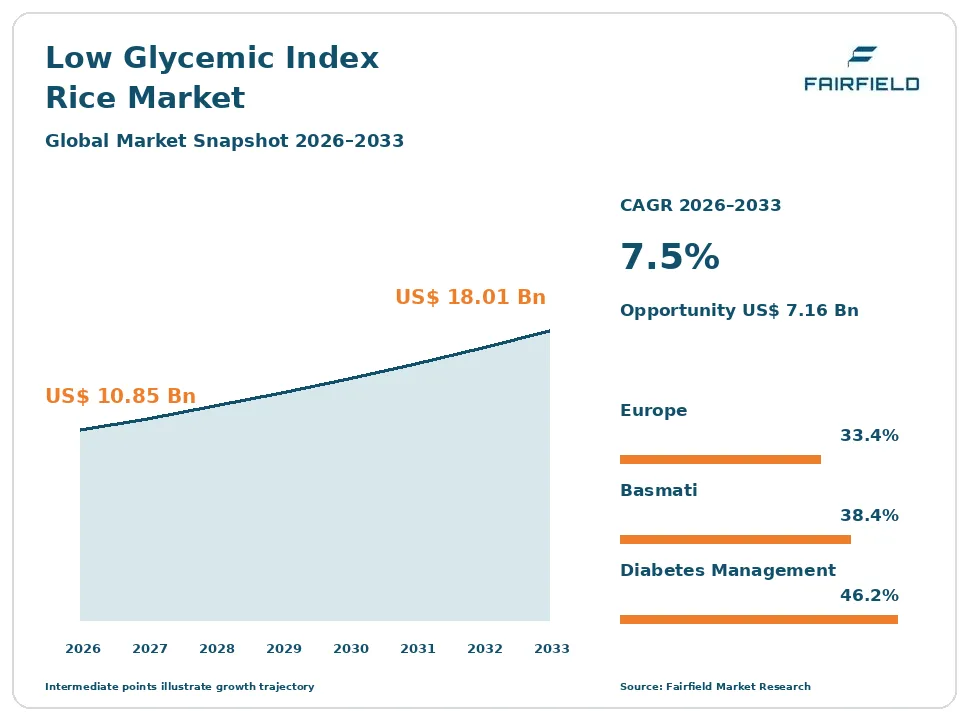
The global low glycemic index rice market size is expected to be valued at US$ 10.85 billion in 2026 and projected to reach US$ 18.01 billion by 2033, growing at a CAGR of 7.5% between 2026 and 2033.
Between 2020 and 2025, the market grew at a CAGR of about 6.4%, as rising diabetes rates and pandemic-era health awareness increased demand for diabetic-friendly foods, while rice export restrictions and price spikes in 2023 disrupted supply. Three factors now drive growth: the global rise in type 2 diabetes and obesity, consumer interest in healthier staple foods with lower glycemic load, and new rice varieties bred for higher amylose and resistant starch. The market is shifting from traditional basmati rice and brown rice toward certified low-GI branded products, parboiled rice, and new ultra-low-GI varieties sold through supermarkets and online channels.
Key Report Takeaways
- By Type: Basmati held 38.4% share in 2026, while Brown Rice is projected to expand at a 9.2% CAGR through 2033, driven by whole grain trends and higher fiber content.
- By Application: Diabetes Management held 46.2% share in 2026, while Weight Management is projected to expand at a 9.0% CAGR through 2033, driven by obesity concerns and interest in balanced, low-sugar diets.
- By Distribution Channel: Supermarkets & Hypermarkets held 44.8% share in 2026, while Online Retail is projected to expand at a 11.4% CAGR through 2033, driven by health-focused e-commerce and quick commerce in India.
- By Region: Europe held 33.4% share in 2026, while India is projected to expand at a 9.8% CAGR through 2033, driven by high diabetes prevalence and rising branded rice consumption.
Global Low Glycemic Index Rice Market Trends and Insights
Drivers Impact Analysis
Two drivers carry the strongest influence on low glycemic index rice demand during the forecast period.
| Driver | Impact on CAGR Forecast | Geographic Relevance | Impact Timeline |
| Rising diabetes and obesity prevalence | High | Asia Pacific, Middle East & Africa, North America | Long term (≥4 years) |
| Health-conscious consumption and new low-GI varieties | Medium | Europe, North America, Asia Pacific | Medium term (2-4 years) |
Rising Diabetes Prevalence Is Driving the Low Glycemic Index Rice Market
Rising diabetes and obesity prevalence is the strongest driver of the low glycemic index rice market. Rice is a staple food for billions of people, but most varieties raise blood sugar quickly.
The mechanism is medical advice and consumer behavior. The International Diabetes Federation estimates that more than 530 million adults live with diabetes, most of them in Asia Pacific. India and China have the largest numbers of people with diabetes, and rice is central to their diets. Doctors and dietitians advise patients to choose foods with a lower glycemic index and glycemic load to control blood sugar. Low-GI rice lets people keep eating a familiar staple while managing their health. The Middle East & Africa region also has high diabetes rates and high rice consumption. These trends support steady demand for diabetic-friendly foods such as low-GI rice.
Health-conscious Consumption and New Varieties Are Expanding the Low Glycemic Index Rice Market
Health-conscious consumption and new low-GI varieties are expanding the low glycemic index rice market. Consumers increasingly read labels and seek foods that support steady energy and weight control.
The cause is wellness trends and scientific progress. Consumers in Europe, North America, and Australia choose basmati rice, brown rice, and low-GI certified products as part of balanced diets. Certification programs such as the Glycemic Index Foundation’s low-GI symbol in Australia help shoppers identify products. Plant breeders are developing varieties with more amylose and resistant starch, which digest slowly. The International Rice Research Institute unveiled a rice line with a glycemic index as low as 25 in 2024, compared with about 70 for most varieties. Brands such as KRBL have launched low-GI rice under health-focused lines. These developments widen product choice and attract new consumers.
Restraints Impact Analysis
Two restraints limit how quickly the low glycemic index rice market grows.
| Restraint | Impact on CAGR Forecast | Geographic Relevance | Impact Timeline |
| Premium pricing and limited awareness | High | Asia Pacific, Latin America, Middle East & Africa | Short term (≤2 years) |
| Inconsistent GI testing and labeling rules | Medium | Global | Medium term (2-4 years) |
Premium Pricing and Limited Awareness Slow the Low Glycemic Index Rice Market
Premium pricing and limited awareness slow the low glycemic index rice market. Rice is a basic food, and many consumers buy the cheapest option.
The specific causes are higher production costs and consumer habits. Low-GI rice often costs more than regular white rice because of lower yields, special varieties, testing, and branding. In price-sensitive markets in Asia Pacific, Africa, and Latin America, many households cannot afford premium rice for daily meals. Many consumers do not understand the glycemic index or believe that all rice is unhealthy. Taste, texture, and cooking time preferences can make brown rice and new varieties less appealing. Rice export bans and price swings, such as India’s restrictions in 2023 and 2024, affect supply and prices. These factors limit adoption beyond health-conscious and higher-income buyers.
Inconsistent Testing and Labeling Restrict the Low Glycemic Index Rice Market
Inconsistent GI testing and labeling rules restrict the low glycemic index rice market. Consumers need trustworthy information to choose low-GI products.
The underlying causes are variable results and regulatory gaps. The glycemic index of rice changes with variety, growing conditions, processing, cooking method, and cooling, so the same product can test differently. Testing requires clinical studies with human volunteers, which are costly for small brands. Many countries lack official standards for low-GI labeling, allowing unverified claims. Some regulators restrict health claims on food packaging, limiting marketing. Confusing or exaggerated claims can reduce consumer trust. Low-GI rice also faces competition from other low-GI grains such as quinoa, millets, and cauliflower rice. These factors make it harder for brands to differentiate and build credibility with consumers and doctors.
Market Opportunities
Ultra-low GI Varieties and Functional Rice Products Open a Premium Revenue Pool
Ultra-low GI varieties and functional rice products open a premium revenue pool in the low glycemic index rice market. New science allows rice with much lower blood sugar impact.
Rice breeders, millers, and brands can capture this opportunity. The International Rice Research Institute’s ultra-low GI line, with high protein, is in field trials in the Philippines and planned for India. Rice enriched with resistant starch, fiber, or protein can serve diabetic and fitness consumers. Ready-to-eat low-GI rice pouches, rice blends with pulses and millets, and low-GI rice flour expand product ranges. Partnerships with hospitals, diabetes associations, and dietitians build strong credibility. Clinical testing and certification support premium pricing. Brands that combine taste with proven health benefits can win loyal, repeat customers.
India and Online Health Retail Create a Volume Revenue Pool
India and online health retail create a volume revenue pool in the low glycemic index rice market. India has one of the world’s largest diabetic populations and a huge rice market.
Indian brands and e-commerce platforms can capture this opportunity. KRBL, LT Foods, and other Indian companies sell basmati rice and low-GI products both at home and abroad. Online grocery and quick commerce platforms such as BigBasket, Blinkit, Zepto, and Amazon make specialty rice easy to find. Health apps and digital nutrition programs recommend low-GI foods. Rising incomes and urban lifestyles increase spending on health foods. Government programs such as the Indian Council of Agricultural Research’s breeding work support new varieties. Export markets in the Middle East & Africa region add demand. These factors make India a growth engine.
Segment Analysis
By Type: Basmati Leads While Brown Rice Grows Fastest
Basmati held 38.4% share in 2026. Basmati rice naturally has a lower to medium glycemic index than many white rice varieties, thanks to higher amylose content. India and Pakistan produce most of the world’s basmati, which is popular in Europe, the Middle East & Africa region, and North America. Tilda, KRBL, and LT Foods are leading brands.
Brown Rice is the fastest-growing type, expanding at a 9.2% CAGR through 2033. Brown rice keeps its bran layer, providing more fiber, vitamins, and minerals, and digests more slowly than white rice. Whole grain trends and dietary guidelines support demand. Brands offer quick-cooking and ready-to-eat brown rice to address longer cooking times. Parboiled rice, red and black rice, and specialty low-GI varieties form other types. For the market, brown rice growth reflects whole grain health trends.
By Application: Diabetes Management Leads While Weight Management Grows Fastest
Diabetes Management held 46.2% share in 2026. People with diabetes and prediabetes choose low-GI rice to help control blood sugar after meals. Doctors, dietitians, and diabetes associations recommend lower-GI staples. Hospitals and diabetes care programs also buy low-GI rice for patient meals.
Weight Management is the fastest-growing application, expanding at a 9.0% CAGR through 2033. Low-GI foods may help people feel full longer and avoid energy crashes, supporting weight control. Fitness enthusiasts, athletes, and people following balanced diets choose low-GI and high-fiber rice. Interest in metabolic health is rising with the use of weight-loss drugs and continuous glucose monitors. General wellness forms another application. For the market, weight management growth broadens demand beyond diabetic consumers.
By Distribution Channel: Supermarkets & Hypermarkets Lead While Online Retail Grows Fastest
Supermarkets & Hypermarkets held 44.8% share in 2026. Large retailers offer wide selections of branded basmati rice, brown rice, and low-GI products, with clear labels and promotions. Store brands also include healthier rice options. Tesco, Walmart, Coles, and Reliance Retail are major sellers.
Online Retail is the fastest-growing channel, expanding at a 11.4% CAGR through 2033. E-commerce and quick commerce platforms let consumers find specialty health foods easily and compare products and reviews. Subscription models and health-focused online stores serve diabetic consumers. Social media and influencers promote low-GI diets. Specialty health stores and pharmacies form other channels for diabetic consumers. For the market, online growth expands access in smaller cities.
Geography Analysis
North America Advances the Low Glycemic Index Rice Market Through Health Trends
North America is an important low glycemic index rice market driven by health trends and a large diabetic population. The United States has more than 38 million people with diabetes, and many consumers follow low-carbohydrate or low-GI diets. Basmati rice, brown rice, and ready-to-eat health rice are popular in supermarkets. Brands such as Lundberg Family Farms and Mahatma offer whole grain rice. Growing South Asian and Middle Eastern communities increase basmati demand. Canada has similar health trends. Health-focused retailers such as Whole Foods Market promote whole grain options. One change shaping the region is interest in metabolic health.
Which Region Is Leading the Low Glycemic Index Rice Market?
Europe is leading the low glycemic index rice market with a 33.4% share in 2026. The United Kingdom, Germany, France, the Netherlands, and Italy have strong demand for basmati rice and healthy staples. Tilda, owned by Ebro Foods, is a leading brand in the United Kingdom, and Ebro Foods in Spain is a major rice company. European consumers are highly health-conscious and read nutrition labels. European Union rules on pesticide residues affect basmati imports. Large South Asian communities in the United Kingdom support demand. One change shaping the region is growth in brown and wholegrain rice.
Asia Pacific Drives the Low Glycemic Index Rice Market Through India
Asia Pacific is a fast-growing low glycemic index rice market. China has the world’s largest diabetic population and large rice consumption, and researchers are developing low-GI varieties. Australia has a well-known low-GI certification program, and SunRice sells low-GI rice. The Philippines hosts the International Rice Research Institute. Japan and South Korea have health-conscious consumers who buy functional rice and rice with added fiber. Indonesia, Vietnam, Thailand, and Bangladesh eat large amounts of rice and face rising diabetes rates. India is growing fastest, as detailed below. One change shaping the region is new variety development by public research institutes.
Which Country Is Growing Fastest in the Low Glycemic Index Rice Market?
India is growing fastest in the low glycemic index rice market at a 9.8% CAGR through 2033. The country has more than 100 million people with diabetes and is the world’s largest rice exporter. KRBL expanded its health-focused Uplife rice line with a low-GI variant in February 2026, and LT Foods sells Daawat health rice. Online grocery growth increases access in cities, and doctors increasingly recommend diet changes to patients. The Indian Council of Agricultural Research has released rice varieties with better nutrition. Price sensitivity remains a challenge, as many households buy loose rice. One opportunity is affordable low-GI rice for middle-income families.
Latin America Grows the Low Glycemic Index Rice Market Through Health Awareness
Latin America is a growing low glycemic index rice market. Brazil, Mexico, and Colombia have high rice consumption and rising diabetes and obesity rates. Brown and parboiled rice are widely available in supermarkets, and Brazil has a strong tradition of parboiled rice. Health ministries promote reduced sugar and refined carbohydrate intake, and front-of-pack warning labels in Mexico, Chile, and Colombia push consumers toward healthier foods. Local producers such as Camil Alimentos in Brazil offer whole grain products. Key barriers include price sensitivity, low awareness of the glycemic index, and strong preference for white rice. One opportunity is parboiled and whole grain rice.
Middle East & Africa Builds the Low Glycemic Index Rice Market Through Basmati Demand
Middle East & Africa is an important low glycemic index rice market with high diabetes rates. Saudi Arabia, the United Arab Emirates, and Kuwait consume large amounts of basmati rice. Kuwait, Saudi Arabia, and Qatar have some of the world’s highest diabetes rates, and governments run awareness campaigns. Most basmati is imported from India and Pakistan. Egypt and Nigeria have large and growing rice markets, and South Africa has rising diabetes rates. Supermarket chains in the United Arab Emirates offer wide ranges of premium rice. Key barriers include price sensitivity in Africa and limited labeling rules. One opportunity is diabetic-friendly basmati brands.
Competitive Landscape
The low glycemic index rice market is fragmented. LT Foods, KRBL, Tilda, SunRice, and Sugar Watchers are notable players with strong brands, while Ebro Foods, Chaman Lal Setia Exports, Lundberg Family Farms, Mahatma, and many regional millers compete.
Companies compete on taste, grain quality, verified GI claims, brand trust, price, packaging, and distribution reach across modern and traditional retail. Clinical GI testing and certification help brands stand out. Large rice companies have advantages in sourcing, milling, packaging, and distribution, while smaller brands such as Sugar Watchers focus on specialty low-GI products and online sales. Exporters from India and Pakistan supply basmati to retailers worldwide, including supermarket private labels in Europe and Saudi Arabia. Research partnerships with universities and breeding institutes help companies access new varieties. Marketing through doctors, dietitians, and digital health platforms is increasingly important.
Strategic moves show how competition is changing in this market. In September 2024, the International Rice Research Institute unveiled an ultra-low GI rice line. In July 2025, LT Foods partnered with the Sustainable Rice Platform on climate-smart cultivation. In February 2026, KRBL launched a low-GI variant in its Uplife line. These moves show competition shifting toward health branding, sustainable sourcing, and science-based product claims.
Three themes shape vendor strategy. First, companies are launching health-focused lines. Second, they are investing in clinical GI testing and certification. Third, they are expanding online sales and direct-to-consumer channels.
Low Glycemic Index Rice Market Industry Leaders
LT Foods (Daawat) KRBL (India Gate) Tilda (Ebro Foods) SunRice (Ricegrowers) Sugar Watchers
Recent Industry Developments
- February 2026: KRBL expanded its health-focused Uplife rice line with a low glycemic index variant - targets diabetic and health-conscious consumers.
- July 2025: LT Foods partnered with the Sustainable Rice Platform on climate-smart rice cultivation - strengthens sustainable sourcing for premium rice.
- September 2024: The International Rice Research Institute unveiled a rice line with a glycemic index as low as 25 - moves toward commercial ultra-low GI rice.
Companies Covered in the Report
- LT Foods (Daawat)
- KRBL (India Gate)
- Tilda (Ebro Foods)
- SunRice (Ricegrowers)
- Sugar Watchers
- Ebro Foods
- Chaman Lal Setia Exports
- Lundberg Family Farms
- Mahatma (Riviana Foods)
- Siam Lotus
- The Little Rice Company
- Parish Rice
Low Glycemic Index Rice Market Report Scope
This report covers low glycemic index rice, including basmati, brown, parboiled, red and black, and specialty low-GI varieties, sold as raw, parboiled, and ready-to-eat products, for diabetes management, weight management, and general wellness, through supermarkets and hypermarkets, online retail, specialty stores, and pharmacies. It excludes rice-based snacks and rice flour. The base year is 2025, and the forecast period runs from 2026 to 2033. All values are expressed in US$ Billion.
Type
- Basmati
- Brown Rice
- Parboiled Rice
- Red & Black Rice
- Specialty Low-GI Varieties
Application
- Diabetes Management
- Weight Management
- General Wellness
Distribution Channel
- Supermarkets & Hypermarkets
- Online Retail
- Specialty & Health Stores
- Pharmacies
Regions
- North America
- Europe
- Asia Pacific
- Latin America
- Middle East & Africa
Key Questions Answered in the Report
How big is the low glycemic index rice market in 2026?
The low glycemic index rice market is valued at US$ 10.85 billion in 2026, led by basmati rice for diabetes management.
What is the low glycemic index rice market forecast to 2033?
The market is projected to reach US$ 18.01 billion by 2033, growing at a 7.5% CAGR and adding US$ 7.16 billion.
Which type of low glycemic index rice is growing fastest?
Brown Rice is growing fastest at a 9.2% CAGR through 2033, driven by whole grain trends and higher fiber content.
Which country is growing fastest in the low glycemic index rice market?
India is growing fastest at a 9.8% CAGR through 2033, driven by high diabetes prevalence and rising branded rice consumption.
Which region holds the largest low glycemic index rice market share?
Europe holds the largest share at 33.4% in 2026, supported by strong basmati demand in the United Kingdom and Germany.
1. Executive Summary
1.1. Global Low Glycemic Index Rice Market Snapshot
1.2. Future Projections
1.3. Key Report Takeaways
1.4. Regional Snapshot
2. Market Overview
2.1. Market Definition and Report Scope
2.2. Historical Trends 2020–2025
2.3. Market Dynamics
2.3.1. Drivers
2.3.1.1. Rising Diabetes Prevalence Is Driving the Low Glycemic Index Rice Market
2.3.1.2. Health-conscious Consumption and New Varieties Are Expanding the Low Glycemic Index Rice Market
2.3.2. Restraints
2.3.2.1. Premium Pricing and Limited Awareness Slow the Low Glycemic Index Rice Market
2.3.2.2. Inconsistent Testing and Labeling Restrict the Low Glycemic Index Rice Market
2.3.3. Market Opportunities
2.3.3.1. Ultra-low GI Varieties and Functional Rice Products Open a Premium Revenue Pool
2.3.3.2. India and Online Health Retail Create a Volume Revenue Pool
3. Global Low Glycemic Index Rice Market Outlook, 2020-2033
3.1. Global Low Glycemic Index Rice Market Outlook, by Type, Value (US$ Billion), 2020-2033
3.1.1. Basmati
3.1.2. Brown Rice
3.1.3. Parboiled Rice
3.1.4. Red & Black Rice
3.1.5. Specialty Low-GI Varieties
3.2. Global Low Glycemic Index Rice Market Outlook, by Application, Value (US$ Billion), 2020-2033
3.2.1. Diabetes Management
3.2.2. Weight Management
3.2.3. General Wellness
3.3. Global Low Glycemic Index Rice Market Outlook, by Distribution Channel, Value (US$ Billion), 2020-2033
3.3.1. Supermarkets & Hypermarkets
3.3.2. Online Retail
3.3.3. Specialty & Health Stores
3.3.4. Pharmacies
3.4. Global Low Glycemic Index Rice Market Outlook, by Region, Value (US$ Billion), 2020-2033
3.4.1. North America
3.4.2. Europe
3.4.3. Asia Pacific
3.4.4. Latin America
3.4.5. Middle East & Africa
4. North America Low Glycemic Index Rice Market Outlook, 2020-2033
4.1. North America Low Glycemic Index Rice Market Outlook, by Type, Value (US$ Billion), 2020-2033
4.1.1. Basmati
4.1.2. Brown Rice
4.1.3. Parboiled Rice
4.1.4. Red & Black Rice
4.1.5. Specialty Low-GI Varieties
4.2. North America Low Glycemic Index Rice Market Outlook, by Application, Value (US$ Billion), 2020-2033
4.2.1. Diabetes Management
4.2.2. Weight Management
4.2.3. General Wellness
4.3. North America Low Glycemic Index Rice Market Outlook, by Distribution Channel, Value (US$ Billion), 2020-2033
4.3.1. Supermarkets & Hypermarkets
4.3.2. Online Retail
4.3.3. Specialty & Health Stores
4.3.4. Pharmacies
4.4. North America Low Glycemic Index Rice Market Outlook, by Country, Value (US$ Billion), 2020-2033
4.4.1. United States Low Glycemic Index Rice Market Outlook, by Type, 2020-2033
4.4.2. United States Low Glycemic Index Rice Market Outlook, by Application, 2020-2033
4.4.3. United States Low Glycemic Index Rice Market Outlook, by Distribution Channel, 2020-2033
4.4.4. Canada Low Glycemic Index Rice Market Outlook, by Type, 2020-2033
4.4.5. Canada Low Glycemic Index Rice Market Outlook, by Application, 2020-2033
4.4.6. Canada Low Glycemic Index Rice Market Outlook, by Distribution Channel, 2020-2033
5. Europe Low Glycemic Index Rice Market Outlook, 2020-2033
5.1. Europe Low Glycemic Index Rice Market Outlook, by Type, Value (US$ Billion), 2020-2033
5.1.1. Basmati
5.1.2. Brown Rice
5.1.3. Parboiled Rice
5.1.4. Red & Black Rice
5.1.5. Specialty Low-GI Varieties
5.2. Europe Low Glycemic Index Rice Market Outlook, by Application, Value (US$ Billion), 2020-2033
5.2.1. Diabetes Management
5.2.2. Weight Management
5.2.3. General Wellness
5.3. Europe Low Glycemic Index Rice Market Outlook, by Distribution Channel, Value (US$ Billion), 2020-2033
5.3.1. Supermarkets & Hypermarkets
5.3.2. Online Retail
5.3.3. Specialty & Health Stores
5.3.4. Pharmacies
5.4. Europe Low Glycemic Index Rice Market Outlook, by Country, Value (US$ Billion), 2020-2033
5.4.1. United Kingdom Low Glycemic Index Rice Market Outlook, by Type, 2020-2033
5.4.2. United Kingdom Low Glycemic Index Rice Market Outlook, by Application, 2020-2033
5.4.3. United Kingdom Low Glycemic Index Rice Market Outlook, by Distribution Channel, 2020-2033
5.4.4. Germany Low Glycemic Index Rice Market Outlook, by Type, 2020-2033
5.4.5. Germany Low Glycemic Index Rice Market Outlook, by Application, 2020-2033
5.4.6. Germany Low Glycemic Index Rice Market Outlook, by Distribution Channel, 2020-2033
5.4.7. France Low Glycemic Index Rice Market Outlook, by Type, 2020-2033
5.4.8. France Low Glycemic Index Rice Market Outlook, by Application, 2020-2033
5.4.9. France Low Glycemic Index Rice Market Outlook, by Distribution Channel, 2020-2033
5.4.10. Netherlands Low Glycemic Index Rice Market Outlook, by Type, 2020-2033
5.4.11. Netherlands Low Glycemic Index Rice Market Outlook, by Application, 2020-2033
5.4.12. Netherlands Low Glycemic Index Rice Market Outlook, by Distribution Channel, 2020-2033
5.4.13. Italy Low Glycemic Index Rice Market Outlook, by Type, 2020-2033
5.4.14. Italy Low Glycemic Index Rice Market Outlook, by Application, 2020-2033
5.4.15. Italy Low Glycemic Index Rice Market Outlook, by Distribution Channel, 2020-2033
5.4.16. Spain Low Glycemic Index Rice Market Outlook, by Type, 2020-2033
5.4.17. Spain Low Glycemic Index Rice Market Outlook, by Application, 2020-2033
5.4.18. Spain Low Glycemic Index Rice Market Outlook, by Distribution Channel, 2020-2033
6. Asia Pacific Low Glycemic Index Rice Market Outlook, 2020-2033
6.1. Asia Pacific Low Glycemic Index Rice Market Outlook, by Type, Value (US$ Billion), 2020-2033
6.1.1. Basmati
6.1.2. Brown Rice
6.1.3. Parboiled Rice
6.1.4. Red & Black Rice
6.1.5. Specialty Low-GI Varieties
6.2. Asia Pacific Low Glycemic Index Rice Market Outlook, by Application, Value (US$ Billion), 2020-2033
6.2.1. Diabetes Management
6.2.2. Weight Management
6.2.3. General Wellness
6.3. Asia Pacific Low Glycemic Index Rice Market Outlook, by Distribution Channel, Value (US$ Billion), 2020-2033
6.3.1. Supermarkets & Hypermarkets
6.3.2. Online Retail
6.3.3. Specialty & Health Stores
6.3.4. Pharmacies
6.4. Asia Pacific Low Glycemic Index Rice Market Outlook, by Country, Value (US$ Billion), 2020-2033
6.4.1. China Low Glycemic Index Rice Market Outlook, by Type, 2020-2033
6.4.2. China Low Glycemic Index Rice Market Outlook, by Application, 2020-2033
6.4.3. China Low Glycemic Index Rice Market Outlook, by Distribution Channel, 2020-2033
6.4.4. Australia Low Glycemic Index Rice Market Outlook, by Type, 2020-2033
6.4.5. Australia Low Glycemic Index Rice Market Outlook, by Application, 2020-2033
6.4.6. Australia Low Glycemic Index Rice Market Outlook, by Distribution Channel, 2020-2033
6.4.7. Philippines Low Glycemic Index Rice Market Outlook, by Type, 2020-2033
6.4.8. Philippines Low Glycemic Index Rice Market Outlook, by Application, 2020-2033
6.4.9. Philippines Low Glycemic Index Rice Market Outlook, by Distribution Channel, 2020-2033
6.4.10. Japan Low Glycemic Index Rice Market Outlook, by Type, 2020-2033
6.4.11. Japan Low Glycemic Index Rice Market Outlook, by Application, 2020-2033
6.4.12. Japan Low Glycemic Index Rice Market Outlook, by Distribution Channel, 2020-2033
6.4.13. South Korea Low Glycemic Index Rice Market Outlook, by Type, 2020-2033
6.4.14. South Korea Low Glycemic Index Rice Market Outlook, by Application, 2020-2033
6.4.15. South Korea Low Glycemic Index Rice Market Outlook, by Distribution Channel, 2020-2033
6.4.16. Indonesia Low Glycemic Index Rice Market Outlook, by Type, 2020-2033
6.4.17. Indonesia Low Glycemic Index Rice Market Outlook, by Application, 2020-2033
6.4.18. Indonesia Low Glycemic Index Rice Market Outlook, by Distribution Channel, 2020-2033
6.4.19. Vietnam Low Glycemic Index Rice Market Outlook, by Type, 2020-2033
6.4.20. Vietnam Low Glycemic Index Rice Market Outlook, by Application, 2020-2033
6.4.21. Vietnam Low Glycemic Index Rice Market Outlook, by Distribution Channel, 2020-2033
6.4.22. Thailand Low Glycemic Index Rice Market Outlook, by Type, 2020-2033
6.4.23. Thailand Low Glycemic Index Rice Market Outlook, by Application, 2020-2033
6.4.24. Thailand Low Glycemic Index Rice Market Outlook, by Distribution Channel, 2020-2033
6.4.25. Bangladesh Low Glycemic Index Rice Market Outlook, by Type, 2020-2033
6.4.26. Bangladesh Low Glycemic Index Rice Market Outlook, by Application, 2020-2033
6.4.27. Bangladesh Low Glycemic Index Rice Market Outlook, by Distribution Channel, 2020-2033
6.4.28. India Low Glycemic Index Rice Market Outlook, by Type, 2020-2033
6.4.29. India Low Glycemic Index Rice Market Outlook, by Application, 2020-2033
6.4.30. India Low Glycemic Index Rice Market Outlook, by Distribution Channel, 2020-2033
7. Latin America Low Glycemic Index Rice Market Outlook, 2020-2033
7.1. Latin America Low Glycemic Index Rice Market Outlook, by Type, Value (US$ Billion), 2020-2033
7.1.1. Basmati
7.1.2. Brown Rice
7.1.3. Parboiled Rice
7.1.4. Red & Black Rice
7.1.5. Specialty Low-GI Varieties
7.2. Latin America Low Glycemic Index Rice Market Outlook, by Application, Value (US$ Billion), 2020-2033
7.2.1. Diabetes Management
7.2.2. Weight Management
7.2.3. General Wellness
7.3. Latin America Low Glycemic Index Rice Market Outlook, by Distribution Channel, Value (US$ Billion), 2020-2033
7.3.1. Supermarkets & Hypermarkets
7.3.2. Online Retail
7.3.3. Specialty & Health Stores
7.3.4. Pharmacies
7.4. Latin America Low Glycemic Index Rice Market Outlook, by Country, Value (US$ Billion), 2020-2033
7.4.1. Brazil Low Glycemic Index Rice Market Outlook, by Type, 2020-2033
7.4.2. Brazil Low Glycemic Index Rice Market Outlook, by Application, 2020-2033
7.4.3. Brazil Low Glycemic Index Rice Market Outlook, by Distribution Channel, 2020-2033
7.4.4. Mexico Low Glycemic Index Rice Market Outlook, by Type, 2020-2033
7.4.5. Mexico Low Glycemic Index Rice Market Outlook, by Application, 2020-2033
7.4.6. Mexico Low Glycemic Index Rice Market Outlook, by Distribution Channel, 2020-2033
7.4.7. Colombia Low Glycemic Index Rice Market Outlook, by Type, 2020-2033
7.4.8. Colombia Low Glycemic Index Rice Market Outlook, by Application, 2020-2033
7.4.9. Colombia Low Glycemic Index Rice Market Outlook, by Distribution Channel, 2020-2033
7.4.10. Chile Low Glycemic Index Rice Market Outlook, by Type, 2020-2033
7.4.11. Chile Low Glycemic Index Rice Market Outlook, by Application, 2020-2033
7.4.12. Chile Low Glycemic Index Rice Market Outlook, by Distribution Channel, 2020-2033
8. Middle East & Africa Low Glycemic Index Rice Market Outlook, 2020-2033
8.1. Middle East & Africa Low Glycemic Index Rice Market Outlook, by Type, Value (US$ Billion), 2020-2033
8.1.1. Basmati
8.1.2. Brown Rice
8.1.3. Parboiled Rice
8.1.4. Red & Black Rice
8.1.5. Specialty Low-GI Varieties
8.2. Middle East & Africa Low Glycemic Index Rice Market Outlook, by Application, Value (US$ Billion), 2020-2033
8.2.1. Diabetes Management
8.2.2. Weight Management
8.2.3. General Wellness
8.3. Middle East & Africa Low Glycemic Index Rice Market Outlook, by Distribution Channel, Value (US$ Billion), 2020-2033
8.3.1. Supermarkets & Hypermarkets
8.3.2. Online Retail
8.3.3. Specialty & Health Stores
8.3.4. Pharmacies
8.4. Middle East & Africa Low Glycemic Index Rice Market Outlook, by Country, Value (US$ Billion), 2020-2033
8.4.1. Saudi Arabia Low Glycemic Index Rice Market Outlook, by Type, 2020-2033
8.4.2. Saudi Arabia Low Glycemic Index Rice Market Outlook, by Application, 2020-2033
8.4.3. Saudi Arabia Low Glycemic Index Rice Market Outlook, by Distribution Channel, 2020-2033
8.4.4. United Arab Emirates Low Glycemic Index Rice Market Outlook, by Type, 2020-2033
8.4.5. United Arab Emirates Low Glycemic Index Rice Market Outlook, by Application, 2020-2033
8.4.6. United Arab Emirates Low Glycemic Index Rice Market Outlook, by Distribution Channel, 2020-2033
8.4.7. Kuwait Low Glycemic Index Rice Market Outlook, by Type, 2020-2033
8.4.8. Kuwait Low Glycemic Index Rice Market Outlook, by Application, 2020-2033
8.4.9. Kuwait Low Glycemic Index Rice Market Outlook, by Distribution Channel, 2020-2033
8.4.10. Qatar Low Glycemic Index Rice Market Outlook, by Type, 2020-2033
8.4.11. Qatar Low Glycemic Index Rice Market Outlook, by Application, 2020-2033
8.4.12. Qatar Low Glycemic Index Rice Market Outlook, by Distribution Channel, 2020-2033
8.4.13. Egypt Low Glycemic Index Rice Market Outlook, by Type, 2020-2033
8.4.14. Egypt Low Glycemic Index Rice Market Outlook, by Application, 2020-2033
8.4.15. Egypt Low Glycemic Index Rice Market Outlook, by Distribution Channel, 2020-2033
8.4.16. Nigeria Low Glycemic Index Rice Market Outlook, by Type, 2020-2033
8.4.17. Nigeria Low Glycemic Index Rice Market Outlook, by Application, 2020-2033
8.4.18. Nigeria Low Glycemic Index Rice Market Outlook, by Distribution Channel, 2020-2033
8.4.19. South Africa Low Glycemic Index Rice Market Outlook, by Type, 2020-2033
8.4.20. South Africa Low Glycemic Index Rice Market Outlook, by Application, 2020-2033
8.4.21. South Africa Low Glycemic Index Rice Market Outlook, by Distribution Channel, 2020-2033
9. Competitive Landscape
9.1. Market Concentration and Industry Leaders
9.2. Competitive Differentiation
9.3. Strategic Moves and Market Direction
9.4. Recent Industry Developments
9.5. Company Profiles
9.5.1. LT Foods (Daawat)
9.5.2. KRBL (India Gate)
9.5.3. Tilda (Ebro Foods)
9.5.4. SunRice (Ricegrowers)
9.5.5. Sugar Watchers
9.5.6. Ebro Foods
9.5.7. Chaman Lal Setia Exports
9.5.8. Lundberg Family Farms
9.5.9. Mahatma (Riviana Foods)
9.5.10. Siam Lotus
9.5.11. The Little Rice Company
9.5.12. Parish Rice
10. Appendix
10.1. Research Methodology
10.2. Report Assumptions
10.3. Acronyms and Abbreviations
| Type | Basmati, Brown Rice, Parboiled Rice, Red & Black Rice, Specialty Low-GI Varieties |
| Application | Diabetes Management, Weight Management, General Wellness |
| Distribution Channel | Supermarkets & Hypermarkets, Online Retail, Specialty & Health Stores, Pharmacies |
| Regions | North America, Europe, Asia Pacific, Latin America, Middle East & Africa |
Our Research Methodology
Considering the volatility of business today, traditional approaches to strategizing a game plan can be unfruitful if not detrimental. True ambiguity is no way to determine a forecast. A myriad of predetermined factors must be accounted for such as the degree of risk involved, the magnitude of circumstances, as well as conditions or consequences that are not known or unpredictable. To circumvent binary views that cast uncertainty, the application of market research intelligence to strategically posture, move, and enable actionable outcomes is necessary.
View Methodology
Quality Assured
Rigorous Validation Process

Confidentiality Assured
End-to-end Data Security

Custom Research Services
Tailored To Your Objectives
FAQs
The low glycemic index rice market is valued at US$ 10.85 billion in 2026, led by basmati rice for diabetes management.
The market is projected to reach US$ 18.01 billion by 2033, growing at a 7.5% CAGR and adding US$ 7.16 billion.
Brown Rice is growing fastest at a 9.2% CAGR through 2033, driven by whole grain trends and higher fiber content.
India is growing fastest at a 9.8% CAGR through 2033, driven by high diabetes prevalence and rising branded rice consumption.
Europe holds the largest share at 33.4% in 2026, supported by strong basmati demand in the United Kingdom and Germany.
Related Reports
Oat Milk Market Size, Share, Insights, Competitive Landscape, and Forecast 2026 to 2033
Oat milk market to reach US$ 13.72 billion by 2033 at a 16.8% CAGR. Explore product types, organic demand, distribution channels and regional trends.
Yeast Ingredient Market Size, Share, Insights, Competitive Landscape, and Forecast 2026 to 2033
Explore the yeast ingredient market, reaching US$ 16.5 billion by 2033 at 6.2% CAGR, with product, application and regional insights.
Vegan Yoghurt Market Size, Share, Insights, Competitive Landscape, and Forecast 2026 to 2033
Explore the vegan yoghurt market, reaching US$ 6.0 billion by 2033 at 6.3% CAGR, with base types, formats, distribution and regional insights.
Sourdough Market Size, Share, Insights, Competitive Landscape, and Forecast 2026 to 2033
Explore the sourdough market, reaching US$ 10.2 billion by 2033 at 6.9% CAGR, with product, fermentation, distribution and regional insights.
Phytogenic Feed Additives Market Size, Share, Insights, Competitive Landscape, and Forecast 2026 to 2033
Explore the phytogenic feed additives market, reaching US$ 2.7 billion by 2033 at 9.8% CAGR, with type, livestock and regional insights.
Malt Extracts And Ingredients Market Size, Share, Insights, Competitive Landscape, and Forecast 2026 to 2033
Explore the malt extracts and ingredients market, reaching US$ 6.7 billion by 2033 at 5.5% CAGR, with product, source and regional insights.