



Oat Milk Market
Oat Milk Market Size, Share, Insights, Competitive Landscape, and Forecast 2026 to 2033
Oat Milk Market Analysis, 2026–2033
Oat Milk Market
Oat Milk Market Size, Share, Insights, Competitive Landscape, and Forecast 2026 to 2033
Oat Milk Market Size and Trend Analysis
How Fast Is the Oat Milk Market Growing?
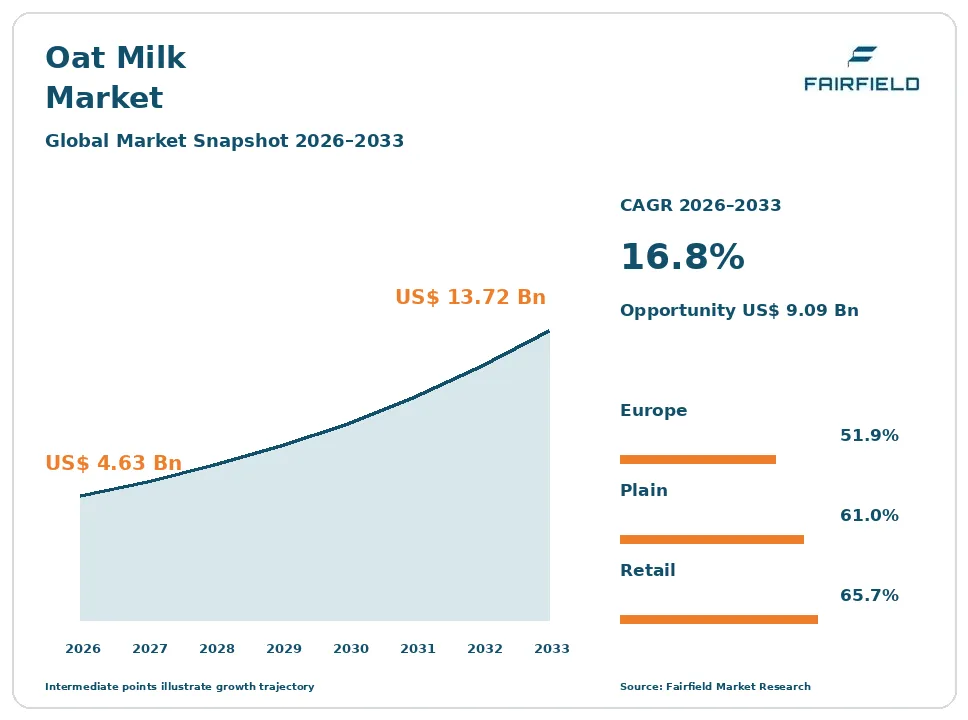
The global oat milk market size is expected to be valued at US$ 4.63 billion in 2026 and projected to reach US$ 13.72 billion by 2033, growing at a CAGR of 16.8% between 2026 and 2033.
Between 2020 and 2025, the market grew at a CAGR of about 13.5%, rising fast during the pandemic as home coffee making boomed, then slowing in 2023 and 2024 when inflation pushed some shoppers back to cheaper dairy milk. Three factors now drive growth: the shift toward plant-based milk for health, ethical, and climate reasons, rising lactose intolerance awareness, and strong demand for barista oat milk in cafés and coffee chains. The market is shifting toward fortified oat milk with added calcium, vitamins, protein, and fiber, along with ready-to-drink coffees, cold foam, and lower-sugar formats. Oat milk has become the leading dairy alternatives choice in many coffee shops because it steams well and has a neutral, creamy taste.
Key Report Takeaways
- By Product Type: Plain held 61.0% share in 2026, while Flavored is projected to expand at an 18.4% CAGR through 2033, driven by vanilla, chocolate, coffee, and seasonal flavors for younger consumers.
- By Nature: Conventional held 72.6% share in 2026, while Organic is projected to expand at a 17.7% CAGR through 2033, driven by clean-label demand and premium pricing in Europe and North America.
- By Distribution Channel: Retail held 65.7% share in 2026, while Food Service is projected to expand at an 18.1% CAGR through 2033, driven by café and coffee chain adoption of barista oat milk.
- By Region: Europe held 51.9% share in 2026, while Asia Pacific is projected to expand at a 19.6% CAGR through 2033, driven by coffee culture and lactose intolerance in China, Japan, and South Korea.
Global Oat Milk Market Trends and Insights
Drivers Impact Analysis
Two drivers carry the strongest influence on oat milk demand during the forecast period.
| Driver | Impact on CAGR Forecast | Geographic Relevance | Impact Timeline |
| Shift to plant-based diets and lactose intolerance | High | Europe, North America, Asia Pacific | Long term (≥4 years) |
| Coffee shop and barista demand | High | Europe, Asia Pacific, North America | Medium term (2-4 years) |
Plant-Based Diets Are Driving the Oat Milk Market
The shift toward plant-based milk and rising lactose intolerance awareness are the strongest driver of the oat milk market. Consumers want milk alternatives that suit their health, values, and taste.
The mechanism is changing diets and better awareness of food sensitivities. About 65% of the world’s adults have reduced ability to digest lactose, with rates highest in Asia Pacific, Middle East & Africa, and Latin America. Flexitarian, vegan, and vegetarian diets are growing in Europe and North America, especially among younger consumers. Oat milk has a lower climate footprint than dairy milk, using less land and water and producing fewer emissions. It is free from common allergens such as nuts and soy, giving it an advantage over almond and soy milk. Oats provide beta-glucan fiber linked to heart health. These factors keep pulling consumers toward oat-based dairy alternatives.
Coffee Culture Is Expanding the Oat Milk Market
Coffee shop and café demand is expanding the oat milk market. Barista oat milk has become a standard option in many coffee chains.
The cause is the growth of specialty coffee and plant-based menus. Oat milk foams and steams well, has a mild sweet taste, and does not curdle in hot coffee, making it popular with baristas. Starbucks, Costa Coffee, Pret A Manger, and many independent cafés offer oat milk, and some chains have removed surcharges for plant-based milk. Oatly launched Baristamatic for automated coffee machines in 2025 and Barista Cold Foam in 2026. Coffee consumption is rising fast in China, South Korea, and India, where chains such as Luckin Coffee use oat milk in popular drinks. Iced coffees and ready-to-drink lattes extend demand to retail. These trends support strong food service and retail growth.
Restraints Impact Analysis
Two restraints limit how quickly the oat milk market grows.
| Restraint | Impact on CAGR Forecast | Geographic Relevance | Impact Timeline |
| Higher prices than dairy milk | High | Global | Short term (≤2 years) |
| Nutrition and processing concerns | Medium | North America, Europe | Medium term (2-4 years) |
Price Premiums Slow the Oat Milk Market
Higher prices than dairy milk slow the oat milk market. Oat milk often costs two to three times as much per liter as cow’s milk.
The specific causes are production costs, scale, and price sensitivity. Oat milk needs enzymatic processing, added oils, fortification, and aseptic packaging, which raise costs. Dairy milk benefits from large scale and, in many countries, farm subsidies. High inflation in 2022 to 2024 pushed many shoppers to switch back to cheaper dairy or private-label products. Some coffee chains still charge extra for plant-based milk. Leading brands have struggled with profitability, and Oatly only reached positive adjusted earnings in 2025. Private-label oat milk from retailers lowers prices but squeezes brand margins. Retailers in Germany and the United Kingdom have also cut prices on own-brand dairy, widening the gap. These factors slow volume growth among price-conscious consumers.
Nutrition Concerns Restrict the Oat Milk Market
Nutrition and processing concerns restrict the oat milk market. Some consumers question whether oat milk is as healthy as dairy milk.
The underlying causes are lower protein content, natural sugars, and debates about processing. Oat milk usually has about 1 to 3 grams of protein per cup, compared with about 8 grams in cow’s milk. Enzymatic processing breaks oat starch into maltose, which raises the glycemic index, concerning people managing blood sugar. Added rapeseed or sunflower oils and stabilizers attract criticism on social media. Some consumers prefer whole foods and avoid ultra-processed products. Labeling disputes, such as the UK Supreme Court ruling in 2026 on Oatly’s “Post Milk Generation” trademark, add marketing challenges. Some dietitians recommend dairy or soy milk for children because of higher protein. These concerns slow adoption among health-focused consumers and parents.
Market Opportunities
Functional and Fortified Oat Milk Open a Premium Revenue Pool
Functional and fortified oat milk opens a premium revenue pool in the oat milk market. Consumers want drinks that offer more than basic nutrition.
Brands that add protein, fiber, and vitamins can capture this opportunity. High-protein oat milk blends with pea or fava protein address the protein gap with dairy. Oatly launched fiber-enriched barista and low-calorie drinks in the United Kingdom in 2026. Calcium, vitamin D, vitamin B12, and iodine fortification makes oat milk a better dairy substitute. Lower-sugar and unsweetened versions attract health-focused shoppers. Gut health positioning using beta-glucan and prebiotics adds value. Premium functional products can command higher prices and margins. Products for children, older adults, and athletes allow targeted marketing, and partnerships with nutrition experts help build trust. Clear on-pack claims approved by regulators strengthen credibility.
Asia Pacific Coffee and Lactose-Free Demand Create a Volume Revenue Pool
Coffee growth and lactose-free demand in Asia Pacific create a volume revenue pool in the oat milk market. Many consumers in the region cannot digest lactose easily.
Brands with local production and partnerships can capture this opportunity. China has a fast-growing coffee chain sector, led by Luckin Coffee, Starbucks, and Cotti Coffee, which use oat milk in many drinks. Japan and South Korea have strong café cultures and convenience store channels. India, Indonesia, and Vietnam have large young populations and rising incomes. Local brands such as OATOAT in China and Minor Figures partnerships help adapt flavors. Local oat sourcing and production lower prices. E-commerce platforms such as Tmall and JD.com speed distribution and allow fast testing of new flavors. Convenience stores in Japan and South Korea offer wide reach for ready-to-drink oat coffees.
Segment Analysis
By Product Type: Plain Leads While Flavored Grows Fastest
Plain held 61.0% share in 2026. Plain oat milk, including original, unsweetened, and barista oat milk versions, is used in coffee, tea, cereal, cooking, and baking. Its neutral taste makes it a direct replacement for dairy milk at home and in cafés. Oatly, Califia Farms, Planet Oat, Alpro, and private labels compete strongly in plain formats. Barista editions with added oils foam better and hold up in hot drinks.
Flavored is the fastest-growing product type, expanding at an 18.4% CAGR through 2033. Vanilla, chocolate, coffee, caramel, and seasonal flavors appeal to children and younger adults. Oatly launched coconut, vanilla, and caramel barista editions in the United Kingdom in 2026. Ready-to-drink oat lattes and iced coffees add new options. Minor Figures announced oat lattes and functional oat drinks in 2025. For the market, flavored growth raises value per liter.
By Nature: Conventional Leads While Organic Grows Fastest
Conventional held 72.6% share in 2026. Conventional oat milk uses non-organic oats and offers lower prices, making it the main choice in supermarkets and coffee chains. Large brands and private labels produce most volume in conventional formats. Many conventional products are fortified and certified gluten-free. Price promotions and multipacks drive volume in supermarkets and discount stores, and food service buyers prefer conventional products for cost reasons.
Organic is the fastest-growing nature segment, expanding at a 17.7% CAGR through 2033. Organic oat milk avoids synthetic pesticides and appeals to clean-label shoppers. Califia Farms launched organic oat milk with simple ingredient lists, and Minor Figures relaunched an organic lighter barista product in 2025. Organic products are especially popular in Germany, Sweden, and the United States. For the market, organic growth raises premium sales.
By Distribution Channel: Retail Leads While Food Service Grows Fastest
Retail held 65.7% share in 2026. Supermarkets, hypermarkets, convenience stores, and online stores sell shelf-stable and chilled oat milk in cartons and bottles. Retailers stock several brands and private-label options, giving consumers wide choice. E-commerce and quick delivery apps are growing quickly in China, India, and Europe. Private labels from Aldi, Lidl, Tesco, and Walmart offer lower prices.
Food Service is the fastest-growing channel, expanding at an 18.1% CAGR through 2033. Coffee shops, restaurants, hotels, airlines, offices, and universities use barista oat milk in large formats. Oatly products are now served on Air Canada flights, and Califia Farms bought dispenser brand Uproot in 2024 for campus food service. Offices and hotels are adding plant-based options to coffee machines, and airlines see oat milk as a long-life choice for cabin service. For the market, food service growth builds brand trial.
Geography Analysis
North America Advances the Oat Milk Market Through Coffee and Retail
North America is a major oat milk market. The United States is one of the largest country markets, with strong sales through supermarkets, club stores, and coffee chains such as Starbucks and Dunkin’. Oatly, Califia Farms, Planet Oat, Chobani, and Silk compete for shelf space. Oat milk is now the leading plant-based milk in many coffee shops. Canada has a fast-growing plant-based sector, and Air Canada began serving Oatly in 2026. Price competition and private labels are increasing. One change shaping the region is the rise of protein-fortified oat milk.
Which Region Is Leading the Oat Milk Market?
Europe is leading the oat milk market with a 51.9% share in 2026. Sweden is the birthplace of commercial oat milk and home to Oatly, while the United Kingdom, Germany, the Netherlands, Denmark, and Finland have high per-capita consumption. Plant-based diets, climate awareness, and strong café cultures support demand. Alpro from Danone, Oatly, Rude Health, Minor Figures, and many private labels compete. Oatly reported strong European retail growth in 2026, helping it raise its full-year guidance. One change shaping the region is the launch of fiber-enriched and flavored barista products.
Which Region Is Growing Fastest in the Oat Milk Market?
Asia Pacific is growing fastest in the oat milk market at a 19.6% CAGR through 2033. China is the largest country market in the region, with oat lattes popular in coffee chains such as Luckin Coffee and Starbucks, and local brands such as OATOAT. Japan and South Korea have strong café cultures and convenience store sales. Australia has a large specialty coffee scene and local brands such as Vitasoy and Bonsoy. India, Indonesia, and Vietnam are emerging markets. Local oat processing plants in China reduce import costs. One opportunity is affordable locally produced oat milk.
Latin America Grows the Oat Milk Market Through Urban Consumers
Latin America is a growing oat milk market. Brazil and Mexico have rising numbers of vegan and flexitarian consumers in large cities such as São Paulo and Mexico City, and coffee chains are adding plant-based options. Chile, Colombia, and Argentina see growing interest in dairy alternatives and lactose-free products. Local brands and international players compete in supermarkets and online. Lactose intolerance is common in the region, which supports demand for dairy-free products. Key barriers include high prices and import duties. Uruguay and Peru are also adding plant-based ranges. One opportunity is local oat sourcing and production.
Middle East & Africa Builds the Oat Milk Market
Middle East & Africa is an emerging oat milk market. The United Arab Emirates and Saudi Arabia have growing café cultures, expatriate populations, and health-conscious consumers who buy imported oat milk. South Africa has a developing plant-based sector with local brands and growing café chains in Cape Town and Johannesburg. Israel has a strong vegan community and food innovation sector. Lactose intolerance is common across the region, and modern retail and delivery apps are expanding access to imported plant-based brands. Key barriers include high prices and limited local production. One opportunity is regional coffee chain partnerships.
Competitive Landscape
The oat milk market is moderately concentrated. Oatly is the leading pure-play brand, while large food and beverage companies such as Danone with Alpro and Silk, PepsiCo with Quaker, HP Hood with Planet Oat, Chobani, and Califia Farms compete strongly. Minor Figures, Rude Health, Elmhurst 1925, Vitasoy, and OATOAT add regional strength, and retailers sell many private-label products.
Companies compete on taste, texture, barista performance, nutrition, price, sustainability, and brand image. Coffee chain partnerships provide visibility and trial. Retail shelf space, distribution reach, and promotions shape sales. Private labels compete on price, pushing brands toward premium, functional, and flavored products. Large dairy and beverage companies use existing distribution, cold chains, and marketing budgets to win shelf space, while pure-play brands rely on strong brand identity and café partnerships. Production capacity and oat sourcing also affect cost positions.
Strategic moves show how competition is changing. In August 2024, Califia Farms agreed to acquire Uproot, a dairy-alternative dispenser brand. In March 2025, Minor Figures announced oat lattes and a functional oat drink. In February 2026, Oatly reported its first full year of positive adjusted earnings. In May 2026, Oatly launched Barista Cold Foam, and in September 2026 it launched fiber drinks in the United Kingdom. These moves show competition shifting toward functional products and profitability.
Three themes shape vendor strategy. First, brands are adding protein, fiber, and lower sugar. Second, they are expanding in food service and travel channels. Third, they are cutting costs to improve margins.
Oat Milk Market Industry Leaders
Oatly Danone PepsiCo Califia Farms HP Hood
Recent Industry Developments
- September 2026: Oatly launched Fibre Barista Edition and Fibre Low-Cal Edition with 5g of fiber per 250ml in the United Kingdom - expands functional oat milk.
- May 2026: Oatly launched Barista Cold Foam in the United Kingdom - adds a new format for cold coffee drinks.
- February 2026: Oatly reported full-year 2025 revenue of US$ 862.5 million and its first positive adjusted EBITDA - shows the leading brand moving to profitability.
- March 2025: Minor Figures announced Oat Lattes and Hyper Oat for launch in 2026 - extends oat milk into ready-to-drink coffee and functional drinks.
- August 2024: Califia Farms agreed to acquire Uproot, a self-serve plant-based dispenser brand in more than 150 campuses and hospitals - strengthens food service reach.
Companies Covered in the Report
- Oatly
- Danone (Alpro, Silk)
- PepsiCo (Quaker)
- Califia Farms
- HP Hood (Planet Oat)
- Chobani
- Minor Figures
- Rude Health
- Elmhurst 1925
- Vitasoy
- Pacific Foods
- OATOAT
Oat Milk Market Report Scope
This report covers oat milk, including plain and flavored, conventional and organic, and barista, regular, and fortified versions, sold in cartons, bottles, and other packaging through retail and food service channels. It includes ready-to-drink oat milk coffee beverages but excludes oat-based yogurts, creamers sold separately, and ice cream. The base year is 2025, and the forecast period runs from 2026 to 2033. All values are expressed in US$ Billion.
Product Type
- Plain
- Flavored
Nature
- Conventional
- Organic
Distribution Channel
- Retail
- Food Service
Regions
- North America
- Europe
- Asia Pacific
- Latin America
- Middle East & Africa
Key Questions Answered in the Report
How big is the oat milk market in 2026?
The oat milk market is valued at US$ 4.63 billion in 2026, led by plain and barista oat milk sold through retail stores.
What is the oat milk market forecast to 2033?
The oat milk market is projected to reach US$ 13.72 billion by 2033, growing at a 16.8% CAGR and adding US$ 9.09 billion.
Which distribution channel is growing fastest in the oat milk market?
Food service is growing fastest at an 18.1% CAGR through 2033, driven by coffee chains and cafés adopting barista oat milk.
Which region is growing fastest in the oat milk market?
Asia Pacific is growing fastest at a 19.6% CAGR through 2033, driven by coffee culture and lactose intolerance in China and Japan.
Which region holds the largest oat milk market share?
Europe holds the largest share at 51.9% in 2026, supported by high consumption in Sweden, the United Kingdom, and Germany.
1. Executive Summary
1.1. Global Oat Milk Market Snapshot
1.2. Future Projections
1.3. Key Report Takeaways
1.4. Regional Snapshot
2. Market Overview
2.1. Market Definition and Report Scope
2.2. Historical Trends 2020–2025
2.3. Market Dynamics
2.3.1. Drivers
2.3.1.1. Plant-Based Diets Are Driving the Oat Milk Market
2.3.1.2. Coffee Culture Is Expanding the Oat Milk Market
2.3.2. Restraints
2.3.2.1. Price Premiums Slow the Oat Milk Market
2.3.2.2. Nutrition Concerns Restrict the Oat Milk Market
2.3.3. Market Opportunities
2.3.3.1. Functional and Fortified Oat Milk Open a Premium Revenue Pool
2.3.3.2. Asia Pacific Coffee and Lactose-Free Demand Create a Volume Revenue Pool
3. Global Oat Milk Market Outlook, 2020-2033
3.1. Global Oat Milk Market Outlook, by Product Type, Value (US$ Billion), 2020-2033
3.1.1. Plain
3.1.2. Flavored
3.2. Global Oat Milk Market Outlook, by Nature, Value (US$ Billion), 2020-2033
3.2.1. Conventional
3.2.2. Organic
3.3. Global Oat Milk Market Outlook, by Distribution Channel, Value (US$ Billion), 2020-2033
3.3.1. Retail
3.3.2. Food Service
3.4. Global Oat Milk Market Outlook, by Region, Value (US$ Billion), 2020-2033
3.4.1. North America
3.4.2. Europe
3.4.3. Asia Pacific
3.4.4. Latin America
3.4.5. Middle East & Africa
4. North America Oat Milk Market Outlook, 2020-2033
4.1. North America Oat Milk Market Outlook, by Product Type, Value (US$ Billion), 2020-2033
4.1.1. Plain
4.1.2. Flavored
4.2. North America Oat Milk Market Outlook, by Nature, Value (US$ Billion), 2020-2033
4.2.1. Conventional
4.2.2. Organic
4.3. North America Oat Milk Market Outlook, by Distribution Channel, Value (US$ Billion), 2020-2033
4.3.1. Retail
4.3.2. Food Service
4.4. North America Oat Milk Market Outlook, by Country, Value (US$ Billion), 2020-2033
4.4.1. United States Oat Milk Market Outlook, by Product Type, 2020-2033
4.4.2. United States Oat Milk Market Outlook, by Nature, 2020-2033
4.4.3. United States Oat Milk Market Outlook, by Distribution Channel, 2020-2033
4.4.4. Canada Oat Milk Market Outlook, by Product Type, 2020-2033
4.4.5. Canada Oat Milk Market Outlook, by Nature, 2020-2033
4.4.6. Canada Oat Milk Market Outlook, by Distribution Channel, 2020-2033
5. Europe Oat Milk Market Outlook, 2020-2033
5.1. Europe Oat Milk Market Outlook, by Product Type, Value (US$ Billion), 2020-2033
5.1.1. Plain
5.1.2. Flavored
5.2. Europe Oat Milk Market Outlook, by Nature, Value (US$ Billion), 2020-2033
5.2.1. Conventional
5.2.2. Organic
5.3. Europe Oat Milk Market Outlook, by Distribution Channel, Value (US$ Billion), 2020-2033
5.3.1. Retail
5.3.2. Food Service
5.4. Europe Oat Milk Market Outlook, by Country, Value (US$ Billion), 2020-2033
5.4.1. Sweden Oat Milk Market Outlook, by Product Type, 2020-2033
5.4.2. Sweden Oat Milk Market Outlook, by Nature, 2020-2033
5.4.3. Sweden Oat Milk Market Outlook, by Distribution Channel, 2020-2033
5.4.4. United Kingdom Oat Milk Market Outlook, by Product Type, 2020-2033
5.4.5. United Kingdom Oat Milk Market Outlook, by Nature, 2020-2033
5.4.6. United Kingdom Oat Milk Market Outlook, by Distribution Channel, 2020-2033
5.4.7. Germany Oat Milk Market Outlook, by Product Type, 2020-2033
5.4.8. Germany Oat Milk Market Outlook, by Nature, 2020-2033
5.4.9. Germany Oat Milk Market Outlook, by Distribution Channel, 2020-2033
5.4.10. Netherlands Oat Milk Market Outlook, by Product Type, 2020-2033
5.4.11. Netherlands Oat Milk Market Outlook, by Nature, 2020-2033
5.4.12. Netherlands Oat Milk Market Outlook, by Distribution Channel, 2020-2033
5.4.13. Denmark Oat Milk Market Outlook, by Product Type, 2020-2033
5.4.14. Denmark Oat Milk Market Outlook, by Nature, 2020-2033
5.4.15. Denmark Oat Milk Market Outlook, by Distribution Channel, 2020-2033
5.4.16. Finland Oat Milk Market Outlook, by Product Type, 2020-2033
5.4.17. Finland Oat Milk Market Outlook, by Nature, 2020-2033
5.4.18. Finland Oat Milk Market Outlook, by Distribution Channel, 2020-2033
6. Asia Pacific Oat Milk Market Outlook, 2020-2033
6.1. Asia Pacific Oat Milk Market Outlook, by Product Type, Value (US$ Billion), 2020-2033
6.1.1. Plain
6.1.2. Flavored
6.2. Asia Pacific Oat Milk Market Outlook, by Nature, Value (US$ Billion), 2020-2033
6.2.1. Conventional
6.2.2. Organic
6.3. Asia Pacific Oat Milk Market Outlook, by Distribution Channel, Value (US$ Billion), 2020-2033
6.3.1. Retail
6.3.2. Food Service
6.4. Asia Pacific Oat Milk Market Outlook, by Country, Value (US$ Billion), 2020-2033
6.4.1. China Oat Milk Market Outlook, by Product Type, 2020-2033
6.4.2. China Oat Milk Market Outlook, by Nature, 2020-2033
6.4.3. China Oat Milk Market Outlook, by Distribution Channel, 2020-2033
6.4.4. Japan Oat Milk Market Outlook, by Product Type, 2020-2033
6.4.5. Japan Oat Milk Market Outlook, by Nature, 2020-2033
6.4.6. Japan Oat Milk Market Outlook, by Distribution Channel, 2020-2033
6.4.7. South Korea Oat Milk Market Outlook, by Product Type, 2020-2033
6.4.8. South Korea Oat Milk Market Outlook, by Nature, 2020-2033
6.4.9. South Korea Oat Milk Market Outlook, by Distribution Channel, 2020-2033
6.4.10. Australia Oat Milk Market Outlook, by Product Type, 2020-2033
6.4.11. Australia Oat Milk Market Outlook, by Nature, 2020-2033
6.4.12. Australia Oat Milk Market Outlook, by Distribution Channel, 2020-2033
6.4.13. India Oat Milk Market Outlook, by Product Type, 2020-2033
6.4.14. India Oat Milk Market Outlook, by Nature, 2020-2033
6.4.15. India Oat Milk Market Outlook, by Distribution Channel, 2020-2033
6.4.16. Indonesia Oat Milk Market Outlook, by Product Type, 2020-2033
6.4.17. Indonesia Oat Milk Market Outlook, by Nature, 2020-2033
6.4.18. Indonesia Oat Milk Market Outlook, by Distribution Channel, 2020-2033
6.4.19. Vietnam Oat Milk Market Outlook, by Product Type, 2020-2033
6.4.20. Vietnam Oat Milk Market Outlook, by Nature, 2020-2033
6.4.21. Vietnam Oat Milk Market Outlook, by Distribution Channel, 2020-2033
7. Latin America Oat Milk Market Outlook, 2020-2033
7.1. Latin America Oat Milk Market Outlook, by Product Type, Value (US$ Billion), 2020-2033
7.1.1. Plain
7.1.2. Flavored
7.2. Latin America Oat Milk Market Outlook, by Nature, Value (US$ Billion), 2020-2033
7.2.1. Conventional
7.2.2. Organic
7.3. Latin America Oat Milk Market Outlook, by Distribution Channel, Value (US$ Billion), 2020-2033
7.3.1. Retail
7.3.2. Food Service
7.4. Latin America Oat Milk Market Outlook, by Country, Value (US$ Billion), 2020-2033
7.4.1. Brazil Oat Milk Market Outlook, by Product Type, 2020-2033
7.4.2. Brazil Oat Milk Market Outlook, by Nature, 2020-2033
7.4.3. Brazil Oat Milk Market Outlook, by Distribution Channel, 2020-2033
7.4.4. Mexico Oat Milk Market Outlook, by Product Type, 2020-2033
7.4.5. Mexico Oat Milk Market Outlook, by Nature, 2020-2033
7.4.6. Mexico Oat Milk Market Outlook, by Distribution Channel, 2020-2033
7.4.7. Chile Oat Milk Market Outlook, by Product Type, 2020-2033
7.4.8. Chile Oat Milk Market Outlook, by Nature, 2020-2033
7.4.9. Chile Oat Milk Market Outlook, by Distribution Channel, 2020-2033
7.4.10. Colombia Oat Milk Market Outlook, by Product Type, 2020-2033
7.4.11. Colombia Oat Milk Market Outlook, by Nature, 2020-2033
7.4.12. Colombia Oat Milk Market Outlook, by Distribution Channel, 2020-2033
7.4.13. Argentina Oat Milk Market Outlook, by Product Type, 2020-2033
7.4.14. Argentina Oat Milk Market Outlook, by Nature, 2020-2033
7.4.15. Argentina Oat Milk Market Outlook, by Distribution Channel, 2020-2033
7.4.16. Uruguay Oat Milk Market Outlook, by Product Type, 2020-2033
7.4.17. Uruguay Oat Milk Market Outlook, by Nature, 2020-2033
7.4.18. Uruguay Oat Milk Market Outlook, by Distribution Channel, 2020-2033
7.4.19. Peru Oat Milk Market Outlook, by Product Type, 2020-2033
7.4.20. Peru Oat Milk Market Outlook, by Nature, 2020-2033
7.4.21. Peru Oat Milk Market Outlook, by Distribution Channel, 2020-2033
8. Middle East & Africa Oat Milk Market Outlook, 2020-2033
8.1. Middle East & Africa Oat Milk Market Outlook, by Product Type, Value (US$ Billion), 2020-2033
8.1.1. Plain
8.1.2. Flavored
8.2. Middle East & Africa Oat Milk Market Outlook, by Nature, Value (US$ Billion), 2020-2033
8.2.1. Conventional
8.2.2. Organic
8.3. Middle East & Africa Oat Milk Market Outlook, by Distribution Channel, Value (US$ Billion), 2020-2033
8.3.1. Retail
8.3.2. Food Service
8.4. Middle East & Africa Oat Milk Market Outlook, by Country, Value (US$ Billion), 2020-2033
8.4.1. United Arab Emirates Oat Milk Market Outlook, by Product Type, 2020-2033
8.4.2. United Arab Emirates Oat Milk Market Outlook, by Nature, 2020-2033
8.4.3. United Arab Emirates Oat Milk Market Outlook, by Distribution Channel, 2020-2033
8.4.4. Saudi Arabia Oat Milk Market Outlook, by Product Type, 2020-2033
8.4.5. Saudi Arabia Oat Milk Market Outlook, by Nature, 2020-2033
8.4.6. Saudi Arabia Oat Milk Market Outlook, by Distribution Channel, 2020-2033
8.4.7. South Africa Oat Milk Market Outlook, by Product Type, 2020-2033
8.4.8. South Africa Oat Milk Market Outlook, by Nature, 2020-2033
8.4.9. South Africa Oat Milk Market Outlook, by Distribution Channel, 2020-2033
8.4.10. Israel Oat Milk Market Outlook, by Product Type, 2020-2033
8.4.11. Israel Oat Milk Market Outlook, by Nature, 2020-2033
8.4.12. Israel Oat Milk Market Outlook, by Distribution Channel, 2020-2033
9. Competitive Landscape
9.1. Market Concentration and Industry Leaders
9.2. Competitive Differentiation
9.3. Strategic Moves and Market Direction
9.4. Recent Industry Developments
9.5. Company Profiles
9.5.1. Oatly
9.5.2. Danone (Alpro, Silk)
9.5.3. PepsiCo (Quaker)
9.5.4. Califia Farms
9.5.5. HP Hood (Planet Oat)
9.5.6. Chobani
9.5.7. Minor Figures
9.5.8. Rude Health
9.5.9. Elmhurst 1925
9.5.10. Vitasoy
9.5.11. Pacific Foods
9.5.12. OATOAT
10. Appendix
10.1. Research Methodology
10.2. Report Assumptions
10.3. Acronyms and Abbreviations
| Product Type | Plain, Flavored |
| Nature | Conventional, Organic |
| Distribution Channel | Retail, Food Service |
| Regions | North America, Europe, Asia Pacific, Latin America, Middle East & Africa |
Our Research Methodology
Considering the volatility of business today, traditional approaches to strategizing a game plan can be unfruitful if not detrimental. True ambiguity is no way to determine a forecast. A myriad of predetermined factors must be accounted for such as the degree of risk involved, the magnitude of circumstances, as well as conditions or consequences that are not known or unpredictable. To circumvent binary views that cast uncertainty, the application of market research intelligence to strategically posture, move, and enable actionable outcomes is necessary.
View Methodology
Quality Assured
Rigorous Validation Process

Confidentiality Assured
End-to-end Data Security

Custom Research Services
Tailored To Your Objectives
FAQs
The oat milk market is valued at US$ 4.63 billion in 2026, led by plain and barista oat milk sold through retail stores.
The oat milk market is projected to reach US$ 13.72 billion by 2033, growing at a 16.8% CAGR and adding US$ 9.09 billion.
Food service is growing fastest at an 18.1% CAGR through 2033, driven by coffee chains and cafés adopting barista oat milk.
Asia Pacific is growing fastest at a 19.6% CAGR through 2033, driven by coffee culture and lactose intolerance in China and Japan.
Europe holds the largest share at 51.9% in 2026, supported by high consumption in Sweden, the United Kingdom, and Germany.
Related Reports
Coconut Sugar Market Size, Share, Insights, Competitive Landscape, and Forecast 2026 to 2033
Explore the coconut sugar market outlook for 2026–2033, with organic sourcing, product formats, application trends, regional insights, and competition.
Baby Infant Formula Market Size, Share, Insights, Competitive Landscape, and Forecast 2026 to 2033
Explore the baby infant formula market outlook for 2026–2033, including product trends, ingredient bases, regional insights, and competitive analysis.
Margarine Market Size, Share, Insights, Competitive Landscape, and Forecast 2026 to 2033
The margarine market is projected to grow from US$23.5 billion in 2026 to US$27.0 billion by 2033 at a 2.0% CAGR.
Low Fat Cheese Market Size, Share, Insights, Competitive Landscape, and Forecast 2026 to 2033
The global low fat cheese market is valued at US$6.8 billion in 2026, reaching US$9.2 billion by 2033, growing at a 4.4% CAGR
Instant Beverage Premix Market Size, Share, Insights, Competitive Landscape, and Forecast 2026 to 2033
The global instant beverage premix market is valued at US$24.0 billion in 2026, reaching US$36.5 billion by 2033, growing at a 6.2% CAGR
Infant Nutrition Market Size, Share, Insights, Competitive Landscape, and Forecast 2026 to 2033
The global infant nutrition market is valued at US$103.18 billion in 2026, reaching US$153.09 billion by 2033, growing at a 5.8% CAGR