



Metal Organic Framework Market
Metal Organic Framework Market Size, Share, Insights, Competitive Landscape, and Forecast 2026 to 2033
Metal Organic Framework Market Snapshot
How Fast Is the Metal Organic Framework Market Growing?
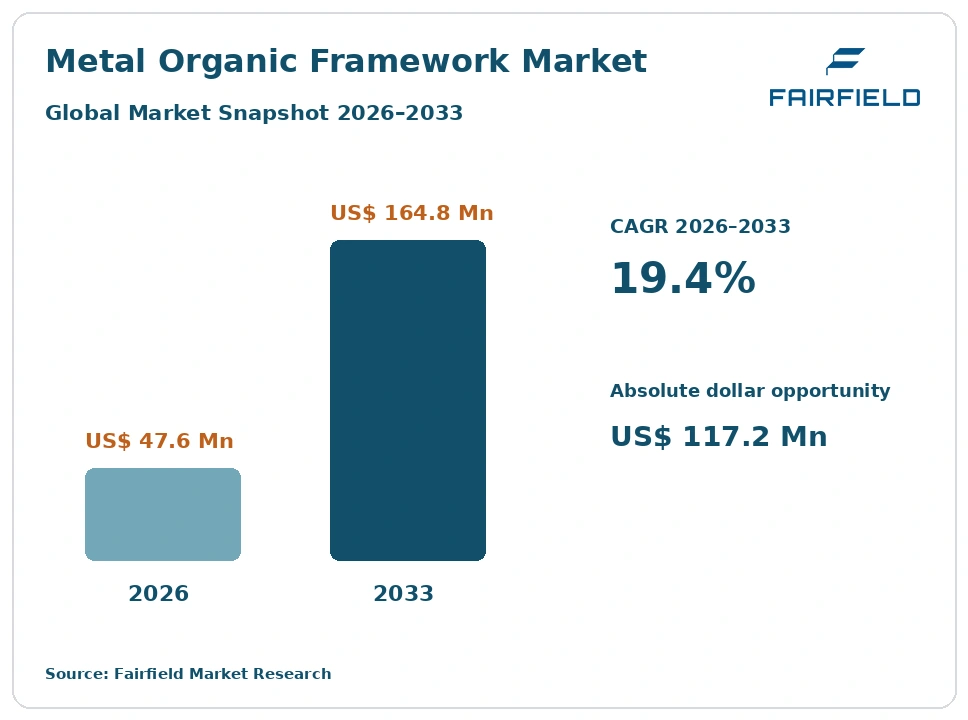
The global metal organic framework market size is expected to be valued at US$ 47.6 million in 2026 and projected to reach US$ 164.8 million by 2033, growing at a CAGR of 19.4% between 2026 and 2033.
Between 2020 and 2025, the market grew at a CAGR of about 21.3%, from a small base, as the first commercial uses in carbon capture, gas storage, and water harvesting moved from labs to factories and producers such as BASF scaled up output. The metal organic framework market covers crystalline porous materials made by linking metal ions or clusters with organic molecules, forming cages with very high internal surface areas of up to about 10,000 square meters per gram. These MOF materials can trap, store, and separate gases and liquids with high selectivity. Uses include carbon dioxide capture, hydrogen and methane storage, gas separation, toxic gas filtration, water harvesting from air, catalysis, sensors, and drug delivery. Growth comes from climate policies, demand for carbon capture sorbents, and better, cheaper production methods. The market is shifting from research quantities to tonnes-scale production. In December 2025, BASF said it makes MOFs at industrial scale, including CALF-20.
Key Report Takeaways
- By Type: Zinc-based held about 34% share in 2025, while Aluminum-based is projected to expand at a 22.5% CAGR through 2033, driven by low-cost, water-stable frameworks used for water harvesting from air, dehumidification, and industrial gas separation at large scale.
- By Application: Gas Storage and Separation held about 41% share in 2025, while Carbon Capture is projected to expand at a 24.8% CAGR through 2033, driven by point-source capture at cement, steel, and power plants and direct air capture projects using MOF sorbents.
- By End Use: Chemicals and Petrochemicals held about 36% share in 2025, while Energy and Environment is projected to expand at a 23.0% CAGR through 2033, driven by climate targets, hydrogen storage research, and carbon removal credits that reward captured carbon dioxide.
- By Region: North America held about 38% share in 2025, while Asia Pacific is projected to expand at a 22.0% CAGR through 2033, driven by strong university research, large chemical industries, and government funding for carbon capture and hydrogen in China, Japan, and South Korea.
Global Metal Organic Framework Market Trends and Insights
Drivers Impact Analysis
Two drivers carry the strongest influence on metal organic framework market demand during the forecast period.
| Driver | Impact on CAGR Forecast | Geographic Relevance | Impact Timeline |
| Carbon capture demand and climate policies | High | North America, Europe, Asia Pacific | Long term (≥4 years) |
| Scale-up of production and falling costs | Medium | Global | Medium term (2-4 years) |
Carbon Capture Demand Is Driving the Metal Organic Framework Market
Carbon capture demand and climate policies are the strongest driver of the metal organic framework market. Industries must cut carbon emissions.
The mechanism is the search for cheaper, more efficient ways to capture carbon dioxide. Traditional amine solvents used in carbon capture need large amounts of heat to release captured gas, raising energy costs. MOF sorbents such as CALF-20 can capture carbon dioxide selectively and release it with less energy, and they keep working in humid flue gas. Svante Technologies uses MOF filters in capture plants for cement, steel, and hydrogen producers, and BASF produces CALF-20 at industrial scale in South Carolina. Policies such as the U.S. 45Q tax credit, the European Union Emissions Trading System, and carbon removal markets reward captured carbon. Cement and steel makers face pressure to cut process emissions. These factors drive strong demand for MOF sorbents.
Production Scale-Up Is Expanding the Metal Organic Framework Market
Scale-up of production and falling costs are expanding the metal organic framework market. MOFs are becoming cheaper to make.
The cause is better manufacturing methods and larger plants. Early MOFs were made in small batches with costly solvents, but new water-based, continuous flow, and mechanochemical processes cut costs and waste. BASF, Promethean Particles, NuMat Technologies, and novoMOF now produce tonnes rather than grams. Lower costs open uses in water harvesting, cooling, and gas storage, where large volumes of material are needed. Venture capital and government grants in North America, Europe, and Asia Pacific fund new plants, and partnerships with chemical companies help startups reach industrial scale. Computer models and AI now help scientists design new MOFs faster. The 2025 Nobel Prize in Chemistry for MOFs increased investor interest. These trends expand the market.
Restraints Impact Analysis
Two restraints limit how quickly the metal organic framework market grows.
| Restraint | Impact on CAGR Forecast | Geographic Relevance | Impact Timeline |
| High production costs compared with zeolites and carbons | High | Global | Long term (≥4 years) |
| Stability and durability concerns in harsh conditions | Medium | Global | Medium term (2-4 years) |
High Costs Slow the Metal Organic Framework Market
High production costs compared with zeolites and carbons slow the metal organic framework market. MOFs still cost more than older sorbents.
The specific causes are expensive raw materials and limited scale. Many MOFs use costly organic linkers and metal salts, and production often needs solvents that must be recovered. Zeolites, activated carbon, and silica gel are cheap, proven, and made in millions of tonnes. Customers in gas separation and filtration are reluctant to switch without clear savings. Shaping MOF powders into pellets, beads, or coatings for industrial use adds more cost and can reduce performance. Few plants operate at large scale, so supply contracts are limited and buyers worry about secure supply. Prices per kilogram remain many times higher than zeolites. These factors slow adoption outside niche and high-value uses.
Stability Concerns Restrict the Metal Organic Framework Market
Stability and durability concerns in harsh conditions restrict the metal organic framework market. Some MOFs break down in use.
The underlying causes are sensitivity to water, heat, acids, and impurities. Some early MOFs lose their structure when exposed to moisture or flue gas contaminants such as sulfur oxides. Long-term performance data over years of cycling is still limited, and engineers need proof before using new materials in large plants. Recycling and disposal methods for spent MOFs are still being developed, and some contain metals that need careful handling and safe disposal. Customers also need standard test methods to compare products from different suppliers. Newer frameworks based on zirconium and aluminum are much more stable, but they must still prove themselves in real plants over many years. These factors restrict adoption.
Market Opportunities
Water Harvesting and Cooling Open a Fast-Growth Revenue Pool
Water harvesting and cooling open a fast-growth revenue pool in the metal organic framework market. MOFs can pull water from dry air.
Developers can capture this opportunity. Some MOFs absorb water vapor at night and release it with sunlight or low heat, making drinking water from desert air without power grids. Startups such as Atoco, founded with Omar Yaghi, are developing water harvesters. MOF coatings in air conditioning can remove humidity with less energy, and BASF is running pilot projects in dehumidifying air conditioning. Water scarcity in Middle East & Africa, India, and the western United States supports demand, and military and disaster relief users need portable water sources. Devices are still early and costly, but prices should fall with volume. Companies with low-cost, stable MOFs can win.
Hydrogen and Gas Storage Create a Growth Revenue Pool
Hydrogen and gas storage create a growth revenue pool in the metal organic framework market. MOFs store more gas in less space.
Suppliers can capture this opportunity. MOFs can store hydrogen, methane, and specialty gases at lower pressure and higher density than empty tanks, and NuMat Technologies sells MOF-based cylinders for toxic gases used in chip making. Chip factories use toxic dopant gases such as arsine and phosphine, and MOF storage lowers leak risks. Hydrogen fuel cell vehicles and storage systems could use MOFs to store more hydrogen at lower pressure, though research is still ongoing. Natural gas storage for vehicles is another option, along with safer storage of gases used in hospitals, labs, and factories. Long-term contracts with chip makers give stable demand. Companies serving semiconductors and hydrogen can grow.
Segment Analysis
By Type: Zinc-based Leads While Aluminum-based Grows Fastest
Zinc-based held about 34% share in 2025. Zinc frameworks such as MOF-5, ZIF-8, and CALF-20 were among the first studied and produced at scale, and they are used in carbon capture, gas separation, and research. CALF-20, made by BASF, is a zinc-based MOF used commercially by Svante. Copper, iron, and zirconium frameworks add other options.
Aluminum-based is the fastest-growing type, expanding at a 22.5% CAGR through 2033. Aluminum frameworks such as MOF-303 and aluminum fumarate are made from cheap, abundant raw materials and are stable in water, which suits water harvesting and dehumidification. They can be made in water-based processes at large scale. For the market, aluminum growth lowers costs and widens uses.
By Application: Gas Storage and Separation Leads While Carbon Capture Grows Fastest
Gas Storage and Separation held about 41% share in 2025. MOFs separate and store gases in chemical plants, semiconductor fabs, and labs, and they store toxic and specialty gases safely at low pressure. Catalysis, sensing, and drug delivery form other applications. Toxic gas filters for gas masks and building protection are another established use, and defense agencies fund research on MOFs that break down chemical warfare agents.
Carbon Capture is the fastest-growing application, expanding at a 24.8% CAGR through 2033. MOF sorbents capture carbon dioxide from industrial flue gas and air with lower energy needs than amine solvents. Large capture plants need tonnes of sorbent, and sorbents must be replaced after years of use, creating repeat sales. For the market, carbon capture growth drives large-volume demand.
By End Use: Chemicals and Petrochemicals Lead While Energy and Environment Grows Fastest
Chemicals and Petrochemicals held about 36% share in 2025. Refineries and chemical plants use MOFs for gas purification, separation, and catalysis, such as removing impurities from natural gas, separating hydrocarbons, and recovering valuable gases from waste streams. These customers need materials that work at large scale and under harsh process conditions, and some MOFs can replace energy-intensive distillation steps.
Energy and Environment is the fastest-growing end use, expanding at a 23.0% CAGR through 2033. Carbon capture, hydrogen, and water harvesting projects are growing quickly with public funding. Electronics and healthcare form other end uses, including gas storage for chip makers, sensors, and research on drug delivery and medical imaging. For the market, energy growth adds scale.
Geography Analysis
Which Region Is Leading the Metal Organic Framework Market?
North America is leading the metal organic framework market with about 38% share in 2025. The United States and Canada host leading MOF research at universities such as UC Berkeley, Northwestern University, and the University of Calgary, along with companies such as NuMat Technologies, Svante Technologies, and Mosaic Materials, now part of Baker Hughes. BASF produces CALF-20 in South Carolina, and the 45Q tax credit supports carbon capture. Federal hydrogen hubs and direct air capture hubs funded by the Department of Energy add demand. Key barriers include high costs. One change shaping the region is carbon capture project growth.
Europe Shapes the Metal Organic Framework Market Through Research and Climate Policy
Europe is a major metal organic framework market. Germany, the United Kingdom, Spain, France, and Switzerland host MOF producers and research groups, including BASF, Promethean Particles, novoMOF, and Nuada. The European Union Emissions Trading System and Innovation Fund support carbon capture projects at cement and steel plants. Many leading academic groups in the region publish key research, and spin-out companies are common. Nuada works with cement makers on capture pilots, and Promethean Particles runs continuous production in the United Kingdom. Key barriers include high energy costs. One opportunity is industrial carbon capture.
Which Region Is Growing Fastest in the Metal Organic Framework Market?
Asia Pacific is growing fastest in the metal organic framework market, expanding at a 22.0% CAGR through 2033. China publishes the most MOF research and has a large chemical industry, while Japan is home to Nobel laureate Susumu Kitagawa and companies developing MOF products. South Korea, Australia, and India fund carbon capture and hydrogen research, and Australia’s CSIRO develops MOF production methods. Many new startups are forming. Large chemical makers in China are building pilot MOF plants, and Japan’s Kyoto University leads research. Key barriers include limited commercial plants. One change shaping the region is scale-up of production.
Latin America Grows the Metal Organic Framework Market Through Research Collaboration
Latin America is a small metal organic framework market. Brazil, Mexico, and Chile have university research groups studying MOFs for gas separation, water treatment, and mining uses, often working with partners in North America and Europe. Oil and gas companies in Brazil, such as Petrobras, are exploring carbon capture and storage at offshore fields. Most MOF materials are imported, and local production is limited to university labs and small pilot projects. Lithium and copper mining in Chile may use MOFs for water and metal recovery. Key barriers include limited funding. One opportunity is mining and water treatment.
Middle East & Africa Develops the Metal Organic Framework Market Through Water and Carbon Capture
Middle East & Africa is a developing metal organic framework market. Saudi Arabia and the United Arab Emirates invest in carbon capture and water technology, and KAUST in Saudi Arabia runs a leading MOF research center. Water harvesting from air could help dry regions, and oil and gas producers want cheaper ways to capture carbon. National climate plans set capture targets, and research centers attract global scientists. South Africa has research groups studying MOFs for hydrogen storage, and desalination plants in the region may use MOFs to improve water treatment. Key barriers include few producers. One change shaping the region is carbon capture investment.
Competitive Landscape
The metal organic framework market is moderately consolidated. BASF, Svante Technologies, NuMat Technologies, Promethean Particles, and novoMOF are leading players, while MOF Technologies, Nuada, framergy, Mosaic Materials, part of Baker Hughes, Atoco, Strem Chemicals, and ProfMOF compete strongly. BASF is the largest producer by volume, while startups focus on specific applications such as carbon capture, water harvesting, or gas storage. Universities and research institutes hold many patents and spin out new companies.
Companies compete on MOF performance, stability, production cost, scale, shaping into usable forms, and partnerships with end users. Large-scale, low-cost production is the main barrier to wider use, so companies invest in new processes. Partnerships with carbon capture developers, chip makers, and air conditioning firms help bring products to market. Intellectual property around specific MOF structures and production methods is important.
Strategic moves show how competition is changing. In October 2025, the Nobel Prize in Chemistry was awarded to Omar Yaghi, Susumu Kitagawa, and Richard Robson for developing MOFs, and Svante said the prize validated MOFs for commercial carbon capture. In December 2025, BASF said it produces MOFs at industrial scale and is focusing on water and carbon dioxide applications. These moves show competition shifting toward commercial scale-up.
Three themes shape vendor strategy. First, companies are scaling up production and cutting costs. Second, they are partnering with carbon capture, water, and semiconductor customers. Third, they are expanding in Asia Pacific and Middle East & Africa, where research and climate funding are rising.
Metal Organic Framework Market Industry Leaders
- BASF
- Svante Technologies
- NuMat Technologies
- Promethean Particles
- novoMOF
Recent Industry Developments
- December 2025: BASF said it produces MOF materials at industrial scale, including CALF-20 at its Seneca, South Carolina site for Svante’s carbon capture systems, and is running dehumidifying air conditioning pilots - shows commercial progress in the metal organic framework market.
- October 2025: The Nobel Prize in Chemistry was awarded to Omar Yaghi, Susumu Kitagawa, and Richard Robson for the development of metal-organic frameworks - raises global attention and investment in MOFs.
- October 2025: Svante Technologies said the Nobel Prize validated MOF technology as critical for commercial carbon capture - supports demand for MOF carbon capture sorbents.
Companies Covered in the Report
- BASF
- Svante Technologies
- NuMat Technologies
- Promethean Particles
- novoMOF
- MOF Technologies
- Nuada
- framergy
- Mosaic Materials (Baker Hughes)
- Atoco
- Strem Chemicals
- ProfMOF
Metal Organic Framework Market Scope
This report covers the metal organic framework market, including zinc-based, copper-based, iron-based, aluminum-based, zirconium-based, and other MOFs, used for gas storage and separation, carbon capture, catalysis, water harvesting, sensing, and drug delivery, across chemicals and petrochemicals, energy and environment, electronics, healthcare, and other end uses. The base year is 2025, and the forecast period runs from 2026 to 2033. All values are expressed in US$ Million.
| Metric | Value |
| Study Period | 2020-2033 |
| Market Size 2026 | US$ 47.6 Million |
| Market Size 2033 | US$ 164.8 Million |
| CAGR 2026-2033 | 19.4% |
| Absolute Dollar Opportunity | US$ 117.2 Million |
| Largest Market | North America |
| Fastest-Growing Market | Asia Pacific |
| Market Concentration | Moderately Consolidated |
| Major Players | BASF, Svante Technologies, NuMat Technologies, Promethean Particles, novoMOF |
Type
- Zinc-based
- Copper-based
- Iron-based
- Aluminum-based
- Zirconium-based
- Others
Application
- Gas Storage and Separation
- Carbon Capture
- Catalysis
- Water Harvesting
- Others
End Use
- Chemicals and Petrochemicals
- Energy and Environment
- Electronics
- Healthcare
- Others
Regions
- North America
- Europe
- Asia Pacific
- Latin America
- Middle East & Africa
1. Executive Summary
1.1 Global Metal Organic Framework Market Snapshot
1.2 Future Projections, 2026-2033
1.3 Key Market Trends
1.4 Regional Snapshot
2. Market Overview
2.1 Market Definition and Report Scope
2.2 Historical Market Trends
2.3 Market Dynamics
2.3.1 Drivers Impact Analysis
2.3.1.1 Carbon Capture Demand Is Driving the Metal Organic Framework Market
2.3.1.2 Production Scale-Up Is Expanding the Metal Organic Framework Market
2.3.2 Restraints Impact Analysis
2.3.2.1 High Costs Slow the Metal Organic Framework Market
2.3.2.2 Stability Concerns Restrict the Metal Organic Framework Market
2.3.3 Market Opportunities
2.3.3.1 Water Harvesting and Cooling Open a Fast-Growth Revenue Pool
2.3.3.2 Hydrogen and Gas Storage Create a Growth Revenue Pool
3. Global Metal Organic Framework Market Outlook, 2020-2033
3.1 Global Metal Organic Framework Market Outlook, by Type, Value (US$ Million), 2020-2033
3.1.1 Zinc-based
3.1.2 Copper-based
3.1.3 Iron-based
3.1.4 Aluminum-based
3.1.5 Zirconium-based
3.1.6 Others
3.2 Global Metal Organic Framework Market Outlook, by Application, Value (US$ Million), 2020-2033
3.2.1 Gas Storage and Separation
3.2.2 Carbon Capture
3.2.3 Catalysis
3.2.4 Water Harvesting
3.2.5 Others
3.3 Global Metal Organic Framework Market Outlook, by End Use, Value (US$ Million), 2020-2033
3.3.1 Chemicals and Petrochemicals
3.3.2 Energy and Environment
3.3.3 Electronics
3.3.4 Healthcare
3.3.5 Others
3.4 Global Metal Organic Framework Market Outlook, by Region, Value (US$ Million), 2020-2033
3.4.1 North America
3.4.2 Europe
3.4.3 Asia Pacific
3.4.4 Latin America
3.4.5 Middle East & Africa
4. North America Metal Organic Framework Market Outlook, 2020-2033
4.1 North America Metal Organic Framework Market Outlook, by Type, Value (US$ Million), 2020-2033
4.1.1 Zinc-based
4.1.2 Copper-based
4.1.3 Iron-based
4.1.4 Aluminum-based
4.1.5 Zirconium-based
4.1.6 Others
4.2 North America Metal Organic Framework Market Outlook, by Application, Value (US$ Million), 2020-2033
4.2.1 Gas Storage and Separation
4.2.2 Carbon Capture
4.2.3 Catalysis
4.2.4 Water Harvesting
4.2.5 Others
4.3 North America Metal Organic Framework Market Outlook, by End Use, Value (US$ Million), 2020-2033
4.3.1 Chemicals and Petrochemicals
4.3.2 Energy and Environment
4.3.3 Electronics
4.3.4 Healthcare
4.3.5 Others
4.4 North America Metal Organic Framework Market Outlook, by Country, Value (US$ Million), 2020-2033
4.4.1 United States Metal Organic Framework Market Outlook, by Type, 2020-2033
4.4.2 United States Metal Organic Framework Market Outlook, by Application, 2020-2033
4.4.3 United States Metal Organic Framework Market Outlook, by End Use, 2020-2033
4.4.4 Canada Metal Organic Framework Market Outlook, by Type, 2020-2033
4.4.5 Canada Metal Organic Framework Market Outlook, by Application, 2020-2033
4.4.6 Canada Metal Organic Framework Market Outlook, by End Use, 2020-2033
5. Europe Metal Organic Framework Market Outlook, 2020-2033
5.1 Europe Metal Organic Framework Market Outlook, by Type, Value (US$ Million), 2020-2033
5.1.1 Zinc-based
5.1.2 Copper-based
5.1.3 Iron-based
5.1.4 Aluminum-based
5.1.5 Zirconium-based
5.1.6 Others
5.2 Europe Metal Organic Framework Market Outlook, by Application, Value (US$ Million), 2020-2033
5.2.1 Gas Storage and Separation
5.2.2 Carbon Capture
5.2.3 Catalysis
5.2.4 Water Harvesting
5.2.5 Others
5.3 Europe Metal Organic Framework Market Outlook, by End Use, Value (US$ Million), 2020-2033
5.3.1 Chemicals and Petrochemicals
5.3.2 Energy and Environment
5.3.3 Electronics
5.3.4 Healthcare
5.3.5 Others
5.4 Europe Metal Organic Framework Market Outlook, by Country, Value (US$ Million), 2020-2033
5.4.1 Germany Metal Organic Framework Market Outlook, by Type, 2020-2033
5.4.2 Germany Metal Organic Framework Market Outlook, by Application, 2020-2033
5.4.3 Germany Metal Organic Framework Market Outlook, by End Use, 2020-2033
5.4.4 United Kingdom Metal Organic Framework Market Outlook, by Type, 2020-2033
5.4.5 United Kingdom Metal Organic Framework Market Outlook, by Application, 2020-2033
5.4.6 United Kingdom Metal Organic Framework Market Outlook, by End Use, 2020-2033
5.4.7 Spain Metal Organic Framework Market Outlook, by Type, 2020-2033
5.4.8 Spain Metal Organic Framework Market Outlook, by Application, 2020-2033
5.4.9 Spain Metal Organic Framework Market Outlook, by End Use, 2020-2033
5.4.10 France Metal Organic Framework Market Outlook, by Type, 2020-2033
5.4.11 France Metal Organic Framework Market Outlook, by Application, 2020-2033
5.4.12 France Metal Organic Framework Market Outlook, by End Use, 2020-2033
5.4.13 Switzerland Metal Organic Framework Market Outlook, by Type, 2020-2033
5.4.14 Switzerland Metal Organic Framework Market Outlook, by Application, 2020-2033
5.4.15 Switzerland Metal Organic Framework Market Outlook, by End Use, 2020-2033
6. Asia Pacific Metal Organic Framework Market Outlook, 2020-2033
6.1 Asia Pacific Metal Organic Framework Market Outlook, by Type, Value (US$ Million), 2020-2033
6.1.1 Zinc-based
6.1.2 Copper-based
6.1.3 Iron-based
6.1.4 Aluminum-based
6.1.5 Zirconium-based
6.1.6 Others
6.2 Asia Pacific Metal Organic Framework Market Outlook, by Application, Value (US$ Million), 2020-2033
6.2.1 Gas Storage and Separation
6.2.2 Carbon Capture
6.2.3 Catalysis
6.2.4 Water Harvesting
6.2.5 Others
6.3 Asia Pacific Metal Organic Framework Market Outlook, by End Use, Value (US$ Million), 2020-2033
6.3.1 Chemicals and Petrochemicals
6.3.2 Energy and Environment
6.3.3 Electronics
6.3.4 Healthcare
6.3.5 Others
6.4 Asia Pacific Metal Organic Framework Market Outlook, by Country, Value (US$ Million), 2020-2033
6.4.1 China Metal Organic Framework Market Outlook, by Type, 2020-2033
6.4.2 China Metal Organic Framework Market Outlook, by Application, 2020-2033
6.4.3 China Metal Organic Framework Market Outlook, by End Use, 2020-2033
6.4.4 Japan Metal Organic Framework Market Outlook, by Type, 2020-2033
6.4.5 Japan Metal Organic Framework Market Outlook, by Application, 2020-2033
6.4.6 Japan Metal Organic Framework Market Outlook, by End Use, 2020-2033
6.4.7 South Korea Metal Organic Framework Market Outlook, by Type, 2020-2033
6.4.8 South Korea Metal Organic Framework Market Outlook, by Application, 2020-2033
6.4.9 South Korea Metal Organic Framework Market Outlook, by End Use, 2020-2033
6.4.10 Australia Metal Organic Framework Market Outlook, by Type, 2020-2033
6.4.11 Australia Metal Organic Framework Market Outlook, by Application, 2020-2033
6.4.12 Australia Metal Organic Framework Market Outlook, by End Use, 2020-2033
6.4.13 India Metal Organic Framework Market Outlook, by Type, 2020-2033
6.4.14 India Metal Organic Framework Market Outlook, by Application, 2020-2033
6.4.15 India Metal Organic Framework Market Outlook, by End Use, 2020-2033
7. Latin America Metal Organic Framework Market Outlook, 2020-2033
7.1 Latin America Metal Organic Framework Market Outlook, by Type, Value (US$ Million), 2020-2033
7.1.1 Zinc-based
7.1.2 Copper-based
7.1.3 Iron-based
7.1.4 Aluminum-based
7.1.5 Zirconium-based
7.1.6 Others
7.2 Latin America Metal Organic Framework Market Outlook, by Application, Value (US$ Million), 2020-2033
7.2.1 Gas Storage and Separation
7.2.2 Carbon Capture
7.2.3 Catalysis
7.2.4 Water Harvesting
7.2.5 Others
7.3 Latin America Metal Organic Framework Market Outlook, by End Use, Value (US$ Million), 2020-2033
7.3.1 Chemicals and Petrochemicals
7.3.2 Energy and Environment
7.3.3 Electronics
7.3.4 Healthcare
7.3.5 Others
7.4 Latin America Metal Organic Framework Market Outlook, by Country, Value (US$ Million), 2020-2033
7.4.1 Brazil Metal Organic Framework Market Outlook, by Type, 2020-2033
7.4.2 Brazil Metal Organic Framework Market Outlook, by Application, 2020-2033
7.4.3 Brazil Metal Organic Framework Market Outlook, by End Use, 2020-2033
7.4.4 Mexico Metal Organic Framework Market Outlook, by Type, 2020-2033
7.4.5 Mexico Metal Organic Framework Market Outlook, by Application, 2020-2033
7.4.6 Mexico Metal Organic Framework Market Outlook, by End Use, 2020-2033
7.4.7 Chile Metal Organic Framework Market Outlook, by Type, 2020-2033
7.4.8 Chile Metal Organic Framework Market Outlook, by Application, 2020-2033
7.4.9 Chile Metal Organic Framework Market Outlook, by End Use, 2020-2033
8. Middle East & Africa Metal Organic Framework Market Outlook, 2020-2033
8.1 Middle East & Africa Metal Organic Framework Market Outlook, by Type, Value (US$ Million), 2020-2033
8.1.1 Zinc-based
8.1.2 Copper-based
8.1.3 Iron-based
8.1.4 Aluminum-based
8.1.5 Zirconium-based
8.1.6 Others
8.2 Middle East & Africa Metal Organic Framework Market Outlook, by Application, Value (US$ Million), 2020-2033
8.2.1 Gas Storage and Separation
8.2.2 Carbon Capture
8.2.3 Catalysis
8.2.4 Water Harvesting
8.2.5 Others
8.3 Middle East & Africa Metal Organic Framework Market Outlook, by End Use, Value (US$ Million), 2020-2033
8.3.1 Chemicals and Petrochemicals
8.3.2 Energy and Environment
8.3.3 Electronics
8.3.4 Healthcare
8.3.5 Others
8.4 Middle East & Africa Metal Organic Framework Market Outlook, by Country, Value (US$ Million), 2020-2033
8.4.1 Saudi Arabia Metal Organic Framework Market Outlook, by Type, 2020-2033
8.4.2 Saudi Arabia Metal Organic Framework Market Outlook, by Application, 2020-2033
8.4.3 Saudi Arabia Metal Organic Framework Market Outlook, by End Use, 2020-2033
8.4.4 United Arab Emirates Metal Organic Framework Market Outlook, by Type, 2020-2033
8.4.5 United Arab Emirates Metal Organic Framework Market Outlook, by Application, 2020-2033
8.4.6 United Arab Emirates Metal Organic Framework Market Outlook, by End Use, 2020-2033
8.4.7 South Africa Metal Organic Framework Market Outlook, by Type, 2020-2033
8.4.8 South Africa Metal Organic Framework Market Outlook, by Application, 2020-2033
8.4.9 South Africa Metal Organic Framework Market Outlook, by End Use, 2020-2033
9. Competitive Landscape
9.1 Industry Leaders
9.2 Recent Industry Developments
9.3 Company Profiles
9.3.1 BASF
9.3.2 Svante Technologies
9.3.3 NuMat Technologies
9.3.4 Promethean Particles
9.3.5 novoMOF
9.3.6 MOF Technologies
9.3.7 Nuada
9.3.8 framergy
9.3.9 Mosaic Materials (Baker Hughes)
9.3.10 Atoco
9.3.11 Strem Chemicals
9.3.12 ProfMOF
10. Appendix
10.1 Research Methodology
10.2 Report Assumptions
10.3 Acronyms and Abbreviations
| Segment | Categories |
|---|---|
| Type | Zinc-based, Copper-based, Iron-based, Aluminum-based, Zirconium-based, Others |
| Application | Gas Storage and Separation, Carbon Capture, Catalysis, Water Harvesting, Others |
| End Use | Chemicals and Petrochemicals, Energy and Environment, Electronics, Healthcare, Others |
| Regions | North America, Europe, Asia Pacific, Latin America, Middle East & Africa |
Our Research Methodology
Considering the volatility of business today, traditional approaches to strategizing a game plan can be unfruitful if not detrimental. True ambiguity is no way to determine a forecast. A myriad of predetermined factors must be accounted for such as the degree of risk involved, the magnitude of circumstances, as well as conditions or consequences that are not known or unpredictable. To circumvent binary views that cast uncertainty, the application of market research intelligence to strategically posture, move, and enable actionable outcomes is necessary.
View Methodology
Quality Assured
Rigorous Validation Process

Confidentiality Assured
End-to-end Data Security

Custom Research Services
Tailored To Your Objectives
FAQs
The metal organic framework market is valued at US$ 47.6 million in 2026, led by gas storage uses and North America.
The market is projected to reach US$ 164.8 million by 2033, growing at a 19.4% CAGR and adding US$ 117.2 million.
Carbon capture is growing fastest at a 24.8% CAGR through 2033, driven by industrial capture projects and direct air capture using MOF sorbents.
Asia Pacific is growing fastest at a 22.0% CAGR through 2033, driven by strong research, chemical industries, and carbon capture funding.
North America holds the largest share at about 38% in 2025, supported by leading research, Svante, and BASF production in South Carolina.
Related Reports
Isopropyl Alcohol Market Size, Share, Insights, Competitive Landscape, and Forecast 2026 to 2033
The global isopropyl alcohol market is valued at US$5.2 billion in 2026, reaching US$6.6 billion by 2033, growing at a 3.5% CAGR
Organic Peroxide Market Size, Share, Insights, Competitive Landscape, and Forecast 2026 to 2033
The organic peroxide market is projected to reach US$2.76 billion by 2033. Explore demand across polymers, rubber, coatings, adhesives, and key regions.
Nitrile Butadiene Rubber (NBR) Latex Market Size, Share, Insights, Competitive Landscape, and Forecast 2026 to 2033
The NBR latex market is projected to reach US$6.09 billion by 2033. Explore demand for nitrile gloves, carboxylated latex, and growth in Asia Pacific.
Nanopesticides Market Size, Share, Insights, Competitive Landscape, and Forecast 2026 to 2033
The nanopesticides market is projected to reach US$2.35 billion by 2033. Explore nanoinsecticides, nanoherbicides, and regional demand for crop protection.
Mono-Ethanolamine Market Size, Share, Insights, Competitive Landscape, and Forecast 2026 to 2033
The mono-ethanolamine market is projected to reach US$1.90 billion by 2033. Explore demand in gas treatment, personal care, and key regional markets.
Moisture Curing Adhesive Market Size, Share, Insights, Competitive Landscape, and Forecast 2026 to 2033
The moisture curing adhesive market is projected to reach US$12.04 billion by 2033. Explore growth in polyurethane, automotive bonding, and Asia Pacific.