



Isopropyl Alcohol Market
Isopropyl Alcohol Market Size, Share, Insights, Competitive Landscape, and Forecast 2026 to 2033
Isopropyl Alcohol Market Size and Trend Analysis
How Fast Will the Isopropyl Alcohol Market Grow to 2033?
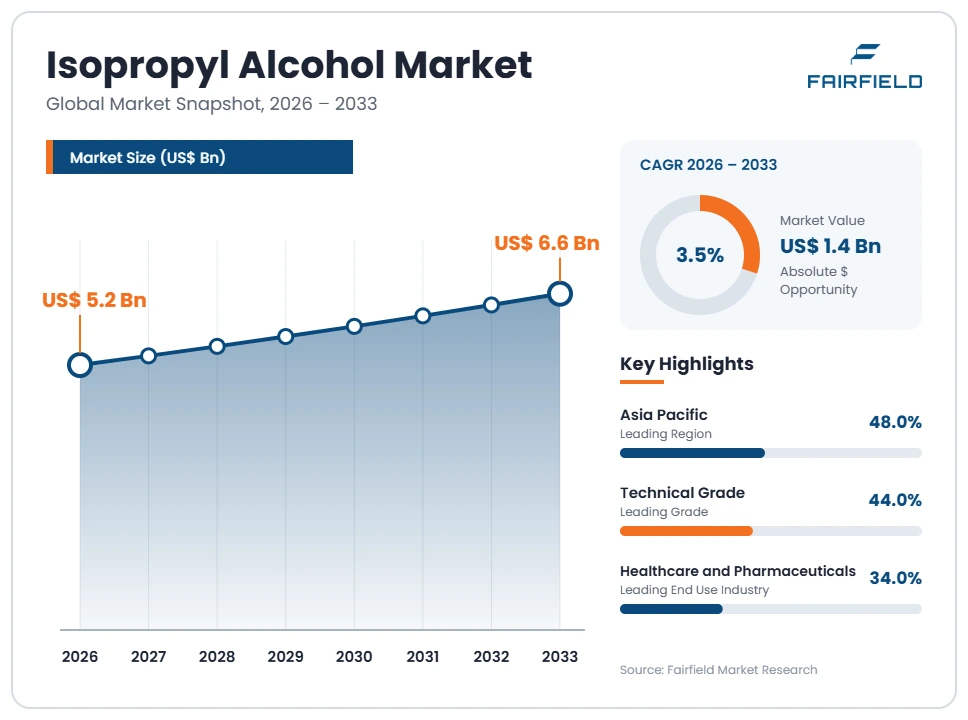
The global Isopropyl Alcohol market size is expected to be valued at US$ 5.2 billion in 2026 and projected to reach US$ 6.6 billion by 2033, growing at a CAGR of 3.5% between 2026 and 2033.
Pricing in this market is set by competition between two production routes. Propylene hydration and acetone hydrogenation serve the same customers from different feedstocks, so isopropanol economics sit at the intersection of the propylene and acetone markets. Because acetone is a co-product of the phenol chain, an unrelated swing in phenol demand can flood acetone supply and make hydrogenation the cheaper route. Between 2020 and 2025 reported value fell at roughly 4% a year, as the sanitiser spike reversed. Growth now rests on pharmaceutical processing, semiconductor wafer cleaning and steady solvent use. The direction is modest recovery on firm volumes, with margins capped by capacity added during the sanitiser episode.
Key Report Takeaways
- By Grade: Technical Grade held 44% share in 2026, while Electronic Grade is projected to expand at a 7.8% CAGR through 2033, driven by wafer fabrication build-out and the tighter particle and metal-ion limits those lines demand.
- By Production Process: Indirect Hydration of Propylene held 42% share in 2026, while Catalytic Hydrogenation of Acetone is projected to grow at a 4.6% CAGR through 2033, as surplus acetone from the phenol chain keeps that route cost-competitive.
- By Application: Cleaning and Disinfection held 32% share in 2026, while Pharmaceutical Processing is projected to advance at a 5.0% CAGR through 2033, supported by validated cleaning protocols and expanded sterile manufacturing capacity.
- By End Use Industry: Healthcare and Pharmaceuticals held 34% share in 2026, while Electronics and Semiconductors is projected to post an 8.3% CAGR through 2033, reflecting new fab capacity and rising solvent use per wafer.
- By Geography: Asia Pacific held 48% share in 2026, while Middle East & Africa is projected to grow at a 4.9% CAGR through 2033, helped by integrated propylene supply and expanding local formulation capacity.
Global Isopropyl Alcohol Market Trends and Insights
Drivers Impact Analysis
Two steady demand pillars support isopropanol consumption now that sanitiser volumes have normalised.
| Driver | Impact on CAGR Forecast | Geographic Relevance | Impact Timeline |
| Pharmaceutical processing and validated cleaning requirements | High | North America, Europe, Asia Pacific | Long term (≥4 years) |
| Solvent use in coatings, inks and adhesive formulation | Medium | Asia Pacific, Europe, Latin America | Medium term (2–4 years) |
Validated Cleaning in Drug Manufacturing Anchors Isopropanol Consumption
Pharmaceutical manufacturing is the most reliable demand base for isopropanol, because its use there is written into approved procedures rather than chosen on price. Cleanroom surface disinfection, equipment cleaning between batches, and wipe-down of materials entering sterile areas all specify 70% aqueous propan-2-ol. Once a cleaning validation is filed, substituting the solvent requires requalification, which makes demand unusually sticky.
The mechanism is regulatory and technical together. Sterile and aseptic manufacturing operates under documented contamination control strategies, and regulators expect a sporicidal and a non-sporicidal agent in rotation, with alcohol serving the latter role. Isopropanol is also widely used as a crystallisation and washing solvent in active ingredient synthesis, where the International Council for Harmonisation places it in the lower-risk residual solvent class. Growth in injectable drugs, biologics fill-finish and contract manufacturing capacity therefore converts directly into litres consumed.
Coatings, Inks and Adhesive Formulators Keep Propan-2-ol as a Default Solvent
Formulated products remain the second pillar of isopropanol demand, covering printing inks, wood and industrial coatings, adhesives, cleaning chemicals and de-icing fluids. Formulators value a solvent that evaporates quickly, mixes with water and most organic solvents, and costs less than specialty alternatives. That combination is difficult to replace without reformulating and retesting a whole product range.
The mechanism is solvency and evaporation balance. Flexographic and gravure inks need a carrier that releases cleanly at press speed without blocking, and alcohol blends deliver that. Adhesive and coating producers use propan-2-ol to adjust viscosity and surface wetting, particularly on low-energy plastic substrates. Demand follows packaging printing, furniture, construction coatings and general manufacturing output, which spreads it across many small accounts rather than a few large ones. That breadth makes this pillar stable even when any single industry weakens.
Restraints Impact Analysis
Two conditions hold back price recovery and add cost across the isopropanol supply chain.
| Restraint | Impact on CAGR Forecast | Geographic Relevance | Impact Timeline |
| Overcapacity left by the sanitiser demand collapse | High | Global | Short term (≤2 years) |
| Flammability classification and solvent emission compliance | Medium | Europe, North America, Asia Pacific | Medium term (2–4 years) |
Overcapacity Left by the Sanitiser Boom Keeps Isopropanol Margins Depressed
The defining recent event in this market was a demand spike and its collapse. During the pandemic, hand sanitiser and surface disinfectant consumption rose sharply, spot prices multiplied, and producers debottlenecked plants, restarted idle units and converted other alcohol capacity to propan-2-ol. Demand then fell back toward pre-pandemic levels far faster than the new capacity could be withdrawn.
The result is an oversupplied market with weak operating rates and thin contract margins. Converted and debottlenecked units are hard to shut because they share utilities and feedstock contracts with other products on the same site. Feedstock volatility compounds the problem: propylene prices track refinery and cracker economics, while acetone prices move with phenol demand from polycarbonate and epoxy resins. When either input swings, producers on the disadvantaged route cannot pass the cost through in an oversupplied market.
Flammability Classification and Solvent Emission Rules Raise Delivered Cost
Regulatory classification adds a persistent cost layer to every litre of isopropanol moved, stored and used. Propan-2-ol is a Class 3 flammable liquid with a flash point near 12 °C, carried under UN 1219 in packing group II. That classification dictates tank design, bunding, electrical area classification, segregation distances, firefighting provision and driver training.
The specific cost sources are identifiable. Storage requires nitrogen blanketing or inerting, bonded and earthed transfer systems, and explosion-protected equipment, all of which raise capital cost per cubic metre of tankage. Transport requires placarded vehicles and approved packaging, which limits carrier choice and raises freight rates. In use, volatile organic compound controls under national air quality permits oblige large users to install vapour capture or abatement. Insurance premiums and warehouse licensing conditions add further fixed cost, which falls hardest on smaller formulators and distributors.
Market Opportunities
Electronic Grade Isopropyl Alcohol Opens the High-Purity Revenue Pool
Semiconductor grade propan-2-ol is the clearest premium revenue pool in this market, selling at a substantial multiple of technical grade. Wafer fabrication consumes large volumes in rinse and drying steps, particularly in the final rinse before drying, where the alcohol displaces water and prevents pattern collapse on fine features. Purity requirements, not solvency, create the value.
Capture belongs to producers able to hold metallic impurities at parts-per-trillion levels, control particle counts and supply in dedicated, qualified containers under SEMI grade specifications for electronic chemicals. That requires purpose-built distillation, filtration and packaging lines rather than converted technical-grade capacity. Demand is created by new fabrication plants in Taiwan, South Korea, Japan, China, the United States and Germany, and by advanced nodes that use more rinse steps per wafer. Supplier qualification runs for years and protects incumbents once approved.
Bio-Based Propan-2-ol Offers a Developmental Route to Differentiated Supply
Bio-based isopropanol is an emerging revenue pool rather than a mature one, but it addresses a demand that already exists. Cosmetics, personal care and consumer cleaning brands have published renewable carbon content targets, and their formulators need drop-in solvents with a verified bio-based share. A chemically identical molecule from a renewable feedstock meets that need without reformulation.
Capture favours producers with access to fermentation-derived propylene, bio-propylene from renewable naphtha, or direct fermentation routes to isopropanol, together with mass-balance certification that auditors accept. Demand concentrates in personal care brand owners and retail cleaning products in Europe, Japan and North America, where renewable content claims influence shelf positioning. Pharmaceutical and electronics buyers are unlikely to pay for the attribute, so the realistic near-term pool is consumer-facing. Cost remains well above conventional supply, which keeps volumes developmental.
Segment Analysis
- By Grade: Technical Material Leads While Electronic Grade Grows Fastest
Technical Grade held 44% of the isopropyl alcohol market in 2026, because industrial cleaning, coatings, inks, adhesives and chemical intermediate uses all accept commercial purity and buy on delivered cost. Pharmaceutical Grade follows at a substantial share, reflecting monograph-compliant material used in drug manufacturing and medical settings, while Cosmetic Grade serves personal care formulation.
Electronic Grade is the fastest-growing grade at a 7.8% CAGR to 2033, from the smallest base. Its specifications are defined by trace metal, particle, anion and moisture limits rather than by assay alone, and it is supplied in dedicated containers to avoid contamination in transit. Qualification at a fabrication plant can take two years, which makes the position defensible once won. The business implication is a widening value gap: tonnage sits in technical grade, but incremental profit increasingly comes from a grade that represents a small fraction of volume.
- By Production Process: Propylene Hydration Dominates as the Acetone Route Gains
Indirect Hydration of Propylene accounted for 42% of production in 2026, using sulphuric acid esterification followed by hydrolysis. It tolerates lower-purity refinery-grade propylene, which gives it a feedstock cost advantage where chemical-grade propylene is scarce. Direct Hydration of Propylene, which reacts propylene and water over a solid or liquid acid catalyst, avoids acid handling and corrosion but requires higher-purity feed.
Catalytic Hydrogenation of Acetone is the fastest-growing route at a 4.6% CAGR through 2033. Its economics depend on acetone, which is produced as a co-product with phenol, so acetone availability is set by polycarbonate and epoxy resin demand rather than by solvent demand. When phenol output rises, surplus acetone depresses its price and makes hydrogenation the lowest-cost route to propan-2-ol. For producers, holding both routes on one site is the most effective hedge against that swing.
- By Application: Cleaning and Disinfection Leads While Pharmaceutical Processing Accelerates
Cleaning and Disinfection represented 32% of consumption in 2026, covering hospital and laboratory surface disinfection, electronics and optical cleaning, industrial degreasing and consumer antiseptic products. The share is lower than during the sanitiser episode but has settled at a durable level, supported by infection control practice in healthcare settings that did not revert.
Pharmaceutical Processing is the fastest-growing application at a 5.0% CAGR to 2033, driven by expanded sterile and biologics manufacturing capacity and by crystallisation, extraction and washing steps in active ingredient synthesis. Coatings, Inks and Adhesives, Cosmetics and Personal Care, Chemical Intermediate use and Automotive and Industrial Products divide the remainder. Intermediate consumption into isopropylamines, isopropyl esters and acetate derivatives is steady but exposed to agrochemical cycles. The implication is that demand growth now comes from regulated, specification-driven uses rather than from consumer volumes.
- By End Use Industry: Healthcare Carries Volume While Semiconductors Lift Value
Healthcare and Pharmaceuticals consumed 34% of isopropyl alcohol in 2026, combining drug manufacturing, hospital disinfection, diagnostics, medical device cleaning and alcohol prep products. Demand is tied to healthcare activity and regulated procedure rather than to industrial output, which makes it the least cyclical part of the market.
Electronics and Semiconductors is the fastest-expanding end use at an 8.3% CAGR through 2033. Volume per wafer has risen as device geometries shrink and rinse steps multiply, and new fabrication capacity adds consumption in step with construction. Paints, Coatings and Printing, Personal Care and Cosmetics, Chemicals and Petrochemicals, Automotive and Transportation and Food and Beverage Processing make up the balance. For suppliers, the structural implication is that a logistics network built for drummed industrial solvent does not serve a fabrication plant, so serving the growth segment requires separate assets.
Geography Analysis
- North America Combines Mature Demand With Integrated Propylene Supply
North America held 20% of the isopropyl alcohol market in 2026 and is forecast to grow at 2.6% a year. The United States accounts for most production and consumption, with large Gulf Coast units integrated into refinery and cracker propylene supply, and Canada and Mexico contributing formulation demand.
Regional demand is weighted toward pharmaceutical manufacturing, healthcare disinfection and industrial cleaning. The United States Food and Drug Administration regulates alcohol-based hand rubs as over-the-counter drug monograph products, and the enforcement activity that followed the demand spike, covering contamination and labelling, has raised quality expectations across the supply chain.
The change shaping the region is semiconductor investment. New fabrication capacity is creating domestic demand for high-purity material that was previously imported, which gives local producers a reason to add dedicated purification capability.
- Europe Prioritises Pharmaceutical and Biocidal Compliance Over Volume Growth
Europe represented 19% of the market in 2026 and is the slowest-growing region at 2.2% a year. Germany, the Netherlands, France, Italy, Spain and Belgium form the core, with production integrated into large chemical clusters and demand led by pharmaceutical, coatings and personal care manufacturing.
Regulation defines commercial access here. Under the Biocidal Products Regulation, propan-2-ol is an approved active substance, and disinfectant products containing it require product authorisation before sale, which adds dossier cost and favours established suppliers. The European Pharmacopoeia monograph governs material sold for drug manufacturing, and the revised Classification, Labelling and Packaging Regulation tightens hazard communication.
The regional opportunity lies in certified bio-based and pharmaceutical grades, where compliance capability is already in place and buyers accept a premium for documentation.
- Which Region Is Leading the Isopropyl Alcohol Market?
Asia Pacific leads the isopropyl alcohol market with 48% share in 2026, growing at 3.9% a year, because the region holds most global production capacity and most of the manufacturing that consumes it. China is the largest producer and consumer, followed by Japan, South Korea, India and Taiwan.
The causes are structural. Propylene from refineries, crackers and dehydrogenation units is locally available, acetone from large phenol complexes supplies the hydrogenation route, and pharmaceutical, electronics, coatings and personal care manufacturing sit close by. Freight on a bulk liquid rewards that proximity.
The region also hosts the most demanding customers. Wafer fabrication in Taiwan, South Korea, Japan and China consumes the bulk of electronic grade volume, and that demand is expanding faster than general industrial use across the region.
- Latin America Relies on Imported Material for Higher Grades
Latin America held 6% of the isopropyl alcohol market in 2026 and is forecast to grow at 3.0% a year. Brazil and Mexico are the principal markets, with Argentina, Colombia and Chile adding formulation and distribution demand across coatings, personal care and cleaning products.
The barriers are structural rather than technical. Local production capacity is limited, so most material arrives by sea in bulk or drums, adding freight, duty and inventory cost. Currency volatility raises the cost of dollar-priced imports, and pharmaceutical and electronic grades are almost entirely imported because domestic purification capability is scarce.
The opportunity is in local formulation and repackaging. Growing domestic pharmaceutical manufacturing and consumer cleaning production in Brazil and Mexico support investment in blending, dilution and drum-filling closer to customers.
- Which Region Is Growing Fastest in the Isopropyl Alcohol Market?
Middle East & Africa is growing fastest in the isopropyl alcohol market at a 4.9% CAGR between 2026 and 2033, from a 7% share in 2026. Saudi Arabia, the United Arab Emirates, Egypt, Turkey, Morocco and South Africa account for most of the activity.
The driver is feedstock position and downstream policy. Propane dehydrogenation and cracker capacity in the Gulf supplies propylene locally, and industrial diversification programmes favour converting that propylene into finished chemicals rather than exporting it. Local pharmaceutical and disinfectant manufacturing has also expanded since the demand spike.
Barriers remain: a thin base of specialty formulation skills, dependence on imported catalysts and equipment, and uneven regulatory frameworks for biocidal product registration. The change to watch is pharmaceutical manufacturing investment, which pulls monograph-grade demand.
Competitive Landscape
The isopropyl alcohol industry is moderately concentrated. A limited number of integrated petrochemical producers, including LyondellBasell Industries N.V., ExxonMobil Corporation, Shell plc, Dow Inc., INEOS Group Limited and Mitsui Chemicals, Inc., operate most of the world-scale units, while a longer tail of regional producers in China, India, Taiwan and South Korea supplies local demand. Concentration is higher in electronic grade, where qualification barriers restrict the field to a handful of suppliers such as Tokuyama Corporation and LCY Chemical Corp. Capacity added during the sanitiser episode has slowed consolidation, because few owners will book a closure while hoping for margin recovery.
Competition rests on feedstock position, route flexibility, grade capability and logistics. Producers that can run both propylene hydration and acetone hydrogenation on one site hold a genuine hedge, since the cheaper route changes with phenol chain economics. In technical grade, delivered cost decides orders and differentiation is minimal. In pharmaceutical and electronic grades, competition shifts to documentation, impurity control, dedicated packaging and audit history, where switching costs are high and price sensitivity is low. New entrants are mostly regional producers backed by local propylene supply rather than technology challengers.
Strategic activity concentrates on rebalancing grade mix toward pharmaceutical and electronic material, debottlenecking rather than greenfield expansion, adding purification and packaging assets near fabrication clusters, and securing acetone offtake agreements from phenol producers. Several suppliers have also expanded tolling and distribution partnerships to reach smaller formulators without building terminals.
Strategic direction is consistent across the industry. Producers are managing utilisation rather than chasing volume, protecting margin through grade upgrading, and treating route flexibility as the primary defence against feedstock swings.
Isopropyl Alcohol Industry Leaders
LyondellBasell Industries N.V.
ExxonMobil Corporation
Shell plc
Dow Inc.
Tokuyama Corporation
Recent Industry Developments
- December 2024: The revised Classification, Labelling and Packaging Regulation entered into force across the European Union, tightening hazard labelling, advertising and distance-selling rules for flammable solvents – raising compliance cost for suppliers of packaged propan-2-ol.
- January 2025: The 2025 edition of the European Agreement concerning the International Carriage of Dangerous Goods by Road took effect, retaining propan-2-ol as a Class 3 flammable liquid in packing group II under UN 1219 – confirming the tank, vehicle and training requirements that shape road distribution cost.
- January 2026: The current biennial amendment to the International Maritime Dangerous Goods Code became mandatory for packaged dangerous goods carried by sea – updating stowage, segregation and documentation requirements for internationally traded solvent cargoes.
- April 2025: The European Chemicals Agency opened consultation on the renewal assessment of propan-2-ol as a biocidal active substance, keeping disinfectant-grade supply tied to a dossier-backed authorisation that favours established producers over opportunistic entrants.
Companies Covered in the Report
- LyondellBasell Industries N.V.
- ExxonMobil Corporation
- Shell plc
- Dow Inc.
- INEOS Group Limited
- Mitsui Chemicals, Inc.
- Tokuyama Corporation
- LCY Chemical Corp.
- Isu Chemical Co., Ltd.
- SK Picglobal Co., Ltd.
- Deepak Fertilisers and Petrochemicals Corporation Limited
- Shandong Dadi Chemical Group Co., Ltd.
Isopropyl Alcohol Market Report Scope
| Metric | Value |
| Study Period (2020–2033) | Historical 2020–2025, base year 2025, forecast 2026–2033 |
| Market Size 2026 | US$ 5.2 Billion |
| Market Size 2033 | US$ 6.6 Billion |
| CAGR 2026–2033 | 3.5% |
| Absolute Dollar Opportunity | US$ 1.4 Billion |
| Largest Market | Asia Pacific (48% share in 2026) |
| Fastest-Growing Market | Middle East & Africa (4.9% CAGR) |
| Market Concentration | Medium |
| Major Players | LyondellBasell Industries N.V., ExxonMobil Corporation, Shell plc, Dow Inc., Tokuyama Corporation |
Isopropyl Alcohol Market Segmentation
- Executive Summary
- Global Isopropyl Alcohol Market Snapshot
- Future Projections, 2026-2033
- Key Market Trends
- Regional Snapshot
- Market Overview
- Market Definition and Report Scope
- Historical Market Trends
- Market Dynamics
- Drivers Impact Analysis
- Validated Cleaning in Drug Manufacturing Anchors Isopropanol Consumption
- Coatings, Inks and Adhesive Formulators Keep Propan-2-ol as a Default Solvent
- Restraints Impact Analysis
- Overcapacity Left by the Sanitiser Boom Keeps Isopropanol Margins Depressed
- Flammability Classification and Solvent Emission Rules Raise Delivered Cost
- Market Opportunities
- Electronic Grade Isopropyl Alcohol Opens the High-Purity Revenue Pool
- Bio-Based Propan-2-ol Offers a Developmental Route to Differentiated Supply
- Drivers Impact Analysis
- Global Isopropyl Alcohol Market Outlook, 2020-2033
- Global Isopropyl Alcohol Market Outlook, by Grade, Value (US$ Billion), 2020-2033
- Technical Grade
- Cosmetic Grade
- Pharmaceutical Grade
- Electronic Grade
- Global Isopropyl Alcohol Market Outlook, by Production Process, Value (US$ Billion), 2020-2033
- Indirect Hydration of Propylene
- Direct Hydration of Propylene
- Catalytic Hydrogenation of Acetone
- Global Isopropyl Alcohol Market Outlook, by Application, Value (US$ Billion), 2020-2033
- Cleaning and Disinfection
- Pharmaceutical Processing
- Coatings, Inks and Adhesives
- Cosmetics and Personal Care
- Chemical Intermediate
- Automotive and Industrial Products
- Global Isopropyl Alcohol Market Outlook, by End Use Industry, Value (US$ Billion), 2020-2033
- Healthcare and Pharmaceuticals
- Paints, Coatings and Printing
- Personal Care and Cosmetics
- Chemicals and Petrochemicals
- Electronics and Semiconductors
- Automotive and Transportation
- Food and Beverage Processing
- Global Isopropyl Alcohol Market Outlook, by Region, Value (US$ Billion), 2020-2033
- North America
- Europe
- Asia Pacific
- Latin America
- Middle East & Africa
- Global Isopropyl Alcohol Market Outlook, by Grade, Value (US$ Billion), 2020-2033
- North America Isopropyl Alcohol Market Outlook, 2020-2033
- North America Isopropyl Alcohol Market Outlook, by Grade, Value (US$ Billion), 2020-2033
- Technical Grade
- Cosmetic Grade
- Pharmaceutical Grade
- Electronic Grade
- North America Isopropyl Alcohol Market Outlook, by Production Process, Value (US$ Billion), 2020-2033
- Indirect Hydration of Propylene
- Direct Hydration of Propylene
- Catalytic Hydrogenation of Acetone
- North America Isopropyl Alcohol Market Outlook, by Application, Value (US$ Billion), 2020-2033
- Cleaning and Disinfection
- Pharmaceutical Processing
- Coatings, Inks and Adhesives
- Cosmetics and Personal Care
- Chemical Intermediate
- Automotive and Industrial Products
- North America Isopropyl Alcohol Market Outlook, by End Use Industry, Value (US$ Billion), 2020-2033
- Healthcare and Pharmaceuticals
- Paints, Coatings and Printing
- Personal Care and Cosmetics
- Chemicals and Petrochemicals
- Electronics and Semiconductors
- Automotive and Transportation
- Food and Beverage Processing
- North America Isopropyl Alcohol Market Outlook, by Country, Value (US$ Billion), 2020-2033
- United States Isopropyl Alcohol Market Outlook, by Grade, 2020-2033
- United States Isopropyl Alcohol Market Outlook, by Production Process, 2020-2033
- United States Isopropyl Alcohol Market Outlook, by Application, 2020-2033
- United States Isopropyl Alcohol Market Outlook, by End Use Industry, 2020-2033
- Canada Isopropyl Alcohol Market Outlook, by Grade, 2020-2033
- Canada Isopropyl Alcohol Market Outlook, by Production Process, 2020-2033
- Canada Isopropyl Alcohol Market Outlook, by Application, 2020-2033
- Canada Isopropyl Alcohol Market Outlook, by End Use Industry, 2020-2033
- Mexico Isopropyl Alcohol Market Outlook, by Grade, 2020-2033
- Mexico Isopropyl Alcohol Market Outlook, by Production Process, 2020-2033
- Mexico Isopropyl Alcohol Market Outlook, by Application, 2020-2033
- Mexico Isopropyl Alcohol Market Outlook, by End Use Industry, 2020-2033
- North America Isopropyl Alcohol Market Outlook, by Grade, Value (US$ Billion), 2020-2033
- Europe Isopropyl Alcohol Market Outlook, 2020-2033
- Europe Isopropyl Alcohol Market Outlook, by Grade, Value (US$ Billion), 2020-2033
- Technical Grade
- Cosmetic Grade
- Pharmaceutical Grade
- Electronic Grade
- Europe Isopropyl Alcohol Market Outlook, by Production Process, Value (US$ Billion), 2020-2033
- Indirect Hydration of Propylene
- Direct Hydration of Propylene
- Catalytic Hydrogenation of Acetone
- Europe Isopropyl Alcohol Market Outlook, by Application, Value (US$ Billion), 2020-2033
- Cleaning and Disinfection
- Pharmaceutical Processing
- Coatings, Inks and Adhesives
- Cosmetics and Personal Care
- Chemical Intermediate
- Automotive and Industrial Products
- Europe Isopropyl Alcohol Market Outlook, by End Use Industry, Value (US$ Billion), 2020-2033
- Healthcare and Pharmaceuticals
- Paints, Coatings and Printing
- Personal Care and Cosmetics
- Chemicals and Petrochemicals
- Electronics and Semiconductors
- Automotive and Transportation
- Food and Beverage Processing
- Europe Isopropyl Alcohol Market Outlook, by Country, Value (US$ Billion), 2020-2033
- Germany Isopropyl Alcohol Market Outlook, by Grade, 2020-2033
- Germany Isopropyl Alcohol Market Outlook, by Production Process, 2020-2033
- Germany Isopropyl Alcohol Market Outlook, by Application, 2020-2033
- Germany Isopropyl Alcohol Market Outlook, by End Use Industry, 2020-2033
- Netherlands Isopropyl Alcohol Market Outlook, by Grade, 2020-2033
- Netherlands Isopropyl Alcohol Market Outlook, by Production Process, 2020-2033
- Netherlands Isopropyl Alcohol Market Outlook, by Application, 2020-2033
- Netherlands Isopropyl Alcohol Market Outlook, by End Use Industry, 2020-2033
- France Isopropyl Alcohol Market Outlook, by Grade, 2020-2033
- France Isopropyl Alcohol Market Outlook, by Production Process, 2020-2033
- France Isopropyl Alcohol Market Outlook, by Application, 2020-2033
- France Isopropyl Alcohol Market Outlook, by End Use Industry, 2020-2033
- Italy Isopropyl Alcohol Market Outlook, by Grade, 2020-2033
- Italy Isopropyl Alcohol Market Outlook, by Production Process, 2020-2033
- Italy Isopropyl Alcohol Market Outlook, by Application, 2020-2033
- Italy Isopropyl Alcohol Market Outlook, by End Use Industry, 2020-2033
- Spain Isopropyl Alcohol Market Outlook, by Grade, 2020-2033
- Spain Isopropyl Alcohol Market Outlook, by Production Process, 2020-2033
- Spain Isopropyl Alcohol Market Outlook, by Application, 2020-2033
- Spain Isopropyl Alcohol Market Outlook, by End Use Industry, 2020-2033
- Belgium Isopropyl Alcohol Market Outlook, by Grade, 2020-2033
- Belgium Isopropyl Alcohol Market Outlook, by Production Process, 2020-2033
- Belgium Isopropyl Alcohol Market Outlook, by Application, 2020-2033
- Belgium Isopropyl Alcohol Market Outlook, by End Use Industry, 2020-2033
- Europe Isopropyl Alcohol Market Outlook, by Grade, Value (US$ Billion), 2020-2033
- Asia Pacific Isopropyl Alcohol Market Outlook, 2020-2033
- Asia Pacific Isopropyl Alcohol Market Outlook, by Grade, Value (US$ Billion), 2020-2033
- Technical Grade
- Cosmetic Grade
- Pharmaceutical Grade
- Electronic Grade
- Asia Pacific Isopropyl Alcohol Market Outlook, by Production Process, Value (US$ Billion), 2020-2033
- Indirect Hydration of Propylene
- Direct Hydration of Propylene
- Catalytic Hydrogenation of Acetone
- Asia Pacific Isopropyl Alcohol Market Outlook, by Application, Value (US$ Billion), 2020-2033
- Cleaning and Disinfection
- Pharmaceutical Processing
- Coatings, Inks and Adhesives
- Cosmetics and Personal Care
- Chemical Intermediate
- Automotive and Industrial Products
- Asia Pacific Isopropyl Alcohol Market Outlook, by End Use Industry, Value (US$ Billion), 2020-2033
- Healthcare and Pharmaceuticals
- Paints, Coatings and Printing
- Personal Care and Cosmetics
- Chemicals and Petrochemicals
- Electronics and Semiconductors
- Automotive and Transportation
- Food and Beverage Processing
- Asia Pacific Isopropyl Alcohol Market Outlook, by Country, Value (US$ Billion), 2020-2033
- China Isopropyl Alcohol Market Outlook, by Grade, 2020-2033
- China Isopropyl Alcohol Market Outlook, by Production Process, 2020-2033
- China Isopropyl Alcohol Market Outlook, by Application, 2020-2033
- China Isopropyl Alcohol Market Outlook, by End Use Industry, 2020-2033
- Japan Isopropyl Alcohol Market Outlook, by Grade, 2020-2033
- Japan Isopropyl Alcohol Market Outlook, by Production Process, 2020-2033
- Japan Isopropyl Alcohol Market Outlook, by Application, 2020-2033
- Japan Isopropyl Alcohol Market Outlook, by End Use Industry, 2020-2033
- South Korea Isopropyl Alcohol Market Outlook, by Grade, 2020-2033
- South Korea Isopropyl Alcohol Market Outlook, by Production Process, 2020-2033
- South Korea Isopropyl Alcohol Market Outlook, by Application, 2020-2033
- South Korea Isopropyl Alcohol Market Outlook, by End Use Industry, 2020-2033
- India Isopropyl Alcohol Market Outlook, by Grade, 2020-2033
- India Isopropyl Alcohol Market Outlook, by Production Process, 2020-2033
- India Isopropyl Alcohol Market Outlook, by Application, 2020-2033
- India Isopropyl Alcohol Market Outlook, by End Use Industry, 2020-2033
- Taiwan Isopropyl Alcohol Market Outlook, by Grade, 2020-2033
- Taiwan Isopropyl Alcohol Market Outlook, by Production Process, 2020-2033
- Taiwan Isopropyl Alcohol Market Outlook, by Application, 2020-2033
- Taiwan Isopropyl Alcohol Market Outlook, by End Use Industry, 2020-2033
- Asia Pacific Isopropyl Alcohol Market Outlook, by Grade, Value (US$ Billion), 2020-2033
- Latin America Isopropyl Alcohol Market Outlook, 2020-2033
- Latin America Isopropyl Alcohol Market Outlook, by Grade, Value (US$ Billion), 2020-2033
- Technical Grade
- Cosmetic Grade
- Pharmaceutical Grade
- Electronic Grade
- Latin America Isopropyl Alcohol Market Outlook, by Production Process, Value (US$ Billion), 2020-2033
- Indirect Hydration of Propylene
- Direct Hydration of Propylene
- Catalytic Hydrogenation of Acetone
- Latin America Isopropyl Alcohol Market Outlook, by Application, Value (US$ Billion), 2020-2033
- Cleaning and Disinfection
- Pharmaceutical Processing
- Coatings, Inks and Adhesives
- Cosmetics and Personal Care
- Chemical Intermediate
- Automotive and Industrial Products
- Latin America Isopropyl Alcohol Market Outlook, by End Use Industry, Value (US$ Billion), 2020-2033
- Healthcare and Pharmaceuticals
- Paints, Coatings and Printing
- Personal Care and Cosmetics
- Chemicals and Petrochemicals
- Electronics and Semiconductors
- Automotive and Transportation
- Food and Beverage Processing
- Latin America Isopropyl Alcohol Market Outlook, by Country, Value (US$ Billion), 2020-2033
- Brazil Isopropyl Alcohol Market Outlook, by Grade, 2020-2033
- Brazil Isopropyl Alcohol Market Outlook, by Production Process, 2020-2033
- Brazil Isopropyl Alcohol Market Outlook, by Application, 2020-2033
- Brazil Isopropyl Alcohol Market Outlook, by End Use Industry, 2020-2033
- Mexico Isopropyl Alcohol Market Outlook, by Grade, 2020-2033
- Mexico Isopropyl Alcohol Market Outlook, by Production Process, 2020-2033
- Mexico Isopropyl Alcohol Market Outlook, by Application, 2020-2033
- Mexico Isopropyl Alcohol Market Outlook, by End Use Industry, 2020-2033
- Argentina Isopropyl Alcohol Market Outlook, by Grade, 2020-2033
- Argentina Isopropyl Alcohol Market Outlook, by Production Process, 2020-2033
- Argentina Isopropyl Alcohol Market Outlook, by Application, 2020-2033
- Argentina Isopropyl Alcohol Market Outlook, by End Use Industry, 2020-2033
- Colombia Isopropyl Alcohol Market Outlook, by Grade, 2020-2033
- Colombia Isopropyl Alcohol Market Outlook, by Production Process, 2020-2033
- Colombia Isopropyl Alcohol Market Outlook, by Application, 2020-2033
- Colombia Isopropyl Alcohol Market Outlook, by End Use Industry, 2020-2033
- Chile Isopropyl Alcohol Market Outlook, by Grade, 2020-2033
- Chile Isopropyl Alcohol Market Outlook, by Production Process, 2020-2033
- Chile Isopropyl Alcohol Market Outlook, by Application, 2020-2033
- Chile Isopropyl Alcohol Market Outlook, by End Use Industry, 2020-2033
- Latin America Isopropyl Alcohol Market Outlook, by Grade, Value (US$ Billion), 2020-2033
- Middle East & Africa Isopropyl Alcohol Market Outlook, 2020-2033
- Middle East & Africa Isopropyl Alcohol Market Outlook, by Grade, Value (US$ Billion), 2020-2033
- Technical Grade
- Cosmetic Grade
- Pharmaceutical Grade
- Electronic Grade
- Middle East & Africa Isopropyl Alcohol Market Outlook, by Production Process, Value (US$ Billion), 2020-2033
- Indirect Hydration of Propylene
- Direct Hydration of Propylene
- Catalytic Hydrogenation of Acetone
- Middle East & Africa Isopropyl Alcohol Market Outlook, by Application, Value (US$ Billion), 2020-2033
- Cleaning and Disinfection
- Pharmaceutical Processing
- Coatings, Inks and Adhesives
- Cosmetics and Personal Care
- Chemical Intermediate
- Automotive and Industrial Products
- Middle East & Africa Isopropyl Alcohol Market Outlook, by End Use Industry, Value (US$ Billion), 2020-2033
- Healthcare and Pharmaceuticals
- Paints, Coatings and Printing
- Personal Care and Cosmetics
- Chemicals and Petrochemicals
- Electronics and Semiconductors
- Automotive and Transportation
- Food and Beverage Processing
- Middle East & Africa Isopropyl Alcohol Market Outlook, by Country and Subregion, Value (US$ Billion), 2020-2033
- Saudi Arabia Isopropyl Alcohol Market Outlook, by Grade, 2020-2033
- Saudi Arabia Isopropyl Alcohol Market Outlook, by Production Process, 2020-2033
- Saudi Arabia Isopropyl Alcohol Market Outlook, by Application, 2020-2033
- Saudi Arabia Isopropyl Alcohol Market Outlook, by End Use Industry, 2020-2033
- United Arab Emirates Isopropyl Alcohol Market Outlook, by Grade, 2020-2033
- United Arab Emirates Isopropyl Alcohol Market Outlook, by Production Process, 2020-2033
- United Arab Emirates Isopropyl Alcohol Market Outlook, by Application, 2020-2033
- United Arab Emirates Isopropyl Alcohol Market Outlook, by End Use Industry, 2020-2033
- Egypt Isopropyl Alcohol Market Outlook, by Grade, 2020-2033
- Egypt Isopropyl Alcohol Market Outlook, by Production Process, 2020-2033
- Egypt Isopropyl Alcohol Market Outlook, by Application, 2020-2033
- Egypt Isopropyl Alcohol Market Outlook, by End Use Industry, 2020-2033
- Turkey Isopropyl Alcohol Market Outlook, by Grade, 2020-2033
- Turkey Isopropyl Alcohol Market Outlook, by Production Process, 2020-2033
- Turkey Isopropyl Alcohol Market Outlook, by Application, 2020-2033
- Turkey Isopropyl Alcohol Market Outlook, by End Use Industry, 2020-2033
- Morocco Isopropyl Alcohol Market Outlook, by Grade, 2020-2033
- Morocco Isopropyl Alcohol Market Outlook, by Production Process, 2020-2033
- Morocco Isopropyl Alcohol Market Outlook, by Application, 2020-2033
- Morocco Isopropyl Alcohol Market Outlook, by End Use Industry, 2020-2033
- South Africa Isopropyl Alcohol Market Outlook, by Grade, 2020-2033
- South Africa Isopropyl Alcohol Market Outlook, by Production Process, 2020-2033
- South Africa Isopropyl Alcohol Market Outlook, by Application, 2020-2033
- South Africa Isopropyl Alcohol Market Outlook, by End Use Industry, 2020-2033
- Gulf Isopropyl Alcohol Market Outlook, by Grade, 2020-2033
- Gulf Isopropyl Alcohol Market Outlook, by Production Process, 2020-2033
- Gulf Isopropyl Alcohol Market Outlook, by Application, 2020-2033
- Gulf Isopropyl Alcohol Market Outlook, by End Use Industry, 2020-2033
- Middle East & Africa Isopropyl Alcohol Market Outlook, by Grade, Value (US$ Billion), 2020-2033
- Competitive Landscape
- Industry Leaders
- Recent Industry Developments
- Company Profiles
- LyondellBasell Industries N.V.
- ExxonMobil Corporation
- Shell plc
- Dow Inc.
- INEOS Group Limited
- Mitsui Chemicals, Inc.
- Tokuyama Corporation
- LCY Chemical Corp.
- Isu Chemical Co., Ltd.
- SK Picglobal Co., Ltd.
- Deepak Fertilisers and Petrochemicals Corporation Limited
- Shandong Dadi Chemical Group Co., Ltd.
- Appendix
- Research Methodology
- Report Assumptions
- Acronyms and Abbreviations
Grade
- Technical Grade
- Cosmetic Grade
- Pharmaceutical Grade
- Electronic Grade
Production Process
- Indirect Hydration of Propylene
- Direct Hydration of Propylene
- Catalytic Hydrogenation of Acetone
Application
- Cleaning and Disinfection
- Pharmaceutical Processing
- Coatings, Inks and Adhesives
- Cosmetics and Personal Care
- Chemical Intermediate
- Automotive and Industrial Products
End Use Industry
- Healthcare and Pharmaceuticals
- Paints, Coatings and Printing
- Personal Care and Cosmetics
- Chemicals and Petrochemicals
- Electronics and Semiconductors
- Automotive and Transportation
- Food and Beverage Processing
Regions
- North America
- Europe
- Asia Pacific
- Latin America
- Middle East & Africa
Our Research Methodology
Considering the volatility of business today, traditional approaches to strategizing a game plan can be unfruitful if not detrimental. True ambiguity is no way to determine a forecast. A myriad of predetermined factors must be accounted for such as the degree of risk involved, the magnitude of circumstances, as well as conditions or consequences that are not known or unpredictable. To circumvent binary views that cast uncertainty, the application of market research intelligence to strategically posture, move, and enable actionable outcomes is necessary.
View Methodology
Quality Assured
Rigorous Validation Process

Confidentiality Assured
End-to-end Data Security

Custom Research Services
Tailored To Your Objectives
FAQs
The isopropyl alcohol market is valued at US$ 5.2 billion in 2026, reflecting normalised disinfection demand and steady pharmaceutical, solvent and electronics consumption.
The market is projected to reach US$ 6.6 billion by 2033, growing at a 3.5% CAGR and adding US$ 1.4 billion in absolute opportunity.
Technical Grade leads with 44% share in 2026, because industrial cleaning, coatings, inks and intermediate uses accept commercial purity and buy on cost.
Electronics and Semiconductors grows fastest at an 8.3% CAGR through 2033, driven by new fabrication capacity and more rinse steps per wafer.
Asia Pacific holds 48% share in 2026, reflecting concentrated production capacity and the pharmaceutical, electronics and coatings manufacturing that consumes it.
Related Reports
Organic Peroxide Market Size, Share, Insights, Competitive Landscape, and Forecast 2026 to 2033
The organic peroxide market is projected to reach US$2.76 billion by 2033. Explore demand across polymers, rubber, coatings, adhesives, and key regions.
Nitrile Butadiene Rubber (NBR) Latex Market Size, Share, Insights, Competitive Landscape, and Forecast 2026 to 2033
The NBR latex market is projected to reach US$6.09 billion by 2033. Explore demand for nitrile gloves, carboxylated latex, and growth in Asia Pacific.
Nanopesticides Market Size, Share, Insights, Competitive Landscape, and Forecast 2026 to 2033
The nanopesticides market is projected to reach US$2.35 billion by 2033. Explore nanoinsecticides, nanoherbicides, and regional demand for crop protection.
Mono-Ethanolamine Market Size, Share, Insights, Competitive Landscape, and Forecast 2026 to 2033
The mono-ethanolamine market is projected to reach US$1.90 billion by 2033. Explore demand in gas treatment, personal care, and key regional markets.
Moisture Curing Adhesive Market Size, Share, Insights, Competitive Landscape, and Forecast 2026 to 2033
The moisture curing adhesive market is projected to reach US$12.04 billion by 2033. Explore growth in polyurethane, automotive bonding, and Asia Pacific.
Metal Organic Framework Market Size, Share, Insights, Competitive Landscape, and Forecast 2026 to 2033
The metal organic framework market is forecast to grow from US$47.6 million in 2026 to US$164.8 million by 2033 at a 19.4% CAGR. Explore key applications.