



Microgrid Monitoring Systems Market
Microgrid Monitoring Systems Market Size, Share, Insights, Competitive Landscape, and Forecast 2026 to 2033
Microgrid Monitoring Systems Market Size and Trend Analysis
How Fast Will Microgrid Monitoring Systems Demand Grow?
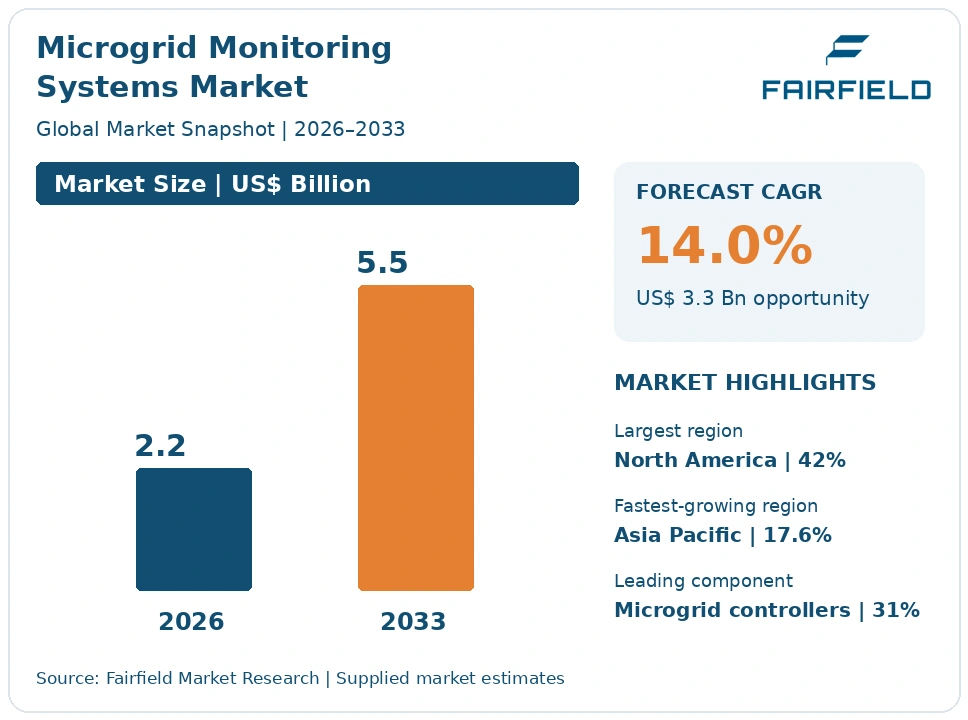
The global Microgrid Monitoring Systems market size is expected to be valued at US$ 2.2 billion in 2026 and projected to reach US$ 5.5 billion by 2033, growing at a CAGR of 14.0% between 2026 and 2033.
The precise 2026 estimate is US$ 2,210 million, rising to US$ 5,540 million by 2033. Between 2020 and 2025 the market expanded at roughly 11.8% a year, lifting value from about US$ 1,110 million to US$ 1,940 million. Three factors explain the faster forward pace. Publication of IEEE 2030.7 and IEEE 2030.8 gave buyers a way to specify and test controllers. Severe outage events pushed hospitals, data centres and military bases toward islandable supply. Finally, falling solar and battery costs multiplied the number of assets that need coordinated dispatch, which is work only a control layer can do.
Key Report Takeaways
- By Component: Microgrid Controllers held 31% share in 2026, while Monitoring and Control Software is projected to expand at a 16.8% CAGR through 2033, as buyers shift budget from fixed-function panels to upgradable dispatch applications.
- By Deployment Mode: On-Premise and Edge Control held 54% share in 2026, while Cloud-Hosted platforms are projected to grow at an 18.2% CAGR through 2033, driven by fleet operators managing many small sites from one remote operations desk.
- By Grid Connectivity: Grid-Connected systems held 57% share in 2026, while Islanded and Off-Grid deployments are projected to advance at a 16.1% CAGR through 2033, reflecting mining, island and remote-community electrification programmes.
- By End Use: Commercial and Industrial sites held 29% share in 2026, while Utility and Community microgrids are projected to rise at a 16.9% CAGR through 2033, supported by distribution-level resilience funding and feeder-segmentation projects.
- By Geography: North America held 42% revenue share in 2026, while Asia Pacific is projected to record a 17.6% CAGR through 2033, as island grids and industrial parks across the region add formal control layers.
Global Microgrid Monitoring Systems Market Trends and Insights
Drivers Impact Analysis
Two forces account for most of the incremental spending on microgrid control and monitoring through 2033.
| Driver | Impact on CAGR Forecast | Geographic Relevance | Impact Timeline |
| Resilience mandates and the rising cost of long outages at critical facilities | High | North America, Asia Pacific, Europe | Short term ≤2 years |
| Standardisation of controller specification and testing under IEEE 2030.7 and IEEE 2030.8 | Medium | Global | Medium term 2–4 years |
Outage Costs at Critical Facilities Are Pulling Microgrid Control Spending Forward
Resilience requirements are now the single largest source of demand for microgrid monitoring and control. Hospitals, water utilities, telecommunications hubs, data centres and defence installations cannot treat a multi-day outage as an acceptable risk, so they buy controllers that can detect a fault, island cleanly and resynchronise without an operator on site. Because the control layer is what converts a collection of generators and batteries into a dependable island, it is funded even when wider capital budgets tighten.
The mechanism is regulatory as much as commercial. Military installation energy resilience requirements oblige bases to prove they can carry critical loads independently for defined periods, and that proof depends on tested controller logic. State and federal resilience grants in the United States, issued after major storm and wildfire outages, fund hardening projects in which controls and islanding detection are mandatory scope items rather than optional additions.
IEEE 2030.7 and IEEE 2030.8 Made Microgrid Controllers a Specifiable, Testable Product
Standardisation has removed a procurement barrier that previously slowed orders for microgrid control systems. Before the controller standards existed, every project negotiated its own definition of islanding, dispatch and resynchronisation functions, which made bids difficult to compare and left owners exposed on acceptance. A defined functional specification and a matching test procedure let engineering firms write repeatable tender documents, and let utilities approve designs faster.
The causal chain runs from standards to interoperability to volume. IEEE 2030.7 sets out the control functions a microgrid controller must perform, and IEEE 2030.8 defines how those functions are verified. Alongside IEEE 1547 interconnection and interoperability requirements for distributed energy resources, and UL 3001 for distributed energy resource systems, the result is a product category with recognisable boundaries. Vendors can now sell configurable platforms instead of bespoke engineering, which lowers unit cost and widens the addressable base of smaller sites.
Restraints Impact Analysis
Two constraints hold back conversion of microgrid interest into commissioned control systems.
| Restraint | Impact on CAGR Forecast | Geographic Relevance | Impact Timeline |
| Interconnection study queues and slow utility approval of islanding schemes | High | North America, Europe | Medium term 2–4 years |
| Cybersecurity obligations that apply once controllers are networked | Medium | Global | Long term ≥4 years |
Interconnection Queues and Utility Approval Timelines Delay Microgrid Control Revenue
Interconnection processes are the most common reason a microgrid control contract slips a year or more. Vendors recognise revenue largely at commissioning, so a project that waits in a distribution study queue ties up engineering staff without generating income. The delay also invites scope change, because distributed energy resource prices and site loads move while the application sits unresolved, and the control design must then be revisited.
Two underlying causes sustain the problem. Utility engineering departments have limited staff to review islanding schemes, protection coordination and anti-islanding settings against IEEE 1547 and local National Electrical Code interconnection provisions, and each review is site-specific. Separately, there is still no standard commercial model for third-party-owned microgrids, so tariff treatment, exit terms and liability for islanded operation are negotiated case by case, extending legal review well beyond the technical approval itself.
Cybersecurity Obligations for Networked Controllers Raise Microgrid Lifecycle Costs
Security requirements increase the total cost of owning a microgrid monitoring system and deter some smaller buyers. Once a controller is reachable from a corporate network or a vendor cloud, it falls within the owner’s operational technology security scope. That brings patch management, access control, logging, network segmentation and periodic assessment, all of which are recurring costs that sit outside the original capital estimate.
The cost source is specific rather than general. Supervisory control and data acquisition links, remote monitoring gateways and metering networks each need hardened configurations and maintained certificates, and owners of critical facilities often require independent penetration testing before energisation. Utilities may also impose their own conditions before allowing a third-party control platform to exchange signals with distribution systems. For a site with modest load, these obligations can rival the price of the controller hardware, which pushes some owners back toward simpler manual transfer schemes.
Market Opportunities
Retrofitting Installed Backup Generation Fleets Opens a Software-Led Control Revenue Pool
The largest untapped revenue pool is the installed base of standby generators, solar arrays and batteries that run without any coordinating control layer. These sites already own the generation assets, so the sale is a controller, metering upgrade and dispatch software rather than a full build. Retrofit projects carry shorter approval cycles and higher software content, which lifts vendor margin compared with new-build microgrid programmes.
Integrators, electrical contractors and controls vendors are best placed to capture this pool, with campuses, hospitals, food processors and telecommunications operators forming the core demand base. Protection relay replacement cycles and revenue metering upgrades create natural entry points, because the site is already de-energised for work. Support comes from distributed energy resource management interfaces that now accept third-party inverters and generator controllers, which lets a retrofit coordinate mixed-vendor equipment without replacing it.
Monitoring-as-a-Service and Market Participation Build Recurring Microgrid Control Revenue
Recurring service contracts represent a second distinct revenue pool, separate from equipment demand. Remote monitoring centres, dispatch optimisation subscriptions and performance guarantees convert a one-time controller sale into an annual fee per site. For vendors managing many small installations, the economics improve with scale, because one operations desk can supervise hundreds of sites using the same analytics platform.
Owners of multi-site portfolios create the demand: retail chains, school districts, municipal utilities and telecommunications operators lack in-house operators for every location. FERC Order No. 2222 supports the pool by allowing aggregations of distributed energy resources to participate in wholesale markets, which gives a monitoring provider a measurable revenue stream to share with site owners. Accurate revenue metering and verified telemetry become billable services rather than overheads, since settlement depends on them.
Segment Analysis
By Component: Microgrid Controllers Lead While Monitoring and Control Software Gains Momentum
Microgrid Controllers held 31% of revenue in 2026, the largest component share, because every islandable system needs one and it is the item utilities review before approval. Controller hardware also carries the protection and resynchronisation logic that owners are least willing to improvise. Monitoring and Control Software is the fastest-growing component at a 16.8% CAGR to 2033, as dispatch optimisation, forecasting and distributed energy resource management functions move into upgradable applications. Protection relays, islanding detection devices and power quality and revenue metering hardware remain steady contributors, while services grow with retrofit activity. The business implication is a gradual shift in value from the panel to the application layer. Vendors that sell a controller without a software roadmap face shorter refresh cycles and weaker pricing power over the forecast period.
By Deployment Mode: On-Premise Edge Control Dominates as Cloud-Hosted Platforms Scale Fastest
On-Premise and Edge Control accounted for 54% of 2026 revenue, because islanding decisions must execute in milliseconds and cannot depend on a wide-area network link. Critical facilities and defence sites also restrict outbound connectivity, which keeps the decision logic local. Cloud-Hosted deployment is expanding fastest at an 18.2% CAGR, driven by operators of many small sites who need one view of fleet performance, alarms and energy settlement. Hybrid designs, where the edge controller runs protection and the cloud handles analytics and reporting, are becoming the default architecture for commercial portfolios. The practical consequence is that buyers increasingly evaluate vendors on data pipeline quality and cybersecurity posture, not only on control performance, and vendors without a credible hosted platform are excluded from multi-site tenders early.
By Grid Connectivity: Grid-Connected Systems Hold Scale While Islanded Deployments Accelerate
Grid-Connected microgrids represented 57% of 2026 revenue, reflecting the large number of campuses and industrial sites that import power normally and island only during disturbances. These systems need the fullest control scope, including anti-islanding, resynchronisation and export management, which raises their average selling price. Islanded and Off-Grid deployments grow fastest at a 16.1% CAGR, as mines, islands and remote settlements replace continuous diesel running with hybrid plants that require genuine dispatch optimisation to save fuel. Hybrid-capable designs that can switch between both modes are gaining ground where utility service is unreliable. For vendors, the split matters commercially: grid-connected work depends on utility approval timelines, while islanded projects are approved by the owner alone and convert to revenue considerably faster.
By End Use: Commercial and Industrial Sites Lead While Utility and Community Microgrids Grow Quickest
Commercial and Industrial sites held 29% of 2026 revenue, the leading end-use share, because manufacturers, data centres and logistics operators quantify downtime losses precisely and fund control upgrades from operating budgets. Utility and Community microgrids are the fastest-growing end use at a 16.9% CAGR, supported by resilience funding programmes and by distribution planners who now segment feeders so a damaged section can run independently. Military and defence installations remain a demanding buyer group, since energy resilience requirements oblige them to demonstrate islanded operation under test. Institutional campuses, including universities and hospitals, provide steady replacement demand for ageing supervisory systems. The implication is that vendors need both a project business serving private sites and a regulated-utility practice able to handle longer procurement and documentation requirements.
Geography Analysis
Which Region Is Leading the Microgrid Monitoring Systems Market?
North America leads the microgrid monitoring systems market with 42% revenue share in 2026 and an expected 12.6% CAGR to 2033. The United States supplies most of that value, with Canada contributing remote-community and mining projects. Three causes stand out. Repeated storm, wildfire and winter-storm outages made resilience a board-level issue for hospitals, utilities and data centre operators. Federal and state grant programmes fund hardening work in which controls and islanding detection are mandatory scope. Military installation energy resilience requirements create a steady, specification-driven buyer. The region also hosts most of the engineering firms that write microgrid tender documents, which concentrates early adoption of standardised controller specifications. The main change ahead is distribution-level feeder segmentation by utilities, which converts one-off campus projects into repeatable programmes.
Europe Ties Microgrid Control Demand to Grid Codes and Industrial Decarbonisation
Europe held 24% of 2026 revenue and is set to grow at 13.5% annually through 2033, making it the second-largest regional market. Germany, Italy, Spain, France and the United Kingdom drive most activity, alongside island systems in Greece and the Canary Islands. Demand is shaped less by storm resilience and more by grid codes, high industrial electricity prices and self-consumption rules that reward precise dispatch of on-site generation. Industrial decarbonisation programmes add heat pumps, electrolysers and electric vehicle charging to sites that previously had simple loads, and those assets need coordinated control to avoid breaching connection capacity. Energy community rules in several member states support shared local supply arrangements. The constraint is slow distribution network operator approval, which lengthens project timelines even where the business case is clear.
Which Region Is Growing Fastest in the Microgrid Monitoring Systems Market?
Asia Pacific is growing fastest, at a 17.6% CAGR between 2026 and 2033, from a 23% revenue share in 2026. China, India, Japan, Australia, Indonesia and the Philippines account for most of the expansion. The drivers differ by country. Island and archipelago electrification programmes in Indonesia and the Philippines replace continuous diesel running with hybrid plants that need dispatch optimisation to cut fuel use. India adds industrial-park and telecom-tower installations where supply quality is poor. Australia builds remote mining and fringe-of-grid systems. Japan continues post-disaster resilience work at municipal facilities. Rapid solar and battery deployment across the region creates coordination problems that only a control layer resolves. Inconsistent interconnection rules between jurisdictions remain the principal obstacle to faster standardisation.
Latin America Turns to Islanded Microgrid Control for Mining and Remote Communities
Latin America accounted for 6% of 2026 revenue and is projected to grow at 14.2% a year through 2033. Chile, Brazil, Mexico, Peru and Colombia lead, with demand concentrated in mining operations, agro-industrial sites and remote communities beyond the reach of reliable distribution. Mines in northern Chile and Peru pair solar with storage and need dispatch control to displace diesel at sites where fuel logistics are expensive. Rural electrification programmes add smaller hybrid systems with basic remote monitoring. The barriers are real: currency volatility raises imported equipment costs, financing tenors are short, and trained commissioning engineers are scarce outside major cities. The opportunity lies in remote operations contracts, which let a regional service centre supervise dispersed sites without stationing staff at each location.
Middle East & Africa Applies Microgrid Monitoring to Off-Grid Electrification and Industrial Sites
Middle East & Africa represented 5% of 2026 revenue, with growth of about 13.8% annually to 2033. Activity splits between Gulf states and sub-Saharan markets. Saudi Arabia, the United Arab Emirates and Oman add control systems at industrial, desalination and remote oilfield sites where solar now displaces gas or diesel generation. Nigeria, Kenya, South Africa and Tanzania deploy mini-grids and commercial rooftop-plus-storage systems where grid supply is unreliable or absent. Barriers include limited local technical support, weak payment enforcement for mini-grid operators, and import duties that raise system costs. The shaping change is the move from simple metering to full remote monitoring, since lenders financing mini-grid portfolios now require verified performance data before releasing later funding tranches.
Competitive Landscape
The microgrid monitoring systems market is moderately concentrated. A group of large electrical and automation suppliers holds the majority of controller and protection revenue, because utility buyers favour vendors that can also supply switchgear, relays and long-term support. Schneider Electric SE, Siemens AG, ABB Ltd, Eaton Corporation plc and Hitachi Energy Ltd each carry recognised distribution automation portfolios that microgrid control extends naturally. Below them sits a long tail of specialist controls and software firms, systems integrators and engineering contractors, which keeps the software layer genuinely competitive. Consolidation has generally taken the form of larger suppliers absorbing control-software specialists rather than merging with each other.
Competition turns on a narrow set of factors. Buyers assess conformance to IEEE 2030.7 and IEEE 2030.8, interoperability with third-party inverters and generators under IEEE 1547, the quality of islanding and resynchronisation performance, cybersecurity documentation, and the ability to support a site remotely for a decade or more. Price matters less than demonstrated test results, because a failed island is far costlier than the controller. New entrants arrive mainly from the software side, including distributed energy resource management and analytics firms that add dispatch optimisation without manufacturing hardware.
Strategically, vendors are moving in similar directions. They are separating fast protection logic at the edge from analytics in hosted platforms, broadening open interfaces so mixed-vendor fleets can be coordinated, building managed-service operations to earn recurring fees, and investing in security certification to satisfy critical-infrastructure owners. Tesla, Inc., S&C Electric Company, Caterpillar Inc. and Yokogawa Electric Corporation illustrate how differently positioned firms, from battery suppliers to generator and process-control specialists, approach the same control layer.
Microgrid Monitoring Systems Industry Leaders
- Schneider Electric SE
- Siemens AG
- ABB Ltd
- Eaton Corporation plc
- S&C Electric Company
Recent Industry Developments
August 2022: The Inflation Reduction Act in the United States made microgrid controllers eligible energy property for the investment tax credit, for systems capable of serving loads up to 20 MW – this placed the control layer, not only generation, inside a federal incentive for the first time.
November 2021: The Infrastructure Investment and Jobs Act authorised US Department of Energy grid resilience and innovation funding – the resulting state and utility programmes routinely scope microgrid controls and islanding detection as required deliverables.
September 2020: FERC issued Order No. 2222, requiring regional markets to allow aggregations of distributed energy resources to participate – this created a measurable revenue stream that depends on verified telemetry and revenue-grade metering.
2018: IEEE 1547-2018 revised interconnection and interoperability requirements for distributed energy resources, adding voltage and frequency ride-through and communication provisions – it set the interface that microgrid controllers must satisfy.
2017: IEEE 2030.7 established the functional specification for microgrid controllers, followed by IEEE 2030.8 for controller testing – together they turned a bespoke engineering scope into a comparable, verifiable product category.
Microgrid Monitoring Systems Market Report Scope
| Metric | Value |
| Study Period | 2020–2033 |
| Market Size 2026 | US$ 2.2 Billion |
| Market Size 2033 | US$ 5.5 Billion |
| CAGR 2026–2033 | 14.0% |
| Absolute Dollar Opportunity | US$ 3.3 Billion |
| Largest Market | North America, 42% share in 2026 |
| Fastest-Growing Market | Asia Pacific, 17.6% CAGR |
| Market Concentration | Medium |
| Major Players | Schneider Electric SE, Siemens AG, ABB Ltd, Eaton Corporation plc |
This report covers the monitoring, control and energy management layer of microgrids. It includes controllers, supervisory control and data acquisition, protection relays, islanding detection, power quality and revenue metering, distributed energy resource management interfaces, remote monitoring platforms, dispatch optimisation software and related services. Generation, storage and switchgear hardware are excluded. The base year is 2025, and the forecast period runs from 2026 to 2033, with all values expressed in US$ Billion.
Microgrid Monitoring Systems Market Segmentation
Component
- Microgrid Controllers
- Protection Relays and Islanding Detection Devices
- Power Quality and Revenue Metering Devices
- Monitoring and Control Software
- Services
Deployment Mode
- On-Premise and Edge Control
- Cloud-Hosted
- Hybrid
Grid Connectivity
- Grid-Connected
- Islanded and Off-Grid
- Hybrid-Capable
End Use
- Commercial and Industrial
- Utility and Community
- Military and Defence
- Institutional and Campus
- Remote and Off-Grid Communities
Regions
- North America
- Europe
- Asia Pacific
- Latin America
- Middle East & Africa
- Executive Summary
- Global Microgrid Monitoring Systems Market Snapshot
- Future Projections
- Key Report Takeaways
- Regional Snapshot
- Market Overview
- Market Definition and Report Scope
- Historical Trends 2020–2025
- Market Dynamics
- Drivers
- Outage Costs at Critical Facilities Are Pulling Microgrid Control Spending Forward
- IEEE 2030.7 and IEEE 2030.8 Made Microgrid Controllers a Specifiable, Testable Product
- Restraints
- Interconnection Queues and Utility Approval Timelines Delay Microgrid Control Revenue
- Cybersecurity Obligations for Networked Controllers Raise Microgrid Lifecycle Costs
- Market Opportunities
- Retrofitting Installed Backup Generation Fleets Opens a Software-Led Control Revenue Pool
- Monitoring-as-a-Service and Market Participation Build Recurring Microgrid Control Revenue
- Drivers
- Global Microgrid Monitoring Systems Market Outlook, 2020–2033
- Global Microgrid Monitoring Systems Market Outlook, by Component, Value (US$ Billion), 2020–2033
- Microgrid Controllers
- Protection Relays and Islanding Detection Devices
- Power Quality and Revenue Metering Devices
- Monitoring and Control Software
- Services
- Global Microgrid Monitoring Systems Market Outlook, by Deployment Mode, Value (US$ Billion), 2020–2033
- On-Premise and Edge Control
- Cloud-Hosted
- Hybrid
- Global Microgrid Monitoring Systems Market Outlook, by Grid Connectivity, Value (US$ Billion), 2020–2033
- Grid-Connected
- Islanded and Off-Grid
- Hybrid-Capable
- Global Microgrid Monitoring Systems Market Outlook, by End Use, Value (US$ Billion), 2020–2033
- Commercial and Industrial
- Utility and Community
- Military and Defence
- Institutional and Campus
- Remote and Off-Grid Communities
- Global Microgrid Monitoring Systems Market Outlook, by Region, Value (US$ Billion), 2020–2033
- North America
- Europe
- Asia Pacific
- Latin America
- Middle East & Africa
- Global Microgrid Monitoring Systems Market Outlook, by Component, Value (US$ Billion), 2020–2033
- North America Microgrid Monitoring Systems Market Outlook, 2020–2033
- North America Microgrid Monitoring Systems Market Outlook, by Component, Value (US$ Billion), 2020–2033
- Microgrid Controllers
- Protection Relays and Islanding Detection Devices
- Power Quality and Revenue Metering Devices
- Monitoring and Control Software
- Services
- North America Microgrid Monitoring Systems Market Outlook, by Deployment Mode, Value (US$ Billion), 2020–2033
- On-Premise and Edge Control
- Cloud-Hosted
- Hybrid
- North America Microgrid Monitoring Systems Market Outlook, by Grid Connectivity, Value (US$ Billion), 2020–2033
- Grid-Connected
- Islanded and Off-Grid
- Hybrid-Capable
- North America Microgrid Monitoring Systems Market Outlook, by End Use, Value (US$ Billion), 2020–2033
- Commercial and Industrial
- Utility and Community
- Military and Defence
- Institutional and Campus
- Remote and Off-Grid Communities
- North America Microgrid Monitoring Systems Market Outlook, by Country, Value (US$ Billion), 2020–2033
- United States Microgrid Monitoring Systems Market Outlook, by Component, 2020–2033
- United States Microgrid Monitoring Systems Market Outlook, by Deployment Mode, 2020–2033
- United States Microgrid Monitoring Systems Market Outlook, by Grid Connectivity, 2020–2033
- United States Microgrid Monitoring Systems Market Outlook, by End Use, 2020–2033
- Canada Microgrid Monitoring Systems Market Outlook, by Component, 2020–2033
- Canada Microgrid Monitoring Systems Market Outlook, by Deployment Mode, 2020–2033
- Canada Microgrid Monitoring Systems Market Outlook, by Grid Connectivity, 2020–2033
- Canada Microgrid Monitoring Systems Market Outlook, by End Use, 2020–2033
- North America Microgrid Monitoring Systems Market Outlook, by Component, Value (US$ Billion), 2020–2033
- Europe Microgrid Monitoring Systems Market Outlook, 2020–2033
- Europe Microgrid Monitoring Systems Market Outlook, by Component, Value (US$ Billion), 2020–2033
- Microgrid Controllers
- Protection Relays and Islanding Detection Devices
- Power Quality and Revenue Metering Devices
- Monitoring and Control Software
- Services
- Europe Microgrid Monitoring Systems Market Outlook, by Deployment Mode, Value (US$ Billion), 2020–2033
- On-Premise and Edge Control
- Cloud-Hosted
- Hybrid
- Europe Microgrid Monitoring Systems Market Outlook, by Grid Connectivity, Value (US$ Billion), 2020–2033
- Grid-Connected
- Islanded and Off-Grid
- Hybrid-Capable
- Europe Microgrid Monitoring Systems Market Outlook, by End Use, Value (US$ Billion), 2020–2033
- Commercial and Industrial
- Utility and Community
- Military and Defence
- Institutional and Campus
- Remote and Off-Grid Communities
- Europe Microgrid Monitoring Systems Market Outlook, by Country, Value (US$ Billion), 2020–2033
- Germany Microgrid Monitoring Systems Market Outlook, by Component, 2020–2033
- Germany Microgrid Monitoring Systems Market Outlook, by Deployment Mode, 2020–2033
- Germany Microgrid Monitoring Systems Market Outlook, by Grid Connectivity, 2020–2033
- Germany Microgrid Monitoring Systems Market Outlook, by End Use, 2020–2033
- Italy Microgrid Monitoring Systems Market Outlook, by Component, 2020–2033
- Italy Microgrid Monitoring Systems Market Outlook, by Deployment Mode, 2020–2033
- Italy Microgrid Monitoring Systems Market Outlook, by Grid Connectivity, 2020–2033
- Italy Microgrid Monitoring Systems Market Outlook, by End Use, 2020–2033
- Spain Microgrid Monitoring Systems Market Outlook, by Component, 2020–2033
- Spain Microgrid Monitoring Systems Market Outlook, by Deployment Mode, 2020–2033
- Spain Microgrid Monitoring Systems Market Outlook, by Grid Connectivity, 2020–2033
- Spain Microgrid Monitoring Systems Market Outlook, by End Use, 2020–2033
- France Microgrid Monitoring Systems Market Outlook, by Component, 2020–2033
- France Microgrid Monitoring Systems Market Outlook, by Deployment Mode, 2020–2033
- France Microgrid Monitoring Systems Market Outlook, by Grid Connectivity, 2020–2033
- France Microgrid Monitoring Systems Market Outlook, by End Use, 2020–2033
- United Kingdom Microgrid Monitoring Systems Market Outlook, by Component, 2020–2033
- United Kingdom Microgrid Monitoring Systems Market Outlook, by Deployment Mode, 2020–2033
- United Kingdom Microgrid Monitoring Systems Market Outlook, by Grid Connectivity, 2020–2033
- United Kingdom Microgrid Monitoring Systems Market Outlook, by End Use, 2020–2033
- Greece Microgrid Monitoring Systems Market Outlook, by Component, 2020–2033
- Greece Microgrid Monitoring Systems Market Outlook, by Deployment Mode, 2020–2033
- Greece Microgrid Monitoring Systems Market Outlook, by Grid Connectivity, 2020–2033
- Greece Microgrid Monitoring Systems Market Outlook, by End Use, 2020–2033
- Canary Islands Microgrid Monitoring Systems Market Outlook, by Component, 2020–2033
- Canary Islands Microgrid Monitoring Systems Market Outlook, by Deployment Mode, 2020–2033
- Canary Islands Microgrid Monitoring Systems Market Outlook, by Grid Connectivity, 2020–2033
- Canary Islands Microgrid Monitoring Systems Market Outlook, by End Use, 2020–2033
- Europe Microgrid Monitoring Systems Market Outlook, by Component, Value (US$ Billion), 2020–2033
- Asia Pacific Microgrid Monitoring Systems Market Outlook, 2020–2033
- Asia Pacific Microgrid Monitoring Systems Market Outlook, by Component, Value (US$ Billion), 2020–2033
- Microgrid Controllers
- Protection Relays and Islanding Detection Devices
- Power Quality and Revenue Metering Devices
- Monitoring and Control Software
- Services
- Asia Pacific Microgrid Monitoring Systems Market Outlook, by Deployment Mode, Value (US$ Billion), 2020–2033
- On-Premise and Edge Control
- Cloud-Hosted
- Hybrid
- Asia Pacific Microgrid Monitoring Systems Market Outlook, by Grid Connectivity, Value (US$ Billion), 2020–2033
- Grid-Connected
- Islanded and Off-Grid
- Hybrid-Capable
- Asia Pacific Microgrid Monitoring Systems Market Outlook, by End Use, Value (US$ Billion), 2020–2033
- Commercial and Industrial
- Utility and Community
- Military and Defence
- Institutional and Campus
- Remote and Off-Grid Communities
- Asia Pacific Microgrid Monitoring Systems Market Outlook, by Country, Value (US$ Billion), 2020–2033
- China Microgrid Monitoring Systems Market Outlook, by Component, 2020–2033
- China Microgrid Monitoring Systems Market Outlook, by Deployment Mode, 2020–2033
- China Microgrid Monitoring Systems Market Outlook, by Grid Connectivity, 2020–2033
- China Microgrid Monitoring Systems Market Outlook, by End Use, 2020–2033
- India Microgrid Monitoring Systems Market Outlook, by Component, 2020–2033
- India Microgrid Monitoring Systems Market Outlook, by Deployment Mode, 2020–2033
- India Microgrid Monitoring Systems Market Outlook, by Grid Connectivity, 2020–2033
- India Microgrid Monitoring Systems Market Outlook, by End Use, 2020–2033
- Japan Microgrid Monitoring Systems Market Outlook, by Component, 2020–2033
- Japan Microgrid Monitoring Systems Market Outlook, by Deployment Mode, 2020–2033
- Japan Microgrid Monitoring Systems Market Outlook, by Grid Connectivity, 2020–2033
- Japan Microgrid Monitoring Systems Market Outlook, by End Use, 2020–2033
- Australia Microgrid Monitoring Systems Market Outlook, by Component, 2020–2033
- Australia Microgrid Monitoring Systems Market Outlook, by Deployment Mode, 2020–2033
- Australia Microgrid Monitoring Systems Market Outlook, by Grid Connectivity, 2020–2033
- Australia Microgrid Monitoring Systems Market Outlook, by End Use, 2020–2033
- Indonesia Microgrid Monitoring Systems Market Outlook, by Component, 2020–2033
- Indonesia Microgrid Monitoring Systems Market Outlook, by Deployment Mode, 2020–2033
- Indonesia Microgrid Monitoring Systems Market Outlook, by Grid Connectivity, 2020–2033
- Indonesia Microgrid Monitoring Systems Market Outlook, by End Use, 2020–2033
- Philippines Microgrid Monitoring Systems Market Outlook, by Component, 2020–2033
- Philippines Microgrid Monitoring Systems Market Outlook, by Deployment Mode, 2020–2033
- Philippines Microgrid Monitoring Systems Market Outlook, by Grid Connectivity, 2020–2033
- Philippines Microgrid Monitoring Systems Market Outlook, by End Use, 2020–2033
- Asia Pacific Microgrid Monitoring Systems Market Outlook, by Component, Value (US$ Billion), 2020–2033
- Latin America Microgrid Monitoring Systems Market Outlook, 2020–2033
- Latin America Microgrid Monitoring Systems Market Outlook, by Component, Value (US$ Billion), 2020–2033
- Microgrid Controllers
- Protection Relays and Islanding Detection Devices
- Power Quality and Revenue Metering Devices
- Monitoring and Control Software
- Services
- Latin America Microgrid Monitoring Systems Market Outlook, by Deployment Mode, Value (US$ Billion), 2020–2033
- On-Premise and Edge Control
- Cloud-Hosted
- Hybrid
- Latin America Microgrid Monitoring Systems Market Outlook, by Grid Connectivity, Value (US$ Billion), 2020–2033
- Grid-Connected
- Islanded and Off-Grid
- Hybrid-Capable
- Latin America Microgrid Monitoring Systems Market Outlook, by End Use, Value (US$ Billion), 2020–2033
- Commercial and Industrial
- Utility and Community
- Military and Defence
- Institutional and Campus
- Remote and Off-Grid Communities
- Latin America Microgrid Monitoring Systems Market Outlook, by Country, Value (US$ Billion), 2020–2033
- Chile Microgrid Monitoring Systems Market Outlook, by Component, 2020–2033
- Chile Microgrid Monitoring Systems Market Outlook, by Deployment Mode, 2020–2033
- Chile Microgrid Monitoring Systems Market Outlook, by Grid Connectivity, 2020–2033
- Chile Microgrid Monitoring Systems Market Outlook, by End Use, 2020–2033
- Brazil Microgrid Monitoring Systems Market Outlook, by Component, 2020–2033
- Brazil Microgrid Monitoring Systems Market Outlook, by Deployment Mode, 2020–2033
- Brazil Microgrid Monitoring Systems Market Outlook, by Grid Connectivity, 2020–2033
- Brazil Microgrid Monitoring Systems Market Outlook, by End Use, 2020–2033
- Mexico Microgrid Monitoring Systems Market Outlook, by Component, 2020–2033
- Mexico Microgrid Monitoring Systems Market Outlook, by Deployment Mode, 2020–2033
- Mexico Microgrid Monitoring Systems Market Outlook, by Grid Connectivity, 2020–2033
- Mexico Microgrid Monitoring Systems Market Outlook, by End Use, 2020–2033
- Peru Microgrid Monitoring Systems Market Outlook, by Component, 2020–2033
- Peru Microgrid Monitoring Systems Market Outlook, by Deployment Mode, 2020–2033
- Peru Microgrid Monitoring Systems Market Outlook, by Grid Connectivity, 2020–2033
- Peru Microgrid Monitoring Systems Market Outlook, by End Use, 2020–2033
- Colombia Microgrid Monitoring Systems Market Outlook, by Component, 2020–2033
- Colombia Microgrid Monitoring Systems Market Outlook, by Deployment Mode, 2020–2033
- Colombia Microgrid Monitoring Systems Market Outlook, by Grid Connectivity, 2020–2033
- Colombia Microgrid Monitoring Systems Market Outlook, by End Use, 2020–2033
- Latin America Microgrid Monitoring Systems Market Outlook, by Component, Value (US$ Billion), 2020–2033
- Middle East & Africa Microgrid Monitoring Systems Market Outlook, 2020–2033
- Middle East & Africa Microgrid Monitoring Systems Market Outlook, by Component, Value (US$ Billion), 2020–2033
- Microgrid Controllers
- Protection Relays and Islanding Detection Devices
- Power Quality and Revenue Metering Devices
- Monitoring and Control Software
- Services
- Middle East & Africa Microgrid Monitoring Systems Market Outlook, by Deployment Mode, Value (US$ Billion), 2020–2033
- On-Premise and Edge Control
- Cloud-Hosted
- Hybrid
- Middle East & Africa Microgrid Monitoring Systems Market Outlook, by Grid Connectivity, Value (US$ Billion), 2020–2033
- Grid-Connected
- Islanded and Off-Grid
- Hybrid-Capable
- Middle East & Africa Microgrid Monitoring Systems Market Outlook, by End Use, Value (US$ Billion), 2020–2033
- Commercial and Industrial
- Utility and Community
- Military and Defence
- Institutional and Campus
- Remote and Off-Grid Communities
- Middle East & Africa Microgrid Monitoring Systems Market Outlook, by Country, Value (US$ Billion), 2020–2033
- Saudi Arabia Microgrid Monitoring Systems Market Outlook, by Component, 2020–2033
- Saudi Arabia Microgrid Monitoring Systems Market Outlook, by Deployment Mode, 2020–2033
- Saudi Arabia Microgrid Monitoring Systems Market Outlook, by Grid Connectivity, 2020–2033
- Saudi Arabia Microgrid Monitoring Systems Market Outlook, by End Use, 2020–2033
- United Arab Emirates Microgrid Monitoring Systems Market Outlook, by Component, 2020–2033
- United Arab Emirates Microgrid Monitoring Systems Market Outlook, by Deployment Mode, 2020–2033
- United Arab Emirates Microgrid Monitoring Systems Market Outlook, by Grid Connectivity, 2020–2033
- United Arab Emirates Microgrid Monitoring Systems Market Outlook, by End Use, 2020–2033
- Oman Microgrid Monitoring Systems Market Outlook, by Component, 2020–2033
- Oman Microgrid Monitoring Systems Market Outlook, by Deployment Mode, 2020–2033
- Oman Microgrid Monitoring Systems Market Outlook, by Grid Connectivity, 2020–2033
- Oman Microgrid Monitoring Systems Market Outlook, by End Use, 2020–2033
- Nigeria Microgrid Monitoring Systems Market Outlook, by Component, 2020–2033
- Nigeria Microgrid Monitoring Systems Market Outlook, by Deployment Mode, 2020–2033
- Nigeria Microgrid Monitoring Systems Market Outlook, by Grid Connectivity, 2020–2033
- Nigeria Microgrid Monitoring Systems Market Outlook, by End Use, 2020–2033
- Kenya Microgrid Monitoring Systems Market Outlook, by Component, 2020–2033
- Kenya Microgrid Monitoring Systems Market Outlook, by Deployment Mode, 2020–2033
- Kenya Microgrid Monitoring Systems Market Outlook, by Grid Connectivity, 2020–2033
- Kenya Microgrid Monitoring Systems Market Outlook, by End Use, 2020–2033
- South Africa Microgrid Monitoring Systems Market Outlook, by Component, 2020–2033
- South Africa Microgrid Monitoring Systems Market Outlook, by Deployment Mode, 2020–2033
- South Africa Microgrid Monitoring Systems Market Outlook, by Grid Connectivity, 2020–2033
- South Africa Microgrid Monitoring Systems Market Outlook, by End Use, 2020–2033
- Tanzania Microgrid Monitoring Systems Market Outlook, by Component, 2020–2033
- Tanzania Microgrid Monitoring Systems Market Outlook, by Deployment Mode, 2020–2033
- Tanzania Microgrid Monitoring Systems Market Outlook, by Grid Connectivity, 2020–2033
- Tanzania Microgrid Monitoring Systems Market Outlook, by End Use, 2020–2033
- Middle East & Africa Microgrid Monitoring Systems Market Outlook, by Component, Value (US$ Billion), 2020–2033
- Competitive Landscape
- Market Concentration and Industry Leaders
- Competitive Differentiation
- Strategic Moves and Market Direction
- Recent Industry Developments
- Company Profiles
- Schneider Electric SE
- Siemens AG
- ABB Ltd
- GE Vernova Inc.
- Eaton Corporation plc
- Honeywell International Inc.
- Hitachi Energy Ltd
- S&C Electric Company
- Emerson Electric Co.
- Rockwell Automation, Inc.
- Yokogawa Electric Corporation
- Tesla, Inc.
- Caterpillar Inc.
- Appendix
- Research Methodology
- Report Assumptions
- Acronyms and Abbreviations
Component
- Microgrid Controllers
- Protection Relays and Islanding Detection Devices
- Power Quality and Revenue Metering Devices
- Monitoring and Control Software
- Services
Deployment Mode
- On-Premise and Edge Control
- Cloud-Hosted
- Hybrid
Grid Connectivity
- Grid-Connected
- Islanded and Off-Grid
- Hybrid-Capable
End Use
- Commercial and Industrial
- Utility and Community
- Military and Defence
- Institutional and Campus
- Remote and Off-Grid Communities
Regions
- North America
- Europe
- Asia Pacific
- Latin America
- Middle East & Africa
Our Research Methodology
Considering the volatility of business today, traditional approaches to strategizing a game plan can be unfruitful if not detrimental. True ambiguity is no way to determine a forecast. A myriad of predetermined factors must be accounted for such as the degree of risk involved, the magnitude of circumstances, as well as conditions or consequences that are not known or unpredictable. To circumvent binary views that cast uncertainty, the application of market research intelligence to strategically posture, move, and enable actionable outcomes is necessary.
View Methodology
Quality Assured
Rigorous Validation Process

Confidentiality Assured
End-to-end Data Security

Custom Research Services
Tailored To Your Objectives
FAQs
The market is valued at US$ 2.2 billion in 2026, covering controllers, protection, metering, monitoring software and related services for microgrid operation.
Revenue is projected to reach US$ 5.5 billion by 2033, expanding at a 14.0% CAGR and adding US$ 3.3 billion of absolute opportunity.
Microgrid Controllers lead with 31% share in 2026, because every islandable system requires one and utilities review it before granting approval.
Cloud-Hosted deployment grows fastest at an 18.2% CAGR, while Asia Pacific is the quickest-expanding region at a 17.6% CAGR through 2033.
North America holds 42% share in 2026, and competition is moderately concentrated among large electrical suppliers alongside specialist control-software firms.
Related Reports
Steam Turbine Aftermarket Size, Share, Insights, Competitive Landscape, and Forecast 2026 to 2033
The Steam Turbine Aftermarket is projected to rise from US$ 4.56 billion in 2026 to US$ 6.29 billion by 2033 at a 4.7% CAGR. Explore key service trends.
Power EPC Market Size, Share, Insights, Competitive Landscape, and Forecast 2026 to 2033
Power EPC Market is projected to rise from US$ 780.56 billion in 2026 to US$ 1,220.97 billion by 2033 at a 6.6% CAGR. Explore generation and project trends.
Port Electrification Market Size, Share, Insights, Competitive Landscape, and Forecast 2026 to 2033
Explore the port electrification market, valued at US$ 6.8 billion in 2026 and forecast to reach US$ 16.4 billion by 2033, growing at a 13.4% CAGR.
Polycrystalline Solar Cell Market Size, Share, Insights, Competitive Landscape, and Forecast 2026 to 2033
Explore the polycrystalline solar cell market, valued at US$ 5.4 billion in 2026 and projected to reach US$ 6.6 billion by 2033, growing at 2.9% CAGR.
Synchronous Condenser Market Size, Share, Insights, Competitive Landscape, and Forecast 2026 to 2033
The global synchronous condenser market is valued at US$1.20 billion in 2026, reaching US$1.50 billion by 2033, growing at a 3.2% CAGR
Water and Wastewater Treatment Market Size, Share, Insights, Competitive Landscape, and Forecast 2026 to 2033
Water and wastewater treatment market to reach US$ 508.0 billion by 2033 from US$ 345.0 billion in 2026 at a 5.7% CAGR. Explore trends, segments and regions.