



Polyvinyl Chloride Market
Global Polyvinyl Chloride Industry Analysis, Size, Share, Growth, Trends, and Forecast 2026-2033 – (By Product Type, By End-User,By Application, By Geographic Coverage and By Company)
Global Polyvinyl Chloride Market: Strategic Analysis 2026-2033
Executive Summary & Key Highlights
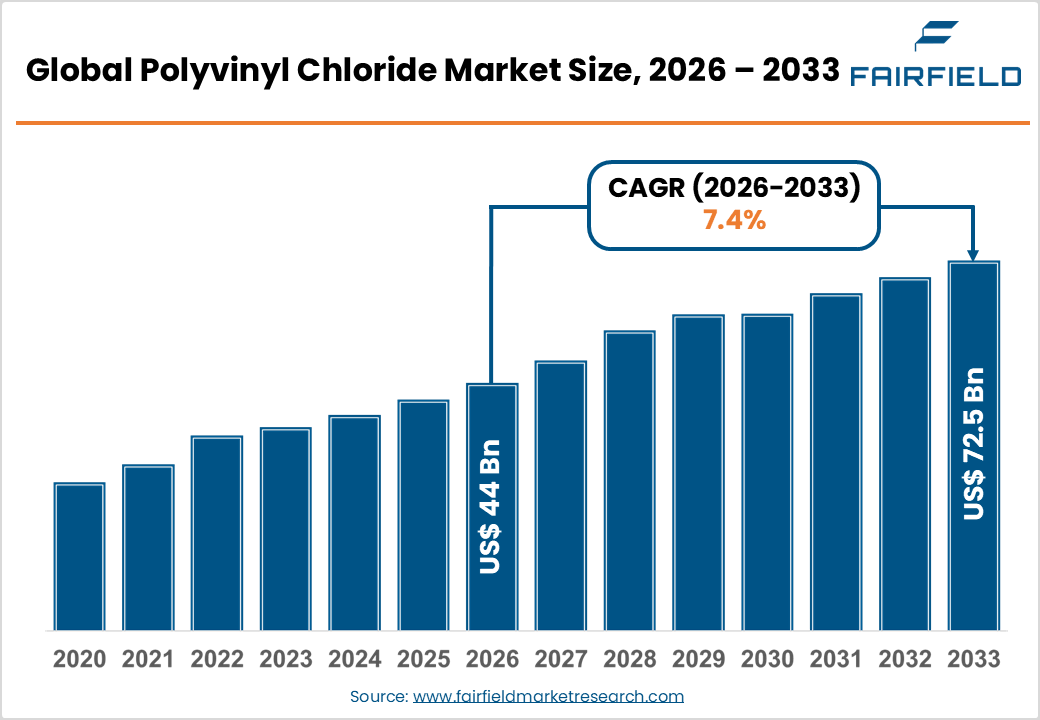
- The Polyvinyl Chloride Market reached approximately US$44 billion in 2026 and projects to US$72.5 billion by 2033 at 7.4% CAGR, reflecting construction demand and regional shifts; stakeholders should prioritize segment-specific positioning amid regulatory pressures.
- Rigid PVC leads with 61.4% share , driven by pipes and profiles; Flexible trails but shows relative acceleration in cables and films .
- Construction commands 69.3% share, anchored in infrastructure; Transportation emerges as fastest growing due to automotive lightweighting .
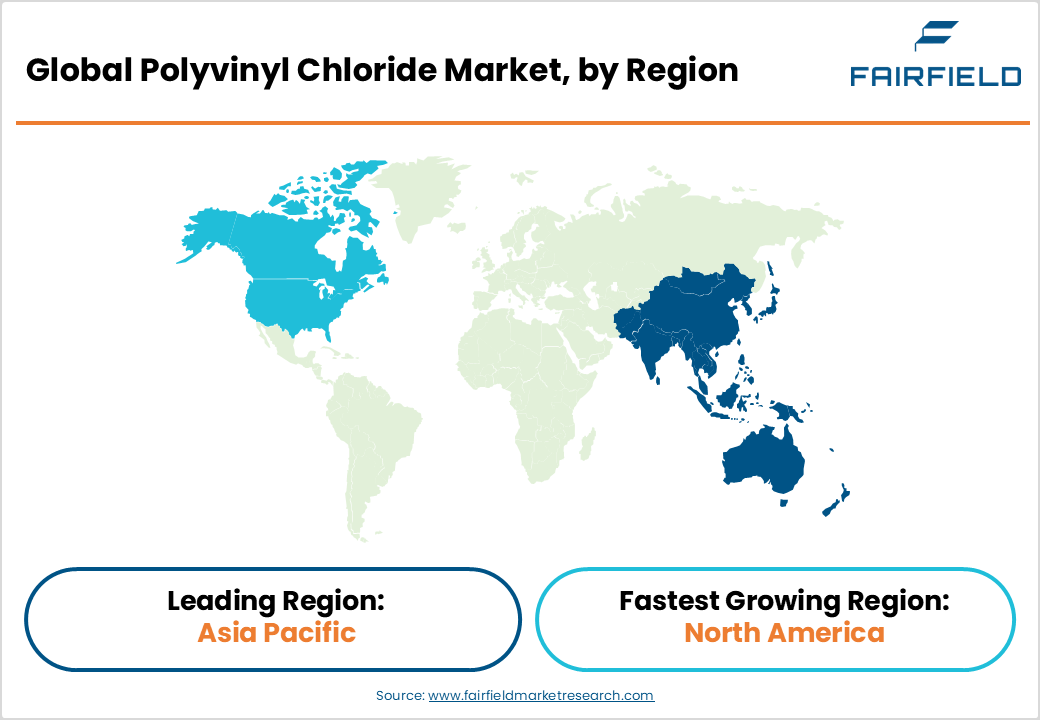
- Asia Pacific holds ~59% global volume share in 2025-2026, led by China; North America (U.S. ~78% regional) and Europe follow with mature construction focus.
- Urbanization drives Asia Pacific expansion; regulatory constraints temper Europe/North America; opportunities lie in sustainable formulations.
- Firms must navigate end-user shifts and regional regulations; construction reliance exposes risks from economic cycles.
Market Dynamics: Drivers, Restraints, and Opportunities Analysis
Market Drivers
- Urbanization and Infrastructure Demand
Urbanization and Infrastructure Demand drives the PVC market, with Construction holding a 69.3% end-user share that underscores its dominance. Global projects aim to accommodate 2.5 billion additional urban residents by 2050 , fueling demand for Rigid PVC where pipes and fittings represent 49.4% usage, contributing approximately 4 percentage points to the CAGR through 2033, particularly in Asia Pacific . Public infrastructure spending reaches US$9 trillion annually , amplifying expansion through localized investments. Firms optimizing supply chains achieve margin stability, though VCM price spikes noted in ICIS 2025 data highlight ethylene supply risks requiring vigilant monitoring.
- Automotive Lightweighting and Electrical Infrastructure Expansion
Automotive Lightweighting and Electrical Infrastructure Expansion further propel growth. Transportation benefits from EV mandates like EU CO2 targets, where PVC in interiors and cables cuts vehicle weight by 10% , accelerating the segment and adding ~1.5 points to overall CAGR alongside 15% U.S. EV penetration. Concurrently, grid modernization under IEA Net Zero 2025 goals boosts Flexible PVC, insulating 70% of new lines with a 7.3% sub-segment CAGR, especially in U.S. renewables markets . Vertical integration counters resin substitution risks, while raw material dependencies persist.
Market Restraints
- Regulatory and Environmental Pressures
Regulatory and Environmental Pressures pose significant challenges to PVC market expansion, as EU REACH and U.S. TSCA regulations restrict phthalates and additives, suppressing approximately 2% of overall growth. ECHA 2025 data highlights regional compliance costs at €500 million, particularly burdening Europe where volume growth lags at a 2.59% CAGR . These constraints drive mitigation efforts toward bio-based alternatives, though scale-up delays continue to compress margins for producers. Market participants must integrate regulatory foresight into long-term planning to navigate additive reformulations and associated certification timelines, ensuring alignment with evolving environmental standards.
- Raw Material Volatility
Raw Material Volatility further hampers performance, with ethylene and VCM prices fluctuating 20% in 2025 according to ICIS data, disproportionately affecting cost-sensitive Flexible PVC applications. Analyst estimates attribute a 1-1.5 percentage point drag to the overall CAGR from these swings. Supply chain diversification strategies, such as U.S. shale gas utilization, offer partial mitigation as evidenced by OPEC assessments, yet global dependencies persist. Organizations should prioritize feedstock hedging and multi-regional sourcing to stabilize costs, while monitoring petrochemical cycles that could exacerbate pricing pressures in downstream segments.
Market Opportunities
- Sustainable PVC Innovations and Emerging Market Penetration
Sustainable PVC Innovations and Emerging Market Penetration present compelling growth avenues in the PVC market. Recycled formulations target a US$10 billion addressable market by 2033, with Construction segment adoption potentially yielding 5-7% premium pricing. The EU Circular Economy Action Plan provides key incentives, though technological barriers necessitate sustained R&D investments . Concurrently, India's urbanization holding 8-10% of Asia Pacific share unlocks a US$5 billion opportunity through escalating pipes demand tied to national water infrastructure projects (NITI Aayog 2025). Low entry costs attract multinational expansion, tempered by intensifying local competition; strategic localization emerges as critical for capturing this high-potential segment
- EV and Renewables Synergies
EV and Renewables Synergies amplify opportunities in specialized applications, with Transportation cables forecasting 7%+ growth driven by electrification trends . Asia-Pacific manufacturing hubs deliver 10-15% cost advantages through scale and proximity, though realization hinges on robust supply chain resilience amid raw material fluctuations. This convergence positions Flexible PVC favorably within renewable energy infrastructure and automotive value chains, particularly where regulatory tailwinds align with performance specifications. Market participants should assess partnership models with OEMs and grid operators to secure foothold in these high-margin sub-sectors, balancing scalability against execution risks in volatile input environments.
Regional Market Assessment: Strategic Geography Analysis
- North America PVC Market
The North American Polyvinyl Chloride (PVC) market, led by the U.S. with ~78% regional share and valued over US$20 billion in 2026, demonstrates maturity anchored in Gulf Coast production capacities . Growth trajectories stem from infrastructure investments via IIJA funding totaling US$1.2 trillion and expanding EV adoption, while EPA TSCA regulations govern compliance requirements. Innovation hubs in Texas and Louisiana advance specialized formulations, supporting strategic evaluation of U.S.-centric approaches amid stable trade environments. Regional volume reaches 6.76 million tons in 2026, bolstered by shale gas feedstock advantages; concurrent M&A activity during 2024-2025 signals ongoing market consolidation and competitive repositioning.
- Europe PVC Market
The European Polyvinyl Chloride (PVC) market projects surpassing US$40 billion by 2033, led by Germany at 21-25% regional share and the UK at ~12%. REACH harmonization enforces additive bans, constraining volume growth to a 2.59% CAGR amid compliance challenges. Sustainability imperatives under the EU Green Deal mandate recycling initiatives, fostering a fragmented competitive landscape that blends multinationals like INEOS with local producers. Investments channel through a €10 billion EU circular economy fund, underscoring the need for granular country-level analysis to address regulatory variances and optimize market entry strategies across diverse national frameworks.
- Asia-Pacific PVC Market
The Asia-Pacific Polyvinyl Chloride (PVC) market commands a ~58-59% global share, with projections exceeding US$47 billion by 2033, dominated by China at ~60-70% regional share and 40% global through manufacturing scale. India emerges as the fastest-growing market via urban infrastructure projects, while Japan maintains maturity in electronics applications; competitive advantages stem from low production costs in ASEAN hubs. Ongoing consolidation trends, exemplified by China's 30 million tons capacity, reshape global competitive dynamics, necessitating assessments of intellectual property protection and varying regulatory environments such as China MIIT standards for effective market entry and sustained positioning.
Segmentation Analysis: Category Wise Strategic Assessment
- Product Type Segmentation
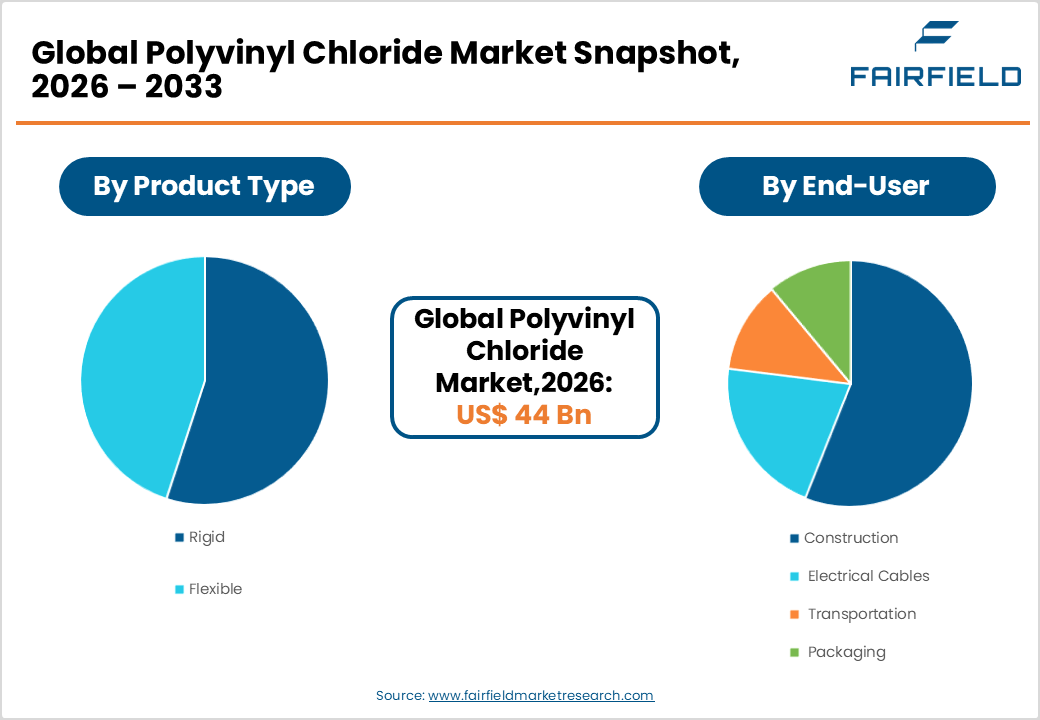
Rigid PVC commands 61.4% of the global Polyvinyl Chloride (PVC) market, valued at approximately US$27 billion in 2026, establishing stable leadership through its durability in pipes and profiles, which hold a 49.4% sub-share volume data.This dominance arises from cost-efficiency and strong alignment with construction applications, where competition centers on consolidated producers pursuing capacity expansions. In contrast, the Flexible PVC segment, representing ~38.6% market share, demonstrates faster expansion at a 7% sub-CAGR driven by cables and automotive demands, reflecting heightened adaptability needs. Strategic implications favor diversified portfolios, though organizations must evaluate entry barriers such as formulation intellectual property prior to resource allocation.
- End-User Segmentation
Construction commands a 69.3% share of the global Polyvinyl Chloride (PVC) market, valued at approximately US$30.5 billion in 2026, with pipes driving 49.4% of volume and leadership rooted in infrastructure expansion. Market dynamics reveal oligopolistic supply structures characterized by vertical integration among key producers. Trailing segments include Electrical Cables at ~10-15% share, alongside Packaging, while Transportation emerges as the fastest-growing end-user, accelerating due to electric vehicle adoption. These growth patterns suggest strategic reallocation toward high-mobility applications, balanced against cyclical risks inherent in construction dependency.
Competitive Landscape: Market Structure and Strategic Positioning
The Polyvinyl Chloride (PVC) market exhibits moderate consolidation, with the top-5 players commanding ~40-50% share, enabling differentiation through cost leadership among Asia producers, technological advancements in recycled PVC, and vertical integration from VCM to resin production. High entry barriers persist, including US$1-2 billion plant construction costs and stringent regulatory compliance requirements. Mergers and acquisitions activity has accelerated, recording 5 major deals in 2024 to achieve economies of scale and strengthen market positioning amid intensifying global competition.
Key Players
- Shin Etsu Chemical Co., Ltd.
- Formosa Plastics Corporation
- Westlake Chemical Corporation
- Occidental Petroleum Corporation (OxyChem)
- INEOS Group Holdings S.A.
- LG Chem Ltd.
- Orbia (Mexichem S.A.B. de C.V.)
- Reliance Industries Limited
- Kem One SAS
- Vinnolit GmbH & Co. KG
- Hanwha Solutions / Hanwha Group
- Xinjiang Zhongtai Chemical Co., Ltd.
- Tianye Group / Xinjiang Tianye
- AVI Global Plast
- Chemplast Sanmar
Key Industry Developments
- In November 2025, Westlake acquired Asia distributor. This strategic acquisition significantly bolsters Westlake's Asia-Pacific market penetration and distribution network.
- In June 2025, INEOS/Shintech JV for Europe recycled PVC plant (€300 million) The joint venture establishes a dedicated facility targeting REACH regulatory compliance through advanced recycling technologies.
- In January 2025, Formosa Plastics expanded U.S. Rigid PVC capacity by 200kt; The expansion at Gulf Coast facilities directly addresses surging North American construction and infrastructure demand.
Market Segmentation of Polyvinyl Chloride Market
By Product Type
- Rigid
- Flexible
By End-User
- Construction
- Electrical Cables
- Transportation
- Packaging
By Application
- Pipes & Fittings
- Films & Sheets
- Cables
- Pastes
- Profiles
By Region
- North America
- Europe
- Asia Pacific
- Latin America
- Middle East and Africa
- Executive Summary
- Global Polyvinyl Chloride Market Snapshot
- Future Projections
- Key Market Trends
- Regional Snapshot, by Value, 2026
- Analyst Recommendations
- Market Overview
- Market Definitions and Segmentations
- Market Dynamics
- Drivers
- Restraints
- Market Opportunities
- Value Chain Analysis
- COVID-19 Impact Analysis
- Porter's Five Forces Analysis
- Impact of Russia-Ukraine Conflict
- PESTLE Analysis
- Regulatory Analysis
- Price Trend Analysis
- Current Prices and Future Projections, 2025-2033
- Price Impact Factors
- Global Polyvinyl Chloride Market Outlook, 2020 - 2033
- Global Polyvinyl Chloride Market Outlook, by Product Type, Value (US$ Bn), 2020-2033
- Rigid
- Flexible
- Global Polyvinyl Chloride Market Outlook, by End-User, Value (US$ Bn), 2020-2033
- Construction
- Electrical Cables
- Transportation
- Packaging
- Global Polyvinyl Chloride Market Outlook, by Application, Value (US$ Bn), 2020-2033
- Pipes & Fittings
- Films & Sheets
- Cables
- Pastes
- Profiles
- Global Polyvinyl Chloride Market Outlook, by Region, Value (US$ Bn), 2020-2033
- North America
- Europe
- Asia Pacific
- Latin America
- Middle East & Africa
- Global Polyvinyl Chloride Market Outlook, by Product Type, Value (US$ Bn), 2020-2033
- North America Polyvinyl Chloride Market Outlook, 2020 - 2033
- North America Polyvinyl Chloride Market Outlook, by Product Type, Value (US$ Bn), 2020-2033
- Rigid
- Flexible
- North America Polyvinyl Chloride Market Outlook, by End-User, Value (US$ Bn), 2020-2033
- Construction
- Electrical Cables
- Transportation
- Packaging
- North America Polyvinyl Chloride Market Outlook, by Application, Value (US$ Bn), 2020-2033
- Pipes & Fittings
- Films & Sheets
- Cables
- Pastes
- Profiles
- North America Polyvinyl Chloride Market Outlook, by Country, Value (US$ Bn), 2020-2033
- U.S. Polyvinyl Chloride Market Outlook, by Product Type, 2020-2033
- U.S. Polyvinyl Chloride Market Outlook, by End-User, 2020-2033
- U.S. Polyvinyl Chloride Market Outlook, by Application, 2020-2033
- Canada Polyvinyl Chloride Market Outlook, by Product Type, 2020-2033
- Canada Polyvinyl Chloride Market Outlook, by End-User, 2020-2033
- Canada Polyvinyl Chloride Market Outlook, by Application, 2020-2033
- BPS Analysis/Market Attractiveness Analysis
- North America Polyvinyl Chloride Market Outlook, by Product Type, Value (US$ Bn), 2020-2033
- Europe Polyvinyl Chloride Market Outlook, 2020 - 2033
- Europe Polyvinyl Chloride Market Outlook, by Product Type, Value (US$ Bn), 2020-2033
- Rigid
- Flexible
- Europe Polyvinyl Chloride Market Outlook, by End-User, Value (US$ Bn), 2020-2033
- Construction
- Electrical Cables
- Transportation
- Packaging
- Europe Polyvinyl Chloride Market Outlook, by Application, Value (US$ Bn), 2020-2033
- Pipes & Fittings
- Films & Sheets
- Cables
- Pastes
- Profiles
- Europe Polyvinyl Chloride Market Outlook, by Country, Value (US$ Bn), 2020-2033
- Germany Polyvinyl Chloride Market Outlook, by Product Type, 2020-2033
- Germany Polyvinyl Chloride Market Outlook, by End-User, 2020-2033
- Germany Polyvinyl Chloride Market Outlook, by Application, 2020-2033
- Italy Polyvinyl Chloride Market Outlook, by Product Type, 2020-2033
- Italy Polyvinyl Chloride Market Outlook, by End-User, 2020-2033
- Italy Polyvinyl Chloride Market Outlook, by Application, 2020-2033
- France Polyvinyl Chloride Market Outlook, by Product Type, 2020-2033
- France Polyvinyl Chloride Market Outlook, by End-User, 2020-2033
- France Polyvinyl Chloride Market Outlook, by Application, 2020-2033
- U.K. Polyvinyl Chloride Market Outlook, by Product Type, 2020-2033
- U.K. Polyvinyl Chloride Market Outlook, by End-User, 2020-2033
- U.K. Polyvinyl Chloride Market Outlook, by Application, 2020-2033
- Spain Polyvinyl Chloride Market Outlook, by Product Type, 2020-2033
- Spain Polyvinyl Chloride Market Outlook, by End-User, 2020-2033
- Spain Polyvinyl Chloride Market Outlook, by Application, 2020-2033
- Russia Polyvinyl Chloride Market Outlook, by Product Type, 2020-2033
- Russia Polyvinyl Chloride Market Outlook, by End-User, 2020-2033
- Russia Polyvinyl Chloride Market Outlook, by Application, 2020-2033
- Rest of Europe Polyvinyl Chloride Market Outlook, by Product Type, 2020-2033
- Rest of Europe Polyvinyl Chloride Market Outlook, by End-User, 2020-2033
- Rest of Europe Polyvinyl Chloride Market Outlook, by Application, 2020-2033
- BPS Analysis/Market Attractiveness Analysis
- Europe Polyvinyl Chloride Market Outlook, by Product Type, Value (US$ Bn), 2020-2033
- Asia Pacific Polyvinyl Chloride Market Outlook, 2020 - 2033
- Asia Pacific Polyvinyl Chloride Market Outlook, by Product Type, Value (US$ Bn), 2020-2033
- Rigid
- Flexible
- Asia Pacific Polyvinyl Chloride Market Outlook, by End-User, Value (US$ Bn), 2020-2033
- Construction
- Electrical Cables
- Transportation
- Packaging
- Asia Pacific Polyvinyl Chloride Market Outlook, by Application, Value (US$ Bn), 2020-2033
- Pipes & Fittings
- Films & Sheets
- Cables
- Pastes
- Profiles
- Asia Pacific Polyvinyl Chloride Market Outlook, by Country, Value (US$ Bn), 2020-2033
- China Polyvinyl Chloride Market Outlook, by Product Type, 2020-2033
- China Polyvinyl Chloride Market Outlook, by End-User, 2020-2033
- China Polyvinyl Chloride Market Outlook, by Application, 2020-2033
- Japan Polyvinyl Chloride Market Outlook, by Product Type, 2020-2033
- Japan Polyvinyl Chloride Market Outlook, by End-User, 2020-2033
- Japan Polyvinyl Chloride Market Outlook, by Application, 2020-2033
- South Korea Polyvinyl Chloride Market Outlook, by Product Type, 2020-2033
- South Korea Polyvinyl Chloride Market Outlook, by End-User, 2020-2033
- South Korea Polyvinyl Chloride Market Outlook, by Application, 2020-2033
- India Polyvinyl Chloride Market Outlook, by Product Type, 2020-2033
- India Polyvinyl Chloride Market Outlook, by End-User, 2020-2033
- India Polyvinyl Chloride Market Outlook, by Application, 2020-2033
- Southeast Asia Polyvinyl Chloride Market Outlook, by Product Type, 2020-2033
- Southeast Asia Polyvinyl Chloride Market Outlook, by End-User, 2020-2033
- Southeast Asia Polyvinyl Chloride Market Outlook, by Application, 2020-2033
- Rest of SAO Polyvinyl Chloride Market Outlook, by Product Type, 2020-2033
- Rest of SAO Polyvinyl Chloride Market Outlook, by End-User, 2020-2033
- Rest of SAO Polyvinyl Chloride Market Outlook, by Application, 2020-2033
- BPS Analysis/Market Attractiveness Analysis
- Asia Pacific Polyvinyl Chloride Market Outlook, by Product Type, Value (US$ Bn), 2020-2033
- Latin America Polyvinyl Chloride Market Outlook, 2020 - 2033
- Latin America Polyvinyl Chloride Market Outlook, by Product Type, Value (US$ Bn), 2020-2033
- Rigid
- Flexible
- Latin America Polyvinyl Chloride Market Outlook, by End-User, Value (US$ Bn), 2020-2033
- Construction
- Electrical Cables
- Transportation
- Packaging
- Latin America Polyvinyl Chloride Market Outlook, by Application, Value (US$ Bn), 2020-2033
- Pipes & Fittings
- Films & Sheets
- Cables
- Pastes
- Profiles
- Latin America Polyvinyl Chloride Market Outlook, by Country, Value (US$ Bn), 2020-2033
- Brazil Polyvinyl Chloride Market Outlook, by Product Type, 2020-2033
- Brazil Polyvinyl Chloride Market Outlook, by End-User, 2020-2033
- Brazil Polyvinyl Chloride Market Outlook, by Application, 2020-2033
- Mexico Polyvinyl Chloride Market Outlook, by Product Type, 2020-2033
- Mexico Polyvinyl Chloride Market Outlook, by End-User, 2020-2033
- Mexico Polyvinyl Chloride Market Outlook, by Application, 2020-2033
- Argentina Polyvinyl Chloride Market Outlook, by Product Type, 2020-2033
- Argentina Polyvinyl Chloride Market Outlook, by End-User, 2020-2033
- Argentina Polyvinyl Chloride Market Outlook, by Application, 2020-2033
- Rest of LATAM Polyvinyl Chloride Market Outlook, by Product Type, 2020-2033
- Rest of LATAM Polyvinyl Chloride Market Outlook, by End-User, 2020-2033
- Rest of LATAM Polyvinyl Chloride Market Outlook, by Application, 2020-2033
- BPS Analysis/Market Attractiveness Analysis
- Latin America Polyvinyl Chloride Market Outlook, by Product Type, Value (US$ Bn), 2020-2033
- Middle East & Africa Polyvinyl Chloride Market Outlook, 2020 - 2033
- Middle East & Africa Polyvinyl Chloride Market Outlook, by Product Type, Value (US$ Bn), 2020-2033
- Rigid
- Flexible
- Middle East & Africa Polyvinyl Chloride Market Outlook, by End-User, Value (US$ Bn), 2020-2033
- Construction
- Electrical Cables
- Transportation
- Packaging
- Middle East & Africa Polyvinyl Chloride Market Outlook, by Application, Value (US$ Bn), 2020-2033
- Pipes & Fittings
- Films & Sheets
- Cables
- Pastes
- Profiles
- Middle East & Africa Polyvinyl Chloride Market Outlook, by Country, Value (US$ Bn), 2020-2033
- GCC Polyvinyl Chloride Market Outlook, by Product Type, 2020-2033
- GCC Polyvinyl Chloride Market Outlook, by End-User, 2020-2033
- GCC Polyvinyl Chloride Market Outlook, by Application, 2020-2033
- South Africa Polyvinyl Chloride Market Outlook, by Product Type, 2020-2033
- South Africa Polyvinyl Chloride Market Outlook, by End-User, 2020-2033
- South Africa Polyvinyl Chloride Market Outlook, by Application, 2020-2033
- Egypt Polyvinyl Chloride Market Outlook, by Product Type, 2020-2033
- Egypt Polyvinyl Chloride Market Outlook, by End-User, 2020-2033
- Egypt Polyvinyl Chloride Market Outlook, by Application, 2020-2033
- Nigeria Polyvinyl Chloride Market Outlook, by Product Type, 2020-2033
- Nigeria Polyvinyl Chloride Market Outlook, by End-User, 2020-2033
- Nigeria Polyvinyl Chloride Market Outlook, by Application, 2020-2033
- Rest of Middle East Polyvinyl Chloride Market Outlook, by Product Type, 2020-2033
- Rest of Middle East Polyvinyl Chloride Market Outlook, by End-User, 2020-2033
- Rest of Middle East Polyvinyl Chloride Market Outlook, by Application, 2020-2033
- BPS Analysis/Market Attractiveness Analysis
- Middle East & Africa Polyvinyl Chloride Market Outlook, by Product Type, Value (US$ Bn), 2020-2033
- Competitive Landscape
- Company Vs Segment Heatmap
- Company Market Share Analysis, 2025
- Competitive Dashboard
- Company Profiles
- Tongwei Co., Ltd.
- Company Overview
- Product Portfolio
- Financial Overview
- Business Strategies and Developments
- GCL Group
- Wacker Chemie AG
- Daqo New Energy Corp.
- OCI Company Ltd.
- Hemlock Semiconductor Group
- REC Silicon ASA
- Tokuyama Corporation
- Xinte Energy Co., Ltd.
- TBEA Co., Ltd.
- SunEdison, Inc.
- Sichuan Yongxiang Co., Ltd.
- KCC Corporation
- Hanwha Chemical
- Hankook Silicon
- Tongwei Co., Ltd.
- Appendix
- Research Methodology
- Report Assumptions
- Acronyms and Abbreviations
|
BASE YEAR |
HISTORICAL DATA |
FORECAST PERIOD |
UNITS |
|||
 |
2025 |
 |
2019 - 2024 |
 |
2026 - 2033 |
Value: US$ Billion |
|
REPORT FEATURES |
DETAILS |
|
By Product Type Coverage |
|
|
By End-User Coverage |
|
|
Geographical Coverage |
|
|
Leading Companies |
|
|
Report Highlights |
Key Market Indicators, Macro-micro economic impact analysis, Technological Roadmap, Key Trends, Driver, Restraints, and Future Opportunities & Revenue Pockets, Porter’s 5 Forces Analysis, Historical Trend (2019-2024), Market Estimates and Forecast, Market Dynamics, Industry Trends, Competition Landscape, Category, Region, Country-wise Trends & Analysis, COVID-19 Impact Analysis (Demand and Supply Chain) |
Our Research Methodology
Considering the volatility of business today, traditional approaches to strategizing a game plan can be unfruitful if not detrimental. True ambiguity is no way to determine a forecast. A myriad of predetermined factors must be accounted for such as the degree of risk involved, the magnitude of circumstances, as well as conditions or consequences that are not known or unpredictable. To circumvent binary views that cast uncertainty, the application of market research intelligence to strategically posture, move, and enable actionable outcomes is necessary.
View Methodology
Quality Assured
Rigorous Validation Process

Confidentiality Assured
End-to-end Data Security

Custom Research Services
Tailored To Your Objectives
FAQs
The Polyvinyl Chloride Market size is US$44 billion in 2026.
The Polyvinyl Chloride Market is projected 7.4% CAGR by 2033 .
The Polyvinyl Chloride Market growth drivers include urbanization/infrastructure demand, automotive lightweighting, and electrical infrastructure expansion.
Asia Pacific is a dominating region for Polyvinyl Chloride Market.
Westlake Corporation, Formosa Plastics, INEOS, Shin-Etsu Chemical, and Orbia are some leading industry players in the Polyvinyl Chloride Market.
Related Reports
Hydrogen Cyanide Market
Hydrogen Cyanide Market reaches USD 3.98 Billion by 2033 from USD 2.85 Billion in 2026, growing at 4.9% CAGR, with Chemicals & Plastics leading at 57%.
Seed Treatment Fungicides Market Insights, Competitive Landscape, and Market Forecast 2033
Seed Treatment Fungicides Market to reach USD 5.74 Bn by 2033, growing at 6.9% CAGR, driven by crop protection, disease control, and sustainable farming.
SDHI Fungicide Market Insights, Competitive Landscape, and Market Forecast 2033
SDHI Fungicide Market to reach USD 3.89 Bn by 2033, growing at 7.8% CAGR, driven by crop protection, disease control, and resistance management.
Lithium Manganese Iron Phosphate (LMFP) Battery Market Forecast - 2033
The global lithium manganese iron phosphate (LMFP) battery market is set to reach US$ 7.24 billion by 2033, growing at a 22.0% CAGR from 2026-2033
Ball Clay Market Insights, Competitive Landscape, and Market Forecast - 2033
Ball clay market is valued at USD 1.65 Billion in 2026 and projected to reach USD 2.26 Billion by 2033, expanding at a CAGR of 4.6%.
N-Vinylformamide Market Insights, Competitive Landscape, and Market Forecast - 2033
N-vinylformamide market is valued at USD 420.00 Million in 2026 and projected to reach USD 683.30 Million by 2033, expanding at a CAGR of 7.2%.