



Pyrolysis Oil Market
Pyrolysis Oil Market Insights, Competitive Landscape, and Market Forecast - 2033
The Pyrolysis Oil Market is valued at USD 890 Mn in 2026 and is projected to reach USD 1320.7 Mn, growing at a CAGR of 6% by 2033.
Pyrolysis Oil Market Insights
Key Growth Determinants
- Rising demand for sustainable feedstock in the chemical and petrochemical industry
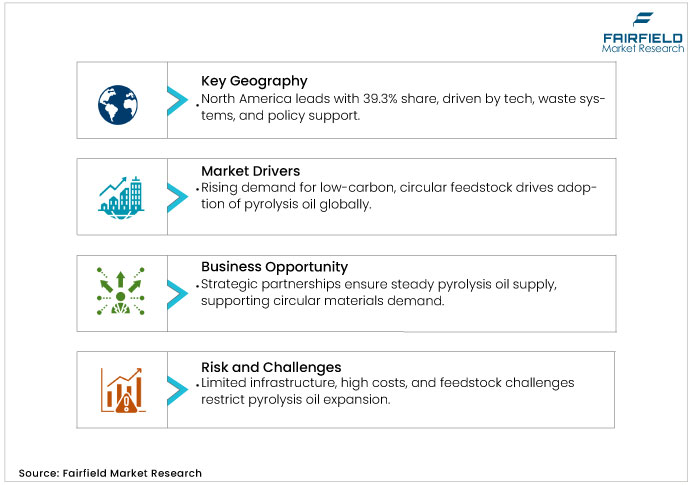
The growing need for sustainable and circular feedstock in the chemical and petrochemical sectors is a significant driver of the global pyrolysis oil market. As industries face mounting pressure to reduce carbon emissions, diversify raw material sources, and comply with stringent environmental regulations, pyrolysis oil, produced from plastic waste or end-of-life tires, has become a viable alternative to traditional fossil-based feedstock.
A prominent example of this trend is the May 2025 partnership between BASF Corporation and Braven Environmental. Under this agreement, Braven will supply pyrolysis oil derived from mixed plastic waste to BASF’s TotalEnergies Petrochemical facility in Port Arthur, Texas, enabling BASF to partially replace fossil-based feedstock with recycled pyrolysis oil and advance its circular economy objectives.
This shift reflects a broader industry trend toward integrating waste-derived feedstock into production processes, reducing reliance on virgin fossil resources, and minimizing environmental impact. The chemical and petrochemical industries, which account for significant fossil fuel consumption, such as 6% of global oil use for plastic production alone, can leverage pyrolysis oil to lower carbon footprints and support sustainable product offerings.
As more manufacturers invest in advanced recycling technologies and sign long-term supply agreements, the use of pyrolysis oil as a substitute for fossil feedstock is set to gain further momentum, driving the growth of the global pyrolysis oil market.
Key Growth Barriers
- Infrastructure limitations and scalability challenges are hindering the pyrolysis oil market growth
A key restraint for the global pyrolysis oil market is the limited scalability and underdeveloped infrastructure for large-scale production and integration. The production of pyrolysis oil from plastic waste or end-of-life tires requires specialized facilities, advanced technologies, and efficient waste collection and sorting systems, which are not yet widely available. The high capital investment needed for establishing pyrolysis plants, coupled with logistical challenges in sourcing consistent and high-quality waste feedstock, hinders the market's ability to meet growing demand.
Another critical challenge is the lack of standardized regulations and quality control measures for pyrolysis oil. The chemical and petrochemical industries, which are among the primary consumers of pyrolysis oil, require feedstock that meets stringent specifications to ensure compatibility with existing production processes. Variations in the composition of pyrolysis oil, influenced by the type and quality of waste used, can lead to inconsistencies that deter adoption by manufacturers accustomed to the reliability of fossil-based feedstock.
Pyrolysis Oil Market Opportunities and Trends
- Strategic partnerships strengthen pyrolysis oil supply chains and support the circular economy in the chemical and tire industries
The global pyrolysis oil market presents a significant opportunity through strategic partnerships that bolster supply chains for sustainable feedstock. Collaborations between chemical companies and specialized recycling firms are enabling a reliable supply of pyrolysis oil derived from plastic waste and end-of-life tires, addressing the growing demand for circular materials in industries like chemicals and tire manufacturing.
For instance, in February 2025, Orion S.A. signed a long-term supply agreement with Contec S.A. in Warsaw, Poland, to secure tire pyrolysis oil (TPO) for producing circular carbon black used in tires and rubber goods. Similarly, Shell Chemicals Europe’s February 2025 agreement to acquire the entire pyrolysis oil output from RES S.p.A.’s recycling plant in Pettoranello del Molise, Italy, which will process 20,000 tons of plastic waste annually using BlueAlp technology, highlights the potential to integrate pyrolysis oil into large-scale operations.
These partnerships allow companies to diversify feedstock sources, reduce reliance on fossil resources, and meet sustainability goals, creating opportunities to expand market reach and cater to environmentally conscious consumers while aligning with stringent regulatory requirements.
- Technological advancements in pyrolysis oil production unlock new applications and support the shift toward circular economy models
A prominent trend in the global pyrolysis oil market is the advancement of technologies that enhance the production and integration of pyrolysis oil into mainstream industrial processes. Innovations in processing techniques are enabling the use of challenging feedstock, such as discarded tires and mixed plastic waste, to produce high-quality pyrolysis oil for chemicals, plastics, and other applications.
In April 2024, Neste successfully conducted a trial run processing pyrolysis oil from discarded tires, sourced from Scandinavian Enviro Systems, to produce high-quality raw materials for new plastics and chemicals. Similarly, Mitsui Chemicals’ March 2024 initiative to source pyrolysis oil from CFP CORPORATION and feed it into a cracker at its Osaka Works for chemically recycled derivatives via the mass balance approach underscores the industry’s shift toward circular economy models.
These technological developments are improving the consistency and scalability of pyrolysis oil, making it a viable alternative to fossil feedstock and supporting the chemical and petrochemical industries’ transition to sustainable production practices.
Leading Segment Overview
- Unrefined pyrolysis oil leads the global pyrolysis oil market due to its cost-effectiveness and versatile feedstock compatibility
In the fuel type, unrefined pyrolysis oil holds the leading position, capturing an estimated 53.2% market share in 2025. This dominance is driven by its cost-effectiveness and versatility, as it requires minimal processing, making it an attractive option for industries seeking affordable alternatives to fossil fuels.
Unrefined pyrolysis oil is widely used in applications such as industrial boilers, power generation, and heating, particularly in heavy industries like cement, steel, and glass manufacturing. Its ability to be produced from diverse feedstock, including plastic waste, rubber, and biomass, enhances its accessibility and scalability. Unrefined pyrolysis oil's ability to convert waste into valuable energy aligns with global sustainability goals, making it an attractive option for various industries.
- Fast Pyrolysis leads the pyrolysis process due to its high yield and efficiency
Among pyrolysis processes, fast pyrolysis is the leading segment due to its high yield and efficiency in producing liquid pyrolysis oil. This process, involving rapid heating of feedstock at 400–600°C without oxygen, generates a higher volume of bio-oil compared to slow or flash pyrolysis, making it the preferred choice for industrial applications.
Fast pyrolysis is particularly effective for processing biomass and plastic waste, offering a renewable fuel source for power generation, transportation, and chemical production. Its ability to achieve uniform temperature distribution and high conversion efficiency through technologies like fluidized bed reactors enhances its market dominance.
- Heat and Power Applications Lead the market due to increasing demand for renewable energy sources
The heat and power is the leading end-use category in the pyrolysis oil market, driven by its established infrastructure and increasing demand for renewable energy sources. Pyrolysis oil is extensively used in industrial boilers, gas turbines, and diesel engines for heat and electricity generation, particularly in heavy industries like cement, steel, and power plants.
In 2025, this segment is expected to hold a significant market share, particularly in regions like North America and Europe, where environmental regulations promote cleaner energy. The segment’s growth is further supported by the rising global energy demand, with heating being the largest energy consumer worldwide.
Regional Analysis
- North America dominates the pyrolysis oil market with advanced infrastructure and supportive policies
North America holds the largest share of the global pyrolysis oil market, accounting for approximately 39.3% in 2025, driven by its advanced technological infrastructure, robust waste management systems, and strong government support for renewable energy. The United States and Canada lead the region, with initiatives like the U.S. Department of Energy’s funding for pyrolysis technology development and Canada’s forestry-driven biomass utilization.
The region’s dominance is fuelled by the high demand for sustainable fuels in industries such as power generation and chemicals, supported by stringent environmental regulations like the Renewable Fuel Standard (RFS) program. Collaborative efforts, such as partnerships between companies like BASF and Braven Environmental, enhance the adoption of pyrolysis oil as a feedstock.
- Europe offers strong market potential for pyrolysis oil amidst stringent environmental regulations
Europe presents significant opportunities in the pyrolysis oil market, driven by stringent environmental regulations, a strong commitment to carbon neutrality by 2050, and well-established waste management systems. Countries like Germany, the UK, and France lead the region, with Spain projected to register a notable growth rate due to EU renewable energy targets.
The region’s focus on circular economy principles, exemplified by partnerships like Shell Chemicals Europe’s agreement with RES S.p.A. to utilize BlueAlp technology for plastic waste processing, creates a conducive environment for market growth.
- Asia Pacific emerges as the fastest-growing pyrolysis oil market, driven by industrialization and sustainability goals
Asia Pacific is the fastest-growing region in the global pyrolysis oil market, projected to achieve a CAGR of 11.6% from 2025 to 2032, driven by rapid industrialization, urbanization, and increasing energy demand in countries like China and India. China, with a 70% share of the regional market in 2024, leads due to its extensive chemical industry and government investments in waste-to-energy solutions. India is the fastest-growing market within the region, fuelled by its focus on sustainable development and abundant plastic and biomass waste.
The region’s growth is supported by rising environmental awareness, government initiatives promoting renewable energy, and the availability of feedstock like plastic and rubber waste. Projects like Mitsui Chemicals’ integration of pyrolysis oil in Japan highlight the region’s adoption of circular economy practices.
Fairfield’s Competitive Landscape Analysis
The global pyrolysis oil market is experiencing robust growth, fueled by the strategic initiatives of key industry players who are expanding their production capacities, establishing long-term supply agreements, and adopting advanced technologies to strengthen their positions in the evolving market. These efforts reflect the increasing demand for sustainable alternatives to fossil fuels across multiple industries, including chemicals, automotive, and energy.
Key Market Companies
- Fortum OyJ
- Enerkem
- Chevron Phillips Chemical
- Ensyn Corporation
- Twence B.V.
- Agilyx Corporation
- Green Fuel Nordic Corporation
- Vadxx Energy LLC
- Quantafuel AS
- RESYNERGI
- nexus FUELS LLC
- JBI Inc. (Plastic2Oil®)
- Bioenergy AE Côte-Nord
Global Pyrolysis Oil Market is Segmented as-
By Fuel Type
- Unrefined
- Refined
- Diesel
- Petrol/Gasoline
- Fuel oil
- Misc.
By Pyrolysis Process
- Fast
- Flash
- Others
By Source
- Plastic
- LDPE
- HDPE
- Polystyrene
- Misc.
- Rubber
- Biomass
- Misc.
By End Use
- Heat & Power
- Boilers
- Gas Turbines
- Diesel Engines
- Automotive Fuel
- Bio Refineries
- Food Flavouring
- Misc.
By Region
- North America
- Europe
- Asia Pacific
- Latin America
- The Middle East & Africa
- Executive Summary
- Global Pyrolysis Oil Market Snapshot
- Future Projections
- Key Market Trends
- Regional Snapshot, by Value, 2026
- Analyst Recommendations
- Market Overview
- Market Definitions and Segmentations
- Market Dynamics
- Drivers
- Restraints
- Market Opportunities
- Value Chain Analysis
- COVID-19 Impact Analysis
- Porter's Five Forces Analysis
- Impact of Russia-Ukraine Conflict
- PESTLE Analysis
- Regulatory Analysis
- Price Trend Analysis
- Current Prices and Future Projections, 2025-2033
- Price Impact Factors
- Global Pyrolysis Oil Market Outlook, 2020 - 2033
- Global Pyrolysis Oil Market Outlook, by Fuel Type, Value (US$ Mn), 2020-2033
- Unrefined
- Refined
- Diesel
- Petrol/Gasoline
- Fuel oil
- Global Pyrolysis Oil Market Outlook, by Pyrolysis Process, Value (US$ Mn), 2020-2033
- Fast
- Flash
- Others
- Global Pyrolysis Oil Market Outlook, by Source, Value (US$ Mn), 2020-2033
- Plastic
- Rubber
- Biomass
- Global Pyrolysis Oil Market Outlook, by End Use, Value (US$ Mn), 2020-2033
- Heat & Power
- Automotive Fuel
- Bio Refineries
- Food Flavouring
- Global Pyrolysis Oil Market Outlook, by Region, Value (US$ Mn), 2020-2033
- North America
- Europe
- Asia Pacific
- Latin America
- Middle East & Africa
- Global Pyrolysis Oil Market Outlook, by Fuel Type, Value (US$ Mn), 2020-2033
- North America Pyrolysis Oil Market Outlook, 2020 - 2033
- North America Pyrolysis Oil Market Outlook, by Fuel Type, Value (US$ Mn), 2020-2033
- Unrefined
- Refined
- Diesel
- Petrol/Gasoline
- Fuel oil
- North America Pyrolysis Oil Market Outlook, by Pyrolysis Process, Value (US$ Mn), 2020-2033
- Fast
- Flash
- Others
- North America Pyrolysis Oil Market Outlook, by Source, Value (US$ Mn), 2020-2033
- Plastic
- Rubber
- Biomass
- North America Pyrolysis Oil Market Outlook, by End Use, Value (US$ Mn), 2020-2033
- Heat & Power
- Automotive Fuel
- Bio Refineries
- Food Flavouring
- North America Pyrolysis Oil Market Outlook, by Country, Value (US$ Mn), 2020-2033
- U.S. Pyrolysis Oil Market Outlook, by Fuel Type, 2020-2033
- U.S. Pyrolysis Oil Market Outlook, by Pyrolysis Process, 2020-2033
- U.S. Pyrolysis Oil Market Outlook, by Source, 2020-2033
- U.S. Pyrolysis Oil Market Outlook, by End Use, 2020-2033
- Canada Pyrolysis Oil Market Outlook, by Fuel Type, 2020-2033
- Canada Pyrolysis Oil Market Outlook, by Pyrolysis Process, 2020-2033
- Canada Pyrolysis Oil Market Outlook, by Source, 2020-2033
- Canada Pyrolysis Oil Market Outlook, by End Use, 2020-2033
- BPS Analysis/Market Attractiveness Analysis
- North America Pyrolysis Oil Market Outlook, by Fuel Type, Value (US$ Mn), 2020-2033
- Europe Pyrolysis Oil Market Outlook, 2020 - 2033
- Europe Pyrolysis Oil Market Outlook, by Fuel Type, Value (US$ Mn), 2020-2033
- Unrefined
- Refined
- Diesel
- Petrol/Gasoline
- Fuel oil
- Europe Pyrolysis Oil Market Outlook, by Pyrolysis Process, Value (US$ Mn), 2020-2033
- Fast
- Flash
- Others
- Europe Pyrolysis Oil Market Outlook, by Source, Value (US$ Mn), 2020-2033
- Plastic
- Rubber
- Biomass
- Europe Pyrolysis Oil Market Outlook, by End Use, Value (US$ Mn), 2020-2033
- Heat & Power
- Automotive Fuel
- Bio Refineries
- Food Flavouring
- Europe Pyrolysis Oil Market Outlook, by Country, Value (US$ Mn), 2020-2033
- Germany Pyrolysis Oil Market Outlook, by Fuel Type, 2020-2033
- Germany Pyrolysis Oil Market Outlook, by Pyrolysis Process, 2020-2033
- Germany Pyrolysis Oil Market Outlook, by Source, 2020-2033
- Germany Pyrolysis Oil Market Outlook, by End Use, 2020-2033
- Italy Pyrolysis Oil Market Outlook, by Fuel Type, 2020-2033
- Italy Pyrolysis Oil Market Outlook, by Pyrolysis Process, 2020-2033
- Italy Pyrolysis Oil Market Outlook, by Source, 2020-2033
- Italy Pyrolysis Oil Market Outlook, by End Use, 2020-2033
- France Pyrolysis Oil Market Outlook, by Fuel Type, 2020-2033
- France Pyrolysis Oil Market Outlook, by Pyrolysis Process, 2020-2033
- France Pyrolysis Oil Market Outlook, by Source, 2020-2033
- France Pyrolysis Oil Market Outlook, by End Use, 2020-2033
- U.K. Pyrolysis Oil Market Outlook, by Fuel Type, 2020-2033
- U.K. Pyrolysis Oil Market Outlook, by Pyrolysis Process, 2020-2033
- U.K. Pyrolysis Oil Market Outlook, by Source, 2020-2033
- U.K. Pyrolysis Oil Market Outlook, by End Use, 2020-2033
- Spain Pyrolysis Oil Market Outlook, by Fuel Type, 2020-2033
- Spain Pyrolysis Oil Market Outlook, by Pyrolysis Process, 2020-2033
- Spain Pyrolysis Oil Market Outlook, by Source, 2020-2033
- Spain Pyrolysis Oil Market Outlook, by End Use, 2020-2033
- Russia Pyrolysis Oil Market Outlook, by Fuel Type, 2020-2033
- Russia Pyrolysis Oil Market Outlook, by Pyrolysis Process, 2020-2033
- Russia Pyrolysis Oil Market Outlook, by Source, 2020-2033
- Russia Pyrolysis Oil Market Outlook, by End Use, 2020-2033
- Rest of Europe Pyrolysis Oil Market Outlook, by Fuel Type, 2020-2033
- Rest of Europe Pyrolysis Oil Market Outlook, by Pyrolysis Process, 2020-2033
- Rest of Europe Pyrolysis Oil Market Outlook, by Source, 2020-2033
- Rest of Europe Pyrolysis Oil Market Outlook, by End Use, 2020-2033
- BPS Analysis/Market Attractiveness Analysis
- Europe Pyrolysis Oil Market Outlook, by Fuel Type, Value (US$ Mn), 2020-2033
- Asia Pacific Pyrolysis Oil Market Outlook, 2020 - 2033
- Asia Pacific Pyrolysis Oil Market Outlook, by Fuel Type, Value (US$ Mn), 2020-2033
- Unrefined
- Refined
- Diesel
- Petrol/Gasoline
- Fuel oil
- Asia Pacific Pyrolysis Oil Market Outlook, by Pyrolysis Process, Value (US$ Mn), 2020-2033
- Fast
- Flash
- Others
- Asia Pacific Pyrolysis Oil Market Outlook, by Source, Value (US$ Mn), 2020-2033
- Plastic
- Rubber
- Biomass
- Asia Pacific Pyrolysis Oil Market Outlook, by End Use, Value (US$ Mn), 2020-2033
- Heat & Power
- Automotive Fuel
- Bio Refineries
- Food Flavouring
- Asia Pacific Pyrolysis Oil Market Outlook, by Country, Value (US$ Mn), 2020-2033
- China Pyrolysis Oil Market Outlook, by Fuel Type, 2020-2033
- China Pyrolysis Oil Market Outlook, by Pyrolysis Process, 2020-2033
- China Pyrolysis Oil Market Outlook, by Source, 2020-2033
- China Pyrolysis Oil Market Outlook, by End Use, 2020-2033
- Japan Pyrolysis Oil Market Outlook, by Fuel Type, 2020-2033
- Japan Pyrolysis Oil Market Outlook, by Pyrolysis Process, 2020-2033
- Japan Pyrolysis Oil Market Outlook, by Source, 2020-2033
- Japan Pyrolysis Oil Market Outlook, by End Use, 2020-2033
- South Korea Pyrolysis Oil Market Outlook, by Fuel Type, 2020-2033
- South Korea Pyrolysis Oil Market Outlook, by Pyrolysis Process, 2020-2033
- South Korea Pyrolysis Oil Market Outlook, by Source, 2020-2033
- South Korea Pyrolysis Oil Market Outlook, by End Use, 2020-2033
- India Pyrolysis Oil Market Outlook, by Fuel Type, 2020-2033
- India Pyrolysis Oil Market Outlook, by Pyrolysis Process, 2020-2033
- India Pyrolysis Oil Market Outlook, by Source, 2020-2033
- India Pyrolysis Oil Market Outlook, by End Use, 2020-2033
- Southeast Asia Pyrolysis Oil Market Outlook, by Fuel Type, 2020-2033
- Southeast Asia Pyrolysis Oil Market Outlook, by Pyrolysis Process, 2020-2033
- Southeast Asia Pyrolysis Oil Market Outlook, by Source, 2020-2033
- Southeast Asia Pyrolysis Oil Market Outlook, by End Use, 2020-2033
- Rest of SAO Pyrolysis Oil Market Outlook, by Fuel Type, 2020-2033
- Rest of SAO Pyrolysis Oil Market Outlook, by Pyrolysis Process, 2020-2033
- Rest of SAO Pyrolysis Oil Market Outlook, by Source, 2020-2033
- Rest of SAO Pyrolysis Oil Market Outlook, by End Use, 2020-2033
- BPS Analysis/Market Attractiveness Analysis
- Asia Pacific Pyrolysis Oil Market Outlook, by Fuel Type, Value (US$ Mn), 2020-2033
- Latin America Pyrolysis Oil Market Outlook, 2020 - 2033
- Latin America Pyrolysis Oil Market Outlook, by Fuel Type, Value (US$ Mn), 2020-2033
- Unrefined
- Refined
- Diesel
- Petrol/Gasoline
- Fuel oil
- Latin America Pyrolysis Oil Market Outlook, by Pyrolysis Process, Value (US$ Mn), 2020-2033
- Fast
- Flash
- Others
- Latin America Pyrolysis Oil Market Outlook, by Source, Value (US$ Mn), 2020-2033
- Plastic
- Rubber
- Biomass
- Latin America Pyrolysis Oil Market Outlook, by End Use, Value (US$ Mn), 2020-2033
- Heat & Power
- Automotive Fuel
- Bio Refineries
- Food Flavouring
- Latin America Pyrolysis Oil Market Outlook, by Country, Value (US$ Mn), 2020-2033
- Brazil Pyrolysis Oil Market Outlook, by Fuel Type, 2020-2033
- Brazil Pyrolysis Oil Market Outlook, by Pyrolysis Process, 2020-2033
- Brazil Pyrolysis Oil Market Outlook, by Source, 2020-2033
- Brazil Pyrolysis Oil Market Outlook, by End Use, 2020-2033
- Mexico Pyrolysis Oil Market Outlook, by Fuel Type, 2020-2033
- Mexico Pyrolysis Oil Market Outlook, by Pyrolysis Process, 2020-2033
- Mexico Pyrolysis Oil Market Outlook, by Source, 2020-2033
- Mexico Pyrolysis Oil Market Outlook, by End Use, 2020-2033
- Argentina Pyrolysis Oil Market Outlook, by Fuel Type, 2020-2033
- Argentina Pyrolysis Oil Market Outlook, by Pyrolysis Process, 2020-2033
- Argentina Pyrolysis Oil Market Outlook, by Source, 2020-2033
- Argentina Pyrolysis Oil Market Outlook, by End Use, 2020-2033
- Rest of LATAM Pyrolysis Oil Market Outlook, by Fuel Type, 2020-2033
- Rest of LATAM Pyrolysis Oil Market Outlook, by Pyrolysis Process, 2020-2033
- Rest of LATAM Pyrolysis Oil Market Outlook, by Source, 2020-2033
- Rest of LATAM Pyrolysis Oil Market Outlook, by End Use, 2020-2033
- BPS Analysis/Market Attractiveness Analysis
- Latin America Pyrolysis Oil Market Outlook, by Fuel Type, Value (US$ Mn), 2020-2033
- Middle East & Africa Pyrolysis Oil Market Outlook, 2020 - 2033
- Middle East & Africa Pyrolysis Oil Market Outlook, by Fuel Type, Value (US$ Mn), 2020-2033
- Unrefined
- Refined
- Diesel
- Petrol/Gasoline
- Fuel oil
- Middle East & Africa Pyrolysis Oil Market Outlook, by Pyrolysis Process, Value (US$ Mn), 2020-2033
- Fast
- Flash
- Others
- Middle East & Africa Pyrolysis Oil Market Outlook, by Source, Value (US$ Mn), 2020-2033
- Plastic
- Rubber
- Biomass
- Middle East & Africa Pyrolysis Oil Market Outlook, by End Use, Value (US$ Mn), 2020-2033
- Heat & Power
- Automotive Fuel
- Bio Refineries
- Food Flavouring
- Middle East & Africa Pyrolysis Oil Market Outlook, by Country, Value (US$ Mn), 2020-2033
- GCC Pyrolysis Oil Market Outlook, by Fuel Type, 2020-2033
- GCC Pyrolysis Oil Market Outlook, by Pyrolysis Process, 2020-2033
- GCC Pyrolysis Oil Market Outlook, by Source, 2020-2033
- GCC Pyrolysis Oil Market Outlook, by End Use, 2020-2033
- South Africa Pyrolysis Oil Market Outlook, by Fuel Type, 2020-2033
- South Africa Pyrolysis Oil Market Outlook, by Pyrolysis Process, 2020-2033
- South Africa Pyrolysis Oil Market Outlook, by Source, 2020-2033
- South Africa Pyrolysis Oil Market Outlook, by End Use, 2020-2033
- Egypt Pyrolysis Oil Market Outlook, by Fuel Type, 2020-2033
- Egypt Pyrolysis Oil Market Outlook, by Pyrolysis Process, 2020-2033
- Egypt Pyrolysis Oil Market Outlook, by Source, 2020-2033
- Egypt Pyrolysis Oil Market Outlook, by End Use, 2020-2033
- Nigeria Pyrolysis Oil Market Outlook, by Fuel Type, 2020-2033
- Nigeria Pyrolysis Oil Market Outlook, by Pyrolysis Process, 2020-2033
- Nigeria Pyrolysis Oil Market Outlook, by Source, 2020-2033
- Nigeria Pyrolysis Oil Market Outlook, by End Use, 2020-2033
- Rest of Middle East Pyrolysis Oil Market Outlook, by Fuel Type, 2020-2033
- Rest of Middle East Pyrolysis Oil Market Outlook, by Pyrolysis Process, 2020-2033
- Rest of Middle East Pyrolysis Oil Market Outlook, by Source, 2020-2033
- Rest of Middle East Pyrolysis Oil Market Outlook, by End Use, 2020-2033
- BPS Analysis/Market Attractiveness Analysis
- Middle East & Africa Pyrolysis Oil Market Outlook, by Fuel Type, Value (US$ Mn), 2020-2033
- Competitive Landscape
- Company Vs Segment Heatmap
- Company Market Share Analysis, 2025
- Competitive Dashboard
- Company Profiles
- Fortum OyJ
- Company Overview
- Product Portfolio
- Financial Overview
- Business Strategies and Developments
- Enerkem
- Chevron Phillips Chemical
- Ensyn Corporation
- Twence B.V.
- Agilyx Corporation
- Green Fuel Nordic Corporation
- Vadxx Energy LLC
- Quantafuel AS
- RESYNERGI
- Fortum OyJ
- Appendix
- Research Methodology
- Report Assumptions
- Acronyms and Abbreviations
|
BASE YEAR |
HISTORICAL DATA |
FORECAST PERIOD |
UNITS |
|||
 |
2025 |
 |
2019 - 2024 |
 |
2026 - 2033 |
Value: US$ Million |
|
REPORT FEATURES |
DETAILS |
|
Fuel Type Coverage |
|
|
Pyrolysis Process Coverage |
|
|
Source |
|
|
End Use |
|
|
Geographical Coverage |
|
|
Leading Companies |
|
|
Report Highlights |
Key Market Indicators, Macro-micro economic impact analysis, Technological Roadmap, Key Trends, Driver, Restraints, and Future Opportunities & Revenue Pockets, Porter’s 5 Forces Analysis, Historical Trend (2019-2024), Market Estimates and Forecast, Market Dynamics, Industry Trends, Competition Landscape, Category, Region, Country-wise Trends & Analysis, COVID-19 Impact Analysis (Demand and Supply Chain) |
Our Research Methodology
Considering the volatility of business today, traditional approaches to strategizing a game plan can be unfruitful if not detrimental. True ambiguity is no way to determine a forecast. A myriad of predetermined factors must be accounted for such as the degree of risk involved, the magnitude of circumstances, as well as conditions or consequences that are not known or unpredictable. To circumvent binary views that cast uncertainty, the application of market research intelligence to strategically posture, move, and enable actionable outcomes is necessary.
View Methodology
Quality Assured
Rigorous Validation Process

Confidentiality Assured
End-to-end Data Security

Custom Research Services
Tailored To Your Objectives
FAQs
Pyrolysis Oil Market is valued at USD 890 Mn in 2026.
Rising demand for sustainable feedstock in the chemical and petrochemical industry.
Fortum OyJ, Enerkem, Chevron Phillips Chemical, Ensyn Corporation, Twence B.V. etc. are some of the leading industry players.
The market is projected to record a CAGR of 6% during the forecast period from 2026 to 2033.
Strategic partnerships strengthen pyrolysis oil supply chains and support the circular economy in the chemical and tire industries.
Related Reports
Solar Mobile Light Tower Market Insights, Competitive Landscape, and Market Forecast - 2033
The global solar mobile light tower market is projected to grow from US$480.00 million in 2026 to US$960.62 million by 2033, at a 10.4% CAGR.
Waste Pre-processing For Alternate Fuel and Raw Materials (AFR) Market Forecast - 2033
The global waste pre-processing for alternate fuel and raw materials market is set to reach US$ 7.30 Bn by 2033, growing at an 8.6% CAGR from 2026-2033
Micro Turbine Market Insights, Competitive Landscape, and Market Forecast 2033
The micro turbine market is projected to rise from US$2.4 billion in 2026 to US$4.1 billion by 2033 at a 7.9% CAGR, driven by decentralized energy generation.
U.S. Fire Protection System Market Insights, Competitive Landscape, and Market Forecast 2026–2033
U.S. Fire Protection System Market is projected to reach US$12.86 billion by 2033, driven by stringent safety regulations and smart systems.
Underfloor Heating Market Insights, Competitive Landscape, and Market Forecast 2026–2033
Underfloor Heating Market is projected to reach US$9.72 billion by 2033, driven by energy efficiency, smart homes, premium housing, and retrofit demand.
Power Boiler Market Insights, Competitive Landscape, and Market Forecast 2026–2033
Power Boiler Market is projected to reach US$31.38 billion by 2033, driven by industrial modernization, power generation expansion, fleet replacement