



Rayon Fiber Market
Rayon Fiber Market Size, Share, Insights, Competitive Landscape, and Forecast 2026 to 2033
Report Overview
Rayon Fiber Market Size and Trend Analysis
How Fast Is the Rayon Fiber Market Growing?
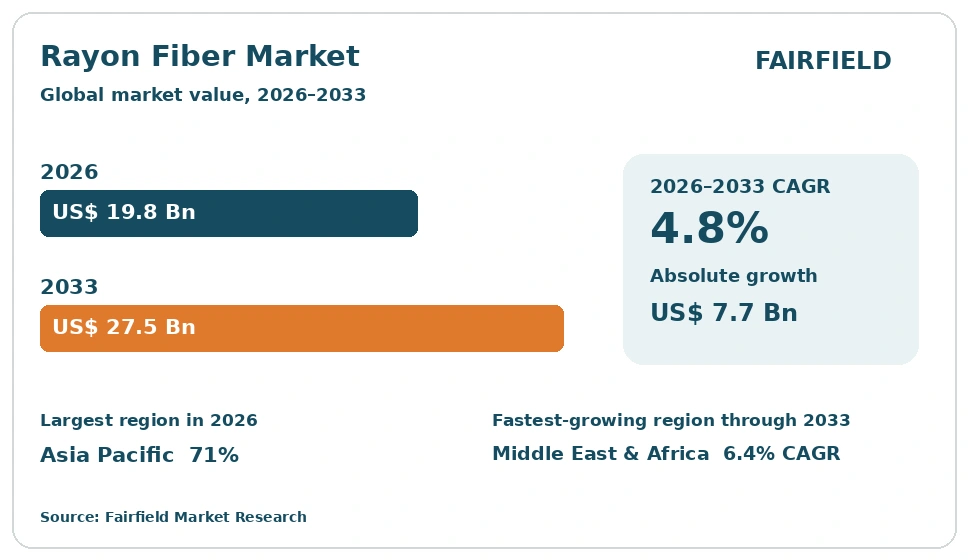
The global rayon fiber market size is expected to be valued at US$ 19.8 billion in 2026 and projected to reach US$ 27.5 billion by 2033, growing at a CAGR of 4.8% between 2026 and 2033.
Growth averaged about 3.4% a year between 2020 and 2025, lifting the market to roughly US$ 18.9 billion, with a sharp pandemic dip in apparel offset by unusually strong nonwovens demand. Three factors set the faster pace ahead. Apparel brands are specifying regenerated cellulose as a cotton substitute that needs less land and water. Nonwoven converters are being pushed toward cellulosic webs by disposability rules for wipes. Lyocell capacity is expanding and sells at a premium to standard viscose. The direction is steady rather than dramatic: this is a mature commodity fibre whose growth tracks global textile consumption, with the value shift coming from process route and traceability rather than from volume alone.
Key Report Takeaways
- By Product Type: Viscose Staple Fibre held 58% share in 2026, while Lyocell is projected to expand at an 8.4% CAGR through 2033, driven by closed-loop solvent recovery that removes the sulphur chemistry of conventional viscose.
- By Application: Apparel and Fashion held 52% share in 2026, while Nonwovens is projected to expand at a 6.5% CAGR through 2033, driven by disposability requirements that favour cellulosic webs over synthetic ones in wipes.
- By Raw Material Source: Wood-Based Dissolving Pulp held 72% share in 2026, while Recycled Cellulosic Feedstock is projected to expand at a 14.2% CAGR through 2033, driven by brand commitments to textile-to-textile fibre routes.
- By End Use Industry: Textile and Apparel held 61% share in 2026, while Healthcare and Hygiene is projected to expand at a 6.9% CAGR through 2033, driven by surgical textile and wound care demand for absorbent cellulose.
- By Geography: Asia Pacific held 71% share in 2026, while Middle East & Africa is projected to expand at a 6.4% CAGR through 2033, driven by textile manufacturing investment in Egypt and across North Africa.
Global Rayon Fiber Market Trends and Insights
Drivers Impact Analysis
Two demand forces explain most of the incremental volume expected between 2026 and 2033.
| Driver | Impact on CAGR Forecast | Geographic Relevance | Impact Timeline |
| Brand fibre sourcing commitments shifting volume to audited mills | High | Europe, North America, Asia Pacific | Short term (≤2 years) |
| Cellulose-specified nonwovens in wipes and hygiene products | Medium | Europe, North America | Medium term (2–4 years) |
Brand Sourcing Commitments Redirect Rayon Volume Toward Audited Mills
Apparel brands now buy regenerated cellulose by mill, not by fibre type, and that has become a genuine demand driver. Retailers publish fibre policies that name acceptable producers, and mills that cannot evidence closed-loop recovery or verified forest sourcing lose access to those order books. The effect is to concentrate growth in a minority of plants rather than to lift the industry evenly.
The mechanism is reputational risk transferred through the supply chain. Brand-facing ranking initiatives assess producers on process emissions and pulp origin, and buyers use those assessments in vendor approval. FSC and PEFC certification of dissolving pulp has moved from a courtesy to a purchase condition, and the EU Deforestation Regulation adds a legal due diligence layer on wood inputs. Mills that invested early in sulphur recovery and effluent treatment now convert that spending into order security and price.
Cellulose-Specified Nonwovens Lift Viscose Demand in Wipes and Hygiene
Nonwoven converters are a second, structurally different source of growth, and they buy viscose staple for a technical reason rather than a fashion one. Cellulose disperses and degrades in ways polyester does not, so wipes that must meet disposability or biodegradability claims are built on regenerated cellulose webs. That specification locks the fibre into the product rather than leaving it open to substitution.
The push comes from regulation and from retailer labelling. Rules on single-use plastics in the European Union require visible marking on wet wipes containing plastic, which has pushed converters toward all-cellulose constructions to avoid the mark entirely. Water utilities campaigning against sewer blockages reinforce the same choice. Medical and hygiene converters add steady volume, because absorbency, purity and sterilisability favour viscose over synthetic staple in wound care and surgical textiles.
Restraints Impact Analysis
Two constraints limit how quickly the industry can shift toward cleaner process routes.
| Restraint | Impact on CAGR Forecast | Geographic Relevance | Impact Timeline |
| Capital intensity of closed-loop and lyocell capacity | High | Global | Long term (≥4 years) |
| Dissolving pulp cost and effluent permitting for new viscose lines | Medium | Asia Pacific, Europe | Medium term (2–4 years) |
Capital Intensity of Closed-Loop Lines Slows the Shift Away From Viscose
The cleaner route exists but cannot be built quickly, and that is the central restraint on process improvement. A lyocell line uses an amine oxide solvent in a closed loop and avoids the sulphur chemistry of viscose, yet it costs substantially more per tonne of installed capacity than a conventional viscose line and takes years to commission. Capacity therefore shifts slowly even where buyers clearly prefer it.
The cost sources are specific. Solvent recovery must exceed 99% for the economics to work, which demands high-grade recovery columns, tight vapour control and continuous monitoring. Solvent inventory itself is expensive working capital. Retrofitting an existing viscose plant is rarely practical, so the investment is greenfield. Standard viscose, meanwhile, competes against polyester and cotton on price, and the premium a lyocell line needs is not always available in mid-market apparel.
Dissolving Pulp Cost and Effluent Permitting Constrain New Viscose Capacity
Feedstock and permitting together decide where new rayon capacity can realistically be sited. Dissolving pulp competes for the same wood as paper pulp, so its price moves with pulp cycles and can swing fibre margins sharply within a single year. Producers without integrated pulp positions carry that volatility directly, and it limits their ability to quote stable prices to apparel buyers.
Permitting is the harder constraint. Conventional viscose production uses carbon disulphide, which carries occupational exposure limits and air emission controls, and the spinning bath generates sulphates, zinc and heavy organic loads in effluent. Authorities applying best available techniques requirements for pulp, paper and polymer production expect recovery rates that older plants cannot reach. The practical result is that new lines concentrate in jurisdictions with available water, established treatment infrastructure and predictable permitting timelines.
Market Opportunities
Lyocell Capacity Additions Open a Premium Cellulosic Fibre Revenue Pool
Lyocell is the clearest premium revenue pool in regenerated cellulose, because it solves the process problem that defines the industry’s reputation and can be sold at a visible markup over standard viscose staple. Demand currently exceeds qualified supply in several apparel categories, so new lines are commissioned against contracted volume rather than speculative capacity, which materially lowers the investment risk.
Vertically integrated producers with their own dissolving pulp are best placed to capture it, since solvent recovery economics improve with consistent pulp quality. The demand comes from denim, activewear and premium knitwear brands that need a cotton alternative with defined water and land performance, and from home textile buyers specifying blends. Textile labelling rules in the European Union give lyocell its own generic fibre name, which lets brands communicate the process difference on the garment label itself.
Textile-to-Textile Recycled Cellulose Creates a Second Feedstock Stream
Recycled cellulosic feedstock opens a revenue pool that does not depend on forest supply at all. Pulp made from post-consumer cotton and cellulosic garments can be dissolved alongside wood pulp, and even a modest blend ratio converts a waste stream into qualifying feedstock. Producers able to certify recycled content can price that fibre above standard grades and secure multi-year brand agreements.
Fibre producers, recyclers and apparel brands will capture this jointly, because none controls the full chain. Collection and sorting operators supply the input, brands underwrite the offtake, and fibre makers provide the dissolving capacity. Mandatory separate collection of textile waste across European Union Member States from January 2025 materially increased the volume of sorted cellulosic material available, which is the practical precondition for scaling the route beyond pilot quantities.
Segment Analysis
By Product Type: Viscose Staple Fibre Leads as Lyocell Expands Fastest
Viscose Staple Fibre held 58% of revenue in 2026, the dominant product type, because it is the lowest-cost regenerated cellulose route and serves apparel, home textiles and nonwovens from the same asset base. Viscose Filament Yarn ranked second, supported by traditional woven apparel in India and China. Lyocell is the fastest-growing type at an 8.4% CAGR to 2033, driven by closed-loop solvent recovery that avoids the sulphur chemistry buyers increasingly refuse to accept. Modal holds a stable position in intimate apparel and bedding, while Cupro remains a small specialty with limited production capacity. The commercial implication is a widening two-tier structure. Standard viscose competes with polyester and cotton on delivered price, while lyocell and premium modal compete on documented process performance and command margins that justify new capital.
By Application: Apparel Dominates Volume While Nonwovens Grow Quicker
Apparel and Fashion accounted for 52% of demand in 2026, the largest application, because rayon’s drape, dye uptake and moisture handling make it a direct substitute for cotton in woven and knitted garments. Home Textiles followed, concentrated in bedding and curtains. Nonwovens, covering wipes and hygiene, is the fastest-growing application at a 6.5% CAGR, as converters reformulate toward all-cellulose webs to meet disposability expectations. Medical and Surgical Textiles add purity-driven demand, while Tyre Cord and Industrial Yarn remains a small, technically demanding niche where rayon’s heat stability still wins against polyester in high-performance tyres. Cigarette Tow is a declining outlet. For producers, the spread matters: apparel sets volume and exposes mills to fashion cycles, while nonwovens and medical buyers purchase on specification and contract more steadily through downturns.
By Raw Material Source: Wood Pulp Holds Scale as Recycled Feedstock Accelerates
Wood-Based Dissolving Pulp supplied 72% of fibre volume in 2026, the clear leading source, because eucalyptus and softwood pulp offer the consistency and alpha-cellulose content that spinning lines require. Bamboo-Derived Pulp holds a meaningful share in China, though textile labelling rules in the European Union require the resulting fibre to be sold as viscose rather than as bamboo. Cotton Linter Pulp serves specialty and cupro production. Recycled Cellulosic Feedstock is the fastest-growing source at a 14.2% CAGR from a very small base, as textile-to-textile pulp reaches commercial blend ratios. Dissolving pulp is treated here as feedstock context and is excluded from the revenue figures, which count fibre at producer level only. The implication is that feedstock choice is becoming a marketing claim as well as a procurement decision, and mills are documenting it accordingly.
By End Use Industry: Textiles Lead While Healthcare Demand Rises Faster
Textile and Apparel represented 61% of end use demand in 2026, the largest industry outlet, reflecting rayon’s position as the third most used apparel fibre after polyester and cotton. Household and Furnishing followed. Healthcare and Hygiene is the fastest-growing end use at a 6.9% CAGR to 2033, supported by surgical drapes, gauze, wound dressings and absorbent hygiene cores where cellulose purity and fluid handling are specified rather than preferred. Automotive takes rayon mainly as tyre cord and interior fabric, a stable but slow outlet. Tobacco continues to decline. The business implication is diversification value: producers serving only apparel inherit the full volatility of fashion ordering, while medical and hygiene qualification brings longer contracts, audited quality systems and pricing that holds up when garment demand softens.
Geography Analysis
North America Buys Imported Rayon for Nonwovens and Medical Textiles
North America held 7% of global revenue in 2026 and is projected to grow at 3.1% a year to 2033. Domestic rayon spinning capacity is minimal, so the region is overwhelmingly an import market served from overseas producers. Demand concentrates in nonwoven wipes, hygiene products, medical textiles and premium apparel brands sourcing certified cellulosic fibre. The United States Federal Trade Commission textile rules require fibre made from bamboo to be labelled as rayon, and enforcement against misleading bamboo claims has made brands careful about fibre naming. Retailer sustainability commitments are the main demand lever, since large apparel buyers set mill-level requirements that reach back through contract manufacturers. The principal barrier is cost exposure to freight and tariffs. The clearest opportunity lies in domestic recycled cellulosic pulp projects supplying overseas spinning lines.
Europe Sets the Process and Traceability Standard for Regenerated Cellulose
Europe accounted for 13% of revenue in 2026 and is forecast to grow at 3.6% annually. The region hosts specialty producers in Austria, Germany and the Czech Republic that focus on lyocell, specialty viscose and technical yarns rather than commodity staple. Regulation is the defining feature: occupational exposure limits for carbon disulphide, best available techniques requirements for pulp, paper and polymer production, textile fibre naming rules and separate textile waste collection all apply simultaneously. That combination raises operating costs but also creates a defensible position in audited, traceable fibre. Germany, Austria, Italy and Turkey are the main consumption centres. Energy cost remains the key vulnerability for local spinning. The opportunity is in recycled cellulosic feedstock, where collection infrastructure and brand demand are further advanced than anywhere else.
Which Region Is Leading the Rayon Fiber Market?
Asia Pacific leads the rayon fiber market with 71% revenue share in 2026 and is forecast to grow at 5.1% annually through 2033. China alone accounts for the majority of global viscose staple capacity, supported by integrated dissolving pulp supply, domestic spinning and weaving, and the world’s largest apparel manufacturing base. India adds substantial viscose staple and filament output serving both domestic garment production and exports. Indonesia and Thailand host sizeable export-oriented capacity. The region’s advantage is full vertical integration from pulp to finished garment within a short logistics radius, which no other region matches. Environmental enforcement has tightened considerably, with provincial authorities in China imposing stricter effluent and sulphur recovery requirements that have closed older lines. The ongoing shift is toward fewer, larger and better-controlled plants rather than continued unconstrained capacity growth.
Latin America Builds Dissolving Pulp Strength Without Matching Fibre Capacity
Latin America represented 5% of revenue in 2026 and is projected to grow at 4.4% a year. Brazil is a major exporter of eucalyptus dissolving pulp, giving the region genuine upstream weight, but very little of that pulp is spun into fibre locally. Consumption is concentrated in Brazilian, Colombian and Mexican apparel manufacturing and in hygiene converting. The main barriers are the absence of large-scale domestic spinning capacity, high capital costs and exposure to currency movements on imported fibre. Water availability and effluent treatment also limit siting options for any new viscose line. The clearest opportunity is forward integration: pulp producers that already meet forest certification requirements could supply fibre makers seeking certified feedstock, or partner on regional spinning capacity serving nearshoring apparel demand.
Which Region Is Growing Fastest in the Rayon Fiber Market?
Middle East & Africa is growing fastest, at a 6.4% CAGR between 2026 and 2033, from a small 4% share in 2026. Egypt, Morocco, Turkey’s southern textile cluster and Ethiopia have attracted garment manufacturing investment aimed at serving European retailers on short lead times, and that activity pulls fibre imports with it. Hygiene and wipes converting is expanding alongside population growth and rising retail penetration in Gulf markets and Nigeria. The barriers are real: almost no local fibre production, limited dissolving pulp access, constrained water resources for any future wet spinning, and inconsistent power supply. Duty-free access arrangements into European markets are the main structural advantage. The opportunity is in converting operations rather than fibre manufacture, with yarn and fabric capacity following garment assembly as volumes consolidate.
Competitive Landscape
The rayon fiber market is moderately concentrated. A handful of producers control a large share of global viscose staple capacity, with Sateri Holdings Limited, Grasim Industries Limited and Tangshan Sanyou Chemical Industries Co., Ltd. operating among the largest plants, while Lenzing AG anchors the specialty and lyocell end. Filament yarn is more fragmented, with several Chinese and Indian producers serving regional weaving industries. Consolidation has been driven less by acquisition than by closure, as older lines unable to meet effluent and sulphur recovery requirements have exited, leaving capacity in fewer and larger hands.
Competition now turns on process credentials as much as on cost. Producers compete on sulphur and carbon disulphide recovery rates, effluent quality, certified pulp sourcing, mill-level transparency and the ability to supply a documented chain of custody. Specialty positions are defended on fibre functionality: Kelheim Fibres GmbH in shaped speciality viscose, Asahi Kasei Corporation in cupro, and Cordenka GmbH & Co. KG and Glanzstoff Industries in rayon tyre cord, where heat resistance still beats synthetic alternatives. New entrants are mostly recycling-led, offering cellulosic pulp from post-consumer textiles rather than new spinning capacity.
Strategic activity concentrates on three themes. Capacity investment is shifting toward closed-loop lyocell lines, which attract contracted offtake before commissioning. Producers are retrofitting existing viscose plants with improved recovery to protect access to brand-approved supplier lists. Several are securing or expanding captive dissolving pulp positions to insulate fibre margins from pulp price cycles.
The strategic direction is toward verified process performance. Vendors are competing to make their environmental data auditable, because brand procurement increasingly treats unverifiable claims as equivalent to no claim at all.
Rayon Fiber Industry Leaders
- Lenzing AG
- Grasim Industries Limited
- Sateri Holdings Limited
- Tangshan Sanyou Chemical Industries Co., Ltd.
- Asahi Kasei Corporation
Recent Industry Developments
- 2000: The European Union set an indicative occupational exposure limit value for carbon disulphide of 5 ppm – established the workplace benchmark that drives recovery and ventilation investment at every conventional viscose plant.
- May 2012: European Union textile fibre naming and labelling rules became applicable – requires regenerated cellulose to be labelled viscose, modal, lyocell or cupro rather than by raw material, ending bamboo fibre marketing in Europe.
- July 2024: The European Union Ecodesign for Sustainable Products Regulation entered into force, with textiles identified among the first priority product groups – creates the legal route to future durability and recycled content requirements for cellulosic fibres.
- January 2025: Separate collection of textile waste became mandatory across European Union Member States – increases the sorted cellulosic volume available to textile-to-textile pulping routes.
Companies Covered in the Report
- Lenzing AG
- Grasim Industries Limited
- Sateri Holdings Limited
- Tangshan Sanyou Chemical Industries Co., Ltd.
- Yibin Grace Group Co., Ltd.
- Xinxiang Chemical Fiber Co., Ltd.
- Zhejiang Fulida Group
- Kelheim Fibres GmbH
- Asahi Kasei Corporation
- Daiwabo Rayon Co., Ltd.
- Cordenka GmbH & Co. KG
- Glanzstoff Industries
- Nanjing Chemical Fibre Co., Ltd.
Rayon Fiber Market Report Scope
This study covers regenerated cellulose fibres made from dissolving pulp, including viscose staple and filament, modal, lyocell, cupro and bamboo-derived viscose. Dissolving pulp is treated as feedstock context and excluded from revenue. Polyester, cotton and other synthetic fibres are competing materials examined separately. The base year is 2025, the forecast period runs from 2026 to 2033, and values are reported in US$ Billion.
| Product Type | Viscose Staple Fibre, Viscose Filament Yarn, Modal, Lyocell, Cupro |
| Application | Apparel and Fashion, Home Textiles, Nonwovens, Medical and Surgical Textiles, Tyre Cord and Industrial Yarn, Cigarette Tow |
| Raw Material Source | Wood-Based Dissolving Pulp, Bamboo-Derived Pulp, Cotton Linter Pulp, Recycled Cellulosic Feedstock |
| End Use Industry | Textile and Apparel, Healthcare and Hygiene, Automotive, Household and Furnishing, Tobacco |
| Regions | North America, Europe, Asia Pacific, Latin America, Middle East & Africa |
1. Executive Summary
1.1 Global Rayon Fiber Market Snapshot
1.2 Future Projections, 2026-2033
1.3 Key Market Trends
1.4 Regional Snapshot
2. Market Overview
2.1 Market Definition and Report Scope
2.2 Historical Market Trends
2.3 Market Dynamics
2.3.1 Drivers Impact Analysis
2.3.1.1 Brand Sourcing Commitments Redirect Rayon Volume Toward Audited Mills
2.3.1.2 Cellulose-Specified Nonwovens Lift Viscose Demand in Wipes and Hygiene
2.3.2 Restraints Impact Analysis
2.3.2.1 Capital Intensity of Closed-Loop Lines Slows the Shift Away From Viscose
2.3.2.2 Dissolving Pulp Cost and Effluent Permitting Constrain New Viscose Capacity
2.3.3 Market Opportunities
2.3.3.1 Lyocell Capacity Additions Open a Premium Cellulosic Fibre Revenue Pool
2.3.3.2 Textile-to-Textile Recycled Cellulose Creates a Second Feedstock Stream
3. Global Rayon Fiber Market Outlook, 2020-2033
3.1 Global Rayon Fiber Market Outlook, by Product Type, Value (US$ Billion), 2020-2033
3.1.1 Viscose Staple Fibre
3.1.2 Viscose Filament Yarn
3.1.3 Modal
3.1.4 Lyocell
3.1.5 Cupro
3.2 Global Rayon Fiber Market Outlook, by Application, Value (US$ Billion), 2020-2033
3.2.1 Apparel and Fashion
3.2.2 Home Textiles
3.2.3 Nonwovens
3.2.4 Medical and Surgical Textiles
3.2.5 Tyre Cord and Industrial Yarn
3.2.6 Cigarette Tow
3.3 Global Rayon Fiber Market Outlook, by Raw Material Source, Value (US$ Billion), 2020-2033
3.3.1 Wood-Based Dissolving Pulp
3.3.2 Bamboo-Derived Pulp
3.3.3 Cotton Linter Pulp
3.3.4 Recycled Cellulosic Feedstock
3.4 Global Rayon Fiber Market Outlook, by End Use Industry, Value (US$ Billion), 2020-2033
3.4.1 Textile and Apparel
3.4.2 Healthcare and Hygiene
3.4.3 Automotive
3.4.4 Household and Furnishing
3.4.5 Tobacco
3.5 Global Rayon Fiber Market Outlook, by Region, Value (US$ Billion), 2020-2033
3.5.1 North America
3.5.2 Europe
3.5.3 Asia Pacific
3.5.4 Latin America
3.5.5 Middle East & Africa
4. North America Rayon Fiber Market Outlook, 2020-2033
4.1 North America Rayon Fiber Market Outlook, by Product Type, Value (US$ Billion), 2020-2033
4.1.1 Viscose Staple Fibre
4.1.2 Viscose Filament Yarn
4.1.3 Modal
4.1.4 Lyocell
4.1.5 Cupro
4.2 North America Rayon Fiber Market Outlook, by Application, Value (US$ Billion), 2020-2033
4.2.1 Apparel and Fashion
4.2.2 Home Textiles
4.2.3 Nonwovens
4.2.4 Medical and Surgical Textiles
4.2.5 Tyre Cord and Industrial Yarn
4.2.6 Cigarette Tow
4.3 North America Rayon Fiber Market Outlook, by Raw Material Source, Value (US$ Billion), 2020-2033
4.3.1 Wood-Based Dissolving Pulp
4.3.2 Bamboo-Derived Pulp
4.3.3 Cotton Linter Pulp
4.3.4 Recycled Cellulosic Feedstock
4.4 North America Rayon Fiber Market Outlook, by End Use Industry, Value (US$ Billion), 2020-2033
4.4.1 Textile and Apparel
4.4.2 Healthcare and Hygiene
4.4.3 Automotive
4.4.4 Household and Furnishing
4.4.5 Tobacco
4.5 North America Rayon Fiber Market Outlook, by Country, Value (US$ Billion), 2020-2033
4.5.1 United States Rayon Fiber Market Outlook, by Product Type, 2020-2033
4.5.2 United States Rayon Fiber Market Outlook, by Application, 2020-2033
4.5.3 United States Rayon Fiber Market Outlook, by Raw Material Source, 2020-2033
4.5.4 United States Rayon Fiber Market Outlook, by End Use Industry, 2020-2033
5. Europe Rayon Fiber Market Outlook, 2020-2033
5.1 Europe Rayon Fiber Market Outlook, by Product Type, Value (US$ Billion), 2020-2033
5.1.1 Viscose Staple Fibre
5.1.2 Viscose Filament Yarn
5.1.3 Modal
5.1.4 Lyocell
5.1.5 Cupro
5.2 Europe Rayon Fiber Market Outlook, by Application, Value (US$ Billion), 2020-2033
5.2.1 Apparel and Fashion
5.2.2 Home Textiles
5.2.3 Nonwovens
5.2.4 Medical and Surgical Textiles
5.2.5 Tyre Cord and Industrial Yarn
5.2.6 Cigarette Tow
5.3 Europe Rayon Fiber Market Outlook, by Raw Material Source, Value (US$ Billion), 2020-2033
5.3.1 Wood-Based Dissolving Pulp
5.3.2 Bamboo-Derived Pulp
5.3.3 Cotton Linter Pulp
5.3.4 Recycled Cellulosic Feedstock
5.4 Europe Rayon Fiber Market Outlook, by End Use Industry, Value (US$ Billion), 2020-2033
5.4.1 Textile and Apparel
5.4.2 Healthcare and Hygiene
5.4.3 Automotive
5.4.4 Household and Furnishing
5.4.5 Tobacco
5.5 Europe Rayon Fiber Market Outlook, by Country, Value (US$ Billion), 2020-2033
5.5.1 Austria Rayon Fiber Market Outlook, by Product Type, 2020-2033
5.5.2 Austria Rayon Fiber Market Outlook, by Application, 2020-2033
5.5.3 Austria Rayon Fiber Market Outlook, by Raw Material Source, 2020-2033
5.5.4 Austria Rayon Fiber Market Outlook, by End Use Industry, 2020-2033
5.5.5 Germany Rayon Fiber Market Outlook, by Product Type, 2020-2033
5.5.6 Germany Rayon Fiber Market Outlook, by Application, 2020-2033
5.5.7 Germany Rayon Fiber Market Outlook, by Raw Material Source, 2020-2033
5.5.8 Germany Rayon Fiber Market Outlook, by End Use Industry, 2020-2033
5.5.9 Czech Republic Rayon Fiber Market Outlook, by Product Type, 2020-2033
5.5.10 Czech Republic Rayon Fiber Market Outlook, by Application, 2020-2033
5.5.11 Czech Republic Rayon Fiber Market Outlook, by Raw Material Source, 2020-2033
5.5.12 Czech Republic Rayon Fiber Market Outlook, by End Use Industry, 2020-2033
5.5.13 Italy Rayon Fiber Market Outlook, by Product Type, 2020-2033
5.5.14 Italy Rayon Fiber Market Outlook, by Application, 2020-2033
5.5.15 Italy Rayon Fiber Market Outlook, by Raw Material Source, 2020-2033
5.5.16 Italy Rayon Fiber Market Outlook, by End Use Industry, 2020-2033
5.5.17 Turkey Rayon Fiber Market Outlook, by Product Type, 2020-2033
5.5.18 Turkey Rayon Fiber Market Outlook, by Application, 2020-2033
5.5.19 Turkey Rayon Fiber Market Outlook, by Raw Material Source, 2020-2033
5.5.20 Turkey Rayon Fiber Market Outlook, by End Use Industry, 2020-2033
6. Asia Pacific Rayon Fiber Market Outlook, 2020-2033
6.1 Asia Pacific Rayon Fiber Market Outlook, by Product Type, Value (US$ Billion), 2020-2033
6.1.1 Viscose Staple Fibre
6.1.2 Viscose Filament Yarn
6.1.3 Modal
6.1.4 Lyocell
6.1.5 Cupro
6.2 Asia Pacific Rayon Fiber Market Outlook, by Application, Value (US$ Billion), 2020-2033
6.2.1 Apparel and Fashion
6.2.2 Home Textiles
6.2.3 Nonwovens
6.2.4 Medical and Surgical Textiles
6.2.5 Tyre Cord and Industrial Yarn
6.2.6 Cigarette Tow
6.3 Asia Pacific Rayon Fiber Market Outlook, by Raw Material Source, Value (US$ Billion), 2020-2033
6.3.1 Wood-Based Dissolving Pulp
6.3.2 Bamboo-Derived Pulp
6.3.3 Cotton Linter Pulp
6.3.4 Recycled Cellulosic Feedstock
6.4 Asia Pacific Rayon Fiber Market Outlook, by End Use Industry, Value (US$ Billion), 2020-2033
6.4.1 Textile and Apparel
6.4.2 Healthcare and Hygiene
6.4.3 Automotive
6.4.4 Household and Furnishing
6.4.5 Tobacco
6.5 Asia Pacific Rayon Fiber Market Outlook, by Country, Value (US$ Billion), 2020-2033
6.5.1 China Rayon Fiber Market Outlook, by Product Type, 2020-2033
6.5.2 China Rayon Fiber Market Outlook, by Application, 2020-2033
6.5.3 China Rayon Fiber Market Outlook, by Raw Material Source, 2020-2033
6.5.4 China Rayon Fiber Market Outlook, by End Use Industry, 2020-2033
6.5.5 India Rayon Fiber Market Outlook, by Product Type, 2020-2033
6.5.6 India Rayon Fiber Market Outlook, by Application, 2020-2033
6.5.7 India Rayon Fiber Market Outlook, by Raw Material Source, 2020-2033
6.5.8 India Rayon Fiber Market Outlook, by End Use Industry, 2020-2033
6.5.9 Indonesia Rayon Fiber Market Outlook, by Product Type, 2020-2033
6.5.10 Indonesia Rayon Fiber Market Outlook, by Application, 2020-2033
6.5.11 Indonesia Rayon Fiber Market Outlook, by Raw Material Source, 2020-2033
6.5.12 Indonesia Rayon Fiber Market Outlook, by End Use Industry, 2020-2033
6.5.13 Thailand Rayon Fiber Market Outlook, by Product Type, 2020-2033
6.5.14 Thailand Rayon Fiber Market Outlook, by Application, 2020-2033
6.5.15 Thailand Rayon Fiber Market Outlook, by Raw Material Source, 2020-2033
6.5.16 Thailand Rayon Fiber Market Outlook, by End Use Industry, 2020-2033
7. Latin America Rayon Fiber Market Outlook, 2020-2033
7.1 Latin America Rayon Fiber Market Outlook, by Product Type, Value (US$ Billion), 2020-2033
7.1.1 Viscose Staple Fibre
7.1.2 Viscose Filament Yarn
7.1.3 Modal
7.1.4 Lyocell
7.1.5 Cupro
7.2 Latin America Rayon Fiber Market Outlook, by Application, Value (US$ Billion), 2020-2033
7.2.1 Apparel and Fashion
7.2.2 Home Textiles
7.2.3 Nonwovens
7.2.4 Medical and Surgical Textiles
7.2.5 Tyre Cord and Industrial Yarn
7.2.6 Cigarette Tow
7.3 Latin America Rayon Fiber Market Outlook, by Raw Material Source, Value (US$ Billion), 2020-2033
7.3.1 Wood-Based Dissolving Pulp
7.3.2 Bamboo-Derived Pulp
7.3.3 Cotton Linter Pulp
7.3.4 Recycled Cellulosic Feedstock
7.4 Latin America Rayon Fiber Market Outlook, by End Use Industry, Value (US$ Billion), 2020-2033
7.4.1 Textile and Apparel
7.4.2 Healthcare and Hygiene
7.4.3 Automotive
7.4.4 Household and Furnishing
7.4.5 Tobacco
7.5 Latin America Rayon Fiber Market Outlook, by Country, Value (US$ Billion), 2020-2033
7.5.1 Brazil Rayon Fiber Market Outlook, by Product Type, 2020-2033
7.5.2 Brazil Rayon Fiber Market Outlook, by Application, 2020-2033
7.5.3 Brazil Rayon Fiber Market Outlook, by Raw Material Source, 2020-2033
7.5.4 Brazil Rayon Fiber Market Outlook, by End Use Industry, 2020-2033
8. Middle East & Africa Rayon Fiber Market Outlook, 2020-2033
8.1 Middle East & Africa Rayon Fiber Market Outlook, by Product Type, Value (US$ Billion), 2020-2033
8.1.1 Viscose Staple Fibre
8.1.2 Viscose Filament Yarn
8.1.3 Modal
8.1.4 Lyocell
8.1.5 Cupro
8.2 Middle East & Africa Rayon Fiber Market Outlook, by Application, Value (US$ Billion), 2020-2033
8.2.1 Apparel and Fashion
8.2.2 Home Textiles
8.2.3 Nonwovens
8.2.4 Medical and Surgical Textiles
8.2.5 Tyre Cord and Industrial Yarn
8.2.6 Cigarette Tow
8.3 Middle East & Africa Rayon Fiber Market Outlook, by Raw Material Source, Value (US$ Billion), 2020-2033
8.3.1 Wood-Based Dissolving Pulp
8.3.2 Bamboo-Derived Pulp
8.3.3 Cotton Linter Pulp
8.3.4 Recycled Cellulosic Feedstock
8.4 Middle East & Africa Rayon Fiber Market Outlook, by End Use Industry, Value (US$ Billion), 2020-2033
8.4.1 Textile and Apparel
8.4.2 Healthcare and Hygiene
8.4.3 Automotive
8.4.4 Household and Furnishing
8.4.5 Tobacco
8.5 Middle East & Africa Rayon Fiber Market Outlook, by Country and Subregion, Value (US$ Billion), 2020-2033
8.5.1 Egypt Rayon Fiber Market Outlook, by Product Type, 2020-2033
8.5.2 Egypt Rayon Fiber Market Outlook, by Application, 2020-2033
8.5.3 Egypt Rayon Fiber Market Outlook, by Raw Material Source, 2020-2033
8.5.4 Egypt Rayon Fiber Market Outlook, by End Use Industry, 2020-2033
8.5.5 Morocco Rayon Fiber Market Outlook, by Product Type, 2020-2033
8.5.6 Morocco Rayon Fiber Market Outlook, by Application, 2020-2033
8.5.7 Morocco Rayon Fiber Market Outlook, by Raw Material Source, 2020-2033
8.5.8 Morocco Rayon Fiber Market Outlook, by End Use Industry, 2020-2033
8.5.9 Turkey Rayon Fiber Market Outlook, by Product Type, 2020-2033
8.5.10 Turkey Rayon Fiber Market Outlook, by Application, 2020-2033
8.5.11 Turkey Rayon Fiber Market Outlook, by Raw Material Source, 2020-2033
8.5.12 Turkey Rayon Fiber Market Outlook, by End Use Industry, 2020-2033
8.5.13 Ethiopia Rayon Fiber Market Outlook, by Product Type, 2020-2033
8.5.14 Ethiopia Rayon Fiber Market Outlook, by Application, 2020-2033
8.5.15 Ethiopia Rayon Fiber Market Outlook, by Raw Material Source, 2020-2033
8.5.16 Ethiopia Rayon Fiber Market Outlook, by End Use Industry, 2020-2033
8.5.17 Gulf Rayon Fiber Market Outlook, by Product Type, 2020-2033
8.5.18 Gulf Rayon Fiber Market Outlook, by Application, 2020-2033
8.5.19 Gulf Rayon Fiber Market Outlook, by Raw Material Source, 2020-2033
8.5.20 Gulf Rayon Fiber Market Outlook, by End Use Industry, 2020-2033
8.5.21 Nigeria Rayon Fiber Market Outlook, by Product Type, 2020-2033
8.5.22 Nigeria Rayon Fiber Market Outlook, by Application, 2020-2033
8.5.23 Nigeria Rayon Fiber Market Outlook, by Raw Material Source, 2020-2033
8.5.24 Nigeria Rayon Fiber Market Outlook, by End Use Industry, 2020-2033
9. Competitive Landscape
9.1 Industry Leaders
9.2 Recent Industry Developments
9.3 Company Profiles
9.3.1 Lenzing AG
9.3.2 Grasim Industries Limited
9.3.3 Sateri Holdings Limited
9.3.4 Tangshan Sanyou Chemical Industries Co., Ltd.
9.3.5 Yibin Grace Group Co., Ltd.
9.3.6 Xinxiang Chemical Fiber Co., Ltd.
9.3.7 Zhejiang Fulida Group
9.3.8 Kelheim Fibres GmbH
9.3.9 Asahi Kasei Corporation
9.3.10 Daiwabo Rayon Co., Ltd.
9.3.11 Cordenka GmbH & Co. KG
9.3.12 Glanzstoff Industries
9.3.13 Nanjing Chemical Fibre Co., Ltd.
10. Appendix
10.1 Research Methodology
10.2 Report Assumptions
10.3 Acronyms and Abbreviations
| Product Type | Viscose Staple Fibre, Viscose Filament Yarn, Modal, Lyocell, Cupro |
| Application | Apparel and Fashion, Home Textiles, Nonwovens, Medical and Surgical Textiles, Tyre Cord and Industrial Yarn, Cigarette Tow |
| Raw Material Source | Wood-Based Dissolving Pulp, Bamboo-Derived Pulp, Cotton Linter Pulp, Recycled Cellulosic Feedstock |
| End Use Industry | Textile and Apparel, Healthcare and Hygiene, Automotive, Household and Furnishing, Tobacco |
| Regions | North America, Europe, Asia Pacific, Latin America, Middle East & Africa |
Our Research Methodology
Considering the volatility of business today, traditional approaches to strategizing a game plan can be unfruitful if not detrimental. True ambiguity is no way to determine a forecast. A myriad of predetermined factors must be accounted for such as the degree of risk involved, the magnitude of circumstances, as well as conditions or consequences that are not known or unpredictable. To circumvent binary views that cast uncertainty, the application of market research intelligence to strategically posture, move, and enable actionable outcomes is necessary.
View Methodology
Quality Assured
Rigorous Validation Process

Confidentiality Assured
End-to-end Data Security

Custom Research Services
Tailored To Your Objectives
FAQs
The market is valued at US$ 19.8 billion in 2026, making regenerated cellulose the third largest apparel fibre group after polyester and cotton.
Revenue is projected to reach US$ 27.5 billion by 2033, growing at a 4.8% CAGR and adding US$ 7.7 billion across the forecast period.
Viscose Staple Fibre leads with 58% share in 2026, because it is the lowest-cost regenerated cellulose route serving apparel, home textiles and nonwovens.
Middle East & Africa grows fastest at a 6.4% CAGR, as garment manufacturing investment in Egypt, Morocco and Ethiopia pulls fibre imports upward.
Asia Pacific holds 71% share in 2026, supported by integrated dissolving pulp, spinning and garment manufacturing concentrated in China and India.
Related Reports
Isopropyl Alcohol Market Size, Share, Insights, Competitive Landscape, and Forecast 2026 to 2033
The global isopropyl alcohol market is valued at US$5.2 billion in 2026, reaching US$6.6 billion by 2033, growing at a 3.5% CAGR
Organic Peroxide Market Size, Share, Insights, Competitive Landscape, and Forecast 2026 to 2033
The organic peroxide market is projected to reach US$2.76 billion by 2033. Explore demand across polymers, rubber, coatings, adhesives, and key regions.
Nitrile Butadiene Rubber (NBR) Latex Market Size, Share, Insights, Competitive Landscape, and Forecast 2026 to 2033
The NBR latex market is projected to reach US$6.09 billion by 2033. Explore demand for nitrile gloves, carboxylated latex, and growth in Asia Pacific.
Nanopesticides Market Size, Share, Insights, Competitive Landscape, and Forecast 2026 to 2033
The nanopesticides market is projected to reach US$2.35 billion by 2033. Explore nanoinsecticides, nanoherbicides, and regional demand for crop protection.
Mono-Ethanolamine Market Size, Share, Insights, Competitive Landscape, and Forecast 2026 to 2033
The mono-ethanolamine market is projected to reach US$1.90 billion by 2033. Explore demand in gas treatment, personal care, and key regional markets.
Moisture Curing Adhesive Market Size, Share, Insights, Competitive Landscape, and Forecast 2026 to 2033
The moisture curing adhesive market is projected to reach US$12.04 billion by 2033. Explore growth in polyurethane, automotive bonding, and Asia Pacific.