



Refurbished Medical Equipment Market
Refurbished Medical Equipment Market Insights, Competitive Landscape, and Market Forecast - 2033
The Refurbished Medical Equipment Market is expected to grow from USD 18.2 Bn in 2026 to USD 26.3 Bn by 2033, registering a steady 5% CAGR over the forecast period.
Refurbished Medical Equipment Market Insights
A Look Back and a Look Forward - Comparative Analysis
The increasing need for cost-effective healthcare solutions fueled the refurbished medical equipment market during the period from 2019 to 2023. Hospitals and diagnostic centers, especially in emerging economies, embraced refurbished medical devices to manage budget constraints while meeting patient care needs.
North America and Europe dominated the market during this period, with their robust healthcare infrastructure and stringent regulatory frameworks ensuring quality assurance. The growing emphasis on sustainability was pivotal in encouraging healthcare providers to adopt refurbished equipment, reducing electronic waste.
Rising healthcare expenditure and advancements in refurbishing technology will likely enhance product quality and reliability, further driving adoption. Emerging economies in Asia-Pacific and Latin America are projected to become key growth areas due to expanding healthcare infrastructures and increasing demand for affordable medical devices. A growing focus on value-based care and sustainability initiatives will solidify the market’s trajectory over the forecast period.
Key Growth Determinants
- Increased Demand for High-end Imaging Equipment at Reduced Costs Fuels Demand
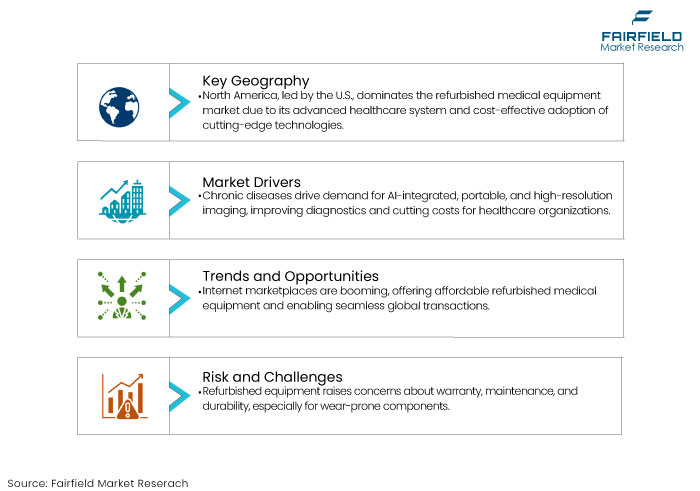
Chronic diseases such as cancer, vascular disorders, and neurological conditions necessitated the implementation of enhanced diagnostic imaging in clinics, hospitals, or medical centers. Advanced AI-integrated imaging, portable systems, and novel high-resolution modalities are enhancing the usability of diagnostic equipment and reducing operational costs for most healthcare organizations.
The refurbishment and reuse of instruments contribute to global sustainability objectives by minimizing electronic waste and its environmental impact over its lifecycle. The prevalence of chronic diseases and global initiatives for enhanced diagnostics in neurology and cardiology have generated tremendous demand.
A notable advantage of remanufactured equipment is that it provides extensive coverage without compromising quality. Refurbished systems enable facilities to adopt the latest technology without the high expenses of entirely new equipment.
- Focus on Sustainability and Circular Economy Boosts Market Growth
Sustainability and environmental legislation concerns are driving the healthcare sector to embrace environment-friendly methods. Refurbished medical equipment supports these objectives by prolonging the lifespan of medical devices, minimizing electronic waste, and preserving resources. Growing focus on sustainability and circular economy remains a key driver for refurbished medical equipment market growth.
Prominent manufacturers are advocating refurbishment as a component of their sustainability initiatives, targeting environmentally aware consumers. Numerous hospitals and clinics are increasingly driven by financial efficiency and their responsibility to minimize environmental impacts.
With the increasing global focus on sustainability, the refurbished medical equipment market is projected to expand considerably, capitalizing on its congruence with circular economy concepts.
Key Growth Barriers
- Perception of Used Medical Equipment Being Less Dependable is a Main Setback
Refurbished equipment often lacks the warranty and customer support typically associated with new equipment, leading to concerns regarding dependability and maintenance among consumers. Refurbished equipment has typically been previously utilized, prompting inquiries about their remaining lifespan and performance, particularly concerning components prone to wear.
Refurbished gadgets may include obsolete technology or lack compatibility with contemporary systems, raising further concerns regarding reliability in the rapidly advancing medical technology domain.
These concerns are typically resolved by high-quality refurbishment methods utilizing a licensed OEM source or reputable supplier, rendering refurbished medical equipment a dependable and cost-effective option for several healthcare facilities.
- Lack of Standardized Protocols Among Medical Equipment Manufacturers Hinders Market Growth
Several nations possess conflicting and inconsistent legislation concerning refurbished medical devices and are subject to stringent laws, but others may be entirely unregulated. Independent manufacturers and third-party sellers frequently employ varied procedures for the refurbishment, testing, and certification of reconditioned goods.
Due to the divergent processes involved, it would expose one to a deficiency in responsibility while attempting to establish a direct correlation between a reconditioned gadget and unreliability. In the absence of a standardized and measured refurbishing procedure, healthcare practitioners may voice apprehension regarding the safety and quality of refurbished equipment.
Implementing refurbishing standards, such as those aligned with ISO certification techniques, could enhance confidence and acceptance through globally recognized benchmarks. Consistent regulations would enhance adherence and safety in the repair and resale of medical equipment.
Refurbished Medical Equipment Market Trends and Opportunities
- Expanding Networks for Recycled Medical Equipment Bolsters Demand
Internet marketplaces have seen a steep rise, mostly focusing on refurbished medical equipment due to providers' escalating need for affordable, high-quality medical products. Such internet platforms facilitate global transactions, hence streamlining the entire process.
Platforms integrated with logistical networks can save costs and enhance accessibility while prolonging the lifespan of medical products. Call centers and integrated e-commerce platforms for payment gateways, user reviews, and artificial intelligence-driven recommendation services further facilitate healthcare practitioners in acquiring certified reconditioned equipment.
It diminishes electronic waste and lowers procurement expenses for healthcare providers, as refurbished products align with the principles of a circular economy. An online platform facilitates vendors in connecting with prospective buyers globally for transactions involving refurbished neurology, imaging, and surgical equipment.
- Integration of Advanced Refurbishment Technologies
The integration of cutting-edge refurbishment technologies is revolutionizing the refurbished medical equipment market. Modern refurbishment processes now employ advanced AI, IoT, and automation tools to diagnose, repair, and upgrade medical devices efficiently.
The technologies allow companies to evaluate the condition of used equipment more precisely, ensuring that repairs or replacements are done to meet or even exceed original performance specifications. IoT-enabled diagnostic tools can continuously monitor device components during refurbishment, predicting potential failures and ensuring higher reliability post-refurbishment.
Refurbished products now appeal to a broader range of buyers, including high-end hospitals and specialty clinics, which may have hesitated to adopt. By integrating these transformative technologies, the market is enhancing its credibility and expanding its reach into premium healthcare segments.
How Does Regulatory Scenario Shaping the Industry?
The regulatory scenario is pivotal in shaping the refurbished medical equipment market, ensuring product safety, reliability, and market growth. Regulatory frameworks vary across regions but share a common goal: to provide end-users with confidence about the quality and safety of refurbished devices.
In North America, agencies like the U.S. Food and Drug Administration (FDA) enforce strict guidelines for refurbishing processes, requiring compliance with Good Manufacturing Practices (GMP). It includes reconditioning, recalibration, and quality testing, ensuring refurbished equipment performs comparably to new devices. Such stringent standards have boosted trust among healthcare providers and driven adoption in the region.
In Europe, CE certification is mandatory, ensuring that refurbished equipment meets European safety, health, and environmental requirements. These regulations encourage sustainability by promoting the reuse of medical devices under well-defined standards.
Emerging markets in Asia Pacific and Latin America are adopting regulatory frameworks inspired by Western standards, further opening opportunities for global players. Compliance with these standards reassures buyers in these regions of the reliability of refurbished products.
Segments Covered in the Report
- Demand to Remain High for Medical Imaging Devices
Medical imaging devices own a substantial market share in the refurbished medical equipment market due to their cost advantage over new models. Healthcare providers are selecting refurbished equipment to economize on essential diagnostic applications such as X-ray, MRI, and CT scans.
Refurbished MRI machines cost approximately 30 to 50% less than new models, rendering them appropriate for budget-sensitive healthcare institutions. Modern refurbishing technologies, including high-end software and hardware upgrades, allow refurbished equipment to match industry performance standards.
Healthcare companies believe that refurbished equipment functions effectively for a long period of time if maintained properly. Refurbished equipment offered by GE Healthcare and Siemens Healthineers is recognized by consumers for its superior quality, upgraded features, and included warranties.
- High Sales come from Hospitals Sector with Growing Demand for Affordable and Reliable Medical Devices
Hospitals dominate the refurbished medical equipment market because of their broad demand for affordable, reliable, and advanced medical technology. It is further supported by financial constraints, service expansion needs, and the availability of high-quality refurbished equipment that meets regulatory standards.
Hospitals often need to manage large numbers of patients while adhering to budget constraints. Refurbished medical equipment offers a cost-effective alternative to new equipment purchases, allowing hospitals to equip their facilities with high-quality technology at relatively lower prices.
Hospitals require a variety of medical equipment, such as imaging systems, patient monitoring systems, and surgical instruments. Refurbished options are often prioritized to quickly and affordably address gaps in these critical areas, especially in regions with limited healthcare funding.
Regional Analysis
- North America Maintains Primacy in the Market
North America leads the refurbished medical equipment market, primarily driven by the United States. The region benefits from a high-end healthcare system with a high adoption rate of advanced medical technologies. Hospitals and diagnostic centres in North America frequently opt for refurbished equipment to balance their need for cutting-edge solutions with cost constraints.
Institutions are opting for refurbished medical equipment with rising healthcare costs to reduce expenses without compromising healthcare facilities. Many healthcare providers in the U.S. and Canada prioritize refurbished equipment as a practical alternative for upgrading their facilities.
Stringent regulations around refurbished medical devices give buyers confidence about the product's safety, quality, and quality. Regulatory frameworks by organizations like the U.S. FDA ensure refurbished equipment meets stringent standards, bolstering market trust.
- Europe Refurbished Medical Equipment Market to Stand out
Europe holds the second largest share of the refurbished medical equipment market, driven by significant adoption in countries like Germany, the UK, and France. Countries in Europe place a strong emphasis on environmental sustainability and the circular economy. The use of refurbished equipment aligns with these principles, reducing electronic waste and extending the lifecycle of medical devices.
Several countries in Europe face budgetary restrictions in their public healthcare systems. Refurbished equipment provides a cost-effective solution for hospitals and clinics to acquire advanced technologies while managing financial limitations.
Nations in Europe are increasingly adopting refurbished medical equipment as they expand their healthcare infrastructure. The affordability of these devices enables these countries to meet growing patient demands.
Fairfield’s Competitive Landscape Analysis
The refurbished medical equipment market is intensely competitive, comprising major entities such as GE Healthcare, Siemens Healthineers, Philips Healthcare, and Canon Medical Systems. The competition is increased by improvements in refurbishing methods that adhere to regulatory criteria such as FDA and CE certifications.
Key strategies encompass collaborations with hospitals, expanding service networks, and the provision of extended warranties. New market entrants concentrate on specialized segments and pricing strategies to acquire market share. Environmental initiatives and circular economy practices significantly influence competition among prominent enterprises.
Key Market Companies
• Medtronic plc
• Nationwide Imaging Services
• Koninklijke Philips N.V.
• Radio Oncology Systems
• Siemens Healthineers
• Agito Medical
• Amber Diagnostics
• Avante Health Solutions
• Canon Medical Systems
• Fair Medical Co., Ltd
Global Refurbished Medical Equipment Market is Segmented as-
By Type
- Operating Room and Surgical Devices
- Medical Imaging Devices
- Cardiovascular and Cardiology Devices
- Patient Monitors
- Neurology Devices
By Application
- Diagnostic
- Therapeutic
By End Use
- Hospitals
- Diagnostic Centers
- Ambulatory Care Centers
By Region
- North America
- Europe
- Asia Pacific
- Latin America
- The Middle East & Africa
- Executive Summary
- Global Refurbished Medical Equipment Market Snapshot
- Future Projections
- Key Market Trends
- Regional Snapshot, by Value, 2026
- Analyst Recommendations
- Market Overview
- Market Definitions and Segmentations
- Market Dynamics
- Drivers
- Restraints
- Market Opportunities
- Value Chain Analysis
- COVID-19 Impact Analysis
- Porter's Five Forces Analysis
- Impact of Russia-Ukraine Conflict
- PESTLE Analysis
- Regulatory Analysis
- Price Trend Analysis
- Current Prices and Future Projections, 2025-2033
- Price Impact Factors
- Global Refurbished Medical Equipment Market Outlook, 2020 - 2033
- Global Refurbished Medical Equipment Market Outlook, by Type, Value (US$ Bn), 2020-2033
- Operating Room and Surgical Devices
- Medical Imaging Devices
- Cardiovascular and Cardiology Devices
- Patient Monitors
- Neurology Devices
- Global Refurbished Medical Equipment Market Outlook, by Application, Value (US$ Bn), 2020-2033
- Diagnostic
- Therapeutic
- Global Refurbished Medical Equipment Market Outlook, by End Use, Value (US$ Bn), 2020-2033
- Hospitals
- Diagnostic Centers
- Ambulatory Care Centers
- Global Refurbished Medical Equipment Market Outlook, by Region, Value (US$ Bn), 2020-2033
- North America
- Europe
- Asia Pacific
- Latin America
- Middle East & Africa
- Global Refurbished Medical Equipment Market Outlook, by Type, Value (US$ Bn), 2020-2033
- North America Refurbished Medical Equipment Market Outlook, 2020 - 2033
- North America Refurbished Medical Equipment Market Outlook, by Type, Value (US$ Bn), 2020-2033
- Operating Room and Surgical Devices
- Medical Imaging Devices
- Cardiovascular and Cardiology Devices
- Patient Monitors
- Neurology Devices
- North America Refurbished Medical Equipment Market Outlook, by Application, Value (US$ Bn), 2020-2033
- Diagnostic
- Therapeutic
- North America Refurbished Medical Equipment Market Outlook, by End Use, Value (US$ Bn), 2020-2033
- Hospitals
- Diagnostic Centers
- Ambulatory Care Centers
- North America Refurbished Medical Equipment Market Outlook, by Country, Value (US$ Bn), 2020-2033
- U.S. Refurbished Medical Equipment Market Outlook, by Type, 2020-2033
- U.S. Refurbished Medical Equipment Market Outlook, by Application, 2020-2033
- U.S. Refurbished Medical Equipment Market Outlook, by End Use, 2020-2033
- Canada Refurbished Medical Equipment Market Outlook, by Type, 2020-2033
- Canada Refurbished Medical Equipment Market Outlook, by Application, 2020-2033
- Canada Refurbished Medical Equipment Market Outlook, by End Use, 2020-2033
- BPS Analysis/Market Attractiveness Analysis
- North America Refurbished Medical Equipment Market Outlook, by Type, Value (US$ Bn), 2020-2033
- Europe Refurbished Medical Equipment Market Outlook, 2020 - 2033
- Europe Refurbished Medical Equipment Market Outlook, by Type, Value (US$ Bn), 2020-2033
- Operating Room and Surgical Devices
- Medical Imaging Devices
- Cardiovascular and Cardiology Devices
- Patient Monitors
- Neurology Devices
- Europe Refurbished Medical Equipment Market Outlook, by Application, Value (US$ Bn), 2020-2033
- Diagnostic
- Therapeutic
- Europe Refurbished Medical Equipment Market Outlook, by End Use, Value (US$ Bn), 2020-2033
- Hospitals
- Diagnostic Centers
- Ambulatory Care Centers
- Europe Refurbished Medical Equipment Market Outlook, by Country, Value (US$ Bn), 2020-2033
- Germany Refurbished Medical Equipment Market Outlook, by Type, 2020-2033
- Germany Refurbished Medical Equipment Market Outlook, by Application, 2020-2033
- Germany Refurbished Medical Equipment Market Outlook, by End Use, 2020-2033
- Italy Refurbished Medical Equipment Market Outlook, by Type, 2020-2033
- Italy Refurbished Medical Equipment Market Outlook, by Application, 2020-2033
- Italy Refurbished Medical Equipment Market Outlook, by End Use, 2020-2033
- France Refurbished Medical Equipment Market Outlook, by Type, 2020-2033
- France Refurbished Medical Equipment Market Outlook, by Application, 2020-2033
- France Refurbished Medical Equipment Market Outlook, by End Use, 2020-2033
- U.K. Refurbished Medical Equipment Market Outlook, by Type, 2020-2033
- U.K. Refurbished Medical Equipment Market Outlook, by Application, 2020-2033
- U.K. Refurbished Medical Equipment Market Outlook, by End Use, 2020-2033
- Spain Refurbished Medical Equipment Market Outlook, by Type, 2020-2033
- Spain Refurbished Medical Equipment Market Outlook, by Application, 2020-2033
- Spain Refurbished Medical Equipment Market Outlook, by End Use, 2020-2033
- Russia Refurbished Medical Equipment Market Outlook, by Type, 2020-2033
- Russia Refurbished Medical Equipment Market Outlook, by Application, 2020-2033
- Russia Refurbished Medical Equipment Market Outlook, by End Use, 2020-2033
- Rest of Europe Refurbished Medical Equipment Market Outlook, by Type, 2020-2033
- Rest of Europe Refurbished Medical Equipment Market Outlook, by Application, 2020-2033
- Rest of Europe Refurbished Medical Equipment Market Outlook, by End Use, 2020-2033
- BPS Analysis/Market Attractiveness Analysis
- Europe Refurbished Medical Equipment Market Outlook, by Type, Value (US$ Bn), 2020-2033
- Asia Pacific Refurbished Medical Equipment Market Outlook, 2020 - 2033
- Asia Pacific Refurbished Medical Equipment Market Outlook, by Type, Value (US$ Bn), 2020-2033
- Operating Room and Surgical Devices
- Medical Imaging Devices
- Cardiovascular and Cardiology Devices
- Patient Monitors
- Neurology Devices
- Asia Pacific Refurbished Medical Equipment Market Outlook, by Application, Value (US$ Bn), 2020-2033
- Diagnostic
- Therapeutic
- Asia Pacific Refurbished Medical Equipment Market Outlook, by End Use, Value (US$ Bn), 2020-2033
- Hospitals
- Diagnostic Centers
- Ambulatory Care Centers
- Asia Pacific Refurbished Medical Equipment Market Outlook, by Country, Value (US$ Bn), 2020-2033
- China Refurbished Medical Equipment Market Outlook, by Type, 2020-2033
- China Refurbished Medical Equipment Market Outlook, by Application, 2020-2033
- China Refurbished Medical Equipment Market Outlook, by End Use, 2020-2033
- Japan Refurbished Medical Equipment Market Outlook, by Type, 2020-2033
- Japan Refurbished Medical Equipment Market Outlook, by Application, 2020-2033
- Japan Refurbished Medical Equipment Market Outlook, by End Use, 2020-2033
- South Korea Refurbished Medical Equipment Market Outlook, by Type, 2020-2033
- South Korea Refurbished Medical Equipment Market Outlook, by Application, 2020-2033
- South Korea Refurbished Medical Equipment Market Outlook, by End Use, 2020-2033
- India Refurbished Medical Equipment Market Outlook, by Type, 2020-2033
- India Refurbished Medical Equipment Market Outlook, by Application, 2020-2033
- India Refurbished Medical Equipment Market Outlook, by End Use, 2020-2033
- Southeast Asia Refurbished Medical Equipment Market Outlook, by Type, 2020-2033
- Southeast Asia Refurbished Medical Equipment Market Outlook, by Application, 2020-2033
- Southeast Asia Refurbished Medical Equipment Market Outlook, by End Use, 2020-2033
- Rest of SAO Refurbished Medical Equipment Market Outlook, by Type, 2020-2033
- Rest of SAO Refurbished Medical Equipment Market Outlook, by Application, 2020-2033
- Rest of SAO Refurbished Medical Equipment Market Outlook, by End Use, 2020-2033
- BPS Analysis/Market Attractiveness Analysis
- Asia Pacific Refurbished Medical Equipment Market Outlook, by Type, Value (US$ Bn), 2020-2033
- Latin America Refurbished Medical Equipment Market Outlook, 2020 - 2033
- Latin America Refurbished Medical Equipment Market Outlook, by Type, Value (US$ Bn), 2020-2033
- Operating Room and Surgical Devices
- Medical Imaging Devices
- Cardiovascular and Cardiology Devices
- Patient Monitors
- Neurology Devices
- Latin America Refurbished Medical Equipment Market Outlook, by Application, Value (US$ Bn), 2020-2033
- Diagnostic
- Therapeutic
- Latin America Refurbished Medical Equipment Market Outlook, by End Use, Value (US$ Bn), 2020-2033
- Hospitals
- Diagnostic Centers
- Ambulatory Care Centers
- Latin America Refurbished Medical Equipment Market Outlook, by Country, Value (US$ Bn), 2020-2033
- Brazil Refurbished Medical Equipment Market Outlook, by Type, 2020-2033
- Brazil Refurbished Medical Equipment Market Outlook, by Application, 2020-2033
- Brazil Refurbished Medical Equipment Market Outlook, by End Use, 2020-2033
- Mexico Refurbished Medical Equipment Market Outlook, by Type, 2020-2033
- Mexico Refurbished Medical Equipment Market Outlook, by Application, 2020-2033
- Mexico Refurbished Medical Equipment Market Outlook, by End Use, 2020-2033
- Argentina Refurbished Medical Equipment Market Outlook, by Type, 2020-2033
- Argentina Refurbished Medical Equipment Market Outlook, by Application, 2020-2033
- Argentina Refurbished Medical Equipment Market Outlook, by End Use, 2020-2033
- Rest of LATAM Refurbished Medical Equipment Market Outlook, by Type, 2020-2033
- Rest of LATAM Refurbished Medical Equipment Market Outlook, by Application, 2020-2033
- Rest of LATAM Refurbished Medical Equipment Market Outlook, by End Use, 2020-2033
- BPS Analysis/Market Attractiveness Analysis
- Latin America Refurbished Medical Equipment Market Outlook, by Type, Value (US$ Bn), 2020-2033
- Middle East & Africa Refurbished Medical Equipment Market Outlook, 2020 - 2033
- Middle East & Africa Refurbished Medical Equipment Market Outlook, by Type, Value (US$ Bn), 2020-2033
- Operating Room and Surgical Devices
- Medical Imaging Devices
- Cardiovascular and Cardiology Devices
- Patient Monitors
- Neurology Devices
- Middle East & Africa Refurbished Medical Equipment Market Outlook, by Application, Value (US$ Bn), 2020-2033
- Diagnostic
- Therapeutic
- Middle East & Africa Refurbished Medical Equipment Market Outlook, by End Use, Value (US$ Bn), 2020-2033
- Hospitals
- Diagnostic Centers
- Ambulatory Care Centers
- Middle East & Africa Refurbished Medical Equipment Market Outlook, by Country, Value (US$ Bn), 2020-2033
- GCC Refurbished Medical Equipment Market Outlook, by Type, 2020-2033
- GCC Refurbished Medical Equipment Market Outlook, by Application, 2020-2033
- GCC Refurbished Medical Equipment Market Outlook, by End Use, 2020-2033
- South Africa Refurbished Medical Equipment Market Outlook, by Type, 2020-2033
- South Africa Refurbished Medical Equipment Market Outlook, by Application, 2020-2033
- South Africa Refurbished Medical Equipment Market Outlook, by End Use, 2020-2033
- Egypt Refurbished Medical Equipment Market Outlook, by Type, 2020-2033
- Egypt Refurbished Medical Equipment Market Outlook, by Application, 2020-2033
- Egypt Refurbished Medical Equipment Market Outlook, by End Use, 2020-2033
- Nigeria Refurbished Medical Equipment Market Outlook, by Type, 2020-2033
- Nigeria Refurbished Medical Equipment Market Outlook, by Application, 2020-2033
- Nigeria Refurbished Medical Equipment Market Outlook, by End Use, 2020-2033
- Rest of Middle East Refurbished Medical Equipment Market Outlook, by Type, 2020-2033
- Rest of Middle East Refurbished Medical Equipment Market Outlook, by Application, 2020-2033
- Rest of Middle East Refurbished Medical Equipment Market Outlook, by End Use, 2020-2033
- BPS Analysis/Market Attractiveness Analysis
- Middle East & Africa Refurbished Medical Equipment Market Outlook, by Type, Value (US$ Bn), 2020-2033
- Competitive Landscape
- Company Vs Segment Heatmap
- Company Market Share Analysis, 2025
- Competitive Dashboard
- Company Profiles
- Medtronic plc
- Company Overview
- Product Portfolio
- Financial Overview
- Business Strategies and Developments
- Nationwide Imaging Services
- Koninklijke Philips N.V.
- Radio Oncology Systems
- Siemens Healthineers
- Agito Medical
- Amber Diagnostics
- Avante Health Solutions
- Canon Medical Systems
- Fair Medical Co., Ltd
- Medtronic plc
- Appendix
- Research Methodology
- Report Assumptions
- Acronyms and Abbreviations
BASE YEAR |
HISTORICAL DATA |
FORECAST PERIOD |
UNITS |
|||
 |
2025 |
 |
2020 - 2025 |
 |
2026 - 2033 |
Value: US$ Million |
Our Research Methodology
Considering the volatility of business today, traditional approaches to strategizing a game plan can be unfruitful if not detrimental. True ambiguity is no way to determine a forecast. A myriad of predetermined factors must be accounted for such as the degree of risk involved, the magnitude of circumstances, as well as conditions or consequences that are not known or unpredictable. To circumvent binary views that cast uncertainty, the application of market research intelligence to strategically posture, move, and enable actionable outcomes is necessary.
View Methodology
Quality Assured
Rigorous Validation Process

Confidentiality Assured
End-to-end Data Security

Custom Research Services
Tailored To Your Objectives
FAQs
The Refurbished Medical Equipment Market is valued at USD 18.2 Bn in 2026.
The Refurbished Medical Equipment Market is projected to grow at a CAGR of 5% through 2033, reaching USD 26.3 Bn.
The market is driven by the growing demand for cost-effective medical devices, increasing focus on sustainability and the circular economy, and rising adoption of refurbished imaging equipment by healthcare facilities.
North America is the dominant regional market for Refurbished Medical Equipment due to its advanced healthcare infrastructure, strong regulatory framework, and high adoption of refurbished technologies.
Medtronic plc, Koninklijke Philips N.V., Siemens Healthineers, Canon Medical Systems, and Avante Health Solutions are among the leading players in the Refurbished Medical Equipment Market.
Related Reports
Advanced Therapy Medicinal Products Market
The global advanced therapy medicinal products market will reach US$ 48.04 Bn by 2033, growing at a 14.6% CAGR, driven by demand for innovative therapies
Pen and Injector Drug Delivery Devices Market
The global pen and injector drug delivery devices market will reach US$ 20.88 Billion by 2033, growing at an 8.9% CAGR from 2026-2033
Healthcare Waste Treatment Market Insights, Competitive Landscape, and Market Forecast - 2033
The healthcare waste treatment market will grow from USD12.80 billion in 2026 to USD20.15 billion by 2033, driven by expanding healthcare systems.
Medical Rehabilitation Service Market Size and Forecast 2033
Medical Rehabilitation Service Market to reach USD 54.27 Bn by 2033, growing at 7.6% CAGR, driven by aging populations, outpatient care, and home-based rehabilitation.
Growth Factor Plus Market Insights, Competitive Landscape, and Market Forecast 2033
Growth Factor Plus Market to reach USD 798.88 Mn by 2033, growing at 9.6% CAGR, driven by clinical skincare, dermatology, medical aesthetics, and premium formulations.
At-home Genetic Testing Market Insights, Competitive Landscape, and Market Forecast - 2033
The at-home genetic testing market is expected to grow from USD 3.10 billion in 2026 to USD 7.38 billion by 2033, driven by rising consumer health data interest