



Saliva-based Screening Market
Saliva Based Screening Market Insights, Competitive Landscape, and Market Forecast - 2033
Global Saliva-based Screening Market Forecast
The Saliva Based Screening Market is witnessing steady growth, rising from USD 385.5 Mn in 2026 to an estimated USD 611 Mn by 2033, driven by a CAGR of 6.80%.
Saliva-based Screening Market Insights
A Look Back and a Look Forward - Comparative Analysis
The saliva-based screening market experienced steady growth during the period from 2019 to 2023 driven by increasing awareness of non-invasive diagnostic methods and their advantages over traditional techniques.
The market expanded significantly due to the COVID-19 pandemic, accelerating the adoption of saliva-based diagnostic tests for viral detection. Advancements in biomarkers for diabetes, cancer, and infectious diseases further contributed to market development.
Cost-effectiveness, ease of sample collection, and patient compliance made saliva-based screening a preferred alternative for diagnostic labs and research applications. However, adoption was slower in resource-limited settings due to the need for advanced technologies.
The market is projected to expand at a CAGR of fueled by technological advancements in point-of-care (POC) testing and increased integration of artificial intelligence (AI) in diagnostics. Saliva-based diagnostics are expanding into broad applications, such as early cancer detection, hormonal monitoring, and drug testing.
Supportive government initiatives and investments in healthcare infrastructure, particularly in emerging economies, are further accelerating growth. The increasing prevalence of chronic diseases and the rising demand for personalized healthcare solutions ensure sustained market expansion. These factors collectively position saliva-based screening as a transformative force in the global diagnostics industry.
Key Growth Determinants
- Rising Prevalence of Chronic Diseases to Bolster Market
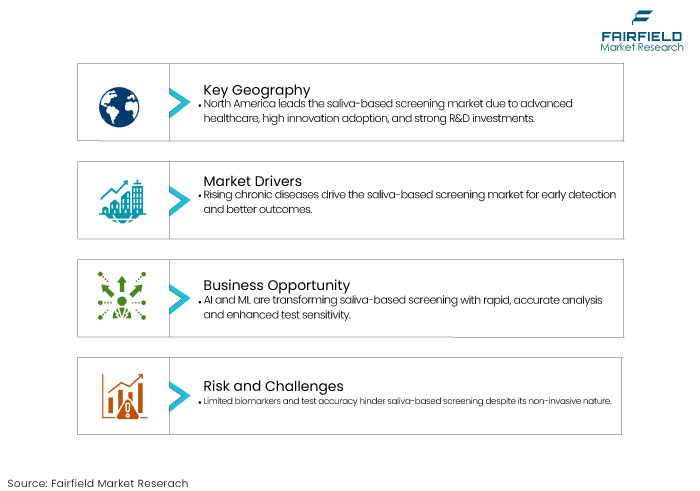
The increasing prevalence of chronic diseases, such as diabetes, cancer, and cardiovascular disorders, is a key driver for the saliva-based screening market. These conditions require regular monitoring and early detection to improve patient outcomes and reduce healthcare costs.
Saliva-based diagnostics offer a non-invasive and cost-effective alternative for detecting biomarkers associated with these diseases. Saliva tests can detect glucose levels for diabetes management or identify specific genetic markers for cancer risk.
The convenience of saliva-based screening encourages patient compliance, particularly for populations requiring frequent testing, such as the elderly or those in remote areas. As the burden of chronic diseases continues to grow globally, the demand for efficient and patient-friendly diagnostic solutions like saliva-based screening will increase.
- Growing Demand for Non-Invasive Diagnostic Methods
The global shift towards non-invasive diagnostic techniques is a major growth driver for the saliva-based screening market. Unlike traditional methods such as blood draws or biopsies, saliva collection is painless, simple, and stress-free, making it ideal for a wide range of patients, including children and those with needle phobia.
Saliva-based screening reduces the risk of infection transmission, making it highly relevant in the post-pandemic era. With increasing awareness of patient-centric care and the advantages of non-invasive diagnostics, saliva-based screening is poised to become a preferred choice in healthcare settings worldwide.
Key Growth Barriers
- Limited Biomarker Availability and Test Accuracy Remains Key Barrier
One of the significant restraints for the saliva-based screening market is the limited availability of reliable biomarkers and challenges in test accuracy. While saliva offers a non-invasive and accessible medium, the concentration of many biomarkers in saliva is often lower than in blood, making detection more complex.
The said limitation impacts the sensitivity and specificity of saliva-based tests, particularly for diseases requiring early diagnosis or those with subtle biomarker signatures, such as early-stage cancers.
Environmental factors, such as diet, hydration, and oral hygiene, can influence saliva composition and lead to variability in test results. These factors make it challenging to standardize saliva-based diagnostic protocols across diverse populations, limiting their widespread adoption. Despite advancements in molecular technologies, overcoming these hurdles remains crucial to fully unlocking the potential of saliva-based diagnostics.
- High Initial Development Costs and Regulatory Challenges
The saliva-based screening market faces significant restraints from high initial development costs and complex regulatory hurdles. Developing saliva-based diagnostic tools requires substantial investment in research to identify and validate biomarkers, and integrate advanced technologies like polymerase chain reaction (PCR) and point-of-care devices. These processes can be time-consuming and costly, particularly for small or emerging players.
Regulatory agencies such as the FDA and EMA impose stringent requirements for demonstrating diagnostic tests' safety, efficacy, and reliability. Meeting these standards involves extensive clinical trials and documentation, increasing time-to-market and costs for developers.
For start-ups and companies without robust financial backing, these challenges can hinder market entry and innovation, slowing the overall saliva-based screening industry growth. Addressing regulatory and cost barriers is critical for fostering broad adoption and technological advancements.
Saliva-based Screening Market Trends and Opportunities
- Integration of AI and Machine Learning in Saliva-Based Diagnostics
Integrating artificial intelligence (AI) and machine learning (ML) in diagnostics is a notable trend shaping the saliva-based screening market. AI and ML revolutionize how saliva-based diagnostic tools analyze complex data sets, enabling rapid and highly accurate results. These technologies excel at identifying patterns in biomarker profiles, even in low concentrations, enhancing the sensitivity and specificity of tests.
AI algorithms can detect minute variations in saliva samples indicative of early-stage diseases like cancer or neurodegenerative disorders. AI-powered platforms are being used to predict patient outcomes and recommend personalized treatment plans based on saliva-based screening. .
The rise of wearable health devices with integrated saliva diagnostic features further exemplifies this trend. These advancements improve diagnostic capabilities and streamline workflows for clinicians, making saliva-based screening a roust and reliable option for real-time health monitoring.
- Expansion into Preventive and Personalized Healthcare
The growing emphasis on preventive and personalized healthcare presents a significant opportunity for the saliva-based screening market. Saliva diagnostics offer a non-invasive, cost-effective, and patient-friendly method for early disease detection and regular health monitoring, aligning with the global shift towards proactive healthcare.
Saliva-based tests are increasingly used for detecting genetic predispositions to diseases, enabling individuals to take preventive measures long before symptoms arise. Similarly, hormonal monitoring through saliva can guide personalized treatments for conditions such as infertility, stress-related disorders, and endocrine imbalances.
Emerging markets also provide untapped opportunities, as saliva diagnostics can improve healthcare access in regions with limited infrastructure. Companies investing in affordable, portable diagnostic tools can cater to underserved populations while addressing global health challenges.
Collaboration with telemedicine platforms and wearable technology developers can expand the reach of saliva-based diagnostics, making them integral to future healthcare solutions focused on prevention and personalization.
How Does Regulatory Scenario Shape the Industry?
The regulatory environment plays a pivotal role in shaping the saliva-based screening market. Regulatory agencies such as the FDA (U.S.), EMA (Europe), and local healthcare authorities in emerging economies enforce strict guidelines to ensure saliva-based diagnostic tools' safety, accuracy, and reliability. These regulations are essential for building trust among healthcare providers and patients and driving market credibility.
Saliva-based diagnostic tools must undergo rigorous validation processes in developed markets including clinical trials to demonstrate their efficacy compared to traditional methods like blood tests. The FDA's emergency use authorization (EUA) during the COVID-19 pandemic accelerated the adoption of saliva-based testing for viral detection. This regulatory flexibility showcased the potential of saliva diagnostics in meeting urgent healthcare needs.
Stringent requirements and lengthy approval processes pose challenges for new entrants and innovative start-ups, particularly in emerging regions. Efforts to harmonize global standards for diagnostic tools are ongoing, aiming to streamline approvals and foster market expansion.
Regulatory support for advanced technologies such as AI-powered diagnostic platforms and portable saliva-based devices fosters innovation. Governments and agencies are also incentivizing research into biomarker discovery and saliva-based testing applications, further accelerating growth in this sector while ensuring public health safety.
Segments Covered in the Report
- Saliva-Based Detection Kits to Stand Out with a 60% of Market Share
Saliva-Based detection kits are designed to identify specific biomarkers in saliva, facilitating the diagnosis of various conditions, including infectious diseases, genetic disorders, and hormonal imbalances.
The surge in demand for non-invasive, rapid, and user-friendly diagnostic tools has propelled the adoption of these kits. Their prominence was notably amplified during the COVID-19 pandemic, where they served as efficient alternatives to nasopharyngeal swabs for virus detection.
Companies like Nalagenetics and Nusantics received regulatory approval to introduce PCR test kits for detecting COVID-19 in saliva samples, highlighting the growing acceptance and utilization of saliva-based detection methods. The advantages of saliva-based detection kits include ease of sample collection, reduced discomfort compared to blood draws, and the potential for at-home testing, which enhance patient compliance and broadens accessibility.
As technological advancements continue to improve the sensitivity and specificity of these kits, their application scope is expanding beyond infectious diseases to areas like oncology and metabolic disorders.
- Infection analysis/detection stands out as the dominant application
The infection analysis/detection segment has gained prominence due to the increasing demand for non-invasive, rapid, and reliable diagnostic methods for infectious diseases. Saliva-based tests for infection detection have become essential tools in diagnosing various infectious diseases, including viral, bacterial, and fungal infections.
The non-invasive nature of saliva collection offers a patient-friendly alternative to traditional blood tests, enhancing patient compliance and facilitating mass screening efforts. During the COVID-19 pandemic, saliva-based diagnostics played a crucial role in large-scale testing due to their ease of use and reduced risk of transmission during sample collection.
The said application segment has been further supported by advancements in molecular diagnostic technologies, such as PCR and rapid antigen tests, improving the sensitivity and specificity of saliva-based infection detection. The growing prevalence of infectious diseases globally and the need for efficient diagnostic tools continue to drive the dominance of this application in the saliva-based screening market.
While specific percentage market share figures for infection analysis/detection within the saliva-based screening market are not readily available, this application is recognized as a leading segment due to its widespread adoption and critical role in public health diagnostics.
The ongoing development of saliva-based assays for a broader range of pathogens is expected to solidify further its position as the dominant application in the market.
Regional Analysis
- North America Takes the Lead with Advanced Healthcare Infrastructure
North America is the dominant region in the saliva-based screening market, driven by its advanced healthcare infrastructure, high adoption rates for innovative diagnostic technologies, and significant investments in research and development.
North America is home to leading diagnostic companies and research institutions, making it a hub for technological advancements in saliva-based screening. Key players like OraSure Technologies and Thermo Fisher Scientific are actively developing cutting-edge saliva diagnostic kits for infection detection, genomics, and oncology applications.
The region's focus on patient-centric healthcare has encouraged the adoption of non-invasive diagnostic methods. Saliva-based tests are particularly popular for their ease of use, cost-effectiveness, and potential for at-home testing.
North America's leadership in the saliva-based screening market is anchored by its robust healthcare ecosystem, commitment to innovation, and early adoption of advanced diagnostic tools. The region's market dominance is expected to continue, driven by increasing healthcare expenditure and a focus on preventive diagnostics.
- Europe to be Second Largest Market with Supportive Regulatory Framework
Europe is the second-largest market for saliva-based screening, driven by its focus on innovation, preventive healthcare, and a supportive regulatory framework. The region has shown significant growth potential due to its increasing adoption of non-invasive diagnostics and the rising prevalence of chronic diseases.
Countries in Europe including Germany, the United Kingdom, France, and Italy, are at the forefront of adopting saliva-based diagnostic technologies. These nations invest significantly in research and development, advancing saliva-based testing for infection detection, genomics, and oncology applications.
The integration of saliva diagnostics into preventive healthcare systems and their use in early disease detection is gaining momentum, particularly in chronic and hereditary diseases.
Europe's regulatory landscape, governed by the European Medicines Agency (EMA) and local regulatory bodies, encourages innovation in diagnostics.
The introduction of the European Union's In-Vitro Diagnostic Regulation (IVDR) emphasizes safety, accuracy, and performance, fostering confidence in saliva-based diagnostic tools. Governments across Europe are providing funding and incentives for research in non-invasive diagnostics, boosting the market for saliva-based screening solutions.
Fairfield’s Competitive Landscape Analysis
The saliva-based screening market is highly competitive, driven by innovation and the increasing demand for non-invasive diagnostic solutions. Key players include OraSure Technologies, Salimetrics LLC, Thermo Fisher Scientific, NEOGEN Corporation, and Quest Diagnostics, each focusing on developing advanced diagnostic kits and technologies.
Emerging players are introducing cost-effective, portable solutions targeting underserved markets. Technological advancements, regulatory approvals, and a growing emphasis on personalized and preventive healthcare shape the competitive landscape.
Key Market Companies
- Thermo Fisher Scientific
- Hologic
- Qiagen
- Zymo Research Corporation
- DNA Genotek Inc.
- Invitek Molecular GmbH
- Salimetrics, LLC.
- BioChain Institute Inc.
- Mawi DNA Technologies LLC
- Cell Projects Ltd.
- Kyodo International, Inc.
- Spectrum Solutions
- NEOGEN Corporation
- Xiamen Zeesan Biotech Co., Ltd.
- Sedia Biosciences Corporation
- Biosynex SA
- Chembio Diagnostics, Inc.
- Creative Diagnostics
- OraSure Technologies
Global Saliva-based Screening Market is Segmented as-
By Product
- Saliva Collection Devices
- Saliva Nucleic Acid Purification Kits
- Saliva Base Detection Kits
By Purpose
- Research
- Diagnostics
By Application
- Infection analysis/detection
- Genomic analysis
- Proteomics
- Pharmacogenomics
- Liquid biopsy
By End User
- Hospitals & Clinics
- Diagnostic laboratories
- Academic & research institutes
- Biopharmaceuticals & CRO’s
By Region
- North America
- Europe
- Asia Pacific
- Latin America
- The Middle East & Africa
- Executive Summary
- Global Saliva Based Screening Market Snapshot
- Future Projections
- Key Market Trends
- Regional Snapshot, by Value, 2026
- Analyst Recommendations
- Market Overview
- Market Definitions and Segmentations
- Market Dynamics
- Drivers
- Restraints
- Market Opportunities
- Value Chain Analysis
- COVID-19 Impact Analysis
- Porter's Five Forces Analysis
- Impact of Russia-Ukraine Conflict
- PESTLE Analysis
- Regulatory Analysis
- Price Trend Analysis
- Current Prices and Future Projections, 2025-2033
- Price Impact Factors
- Global Saliva Based Screening Market Outlook, 2020 - 2033
- Global Saliva Based Screening Market Outlook, by Product Type, Value (US$ Mn), 2020-2033
- Saliva Collection Devices
- Saliva Nucleic Acid Purification Kits
- Saliva Base Detection Kits
- Global Saliva Based Screening Market Outlook, by Purpose, Value (US$ Mn), 2020-2033
- Research
- Diagnostics
- Global Saliva Based Screening Market Outlook, by Application, Value (US$ Mn), 2020-2033
- Infection analysis/detection
- Genomic analysis
- Proteomics
- Pharmacogenomics
- Liquid biopsy
- Global Saliva Based Screening Market Outlook, by End User, Value (US$ Mn), 2020-2033
- Hospitals & Clinics
- Diagnostic laboratories
- Academic & research institutes
- Biopharmaceuticals & CRO’s
- Global Saliva Based Screening Market Outlook, by Region, Value (US$ Mn), 2020-2033
- North America
- Europe
- Asia Pacific
- Latin America
- Middle East & Africa
- Global Saliva Based Screening Market Outlook, by Product Type, Value (US$ Mn), 2020-2033
- North America Saliva Based Screening Market Outlook, 2020 - 2033
- North America Saliva Based Screening Market Outlook, by Product Type, Value (US$ Mn), 2020-2033
- Saliva Collection Devices
- Saliva Nucleic Acid Purification Kits
- Saliva Base Detection Kits
- North America Saliva Based Screening Market Outlook, by Purpose, Value (US$ Mn), 2020-2033
- Research
- Diagnostics
- North America Saliva Based Screening Market Outlook, by Application, Value (US$ Mn), 2020-2033
- Infection analysis/detection
- Genomic analysis
- Proteomics
- Pharmacogenomics
- Liquid biopsy
- North America Saliva Based Screening Market Outlook, by End User, Value (US$ Mn), 2020-2033
- Hospitals & Clinics
- Diagnostic laboratories
- Academic & research institutes
- Biopharmaceuticals & CRO’s
- North America Saliva Based Screening Market Outlook, by Country, Value (US$ Mn), 2020-2033
- U.S. Saliva Based Screening Market Outlook, by Product Type, 2020-2033
- U.S. Saliva Based Screening Market Outlook, by Purpose, 2020-2033
- U.S. Saliva Based Screening Market Outlook, by Application, 2020-2033
- U.S. Saliva Based Screening Market Outlook, by End User, 2020-2033
- Canada Saliva Based Screening Market Outlook, by Product Type, 2020-2033
- Canada Saliva Based Screening Market Outlook, by Purpose, 2020-2033
- Canada Saliva Based Screening Market Outlook, by Application, 2020-2033
- Canada Saliva Based Screening Market Outlook, by End User, 2020-2033
- BPS Analysis/Market Attractiveness Analysis
- North America Saliva Based Screening Market Outlook, by Product Type, Value (US$ Mn), 2020-2033
- Europe Saliva Based Screening Market Outlook, 2020 - 2033
- Europe Saliva Based Screening Market Outlook, by Product Type, Value (US$ Mn), 2020-2033
- Saliva Collection Devices
- Saliva Nucleic Acid Purification Kits
- Saliva Base Detection Kits
- Europe Saliva Based Screening Market Outlook, by Purpose, Value (US$ Mn), 2020-2033
- Research
- Diagnostics
- Europe Saliva Based Screening Market Outlook, by Application, Value (US$ Mn), 2020-2033
- Infection analysis/detection
- Genomic analysis
- Proteomics
- Pharmacogenomics
- Liquid biopsy
- Europe Saliva Based Screening Market Outlook, by End User, Value (US$ Mn), 2020-2033
- Hospitals & Clinics
- Diagnostic laboratories
- Academic & research institutes
- Biopharmaceuticals & CRO’s
- Europe Saliva Based Screening Market Outlook, by Country, Value (US$ Mn), 2020-2033
- Germany Saliva Based Screening Market Outlook, by Product Type, 2020-2033
- Germany Saliva Based Screening Market Outlook, by Purpose, 2020-2033
- Germany Saliva Based Screening Market Outlook, by Application, 2020-2033
- Germany Saliva Based Screening Market Outlook, by End User, 2020-2033
- Italy Saliva Based Screening Market Outlook, by Product Type, 2020-2033
- Italy Saliva Based Screening Market Outlook, by Purpose, 2020-2033
- Italy Saliva Based Screening Market Outlook, by Application, 2020-2033
- Italy Saliva Based Screening Market Outlook, by End User, 2020-2033
- France Saliva Based Screening Market Outlook, by Product Type, 2020-2033
- France Saliva Based Screening Market Outlook, by Purpose, 2020-2033
- France Saliva Based Screening Market Outlook, by Application, 2020-2033
- France Saliva Based Screening Market Outlook, by End User, 2020-2033
- U.K. Saliva Based Screening Market Outlook, by Product Type, 2020-2033
- U.K. Saliva Based Screening Market Outlook, by Purpose, 2020-2033
- U.K. Saliva Based Screening Market Outlook, by Application, 2020-2033
- U.K. Saliva Based Screening Market Outlook, by End User, 2020-2033
- Spain Saliva Based Screening Market Outlook, by Product Type, 2020-2033
- Spain Saliva Based Screening Market Outlook, by Purpose, 2020-2033
- Spain Saliva Based Screening Market Outlook, by Application, 2020-2033
- Spain Saliva Based Screening Market Outlook, by End User, 2020-2033
- Russia Saliva Based Screening Market Outlook, by Product Type, 2020-2033
- Russia Saliva Based Screening Market Outlook, by Purpose, 2020-2033
- Russia Saliva Based Screening Market Outlook, by Application, 2020-2033
- Russia Saliva Based Screening Market Outlook, by End User, 2020-2033
- Rest of Europe Saliva Based Screening Market Outlook, by Product Type, 2020-2033
- Rest of Europe Saliva Based Screening Market Outlook, by Purpose, 2020-2033
- Rest of Europe Saliva Based Screening Market Outlook, by Application, 2020-2033
- Rest of Europe Saliva Based Screening Market Outlook, by End User, 2020-2033
- BPS Analysis/Market Attractiveness Analysis
- Europe Saliva Based Screening Market Outlook, by Product Type, Value (US$ Mn), 2020-2033
- Asia Pacific Saliva Based Screening Market Outlook, 2020 - 2033
- Asia Pacific Saliva Based Screening Market Outlook, by Product Type, Value (US$ Mn), 2020-2033
- Saliva Collection Devices
- Saliva Nucleic Acid Purification Kits
- Saliva Base Detection Kits
- Asia Pacific Saliva Based Screening Market Outlook, by Purpose, Value (US$ Mn), 2020-2033
- Research
- Diagnostics
- Asia Pacific Saliva Based Screening Market Outlook, by Application, Value (US$ Mn), 2020-2033
- Infection analysis/detection
- Genomic analysis
- Proteomics
- Pharmacogenomics
- Liquid biopsy
- Asia Pacific Saliva Based Screening Market Outlook, by End User, Value (US$ Mn), 2020-2033
- Hospitals & Clinics
- Diagnostic laboratories
- Academic & research institutes
- Biopharmaceuticals & CRO’s
- Asia Pacific Saliva Based Screening Market Outlook, by Country, Value (US$ Mn), 2020-2033
- China Saliva Based Screening Market Outlook, by Product Type, 2020-2033
- China Saliva Based Screening Market Outlook, by Purpose, 2020-2033
- China Saliva Based Screening Market Outlook, by Application, 2020-2033
- China Saliva Based Screening Market Outlook, by End User, 2020-2033
- Japan Saliva Based Screening Market Outlook, by Product Type, 2020-2033
- Japan Saliva Based Screening Market Outlook, by Purpose, 2020-2033
- Japan Saliva Based Screening Market Outlook, by Application, 2020-2033
- Japan Saliva Based Screening Market Outlook, by End User, 2020-2033
- South Korea Saliva Based Screening Market Outlook, by Product Type, 2020-2033
- South Korea Saliva Based Screening Market Outlook, by Purpose, 2020-2033
- South Korea Saliva Based Screening Market Outlook, by Application, 2020-2033
- South Korea Saliva Based Screening Market Outlook, by End User, 2020-2033
- India Saliva Based Screening Market Outlook, by Product Type, 2020-2033
- India Saliva Based Screening Market Outlook, by Purpose, 2020-2033
- India Saliva Based Screening Market Outlook, by Application, 2020-2033
- India Saliva Based Screening Market Outlook, by End User, 2020-2033
- Southeast Asia Saliva Based Screening Market Outlook, by Product Type, 2020-2033
- Southeast Asia Saliva Based Screening Market Outlook, by Purpose, 2020-2033
- Southeast Asia Saliva Based Screening Market Outlook, by Application, 2020-2033
- Southeast Asia Saliva Based Screening Market Outlook, by End User, 2020-2033
- Rest of SAO Saliva Based Screening Market Outlook, by Product Type, 2020-2033
- Rest of SAO Saliva Based Screening Market Outlook, by Purpose, 2020-2033
- Rest of SAO Saliva Based Screening Market Outlook, by Application, 2020-2033
- Rest of SAO Saliva Based Screening Market Outlook, by End User, 2020-2033
- BPS Analysis/Market Attractiveness Analysis
- Asia Pacific Saliva Based Screening Market Outlook, by Product Type, Value (US$ Mn), 2020-2033
- Latin America Saliva Based Screening Market Outlook, 2020 - 2033
- Latin America Saliva Based Screening Market Outlook, by Product Type, Value (US$ Mn), 2020-2033
- Saliva Collection Devices
- Saliva Nucleic Acid Purification Kits
- Saliva Base Detection Kits
- Latin America Saliva Based Screening Market Outlook, by Purpose, Value (US$ Mn), 2020-2033
- Research
- Diagnostics
- Latin America Saliva Based Screening Market Outlook, by Application, Value (US$ Mn), 2020-2033
- Infection analysis/detection
- Genomic analysis
- Proteomics
- Pharmacogenomics
- Liquid biopsy
- Latin America Saliva Based Screening Market Outlook, by End User, Value (US$ Mn), 2020-2033
- Hospitals & Clinics
- Diagnostic laboratories
- Academic & research institutes
- Biopharmaceuticals & CRO’s
- Latin America Saliva Based Screening Market Outlook, by Country, Value (US$ Mn), 2020-2033
- Brazil Saliva Based Screening Market Outlook, by Product Type, 2020-2033
- Brazil Saliva Based Screening Market Outlook, by Purpose, 2020-2033
- Brazil Saliva Based Screening Market Outlook, by Application, 2020-2033
- Brazil Saliva Based Screening Market Outlook, by End User, 2020-2033
- Mexico Saliva Based Screening Market Outlook, by Product Type, 2020-2033
- Mexico Saliva Based Screening Market Outlook, by Purpose, 2020-2033
- Mexico Saliva Based Screening Market Outlook, by Application, 2020-2033
- Mexico Saliva Based Screening Market Outlook, by End User, 2020-2033
- Argentina Saliva Based Screening Market Outlook, by Product Type, 2020-2033
- Argentina Saliva Based Screening Market Outlook, by Purpose, 2020-2033
- Argentina Saliva Based Screening Market Outlook, by Application, 2020-2033
- Argentina Saliva Based Screening Market Outlook, by End User, 2020-2033
- Rest of LATAM Saliva Based Screening Market Outlook, by Product Type, 2020-2033
- Rest of LATAM Saliva Based Screening Market Outlook, by Purpose, 2020-2033
- Rest of LATAM Saliva Based Screening Market Outlook, by Application, 2020-2033
- Rest of LATAM Saliva Based Screening Market Outlook, by End User, 2020-2033
- BPS Analysis/Market Attractiveness Analysis
- Latin America Saliva Based Screening Market Outlook, by Product Type, Value (US$ Mn), 2020-2033
- Middle East & Africa Saliva Based Screening Market Outlook, 2020 - 2033
- Middle East & Africa Saliva Based Screening Market Outlook, by Product Type, Value (US$ Mn), 2020-2033
- Saliva Collection Devices
- Saliva Nucleic Acid Purification Kits
- Saliva Base Detection Kits
- Middle East & Africa Saliva Based Screening Market Outlook, by Purpose, Value (US$ Mn), 2020-2033
- Research
- Diagnostics
- Middle East & Africa Saliva Based Screening Market Outlook, by Application, Value (US$ Mn), 2020-2033
- Infection analysis/detection
- Genomic analysis
- Proteomics
- Pharmacogenomics
- Liquid biopsy
- Middle East & Africa Saliva Based Screening Market Outlook, by End User, Value (US$ Mn), 2020-2033
- Hospitals & Clinics
- Diagnostic laboratories
- Academic & research institutes
- Biopharmaceuticals & CRO’s
- Middle East & Africa Saliva Based Screening Market Outlook, by Country, Value (US$ Mn), 2020-2033
- GCC Saliva Based Screening Market Outlook, by Product Type, 2020-2033
- GCC Saliva Based Screening Market Outlook, by Purpose, 2020-2033
- GCC Saliva Based Screening Market Outlook, by Application, 2020-2033
- GCC Saliva Based Screening Market Outlook, by End User, 2020-2033
- South Africa Saliva Based Screening Market Outlook, by Product Type, 2020-2033
- South Africa Saliva Based Screening Market Outlook, by Purpose, 2020-2033
- South Africa Saliva Based Screening Market Outlook, by Application, 2020-2033
- South Africa Saliva Based Screening Market Outlook, by End User, 2020-2033
- Egypt Saliva Based Screening Market Outlook, by Product Type, 2020-2033
- Egypt Saliva Based Screening Market Outlook, by Purpose, 2020-2033
- Egypt Saliva Based Screening Market Outlook, by Application, 2020-2033
- Egypt Saliva Based Screening Market Outlook, by End User, 2020-2033
- Nigeria Saliva Based Screening Market Outlook, by Product Type, 2020-2033
- Nigeria Saliva Based Screening Market Outlook, by Purpose, 2020-2033
- Nigeria Saliva Based Screening Market Outlook, by Application, 2020-2033
- Nigeria Saliva Based Screening Market Outlook, by End User, 2020-2033
- Rest of Middle East Saliva Based Screening Market Outlook, by Product Type, 2020-2033
- Rest of Middle East Saliva Based Screening Market Outlook, by Purpose, 2020-2033
- Rest of Middle East Saliva Based Screening Market Outlook, by Application, 2020-2033
- Rest of Middle East Saliva Based Screening Market Outlook, by End User, 2020-2033
- BPS Analysis/Market Attractiveness Analysis
- Middle East & Africa Saliva Based Screening Market Outlook, by Product Type, Value (US$ Mn), 2020-2033
- Competitive Landscape
- Company Vs Segment Heatmap
- Company Market Share Analysis, 2025
- Competitive Dashboard
- Company Profiles
- Thermo Fisher Scientific, Inc.
- Company Overview
- Product Portfolio
- Financial Overview
- Business Strategies and Developments
- Abbott Laboratories
- OraSure Technologies, Inc.
- Quest Diagnostics Incorporated
- Laboratory Corporation of America (LabCorp)
- Salimetrics, LLC
- Neogen Corporation
- Hologic, Inc.
- Hoffmann-La Roche Ltd, QIAGEN N.V.
- Thermo Fisher Scientific, Inc.
- Appendix
- Research Methodology
- Report Assumptions
- Acronyms and Abbreviations
|
BASE YEAR |
HISTORICAL DATA |
FORECAST PERIOD |
UNITS |
|||
 |
2025 |
 |
2020- 2025 |
 |
2026 - 2033 |
Value: US$ Million |
|
REPORT FEATURES |
DETAILS |
|
Product Coverage |
|
|
Purpose Coverage |
|
|
Application Coverage |
|
|
End User Coverage |
|
|
Geographical Coverage |
|
|
Leading Companies |
|
|
Report Highlights |
Key Market Indicators, Macro-micro economic impact analysis, Technological Roadmap, Key Trends, Driver, Restraints, and Future Opportunities & Revenue Pockets, Porter’s 5 Forces Analysis, Historical Trend (2019-2021), Market Estimates and Forecast, Market Dynamics, Industry Trends, Competition Landscape, Category, Region, Country-wise Trends & Analysis, COVID-19 Impact Analysis (Demand and Supply Chain) |
Our Research Methodology
Considering the volatility of business today, traditional approaches to strategizing a game plan can be unfruitful if not detrimental. True ambiguity is no way to determine a forecast. A myriad of predetermined factors must be accounted for such as the degree of risk involved, the magnitude of circumstances, as well as conditions or consequences that are not known or unpredictable. To circumvent binary views that cast uncertainty, the application of market research intelligence to strategically posture, move, and enable actionable outcomes is necessary.
View Methodology
Quality Assured
Rigorous Validation Process

Confidentiality Assured
End-to-end Data Security

Custom Research Services
Tailored To Your Objectives
FAQs
The saliva-based screening industry is estimated to be valued at USD 385.5 Mn in 2026.
Rising prevalence of infectious diseases globally is a key opportunity.
North America commanded the prominent share in 2026.
The industry is estimated to rise at a CAGR of 6.80% through 2033.
Thermo Fisher Scientific, Hologic, and Qiagen are the top competitors.
Related Reports
Oral Cancer Rapid Test Kit Market
The oral cancer rapid test kits market will grow from USD 240.00 Mn in 2026 to USD 550.80 Mn by 2033, driven by early detection and point-of-care screening.
Non-Hodgkin Lymphoma Therapeutics Market Insights, Competitive Landscape, and Market Forecast 2033
The non-Hodgkin lymphoma therapeutics market will expand from USD 16.80 billion in 2026 to USD 28.98 billion by 2033, driven by targeted therapies.
In Vitro Toxicology Testing Market Insights, Competitive Landscape, and Market Forecast 2033
The in vitro toxicology testing market is expected to grow from USD 8.60 billion in 2026 to USD 16.03 billion by 2033, driven by animal testing alternatives.
Healthcare Fintech Market Insights, Competitive Landscape, and Market Forecast 2033
Healthcare Fintech Market to reach USD 26.40 Bn by 2033, growing at 16.8% CAGR, driven by digital billing, patient payments, and claims automation.
Diagnostic Ultrasound Market Insights, Competitive Landscape, and Market Forecast - 2033
Diagnostic Ultrasound Market is valued at USD 9.70 Billion in 2026 and projected to reach USD 14.78 Billion by 2033, growing at a 6.2% CAGR.
Infection Control Supplies Market Forecast - 2033
The global infection control supplies market is set to reach US$ 19.76 Bn by 2033, growing at a 6.4% CAGR, driven by infection prevention demand