



Smart Gas Meter Market
Smart Gas Meter Market Insights, Competitive Landscape, and Market Forecast - 2033
Smart Gas Meter Market Growth and Industry Forecast
The Smart Gas Meter Market is valued at USD 3.1 Bn in 2026 and is projected to reach USD 5.4 Bn, growing at a CAGR of 8% by 2033.
Smart Gas Meter Market Summary: Key Insights & Trends
- The hardware segment leads with 65% share, supported by durable sensors and critical infrastructure upgrades.
- The software segment is the fastest growing, driven by demand for cloud-based analytics and scalable solutions.
- The smart diaphragm gas meter dominates with 55% share, favored for cost-effective and reliable residential applications.
- The smart ultrasonic gas meter is the fastest growing type, gaining traction in industrial use for precise measurement.
- Advanced Metering Infrastructure leads with 70% share, offering two-way communication and stronger outage management capabilities.
- Automatic Meter Reading records fastest growth, supported by affordability and reduced reliance on manual readings.
- The residential sector leads with 50% share, driven by strong household demand for energy monitoring and awareness.
- Asia Pacific dominates with 35% share, followed by North America at 30%, highlighting strong global adoption patterns.
Key Growth Drivers
- Impact of Grid Modernization Policies on Global Smart Gas Meter Adoption
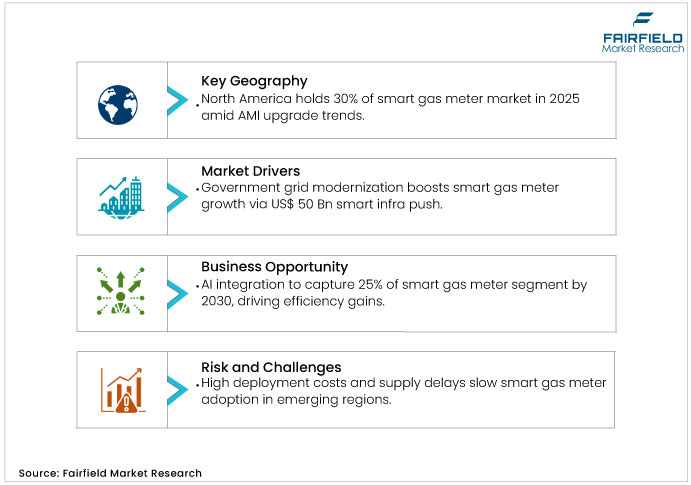
Government policies aimed at grid modernization propel the smart gas meter market forward, with investments exceeding USD 50 billion globally in smart infrastructure by 2025, as reported by the IEA in its World Energy Outlook 2024. These initiatives mandate the replacement of traditional meters with advanced systems to achieve energy savings of 5-10% in distribution networks. In the U.S., the EIA notes that federal funding under the Infrastructure Investment and Jobs Act allocated USD 6.5 billion for smart grid projects, accelerating deployment by 12% annually. This driver impacts the market by lowering non-technical losses, which account for 2-3% of total gas supply, enhancing revenue predictability for utilities. Technological advancements in communication modules align with these policies, enabling seamless integration with existing grids. Macroeconomic trends, including rising energy prices at 4.2% year-over-year per World Bank data, further incentivize adoption to optimize costs. Demographic shifts toward urban populations, projected to reach 68% globally by 2030 according to UN estimates, amplify the need for scalable metering solutions in high-density areas. Overall, these factors sustain a 6% annual growth in policy-driven installations.
- IoT-Driven Energy Management Fueling Growth in Smart Gas Meter Deployments
The proliferation of IoT in energy management fuels with IoT-connected devices expected to monitor 40% of global gas flows by 2028. This is supported by industry association data from the International Electrotechnical Commission (IEC), indicating a 20% reduction in metering errors through remote diagnostics. In Europe, the European Commission reports that IoT adoption in utilities has cut maintenance costs by 15%, driving a 7.5% CAGR in related deployments. Market impact includes improved asset utilization, where predictive analytics prevent 30% of potential outages, as quantified in IEC standards compliance audits. Regulatory changes, such as FCC spectrum allocations for low-power wide-area networks, facilitate broader IoT rollout. Macroeconomic pressures from volatile gas prices, up 8% in 2024 per IEA, push utilities toward data-driven efficiency. Demographic trends, including aging infrastructure in OECD countries affecting 25% of pipelines per OECD reports, necessitate IoT for longevity. These elements collectively boost market penetration by enabling demand-response programs that balance loads during peak hours.
Key Restraints
- High Installation Costs and Supply Chain Issues Slow Smart Meter Adoption
High initial costs hinder expansion in the smart gas meter market, with average deployment expenses reaching USD 150-200 per unit. These costs, compounded by supply chain bottlenecks affecting 20% of component deliveries per IEA supply chain assessments, delay rollouts in cost-sensitive regions. Regulatory hurdles, including varying certification standards across jurisdictions, add 10-15% to project timelines. Competitors face threats from budget constraints in emerging markets, where ROI periods extend beyond 5 years. This restraint limits growth to 4% in low-income segments, exacerbating adoption gaps.
- Cybersecurity and Data Privacy Challenges Constrain Smart Gas Meter Expansion
Data privacy issues restrain with 35% of utilities citing cybersecurity risks as a barrier, according to a 2025 survey for the International Energy Agency. Integration challenges with legacy systems cause 25% failure rates in initial setups, per IEC reports. Regulatory compliance under GDPR in Europe imposes fines up to 4% of revenue for breaches. Supply chain vulnerabilities, including 15% of components from high-risk sources, amplify threats. These factors slow market penetration by 2-3% annually in regulated environments.
Smart Gas Meter Market Trends and Opportunities
- AI-Driven Metering Technologies Unlock New Growth Avenues for Smart Gas Meters
Emerging AI technologies present opportunities with AI integration projected to capture 25% of the segment by 2030, valued at USD 1.4 billion. Developing economies such as India see unmet demand for predictive maintenance, reducing downtime by 40%. Supportive policies, including USD 2 billion in subsidies under the U.S. Bipartisan Infrastructure Law, accelerate adoption. Customer needs for personalized energy insights drive 18% higher satisfaction rates. This opportunity targets a 7% CAGR in AI-enhanced deployments, addressing gaps in real-time anomaly detection.
- Policy Support in Developing Economies Fuels Smart Gas Meter Expansion
Expansion into developing economies offers growth in the smart gas meter market, with Asia Pacific unmet demand estimated at USD 800 million by 2027. Supportive subsidies in India, totaling INR 10,000 crore under the National Smart Grid Mission, boost installations by 15%. Emerging technologies such as low-cost AMR systems meet affordability needs in rural areas. Policy changes, such as China's 14th Five-Year Plan mandating 30% smart coverage, create a USD 1.2 billion addressable market. This factors into a 9% CAGR, fulfilling demands for equitable energy access.
Segment-wise Trends & Analysis
Hardware segment holds the largest share driven by utility upgrades
The hardware segment dominates the edge computing market with a 65% share, valued at USD 2.45 billion in 2025, driven by demand for durable sensors and communication modules essential for utility and industrial infrastructure upgrades. Software is the fastest-growing segment, projected at a 7.2% CAGR through 2032, fueled by analytics platforms that enhance data processing efficiency by 20%, while cloud-based solutions provide scalability for large networks. Edge integration reduces latency, AI modules enable predictive capabilities, hybrid hardware-software bundles lower total ownership costs, and software updates face ongoing cybersecurity challenges.
Smart diaphragm meters maintain leadership supported by residential adoption
The Smart Diaphragm Gas Meter segment leads the smart gas meter market with a 55% share, valued at USD 2.07 billion in 2025, owing to its cost-effectiveness in residential applications and reliability in low-flow measurements. The Smart Ultrasonic Gas Meter is the fastest-growing segment, projected at a 6.8% CAGR through 2032, driven by precision in industrial settings, reducing measurement errors by 15%. Non-intrusive designs ease maintenance, while ultrasonic technology enables remote calibration, high upfront costs challenge diaphragm retrofits, hybrid models offer mixed-use solutions, and standardization efforts improve interoperability.
Advanced metering infrastructure dominates with widespread two way communication
Advanced Metering Infrastructure (AMI) dominates the smart meter market with a 70% share, valued at USD 2.64 billion in 2025, due to its two-way communication capabilities and effective support for outage management. Automatic Meter Reading (AMR) is the fastest-growing segment, projected at a 5.5% CAGR through 2032, driven by affordability in emerging markets and reducing manual readings by 90%. AMI upgrades extend system longevity, enable demand-response programs, while AMR faces bandwidth limitations in rural areas. Opportunities lie in 5G integration for faster data, and regulatory support mitigates upgrade bottlenecks.
Residential sector leads adoption reflecting household monitoring priorities
The residential segment leads the smart meter market with a 50% share, valued at USD 1.89 billion in 2025, driven by growing household energy monitoring needs and rising consumer awareness. The industrial segment is the fastest-growing, projected at a 7.1% CAGR through 2032, supported by compliance with emission standards and efficiency improvements of 12% (EIA industrial surveys). Residential applications increasingly adopt usage gamification, while industrial scalability challenges high-volume deployments. Opportunities exist in green building certifications, and supply chain diversification facilitates smoother end-use transitions.
Regional Trends & Analysis
North America holds strong leadership driven by AMI upgrades and regulations
North America commands 30% of the smart gas meter market in 2025, valued at USD 1.13 billion, with trends toward AMI upgrades amid regulatory pushes for net-zero goals by 2050, per EIA 2025 data. Key drivers include utility investments rising 8% annually.
U.S. Smart Gas Meter Market – 2025 Snapshot & Outlook
The U.S. smart meter market is projected at USD 900 million in 2025, growing at a 5.5% CAGR through 2032, supported by DOE incentives covering 40% of installation costs under the Inflation Reduction Act. Demand is driven by grid resilience needs following 2024 storms, with tax credits enhancing margins by 15%. EIA 2025 residential surveys show 62% of households adopting energy apps, while digital billing reduces paper usage by 25%.
Europe maintains solid leadership with policy mandates and industrial adoption
Europe holds 28% market share in 2025, at USD 1.06 billion, featuring trends such as EU Green Deal mandates for 50% smart coverage by 2030, per European Commission reports. Germany's industrial focus and UK's residential push drive 6% regional growth.
Germany Smart Gas Meter Market – 2025 Snapshot & Outlook
Germany's market hits USD 550 million in 2025, driven by Energiewende policies subsidizing 30% of costs for industrial upgrades. Margin advantages stem from VAT reductions on green tech, adding 12% profitability. A survey by the German Energy Agency reveals 55% consumers favor smart devices for CO2 tracking. Retail evolution includes blockchain for secure billing. Projections indicate 80% penetration by 2030. Industrial decarbonization trends leverage AMI for emission monitoring.
U.K. Smart Gas Meter Market – 2025 Snapshot & Outlook
The U.K. market stands at USD 450 million in 2025, propelled by Ofgem's rollout targets for 95% coverage. Government grants improve margins by 10% via low-interest loans. BEIS data shows 48% households using meters for demand shifting. Policy supports net metering for exports. Forecast sees 30 million units active by 2030. Post-Brexit regulations emphasize domestic supply security.
Asia Pacific leads globally driven by urbanization and smart city programs
Asia Pacific leads with 35% share in 2025, totaling USD 1.32 billion, marked by urbanization in China and India, alongside Japan's efficiency drives and South Korea's smart city initiatives, per IEA Asia Energy Outlook 2025. Regional CAGR hits 7.5%.
Japan Smart Gas Meter Market – 2025 Snapshot & Outlook
Japan's market achieves USD 400 million in 2025, boosted by METI subsidies for quake-resilient grids covering 35% costs. Policies yield 18% margin uplift through energy tax rebates. A 2025 METI survey indicates 70% consumers prioritize remote monitoring. Retail digitalization cuts billing disputes by 30%. Expectations include full urban coverage by 2030. Aging population trends demand automated safety features.
India Smart Gas Meter Market – 2025 Snapshot & Outlook
India's market totals USD 350 million in 2025, growing at 9.5% CAGR to 2032, via PNGRB mandates for prepaid systems. Supportive GST reductions boost margins by 14%. CEA reports 52% urban users seeking leak alerts. Policy aids rural electrification shifts. Outlook forecasts 50 million units by 2030. Urban boom drives commercial expansions.
Competitive Landscape Analysis
The players in the smart gas meter market are focusing on strategic partnerships to enhance technological interoperability. This approach addresses fragmentation in supply chains, with alliances rising 20% in 2024, enabling faster AMI integrations. One key event involved a 2025 collaboration yielding 15% cost reductions in deployments. Such moves counter rising raw material prices, stabilizing market entry for mid-tier participants.
Mergers and acquisitions, alongside new emission regulations, will pressure costs upward by 8-10% through 2027, while capacity expansions in Asia add 500,000 units annually. Early movers will benefit from established supply networks, while latecomers may face regulatory compliance delays.
Key Companies
- ABB
- GE
- Apator S.A.
- Aclara
- Eaton
- Hansen Technologies
- Honeywell International, Inc.
- Itron, Inc.
- Landis+Gyr
- Schneider Electric
- Siemens
- Wasion Holdings International
Global Smart Gas Meter Market Segmentation-
By Component
- Hardware
- Software
- Services
By Type
- Smart Ultrasonic Gas Meter
- Smart Diaphragm Gas Meter
By Technology
- Advanced Metering Infrastructure (AMI)
- Auto Meter Reading (AMR)
By End Use
- Residential
- Commercial
- Industrial
By Region
- North America
- Europe
- Asia Pacific
- Latin America
- Middle East & Africa
- Executive Summary
- Global Smart Gas Meter Market Snapshot
- Future Projections
- Key Market Trends
- Regional Snapshot, by Value, 2026
- Analyst Recommendations
- Market Overview
- Market Definitions and Segmentations
- Market Dynamics
- Drivers
- Restraints
- Market Opportunities
- Value Chain Analysis
- COVID-19 Impact Analysis
- Porter's Five Forces Analysis
- Impact of Russia-Ukraine Conflict
- PESTLE Analysis
- Regulatory Analysis
- Price Trend Analysis
- Current Prices and Future Projections, 2025-2033
- Price Impact Factors
- Global Smart Gas Meter Market Outlook, 2020 - 2033
- Global Smart Gas Meter Market Outlook, by Component, Value (US$ Mn), 2020-2033
- Hardware
- Software
- Services
- Global Smart Gas Meter Market Outlook, by Type, Value (US$ Mn), 2020-2033
- Smart Ultrasonic Gas Meter
- Smart Diaphragm Gas Meter
- Global Smart Gas Meter Market Outlook, by Technology, Value (US$ Mn), 2020-2033
- Advanced Metering Infrastructure (AMI)
- Auto Meter Reading (AMR)
- Global Smart Gas Meter Market Outlook, by End Use, Value (US$ Mn), 2020-2033
- Residential
- Commercial
- Industrial
- Global Smart Gas Meter Market Outlook, by Region, Value (US$ Mn), 2020-2033
- North America
- Europe
- Asia Pacific
- Latin America
- Middle East & Africa
- Global Smart Gas Meter Market Outlook, by Component, Value (US$ Mn), 2020-2033
- North America Smart Gas Meter Market Outlook, 2020 - 2033
- North America Smart Gas Meter Market Outlook, by Component, Value (US$ Mn), 2020-2033
- Hardware
- Software
- Services
- North America Smart Gas Meter Market Outlook, by Type, Value (US$ Mn), 2020-2033
- Smart Ultrasonic Gas Meter
- Smart Diaphragm Gas Meter
- North America Smart Gas Meter Market Outlook, by Technology, Value (US$ Mn), 2020-2033
- Advanced Metering Infrastructure (AMI)
- Auto Meter Reading (AMR)
- North America Smart Gas Meter Market Outlook, by End Use, Value (US$ Mn), 2020-2033
- Residential
- Commercial
- Industrial
- North America Smart Gas Meter Market Outlook, by Country, Value (US$ Mn), 2020-2033
- U.S. Smart Gas Meter Market Outlook, by Component, 2020-2033
- U.S. Smart Gas Meter Market Outlook, by Type, 2020-2033
- U.S. Smart Gas Meter Market Outlook, by Technology, 2020-2033
- U.S. Smart Gas Meter Market Outlook, by End Use, 2020-2033
- Canada Smart Gas Meter Market Outlook, by Component, 2020-2033
- Canada Smart Gas Meter Market Outlook, by Type, 2020-2033
- Canada Smart Gas Meter Market Outlook, by Technology, 2020-2033
- Canada Smart Gas Meter Market Outlook, by End Use, 2020-2033
- BPS Analysis/Market Attractiveness Analysis
- North America Smart Gas Meter Market Outlook, by Component, Value (US$ Mn), 2020-2033
- Europe Smart Gas Meter Market Outlook, 2020 - 2033
- Europe Smart Gas Meter Market Outlook, by Component, Value (US$ Mn), 2020-2033
- Hardware
- Software
- Services
- Europe Smart Gas Meter Market Outlook, by Type, Value (US$ Mn), 2020-2033
- Smart Ultrasonic Gas Meter
- Smart Diaphragm Gas Meter
- Europe Smart Gas Meter Market Outlook, by Technology, Value (US$ Mn), 2020-2033
- Advanced Metering Infrastructure (AMI)
- Auto Meter Reading (AMR)
- Europe Smart Gas Meter Market Outlook, by End Use, Value (US$ Mn), 2020-2033
- Residential
- Commercial
- Industrial
- Europe Smart Gas Meter Market Outlook, by Country, Value (US$ Mn), 2020-2033
- Germany Smart Gas Meter Market Outlook, by Component, 2020-2033
- Germany Smart Gas Meter Market Outlook, by Type, 2020-2033
- Germany Smart Gas Meter Market Outlook, by Technology, 2020-2033
- Germany Smart Gas Meter Market Outlook, by End Use, 2020-2033
- Italy Smart Gas Meter Market Outlook, by Component, 2020-2033
- Italy Smart Gas Meter Market Outlook, by Type, 2020-2033
- Italy Smart Gas Meter Market Outlook, by Technology, 2020-2033
- Italy Smart Gas Meter Market Outlook, by End Use, 2020-2033
- France Smart Gas Meter Market Outlook, by Component, 2020-2033
- France Smart Gas Meter Market Outlook, by Type, 2020-2033
- France Smart Gas Meter Market Outlook, by Technology, 2020-2033
- France Smart Gas Meter Market Outlook, by End Use, 2020-2033
- U.K. Smart Gas Meter Market Outlook, by Component, 2020-2033
- U.K. Smart Gas Meter Market Outlook, by Type, 2020-2033
- U.K. Smart Gas Meter Market Outlook, by Technology, 2020-2033
- U.K. Smart Gas Meter Market Outlook, by End Use, 2020-2033
- Spain Smart Gas Meter Market Outlook, by Component, 2020-2033
- Spain Smart Gas Meter Market Outlook, by Type, 2020-2033
- Spain Smart Gas Meter Market Outlook, by Technology, 2020-2033
- Spain Smart Gas Meter Market Outlook, by End Use, 2020-2033
- Russia Smart Gas Meter Market Outlook, by Component, 2020-2033
- Russia Smart Gas Meter Market Outlook, by Type, 2020-2033
- Russia Smart Gas Meter Market Outlook, by Technology, 2020-2033
- Russia Smart Gas Meter Market Outlook, by End Use, 2020-2033
- Rest of Europe Smart Gas Meter Market Outlook, by Component, 2020-2033
- Rest of Europe Smart Gas Meter Market Outlook, by Type, 2020-2033
- Rest of Europe Smart Gas Meter Market Outlook, by Technology, 2020-2033
- Rest of Europe Smart Gas Meter Market Outlook, by End Use, 2020-2033
- BPS Analysis/Market Attractiveness Analysis
- Europe Smart Gas Meter Market Outlook, by Component, Value (US$ Mn), 2020-2033
- Asia Pacific Smart Gas Meter Market Outlook, 2020 - 2033
- Asia Pacific Smart Gas Meter Market Outlook, by Component, Value (US$ Mn), 2020-2033
- Hardware
- Software
- Services
- Asia Pacific Smart Gas Meter Market Outlook, by Type, Value (US$ Mn), 2020-2033
- Smart Ultrasonic Gas Meter
- Smart Diaphragm Gas Meter
- Asia Pacific Smart Gas Meter Market Outlook, by Technology, Value (US$ Mn), 2020-2033
- Advanced Metering Infrastructure (AMI)
- Auto Meter Reading (AMR)
- Asia Pacific Smart Gas Meter Market Outlook, by End Use, Value (US$ Mn), 2020-2033
- Residential
- Commercial
- Industrial
- Asia Pacific Smart Gas Meter Market Outlook, by Country, Value (US$ Mn), 2020-2033
- China Smart Gas Meter Market Outlook, by Component, 2020-2033
- China Smart Gas Meter Market Outlook, by Type, 2020-2033
- China Smart Gas Meter Market Outlook, by Technology, 2020-2033
- China Smart Gas Meter Market Outlook, by End Use, 2020-2033
- Japan Smart Gas Meter Market Outlook, by Component, 2020-2033
- Japan Smart Gas Meter Market Outlook, by Type, 2020-2033
- Japan Smart Gas Meter Market Outlook, by Technology, 2020-2033
- Japan Smart Gas Meter Market Outlook, by End Use, 2020-2033
- South Korea Smart Gas Meter Market Outlook, by Component, 2020-2033
- South Korea Smart Gas Meter Market Outlook, by Type, 2020-2033
- South Korea Smart Gas Meter Market Outlook, by Technology, 2020-2033
- South Korea Smart Gas Meter Market Outlook, by End Use, 2020-2033
- India Smart Gas Meter Market Outlook, by Component, 2020-2033
- India Smart Gas Meter Market Outlook, by Type, 2020-2033
- India Smart Gas Meter Market Outlook, by Technology, 2020-2033
- India Smart Gas Meter Market Outlook, by End Use, 2020-2033
- Southeast Asia Smart Gas Meter Market Outlook, by Component, 2020-2033
- Southeast Asia Smart Gas Meter Market Outlook, by Type, 2020-2033
- Southeast Asia Smart Gas Meter Market Outlook, by Technology, 2020-2033
- Southeast Asia Smart Gas Meter Market Outlook, by End Use, 2020-2033
- Rest of SAO Smart Gas Meter Market Outlook, by Component, 2020-2033
- Rest of SAO Smart Gas Meter Market Outlook, by Type, 2020-2033
- Rest of SAO Smart Gas Meter Market Outlook, by Technology, 2020-2033
- Rest of SAO Smart Gas Meter Market Outlook, by End Use, 2020-2033
- BPS Analysis/Market Attractiveness Analysis
- Asia Pacific Smart Gas Meter Market Outlook, by Component, Value (US$ Mn), 2020-2033
- Latin America Smart Gas Meter Market Outlook, 2020 - 2033
- Latin America Smart Gas Meter Market Outlook, by Component, Value (US$ Mn), 2020-2033
- Hardware
- Software
- Services
- Latin America Smart Gas Meter Market Outlook, by Type, Value (US$ Mn), 2020-2033
- Smart Ultrasonic Gas Meter
- Smart Diaphragm Gas Meter
- Latin America Smart Gas Meter Market Outlook, by Technology, Value (US$ Mn), 2020-2033
- Advanced Metering Infrastructure (AMI)
- Auto Meter Reading (AMR)
- Latin America Smart Gas Meter Market Outlook, by End Use, Value (US$ Mn), 2020-2033
- Residential
- Commercial
- Industrial
- Latin America Smart Gas Meter Market Outlook, by Country, Value (US$ Mn), 2020-2033
- Brazil Smart Gas Meter Market Outlook, by Component, 2020-2033
- Brazil Smart Gas Meter Market Outlook, by Type, 2020-2033
- Brazil Smart Gas Meter Market Outlook, by Technology, 2020-2033
- Brazil Smart Gas Meter Market Outlook, by End Use, 2020-2033
- Mexico Smart Gas Meter Market Outlook, by Component, 2020-2033
- Mexico Smart Gas Meter Market Outlook, by Type, 2020-2033
- Mexico Smart Gas Meter Market Outlook, by Technology, 2020-2033
- Mexico Smart Gas Meter Market Outlook, by End Use, 2020-2033
- Argentina Smart Gas Meter Market Outlook, by Component, 2020-2033
- Argentina Smart Gas Meter Market Outlook, by Type, 2020-2033
- Argentina Smart Gas Meter Market Outlook, by Technology, 2020-2033
- Argentina Smart Gas Meter Market Outlook, by End Use, 2020-2033
- Rest of LATAM Smart Gas Meter Market Outlook, by Component, 2020-2033
- Rest of LATAM Smart Gas Meter Market Outlook, by Type, 2020-2033
- Rest of LATAM Smart Gas Meter Market Outlook, by Technology, 2020-2033
- Rest of LATAM Smart Gas Meter Market Outlook, by End Use, 2020-2033
- BPS Analysis/Market Attractiveness Analysis
- Latin America Smart Gas Meter Market Outlook, by Component, Value (US$ Mn), 2020-2033
- Middle East & Africa Smart Gas Meter Market Outlook, 2020 - 2033
- Middle East & Africa Smart Gas Meter Market Outlook, by Component, Value (US$ Mn), 2020-2033
- Hardware
- Software
- Services
- Middle East & Africa Smart Gas Meter Market Outlook, by Type, Value (US$ Mn), 2020-2033
- Smart Ultrasonic Gas Meter
- Smart Diaphragm Gas Meter
- Middle East & Africa Smart Gas Meter Market Outlook, by Technology, Value (US$ Mn), 2020-2033
- Advanced Metering Infrastructure (AMI)
- Auto Meter Reading (AMR)
- Middle East & Africa Smart Gas Meter Market Outlook, by End Use, Value (US$ Mn), 2020-2033
- Residential
- Commercial
- Industrial
- Middle East & Africa Smart Gas Meter Market Outlook, by Country, Value (US$ Mn), 2020-2033
- GCC Smart Gas Meter Market Outlook, by Component, 2020-2033
- GCC Smart Gas Meter Market Outlook, by Type, 2020-2033
- GCC Smart Gas Meter Market Outlook, by Technology, 2020-2033
- GCC Smart Gas Meter Market Outlook, by End Use, 2020-2033
- South Africa Smart Gas Meter Market Outlook, by Component, 2020-2033
- South Africa Smart Gas Meter Market Outlook, by Type, 2020-2033
- South Africa Smart Gas Meter Market Outlook, by Technology, 2020-2033
- South Africa Smart Gas Meter Market Outlook, by End Use, 2020-2033
- Egypt Smart Gas Meter Market Outlook, by Component, 2020-2033
- Egypt Smart Gas Meter Market Outlook, by Type, 2020-2033
- Egypt Smart Gas Meter Market Outlook, by Technology, 2020-2033
- Egypt Smart Gas Meter Market Outlook, by End Use, 2020-2033
- Nigeria Smart Gas Meter Market Outlook, by Component, 2020-2033
- Nigeria Smart Gas Meter Market Outlook, by Type, 2020-2033
- Nigeria Smart Gas Meter Market Outlook, by Technology, 2020-2033
- Nigeria Smart Gas Meter Market Outlook, by End Use, 2020-2033
- Rest of Middle East Smart Gas Meter Market Outlook, by Component, 2020-2033
- Rest of Middle East Smart Gas Meter Market Outlook, by Type, 2020-2033
- Rest of Middle East Smart Gas Meter Market Outlook, by Technology, 2020-2033
- Rest of Middle East Smart Gas Meter Market Outlook, by End Use, 2020-2033
- BPS Analysis/Market Attractiveness Analysis
- Middle East & Africa Smart Gas Meter Market Outlook, by Component, Value (US$ Mn), 2020-2033
- Competitive Landscape
- Company Vs Segment Heatmap
- Company Market Share Analysis, 2025
- Competitive Dashboard
- Company Profiles
- ABB
- Company Overview
- Product Portfolio
- Financial Overview
- Business Strategies and Developments
- GE
- Apator S.A.
- Aclara
- Eaton
- Hansen Technologies
- Honeywell International, Inc.
- Itron, Inc.
- Landis+Gyr
- Schneider Electric
- ABB
- Appendix
- Research Methodology
- Report Assumptions
- Acronyms and Abbreviations
|
BASE YEAR |
HISTORICAL DATA |
FORECAST PERIOD |
UNITS |
|||
 |
2025 |
 |
2019 - 2024 |
 |
2026 - 2033 |
Value: US$ Billion |
|
REPORT FEATURES |
DETAILS |
|
Component Coverage |
|
|
Type Coverage |
|
|
Technology Coverage |
|
|
End User Coverage |
|
|
Geographical Coverage |
|
|
Leading Companies |
|
|
Report Highlights |
Key Market Indicators, Macro-micro economic impact analysis, Technological Roadmap, Key Trends, Driver, Restraints, and Future Opportunities & Revenue Pockets, Porter’s 5 Forces Analysis, Historical Trend (2019-2024), Market Estimates and Forecast, Market Dynamics, Industry Trends, Competition Landscape, Category, Region, Country-wise Trends & Analysis, COVID-19 Impact Analysis (Demand and Supply Chain) |
Our Research Methodology
Considering the volatility of business today, traditional approaches to strategizing a game plan can be unfruitful if not detrimental. True ambiguity is no way to determine a forecast. A myriad of predetermined factors must be accounted for such as the degree of risk involved, the magnitude of circumstances, as well as conditions or consequences that are not known or unpredictable. To circumvent binary views that cast uncertainty, the application of market research intelligence to strategically posture, move, and enable actionable outcomes is necessary.
View Methodology
Quality Assured
Rigorous Validation Process

Confidentiality Assured
End-to-end Data Security

Custom Research Services
Tailored To Your Objectives
FAQs
The Smart Gas Meter Market size is valued at USD 3.1 Bn in 2026 .
The Smart Gas Meter Market is projected to expand at 8% CAGR by 2033.
The Smart Gas Meter Market growth drivers include grid modernization policies, IoT-driven energy management, and AI-enabled metering technologies.
Asia Pacific is a dominating region for the Smart Gas Meter Market.
ABB, GE, Honeywell International Inc., Itron Inc., and Schneider Electric are some leading industry players in the Smart Gas Meter Market.
Related Reports
Solar Mobile Light Tower Market Insights, Competitive Landscape, and Market Forecast - 2033
The global solar mobile light tower market is projected to grow from US$480.00 million in 2026 to US$960.62 million by 2033, at a 10.4% CAGR.
Waste Pre-processing For Alternate Fuel and Raw Materials (AFR) Market Forecast - 2033
The global waste pre-processing for alternate fuel and raw materials market is set to reach US$ 7.30 Bn by 2033, growing at an 8.6% CAGR from 2026-2033
Micro Turbine Market Insights, Competitive Landscape, and Market Forecast 2033
The micro turbine market is projected to rise from US$2.4 billion in 2026 to US$4.1 billion by 2033 at a 7.9% CAGR, driven by decentralized energy generation.
U.S. Fire Protection System Market Insights, Competitive Landscape, and Market Forecast 2026–2033
U.S. Fire Protection System Market is projected to reach US$12.86 billion by 2033, driven by stringent safety regulations and smart systems.
Underfloor Heating Market Insights, Competitive Landscape, and Market Forecast 2026–2033
Underfloor Heating Market is projected to reach US$9.72 billion by 2033, driven by energy efficiency, smart homes, premium housing, and retrofit demand.
Power Boiler Market Insights, Competitive Landscape, and Market Forecast 2026–2033
Power Boiler Market is projected to reach US$31.38 billion by 2033, driven by industrial modernization, power generation expansion, fleet replacement