



Specimen Collection Cards Market
Global Specimen Collection Cards Industry Analysis, Size, Share, Growth, Trends, Regional Outlook, and Forecast 2023-2030 - (By Specimen Coverage, By Material Coverage, By Product Coverage, By Application Coverage, By Distribution Channel Coverage, By End User Coverage, By Geographic Coverage and Leading Companies)
Global Specimen Collection Cards Market Forecast
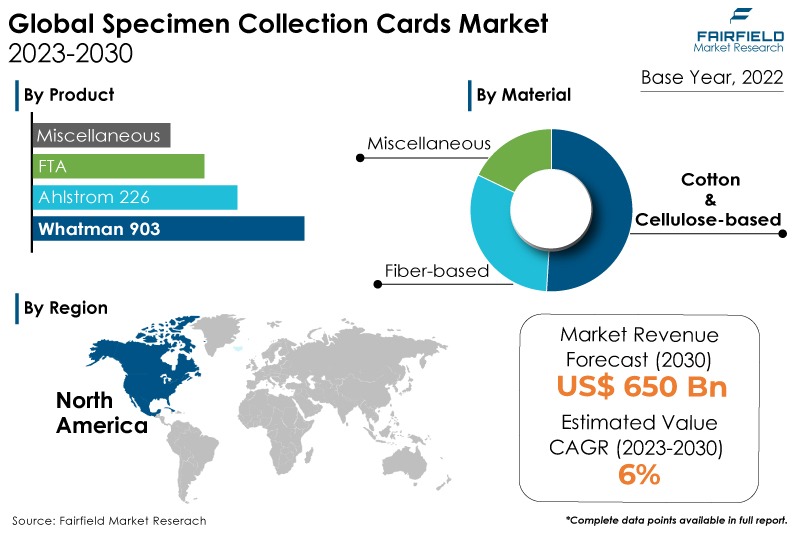
- Global market size to reach approximately US$650 Mn by 2030-end
- Market valuation to witness healthy expansion at a CAGR of 6% over 2023 - 2030
Market Analysis in Brief
The expansion of forensic toxicology applications has significantly impacted the specimen collection card market, increasing the acceptance of these cards for efficient and reliable sample collection. Specimen collection cards are now popular in forensic toxicology due to their ease of use, reliability, and capacity to store samples for extended periods. They offer several advantages, including noninvasiveness, reduced sample volume requirements, and enhanced sample stability during transportation and storage, ultimately improving the accuracy and efficiency of forensic toxicological testing. Personalised drugs aims to tailor treatments based on individual genetic profiles and lifestyle factors facilitated by genetic testing.
Specimen collection cards have become indispensable tools in genetic testing processes, enabling the collection of various biological samples like saliva, blood, and tissue conveniently and reliably. However, the market needs help with sample integrity and storage. Maintaining the quality and stability of collected samples is critical to obtaining accurate testing results. Potential sample contamination from environmental pollutants, microorganisms, and chemicals can lead to erroneous test outcomes, including false positives or negatives. Addressing these challenges will be vital to ensure the continued growth and success of the specimen collection cards market in the future.
Key Report Findings
- The specimen collection cards market will demonstrate more than 2x expansion in revenue over 2023-2030.
- Whatman 903 product captured the largest market share in the specimen collection cards market due to its superior sample retention capabilities, reputable brand image, and user-friendly features.
- Cotton & cellulose-based materials captured the largest market share in specimen collection cards due to their exceptional absorbent properties, biocompatibility, and cost-effectiveness.
- North America will continue to lead its way, whereas Asia Pacific's Specimen Collection Cards market will experience the strongest growth till 2030.
Growth Drivers
Expanding Application Range from Forensics to Toxicology
The rise of forensic toxicology applications has been a significant driver of the specimen collection cards market. Forensic toxicology has the analysis of biological samples to detect and quantify the presence of drugs, poisons, and other substances in the human body.
Specimen collection cards have emerged as essential tools in this field because they can efficiently and reliably collect various biological samples, such as blood, urine, and saliva. These cards ensure preserving the samples' integrity during collection, transportation, and storage, which is crucial for obtaining accurate and dependable results in forensic toxicological testing.
Furthermore, the increasing demand for forensic toxicology services, driven by the need for accurate and timely investigation of crimes, accidents, and workplace incidents, has fueled the adoption of specimen collection cards. Law enforcement agencies, medical examiners, and forensic laboratories rely on these cards to collect and preserve evidence effectively, enabling the identification of toxic substances and aiding in legal proceedings.
The versatility and convenience offered by specimen collection cards have made them indispensable in forensic toxicology applications, leading to widespread adoption and market growth.
Additionally, advancements in analytical technologies and testing methods have expanded the scope and precision of forensic toxicology. This increased the demand for high-quality, standardised specimen collection cards to ensure consistent and reliable results. As the field continues to evolve, specimen collection cards are likely to play an increasingly critical role in forensic toxicology, driving further innovation and growth in the market.
Moreover, the global increase in drug abuse and the need to combat illicit drug trafficking have also contributed to the growing demand for specimen collection cards in forensic toxicology applications, further propelling market expansion.
Rising Focus on Modified Medicine, and Genetic Testing
The growing focus on personalised medicine and genetic testing has become a significant driver of the specimen collection card market. Personalised drugs aims to tailor treatments based on an individual's unique genetic profile, lifestyle factors, and health history. Genetic testing is pivotal in this approach by providing insights into a person's genetic makeup, enabling personalised diagnostics, treatment selection, and disease prevention strategies.
Specimen collection cards have become indispensable tools in genetic testing, offering a convenient and reliable method of collecting various biological samples, such as saliva, blood, and tissue. These cards preserve the samples' integrity, allowing for accurate and consistent genetic testing results.
Furthermore, the advancements in genomics and molecular biology have led to a surge in demand for genetic testing services, driving the adoption of specimen collection cards. Specimen collection cards are instrumental in such kits, making it easier for individuals to collect their samples and send them to laboratories for analysis. The convenience and simplicity of using specimen collection cards have facilitated the widespread adoption of genetic testing, fueling the market's growth.
Moreover, the emphasis on preventive healthcare and early disease detection has also contributed to the demand for genetic testing and specimen collection cards. By identifying individuals' genetic predispositions to certain diseases, healthcare professionals can develop personalised preventive measures and early intervention strategies, potentially improving health outcomes and reducing healthcare costs.
The adoption of specimen collection cards in genetic testing aligns with the broader trend of patient-centric care, where medical decisions are increasingly tailored to each individual's unique needs and genetic makeup, further propelling the specimen collection cards market forward.
Growth Challenges
High Initial Costs of Systems, and Infrastructural Necessities
The specimen collection cards market faces significant challenges due to high initial setup costs and infrastructure requirements. Firstly, establishing a production facility for specimen collection cards demands substantial capital investment. The manufacturing process involves specialised machinery, materials, and quality control measures to ensure the cards' accuracy and reliability. These upfront costs can deter potential new entrants or smaller companies from entering the market, limiting competition and innovation.
Moreover, maintaining a robust distribution network and storage facilities is crucial for efficiently supplying specimen collection cards to healthcare facilities and research institutions. Proper storage conditions are essential to preserve the integrity of collected samples. Implementing and managing such infrastructure across diverse geographical regions can be logistically challenging and costly. This can lead to inefficiencies in the supply chain, resulting in delays in delivering cards and affecting the overall market growth.
Lastly, regulatory compliance and quality standards add to companies' challenges in the specimen collection cards market. Meeting stringent regulations and obtaining necessary certifications can involve complex and time-consuming processes. Ensuring consistent quality and adherence to regulations across production, distribution, and storage facilities requires continuous investment in monitoring, testing, and quality assurance measures, further contributing to the overall setup costs.
In conclusion, the specimen collection cards market faces hurdles in the form of high initial setup costs and infrastructure requirements. Overcoming these challenges demands strategic planning, financial stability, and a commitment to meeting regulatory standards. Despite these obstacles, the increasing demand for advanced diagnostics and research tools may continue to drive companies to invest in this market, leading to potential advancements and innovations that could address some of these challenges in the future.
Overview of Key Segments
Whatman 903 Captures the Largest Market Share
Whatman 903 product, a cellulose-based specimen collection card type, has captured the largest market share for several reasons. Firstly, the Whatman 903 card's unique design and high-quality materials provide superior sample retention and stability. Its dense fiber matrix enables efficient and reliable absorption of biological fluids, preventing smearing and improving the overall integrity of the sample during collection and transportation. These properties make it a preferred choice for various diagnostic tests, such as dried blood spot (DBS) assays requiring accurate and consistent sample volumes for reliable results.
Moreover, the Whatman 903 card's widespread recognition and reputation in the healthcare and research communities have contributed to its market dominance. The brand's long history of manufacturing reliable laboratory products and commitment to meeting stringent quality standards have instilled trust among professionals, making the Whatman 903 card a go-to option for specimen collection and analysis. Its proven track record in supporting critical applications, such as newborn screening and infectious disease testing, cemented its position as a trusted and dependable specimen collection card.
Lastly, the convenience and ease of use of the Whatman 903 card have played a crucial role in its market success. The card's compact size, simple handling, and compatibility with various sampling techniques make it practical for clinical and research settings. Additionally, its cost-effectiveness and compatibility with a wide range of analytes have made it a cost-efficient option for large-scale testing programs and research studies, further driving its adoption in the market.
In conclusion, the Whatman 903 product's superior sample retention capabilities, reputable brand image, and user-friendly features have propelled it to capture the largest market share in the specimen collection cards market. Its reliable performance and versatility have made it an indispensable tool for diagnostics, research, and epidemiological studies, solidifying its position as a leading choice in the industry.
Cotton & Cellulose-based Material Sought-after
For several reasons, cotton and cellulose-based materials have captured the largest market share in the specimen collection cards market. These materials are known for their exceptional absorbent properties, making them ideal for efficiently collecting and preserving biological samples.
When a specimen is collected, cotton and cellulose-based cards quickly absorb and retain the required fluid, preventing contamination and maintaining the sample's integrity for subsequent analysis. Their ability to handle various sample types, including blood, saliva, and other bodily fluids, makes them versatile and widely preferred by healthcare professionals and researchers.
Furthermore, cotton and cellulose-based materials are considered safe and biocompatible, minimising the risk of adverse reactions or interference with the collected samples. These materials have been extensively used in medical and research applications for decades, establishing a strong reliability and safety track record. Their biodegradability and environmentally friendly nature further add to their appeal in the current global push for sustainable and eco-friendly solutions in the healthcare industry.
Lastly, the cost-effectiveness of cotton and cellulose-based specimen collection cards is crucial in their market dominance. Cotton and cellulose are widely available and inexpensive materials, making producing these cards more economically viable.
In conclusion, the widespread adoption of cotton and cellulose-based materials in specimen collection cards is attributed to their superior absorbent properties, biocompatibility, and cost-effectiveness. As the healthcare and research sectors continue to grow, the demand for efficient and reliable specimen collection tools is expected to remain high, further solidifying the position of cotton and cellulose-based cards as the preferred choice in the market.
Growth Opportunities Across Regions
North America Spearheads
For several reasons, North America has captured the largest market share in the specimen collection cards industry. Firstly, the region's strong healthcare infrastructure and well-established medical systems have created a conducive environment for adopting advanced medical technologies, including specimen collection cards. The availability of sophisticated laboratories, well-trained medical professionals, and a robust distribution network have contributed to the widespread usage of these cards in North America.
Secondly, North America boasts a significant research and development (R&D) sector, with substantial investments in healthcare innovations. This has resulted in the continuous improvement and development of specimen collection cards, making them more efficient, user-friendly, and reliable. The presence of leading pharmaceutical companies, research institutions, and biotechnology firms in the region further accelerates the adoption of these cards for various clinical and research purposes.
Lastly, North America's large population, diverse healthcare needs, and high diagnostics demand have driven the specimen collection card market. These cards are crucial in sample preservation and transportation, making them indispensable for medical testing, disease diagnosis, and epidemiological studies.
Additionally, the region's emphasis on public health initiatives and early disease detection has increased demand for specimen collection cards to manage and prevent various health conditions.
In conclusion, North America's strong healthcare infrastructure, focus on research and development, and substantial market demand have contributed to its capturing the largest market share in the specimen collection cards industry. As the region continues to invest in healthcare advancements and technology, its position in the market is likely to remain dominant in the future.
Asia Pacific Develops a Lucrative Market
Due to several key factors, Asia Pacific is experiencing the fastest CAGR in the specimen collection cards market. Firstly, the region's large and diverse population and rising healthcare awareness have led to increased demand for medical services and diagnostics.
Secondly, the rapid economic growth in many Asia Pacific countries has led to increased investments in healthcare and research. As disposable incomes rise, individuals and governments allocate more resources to improve healthcare outcomes, expanding the medical technology and device market, including specimen collection cards.
Moreover, the region is witnessing significant advancements in medical research and biotechnology, further fueling the demand for specimen collection cards to support various studies and clinical trials.
Overall, the combination of a large population base, increasing healthcare investments, and advancing medical research in the Asia region is driving the growth of the specimen collection cards market at the fastest CAGR. As these trends continue, the region will likely remain a significant player in the global healthcare industry and an essential driver of market growth for specimen collection cards.
Specimen Collection Cards Market: Competitive Landscape
Some of the leading players at the forefront in the specimen collection cards market space include QIAGEN, PerkinElmer Inc., DBS System SA, Danaher Corporation, Eastern Business Forms, Inc., Ahlstrom, ARCHIMED Life Science GmbH, GenTegra LLC, FortiusBio, and CENTOGENE N.V.
Recent Notable Developments
In August 2022, Boston Heart Diagnostics Corporation introduced an extensive lineup of tests utilising dried blood spot collection for various applications, encompassing cardiovascular risk factors, type 2 diabetes, and wellness assessments targeting cognitive, nutritional, women's, and men's health.
Similarly, in June 2022, an independent investigation was carried out by a group of scientists from the Division of Vector-Borne Diseases, Fort Collins, to assess the efficacy of Whatman FTA cards in molecular diagnostics for Yellow Fever Virus (YFV) detection. The study demonstrated that these cards are user-friendly and offer a cost-effective solution for the molecular diagnosis of yellow fever. Moreover, the Whatman FTA cards enable the preservation of viral RNA without needing a cold chain, providing added convenience to physicians and researchers.
The Global Specimen Collection Cards Market is Segmented as Below:
By Specimen
- Blood
- Saliva
- Urine
- Buccal Cells
- Miscellaneous
By Material
- Cotton & Cellulose-based
- Fiber-based
- Miscellaneous
By Product
- Whatman 903
- Ahlstrom 226
- FTA
- Miscellaneous
By Application
- New Born Screening (NBS)
- Infectious Diseases Testing
- Therapeutic Drug Monitoring
- Forensics
- Research
- Wellbeing/Health Monitoring
- Miscellaneous
By Distribution Channel
- Online
- Offline
By End User
- Hospitals & Clinics
- Diagnostics Centers
- Miscellaneous
By Geographic Coverage
- North America
- U.S.
- Canada
- Europe
- Germany
- U.K.
- France
- Italy
- Russia
- Rest of Europe
- Asia Pacific
- China
- Japan
- South Korea
- India
- Southeast Asia
- Rest of Asia Pacific
- Latin America
- Brazil
- Mexico
- Rest of Latin America
- Middle East & Africa
- GCC
- South Africa
- Rest of the Middle East & Africa
1. Executive Summary
1.1. Global Specimen Collection Cards Market Snapshot
1.2. Future Projections
1.3. Key Market Trends
1.4. Regional Snapshot, by Value, 2022
1.5. Analyst Recommendations
2. Market Overview
2.1. Market Definitions and Segmentations
2.2. Market Dynamics
2.2.1. Drivers
2.2.2. Restraints
2.2.3. Market Opportunities
2.3. Value Chain Analysis
2.4. Porter’s Five Forces Analysis
2.5. COVID - 19 Impact Analysis
2.5.1. Supply
2.5.2. Demand
2.6. Impact of Ukraine - Russia Conflict
2.7. Economic Overview
2.7.1. World Economic Projections
2.8. PESTLE Analysis
3. Global Specimen Collection Cards Market Outlook, 2018 - 2030
3.1. Global Specimen Collection Cards Market Outlook, by Specimen, Value (US$ Mn), 2018 - 2030
3.1.1. Key Highlights
3.1.1.1. Blood
3.1.1.2. Saliva
3.1.1.3. Urine
3.1.1.4. Buccal Cells
3.1.1.5. Misc.
3.2. Global Specimen Collection Cards Market Outlook, by Material, Value (US$ Mn), 2018 - 2030
3.2.1. Key Highlights
3.2.1.1. Cotton & Cellulose - based
3.2.1.2. Fiber - based
3.2.1.3. Misc.
3.3. Global Specimen Collection Cards Market Outlook, by Product, Value (US$ Mn), 2018 - 2030
3.3.1. Key Highlights
3.3.1.1. Whatman 903
3.3.1.2. Ahlstrom 226
3.3.1.3. FTA
3.3.1.4. Misc.
3.4. Global Specimen Collection Cards Market Outlook, by Application, Value (US$ Mn), 2018 - 2030
3.4.1. Key Highlights
3.4.1.1. New Born Screening (NBS)
3.4.1.2. Infectious Diseases Testing
3.4.1.3. Therapeutic Drug Monitoring
3.4.1.4. Forensics
3.4.1.5. Research
3.4.1.6. Wellbeing/Health Monitoring
3.4.1.7. Misc.
3.5. Global Specimen Collection Cards Market Outlook, by Distribution Channel, Value (US$ Mn), 2018 - 2030
3.5.1. Key Highlights
3.5.1.1. Online
3.5.1.2. Offline
3.6. Global Specimen Collection Cards Market Outlook, by End User, Value (US$ Mn), 2018 - 2030
3.6.1. Key Highlights
3.6.1.1. Hospitals & Clinics
3.6.1.2. Diagnostics Centers
3.6.1.3. Misc.
3.7. Global Specimen Collection Cards Market Outlook, by Region, Value (US$ Mn), 2018 - 2030
3.7.1. Key Highlights
3.7.1.1. North America
3.7.1.2. Europe
3.7.1.3. Asia Pacific
3.7.1.4. Latin America
3.7.1.5. Middle East & Africa
4. North America Specimen Collection Cards Market Outlook, 2018 - 2030
4.1. North America Specimen Collection Cards Market Outlook, by Specimen, Value (US$ Mn), 2018 - 2030
4.1.1. Key Highlights
4.1.1.1. Blood
4.1.1.2. Saliva
4.1.1.3. Urine
4.1.1.4. Buccal Cells
4.1.1.5. Misc.
4.2. North America Specimen Collection Cards Market Outlook, by Material, Value (US$ Mn), 2018 - 2030
4.2.1. Key Highlights
4.2.1.1. Cotton & Cellulose - based
4.2.1.2. Fiber - based
4.2.1.3. Misc.
4.3. North America Specimen Collection Cards Market Outlook, by Product, Value (US$ Mn), 2018 - 2030
4.3.1.1. Whatman 903
4.3.1.2. Ahlstrom 226
4.3.1.3. FTA
4.3.1.4. Misc.
4.4. North America Specimen Collection Cards Market Outlook, by Application, Value (US$ Mn), 2018 - 2030
4.4.1. Key Highlights
4.4.1.1. New Born Screening (NBS)
4.4.1.2. Infectious Diseases Testing
4.4.1.3. Therapeutic Drug Monitoring
4.4.1.4. Forensics
4.4.1.5. Research
4.4.1.6. Wellbeing/Health Monitoring
4.4.1.7. Misc.
4.5. North America Specimen Collection Cards Market Outlook, by Distribution Channel, Value (US$ Mn), 2018 - 2030
4.5.1. Key Highlights
4.5.1.1. Online
4.5.1.2. Offline
4.6. North America Specimen Collection Cards Market Outlook, by End User, Value (US$ Mn), 2018 - 2030
4.6.1. Key Highlights
4.6.1.1. Hospitals & Clinics
4.6.1.2. Diagnostics Centers
4.6.1.3. Misc.
4.7. North America Specimen Collection Cards Market Outlook, by Country, Value (US$ Mn), 2018 - 2030
4.7.1. Key Highlights
4.7.1.1. U.S. Specimen Collection Cards Market by Specimen, Value (US$ Mn), 2018 - 2030
4.7.1.2. U.S. Specimen Collection Cards Market by Material, Value (US$ Mn), 2018 - 2030
4.7.1.3. U.S. Specimen Collection Cards Market by Product, Value (US$ Mn), 2018 - 2030
4.7.1.4. U.S. Specimen Collection Cards Market by Application, Value (US$ Mn), 2018 - 2030
4.7.1.5. U.S. Specimen Collection Cards Market by Distribution Channel, Value (US$ Mn), 2018 - 2030
4.7.1.6. U.S. Specimen Collection Cards Market by End User, Value (US$ Mn), 2018 - 2030
4.7.1.7. Canada Specimen Collection Cards Market by Specimen, Value (US$ Mn), 2018 - 2030
4.7.1.8. Canada Specimen Collection Cards Market by Material, Value (US$ Mn), 2018 - 2030
4.7.1.9. Canada Specimen Collection Cards Market by Product, Value (US$ Mn), 2018 - 2030
4.7.1.10. Canada Specimen Collection Cards Market by Application, Value (US$ Mn), 2018 - 2030
4.7.1.11. Canada Specimen Collection Cards Market by Distribution Channel, Value (US$ Mn), 2018 - 2030
4.7.1.12. Canada Specimen Collection Cards Market by End User, Value (US$ Mn), 2018 - 2030
4.7.2. BPS Analysis/Market Attractiveness Analysis
5. Europe Specimen Collection Cards Market Outlook, 2018 - 2030
5.1. Europe Specimen Collection Cards Market Outlook, by Specimen, Value (US$ Mn), 2018 - 2030
5.1.1. Key Highlights
5.1.1.1. Blood
5.1.1.2. Saliva
5.1.1.3. Urine
5.1.1.4. Buccal Cells
5.1.1.5. Misc.
5.2. Europe Specimen Collection Cards Market Outlook, by Material, Value (US$ Mn), 2018 - 2030
5.2.1. Key Highlights
5.2.1.1. Cotton & Cellulose - based
5.2.1.2. Fiber - based
5.2.1.3. Misc.
5.3. Europe Specimen Collection Cards Market Outlook, by Product, Value (US$ Mn), 2018 - 2030
5.3.1. Key Highlights
5.3.1.1. Whatman 903
5.3.1.2. Ahlstrom 226
5.3.1.3. FTA
5.3.1.4. Misc.
5.4. Europe Specimen Collection Cards Market Outlook, by Application, Value (US$ Mn), 2018 - 2030
5.4.1. Key Highlights
5.4.1.1. New Born Screening (NBS)
5.4.1.2. Infectious Diseases Testing
5.4.1.3. Therapeutic Drug Monitoring
5.4.1.4. Forensics
5.4.1.5. Research
5.4.1.6. Wellbeing/Health Monitoring
5.4.1.7. Misc.
5.5. Europe Specimen Collection Cards Market Outlook, by Distribution Channel, Value (US$ Mn), 2018 - 2030
5.5.1. Key Highlights
5.5.1.1. Online
5.5.1.2. Offline
5.6. Europe Specimen Collection Cards Market Outlook, by End User, Value (US$ Mn), 2018 - 2030
5.6.1. Key Highlights
5.6.1.1. Hospitals & Clinics
5.6.1.2. Diagnostics Centers
5.6.1.3. Misc.
5.6.2. BPS Analysis/Market Attractiveness Analysis
5.7. Europe Specimen Collection Cards Market Outlook, by Country, Value (US$ Mn), 2018 - 2030
5.7.1. Key Highlights
5.7.1.1. Germany Specimen Collection Cards Market by Specimen, Value (US$ Mn), 2018 - 2030
5.7.1.2. Germany Specimen Collection Cards Market by Material, Value (US$ Mn), 2018 - 2030
5.7.1.3. Germany Specimen Collection Cards Market by Product, Value (US$ Mn), 2018 - 2030
5.7.1.4. Germany Specimen Collection Cards Market by Application, Value (US$ Mn), 2018 - 2030
5.7.1.5. Germany Specimen Collection Cards Market by Distribution Channel, Value (US$ Mn), 2018 - 2030
5.7.1.6. Germany Specimen Collection Cards Market by End User, Value (US$ Mn), 2018 - 2030
5.7.1.7. U.K. Specimen Collection Cards Market by Specimen, Value (US$ Mn), 2018 - 2030
5.7.1.8. U.K. Specimen Collection Cards Market by Material, Value (US$ Mn), 2018 - 2030
5.7.1.9. U.K. Specimen Collection Cards Market by Product, Value (US$ Mn), 2018 - 2030
5.7.1.10. U.K. Specimen Collection Cards Market by Application, Value (US$ Mn), 2018 - 2030
5.7.1.11. U.K. Specimen Collection Cards Market by Distribution Channel, Value (US$ Mn), 2018 - 2030
5.7.1.12. U.K. Specimen Collection Cards Market by End User, Value (US$ Mn), 2018 - 2030
5.7.1.13. France Specimen Collection Cards Market By Specimen, Value (US$ Mn), 2018 - 2030
5.7.1.14. France Specimen Collection Cards Market By Material, Value (US$ Mn), 2018 - 2030
5.7.1.15. France Specimen Collection Cards Market By Product, Value (US$ Mn), 2018 - 2030
5.7.1.16. France Specimen Collection Cards Market By Application, Value (US$ Mn), 2018 - 2030
5.7.1.17. France Specimen Collection Cards Market By Distribution Channel, Value (US$ Mn), 2018 - 2030
5.7.1.18. France Specimen Collection Cards Market By End User, Value (US$ Mn), 2018 - 2030
5.7.1.19. Italy Specimen Collection Cards Market By Specimen, Value (US$ Mn), 2018 - 2030
5.7.1.20. Italy Specimen Collection Cards Market By Material, Value (US$ Mn), 2018 - 2030
5.7.1.21. Italy Specimen Collection Cards Market By Product, Value (US$ Mn), 2018 - 2030
5.7.1.22. Italy Specimen Collection Cards Market By Application, Value (US$ Mn), 2018 - 2030
5.7.1.23. Italy Specimen Collection Cards Market By Distribution Channel, Value (US$ Mn), 2018 - 2030
5.7.1.24. Italy Specimen Collection Cards Market By End User, Value (US$ Mn), 2018 - 2030
5.7.1.25. Turkey Specimen Collection Cards Market By Specimen, Value (US$ Mn), 2018 - 2030
5.7.1.26. Turkey Specimen Collection Cards Market By Material, Value (US$ Mn), 2018 - 2030
5.7.1.27. Turkey Specimen Collection Cards Market By Product, Value (US$ Mn), 2018 - 2030
5.7.1.28. Turkey Specimen Collection Cards Market By Application, Value (US$ Mn), 2018 - 2030
5.7.1.29. Turkey Specimen Collection Cards Market By Distribution Channel, Value (US$ Mn), 2018 - 2030
5.7.1.30. Turkey Specimen Collection Cards Market By End User, Value (US$ Mn), 2018 - 2030
5.7.1.31. Russia Specimen Collection Cards Market By Specimen, Value (US$ Mn), 2018 - 2030
5.7.1.32. Russia Specimen Collection Cards Market By Material, Value (US$ Mn), 2018 - 2030
5.7.1.33. Russia Specimen Collection Cards Market By Product, Value (US$ Mn), 2018 - 2030
5.7.1.34. Russia Specimen Collection Cards Market By Application, Value (US$ Mn), 2018 - 2030
5.7.1.35. Russia Specimen Collection Cards Market By Distribution Channel, Value (US$ Mn), 2018 - 2030
5.7.1.36. Russia Specimen Collection Cards Market By End User, Value (US$ Mn), 2018 - 2030
5.7.1.37. Rest Of Europe Specimen Collection Cards Market By Specimen, Value (US$ Mn), 2018 - 2030
5.7.1.38. Rest Of Europe Specimen Collection Cards Market By Material, Value (US$ Mn), 2018 - 2030
5.7.1.39. Rest Of Europe Specimen Collection Cards Market By Product, Value (US$ Mn), 2018 - 2030
5.7.1.40. Rest Of Europe Specimen Collection Cards Market By Application, Value (US$ Mn), 2018 - 2030
5.7.1.41. Rest Of Europe Specimen Collection Cards Market By Distribution Channel, Value (US$ Mn), 2018 - 2030
5.7.1.42. Rest Of Europe Specimen Collection Cards Market By End User, Value (US$ Mn), 2018 - 2030
5.7.2. BPS Analysis/Market Attractiveness Analysis
6. Asia Pacific Specimen Collection Cards Market Outlook, 2018 - 2030
6.1. Asia Pacific Specimen Collection Cards Market Outlook, by Specimen, Value (US$ Mn), 2018 - 2030
6.1.1. Key Highlights
6.1.1.1. Blood
6.1.1.2. Saliva
6.1.1.3. Urine
6.1.1.4. Buccal Cells
6.1.1.5. Misc.
6.2. Asia Pacific Specimen Collection Cards Market Outlook, by Material, Value (US$ Mn), 2018 - 2030
6.2.1. Key Highlights
6.2.1.1. Cotton & Cellulose - based
6.2.1.2. Fiber - based
6.2.1.3. Misc.
6.3. Asia Pacific Specimen Collection Cards Market Outlook, by Product, Value (US$ Mn), 2018 - 2030
6.3.1. Key Highlights
6.3.1.1. Whatman 903
6.3.1.2. Ahlstrom 226
6.3.1.3. FTA
6.3.1.4. Misc.
6.4. Asia Pacific Specimen Collection Cards Market Outlook, by Application, Value (US$ Mn), 2018 - 2030
6.4.1. Key Highlights
6.4.1.1. New Born Screening (NBS)
6.4.1.2. Infectious Diseases Testing
6.4.1.3. Therapeutic Drug Monitoring
6.4.1.4. Forensics
6.4.1.5. Research
6.4.1.6. Wellbeing/Health Monitoring
6.4.1.7. Misc.
6.5. Asia Pacific Specimen Collection Cards Market Outlook, by Distribution Channel, Value (US$ Mn), 2018 - 2030
6.5.1. Key Highlights
6.5.1.1. Online
6.5.1.2. Offline
6.6. Asia Pacific Specimen Collection Cards Market Outlook, by End User, Value (US$ Mn), 2018 - 2030
6.6.1. Key Highlights
6.6.1.1. Hospitals & Clinics
6.6.1.2. Diagnostics Centers
6.6.1.3. Misc.
6.6.2. BPS Analysis/Market Attractiveness Analysis
6.7. Asia Pacific Specimen Collection Cards Market Outlook, by Country, Value (US$ Mn), 2018 - 2030
6.7.1. Key Highlights
6.7.1.1. China Specimen Collection Cards Market by Specimen, Value (US$ Mn), 2018 - 2030
6.7.1.2. China Specimen Collection Cards Market by Material, Value (US$ Mn), 2018 - 2030
6.7.1.3. China Specimen Collection Cards Market by Product, Value (US$ Mn), 2018 - 2030
6.7.1.4. China Specimen Collection Cards Market by Application, Value (US$ Mn), 2018 - 2030
6.7.1.5. China Specimen Collection Cards Market by Distribution Channel, Value (US$ Mn), 2018 - 2030
6.7.1.6. China Specimen Collection Cards Market by End User, Value (US$ Mn), 2018 - 2030
6.7.1.7. Japan Specimen Collection Cards Market by Specimen, Value (US$ Mn), 2018 - 2030
6.7.1.8. Japan Specimen Collection Cards Market by Material, Value (US$ Mn), 2018 - 2030
6.7.1.9. Japan Specimen Collection Cards Market by Product, Value (US$ Mn), 2018 - 2030
6.7.1.10. Japan Specimen Collection Cards Market by Application, Value (US$ Mn), 2018 - 2030
6.7.1.11. Japan Specimen Collection Cards Market by Distribution Channel, Value (US$ Mn), 2018 - 2030
6.7.1.12. Japan Specimen Collection Cards Market by End User, Value (US$ Mn), 2018 - 2030
6.7.1.13. South Korea Specimen Collection Cards Market by Specimen, Value (US$ Mn), 2018 - 2030
6.7.1.14. South Korea Specimen Collection Cards Market by Material, Value (US$ Mn), 2018 - 2030
6.7.1.15. South Korea Specimen Collection Cards Market by Product, Value (US$ Mn), 2018 - 2030
6.7.1.16. South Korea Specimen Collection Cards Market by Application, Value (US$ Mn), 2018 - 2030
6.7.1.17. South Korea Specimen Collection Cards Market by Distribution Channel, Value (US$ Mn), 2018 - 2030
6.7.1.18. South Korea Specimen Collection Cards Market by End User, Value (US$ Mn), 2018 - 2030
6.7.1.19. India Specimen Collection Cards Market by Specimen, Value (US$ Mn), 2018 - 2030
6.7.1.20. India Specimen Collection Cards Market by Material, Value (US$ Mn), 2018 - 2030
6.7.1.21. India Specimen Collection Cards Market by Product, Value (US$ Mn), 2018 - 2030
6.7.1.22. India Specimen Collection Cards Market by Application, Value (US$ Mn), 2018 - 2030
6.7.1.23. India Specimen Collection Cards Market by Distribution Channel, Value (US$ Mn), 2018 - 2030
6.7.1.24. India Specimen Collection Cards Market by End User, Value (US$ Mn), 2018 - 2030
6.7.1.25. Southeast Asia Specimen Collection Cards Market by Specimen, Value (US$ Mn), 2018 - 2030
6.7.1.26. Southeast Asia Specimen Collection Cards Market by Material, Value (US$ Mn), 2018 - 2030
6.7.1.27. Southeast Asia Specimen Collection Cards Market by Product, Value (US$ Mn), 2018 - 2030
6.7.1.28. Southeast Asia Specimen Collection Cards Market by Application, Value (US$ Mn), 2018 - 2030
6.7.1.29. Southeast Asia Specimen Collection Cards Market by Distribution Channel, Value (US$ Mn), 2018 - 2030
6.7.1.30. Southeast Asia Specimen Collection Cards Market by End User, Value (US$ Mn), 2018 - 2030
6.7.1.31. Rest of Asia Pacific Specimen Collection Cards Market by Specimen, Value (US$ Mn), 2018 - 2030
6.7.1.32. Rest of Asia Pacific Specimen Collection Cards Market by Material, Value (US$ Mn), 2018 - 2030
6.7.1.33. Rest of Asia Pacific Specimen Collection Cards Market by Product, Value (US$ Mn), 2018 - 2030
6.7.1.34. Rest of Asia Pacific Specimen Collection Cards Market by Application, Value (US$ Mn), 2018 - 2030
6.7.1.35. Rest of Asia Pacific Specimen Collection Cards Market by Distribution Channel, Value (US$ Mn), 2018 - 2030
6.7.1.36. Rest of Asia Pacific Specimen Collection Cards Market by End User, Value (US$ Mn), 2018 - 2030
6.7.2. BPS Analysis/Market Attractiveness Analysis
7. Latin America Specimen Collection Cards Market Outlook, 2018 - 2030
7.1. Latin America Specimen Collection Cards Market Outlook, by Specimen, Value (US$ Mn), 2018 - 2030
7.1.1. Key Highlights
7.1.1.1. Blood
7.1.1.2. Saliva
7.1.1.3. Urine
7.1.1.4. Buccal Cells
7.1.1.5. Misc.
7.2. Latin America Specimen Collection Cards Market Outlook, by Material, Value (US$ Mn), 2018 - 2030
7.2.1. Key Highlights
7.2.1.1. Cotton & Cellulose - based
7.2.1.2. Fiber - based
7.2.1.3. Misc.
7.3. Latin America Specimen Collection Cards Market Outlook, by Product, Value (US$ Mn), 2018 - 2030
7.3.1.1. Whatman 903
7.3.1.2. Ahlstrom 226
7.3.1.3. FTA
7.3.1.4. Misc.
7.4. Latin America Specimen Collection Cards Market Outlook, by Application, Value (US$ Mn), 2018 - 2030
7.4.1.1. New Born Screening (NBS)
7.4.1.2. Infectious Diseases Testing
7.4.1.3. Therapeutic Drug Monitoring
7.4.1.4. Forensics
7.4.1.5. Research
7.4.1.6. Wellbeing/Health Monitoring
7.4.1.7. Misc.
7.5. Latin America Specimen Collection Cards Market Outlook, by Distribution Channel, Value (US$ Mn), 2018 - 2030
7.5.1.1. Online
7.5.1.2. Offline
7.6. Latin America Specimen Collection Cards Market Outlook, by End User, Value (US$ Mn), 2018 - 2030
7.6.1.1. Hospitals & Clinics
7.6.1.2. Diagnostics Centers
7.6.1.3. Misc.
7.6.2. BPS Analysis/Market Attractiveness Analysis
7.7. Latin America Specimen Collection Cards Market Outlook, by Country, Value (US$ Mn), 2018 - 2030
7.7.1. Key Highlights
7.7.1.1. Brazil Specimen Collection Cards Market by Specimen, Value (US$ Mn), 2018 - 2030
7.7.1.2. Brazil Specimen Collection Cards Market by Material, Value (US$ Mn), 2018 - 2030
7.7.1.3. Brazil Specimen Collection Cards Market by Product, Value (US$ Mn), 2018 - 2030
7.7.1.4. Brazil Specimen Collection Cards Market by Application, Value (US$ Mn), 2018 - 2030
7.7.1.5. Brazil Specimen Collection Cards Market by Distribution Channel, Value (US$ Mn), 2018 - 2030
7.7.1.6. Brazil Specimen Collection Cards Market by End User, Value (US$ Mn), 2018 - 2030
7.7.1.7. Mexico Specimen Collection Cards Market by Specimen, Value (US$ Mn), 2018 - 2030
7.7.1.8. Mexico Specimen Collection Cards Market by Material, Value (US$ Mn), 2018 - 2030
7.7.1.9. Mexico Specimen Collection Cards Market by Product, Value (US$ Mn), 2018 - 2030
7.7.1.10. Mexico Specimen Collection Cards Market by Application, Value (US$ Mn), 2018 - 2030
7.7.1.11. Mexico Specimen Collection Cards Market by Distribution Channel, Value (US$ Mn), 2018 - 2030
7.7.1.12. Mexico Specimen Collection Cards Market by End User, Value (US$ Mn), 2018 - 2030
7.7.1.13. Argentina Specimen Collection Cards Market by Specimen, Value (US$ Mn), 2018 - 2030
7.7.1.14. Argentina Specimen Collection Cards Market by Material, Value (US$ Mn), 2018 - 2030
7.7.1.15. Argentina Specimen Collection Cards Market by Product, Value (US$ Mn), 2018 - 2030
7.7.1.16. Argentina Specimen Collection Cards Market by Application, Value (US$ Mn), 2018 - 2030
7.7.1.17. Argentina Specimen Collection Cards Market by Distribution Channel, Value (US$ Mn), 2018 - 2030
7.7.1.18. Argentina Specimen Collection Cards Market by End User, Value (US$ Mn), 2018 - 2030
7.7.1.19. Rest of Latin America Specimen Collection Cards Market by Specimen, Value (US$ Mn), 2018 - 2030
7.7.1.20. Rest of Latin America Specimen Collection Cards Market by Material, Value (US$ Mn), 2018 - 2030
7.7.1.21. Rest of Latin America Specimen Collection Cards Market by Product, Value (US$ Mn), 2018 - 2030
7.7.1.22. Rest of Latin America Specimen Collection Cards Market by Application, Value (US$ Mn), 2018 - 2030
7.7.1.23. Rest of Latin America Specimen Collection Cards Market by Distribution Channel, Value (US$ Mn), 2018 - 2030
7.7.1.24. Rest of Latin America Specimen Collection Cards Market by End User, Value (US$ Mn), 2018 - 2030
7.7.2. BPS Analysis/Market Attractiveness Analysis
8. Middle East & Africa Specimen Collection Cards Market Outlook, 2018 - 2030
8.1. Middle East & Africa Specimen Collection Cards Market Outlook, by Specimen, Value (US$ Mn), 2018 - 2030
8.1.1. Key Highlights
8.1.1.1. Blood
8.1.1.2. Saliva
8.1.1.3. Urine
8.1.1.4. Buccal Cells
8.1.1.5. Misc.
8.2. Middle East Specimen Collection Cards Market Outlook, by Material, Value (US$ Mn), 2018 - 2030
8.2.1. Key Highlights
8.2.1.1. Cotton & Cellulose - based
8.2.1.2. Fiber - based
8.2.1.3. Misc.
8.3. Middle East & Africa Specimen Collection Cards Market Outlook, by Product, Value (US$ Mn), 2018 - 2030
8.3.1. Key Highlights
8.3.1.1. Whatman 903
8.3.1.2. Ahlstrom 226
8.3.1.3. FTA
8.3.1.4. Misc.
8.4. Middle East & Africa Specimen Collection Cards Market Outlook, by Application, Value (US$ Mn), 2018 - 2030
8.4.1. Key Highlights
8.4.1.1. New Born Screening (NBS)
8.4.1.2. Infectious Diseases Testing
8.4.1.3. Therapeutic Drug Monitoring
8.4.1.4. Forensics
8.4.1.5. Research
8.4.1.6. Wellbeing/Health Monitoring
8.4.1.7. Misc.
8.5. Middle East & Africa Specimen Collection Cards Market Outlook, by Distribution Channel, Value (US$ Mn), 2018 - 2030
8.5.1. Key Highlights
8.5.1.1. Online
8.5.1.2. Offline
8.6. Middle East & Africa Specimen Collection Cards Market Outlook, by End User, Value (US$ Mn), 2018 - 2030
8.6.1. Key Highlights
8.6.1.1. Hospitals & Clinics
8.6.1.2. Diagnostics Centers
8.6.1.3. Misc.
8.6.2. BPS Analysis/Market Attractiveness Analysis
8.7. Middle East & Africa Specimen Collection Cards Market Outlook, by Country, Value (US$ Mn), 2018 - 2030
8.7.1. Key Highlights
8.7.1.1. GCC Specimen Collection Cards Market by Specimen, Value (US$ Mn), 2018 - 2030
8.7.1.2. GCC Specimen Collection Cards Market by Material, Value (US$ Mn), 2018 - 2030
8.7.1.3. GCC Specimen Collection Cards Market by Product, Value (US$ Mn), 2018 - 2030
8.7.1.4. GCC Specimen Collection Cards Market by Application, Value (US$ Mn), 2018 - 2030
8.7.1.5. GCC Specimen Collection Cards Market by Distribution Channel, Value (US$ Mn), 2018 - 2030
8.7.1.6. GCC Specimen Collection Cards Market by End User, Value (US$ Mn), 2018 - 2030
8.7.1.7. South Africa Specimen Collection Cards Market by Specimen, Value (US$ Mn), 2018 - 2030
8.7.1.8. South Africa Specimen Collection Cards Market by Material, Value (US$ Mn), 2018 - 2030
8.7.1.9. South Africa Specimen Collection Cards Market by Product, Value (US$ Mn), 2018 - 2030
8.7.1.10. South Africa Specimen Collection Cards Market by Application, Value (US$ Mn), 2018 - 2030
8.7.1.11. South Africa Specimen Collection Cards Market by Distribution Channel, Value (US$ Mn), 2018 - 2030
8.7.1.12. South Africa Specimen Collection Cards Market by End User, Value (US$ Mn), 2018 - 2030
8.7.1.13. Egypt Specimen Collection Cards Market by Specimen, Value (US$ Mn), 2018 - 2030
8.7.1.14. Egypt Specimen Collection Cards Market by Material, Value (US$ Mn), 2018 - 2030
8.7.1.15. Egypt Specimen Collection Cards Market by Product, Value (US$ Mn), 2018 - 2030
8.7.1.16. Egypt Specimen Collection Cards Market by Application, Value (US$ Mn), 2018 - 2030
8.7.1.17. Egypt Specimen Collection Cards Market by Distribution Channel, Value (US$ Mn), 2018 - 2030
8.7.1.18. Egypt Specimen Collection Cards Market by End User, Value (US$ Mn), 2018 - 2030
8.7.1.19. Nigeria Specimen Collection Cards Market by Specimen, Value (US$ Mn), 2018 - 2030
8.7.1.20. Nigeria Specimen Collection Cards Market by Material, Value (US$ Mn), 2018 - 2030
8.7.1.21. Nigeria Specimen Collection Cards Market by Product, Value (US$ Mn), 2018 - 2030
8.7.1.22. Nigeria Specimen Collection Cards Market by Application, Value (US$ Mn), 2018 - 2030
8.7.1.23. Nigeria Specimen Collection Cards Market by Distribution Channel, Value (US$ Mn), 2018 - 2030
8.7.1.24. Nigeria Specimen Collection Cards Market by End User, Value (US$ Mn), 2018 - 2030
8.7.1.25. Rest of Middle East & Africa Specimen Collection Cards Market by Specimen, Value (US$ Mn), 2018 - 2030
8.7.1.26. Rest of Middle East & Africa Specimen Collection Cards Market by Material, Value (US$ Mn), 2018 - 2030
8.7.1.27. Rest of Middle East & Africa Specimen Collection Cards Market by Product, Value (US$ Mn), 2018 - 2030
8.7.1.28. Rest of Middle East & Africa Specimen Collection Cards Market by Application, Value (US$ Mn), 2018 - 2030
8.7.1.29. Rest of Middle East & Africa Specimen Collection Cards Market by Distribution Channel, Value (US$ Mn), 2018 - 2030
8.7.1.30. Rest of Middle East & Africa Specimen Collection Cards Market by End User, Value (US$ Mn), 2018 - 2030
8.7.2. BPS Analysis/Market Attractiveness Analysis
9. Competitive Landscape
9.1. Specimen vs Application Heatmap
9.2. Manufacturer vs Application Heatmap
9.3. Company Market Share Analysis, 2022
9.4. Competitive Dashboard
9.5. Company Profiles
9.5.1. QIAGEN
9.5.1.1. Company Overview
9.5.1.2. Specimen Portfolio
9.5.1.3. Financial Overview
9.5.1.4. Business Strategies and Development
9.5.2. PerkinElmer Inc.
9.5.2.1. Company Overview
9.5.2.2. Specimen Portfolio
9.5.2.3. Financial Overview
9.5.2.4. Business Strategies and Development
9.5.3. DBS System SA
9.5.3.1. Company Overview
9.5.3.2. Specimen Portfolio
9.5.3.3. Financial Overview
9.5.3.4. Business Strategies and Development
9.5.4. Danaher Corporation
9.5.4.1. Company Overview
9.5.4.2. Specimen Portfolio
9.5.4.3. Financial Overview
9.5.4.4. Business Strategies and Development
9.5.5. Eastern Business Forms
9.5.5.1. Company Overview
9.5.5.2. Specimen Portfolio
9.5.5.3. Financial Overview
9.5.5.4. Business Strategies and Development
9.5.6. Ahlstrom
9.5.6.1. Company Overview
9.5.6.2. Specimen Portfolio
9.5.6.3. Financial Overview
9.5.6.4. Business Strategies and Development
9.5.7. ARCHIMED Life Science GmbH
9.5.7.1. Company Overview
9.5.7.2. Specimen Portfolio
9.5.7.3. Financial Overview
9.5.7.4. Business Strategies and Development
9.5.8. GenTegra LLC
9.5.8.1. Company Overview
9.5.8.2. Specimen Portfolio
9.5.8.3. Financial Overview
9.5.8.4. Business Strategies and Development
9.5.9. FortiusBio
9.5.9.1. Company Overview
9.5.9.2. Specimen Portfolio
9.5.9.3. Financial Overview
9.5.9.4. Business Strategies and Development
9.5.10. CENTOGENE N.V.
9.5.10.1. Company Overview
9.5.10.2. Specimen Portfolio
9.5.10.3. Financial Overview
9.5.10.4. Business Strategies and Development
10. Appendix
10.1. Research Methodology
10.2. Report Assumptions
10.3. Acronyms and Abbreviations
|
BASE YEAR |
HISTORICAL DATA |
FORECAST PERIOD |
UNITS |
|||
 |
2022 |
 |
2018 - 2022 |
 |
2023 - 2030 |
Value: US$ Million |
|
REPORT FEATURES |
DETAILS |
|
Specimen Coverage |
|
|
Material Coverage |
|
|
Product Coverage |
|
|
Application Coverage |
|
|
Distribution Channel Coverage |
|
|
End User Coverage |
|
|
Geographical Coverage |
|
|
Leading Companies |
|
|
Report Highlights |
Key Market Indicators, Macro-micro economic impact analysis, Technological Roadmap, Key Trends, Driver, Restraints, and Future Opportunities & Revenue Pockets, Porter’s 5 Forces Analysis, Historical Trend (2019-2021), Market Estimates and Forecast, Market Dynamics, Industry Trends, Competition Landscape, Category, Region, Country-wise Trends & Analysis, COVID-19 Impact Analysis (Demand and Supply Chain) |
Our Research Methodology
Considering the volatility of business today, traditional approaches to strategizing a game plan can be unfruitful if not detrimental. True ambiguity is no way to determine a forecast. A myriad of predetermined factors must be accounted for such as the degree of risk involved, the magnitude of circumstances, as well as conditions or consequences that are not known or unpredictable. To circumvent binary views that cast uncertainty, the application of market research intelligence to strategically posture, move, and enable actionable outcomes is necessary.
View Methodology
Quality Assured
Rigorous Validation Process

Confidentiality Assured
End-to-end Data Security

Custom Research Services
Tailored To Your Objectives
FAQs
Specimen collection cards, also known as sample collection cards or filter paper cards, are specialised paper cards designed to collect and preserve biological samples such as blood, saliva, or urine, for diagnostic testing or research purposes. As these cards are used to simplify sample collection, transportation, and storage, making it easier to analyse samples in a laboratory setting, the market is expected to see 6% growth in revenue over 2023 - 2030.
Specimen collection cards are widely used in medical diagnostics by allowing individuals to provide small samples of their bodily fluids (e.g., blood drops, or saliva) directly onto the card. These cards preserve the samples, preventing degradation and contamination during transport. In the lab, technicians can extract the samples from the cards and perform various tests to diagnose medical conditions or conduct research. However, applications are beyond the medical field, which include forensics, environmental monitoring, and research.
Yes, specimen collection cards offer several advantages, including ease of use, reduced risk of biohazard exposure for healthcare workers, and simplified transportation and storage. They are particularly valuable for collecting samples in remote or resource-limited areas, as they eliminate the need for specialised equipment for sample collection and storage.
Whatman 903 product, a cellulose-based specimen collection card type, has captured the largest market share with its unique design and high-quality materials provide superior sample retention and stability. By material, cotton and cellulose-based materials capture the largest market share for their exceptional absorbent properties that account for their abilities to efficiently collect and preserve biological samples.
PerkinElmer Inc., Danaher Corporation, QIAGEN, DBS System SA, and ARCHIMED Life Science GmbH represent some of the biggest names in the industry.
Related Reports
Oral Care Market Insights, Competitive Landscape, and Market Forecast 2033
The oral care market is forecast to reach US$49.32 Bn by 2033 from US$36.00 Bn in 2026 at a 4.6% CAGR, driven by persistent oral health needs worldwide.
Veterinary Eye Care Market Insights, Competitive Landscape, and Market Forecast 2033
The veterinary eye care market will grow from US$8.70 Bn in 2026 to US$12.66 Bn by 2033 at a 5.5% CAGR, driven by premium veterinary & ophthalmic care.
Healthcare Gamification Market Insights, Competitive Landscape, and Market Forecast 2033
Healthcare Gamification Market is projected to reach US$29.39 billion by 2033, driven by digital health adoption and patient engagement.
Veterinary Telehealth Market Insights, Competitive Landscape, and Market Forecast 2026–2033
Veterinary Telehealth Market is projected to reach US$1.67 billion by 2033, driven by pet humanization, vet shortages, and growing demand for remote care.
Pet Insurance Market Insights, Competitive Landscape, and Market Forecast 2033
Pet Insurance Market to reach US$28.68 Bn by 2033, driven by rising veterinary costs, pet humanization, comprehensive coverage, and embedded insurance.
Digital Health Market Insights, Competitive Landscape, and Market Forecast 2033
Digital Health Market to reach US$372.44 Bn by 2033, driven by telehealth, AI analytics, remote monitoring, and connected healthcare infrastructure.