



Teleoperations Market
Global Teleoperations Industry Analysis, Size, Share, Growth, Trends, and Forecast 2025-2032 - (By Component, By Enterprise Size, By Application, By Geographic Coverage and By Company)
Global Teleoperations Market Forecast
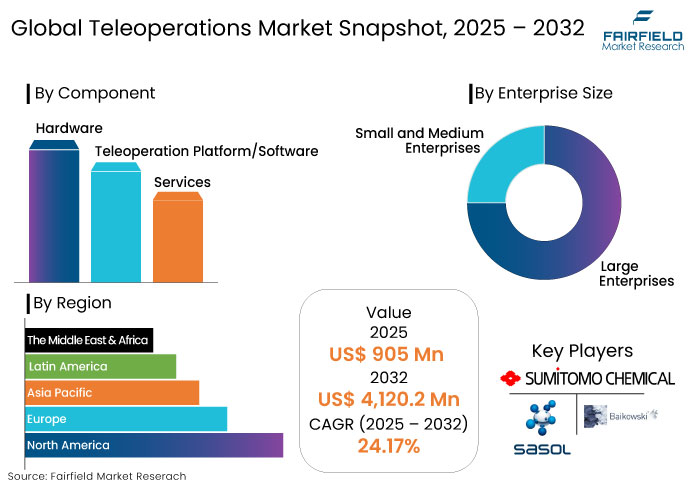
- The teleoperations market is estimated to reach a size of US$ 4,120.2 Mn by 2032, showing significant growth from US$ 905 Mn attained in 2025.
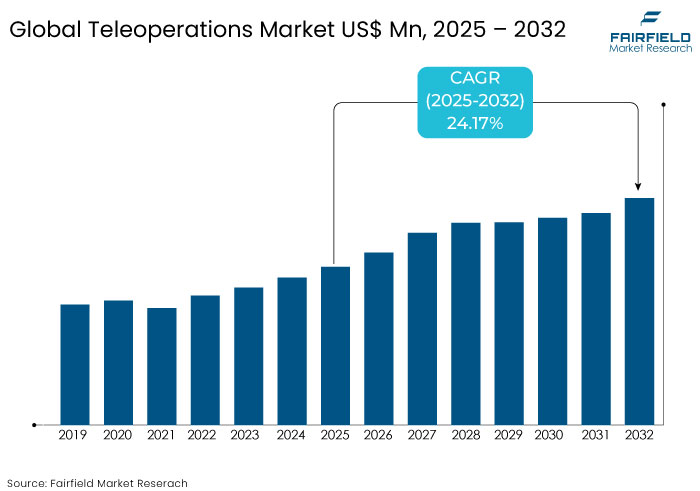
- The market valuation for teleoperations is anticipated to expand at a CAGR of 24.17% from 2025 to 2032.
Teleoperations Market Insights
A Look Back and a Look Forward - Comparative Analysis
The teleoperations market growth was steady at a CAGR of 18.4% during the historical period. The period witnessed expansion as industries recognized its potential for remote management and control, particularly in high-risk environments.
Early applications were seen in autonomous vehicles, robotics, and industrial automation, where teleoperations improved safety and efficiency. The COVID-19 pandemic accelerated adoption, as businesses sought remote solutions to comply with safety protocols. This led to a surge in demand for telepresence robots and remote-controlled systems, especially in healthcare and warehousing.
Over the forecast period, advancements in technologies like quantum computing and the Internet of Things (IoT) are likely to enable real-time control of complex systems like space exploration and deep-sea robots. The development of policy frameworks and standardized protocols are likely to boost growth. Collaborative efforts between governments and industry stakeholders are key to addressing safety, data privacy, and ethics, thereby driving adoption, especially in regulated sectors like healthcare.
Market Growth Determinants
- Teleoperation Decreases Physical Presence Requirements in the Healthcare Sector
Telepresence and high-end teleoperation technologies are driving growth in the teleoperation market, especially in healthcare robotics. Such innovations enable remote surgeries, diagnostics, and patient monitoring with precision, addressing challenges in underserved regions with limited access to skilled practitioners.
By allowing experts to control robotic systems from a distance, teleoperation decreases physical presence requirements while enhancing accuracy and minimizing human error. Rising demand for accessible healthcare and robotic-assisted solutions positions teleoperation as a cost-effective and efficient approach that enhances patient care while extending healthcare reach.
Utility of teleoperations in high-risk scenarios, like epidemics or natural disasters, further underscores its critical role in modern healthcare. This increasing adoption accelerates innovation and expansion, with institutions investing to enhance operational efficiency and alleviate local healthcare burdens.
- Logistics and Transportation Industry to Fuel Adoption to Tackle Driver Shortages
The industry is witnessing rapid growth owing to the logistics industry's requirement to tackle driver shortages and boost efficiency. Companies like DHL Freight are adopting teleoperation, enabling remote vehicle control, and reducing the need for on-site drivers. Technology enhances job satisfaction by enabling operators to work in controlled environments, offering better work-life balance.
Beyond addressing labour shortages, teleoperation supports logistics digitization by streamlining operations. It enables a single operator to manage multiple vehicles, particularly in controlled settings like freight terminals, complementing autonomous systems without public road regulations.
With human oversight maintaining decision-making in complex scenarios, teleoperation combines advanced sensors and communication technologies for safe and efficient operations. As logistics embrace tech integration, teleoperation is emerging as a transformative solution, poised to drive safety, adaptability, and growth in the sector.
Market Growth Barriers
- Network Latency to Hamper Expansion
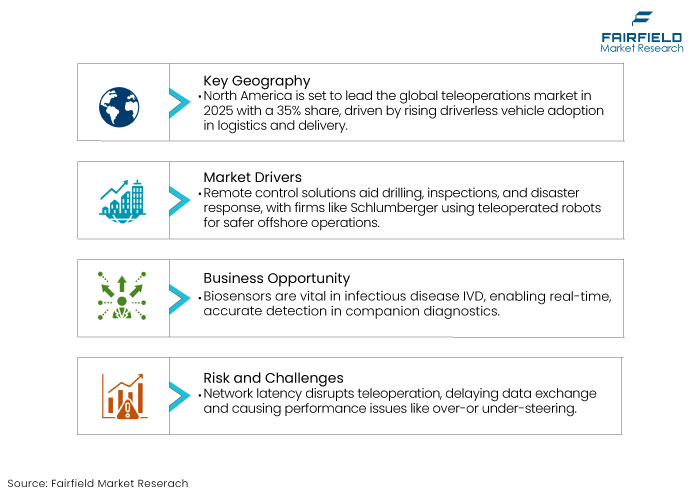
Network latency poses a significant challenge in teleoperation, disrupting communication by delaying sensory and control data exchange between vehicles and remote stations. Latency negatively impacts performance, leading to issues like over- or under-steering.
While latencies below 170 ms are manageable and below 300 ms are adaptable, delays between 300 ms and 500 ms becomes challenging, particularly at low speeds. Latencies above 700 ms render real-time control nearly impossible.
Mitigation strategies, like Model-Mediated Teleoperation (MMT) and passivity control algorithms, offer partial solutions but have limitations, including reliance on accurate models or issues like position drift. Networks also vary in latency with 3G averaging 217 ms while 4G improves to 107 to 183 ms, and 5G reduces to 60 to 260 ms, though challenges remain.
Market Growth Opportunities
- Remote Control in Hazardous Environments
Remote control solutions are widely used for tasks such as drilling, pipeline inspections, maintenance in offshore platforms, and disaster response. Companies like Schlumberger and Halliburton utilize teleoperated robots to carry out remote inspections in offshore drilling operations. This reduces the need for personnel to be exposed to high-risk situations.
Rio Tinto, a major mining company, uses remote-controlled haul trucks and drilling equipment in its mines in Australia and Canada. These systems ensure that operations continue even in highly hazardous areas like open-pit mines and areas affected by rockfalls.
Teleoperation is critical in nuclear power plants, especially for maintenance and decommissioning processes where exposure to radiation or other hazardous conditions can put human lives at risk. In the aftermath of the Fukushima nuclear disaster, Japan increased its use of remote-controlled robots for tasks like inspecting damaged reactors, repairing equipment, and cleaning up contaminated areas
- Growth in Drone and UAV Applications
Drones have found wide adoption in commercial and industrial sectors, including agriculture, construction, energy, logistics, film production, and public safety. The ability to remotely control drones for tasks such as aerial surveillance, mapping, inspection, and delivery is fueling their use across these industries.
Drones are being used in agriculture for crop monitoring, spraying pesticides, irrigation management, and land surveying. Teleoperation provides farmers with a remote way to monitor large areas, collect data, and manage agricultural operations more efficiently.
Drones equipped with high-resolution cameras, sensors, and LiDAR are used for inspecting critical infrastructure like bridges, power lines, telecommunication towers, pipelines, and wind turbines. Teleoperated drones enable operators to remotely inspect infrastructure in dangerous or hard-to-reach areas, decreasing the risk of human exposure to hazards.
How is Regulatory Scenario Shaping this Industry?
The regulatory scenario is pivotal in shaping the teleoperations market, especially as industries like autonomous vehicles, robotics, and remote-controlled systems gain traction. Governments and regulatory bodies worldwide are working to establish frameworks that ensure the safety, reliability, and interoperability of teleoperation systems.
Development of policies for 5G networks, a critical enabler of teleoperations, further supports market growth by enhancing communication speed and reducing latency. The lack of globally unified standards poses a challenge, as companies must navigate differing requirements across regions.
Evolving regulatory frameworks foster innovation as businesses strive to meet compliance while advancing teleoperation technologies. The balance between regulation and innovation is estimated to drive the growth as well as global adoption.
Segments Covered in the Report
- Widespread Adoption of Hardware Technologies to Spur Growth
Hardware is estimated to dominate the global teleoperation market with a share of 50% in 2025. This dominance is driven by the increasing demand for advanced devices that enable effective remote operations across various industries.
Key hardware components in teleoperation include head-mounted displays (HMDs), tele manipulator devices, and other essential tools that facilitate seamless interaction between operators and remote systems.
HMDs are crucial for providing immersive visual feedback, enhancing situational awareness, and improving control. Tele manipulator devices, which enable operators to control robotic arms or vehicles remotely, are essential in sectors like healthcare, logistics, and manufacturing, enabling precise and complex tasks.
Sensors, cameras, and communication systems play a vital role in ensuring real-time feedback and the smooth operation of teleoperation systems. The widespread adoption of these hardware technologies is driving growth in the teleoperation market, thereby cementing the hardware segment’s position.
- Teleoperation in Transportation and Logistics to Facilitate Efficiency
Teleoperation in transportation and logistics has captured 25% of share, with companies like DHL Freight leading the charge. Teleoperators are increasingly controlling autonomous vehicles, initially tested in controlled environments and now expanding onto public roads, especially in freight transportation.
Teleoperations technology addresses labour shortages while enhancing operational efficiency by enabling operators to remotely manage multiple vehicles, improving work-life balance and job satisfaction. Challenges like situational awareness and mental load on teleoperators are being addressed through a user-centered approach that incorporate technologies like AR, AI safety measures, and biofeedback.
By streamlining logistics processes and providing human oversight in complex scenarios, teleoperation is transforming the industry, offering safer and efficient workflows. This trend positions teleoperation as a prominent driver in the logistics market, catering to the demand for digitization while addressing workforce shortages.
Regional Analysis
- Increasing Adoption of Driverless Vehicles Spur Demand in North America
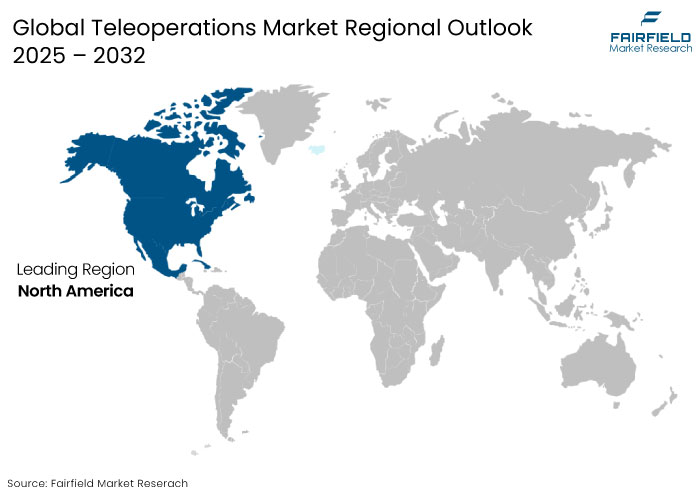
North America is predicted to lead the global teleoperations market with a share of 35% in 2025. Leadership of the region is primarily driven by the increasing adoption of driverless vehicles, particularly in logistics and delivery operations, giving the teleoperations market in the U.S. a significant edge.
The use of autonomous vehicles for goods transportation, especially in sectors like e-commerce, is providing a substantial boost to teleoperation technologies. In 2022, U.S.-based companies contributed heavily to the country's dominant share in the global teleoperations market, further solidifying the U.S. as a leader in this space.
The U.S. Army’s Future Combat Systems (FCS) program is pioneering the development of autonomous unmanned ground vehicles (UGVs) for military missions. These vehicles are designed to undertake tasks deemed “triple D”- dirty, dull, and dangerous, like reconnaissance in hazardous environments, without putting soldiers' lives at risk.
- Asia Pacific is Adopting Teleoperation Systems Across Various Industries
Asia Pacific emerging as a dominant player in the teleoperations market and is likely to exhibit a CAGR of 28.6% from 2025 to 2032. This robust growth can be attributed to a combination of factors, including the rising disposable incomes in key countries like China, India, and South Korea.
As the economic development in these countries continues to accelerate, a larger portion of the population is entering the middle class. This further increases the demand for advanced technologies like teleoperations.
Governments in these countries are increasingly investing in infrastructure development, technological advancements, and automation. This further supports the adoption of teleoperation systems across various industries, including manufacturing, healthcare, and logistics.
Fairfield’s Competitive Landscape Analysis
Companies in the teleoperations market are focused on advancing automation and remote-controlled technologies. Prominent businesses are competing to develop cutting-edge systems that incorporate AI-driven remote control, sensor technologies, and real-time feedback mechanisms.
By offering products that provide higher precision, efficiency, and safety, manufacturers aim to differentiate themselves in a rapidly evolving market. To stay competitive, manufacturers are increasingly forming alliances with other technology providers and sector-specific companies.
Manufacturers can tailor their systems to cater to the unique requirements of different sectors, gaining a competitive advantage in the industry. Competition is anticipated to intensify as manufacturers seek to access new markets and customer bases.
Key Market Companies
- Sumitomo Chemical Co. Ltd
- Sasol Ltd.
- Baikowski
- Nippon Light Metal Co. Ltd
- Alcoa Inc.
- Altech Chemicals Ltd.
- Honghe Chemicals
- Hebei Heng Bo New Materials Application Co. Ltd.
- Xuancheng Jingrui New Material Co. Ltd
- Dalian Hiland Photoelectric Material Co. Ltd
- Alpha HPA
- FYI Resources
- Ottopia Technologies, Ltd.
- Voysys
- Formant
- Shadow Robot Company
- Neya Systems
- Boston Dynamics
- Taurob
- Clearpath Robotics Inc.
- DriveU.auto
- Roboauto
- TELEXISTENCE Inc
- SK Godelius
Recent Industry Developments
- In June 2024, Ottopia launched its AI-powered remote driving platform, marking a significant milestone in the market. Combining AI, network optimization, and video compression, the platform enables OEMs and AV companies to integrate Ottopia’s technology and offer premium remote driving services.
- In June, 2024, Neya Systems, a leading innovator in off-road autonomy and mission planning software, announced a strategic partnership with the Association for Uncrewed Vehicle Systems International (AUVSI) to create a robust cybersecurity and supply chain framework, accompanied by a certification program, specifically tailored for uncrewed ground vehicles (UGVs).
- In May 2024, Shadow Robot announced the world’s most robust dexterous robot hand, developed in partnership with Google DeepMind.
An Expert’s Eye
- Advancements in real-time technologies and policy frameworks are estimated to drive significant growth.
- Innovations in quantum computing, IoT, and 4G/5G networks are enabling real-time control of complex systems, enhancing efficiency and precision.
- Increased focus on logistics and healthcare sectors highlights teleoperation’s potential for innovation and growth.
- Teleoperation systems are transforming healthcare with remote surgeries, diagnostics, and patient monitoring, improving accessibility and care quality in underserved regions.
- Teleoperation addresses driver shortages and enhances efficiency by enabling remote vehicle management, offering better work-life balance for operators.
Global Teleoperations Market is Segmented as-
By Component
- Hardware
- HMD Devices
- Telemanipulator Devices
- Others
- Teleoperation Platform/Software
- Services
- Design and Development Services
- Consulting Services
- Integration Services
- Support and Maintenance
- Other Components
By Enterprise Size
- Small and Medium Enterprises (SMEs)
- Large Enterprises
By Application
- Transportation and Logistics
- Healthcare and Medical
- Aerospace and Defense
- Industrial
- Energy and Power
- Agriculture
- Construction and Mining
By Region
- North America
- Europe
- Asia Pacific
- Latin America
- Middle East & Africa
1. Executive Summary
1.1. Global Teleoperations Market Snapshot
1.2. Future Projections
1.3. Key Market Trends
1.4. Regional Snapshot, by Value, 2025
1.5. Analyst Recommendations
2. Market Overview
2.1. Market Definitions and Segmentations
2.2. Market Dynamics
2.2.1. Drivers
2.2.2. Restraints
2.2.3. Market Opportunities
2.3. Value Chain Analysis
2.4. Porter’s Five Forces Analysis
2.5. COVID-19 Impact Analysis
2.5.1. Supply
2.5.2. Demand
2.6. Impact of Ukraine-Russia Conflict
2.7. Economic Overview
2.7.1. World Economic Projections
2.8. PESTLE Analysis
3. Global Teleoperations Market Outlook, 2019 - 2032
3.1. Global Teleoperations Market Outlook, by Component, Value (US$ Bn), 2019 - 2032
3.1.1. Key Highlights
3.1.1.1. Hardware
3.1.1.1.1. HMD Devices
3.1.1.1.2. Telemanipulator Devices
3.1.1.1.3. Others
3.1.1.2. Teleoperation Platform/Software
3.1.1.3. Services
3.1.1.3.1. Design & Development Services
3.1.1.3.2. Consulting Services
3.1.1.3.3. Integration Services
3.1.1.3.4. Support & Maintenance
3.1.1.3.5. Other Components
3.2. Global Teleoperations Market Outlook, by Enterprise Size, Value (US$ Bn), 2019 - 2032
3.2.1. Key Highlights
3.2.1.1. Small and Medium Enterprises (SMEs)
3.2.1.2. Large Enterprises
3.3. Global Teleoperations Market Outlook, by Application, Value (US$ Bn), 2019 - 2032
3.3.1. Key Highlights
3.3.1.1. Transportation & Logistics
3.3.1.2. Healthcare & Medical
3.3.1.3. Aerospace and Defense
3.3.1.4. Industrial
3.3.1.5. Energy & Power
3.3.1.6. Agriculture
3.3.1.7. Construction and Mining
3.3.1.8. Misc.
3.4. Global Teleoperations Market Outlook, by Region, Value (US$ Bn), 2019 - 2032
3.4.1. Key Highlights
3.4.1.1. North America
3.4.1.2. Europe
3.4.1.3. Asia Pacific
3.4.1.4. Latin America
3.4.1.5. Middle East & Africa
4. North America Teleoperations Market Outlook, 2019 - 2032
4.1. North America Teleoperations Market Outlook, by Component, Value (US$ Bn), 2019 - 2032
4.1.1. Key Highlights
4.1.1.1. Hardware
4.1.1.1.1. HMD Devices
4.1.1.1.2. Telemanipulator Devices
4.1.1.1.3. Others
4.1.1.2. Teleoperation Platform/Software
4.1.1.3. Services
4.1.1.3.1. Design & Development Services
4.1.1.3.2. Consulting Services
4.1.1.3.3. Integration Services
4.1.1.3.4. Support & Maintenance
4.1.1.3.5. Other Components
4.2. North America Teleoperations Market Outlook, by Enterprise Size, Value (US$ Bn), 2019 - 2032
4.2.1. Key Highlights
4.2.1.1. Small and Medium Enterprises (SMEs)
4.2.1.2. Large Enterprises
4.3. North America Teleoperations Market Outlook, by Application, Value (US$ Bn), 2019 - 2032
4.3.1. Key Highlights
4.3.1.1. Transportation & Logistics
4.3.1.2. Healthcare & Medical
4.3.1.3. Aerospace and Defense
4.3.1.4. Industrial
4.3.1.5. Energy & Power
4.3.1.6. Agriculture
4.3.1.7. Construction and Mining
4.3.1.8. Misc.
4.3.2. BPS Analysis/Market Attractiveness Analysis
4.4. North America Teleoperations Market Outlook, by Country, Value (US$ Bn), 2019 - 2032
4.4.1. Key Highlights
4.4.1.1. U.S. Teleoperations Market by Component, Value (US$ Bn), 2019 - 2032
4.4.1.2. U.S. Teleoperations Market by Enterprise Size, Value (US$ Bn), 2019 - 2032
4.4.1.3. U.S. Teleoperations Market by Application, Value (US$ Bn), 2019 - 2032
4.4.1.4. Canada Teleoperations Market by Component, Value (US$ Bn), 2019 - 2032
4.4.1.5. Canada Teleoperations Market by Enterprise Size, Value (US$ Bn), 2019 - 2032
4.4.1.6. Canada Teleoperations Market by Application, Value (US$ Bn), 2019 - 2032
4.4.2. BPS Analysis/Market Attractiveness Analysis
5. Europe Teleoperations Market Outlook, 2019 - 2032
5.1. Europe Teleoperations Market Outlook, by Component, Value (US$ Bn), 2019 - 2032
5.1.1. Key Highlights
5.1.1.1. Hardware
5.1.1.1.1. HMD Devices
5.1.1.1.2. Telemanipulator Devices
5.1.1.1.3. Others
5.1.1.2. Teleoperation Platform/Software
5.1.1.3. Services
5.1.1.3.1. Design & Development Services
5.1.1.3.2. Consulting Services
5.1.1.3.3. Integration Services
5.1.1.3.4. Support & Maintenance
5.1.1.3.5. Other Components
5.2. Europe Teleoperations Market Outlook, by Enterprise Size, Value (US$ Bn), 2019 - 2032
5.2.1. Key Highlights
5.2.1.1. Small and Medium Enterprises (SMEs)
5.2.1.2. Large Enterprises
5.3. Europe Teleoperations Market Outlook, by Application, Value (US$ Bn), 2019 - 2032
5.3.1. Key Highlights
5.3.1.1. Transportation & Logistics
5.3.1.2. Healthcare & Medical
5.3.1.3. Aerospace and Defense
5.3.1.4. Industrial
5.3.1.5. Energy & Power
5.3.1.6. Agriculture
5.3.1.7. Construction and Mining
5.3.1.8. Misc.
5.3.2. BPS Analysis/Market Attractiveness Analysis
5.4. Europe Teleoperations Market Outlook, by Country, Value (US$ Bn), 2019 - 2032
5.4.1. Key Highlights
5.4.1.1. Germany Teleoperations Market by Component, Value (US$ Bn), 2019 - 2032
5.4.1.2. Germany Teleoperations Market by Enterprise Size, Value (US$ Bn), 2019 - 2032
5.4.1.3. Germany Teleoperations Market by Application, Value (US$ Bn), 2019 - 2032
5.4.1.4. U.K. Teleoperations Market by Component, Value (US$ Bn), 2019 - 2032
5.4.1.5. U.K. Teleoperations Market by Enterprise Size, Value (US$ Bn), 2019 - 2032
5.4.1.6. U.K. Teleoperations Market by Application, Value (US$ Bn), 2019 - 2032
5.4.1.7. France Teleoperations Market by Component, Value (US$ Bn), 2019 - 2032
5.4.1.8. France Teleoperations Market by Enterprise Size, Value (US$ Bn), 2019 - 2032
5.4.1.9. France Teleoperations Market by Application, Value (US$ Bn), 2019 - 2032
5.4.1.10. Italy Teleoperations Market by Component, Value (US$ Bn), 2019 - 2032
5.4.1.11. Italy Teleoperations Market by Enterprise Size, Value (US$ Bn), 2019 - 2032
5.4.1.12. Italy Teleoperations Market by Application, Value (US$ Bn), 2019 - 2032
5.4.1.13. Turkey Teleoperations Market by Component, Value (US$ Bn), 2019 - 2032
5.4.1.14. Turkey Teleoperations Market by Enterprise Size, Value (US$ Bn), 2019 - 2032
5.4.1.15. Turkey Teleoperations Market by Application, Value (US$ Bn), 2019 - 2032
5.4.1.16. Russia Teleoperations Market by Component, Value (US$ Bn), 2019 - 2032
5.4.1.17. Russia Teleoperations Market by Enterprise Size, Value (US$ Bn), 2019 - 2032
5.4.1.18. Russia Teleoperations Market by Application, Value (US$ Bn), 2019 - 2032
5.4.1.19. Rest of Europe Teleoperations Market by Component, Value (US$ Bn), 2019 - 2032
5.4.1.20. Rest of Europe Teleoperations Market by Enterprise Size, Value (US$ Bn), 2019 - 2032
5.4.1.21. Rest of Europe Teleoperations Market by Application, Value (US$ Bn), 2019 - 2032
5.4.2. BPS Analysis/Market Attractiveness Analysis
6. Asia Pacific Teleoperations Market Outlook, 2019 - 2032
6.1. Asia Pacific Teleoperations Market Outlook, by Component, Value (US$ Bn), 2019 - 2032
6.1.1. Key Highlights
6.1.1.1. Hardware
6.1.1.1.1. HMD Devices
6.1.1.1.2. Telemanipulator Devices
6.1.1.1.3. Others
6.1.1.2. Teleoperation Platform/Software
6.1.1.3. Services
6.1.1.3.1. Design & Development Services
6.1.1.3.2. Consulting Services
6.1.1.3.3. Integration Services
6.1.1.3.4. Support & Maintenance
6.1.1.3.5. Other Components
6.2. Asia Pacific Teleoperations Market Outlook, by Enterprise Size, Value (US$ Bn), 2019 - 2032
6.2.1. Key Highlights
6.2.1.1. Small and Medium Enterprises (SMEs)
6.2.1.2. Large Enterprises
6.3. Asia Pacific Teleoperations Market Outlook, by Application, Value (US$ Bn), 2019 - 2032
6.3.1. Key Highlights
6.3.1.1. Transportation & Logistics
6.3.1.2. Healthcare & Medical
6.3.1.3. Aerospace and Defense
6.3.1.4. Industrial
6.3.1.5. Energy & Power
6.3.1.6. Agriculture
6.3.1.7. Construction and Mining
6.3.1.8. Misc.
6.3.2. BPS Analysis/Market Attractiveness Analysis
6.4. Asia Pacific Teleoperations Market Outlook, by Country, Value (US$ Bn), 2019 - 2032
6.4.1. Key Highlights
6.4.1.1. China Teleoperations Market by Component, Value (US$ Bn), 2019 - 2032
6.4.1.2. China Teleoperations Market by Enterprise Size, Value (US$ Bn), 2019 - 2032
6.4.1.3. China Teleoperations Market by Application, Value (US$ Bn), 2019 - 2032
6.4.1.4. Japan Teleoperations Market by Component, Value (US$ Bn), 2019 - 2032
6.4.1.5. Japan Teleoperations Market by Enterprise Size, Value (US$ Bn), 2019 - 2032
6.4.1.6. Japan Teleoperations Market by Application, Value (US$ Bn), 2019 - 2032
6.4.1.7. South Korea Teleoperations Market by Component, Value (US$ Bn), 2019 - 2032
6.4.1.8. South Korea Teleoperations Market by Enterprise Size, Value (US$ Bn), 2019 - 2032
6.4.1.9. South Korea Teleoperations Market by Application, Value (US$ Bn), 2019 - 2032
6.4.1.10. India Teleoperations Market by Component, Value (US$ Bn), 2019 - 2032
6.4.1.11. India Teleoperations Market by Enterprise Size, Value (US$ Bn), 2019 - 2032
6.4.1.12. India Teleoperations Market by Application, Value (US$ Bn), 2019 - 2032
6.4.1.13. Southeast Asia Teleoperations Market by Component, Value (US$ Bn), 2019 - 2032
6.4.1.14. Southeast Asia Teleoperations Market by Enterprise Size, Value (US$ Bn), 2019 - 2032
6.4.1.15. Southeast Asia Teleoperations Market by Application, Value (US$ Bn), 2019 - 2032
6.4.1.16. Rest of Asia Pacific Teleoperations Market by Component, Value (US$ Bn), 2019 - 2032
6.4.1.17. Rest of Asia Pacific Teleoperations Market by Enterprise Size, Value (US$ Bn), 2019 - 2032
6.4.1.18. Rest of Asia Pacific Teleoperations Market by Application, Value (US$ Bn), 2019 - 2032
6.4.2. BPS Analysis/Market Attractiveness Analysis
7. Latin America Teleoperations Market Outlook, 2019 - 2032
7.1. Latin America Teleoperations Market Outlook, by Component, Value (US$ Bn), 2019 - 2032
7.1.1. Key Highlights
7.1.1.1. Hardware
7.1.1.1.1. HMD Devices
7.1.1.1.2. Telemanipulator Devices
7.1.1.1.3. Others
7.1.1.2. Teleoperation Platform/Software
7.1.1.3. Services
7.1.1.3.1. Design & Development Services
7.1.1.3.2. Consulting Services
7.1.1.3.3. Integration Services
7.1.1.4. Support & Maintenance
7.1.1.5. Other Components
7.2. Latin America Teleoperations Market Outlook, by Enterprise Size, Value (US$ Bn), 2019 - 2032
7.2.1. Key Highlights
7.2.1.1. Small and Medium Enterprises (SMEs)
7.2.1.2. Large Enterprises
7.3. Latin America Teleoperations Market Outlook, by Application, Value (US$ Bn), 2019 - 2032
7.3.1. Key Highlights
7.3.1.1. Transportation & Logistics
7.3.1.2. Healthcare & Medical
7.3.1.3. Aerospace and Defense
7.3.1.4. Industrial
7.3.1.5. Energy & Power
7.3.1.6. Agriculture
7.3.1.7. Construction and Mining
7.3.1.8. Misc.
7.3.2. BPS Analysis/Market Attractiveness Analysis
7.4. Latin America Teleoperations Market Outlook, by Country, Value (US$ Bn), 2019 - 2032
7.4.1. Key Highlights
7.4.1.1. Brazil Teleoperations Market by Component, Value (US$ Bn), 2019 - 2032
7.4.1.2. Brazil Teleoperations Market by Enterprise Size, Value (US$ Bn), 2019 - 2032
7.4.1.3. Brazil Teleoperations Market by Application, Value (US$ Bn), 2019 - 2032
7.4.1.4. Mexico Teleoperations Market by Component, Value (US$ Bn), 2019 - 2032
7.4.1.5. Mexico Teleoperations Market by Enterprise Size, Value (US$ Bn), 2019 - 2032
7.4.1.6. Mexico Teleoperations Market by Application, Value (US$ Bn), 2019 - 2032
7.4.1.7. Argentina Teleoperations Market by Component, Value (US$ Bn), 2019 - 2032
7.4.1.8. Argentina Teleoperations Market by Enterprise Size, Value (US$ Bn), 2019 - 2032
7.4.1.9. Argentina Teleoperations Market by Application, Value (US$ Bn), 2019 - 2032
7.4.1.10. Rest of Latin America Teleoperations Market by Component, Value (US$ Bn), 2019 - 2032
7.4.1.11. Rest of Latin America Teleoperations Market by Enterprise Size, Value (US$ Bn), 2019 - 2032
7.4.1.12. Rest of Latin America Teleoperations Market by Application, Value (US$ Bn), 2019 - 2032
7.4.2. BPS Analysis/Market Attractiveness Analysis
8. Middle East & Africa Teleoperations Market Outlook, 2019 - 2032
8.1. Middle East & Africa Teleoperations Market Outlook, by Component, Value (US$ Bn), 2019 - 2032
8.1.1. Key Highlights
8.1.1.1. Hardware
8.1.1.1.1. HMD Devices
8.1.1.1.2. Telemanipulator Devices
8.1.1.1.3. Others
8.1.1.2. Teleoperation Platform/Software
8.1.1.3. Services
8.1.1.3.1. Design & Development Services
8.1.1.3.2. Consulting Services
8.1.1.3.3. Integration Services
8.1.1.4. Support & Maintenance
8.1.1.5. Other Components
8.2. Middle East & Africa Teleoperations Market Outlook, by Enterprise Size, Value (US$ Bn), 2019 - 2032
8.2.1. Key Highlights
8.2.1.1. Small and Medium Enterprises (SMEs)
8.2.1.2. Large Enterprises
8.3. Middle East & Africa Teleoperations Market Outlook, by Application, Value (US$ Bn), 2019 - 2032
8.3.1. Key Highlights
8.3.1.1. Transportation & Logistics
8.3.1.2. Healthcare & Medical
8.3.1.3. Aerospace and Defense
8.3.1.4. Industrial
8.3.1.5. Energy & Power
8.3.1.6. Agriculture
8.3.1.7. Construction and Mining
8.3.1.8. Misc.
8.3.2. BPS Analysis/Market Attractiveness Analysis
8.4. Middle East & Africa Teleoperations Market Outlook, by Country, Value (US$ Bn), 2019 - 2032
8.4.1. Key Highlights
8.4.1.1. GCC Teleoperations Market by Component, Value (US$ Bn), 2019 - 2032
8.4.1.2. GCC Teleoperations Market by Enterprise Size, Value (US$ Bn), 2019 - 2032
8.4.1.3. GCC Teleoperations Market by Application, Value (US$ Bn), 2019 - 2032
8.4.1.4. South Africa Teleoperations Market by Component, Value (US$ Bn), 2019 - 2032
8.4.1.5. South Africa Teleoperations Market by Enterprise Size, Value (US$ Bn), 2019 - 2032
8.4.1.6. South Africa Teleoperations Market by Application, Value (US$ Bn), 2019 - 2032
8.4.1.7. Egypt Teleoperations Market by Component, Value (US$ Bn), 2019 - 2032
8.4.1.8. Egypt Teleoperations Market by Enterprise Size, Value (US$ Bn), 2019 - 2032
8.4.1.9. Egypt Teleoperations Market by Application, Value (US$ Bn), 2019 - 2032
8.4.1.10. Nigeria Teleoperations Market by Component, Value (US$ Bn), 2019 - 2032
8.4.1.11. Nigeria Teleoperations Market by Enterprise Size, Value (US$ Bn), 2019 - 2032
8.4.1.12. Nigeria Teleoperations Market by Application, Value (US$ Bn), 2019 - 2032
8.4.1.13. Rest of Middle East & Africa Teleoperations Market by Component, Value (US$ Bn), 2019 - 2032
8.4.1.14. Rest of Middle East & Africa Teleoperations Market by Enterprise Size, Value (US$ Bn), 2019 - 2032
8.4.1.15. Rest of Middle East & Africa Teleoperations Market by Application, Value (US$ Bn), 2019 - 2032
8.4.2. BPS Analysis/Market Attractiveness Analysis
9. Competitive Landscape
9.1. Manufacturer vs by Enterprise Size Heatmap
9.2. Company Market Share Analysis, 2023
9.3. Competitive Dashboard
9.4. Company Profiles
9.4.1. Sumitomo Chemical Co. Ltd
9.4.1.1. Company Overview
9.4.1.2. Product Portfolio
9.4.1.3. Financial Overview
9.4.1.4. Business Strategies and Development
9.4.2. Sasol Ltd.
9.4.3. Baikowski
9.4.4. Nippon Light Metal Co. Ltd
9.4.5. Alcoa Inc.
9.4.6. Altech Chemicals Ltd.
9.4.7. Honghe Chemicals
9.4.8. Hebei Heng Bo New Materials Application Co. Ltd.
9.4.9. Xuancheng Jingrui New Material Co. Ltd
9.4.10. Dalian Hiland Photoelectric Material Co. Ltd
9.4.11. Alpha HPA
9.4.12. FYI Resources
9.4.13. Ottopia Technologies, Ltd.
9.4.14. Voysys
9.4.15. Formant
9.4.16. Shadow Robot Company
9.4.17. Neya Systems
9.4.18. Boston Dynamics
9.4.19. Taurob
9.4.20. Clearpath Robotics Inc.
9.4.21. DriveU.auto
9.4.22. Roboauto
9.4.23. TELEXISTENCE Inc
9.4.24. SK Godelius
10. Appendix
10.1. Research Methodology
10.2. Report Assumptions
10.3. Acronyms and Abbreviations
|
BASE YEAR |
HISTORICAL DATA |
FORECAST PERIOD |
UNITS |
|||
 |
2025 |
 |
2019 - 2023 |
 |
2025 - 2032 |
Value: US$ Million |
|
REPORT FEATURES |
DETAILS |
|
Component Coverage |
|
|
Enterprise Size Coverage |
|
|
Application Coverage |
|
|
Geographical Coverage |
|
|
Leading Companies |
|
|
Report Highlights |
Key Market Indicators, Macro-micro economic impact analysis, Technological Roadmap, Key Trends, Driver, Restraints, and Future Opportunities & Revenue Pockets, Porter’s 5 Forces Analysis, Historical Trend (2019-2024), Market Estimates and Forecast, Market Dynamics, Industry Trends, Competition Landscape, Category, Region, Country-wise Trends & Analysis, COVID-19 Impact Analysis (Demand and Supply Chain) |
Our Research Methodology
Considering the volatility of business today, traditional approaches to strategizing a game plan can be unfruitful if not detrimental. True ambiguity is no way to determine a forecast. A myriad of predetermined factors must be accounted for such as the degree of risk involved, the magnitude of circumstances, as well as conditions or consequences that are not known or unpredictable. To circumvent binary views that cast uncertainty, the application of market research intelligence to strategically posture, move, and enable actionable outcomes is necessary.
View Methodology
Quality Assured
Rigorous Validation Process

Confidentiality Assured
End-to-end Data Security

Custom Research Services
Tailored To Your Objectives
FAQs
The industry is projected to be valued at US$ 4 Bn by 2032.
A key opportunity lies in development of the healthcare sector as it is predicted to be the fastest-growing segment.
North America is anticipated to lead the industry with a share of 35% in 2025.
The industry is estimated to record a CAGR of 23.9% through 2032.
Sumitomo Chemical Co. Ltd., Sasol Ltd, and Ottopia Technologies, Ltd. are the key industry players.
Related Reports
Beauty Tech Market Insights, Competitive Landscape, and Market Forecast 2033
Beauty Tech Market is projected to reach US$275.81 billion by 2033, driven by AI, AR, skincare devices, and connected beauty solutions.
Smart Glass and Smart Window Market Insights, Competitive Landscape, and Market Forecast 2026–2033
Smart Glass and Window Market is projected to reach US$26.99 billion by 2033, driven by energy-efficient buildings, automotive use, and retrofit demand.
Smartphone Music Production Software Market Insights, Competitive Landscape, and Market Forecast 2033
The smartphone music production software market is forecast to reach US$196.41 million by 2033 from US$95.20 million in 2026, growing at a 10.9% CAGR.
Veterinary API Market Insights, Competitive Landscape, and Market Forecast 2033
The veterinary API market is projected to rise from US$6.10 billion in 2026 to US$8.87 billion by 2033 at a 5.5% CAGR, driven by animal health demand.
Digital Games Market Insights, Competitive Landscape, and Market Forecast 2033
The digital games market will grow from US$223.90 billion in 2026 to US$319.27 billion by 2033, expanding at a 5.2% CAGR, driven by digital gaming adoption.
Global Satellite Communication Market Insights, Competitive Landscape, and Market Forecast 2033
The global satellite communication market is valued at US$107.40 Bn in 2026 and is projected to reach US$222.98 Bn by 2033, growing at an 11.0% CAGR