



Machine Safety Market
Machine Safety Market Insights, Competitive Landscape, and Market Forecast 2033
Global Machine Safety Market Forecast
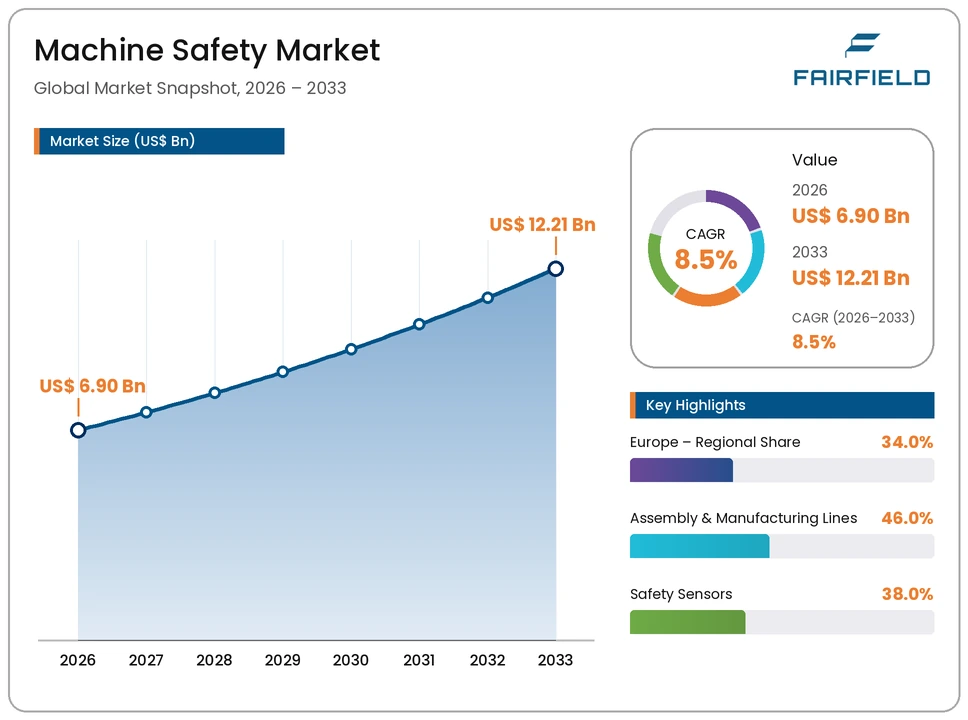
The global machine safety market is expected to be valued at US$ 6.90 Billion in 2026 and is projected to reach US$ 12.21 Billion by 2033, growing at a CAGR of 8.5% between 2026 and 2033. This trajectory reflects a fundamental convergence: aging industrial workforces, accelerating automation deployment, and tightening enforcement of standards such as ISO 13849 and IEC 62061 are simultaneously increasing the cost of non-compliance and the strategic value of integrated safety architectures. The European Agency for Safety and Health at Work (EU-OSHA) estimates that workplace accidents cost EU economies over €476 billion annually, creating durable political will to enforce machinery safety directives with measurable consequences for capital investment decisions.
Key Highlights
- Europe commands the leading regional position, holding 34.0% of global machine safety market share in 2026 and anchored by mandatory compliance timelines under (EU) 2023/1230
- Valued at US$ 6.90 Billion in 2026 and forecast to reach US$ 12.21 Billion by 2033, the machine safety industry carries an incremental revenue opportunity of approximately US$ 5.31 Billion across the forecast window.
- Safety Sensors hold dominant component share at 38.0% of the 2026 market, because every guarded machine interface requires at least one certified sensing device.
- Collaborative robot proliferation is rapidly expanding the addressable perimeter of machine safety solutions beyond traditional fixed-automation contexts.
- The Food & Beverage end-use industry represents a high-conviction growth opportunity within the machine safety sector.
Key Growth Determinants
- Mandatory Compliance with Evolving Machinery Safety Directives
Regulatory frameworks are the most consequential structural driver in the machine safety industry. The European Union's revised Machinery Regulation (EU) 2023/1230, which replaces the Machinery Directive 2006/42/EC and enters full application in 2027, extends mandatory functional safety requirements to autonomous and AI-integrated machinery. Manufacturers operating across EU markets face binding conformity assessment obligations, compelling procurement teams to upgrade legacy safety relay architectures to certified Safety Integrity Level (SIL)-compliant systems. The U.S. Occupational Safety and Health Administration (OSHA) similarly enforces lockout/tagout and machine guarding standards under 29 CFR 1910.212, with citation penalties increasing significantly following the agency's 2023 penalty adjustment cycle. These parallel enforcement regimes on both sides of the Atlantic are sustaining investment demand across the forecast period.
Key Growth Barriers
- High Total Cost of Ownership for Certified Safety Systems
Certified functional safety components carry substantial cost premiums over standard industrial automation hardware. A SIL 2-rated safety controller can cost three to five times more than an equivalent standard programmable logic controller, and full-system validation, including functional safety assessments, documentation packages, and third-party audits by bodies such as TÜV Rheinland, adds meaningful engineering hours and project timeline extensions. For small and medium-sized manufacturers operating on thin margins, particularly in emerging markets, this cost barrier delays or defers machine safety upgrades beyond the minimum compliance threshold.
Market Opportunities
- Safety-as-a-Service and Predictive Functional Safety Analytics
The convergence of Industrial Internet of Things (IIoT) connectivity with machine safety architecture is opening a subscription-based service model with high recurring revenue potential. Safety devices equipped with condition-monitoring firmware can stream diagnostic data, contact wear rates on safety relays, drift in safety sensor alignment, actuator cycle counts on emergency stop devices, to cloud platforms for predictive maintenance scheduling. Pilz GmbH & Co. KG launched its PITreader access management system in 2023, integrating RFID-based personnel authentication with real-time safety zone access logs, illustrating the direction toward managed safety services. System integrators and original equipment manufacturers are well-positioned to monetise this shift by embedding long-term service contracts alongside initial hardware sales.
Category-wise Insights
- Component Analysis
Safety Sensors account for 38.0% of the global machine safety market in 2026, equivalent to US$ 2.62 Billion, sustaining leadership through ubiquitous deployment across virtually every guarded machine application. Automotive assembly plants use safety light curtains and laser scanners to protect operators at robotic welding stations, while semiconductor fabs deploy presence-sensing safety mats at cleanroom equipment access points. These applications require continuous, certified sensing at every human-machine interface, meaning sensor unit volumes scale directly with automation density. The breadth of installation contexts across discrete manufacturing ensures Safety Sensors retain dominant market share throughout the forecast period.
Safety Sensors also represent the fastest-growing component segment, driven by the proliferation of collaborative robotics and autonomous mobile robot deployments requiring Type 4 safety light curtains and 3D safety LiDAR. SICK AG introduced its microScan3 safety laser scanner series with extended scanning ranges specifically targeting cobot perimeter protection, reflecting the category's acceleration into next-generation automation environments.
- Application Analysis
Assembly & Manufacturing Lines account for 46.0% of the global machine safety market in 2026, equivalent to US$ 3.17 Billion, reflecting the highest concentration of guarded machinery and the strictest regulatory scrutiny per installation. Automotive OEMs deploying multi-axis robotic welding and painting lines integrate dozens of safety zones per production cell, requiring interlocked access gates, safety-rated area scanners, and emergency stop networks validated to Performance Level d (PLd) under ISO 13849-1. Electronics manufacturers assembling printed circuit boards use safety light curtains on pick-and-place machines where operator access frequency is high and guarding must not impede cycle time, sustaining premium demand for fast-response safety sensor arrays.
Material Handling & Logistics is the fastest-growing application segment, propelled by the global expansion of automated warehousing. Dematic, a systems integrator serving major retailers and 3PL operators, has specified safety-rated area scanning across its AutoStore grid system implementations since 2023, establishing a replicable safety architecture template that is accelerating standardised procurement across new fulfilment facilities.
- End-use Industry Analysis
Automotive accounts for 35.0% of the global machine safety market in 2026, equivalent to US$ 2.42 Billion, anchored by the industry's structural reliance on high-density robotic automation and its non-negotiable compliance obligations. Vehicle body assembly lines at plants operated by Toyota Motor Corporation, Volkswagen AG, and Stellantis deploy safety interlocks, two-hand control devices, and safety PLCs across hundreds of guarded zones per facility. The shift to electric vehicle production, with battery module assembly requiring additional machine guarding for high-voltage handling, is extending and deepening safety system investment per vehicle platform launched.
Food & Beverage is the fastest-growing end-use segment, driven by the EU Food Safety and Hygiene Regulation (EC) No 852/2004 and parallel national standards requiring washdown-rated, hygienic-design safety switches and sensors in food-contact processing environments. Fortress Technology expanded its Interceptor series of hygienic metal detectors with integrated safety interlocking in 2024, illustrating how food processing OEMs are embedding certified safety functions directly into processing equipment to meet tightening audit requirements from major grocery retailers.
Regional Insights
- North America Machine Safety Market Trends and Insights
North America accounts for 28.0% of the global machine safety market in 2026, representing US$ 1.93 Billion. The region's demand base is anchored by large-scale automotive and aerospace manufacturing, where OSHA enforcement actions and voluntary adoption of ANSI/RIA R15.06 robot safety standards sustain consistent capital allocation toward certified safety systems. Onshoring initiatives incentivised by the U.S. CHIPS and Science Act and Inflation Reduction Act are adding new manufacturing facilities that will require full-specification safety architectures from commissioning.
United States Machine Safety Market Size
The United States machine safety market represents 80.0% of the North America regional market in 2026, equivalent to US$ 1.55 Billion. Demand concentrates in automotive corridors across Michigan and Tennessee and in semiconductor fabrication facilities expanding under CHIPS Act funding. As these greenfield plants move from construction to operational commissioning through 2026–2028, safety system procurement will intensify materially.
- Europe Machine Safety Market Trends and Insights
Europe accounts for 34.0% of the global machine safety market in 2026, representing US$ 2.35 Billion, making it the global leader by regional share. The EU Machinery Regulation (EU) 2023/1230 creates a binding compliance deadline that is accelerating procurement planning among industrial equipment manufacturers throughout Germany, Italy, and France. Europe's position as home to the largest concentration of machine safety component manufacturers also sustains a deep ecosystem of certified system integrators and notified bodies.
Germany Machine Safety Market Size
The Germany machine safety market represents 30.0% of the Europe regional market in 2026, equivalent to US$ 0.70 Billion. Germany's mechanical engineering sector, the largest in Europe by output, anchored by the Verband Deutscher Maschinen- und Anlagenbau (VDMA) member base, drives proportionate demand for embedded safety systems in exported machinery. Continued investment in Industry 4.0 factory modernisation programs sustains a forward growth premium.
Italy Machine Safety Market Size
The Italy machine safety market represents 18.0% of the Europe regional market in 2026, equivalent to US$ 0.42 Billion. Italy's concentrated packaging machinery and food processing equipment manufacturing base, centred in the Emilia-Romagna industrial district, generates sustained demand for hygienic-design safety components meeting EU Machinery Regulation conformity requirements. Accelerating adoption of robotic automation among Italian SME manufacturers signals incremental safety system investment through 2033.
- Asia Pacific Machine Safety Market Trends and Insights
Asia Pacific accounts for 30.0% of the global machine safety market in 2026, representing US$ 2.07 Billion, and is the fastest-growing region at an estimated CAGR of 10.0% through 2033. China's "Made in China 2025" manufacturing upgrade policy and Japan's factory automation maturity are the twin anchors of regional demand, while India's expanding electronics and automotive manufacturing base is emerging as a high-growth incremental opportunity. Regional growth is further supported by the International Labour Organization (ILO)'s sustained advocacy for harmonised occupational safety standards across Southeast Asian manufacturing economies.
China Machine Safety Market Size
The China machine safety market represents 42.0% of the Asia Pacific regional market in 2026, equivalent to US$ 0.87 Billion. Domestic industrial robot installations, China ranked first globally in robot density additions for the third consecutive year per IFR 2023 data, are driving co-investment in certified safety sensor and safety controller systems. Strengthening enforcement of GB/T 15706 national machinery safety standards will accelerate compliance-driven procurement through the forecast period.
Japan Machine Safety Market Size
The Japan machine safety market represents 20.0% of the Asia Pacific regional market in 2026, equivalent to US$ 0.41 Billion. Japan's mature automation base, characterised by high robot-to-worker ratios in automotive and electronics manufacturing, sustains recurring replacement and upgrade demand for safety-rated components. Investments in Society 5.0 manufacturing initiatives are introducing human-robot collaboration scenarios that require upgraded proximity sensing safety architectures beyond legacy perimeter guarding.
Competitive Landscape
The machine safety market is moderately consolidated at the premium certified-component tier and notably fragmented among regional system integrators and niche sensor specialists. Siemens AG, Rockwell Automation, ABB Ltd., and Schneider Electric command significant installed-base advantages through integrated safety PLC and drive portfolios embedded within broader factory automation platforms. Specialist safety vendors, Pilz GmbH & Co. KG, SICK AG, and Banner Engineering, compete on functional safety depth, certification breadth, and application engineering support rather than price. Competitive differentiation increasingly centres on seamless Safety over EtherNet/IP and PROFIsafe protocol integration, as end-users consolidate safety and standard control architectures onto unified networks to reduce total system complexity and validation overhead.
Companies Covered in Machine Safety Market
- Schneider Electric
- Rockwell Automation
- Siemens AG
- ABB Ltd.
- Omron Corporation
- SICK AG
- Pilz GmbH & Co. KG
- Banner Engineering
- Keyence Corporation
- Emerson Electric Co.
- Eaton Corporation
- Honeywell International Inc.
- Fortress Interlocks
- Schmersal Group
- Leuze Electronic GmbH + Co. KG
Market Segmentation
By Component
- Safety Sensors
- Safety Controllers & Modules
- Safety Switches
- Relays & Emergency Stop Devices
By Application
- Assembly & Manufacturing Lines
- Material Handling & Logistics
- Packaging & Processing Systems
By End-use Industry
- Automotive
- Food & Beverage
- Machinery
- Electronics & Other Manufacturin
By Regions
- North America
- Europe
- East Asia
- South Asia & Oceania
- Latin America
- Middle East & Africa
- Executive Summary
- Global Machine Safety Market Snapshot
- Future Projections
- Key Market Trends
- Regional Snapshot, by Value, 2026
- Analyst Recommendations
- Market Overview
- Market Definitions and Segmentations
- Market Dynamics
- Drivers
- Restraints
- Market Opportunities
- Value Chain Analysis
- COVID-19 Impact Analysis
- Porter's Five Forces Analysis
- Impact of Russia-Ukraine Conflict
- PESTLE Analysis
- Regulatory Analysis
- Price Trend Analysis
- Current Prices and Future Projections, 2025-2033
- Price Impact Factors
- Global Machine Safety Market Outlook, 2020 - 2033
- Global Machine Safety Market Outlook, by Component, Value (US$ Bn), 2020-2033
- Safety Sensors
- Safety Controllers & Modules
- Safety Switches, Relays & Emergency Stop Devices
- Global Machine Safety Market Outlook, by Application, Value (US$ Bn), 2020-2033
- Assembly & Manufacturing Lines
- Material Handling & Logistics
- Packaging & Processing Systems
- Global Machine Safety Market Outlook, by End-use Industry, Value (US$ Bn), 2020-2033
- Automotive
- Food & Beverage
- Machinery, Electronics & Other Manufacturing
- Global Machine Safety Market Outlook, by Region, Value (US$ Bn), 2020-2033
- North America
- Europe
- Asia Pacific
- Latin America
- Middle East & Africa
- Global Machine Safety Market Outlook, by Component, Value (US$ Bn), 2020-2033
- North America Machine Safety Market Outlook, 2020 - 2033
- North America Machine Safety Market Outlook, by Component, Value (US$ Bn), 2020-2033
- Safety Sensors
- Safety Controllers & Modules
- Safety Switches, Relays & Emergency Stop Devices
- North America Machine Safety Market Outlook, by Application, Value (US$ Bn), 2020-2033
- Assembly & Manufacturing Lines
- Material Handling & Logistics
- Packaging & Processing Systems
- North America Machine Safety Market Outlook, by End-use Industry, Value (US$ Bn), 2020-2033
- Automotive
- Food & Beverage
- Machinery, Electronics & Other Manufacturing
- North America Machine Safety Market Outlook, by Country, Value (US$ Bn), 2020-2033
- U.S. Machine Safety Market Outlook, by Component, 2020-2033
- U.S. Machine Safety Market Outlook, by Application, 2020-2033
- U.S. Machine Safety Market Outlook, by End-use Industry, 2020-2033
- Canada Machine Safety Market Outlook, by Component, 2020-2033
- Canada Machine Safety Market Outlook, by Application, 2020-2033
- Canada Machine Safety Market Outlook, by End-use Industry, 2020-2033
- BPS Analysis/Market Attractiveness Analysis
- North America Machine Safety Market Outlook, by Component, Value (US$ Bn), 2020-2033
- Europe Machine Safety Market Outlook, 2020 - 2033
- Europe Machine Safety Market Outlook, by Component, Value (US$ Bn), 2020-2033
- Safety Sensors
- Safety Controllers & Modules
- Safety Switches, Relays & Emergency Stop Devices
- Europe Machine Safety Market Outlook, by Application, Value (US$ Bn), 2020-2033
- Assembly & Manufacturing Lines
- Material Handling & Logistics
- Packaging & Processing Systems
- Europe Machine Safety Market Outlook, by End-use Industry, Value (US$ Bn), 2020-2033
- Automotive
- Food & Beverage
- Machinery, Electronics & Other Manufacturing
- Europe Machine Safety Market Outlook, by Country, Value (US$ Bn), 2020-2033
- Germany Machine Safety Market Outlook, by Component, 2020-2033
- Germany Machine Safety Market Outlook, by Application, 2020-2033
- Germany Machine Safety Market Outlook, by End-use Industry, 2020-2033
- Italy Machine Safety Market Outlook, by Component, 2020-2033
- Italy Machine Safety Market Outlook, by Application, 2020-2033
- Italy Machine Safety Market Outlook, by End-use Industry, 2020-2033
- France Machine Safety Market Outlook, by Component, 2020-2033
- France Machine Safety Market Outlook, by Application, 2020-2033
- France Machine Safety Market Outlook, by End-use Industry, 2020-2033
- U.K. Machine Safety Market Outlook, by Component, 2020-2033
- U.K. Machine Safety Market Outlook, by Application, 2020-2033
- U.K. Machine Safety Market Outlook, by End-use Industry, 2020-2033
- Spain Machine Safety Market Outlook, by Component, 2020-2033
- Spain Machine Safety Market Outlook, by Application, 2020-2033
- Spain Machine Safety Market Outlook, by End-use Industry, 2020-2033
- Russia Machine Safety Market Outlook, by Component, 2020-2033
- Russia Machine Safety Market Outlook, by Application, 2020-2033
- Russia Machine Safety Market Outlook, by End-use Industry, 2020-2033
- Rest of Europe Machine Safety Market Outlook, by Component, 2020-2033
- Rest of Europe Machine Safety Market Outlook, by Application, 2020-2033
- Rest of Europe Machine Safety Market Outlook, by End-use Industry, 2020-2033
- BPS Analysis/Market Attractiveness Analysis
- Europe Machine Safety Market Outlook, by Component, Value (US$ Bn), 2020-2033
- Asia Pacific Machine Safety Market Outlook, 2020 - 2033
- Asia Pacific Machine Safety Market Outlook, by Component, Value (US$ Bn), 2020-2033
- Safety Sensors
- Safety Controllers & Modules
- Safety Switches, Relays & Emergency Stop Devices
- Asia Pacific Machine Safety Market Outlook, by Application, Value (US$ Bn), 2020-2033
- Assembly & Manufacturing Lines
- Material Handling & Logistics
- Packaging & Processing Systems
- Asia Pacific Machine Safety Market Outlook, by End-use Industry, Value (US$ Bn), 2020-2033
- Automotive
- Food & Beverage
- Machinery, Electronics & Other Manufacturing
- Asia Pacific Machine Safety Market Outlook, by Country, Value (US$ Bn), 2020-2033
- China Machine Safety Market Outlook, by Component, 2020-2033
- China Machine Safety Market Outlook, by Application, 2020-2033
- China Machine Safety Market Outlook, by End-use Industry, 2020-2033
- Japan Machine Safety Market Outlook, by Component, 2020-2033
- Japan Machine Safety Market Outlook, by Application, 2020-2033
- Japan Machine Safety Market Outlook, by End-use Industry, 2020-2033
- South Korea Machine Safety Market Outlook, by Component, 2020-2033
- South Korea Machine Safety Market Outlook, by Application, 2020-2033
- South Korea Machine Safety Market Outlook, by End-use Industry, 2020-2033
- India Machine Safety Market Outlook, by Component, 2020-2033
- India Machine Safety Market Outlook, by Application, 2020-2033
- India Machine Safety Market Outlook, by End-use Industry, 2020-2033
- Southeast Asia Machine Safety Market Outlook, by Component, 2020-2033
- Southeast Asia Machine Safety Market Outlook, by Application, 2020-2033
- Southeast Asia Machine Safety Market Outlook, by End-use Industry, 2020-2033
- Rest of SAO Machine Safety Market Outlook, by Component, 2020-2033
- Rest of SAO Machine Safety Market Outlook, by Application, 2020-2033
- Rest of SAO Machine Safety Market Outlook, by End-use Industry, 2020-2033
- BPS Analysis/Market Attractiveness Analysis
- Asia Pacific Machine Safety Market Outlook, by Component, Value (US$ Bn), 2020-2033
- Latin America Machine Safety Market Outlook, 2020 - 2033
- Latin America Machine Safety Market Outlook, by Component, Value (US$ Bn), 2020-2033
- Safety Sensors
- Safety Controllers & Modules
- Safety Switches, Relays & Emergency Stop Devices
- Latin America Machine Safety Market Outlook, by Application, Value (US$ Bn), 2020-2033
- Assembly & Manufacturing Lines
- Material Handling & Logistics
- Packaging & Processing Systems
- Latin America Machine Safety Market Outlook, by End-use Industry, Value (US$ Bn), 2020-2033
- Automotive
- Food & Beverage
- Machinery, Electronics & Other Manufacturing
- Latin America Machine Safety Market Outlook, by Country, Value (US$ Bn), 2020-2033
- Brazil Machine Safety Market Outlook, by Component, 2020-2033
- Brazil Machine Safety Market Outlook, by Application, 2020-2033
- Brazil Machine Safety Market Outlook, by End-use Industry, 2020-2033
- Mexico Machine Safety Market Outlook, by Component, 2020-2033
- Mexico Machine Safety Market Outlook, by Application, 2020-2033
- Mexico Machine Safety Market Outlook, by End-use Industry, 2020-2033
- Argentina Machine Safety Market Outlook, by Component, 2020-2033
- Argentina Machine Safety Market Outlook, by Application, 2020-2033
- Argentina Machine Safety Market Outlook, by End-use Industry, 2020-2033
- Rest of LATAM Machine Safety Market Outlook, by Component, 2020-2033
- Rest of LATAM Machine Safety Market Outlook, by Application, 2020-2033
- Rest of LATAM Machine Safety Market Outlook, by End-use Industry, 2020-2033
- BPS Analysis/Market Attractiveness Analysis
- Latin America Machine Safety Market Outlook, by Component, Value (US$ Bn), 2020-2033
- Middle East & Africa Machine Safety Market Outlook, 2020 - 2033
- Middle East & Africa Machine Safety Market Outlook, by Component, Value (US$ Bn), 2020-2033
- Safety Sensors
- Safety Controllers & Modules
- Safety Switches, Relays & Emergency Stop Devices
- Middle East & Africa Machine Safety Market Outlook, by Application, Value (US$ Bn), 2020-2033
- Assembly & Manufacturing Lines
- Material Handling & Logistics
- Packaging & Processing Systems
- Middle East & Africa Machine Safety Market Outlook, by End-use Industry, Value (US$ Bn), 2020-2033
- Automotive
- Food & Beverage
- Machinery, Electronics & Other Manufacturing
- Middle East & Africa Machine Safety Market Outlook, by Country, Value (US$ Bn), 2020-2033
- GCC Machine Safety Market Outlook, by Component, 2020-2033
- GCC Machine Safety Market Outlook, by Application, 2020-2033
- GCC Machine Safety Market Outlook, by End-use Industry, 2020-2033
- South Africa Machine Safety Market Outlook, by Component, 2020-2033
- South Africa Machine Safety Market Outlook, by Application, 2020-2033
- South Africa Machine Safety Market Outlook, by End-use Industry, 2020-2033
- Egypt Machine Safety Market Outlook, by Component, 2020-2033
- Egypt Machine Safety Market Outlook, by Application, 2020-2033
- Egypt Machine Safety Market Outlook, by End-use Industry, 2020-2033
- Nigeria Machine Safety Market Outlook, by Component, 2020-2033
- Nigeria Machine Safety Market Outlook, by Application, 2020-2033
- Nigeria Machine Safety Market Outlook, by End-use Industry, 2020-2033
- Rest of Middle East Machine Safety Market Outlook, by Component, 2020-2033
- Rest of Middle East Machine Safety Market Outlook, by Application, 2020-2033
- Rest of Middle East Machine Safety Market Outlook, by End-use Industry, 2020-2033
- BPS Analysis/Market Attractiveness Analysis
- Middle East & Africa Machine Safety Market Outlook, by Component, Value (US$ Bn), 2020-2033
- Competitive Landscape
- Company Vs Segment Heatmap
- Company Market Share Analysis, 2025
- Competitive Dashboard
- Company Profiles
- Schneider Electric
- Company Overview
- Product Portfolio
- Financial Overview
- Business Strategies and Developments
- Rockwell Automation
- Siemens AG
- ABB Ltd.
- Omron Corporation
- SICK AG
- Pilz GmbH & Co. KG
- Banner Engineering
- Keyence Corporation
- Emerson Electric Co.
- Schneider Electric
- Appendix
- Research Methodology
- Report Assumptions
- Acronyms and Abbreviations
By Component
- Safety Sensors
- Safety Controllers & Modules
- Safety Switches
- Relays & Emergency Stop Devices
By Application
- Assembly & Manufacturing Lines
- Material Handling & Logistics
- Packaging & Processing Systems
By End-use Industry
- Automotive
- Food & Beverage
- Machinery
- Electronics & Other Manufacturin
By Regions
- North America
- Europe
- East Asia
- South Asia & Oceania
- Latin America
- Middle East & Africa
Our Research Methodology
Considering the volatility of business today, traditional approaches to strategizing a game plan can be unfruitful if not detrimental. True ambiguity is no way to determine a forecast. A myriad of predetermined factors must be accounted for such as the degree of risk involved, the magnitude of circumstances, as well as conditions or consequences that are not known or unpredictable. To circumvent binary views that cast uncertainty, the application of market research intelligence to strategically posture, move, and enable actionable outcomes is necessary.
View Methodology
Quality Assured
Rigorous Validation Process

Confidentiality Assured
End-to-end Data Security

Custom Research Services
Tailored To Your Objectives
FAQs
The machine safety market is valued at US$ 6.90 Billion in 2026 and is projected to reach US$ 12.21 Billion by 2033, reflecting a CAGR of 8.5%.
Two structural forces are most consequential: mandatory functional safety certification requirements enforced by bodies including TÜV SÜD and UL Solutions, and the accelerating deployment of collaborative and autonomous robotic systems requiring certified safety architectures beyond conventional perimeter guarding. Both forces operate independent of economic cycles, sustaining baseline demand even during capital expenditure moderation periods.
Safety Sensors hold the largest component share at 38.0%, because certified sensing devices are mandatory at every human-machine interface regardless of application, industry, or geography.
Europe leads with 34.0% of global machine safety market share, supported by the world's most stringent machinery safety regulatory framework and the highest concentration of machine safety component manufacturers and notified certification bodies.
The most actionable near-term opportunity lies in Safety-as-a-Service platforms combining IIoT-connected safety devices with predictive maintenance analytics, targeting manufacturers seeking to reduce unplanned downtime from safety system failures. Vendors with established cloud integration capabilities and functional safety assessment expertise, particularly those holding IEC 61508-certified development process credentials, are best positioned to capture recurring service revenue as industrial customers modernise safety infrastructures.
Related Reports
2D Barcode Reader Market Size, Share, Insights, Competitive Landscape, and Forecast 2026 to 2033
The global 2D barcode reader market is valued at US$4.8 billion in 2026, reaching US$8.6 billion by 2033, growing at an 8.7% CAGR
Tunnel Construction Market Size, Share, Insights, Competitive Landscape, and Forecast 2026 to 2033
The global tunnel construction market is valued at US$29.52 billion in 2026, reaching US$47.09 billion by 2033, growing at a 6.9% CAGR
Sports Analytics Market Size, Share, Insights, Competitive Landscape, and Forecast 2026 to 2033
The global sports analytics market is valued at US$7.06 billion in 2026, reaching US$23.15 billion by 2033, growing at an 18.5% CAGR
Distributed Acoustic Sensing Market Size, Share, Insights, Competitive Landscape, and Forecast 2026 to 2033
The global distributed acoustic sensing market is valued at US$0.565 billion in 2026, reaching US$1.173 billion by 2033, growing at an 11.0% CAGR
Secure Flash Drive Market Size, Share, Insights, Competitive Landscape, and Forecast 2026 to 2033
The global secure flash drive market is valued at US$0.8 billion in 2026, reaching US$1.1 billion by 2033, growing at a 4.7% CAGR
Optical I/O for AI Chips Market Size, Share, Insights, Competitive Landscape, and Forecast 2026 to 2033
The global optical I/O for AI chips market is valued at US$1.6 billion in 2026, reaching US$14.5 billion by 2033, growing at a 37.01% CAGR