



Modular UPS Market
Modular UPS Market Size, Share, Insights, Competitive Landscape, and Forecast 2026 to 2033
Modular UPS Market Size and Trend Analysis
What supports spending on modular UPS systems?
The global Modular UPS market size is expected to be valued at US$3.06209 billion in 2026 and projected to reach US$5.03731 billion by 2033, growing at a CAGR of 7.37% between 2026 and 2033. The opportunity concerns uninterruptible power systems with modular power architectures, rather than every UPS with replaceable batteries. Purchasing depends on protected load, expansion plans, electrical integration, and continuing support within the intended installation.
During 2020–2025, suppliers extended scalable power protection and associated service capabilities. A comparable historical CAGR is unavailable; a consistent backcast places 2025 at US$2.85190 billion. Data infrastructure requirements, staged capacity additions, and maintainability support the outlook. Site readiness and total project costs can delay equipment orders. Installed frame capacity, populated power modules, and usable protected load should be distinguished when assessing demand, since they represent different technical measures rather than interchangeable indicators of market revenue.
Key Report Takeaways
- By Project Context: New Installations and Existing-Site Upgrades separate the physical deployment setting. Comparable shares and growth rankings are unavailable. New projects can plan expansion from inception, while upgrades must address the installed electrical environment and the customer’s acceptable transition arrangements.
- By Capacity Purchase: Initial System Purchases and Expansion Module Purchases distinguish the initial equipment transaction from subsequent additions. Neither should be treated as a verified market leader. The commercial opportunity depends on actual load development and compatibility within the installed product family.
- By Procurement Responsibility: Direct Equipment Procurement and Integrated Project Procurement separate customer-led equipment buying from procurement within a wider project contract. Comparable rankings are unavailable. The distinction helps explain who specifies the system, coordinates site work, and owns the supplier relationship.
- By Geography: Comparable regional size and growth rankings are unavailable in the selected benchmark. All five standard regions are assessed through purchasing conditions and deployment requirements. Supplier presence or a regional product launch alone does not establish the largest or fastest-growing market.
- By Competition: Schneider Electric, Vertiv, Eaton, Delta Electronics, and Socomec document modular UPS products. Medium concentration is analyst judgement, reflecting established suppliers alongside varied architectures and service networks. Whole-company electrical equipment revenues cannot establish comparable modular UPS market shares.
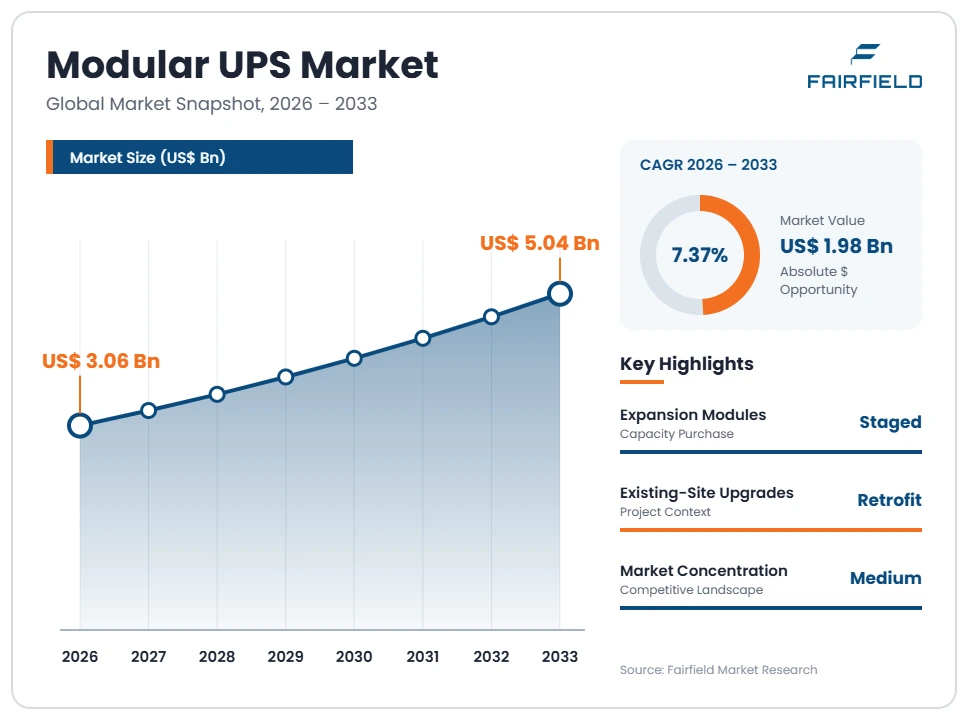
Global Modular UPS Market Trends and Insights
Drivers Impact Analysis
Ratings represent analyst judgement about purchasing mechanisms, without assigning an unsupported numerical contribution to forecast growth.
| Driver | Impact on CAGR Forecast | Geographic Relevance | Impact Timeline |
| Staged investment in protected power capacity | High | Expanding critical-load facilities | Medium term (2–4 years) |
| Maintainability within continuity planning | High | Sites with demanding service requirements | Short term (≤2 years) |
Modular UPS Capacity Planning Supports Staged Equipment Purchases
Staged capacity planning supports modular UPS demand when customers expect their protected loads to develop over time. A suitable system can separate an initial frame decision from later power module purchases. This does not eliminate the need to plan electrical infrastructure, storage, or service access. Buyers should compare expansion paths, including available capacity under their intended operating arrangement. Commercial value depends on actual utilization and compatible additions rather than the maximum capacity printed on a frame.
Schneider Electric documents incremental power modules in its Galaxy VXL architecture, providing a verified example of scalable equipment. This establishes an approach without proving uniform savings. For suppliers, staged purchasing can create follow-on equipment business if the customer expands within the installed platform. Forecasts should distinguish initial systems from subsequent modules and avoid counting empty slots as completed equipment revenue or assuming every planned expansion becomes an order.
Modular UPS Maintainability Influences Critical Power Procurement
Maintainability supports demand where customers need an architecture that fits their continuity and service requirements. Modular construction can allow a different approach to replacing or supporting power components, depending on the specific product and installation. Buyers still need to assess the wider electrical system, supported procedures, and responsible service organization. A modular label alone cannot guarantee uninterrupted operation. Procurement should compare documented capabilities with intended loads and applicable maintenance conditions.
Vertiv describes physically segregated power cores within Trinergy, while Socomec documents modular power equipment and technician training capabilities. These examples show that product architecture and service competence form related purchasing considerations. They do not establish universal availability or remove site dependencies. Suppliers can strengthen proposals through clear service responsibilities and suitable support coverage. The commercial mechanism is customer confidence in a maintainable installation, evaluated through product-specific information rather than an assumption that every modular design offers identical operating behavior.
Restraints Impact Analysis
Electrical integration and uncertain expansion timing can delay purchases despite a clear requirement for protected power.
| Restraint | Impact on CAGR Forecast | Geographic Relevance | Impact Timeline |
| Electrical integration and site readiness costs | High | New builds and installed-site upgrades | Medium term (2–4 years) |
| Uncertain expansion timing and platform dependence | Medium | Facilities with variable load development | Long term (≥4 years) |
Modular UPS Integration Costs Can Delay Equipment Orders
Integration costs can restrain modular UPS adoption because the equipment is only one part of a working power installation. A project may require electrical design, suitable connections, storage arrangements, controls, and acceptance work. Existing sites can introduce additional constraints around space and the timing of transition activities. Customers need complete project estimates beyond the equipment quotation. Delays elsewhere in the project can postpone the order or the commissioning schedule.
Specific cost sources can include switchgear interfaces, cabling, room preparation, monitoring integration, and professional engineering. Their importance depends on the installation. An apparently attractive equipment price can be offset by site work that was omitted from an early comparison. Suppliers and project partners can improve commercial clarity by defining responsibilities and exclusions. Forecast models should connect equipment demand to credible project readiness, rather than translate every announced facility expansion immediately into modular UPS sales.
Modular UPS Expansion Economics Depend on Realized Load Growth
Uncertain load growth can limit expansion-module purchases even after customers select a scalable platform. A facility may install a frame with future capacity in mind, then develop more slowly or change its electrical requirements. The initial investment does not guarantee a recurring stream of module orders. Buyers need to understand addition compatibility and the duration of appropriate support. These questions affect expansion economics.
The underlying commercial risks include underused infrastructure, platform-specific spare parts, service commitments, and the cost of changing designs later. Modularity can make staged expansion possible without making it inevitable. Manufacturers should distinguish qualified opportunities from confirmed orders and avoid valuing every installed frame at fully populated capacity. Customers can compare realistic growth scenarios and obtain product-specific compatibility information. Clear documentation of the intended lifecycle helps both parties assess likely equipment demand without relying on unsupported assumptions about automatic utilization.
Market Opportunities
Emerging revenue pools concern installed-system expansion and coordinated deployment support, with equipment revenue kept separate from the wider project value.
Modular UPS Installed Bases Offer Expansion Module Revenue
Installed compatible systems offer an opportunity for additional power module sales when customer loads grow within the original design. The revenue pool differs from selling another complete frame. Suppliers can assess the installed configuration, remaining capacity, supported module options, and the customer’s credible expansion plans. This account-level approach connects requirements with prospective equipment sales. The opportunity should reflect equipment requirements rather than unused frame capacity.
Manufacturers and their authorized partners are positioned to evaluate product compatibility and available support. Delta Electronics documents modular power configurations in its Modulon DPH portfolio, illustrating a platform context for staged capacity. A product specification does not establish the timing or value of any customer order. Suppliers can improve planning through accurate installed-base records and clear customer communication. Revenue analysis should separate new modules from replacement parts, batteries, and service work, keeping expansion equipment within the defined market boundary.
Modular UPS Deployment Partnerships Can Improve Equipment Access
Deployment partnerships offer an opportunity to reach customers that purchase power protection within a wider infrastructure project. An equipment supplier may need a capable integrator to coordinate the system with site work and customer requirements. The potential revenue pool remains attributable modular UPS equipment, alongside separately identified services where contracted. It should not include an entire data center or electrical project simply because a modular system forms one component. Scope allocation clarifies channel performance.
Socomec’s documented North American training activity illustrates investment in practical service capabilities around equipment, including modular UPS. Such activity can support partner competence without proving market-share gains. Manufacturers with relevant products can assess partner coverage, account access, and the responsibilities expected under each project. Clear interfaces connect equipment supply with implementation. Partnerships require local execution and identifiable purchasing roles; reseller additions alone do not establish dependable pipelines or completed revenue.
Segment Analysis
- By Project Context: Modular UPS Upgrades Face Installed-System Constraints
New Installations and Existing-Site Upgrades distinguish the physical project context. Comparable global shares and fastest-growth rankings are unavailable for this independent category. New Installations can establish the UPS architecture alongside other planned infrastructure. Existing-Site Upgrades concern replacement, augmentation, or modernization within an operating location. The category follows the receiving site rather than whether the equipment itself is newly manufactured, keeping a new product sold into an older facility within the upgrade segment.
The purchasing mechanisms differ because installed systems can constrain space, interfaces, and transition timing. New projects can also face delays when the wider facility is not ready. Suppliers should assess engineering requirements and customer responsibilities before forecasting order conversion. Modular power protection may support either setting, but a product launch does not establish which context leads demand. For strategy teams, the useful comparison is equipment opportunity adjusted for site readiness, project complexity, and realistic delivery timing rather than an unsupported split derived from general construction statistics.
- By Capacity Purchase: Modular UPS Frames and Later Modules Create Different Orders
Initial System Purchases and Expansion Module Purchases separate the equipment transaction by its role in establishing or extending a system. Comparable shares and growth rankings are unavailable. Initial System Purchases cover the frame and power modules supplied to establish the system. Expansion Module Purchases cover compatible power additions to an installed system. Replacement-only parts and battery purchases are excluded from this independent capacity-purchase allocation, preventing maintenance spending from being automatically characterized as expansion.
Scalable products from Schneider Electric, Eaton, and other verified suppliers demonstrate relevant architecture choices. Their specifications do not establish comparable transaction volumes. The commercial implication is to forecast initial orders and subsequent capacity additions separately. A large installed base can support opportunities, but actual module demand depends on load development and platform compatibility. Account plans should therefore record the populated configuration and credible next-stage requirement rather than equate maximum frame capacity with purchased equipment or assume each future addition includes another complete system.
- By Procurement Responsibility: Modular UPS Project Buying Changes Supplier Access
Direct Equipment Procurement and Integrated Project Procurement distinguish the party responsible for buying the modular UPS. Comparable leadership shares and fastest-growth rankings are unavailable. Direct Equipment Procurement places the purchase with the customer or its designated equipment purchasing organization. Integrated Project Procurement includes equipment acquired within a broader project contract by an integrator or project contractor. The category follows the commercial buying responsibility, not the system’s final location or whether sales involve a distributor.
The distinction matters because specifications, account access, and commercial obligations can differ. A manufacturer may work closely with the end customer while receiving the order from a project partner. Project procurement can combine equipment with other work, making scope allocation essential. Suppliers should identify who selects the platform, who issues the purchase order, and who coordinates implementation. This supports realistic channel planning without assigning all project revenue to modular UPS. Buyers can compare equipment and wider project responsibilities with fewer ambiguities in the quotation.
Geography Analysis
- Which Region Is Leading the Modular UPS Market?
A comparable largest-region ranking is unavailable in the selected benchmark. North America is therefore assessed as a commercial region without assigning it an unsupported leadership position. The United States and Canada require local assessment of customer projects, equipment availability, and service coverage. Supplier activity establishes participation rather than measured regional shares or uniform purchasing.
Socomec’s training center activity in Illinois provides a specific example of investment in technical support capability. For suppliers, an opportunity lies in connecting relevant equipment portfolios with dependable implementation and continuing service. Purchasers should assess the complete system and project scope rather than infer availability from a regional announcement. Existing-site upgrades and new installations can create different requirements, making account-level planning more informative than a broad regional demand assumption.
- Europe: Modular UPS Projects Need Electrical and Service Alignment
Europe offers verified modular UPS suppliers and product activity, without a comparable regional share in this report. Germany, France, the United Kingdom, and the Netherlands provide distinct customer markets for assessment. Commercial demand depends on protected-load requirements, site readiness, and the selected equipment architecture. A European supplier headquarters or production location does not establish where the largest share of customer purchases occurs.
An opportunity lies in matching staged capacity plans with realistic local service coverage. Purchasers need to distinguish equipment capability from the wider installation and identify who coordinates system interfaces. Suppliers can evaluate both new facilities and installed-site modernization while keeping their commercial assumptions specific to the country and account. Product availability, project responsibilities, and future module compatibility should form part of the procurement discussion rather than a generic claim of universal modularity.
- Which Region Is Growing Fastest in the Modular UPS Market?
A comparable fastest-growing-region ranking is unavailable in the selected benchmark. Asia Pacific is assessed without assigning an unsupported regional CAGR or country leader. China, India, Japan, and Australia present different equipment and deployment environments. Delta Electronics documents modular UPS products in India, establishing portfolio participation without demonstrating that one country or the wider region grows faster than all alternatives.
Suppliers can assess prospective accounts through load development, customer purchasing responsibility, and the availability of suitable project partners. Local support and equipment configuration matter alongside the initial quotation. The opportunity concerns systems that fit actual capacity and implementation requirements, rather than every announced digital infrastructure investment. Regional forecasts should distinguish confirmed orders, project schedules, and customer expansion plans.
- Latin America: Modular UPS Orders Depend on Complete Project Economics
Latin America requires country-specific assessment of equipment supply, integration, and support. Brazil, Mexico, and Argentina provide distinct starting points for commercial analysis, without a verified regional ranking here. Customers can consider modular architectures when the protected-load requirement and intended expansion path justify them. Suppliers should assess both initial system purchases and credible module additions rather than treat general power infrastructure spending as directly addressable equipment demand.
Barriers can include imported-equipment costs, currency exposure, site readiness, and the expense of maintaining suitable support coverage. Their importance varies locally. An opportunity lies in capable project partnerships that make responsibilities and equipment scope clear. Customers need quotations that account for the intended installation, while suppliers need realistic delivery and payment assumptions. Local execution influences order conversion.
- Middle East & Africa: Modular UPS Expansion Requires Account-Specific Readiness
Middle East & Africa should be approached through identifiable customer projects and national markets. Saudi Arabia, the United Arab Emirates, and South Africa provide useful starting points, without a verified comparative ranking in this report. New facilities and installed-site upgrades can both create modular UPS opportunities. Architecture, support, and project schedules need to fit the intended protected load.
Potential barriers include import logistics, environmental design requirements, uneven service coverage, and the cost of preparing the electrical installation. These considerations need local evidence rather than a uniform regional assumption. Suppliers can develop opportunities through capable partners and clear equipment scope. A planned facility or announced investment does not establish a UPS purchase. Forecasts should connect prospects to purchasing responsibility and credible readiness milestones.
Competitive Landscape
Medium concentration is an analyst judgement reflecting established equipment manufacturers alongside differentiated modular architectures and service networks. It is not a calculated concentration ratio. Schneider Electric, Vertiv, Eaton, Delta Electronics, and Socomec document relevant products. Their broader electrical and infrastructure revenues are unsuitable as comparable modular UPS shares. Competitive analysis should define the equipment scope, intended installation, and customer purchasing arrangement before comparing commercial positions or assessing the addressable opportunity.
Competition concerns documented power architecture, expansion options, integration requirements, and lifecycle support. New entrants need more than a modular product description: customers also require credible equipment information and an implementation route suited to the site. Established suppliers face similar needs when entering another market. Product specifications should be compared under relevant operating conditions rather than combine efficiency modes, frame ratings, and installed module capacities into a single unsupported performance ranking.
Recent developments illustrate complementary competitive priorities. Vertiv introduced a large UPS architecture with segregated modular cores. Schneider Electric introduced a scalable product emphasizing power density and incremental capacity. Socomec documented practical training around equipment support. These moves establish product and service activity, without proving customer adoption, market-share gains, or guaranteed installation outcomes. Commercial significance depends on accessible accounts and credible projects.
The strategic direction is toward clearer expansion pathways and support arrangements within complete power projects. Manufacturers can distinguish equipment revenue from integration work and maintain accurate records of installed configurations. This supports more realistic forecasts for subsequent module purchases. Buyers can assess compatibility, service responsibilities, and project economics alongside initial equipment price. Competitive strength will vary by account and application; the report assigns no supplier ranking and makes no prediction of a universal commercial winner.
Recent Industry Developments
- July 2024: Vertiv introduced Trinergy, featuring physically segregated modular power cores, extending its large-system power protection portfolio.
- December 2024: Schneider Electric announced Galaxy VXL, a modular and scalable UPS with incremental power modules, adding another capacity-planning option for critical-load facilities.
- March 2025: Socomec reported its first official session at a new North American training center, including practice on MODULYS GP equipment, strengthening practical service capabilities.
Companies Covered in the Report
Schneider Electric, Vertiv, Eaton, Delta Electronics, Socomec.
Modular UPS Market Report Scope
| Metric | Value |
| Study Period | 2020–2033 |
| Market Size 2026 | US$3.06209 Billion |
| Market Size 2033 | US$5.03731 Billion |
| CAGR 2026–2033 | 7.37% |
| Absolute Dollar Opportunity | US$1.97522 Billion |
| Largest Market | Not available on a comparable basis |
| Fastest-Growing Market | Not available on a comparable basis |
| Market Concentration | Medium overall, analyst judgement |
| Major Players | Schneider Electric, Vertiv, Eaton, Delta Electronics, Socomec |
Modular UPS Market Segmentation
Project Context
- New Installations
- Existing-Site Upgrades
Capacity Purchase
- Initial System Purchases
- Expansion Module Purchases
Procurement Responsibility
- Direct Equipment Procurement
- Integrated Project Procurement
Regions
- North America
- Europe
- Asia Pacific
- Latin America
- Middle East & Africa
- Executive Summary
- Global Modular UPS Market Snapshot
- Future Projections
- Key Report Takeaways
- Regional Snapshot
- Market Overview
- Market Definition and Report Scope
- Historical Trends 2020–2025
- Market Dynamics
- Drivers
- Modular UPS Capacity Planning Supports Staged Equipment Purchases
- Modular UPS Maintainability Influences Critical Power Procurement
- Restraints
- Modular UPS Integration Costs Can Delay Equipment Orders
- Modular UPS Expansion Economics Depend on Realized Load Growth
- Market Opportunities
- Modular UPS Installed Bases Offer Expansion Module Revenue
- Modular UPS Deployment Partnerships Can Improve Equipment Access
- Drivers
- Global Modular UPS Market Outlook, 2020–2033
- Global Modular UPS Market Outlook, by Project Context, Value (US$ Billion), 2020–2033
- New Installations
- Existing-Site Upgrades
- Global Modular UPS Market Outlook, by Capacity Purchase, Value (US$ Billion), 2020–2033
- Initial System Purchases
- Expansion Module Purchases
- Global Modular UPS Market Outlook, by Procurement Responsibility, Value (US$ Billion), 2020–2033
- Direct Equipment Procurement
- Integrated Project Procurement
- Global Modular UPS Market Outlook, by Region, Value (US$ Billion), 2020–2033
- North America
- Europe
- Asia Pacific
- Latin America
- Middle East & Africa
- Global Modular UPS Market Outlook, by Project Context, Value (US$ Billion), 2020–2033
- North America Modular UPS Market Outlook, 2020–2033
- North America Modular UPS Market Outlook, by Project Context, Value (US$ Billion), 2020–2033
- New Installations
- Existing-Site Upgrades
- North America Modular UPS Market Outlook, by Capacity Purchase, Value (US$ Billion), 2020–2033
- Initial System Purchases
- Expansion Module Purchases
- North America Modular UPS Market Outlook, by Procurement Responsibility, Value (US$ Billion), 2020–2033
- Direct Equipment Procurement
- Integrated Project Procurement
- North America Modular UPS Market Outlook, by Country, Value (US$ Billion), 2020–2033
- United States Modular UPS Market Outlook, by Project Context, 2020–2033
- United States Modular UPS Market Outlook, by Capacity Purchase, 2020–2033
- United States Modular UPS Market Outlook, by Procurement Responsibility, 2020–2033
- Canada Modular UPS Market Outlook, by Project Context, 2020–2033
- Canada Modular UPS Market Outlook, by Capacity Purchase, 2020–2033
- Canada Modular UPS Market Outlook, by Procurement Responsibility, 2020–2033
- North America Modular UPS Market Outlook, by Project Context, Value (US$ Billion), 2020–2033
- Europe Modular UPS Market Outlook, 2020–2033
- Europe Modular UPS Market Outlook, by Project Context, Value (US$ Billion), 2020–2033
- New Installations
- Existing-Site Upgrades
- Europe Modular UPS Market Outlook, by Capacity Purchase, Value (US$ Billion), 2020–2033
- Initial System Purchases
- Expansion Module Purchases
- Europe Modular UPS Market Outlook, by Procurement Responsibility, Value (US$ Billion), 2020–2033
- Direct Equipment Procurement
- Integrated Project Procurement
- Europe Modular UPS Market Outlook, by Country, Value (US$ Billion), 2020–2033
- Germany Modular UPS Market Outlook, by Project Context, 2020–2033
- Germany Modular UPS Market Outlook, by Capacity Purchase, 2020–2033
- Germany Modular UPS Market Outlook, by Procurement Responsibility, 2020–2033
- France Modular UPS Market Outlook, by Project Context, 2020–2033
- France Modular UPS Market Outlook, by Capacity Purchase, 2020–2033
- France Modular UPS Market Outlook, by Procurement Responsibility, 2020–2033
- United Kingdom Modular UPS Market Outlook, by Project Context, 2020–2033
- United Kingdom Modular UPS Market Outlook, by Capacity Purchase, 2020–2033
- United Kingdom Modular UPS Market Outlook, by Procurement Responsibility, 2020–2033
- Netherlands Modular UPS Market Outlook, by Project Context, 2020–2033
- Netherlands Modular UPS Market Outlook, by Capacity Purchase, 2020–2033
- Netherlands Modular UPS Market Outlook, by Procurement Responsibility, 2020–2033
- Europe Modular UPS Market Outlook, by Project Context, Value (US$ Billion), 2020–2033
- Asia Pacific Modular UPS Market Outlook, 2020–2033
- Asia Pacific Modular UPS Market Outlook, by Project Context, Value (US$ Billion), 2020–2033
- New Installations
- Existing-Site Upgrades
- Asia Pacific Modular UPS Market Outlook, by Capacity Purchase, Value (US$ Billion), 2020–2033
- Initial System Purchases
- Expansion Module Purchases
- Asia Pacific Modular UPS Market Outlook, by Procurement Responsibility, Value (US$ Billion), 2020–2033
- Direct Equipment Procurement
- Integrated Project Procurement
- Asia Pacific Modular UPS Market Outlook, by Country, Value (US$ Billion), 2020–2033
- China Modular UPS Market Outlook, by Project Context, 2020–2033
- China Modular UPS Market Outlook, by Capacity Purchase, 2020–2033
- China Modular UPS Market Outlook, by Procurement Responsibility, 2020–2033
- India Modular UPS Market Outlook, by Project Context, 2020–2033
- India Modular UPS Market Outlook, by Capacity Purchase, 2020–2033
- India Modular UPS Market Outlook, by Procurement Responsibility, 2020–2033
- Japan Modular UPS Market Outlook, by Project Context, 2020–2033
- Japan Modular UPS Market Outlook, by Capacity Purchase, 2020–2033
- Japan Modular UPS Market Outlook, by Procurement Responsibility, 2020–2033
- Australia Modular UPS Market Outlook, by Project Context, 2020–2033
- Australia Modular UPS Market Outlook, by Capacity Purchase, 2020–2033
- Australia Modular UPS Market Outlook, by Procurement Responsibility, 2020–2033
- Asia Pacific Modular UPS Market Outlook, by Project Context, Value (US$ Billion), 2020–2033
- Latin America Modular UPS Market Outlook, 2020–2033
- Latin America Modular UPS Market Outlook, by Project Context, Value (US$ Billion), 2020–2033
- New Installations
- Existing-Site Upgrades
- Latin America Modular UPS Market Outlook, by Capacity Purchase, Value (US$ Billion), 2020–2033
- Initial System Purchases
- Expansion Module Purchases
- Latin America Modular UPS Market Outlook, by Procurement Responsibility, Value (US$ Billion), 2020–2033
- Direct Equipment Procurement
- Integrated Project Procurement
- Latin America Modular UPS Market Outlook, by Country, Value (US$ Billion), 2020–2033
- Brazil Modular UPS Market Outlook, by Project Context, 2020–2033
- Brazil Modular UPS Market Outlook, by Capacity Purchase, 2020–2033
- Brazil Modular UPS Market Outlook, by Procurement Responsibility, 2020–2033
- Mexico Modular UPS Market Outlook, by Project Context, 2020–2033
- Mexico Modular UPS Market Outlook, by Capacity Purchase, 2020–2033
- Mexico Modular UPS Market Outlook, by Procurement Responsibility, 2020–2033
- Argentina Modular UPS Market Outlook, by Project Context, 2020–2033
- Argentina Modular UPS Market Outlook, by Capacity Purchase, 2020–2033
- Argentina Modular UPS Market Outlook, by Procurement Responsibility, 2020–2033
- Latin America Modular UPS Market Outlook, by Project Context, Value (US$ Billion), 2020–2033
- Middle East & Africa Modular UPS Market Outlook, 2020–2033
- Middle East & Africa Modular UPS Market Outlook, by Project Context, Value (US$ Billion), 2020–2033
- New Installations
- Existing-Site Upgrades
- Middle East & Africa Modular UPS Market Outlook, by Capacity Purchase, Value (US$ Billion), 2020–2033
- Initial System Purchases
- Expansion Module Purchases
- Middle East & Africa Modular UPS Market Outlook, by Procurement Responsibility, Value (US$ Billion), 2020–2033
- Direct Equipment Procurement
- Integrated Project Procurement
- Middle East & Africa Modular UPS Market Outlook, by Country, Value (US$ Billion), 2020–2033
- Saudi Arabia Modular UPS Market Outlook, by Project Context, 2020–2033
- Saudi Arabia Modular UPS Market Outlook, by Capacity Purchase, 2020–2033
- Saudi Arabia Modular UPS Market Outlook, by Procurement Responsibility, 2020–2033
- United Arab Emirates Modular UPS Market Outlook, by Project Context, 2020–2033
- United Arab Emirates Modular UPS Market Outlook, by Capacity Purchase, 2020–2033
- United Arab Emirates Modular UPS Market Outlook, by Procurement Responsibility, 2020–2033
- South Africa Modular UPS Market Outlook, by Project Context, 2020–2033
- South Africa Modular UPS Market Outlook, by Capacity Purchase, 2020–2033
- South Africa Modular UPS Market Outlook, by Procurement Responsibility, 2020–2033
- Middle East & Africa Modular UPS Market Outlook, by Project Context, Value (US$ Billion), 2020–2033
- Competitive Landscape
- Market Concentration and Industry Leaders
- Competitive Differentiation
- Strategic Moves and Market Direction
- Recent Industry Developments
- Company Profiles
- Schneider Electric
- Vertiv
- Eaton
- Delta Electronics
- Socomec
- Appendix
- Research Methodology
- Report Assumptions
- Acronyms and Abbreviations
Project Context
- New Installations
- Existing-Site Upgrades
Capacity Purchase
- Initial System Purchases
- Expansion Module Purchases
Procurement Responsibility
- Direct Equipment Procurement
- Integrated Project Procurement
Regions
- North America
- Europe
- Asia Pacific
- Latin America
- Middle East & Africa
Our Research Methodology
Considering the volatility of business today, traditional approaches to strategizing a game plan can be unfruitful if not detrimental. True ambiguity is no way to determine a forecast. A myriad of predetermined factors must be accounted for such as the degree of risk involved, the magnitude of circumstances, as well as conditions or consequences that are not known or unpredictable. To circumvent binary views that cast uncertainty, the application of market research intelligence to strategically posture, move, and enable actionable outcomes is necessary.
View Methodology
Quality Assured
Rigorous Validation Process

Confidentiality Assured
End-to-end Data Security

Custom Research Services
Tailored To Your Objectives
FAQs
The Modular UPS Market is valued at US$3.06209 billion in 2026, covering equipment with modular power architectures within the report’s defined scope.
The market is projected to reach US$5.03731 billion by 2033, representing 7.37% CAGR and US$1.97522 billion in additional value over 2026.
Comparable leadership shares are unavailable for the report’s independent categories; equipment purchases are assessed by project context, capacity purchase, and procurement responsibility.
A comparable fastest-growing regional ranking is unavailable in the selected benchmark; country opportunities require account-specific assessment of equipment needs and project readiness.
Medium concentration is an analyst judgement based on established manufacturers and differentiated portfolios; no calculated concentration ratio or comparable supplier revenue ranking is assigned.
Related Reports
Helicopter Meteorological Software Market Size, Share, Insights, Competitive Landscape, and Forecast 2026 to 2033
The global helicopter meteorological software market is valued at US$130.64 million in 2026, reaching US$181.40 million by 2033, growing at a 4.80% CAGR
Teleoperations Market Size, Share, Insights, Competitive Landscape, and Forecast 2026 to 2033
The global teleoperations market is valued at US$650.00 million in 2026, reaching US$2,540.70 million by 2033, growing at a 21.50% CAGR
Pedestrian Entrance Control Systems Market Size, Share, Insights, Competitive Landscape, and Forecast 2026 to 2033
The global pedestrian entrance control systems market is valued at US$2.00 billion in 2026, reaching US$3.40 billion by 2033, growing at a 7.88% CAGR
Facility Management Market Size, Share, Insights, Competitive Landscape, and Forecast 2026 to 2033
The global facility management market is valued at US$1,560.35 billion in 2026, reaching US$2,894.52 billion by 2033, growing at a 9.23% CAGR
Agriculture Drone Market Size, Share, Insights, Competitive Landscape, and Forecast 2026 to 2033
The global agriculture drone market is valued at US$3.90 billion in 2026, reaching US$13.20 billion by 2033, growing at a 19.03% CAGR
Eye Tracking Market Size, Share, Insights, Competitive Landscape, and Forecast 2026 to 2033
The global eye tracking market is valued at US$2.90 billion in 2026, reaching US$16.42 billion by 2033, growing at a 28.1% CAGR