



Textile Recycling Market
Textile Recycling Market Insights, Competitive Landscape, and Market Forecast - 2033
Textile Recycling Market Size, Share, and Growth Forecast 2026 – 2033
The global Textile Recycling Market size is likely to be valued at US$ 13.5 Billion in 2026 and is expected to reach US$ 26.3 Billion by 2033, growing at a CAGR of 10% during the forecast period from 2026 to 2033.
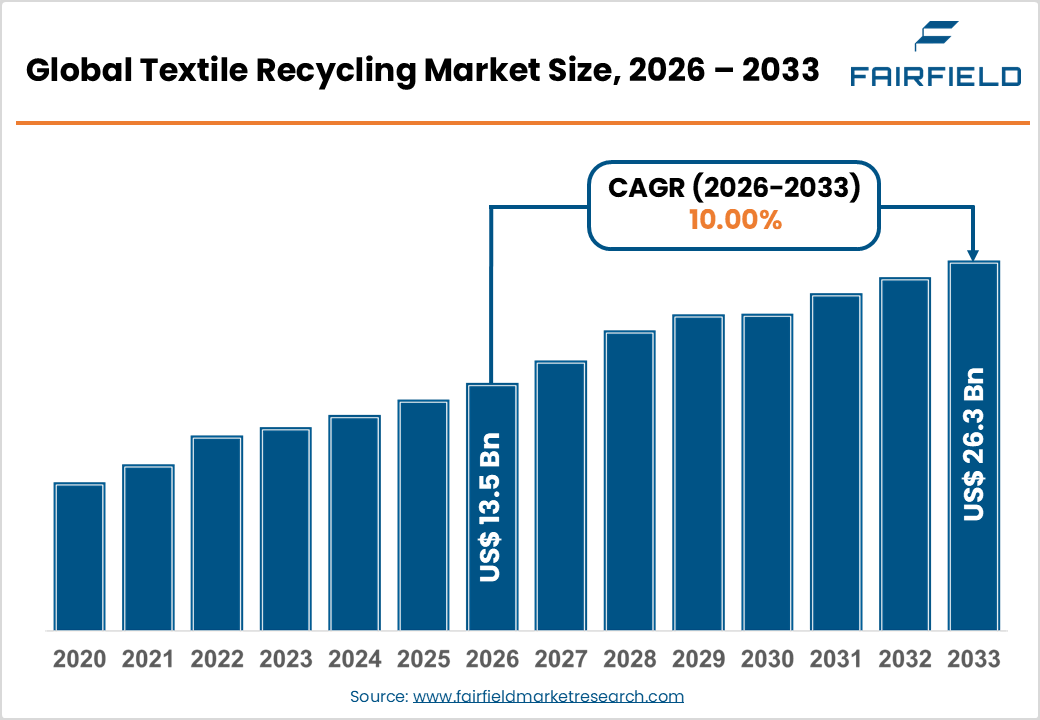
Key Market Highlights
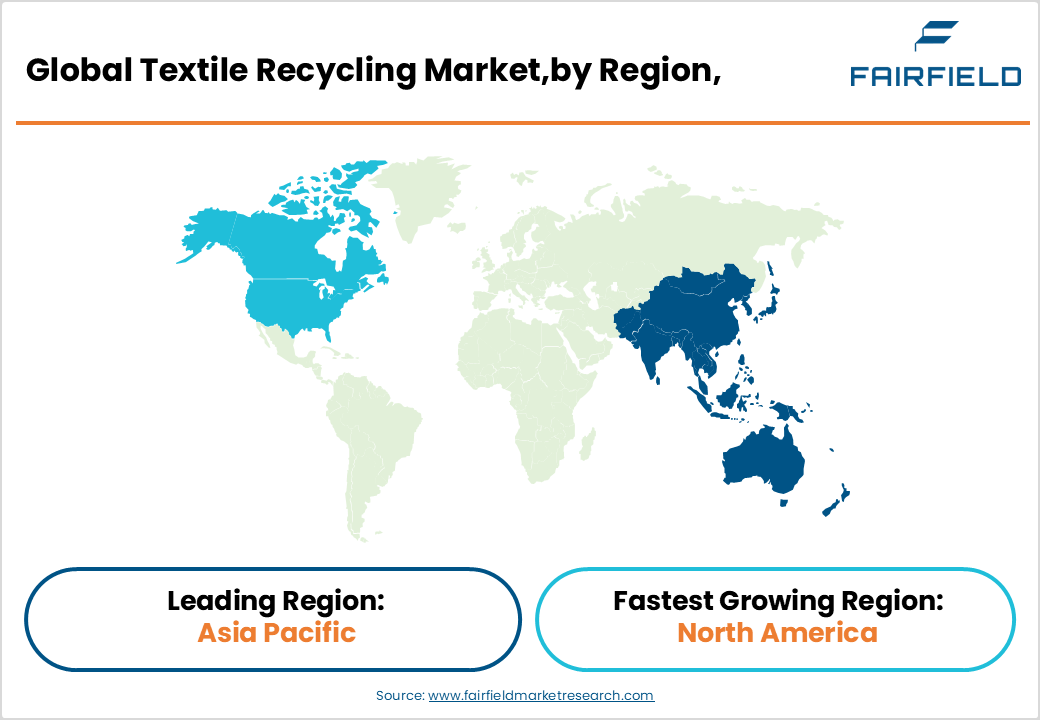
- Asia Pacific leads the global textile recycling market with approximately 45.5% market share, driven by its dominance as the world's largest textile manufacturing hub, large post-industrial waste volumes, and China's recycling policy mandates under the 14th Five-Year Plan.
- North America is the fastest-growing textile recycling market, propelled by expanding EPR legislation including California's Responsible Textile Recovery Act, growing innovation investment, and strong brand sustainability commitments from Levi Strauss & Co., Patagonia, and Unifi, Inc.
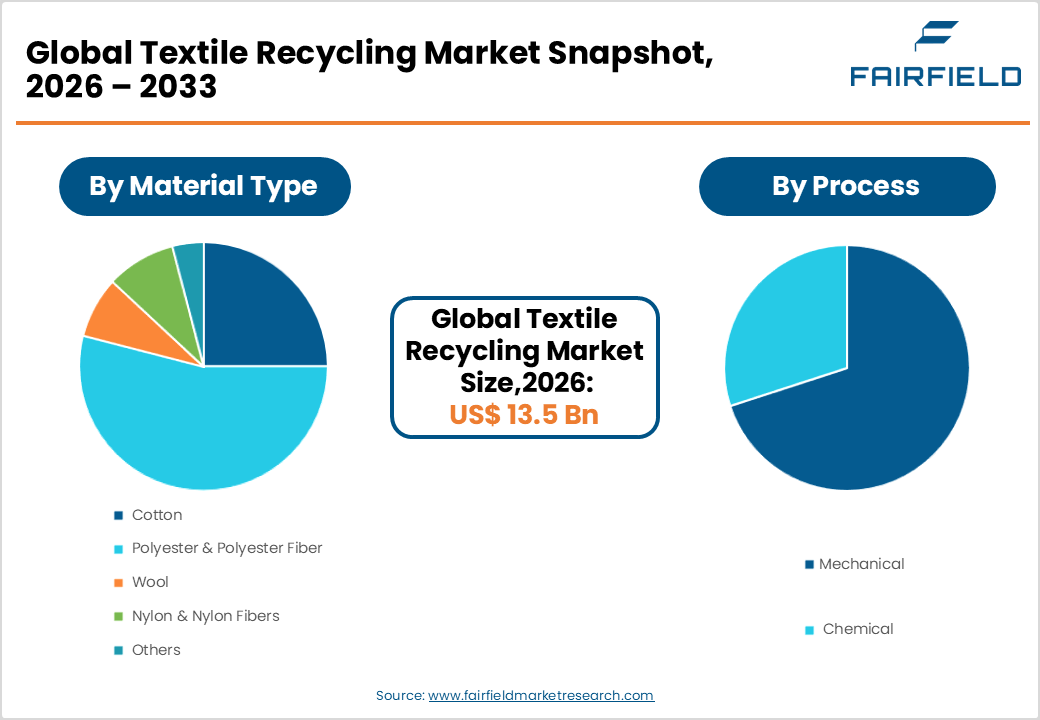
- Mechanical recycling leads the process segment with approximately 65% market share, given its cost-effectiveness and commercial maturity for high-volume post-industrial and post-consumer textile waste processing, especially for polyester and cotton fiber streams.
- Chemical recycling is the fastest-growing process segment, as fiber-to-fiber technologies from Renewcell and Infinited Fiber Company scale commercially and EU Horizon Europe funding accelerates closed-loop textile recycling innovation across Europe and North America.
- Extended producer responsibility (EPR) legislation proliferating globally modeled on France's Refashion system and the EU Waste Framework Directive mandates will unlock large-scale institutional investment in collection and recycling infrastructure, creating durable revenue opportunities for textile recycling operators through 2033.
Market Dynamics
Market Growth Drivers
- Stringent Global Regulatory Mandates Targeting Textile Waste Reduction
Increasingly stringent legislative frameworks targeting textile waste management are a primary market growth catalyst. The European Union's Strategy for Sustainable and Circular Textiles mandates that all EU member states implement separate textile waste collection systems by 2025, obliging municipalities and retailers to invest in collection and recycling infrastructure. The EU Waste Framework Directive also extends producer responsibility to textile brands, compelling them to fund end-of-life textile processing. In the United States, several states including California have enacted or are advancing extended producer responsibility (EPR) legislation for textiles. According to the European Environment Agency (EEA), only approximately 22-35% of textiles collected in Europe are currently recycled, highlighting enormous unmet regulatory compliance demand that will drive textile recycling infrastructure investment and market expansion through 2033.
- Surging Brand Commitments to Recycled Content and Circular Fashion
The global fashion and apparel industry's accelerating sustainability commitments are generating structural, long-term demand for recycled textile fibers. Major global brands have established ambitious recycled content targets; for instance, H&M Group has committed to using only recycled or sustainably sourced materials by 2030, and Adidas AG targets manufacturing 9 out of 10 articles from sustainable materials by 2025. According to the Textile Exchange, recycled polyester accounted for approximately 15% of total polyester production in 2022, with demand growing at double-digit rates year-over-year. These commitments translate into sustained, volume-driven procurement of mechanically and chemically recycled polyester, cotton, and nylon fibers, creating dependable revenue streams for textile recycling market participants and encouraging capacity expansion investments.
Market Restraints
- High Cost and Technical Complexity of Fiber-to-Fiber Chemical Recycling
Despite its transformative potential, fiber-to-fiber chemical recycling remains significantly more capital- and energy-intensive than conventional mechanical recycling or landfilling. Technologies such as solvent-based dissolution and enzymatic hydrolysis require specialized infrastructure, costly chemical inputs, and complex pre-sorting processes to separate fiber blends. Industry analyses indicate that chemical recycling production costs remain 2-5 times higher than virgin fiber production in many cases, limiting scalability without policy support or premium brand procurement commitments. This cost disadvantage restricts widespread commercial deployment, particularly in price-sensitive emerging markets, constraining the textile recycling market's full growth potential in the near term.
- Inadequate Textile Collection Infrastructure and Blended Fiber Sorting Challenges
A major barrier to textile recycling market expansion is the underdeveloped collection and sorting infrastructure in most regions outside Western Europe. The Ellen MacArthur Foundation has noted that less than 1% of clothing produced globally is recycled into new clothing, largely due to the difficulty of separating blended fiber fabrics which account for a significant proportion of post-consumer textile waste. Polycotton blends, dyes, finishes, and zippers further complicate efficient processing. Without consistent feedstock quality and sufficient collection volumes, recycling facilities cannot achieve economies of scale, reducing investment viability and suppressing market growth in regions lacking mature waste management ecosystems.
Market Opportunities
- Chemical Recycling Technology Scale-up Enabling Closed-Loop Fiber Production
The commercialization and scale-up of advanced chemical textile recycling technologies including cellulose dissolution, polyester glycolysis, and enzymatic cotton recycling represent the most transformative commercial opportunity in the textile recycling market. These processes produce fiber-quality recycled outputs indistinguishable from virgin materials, enabling true closed-loop apparel production. Renewcell commenced commercial-scale production at its Swedish facility with a capacity of 120,000 tonnes per year, while Infinited Fiber Company is scaling its first commercial plant in Finland. The EU Horizon Europe program and multiple national green transition funds are co-financing chemical recycling pilot and commercial facilities. As technology costs decline with scale and regulatory premiums for recycled content rise, chemical recycling is positioned to capture an expanding share of the textile recycling market through 2033.
- Extended Producer Responsibility (EPR) Legislation Unlocking Institutional Investment in Recycling
Extended producer responsibility (EPR) legislation for textiles is rapidly expanding globally, compelling fashion brands and textile manufacturers to fund and scale recycling infrastructure creating a significant and durable market opportunity. The EU Waste Framework Directive mandates harmonized textile EPR across all member states, expected to unlock large-scale recycling infrastructure investments. In the United States, California's proposed Responsible Textile Recovery Act signals a trend toward mandated producer funding. As EPR programs proliferate, they will generate guaranteed feedstock volumes and financial mechanisms that reduce investment risk for textile recycling operators, accelerating facility construction and technology adoption globally.
Segmental Insights
- By Material Type Analysis
Polyester & Polyester Fiber leads the textile recycling market by material type, commanding approximately 38% of total market share in 2026. Polyester is the world's most widely produced synthetic textile fiber; according to the Textile Exchange, polyester accounted for approximately 54% of global fiber production in 2022, making it the single largest source of recyclable textile feedstock. The recycled polyester (rPET) value chain is the most commercially mature in textile recycling, with established mechanical recycling processes converting post-consumer plastic bottles and textile waste into high-quality rPET fiber. Major brands including Patagonia, Inc. and Adidas AG have made rPET a cornerstone of their sustainability programs. The availability of high-volume feedstock, established processing technology, and strong brand procurement demand collectively reinforce polyester's dominant segment position.
- By Process Analysis
Mechanical recycling leads the textile recycling market by process, representing approximately 65% of total market share in 2026. Mechanical recycling which involves shredding, garnetting, and re-spinning textile waste into recycled fiber without chemical dissolution is the most commercially mature and cost-effective textile recycling process available at scale. Its lower capital and operational cost compared to chemical recycling makes it the preferred choice for high-volume processing of post-industrial and post-consumer textile waste streams, particularly for cotton and polyester blends. According to the European Recycling Industries' Confederation (EuRIC), mechanical recycling facilities across Europe process millions of tonnes of textile waste annually, supporting established markets for recycled non-woven insulation, industrial wipers, and downcycled yarn products that maintain this segment's market leadership.
- By End-use Industry Analysis
Apparel Waste leads the textile recycling market by end-use industry, accounting for approximately 58% of total market share in 2026. The apparel and fashion sector is the primary generator of post-consumer textile waste, with the United Nations Environment Programme (UNEP) estimating that consumers discard approximately 85% of their clothing in landfills or for incineration. The rapid rise of fast fashion has dramatically accelerated apparel waste generation volumes, creating both the feedstock availability and the reputational and regulatory pressure that drives brand investment in apparel waste collection and recycling programs. Initiatives such as H&M Group's garment collection program and I:CO's take-back infrastructure for brands worldwide are channeling growing volumes of apparel waste into recycling value chains, reinforcing this segment's dominant position in the textile recycling market.
Regional Insights
- North America Textile Recycling Market Trends
North America is the fastest-growing regional market for textile recycling, driven by an expanding legislative framework, growing consumer sustainability awareness, and increasing private investment in advanced recycling technologies. U.S. generates approximately 17 million tonnes of textile waste annually according to the U.S. Environmental Protection Agency (EPA), with only a fraction currently recycled underscoring significant market headroom. California's proposed Responsible Textile Recovery Act and similar EPR initiatives in New York represent the regulatory frontier, expected to catalyze collection infrastructure investment across the continent.
The North American innovation ecosystem is particularly vibrant, with companies including Ambercycle, Worn Again Technologies, and Unifi, Inc. (producer of REPREVE® recycled fiber) advancing commercial-scale recycled fiber production. Levi Strauss & Co. and Patagonia, Inc. are leading brand-level circular textile commitments, creating demand pull for domestic recyclers. The U.S. Department of Energy's clean manufacturing funding programs are further supporting textile recycling technology scale-up, positioning North America as the highest-growth regional market through 2033.
- Europe Textile Recycling Market Trends
Europe leads in textile recycling policy sophistication and infrastructure density, underpinned by the EU Strategy for Sustainable and Circular Textiles, the Waste Framework Directive, and France's pioneering EPR system managed by Refashion. Germany, France, the United Kingdom, and the Netherlands operate the most developed textile collection and sorting networks, with Germany's SOEX Group and France's Refashion collectively processing millions of tonnes annually. The EU's mandatory separate textile collection requirement effective from 2025 is generating significant infrastructure investment across all member states.
Sweden has emerged as a hub for next-generation chemical recycling innovation, hosting Renewcell and its Circulose® technology. Finland is home to Infinited Fiber Company, which is scaling its commercial Infinna™ fiber plant. Spain's Jeanologia is pioneering sustainable denim finishing and recycling technologies. The UK's WRAP organization continues to drive circular textile initiatives through its Textiles 2030 voluntary agreement, which has attracted major retailer signatories. Europe's combination of regulatory leadership, innovation density, and brand sustainability commitments sustains its position as the most policy-advanced textile recycling region globally.
- Asia Pacific Textile Recycling Market Trends
Asia Pacific dominates the global textile recycling market with approximately 45.5% of total market share, driven by the region's status as the world's largest textile manufacturing and export hub. China, India, Bangladesh, and Vietnam collectively produce the majority of the world's apparel, generating enormous post-industrial textile waste volumes that represent a substantial recycling feedstock opportunity. China is both the largest textile producer and an increasingly significant recycled fiber consumer; the country's 14th Five-Year Plan explicitly targets improvements in industrial waste recycling rates, including textiles.
India's expanding textile manufacturing sector supported by the Production Linked Incentive (PLI) Scheme for Textiles is generating growing recycled fiber demand from domestic and export markets. Japan's rigorous industrial recycling culture and Ministry of the Environment initiatives support advanced textile recovery programs. ASEAN nations including Bangladesh and Vietnam are under increasing pressure from international buyers to demonstrate recycling commitments. Circle Economy and regional recycling operators are expanding collection networks across Asia Pacific, and the region's competitive manufacturing cost structure provides an advantage in scaling mechanical recycling operations, reinforcing its dominant market leadership through 2033.
Competitive Landscape
The global textile recycling market is highly fragmented, with a diverse mix of technology startups, established industrial recyclers, fashion brands with in-house recycling programs, and specialized machinery providers competing across value chain segments. No single player commands a dominant global market share, though 3M Company, Unifi, Inc., H&M Group, and I:CO (SOEX Group) are notable scale players. Market leaders differentiate through proprietary recycling technology, brand partnerships, and certified recycled content claims. Key business model trends include brand-financed take-back programs, technology licensing, and joint ventures between fiber technology companies and major fashion conglomerates. Vertical integration from waste collection through sorted feedstock to finished recycled yarn is an emerging competitive differentiator for scaling players.
Key Developments
- In March 2025, Renewcell announced a strategic partnership with a major European fashion retailer to supply Circulose® dissolving pulp at commercial scale, marking a significant milestone in closed-loop cotton recycling and demonstrating industrial-scale fiber-to-fiber circular production viability.
- In October 2024, Infinited Fiber Company secured additional equity investment to accelerate the construction of its first commercial-scale Infinna™ textile-to-textile recycling facility in Finland, targeting annual production capacity of 30,000 tonnes of recycled cotton fiber for global fashion brand customers.
- In June 2023, Unifi, Inc. expanded its REPREVE® recycled fiber production capacity in the United States, surpassing the milestone of 35 billion plastic bottles recycled into REPREVE® fiber since program inception, reinforcing its position as North America's leading recycled performance fiber producer.
Companies Covered in Textile Recycling Market
- Sustainable Textile Solutions Inc.
- Levi Strauss & Co.
- I:CO (Brand of SOEX Group)
- Worn Again Technologies
- Renewcell
- Infinited Fiber Company
- Circle Economy
- ELDAN Recycling A/S
- Patagonia, Inc.
- H&M Group
- Shreds Clothing Recycling
- Unifi, Inc.
- Ambercycle
- Jeanologia
- Star Processing SRL
- Adidas AG
- Refashion (Eco TLC)
- Evrnu
- Outerknown
- Bolt Threads
Market Segmentation
By Material Type
- Cotton
- Polyester & Polyester Fiber
- Wool
- Nylon & Nylon Fibers
- Others
By Process
- Mechanical
- Chemical
By End-use Industry
- Apparel Waste
- Home Furnishing Waste
- Others
By Region
- North America
- Europe
- Asia Pacific
- Latin America
- Middle East & Africa
- Executive Summary
- Global Textile Recycling Market Snapshot
- Future Projections
- Key Market Trends
- Regional Snapshot, by Value, 2026
- Analyst Recommendations
- Market Overview
- Market Definitions and Segmentations
- Market Dynamics
- Drivers
- Restraints
- Market Opportunities
- Value Chain Analysis
- COVID-19 Impact Analysis
- Porter's Five Forces Analysis
- Impact of Russia-Ukraine Conflict
- PESTLE Analysis
- Regulatory Analysis
- Price Trend Analysis
- Current Prices and Future Projections, 2025-2033
- Price Impact Factors
- Global Textile Recycling Market Outlook, 2020 - 2033
- Global Textile Recycling Market Outlook, by Material Type, Value (US$ Bn), 2020-2033
- Cotton
- Global Textile Recycling Market Outlook, by Material Type, Value (US$ Bn), 2020-2033
- 1.1.1.
- Polyester & Polyester Fiber
- Wool
- Nylon & Nylon Fibers
- Others
- Global Textile Recycling Market Outlook, by Process, Value (US$ Bn), 2020-2033
- Mechanical
- Chemical
- Global Textile Recycling Market Outlook, by End-use Industry, Value (US$ Bn), 2020-2033
- Apparel Waste
- Home Furnishing Waste
- Others
- Global Textile Recycling Market Outlook, by Region, Value (US$ Bn), 2020-2033
- North America
- Europe
- Asia Pacific
- Latin America
- Middle East & Africa
- North America Textile Recycling Market Outlook, 2020 - 2033
- North America Textile Recycling Market Outlook, by Material Type, Value (US$ Bn), 2020-2033
- Cotton
- North America Textile Recycling Market Outlook, by Material Type, Value (US$ Bn), 2020-2033
- 1.1.1.
- Polyester & Polyester Fiber
- Wool
- Nylon & Nylon Fibers
- Others
- North America Textile Recycling Market Outlook, by Process, Value (US$ Bn), 2020-2033
- Mechanical
- Chemical
- North America Textile Recycling Market Outlook, by End-use Industry, Value (US$ Bn), 2020-2033
- Apparel Waste
- Home Furnishing Waste
- Others
- North America Textile Recycling Market Outlook, by Country, Value (US$ Bn), 2020-2033
- U.S. Textile Recycling Market Outlook, by Material Type, 2020-2033
- U.S. Textile Recycling Market Outlook, by Process, 2020-2033
- U.S. Textile Recycling Market Outlook, by End-use Industry, 2020-2033
- Canada Textile Recycling Market Outlook, by Material Type, 2020-2033
- Canada Textile Recycling Market Outlook, by Process, 2020-2033
- Canada Textile Recycling Market Outlook, by End-use Industry, 2020-2033
- BPS Analysis/Market Attractiveness Analysis
- Europe Textile Recycling Market Outlook, 2020 - 2033
- Europe Textile Recycling Market Outlook, by Material Type, Value (US$ Bn), 2020-2033
- Cotton
- Europe Textile Recycling Market Outlook, by Material Type, Value (US$ Bn), 2020-2033
- 1.1.1.
- Polyester & Polyester Fiber
- Wool
- Nylon & Nylon Fibers
- Others
- Europe Textile Recycling Market Outlook, by Process, Value (US$ Bn), 2020-2033
- Mechanical
- Chemical
- Europe Textile Recycling Market Outlook, by End-use Industry, Value (US$ Bn), 2020-2033
- Apparel Waste
- Home Furnishing Waste
- Others
- Europe Textile Recycling Market Outlook, by Country, Value (US$ Bn), 2020-2033
- Germany Textile Recycling Market Outlook, by Material Type, 2020-2033
- Germany Textile Recycling Market Outlook, by Process, 2020-2033
- Germany Textile Recycling Market Outlook, by End-use Industry, 2020-2033
- Italy Textile Recycling Market Outlook, by Material Type, 2020-2033
- Italy Textile Recycling Market Outlook, by Process, 2020-2033
- Italy Textile Recycling Market Outlook, by End-use Industry, 2020-2033
- France Textile Recycling Market Outlook, by Material Type, 2020-2033
- France Textile Recycling Market Outlook, by Process, 2020-2033
- France Textile Recycling Market Outlook, by End-use Industry, 2020-2033
- U.K. Textile Recycling Market Outlook, by Material Type, 2020-2033
- U.K. Textile Recycling Market Outlook, by Process, 2020-2033
- U.K. Textile Recycling Market Outlook, by End-use Industry, 2020-2033
- Spain Textile Recycling Market Outlook, by Material Type, 2020-2033
- Spain Textile Recycling Market Outlook, by Process, 2020-2033
- Spain Textile Recycling Market Outlook, by End-use Industry, 2020-2033
- Russia Textile Recycling Market Outlook, by Material Type, 2020-2033
- Russia Textile Recycling Market Outlook, by Process, 2020-2033
- Russia Textile Recycling Market Outlook, by End-use Industry, 2020-2033
- Rest of Europe Textile Recycling Market Outlook, by Material Type, 2020-2033
- Rest of Europe Textile Recycling Market Outlook, by Process, 2020-2033
- Rest of Europe Textile Recycling Market Outlook, by End-use Industry, 2020-2033
- BPS Analysis/Market Attractiveness Analysis
- Asia Pacific Textile Recycling Market Outlook, 2020 - 2033
- Asia Pacific Textile Recycling Market Outlook, by Material Type, Value (US$ Bn), 2020-2033
- Cotton
- Asia Pacific Textile Recycling Market Outlook, by Material Type, Value (US$ Bn), 2020-2033
- 1.1.1.
- Polyester & Polyester Fiber
- Wool
- Nylon & Nylon Fibers
- Others
- Asia Pacific Textile Recycling Market Outlook, by Process, Value (US$ Bn), 2020-2033
- Mechanical
- Chemical
- Asia Pacific Textile Recycling Market Outlook, by End-use Industry, Value (US$ Bn), 2020-2033
- Apparel Waste
- Home Furnishing Waste
- Others
- Asia Pacific Textile Recycling Market Outlook, by Country, Value (US$ Bn), 2020-2033
- China Textile Recycling Market Outlook, by Material Type, 2020-2033
- China Textile Recycling Market Outlook, by Process, 2020-2033
- China Textile Recycling Market Outlook, by End-use Industry, 2020-2033
- Japan Textile Recycling Market Outlook, by Material Type, 2020-2033
- Japan Textile Recycling Market Outlook, by Process, 2020-2033
- Japan Textile Recycling Market Outlook, by End-use Industry, 2020-2033
- South Korea Textile Recycling Market Outlook, by Material Type, 2020-2033
- South Korea Textile Recycling Market Outlook, by Process, 2020-2033
- South Korea Textile Recycling Market Outlook, by End-use Industry, 2020-2033
- India Textile Recycling Market Outlook, by Material Type, 2020-2033
- India Textile Recycling Market Outlook, by Process, 2020-2033
- India Textile Recycling Market Outlook, by End-use Industry, 2020-2033
- Southeast Asia Textile Recycling Market Outlook, by Material Type, 2020-2033
- Southeast Asia Textile Recycling Market Outlook, by Process, 2020-2033
- Southeast Asia Textile Recycling Market Outlook, by End-use Industry, 2020-2033
- Rest of SAO Textile Recycling Market Outlook, by Material Type, 2020-2033
- Rest of SAO Textile Recycling Market Outlook, by Process, 2020-2033
- Rest of SAO Textile Recycling Market Outlook, by End-use Industry, 2020-2033
- BPS Analysis/Market Attractiveness Analysis
- Latin America Textile Recycling Market Outlook, 2020 - 2033
- Latin America Textile Recycling Market Outlook, by Material Type, Value (US$ Bn), 2020-2033
- Cotton
- Latin America Textile Recycling Market Outlook, by Material Type, Value (US$ Bn), 2020-2033
- 1.1.1.
- Polyester & Polyester Fiber
- Wool
- Nylon & Nylon Fibers
- Others
- Latin America Textile Recycling Market Outlook, by Process, Value (US$ Bn), 2020-2033
- Mechanical
- Chemical
- Latin America Textile Recycling Market Outlook, by End-use Industry, Value (US$ Bn), 2020-2033
- Apparel Waste
- Home Furnishing Waste
- Others
- Latin America Textile Recycling Market Outlook, by Country, Value (US$ Bn), 2020-2033
- Brazil Textile Recycling Market Outlook, by Material Type, 2020-2033
- Brazil Textile Recycling Market Outlook, by Process, 2020-2033
- Brazil Textile Recycling Market Outlook, by End-use Industry, 2020-2033
- Mexico Textile Recycling Market Outlook, by Material Type, 2020-2033
- Mexico Textile Recycling Market Outlook, by Process, 2020-2033
- Mexico Textile Recycling Market Outlook, by End-use Industry, 2020-2033
- Argentina Textile Recycling Market Outlook, by Material Type, 2020-2033
- Argentina Textile Recycling Market Outlook, by Process, 2020-2033
- Argentina Textile Recycling Market Outlook, by End-use Industry, 2020-2033
- Rest of LATAM Textile Recycling Market Outlook, by Material Type, 2020-2033
- Rest of LATAM Textile Recycling Market Outlook, by Process, 2020-2033
- Rest of LATAM Textile Recycling Market Outlook, by End-use Industry, 2020-2033
- BPS Analysis/Market Attractiveness Analysis
- Middle East & Africa Textile Recycling Market Outlook, 2020 - 2033
- Middle East & Africa Textile Recycling Market Outlook, by Material Type, Value (US$ Bn), 2020-2033
- Cotton
- Middle East & Africa Textile Recycling Market Outlook, by Material Type, Value (US$ Bn), 2020-2033
- 1.1.1.
- Polyester & Polyester Fiber
- Wool
- Nylon & Nylon Fibers
- Others
- Middle East & Africa Textile Recycling Market Outlook, by Process, Value (US$ Bn), 2020-2033
- Mechanical
- Chemical
- Middle East & Africa Textile Recycling Market Outlook, by End-use Industry, Value (US$ Bn), 2020-2033
- Apparel Waste
- Home Furnishing Waste
- Others
- Middle East & Africa Textile Recycling Market Outlook, by Country, Value (US$ Bn), 2020-2033
- GCC Textile Recycling Market Outlook, by Material Type, 2020-2033
- GCC Textile Recycling Market Outlook, by Process, 2020-2033
- GCC Textile Recycling Market Outlook, by End-use Industry, 2020-2033
- South Africa Textile Recycling Market Outlook, by Material Type, 2020-2033
- South Africa Textile Recycling Market Outlook, by Process, 2020-2033
- South Africa Textile Recycling Market Outlook, by End-use Industry, 2020-2033
- Egypt Textile Recycling Market Outlook, by Material Type, 2020-2033
- Egypt Textile Recycling Market Outlook, by Process, 2020-2033
- Egypt Textile Recycling Market Outlook, by End-use Industry, 2020-2033
- Nigeria Textile Recycling Market Outlook, by Material Type, 2020-2033
- Nigeria Textile Recycling Market Outlook, by Process, 2020-2033
- Nigeria Textile Recycling Market Outlook, by End-use Industry, 2020-2033
- Rest of Middle East Textile Recycling Market Outlook, by Material Type, 2020-2033
- Rest of Middle East Textile Recycling Market Outlook, by Process, 2020-2033
- Rest of Middle East Textile Recycling Market Outlook, by End-use Industry, 2020-2033
- BPS Analysis/Market Attractiveness Analysis
- Competitive Landscape
- Company Vs Segment Heatmap
- Company Market Share Analysis, 2025
- Competitive Dashboard
- Company Profiles
- Sustainable Textile Solutions Inc.
- Company Overview
- Product Portfolio
- Financial Overview
- Business Strategies and Developments
- Levi Strauss & Co.
- I:CO (Brand of SOEX Group)
- Worn Again Technologies
- Renewcell
- Infinited Fiber Company
- Circle Economy
- ELDAN Recycling A/S
- Patagonia, Inc.
- H&M Group
- Shreds Clothing Recycling
- Unifi, Inc.
- Ambercycle
- Jeanologia
- Star Processing SRL
- Sustainable Textile Solutions Inc.
- Appendix
- Research Methodology
- Report Assumptions
- Acronyms and Abbreviations
|
BASE YEAR |
HISTORICAL DATA |
FORECAST PERIOD |
UNITS |
|||
 |
2025 |
 |
2019 - 2024 |
 |
2026 - 2033 |
Value: US$ Million |
|
REPORT FEATURES |
DETAILS |
|
By Material Type Coverage |
|
|
By Process Coverage |
|
|
Geographical Coverage |
|
|
Leading Companies |
|
|
Report Highlights |
Key Market Indicators, Macro-micro economic impact analysis, Technological Roadmap, Key Trends, Driver, Restraints, and Future Opportunities & Revenue Pockets, Porter’s 5 Forces Analysis, Historical Trend (2019-2024), Market Estimates and Forecast, Market Dynamics, Industry Trends, Competition Landscape, Category, Region, Country-wise Trends & Analysis, COVID-19 Impact Analysis (Demand and Supply Chain) |
Our Research Methodology
Considering the volatility of business today, traditional approaches to strategizing a game plan can be unfruitful if not detrimental. True ambiguity is no way to determine a forecast. A myriad of predetermined factors must be accounted for such as the degree of risk involved, the magnitude of circumstances, as well as conditions or consequences that are not known or unpredictable. To circumvent binary views that cast uncertainty, the application of market research intelligence to strategically posture, move, and enable actionable outcomes is necessary.
View Methodology
Quality Assured
Rigorous Validation Process

Confidentiality Assured
End-to-end Data Security

Custom Research Services
Tailored To Your Objectives
FAQs
The Textile Recycling Market size is US$13.5 billion in 2026.
The Textile Recycling Market is projected 10.00% CAGR by 2033.
The Textile Recycling Market growth drivers include sustainability demand, fast fashion waste concerns, and circular economy adoption.
Asia Pacific is a dominating region for Textile Recycling Market.
Worn Again Technologies, Lenzing AG, Birla Cellulose, Pistoni S.r.l., and Waste Management Inc. are some leading industry players in the Textile Recycling Market.
Related Reports
Tungsten Market Insights, Competitive Landscape, and Market Forecast - 2033
Tungsten Market is valued at USD 4.60 Billion in 2026 and is projected to reach USD 6.69 Billion by 2033, growing at a CAGR of 5.5% during 2026-2033.
Bamboo Fiber Tableware & Kitchenware Market Insights, Competitive Landscape, and Market Forecast 2033
The bamboo fiber tableware and kitchenware market will grow from USD 0.62 Bn in 2026 to USD 1.19 Bn by 2033, driven by sustainable product demand.
Decorative Rugs Market Insights, Competitive Landscape, and Market Forecast - 2033
The decorative rugs market to reach USD 17.85 Bn by 2033, growing at 5.1% CAGR from USD 12.60 Bn in 2026, driven by rising home décor demand
Pet Tech Market Insights, Competitive Landscape, and Market Forecast 2033
Pet Tech Market to reach USD 22.00 Bn by 2033, growing at 13.6% CAGR, driven by pet wellness, smart devices, and connected pet care adoption.
Pultrusion Products Market Insights, Competitive Landscape, and Market Forecast - 2033
Pultrusion Products Market to reach USD 6.71 Bn by 2033, growing at 7.3% CAGR, driven by infrastructure, utilities, composites, and corrosion resistance.
Sports Eyewear Market Insights, Competitive Landscape, and Market Forecast 2026–2033
Sports Eyewear Market to reach US$11.56 Bn by 2033, driven by sports participation, outdoor recreation, and prescription eyewear demand.