



Transcatheter Heart Valve Replacement Market
Transcatheter Heart Valve Replacement Repair Market Insights, Competitive Landscape, and Market Forecast - 2033
Global Transcatheter Heart Valve Replacement Repair Market Forecast
The Transcatheter Heart Valve Replacement Repair Market is valued at USD 8.3 Bn in 2026 and is projected to reach USD 12.3 Bn, growing at a CAGR of 6% by 2033.
Transcatheter Heart Valve Replacement Repair Market Insights
A Look Back and a Look Forward - Comparative Analysis
Transcatheter heart valve replacement (THVR) refers to a minimally invasive procedure used to replace malfunctioning heart valves without the need for open-heart surgery. This approach utilizes catheter-based techniques to deliver artificial valves directly to the heart, significantly reducing recovery time and associated risks.
The market for THVR repair encompasses various types of procedures, including transcatheter aortic valve replacement (TAVR) and transcatheter mitral valve repair (TMVR), among others.
There are many benefits of THVR. These benefits include reduced procedural risks, short hospital stays, and quick recovery times compared to traditional surgical methods. The increasing prevalence of heart valve diseases particularly among aging population is driving demand for these innovative solutions.
One of the most notable transcatheter heart valve replacement repair market trends is the advancement in technology. The technological evolution is encouraging more healthcare providers to adopt these procedures, thereby expanding the market.
Another market trend is the shift toward outpatient procedures. This shift not only enhances patient convenience but also reduces healthcare costs making these procedures more accessible.
Key Growth Determinants
- Continuous Evolution of Transcatheter Heart Valve Technologies
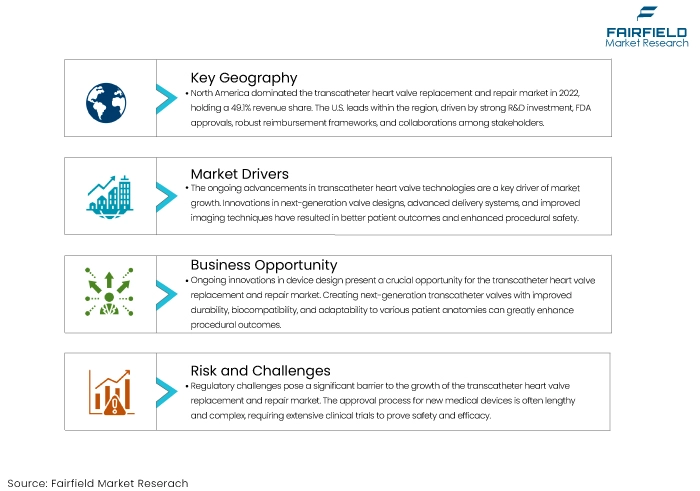
The continuous evolution of transcatheter heart valve technologies is a significant growth driver in the market. Innovations such as next-generation valve designs, improved delivery systems, and enhanced imaging techniques have led to better patient outcomes and increased procedural safety.
Advancements enable healthcare providers to perform complex cases with great precision, expanding the range of patients eligible for treatment. As manufacturers invest in research and development, the introduction of novel devices is estimated to stimulate transcatheter heart valve replacement repair market demand further.
- Growing Aging Population
The global aging population is a primary driver of growth in the market. As individuals age, the incidence of heart valve diseases, such as aortic stenosis and mitral regurgitation, increases significantly. This demographic shift creates a larger patient pool, requiring effective treatment options.
Old patients often prefer minimally invasive procedures, which offer shorter recovery times and lower risks compared to traditional surgeries. This growing demand for less invasive interventions among elderly patients will continue to propel the transcatheter heart valve replacement repair market expansion.
- Rising Prevalence of Cardiovascular Diseases
The increasing prevalence of cardiovascular diseases globally is a key driver for the transcatheter heart valve replacement market. Factors such as sedentary lifestyles, unhealthy diets, and high rates of obesity contribute to the rise in heart-related conditions.
The demand for effective treatments like transcatheter heart valve replacements will increase as more patients are diagnosed with heart valve disorders. Consequently, healthcare systems are focusing on providing minimally invasive solutions that can address these growing health concerns further accelerating transcatheter heart valve replacement repair market share.
Key Growth Barriers
- High Costs of Procedures
One of the significant factors impeding the growth of the transcatheter heart valve replacement repair market sales is the high cost associated with these procedures. The expenses related to advanced medical devices, hospital stays, and specialized healthcare personnel can be substantial.
Many healthcare systems and patients may find it challenging to afford these costs particularly in regions with limited healthcare budgets. This financial barrier can restrict access to transcatheter procedures ultimately slowing market growth and limiting the number of patients who can benefit from these innovative treatments.
- Regulatory Challenges Remain a Big Obstacle
Regulatory hurdles present another obstacle to the expansion of the transcatheter heart valve replacement repair market revenue. The approval process for new medical devices can be lengthy and complex, often requiring extensive clinical trials to demonstrate safety and efficacy.
Regulatory challenges can delay the introduction of innovative products into the market, hindering competition and limiting options for healthcare providers and patients. Additionally, varying regulations across different countries can complicate market entry for manufacturers, further impeding the growth of this promising sector in the healthcare industry.
Transcatheter Heart Valve Replacement Repair Market Trends and Opportunities
- Continuous Innovations in Device Design
Continuous innovations in device design represent a vital opportunity for the transcatheter heart valve replacement repair market. Developing next-generation transcatheter valves that offer enhanced durability, biocompatibility, and adaptability to diverse patient anatomies can significantly improve procedural outcomes.
Advancements in delivery systems such as fully repositionable and retrievable devices, can increase the safety and efficacy of procedures. Investing in research and development focused on these innovations will not only expand the range of treatable conditions but also elevate the overall standard of care in cardiovascular interventions, driving market growth.
How Does Regulatory Scenario Shape this Industry?
The regulatory scenario plays a pivotal role in shaping the transcatheter heart valve replacement repair market growth by establishing guidelines that influence product development, approval timelines, and market entry. In regions like North America and Europe, stringent regulatory frameworks ensure that new devices meet high safety and efficacy standards before reaching the market. The U.S. FDA's approval process, particularly for innovative therapies, is crucial for commercialization, as it builds trust among healthcare providers and patients.
Moreover, favorable reimbursement policies can significantly enhance market growth by incentivizing hospitals and clinics to adopt these advanced therapies. Regulatory bodies also promote clinical trials that validate the effectiveness of transcatheter heart valve technologies, facilitating faster adoption.
Collaborative efforts between manufacturers and regulatory agencies can streamline the approval process, encouraging innovation while ensuring regulation compliance. A supportive regulatory environment fosters the market growth and development enhancing patient care and outcomes.
Fairfield’s Ranking Board
Segments Covered in the Report
- TAVR Dominates the Market with a 78.9% Revenue Share
The industry is divided into transcatheter aortic valve replacement (TAVR) and transcatheter mitral valve repair (TMVR) based on replacement type. As per the transcatheter heart valve replacement repair market forecast, TAVR dominates with a 78.9% market share as it can be used for patients across all risk levels without requiring open-heart surgery.
Minimally invasive nature of TAVR often allows for minimal anesthesia and same-day discharge. In contrast, TMVR accounts for 20.4% of the market with a projected CAGR of 12.4% through 2031 reflecting its growing adoption of heart valve procedures.
- Trans-Femoral Surgical Approaches Lead the Market with 79.9% Market Share
The market is categorized into trans-femoral, trans-apical, and trans-aortic based on surgical approach. The trans-femoral approach leads the transcatheter heart valve replacement repair market with a 79.9% share and is expected to capture a CAGR of 12.2%. This growth is driven by an increased emphasis on investigational products and advancements in minimally invasive techniques. The trans-femoral approach's dominance highlights its preference among healthcare providers for delivering effective treatment options in valve replacement procedures.
- Hospitals Emerge as Ruling End User Segment Accounting for 66.2% Share
Hospitals led the market with a 66.2% share in 2022 and is projected to expand at a CAGR of 14.2% during the forecast period. This growth is driven by patients seeking efficient treatments that minimize recovery time and hospital stays. Additionally, the increasing adoption of advanced medical devices and technologies in hospitals will further support this segment's expansion over the coming years.
- Transcatheter Aortic Valve Set Bar in the Market for Sales with 84.55%
The transcatheter heart valve replacement repair market is segmented into transcatheter aortic, pulmonary, and mitral valves based on application. Among these, transcatheter aortic valve segment dominated the market driven by rising healthcare spending, increasing chronic heart disease prevalence, and more cases of severe aortic stenosis.
Technological advancements in tricuspid interventions and neochord systems are anticipated to further boost usage. Clinical trials, such as the PARTNER II study involving over 1,000 patients, have highlighted the effectiveness of transcatheter aortic valve replacement for inoperable patients, facilitating quick adoption in the United States and EU.
Regional Analysis
- North America Led the Market by Acquiring 49.1% Share in 2022
North America transcatheter heart valve replacement repair market led with a revenue share of 49.1% in 2022. Key factors for this dominance include increased investment in research and development, and heightened awareness of advanced transcatheter therapies.
The United States holds the largest share within the region, with FDA approvals acting as significant milestones for commercialization. Additionally, a strong reimbursement framework, incentives for developing new applications, and, most importantly collaboration among stakeholders further contribute to the region's growth and market leadership.
- Asia Pacific to Expand at a CAGR of 15.3%
The Asia Pacific region is projected to experience the significant CAGR of 15.3% during the forecast period. Key markets like Japan and China are driving this growth, fueled by rising demand for innovative heart valve therapy devices, an expanding healthcare sector, and a growing elderly population.
Increased healthcare spending also supports transcatheter heart valve replacement repair market expansion. In India, favorable government initiatives and reimbursement policies, such as Aarogyasri and Jeevandayee Arogya Yojana, enhance coverage for transcatheter heart therapies, further boosting market potential.
Fairfield’s Competitive Landscape Analysis
The transcatheter heart valve replacement repair market is characterized by intense competition among innovative medical device companies focused on enhancing procedural outcomes and patient care. The market is driven by increasing healthcare expenditures, a rising prevalence of heart diseases, and a growing demand for minimally invasive procedures.
Strategic collaborations, technological advancements, and ongoing clinical trials are crucial for maintaining competitive advantage and fostering market growth particularly in regions like North America, Asia Pacific and Europe.
Key Market Companies
An Expert’s Eye
- Regulatory bodies promote clinical trials validating the effectiveness of transcatheter heart valve technologies.
- The United States holds the significant share in the region with FDA approvals acting as significant milestones for commercialization.
- The approval process for new medical devices can be lengthy and complex, delaying the introduction of innovative products.
- Hospitals emerge as the ruling end-user segment with a 66.2% share.
- Innovations include next-generation valve designs, improved delivery systems, and enhanced imaging techniques.
- The global aging population is a primary driver for the market growth which boosts sales in the industry.
Global Transcatheter Heart Valve Replacement Repair Market is Segmented as-
By Replacement Type
- Transcatheter Aortic Valve Replacement (TAVR)
- Transcatheter Mitral Valve Repair (TMVR)
By Surgical Approach
- Trans-femoral Approach
- Trans-apical Approach
- Trans-aortic Approach
By End User
- Hospitals
- Ambulatory Surgical Centers
- Specialty Clinics
- Others
By Application
- Transcatheter Aortic Valve
- Transcatheter Pulmonary Valve
- Transcatheter Mitral Valve
By Region
- North America
- Asia Pacific
- Latin America
- Europe
- The Middle and East Africa
- Executive Summary
- Global Transcatheter Heart Valve Replacement Repair Market Snapshot
- Future Projections
- Key Market Trends
- Regional Snapshot, by Value, 2026
- Analyst Recommendations
- Market Overview
- Market Definitions and Segmentations
- Market Dynamics
- Drivers
- Restraints
- Market Opportunities
- Value Chain Analysis
- COVID-19 Impact Analysis
- Porter's Five Forces Analysis
- Impact of Russia-Ukraine Conflict
- PESTLE Analysis
- Regulatory Analysis
- Price Trend Analysis
- Current Prices and Future Projections, 2025-2033
- Price Impact Factors
- Global Transcatheter Heart Valve Replacement Repair Market Outlook, 2020 - 2033
- Global Transcatheter Heart Valve Replacement Repair Market Outlook, by Product, Value (US$ Bn), 2020-2033
- Transcatheter Aortic Valve Replacement (TAVR)
- Self – Expandable Transcatheter Aortic Valves
- Balloon-Expandable Transcatheter Aortic Valves
- Mechanically Expanded Transcatheter Aortic Valves
- Transcatheter Mitral Valve Repair (TMVR)
- Others
- Transcatheter Aortic Valve Replacement (TAVR)
- Global Transcatheter Heart Valve Replacement Repair Market Outlook, by Indication, Value (US$ Bn), 2020-2033
- Severe Aortic Valve Stenosis
- Valve-in-Valve Procedures (Failed Bioprosthesis)
- Aortic Regurgitation
- Global Transcatheter Heart Valve Replacement Repair Market Outlook, by End User, Value (US$ Bn), 2020-2033
- Hospitals
- Cardiac Catheterization Labs
- Ambulatory Surgical Centers
- Global Transcatheter Heart Valve Replacement Repair Market Outlook, by Region, Value (US$ Bn), 2020-2033
- North America
- Europe
- Asia Pacific
- Latin America
- Middle East & Africa
- Global Transcatheter Heart Valve Replacement Repair Market Outlook, by Product, Value (US$ Bn), 2020-2033
- North America Transcatheter Heart Valve Replacement Repair Market Outlook, 2020 - 2033
- North America Transcatheter Heart Valve Replacement Repair Market Outlook, by Product, Value (US$ Bn), 2020-2033
- Transcatheter Aortic Valve Replacement (TAVR)
- Self – Expandable Transcatheter Aortic Valves
- Balloon-Expandable Transcatheter Aortic Valves
- Mechanically Expanded Transcatheter Aortic Valves
- Transcatheter Mitral Valve Repair (TMVR)
- Others
- Transcatheter Aortic Valve Replacement (TAVR)
- North America Transcatheter Heart Valve Replacement Repair Market Outlook, by Indication, Value (US$ Bn), 2020-2033
- Severe Aortic Valve Stenosis
- Valve-in-Valve Procedures (Failed Bioprosthesis)
- Aortic Regurgitation
- North America Transcatheter Heart Valve Replacement Repair Market Outlook, by End User, Value (US$ Bn), 2020-2033
- Hospitals
- Cardiac Catheterization Labs
- Ambulatory Surgical Centers
- North America Transcatheter Heart Valve Replacement Repair Market Outlook, by Country, Value (US$ Bn), 2020-2033
- U.S. Transcatheter Heart Valve Replacement Repair Market Outlook, by Product, 2020-2033
- U.S. Transcatheter Heart Valve Replacement Repair Market Outlook, by Indication, 2020-2033
- U.S. Transcatheter Heart Valve Replacement Repair Market Outlook, by End User, 2020-2033
- Canada Transcatheter Heart Valve Replacement Repair Market Outlook, by Product, 2020-2033
- Canada Transcatheter Heart Valve Replacement Repair Market Outlook, by Indication, 2020-2033
- Canada Transcatheter Heart Valve Replacement Repair Market Outlook, by End User, 2020-2033
- BPS Analysis/Market Attractiveness Analysis
- North America Transcatheter Heart Valve Replacement Repair Market Outlook, by Product, Value (US$ Bn), 2020-2033
- Europe Transcatheter Heart Valve Replacement Repair Market Outlook, 2020 - 2033
- Europe Transcatheter Heart Valve Replacement Repair Market Outlook, by Product, Value (US$ Bn), 2020-2033
- Transcatheter Aortic Valve Replacement (TAVR)
- Self – Expandable Transcatheter Aortic Valves
- Balloon-Expandable Transcatheter Aortic Valves
- Mechanically Expanded Transcatheter Aortic Valves
- Transcatheter Mitral Valve Repair (TMVR)
- Others
- Transcatheter Aortic Valve Replacement (TAVR)
- Europe Transcatheter Heart Valve Replacement Repair Market Outlook, by Indication, Value (US$ Bn), 2020-2033
- Severe Aortic Valve Stenosis
- Valve-in-Valve Procedures (Failed Bioprosthesis)
- Aortic Regurgitation
- Europe Transcatheter Heart Valve Replacement Repair Market Outlook, by End User, Value (US$ Bn), 2020-2033
- Hospitals
- Cardiac Catheterization Labs
- Ambulatory Surgical Centers
- Europe Transcatheter Heart Valve Replacement Repair Market Outlook, by Country, Value (US$ Bn), 2020-2033
- Germany Transcatheter Heart Valve Replacement Repair Market Outlook, by Product, 2020-2033
- Germany Transcatheter Heart Valve Replacement Repair Market Outlook, by Indication, 2020-2033
- Germany Transcatheter Heart Valve Replacement Repair Market Outlook, by End User, 2020-2033
- Italy Transcatheter Heart Valve Replacement Repair Market Outlook, by Product, 2020-2033
- Italy Transcatheter Heart Valve Replacement Repair Market Outlook, by Indication, 2020-2033
- Italy Transcatheter Heart Valve Replacement Repair Market Outlook, by End User, 2020-2033
- France Transcatheter Heart Valve Replacement Repair Market Outlook, by Product, 2020-2033
- France Transcatheter Heart Valve Replacement Repair Market Outlook, by Indication, 2020-2033
- France Transcatheter Heart Valve Replacement Repair Market Outlook, by End User, 2020-2033
- U.K. Transcatheter Heart Valve Replacement Repair Market Outlook, by Product, 2020-2033
- U.K. Transcatheter Heart Valve Replacement Repair Market Outlook, by Indication, 2020-2033
- U.K. Transcatheter Heart Valve Replacement Repair Market Outlook, by End User, 2020-2033
- Spain Transcatheter Heart Valve Replacement Repair Market Outlook, by Product, 2020-2033
- Spain Transcatheter Heart Valve Replacement Repair Market Outlook, by Indication, 2020-2033
- Spain Transcatheter Heart Valve Replacement Repair Market Outlook, by End User, 2020-2033
- Russia Transcatheter Heart Valve Replacement Repair Market Outlook, by Product, 2020-2033
- Russia Transcatheter Heart Valve Replacement Repair Market Outlook, by Indication, 2020-2033
- Russia Transcatheter Heart Valve Replacement Repair Market Outlook, by End User, 2020-2033
- Rest of Europe Transcatheter Heart Valve Replacement Repair Market Outlook, by Product, 2020-2033
- Rest of Europe Transcatheter Heart Valve Replacement Repair Market Outlook, by Indication, 2020-2033
- Rest of Europe Transcatheter Heart Valve Replacement Repair Market Outlook, by End User, 2020-2033
- BPS Analysis/Market Attractiveness Analysis
- Europe Transcatheter Heart Valve Replacement Repair Market Outlook, by Product, Value (US$ Bn), 2020-2033
- Asia Pacific Transcatheter Heart Valve Replacement Repair Market Outlook, 2020 - 2033
- Asia Pacific Transcatheter Heart Valve Replacement Repair Market Outlook, by Product, Value (US$ Bn), 2020-2033
- Transcatheter Aortic Valve Replacement (TAVR)
- Self – Expandable Transcatheter Aortic Valves
- Balloon-Expandable Transcatheter Aortic Valves
- Mechanically Expanded Transcatheter Aortic Valves
- Transcatheter Mitral Valve Repair (TMVR)
- Others
- Transcatheter Aortic Valve Replacement (TAVR)
- Asia Pacific Transcatheter Heart Valve Replacement Repair Market Outlook, by Indication, Value (US$ Bn), 2020-2033
- Severe Aortic Valve Stenosis
- Valve-in-Valve Procedures (Failed Bioprosthesis)
- Aortic Regurgitation
- Asia Pacific Transcatheter Heart Valve Replacement Repair Market Outlook, by End User, Value (US$ Bn), 2020-2033
- Hospitals
- Cardiac Catheterization Labs
- Ambulatory Surgical Centers
- Asia Pacific Transcatheter Heart Valve Replacement Repair Market Outlook, by Country, Value (US$ Bn), 2020-2033
- China Transcatheter Heart Valve Replacement Repair Market Outlook, by Product, 2020-2033
- China Transcatheter Heart Valve Replacement Repair Market Outlook, by Indication, 2020-2033
- China Transcatheter Heart Valve Replacement Repair Market Outlook, by End User, 2020-2033
- Japan Transcatheter Heart Valve Replacement Repair Market Outlook, by Product, 2020-2033
- Japan Transcatheter Heart Valve Replacement Repair Market Outlook, by Indication, 2020-2033
- Japan Transcatheter Heart Valve Replacement Repair Market Outlook, by End User, 2020-2033
- South Korea Transcatheter Heart Valve Replacement Repair Market Outlook, by Product, 2020-2033
- South Korea Transcatheter Heart Valve Replacement Repair Market Outlook, by Indication, 2020-2033
- South Korea Transcatheter Heart Valve Replacement Repair Market Outlook, by End User, 2020-2033
- India Transcatheter Heart Valve Replacement Repair Market Outlook, by Product, 2020-2033
- India Transcatheter Heart Valve Replacement Repair Market Outlook, by Indication, 2020-2033
- India Transcatheter Heart Valve Replacement Repair Market Outlook, by End User, 2020-2033
- Southeast Asia Transcatheter Heart Valve Replacement Repair Market Outlook, by Product, 2020-2033
- Southeast Asia Transcatheter Heart Valve Replacement Repair Market Outlook, by Indication, 2020-2033
- Southeast Asia Transcatheter Heart Valve Replacement Repair Market Outlook, by End User, 2020-2033
- Rest of SAO Transcatheter Heart Valve Replacement Repair Market Outlook, by Product, 2020-2033
- Rest of SAO Transcatheter Heart Valve Replacement Repair Market Outlook, by Indication, 2020-2033
- Rest of SAO Transcatheter Heart Valve Replacement Repair Market Outlook, by End User, 2020-2033
- BPS Analysis/Market Attractiveness Analysis
- Asia Pacific Transcatheter Heart Valve Replacement Repair Market Outlook, by Product, Value (US$ Bn), 2020-2033
- Latin America Transcatheter Heart Valve Replacement Repair Market Outlook, 2020 - 2033
- Latin America Transcatheter Heart Valve Replacement Repair Market Outlook, by Product, Value (US$ Bn), 2020-2033
- Transcatheter Aortic Valve Replacement (TAVR)
- Self – Expandable Transcatheter Aortic Valves
- Balloon-Expandable Transcatheter Aortic Valves
- Mechanically Expanded Transcatheter Aortic Valves
- Transcatheter Mitral Valve Repair (TMVR)
- Others
- Transcatheter Aortic Valve Replacement (TAVR)
- Latin America Transcatheter Heart Valve Replacement Repair Market Outlook, by Indication, Value (US$ Bn), 2020-2033
- Severe Aortic Valve Stenosis
- Valve-in-Valve Procedures (Failed Bioprosthesis)
- Aortic Regurgitation
- Latin America Transcatheter Heart Valve Replacement Repair Market Outlook, by End User, Value (US$ Bn), 2020-2033
- Hospitals
- Cardiac Catheterization Labs
- Ambulatory Surgical Centers
- Latin America Transcatheter Heart Valve Replacement Repair Market Outlook, by Country, Value (US$ Bn), 2020-2033
- Brazil Transcatheter Heart Valve Replacement Repair Market Outlook, by Product, 2020-2033
- Brazil Transcatheter Heart Valve Replacement Repair Market Outlook, by Indication, 2020-2033
- Brazil Transcatheter Heart Valve Replacement Repair Market Outlook, by End User, 2020-2033
- Mexico Transcatheter Heart Valve Replacement Repair Market Outlook, by Product, 2020-2033
- Mexico Transcatheter Heart Valve Replacement Repair Market Outlook, by Indication, 2020-2033
- Mexico Transcatheter Heart Valve Replacement Repair Market Outlook, by End User, 2020-2033
- Argentina Transcatheter Heart Valve Replacement Repair Market Outlook, by Product, 2020-2033
- Argentina Transcatheter Heart Valve Replacement Repair Market Outlook, by Indication, 2020-2033
- Argentina Transcatheter Heart Valve Replacement Repair Market Outlook, by End User, 2020-2033
- Rest of LATAM Transcatheter Heart Valve Replacement Repair Market Outlook, by Product, 2020-2033
- Rest of LATAM Transcatheter Heart Valve Replacement Repair Market Outlook, by Indication, 2020-2033
- Rest of LATAM Transcatheter Heart Valve Replacement Repair Market Outlook, by End User, 2020-2033
- BPS Analysis/Market Attractiveness Analysis
- Latin America Transcatheter Heart Valve Replacement Repair Market Outlook, by Product, Value (US$ Bn), 2020-2033
- Middle East & Africa Transcatheter Heart Valve Replacement Repair Market Outlook, 2020 - 2033
- Middle East & Africa Transcatheter Heart Valve Replacement Repair Market Outlook, by Product, Value (US$ Bn), 2020-2033
- Transcatheter Aortic Valve Replacement (TAVR)
- Self – Expandable Transcatheter Aortic Valves
- Balloon-Expandable Transcatheter Aortic Valves
- Mechanically Expanded Transcatheter Aortic Valves
- Transcatheter Mitral Valve Repair (TMVR)
- Others
- Transcatheter Aortic Valve Replacement (TAVR)
- Middle East & Africa Transcatheter Heart Valve Replacement Repair Market Outlook, by Indication, Value (US$ Bn), 2020-2033
- Severe Aortic Valve Stenosis
- Valve-in-Valve Procedures (Failed Bioprosthesis)
- Aortic Regurgitation
- Middle East & Africa Transcatheter Heart Valve Replacement Repair Market Outlook, by End User, Value (US$ Bn), 2020-2033
- Hospitals
- Cardiac Catheterization Labs
- Ambulatory Surgical Centers
- Middle East & Africa Transcatheter Heart Valve Replacement Repair Market Outlook, by Country, Value (US$ Bn), 2020-2033
- GCC Transcatheter Heart Valve Replacement Repair Market Outlook, by Product, 2020-2033
- GCC Transcatheter Heart Valve Replacement Repair Market Outlook, by Indication, 2020-2033
- GCC Transcatheter Heart Valve Replacement Repair Market Outlook, by End User, 2020-2033
- South Africa Transcatheter Heart Valve Replacement Repair Market Outlook, by Product, 2020-2033
- South Africa Transcatheter Heart Valve Replacement Repair Market Outlook, by Indication, 2020-2033
- South Africa Transcatheter Heart Valve Replacement Repair Market Outlook, by End User, 2020-2033
- Egypt Transcatheter Heart Valve Replacement Repair Market Outlook, by Product, 2020-2033
- Egypt Transcatheter Heart Valve Replacement Repair Market Outlook, by Indication, 2020-2033
- Egypt Transcatheter Heart Valve Replacement Repair Market Outlook, by End User, 2020-2033
- Nigeria Transcatheter Heart Valve Replacement Repair Market Outlook, by Product, 2020-2033
- Nigeria Transcatheter Heart Valve Replacement Repair Market Outlook, by Indication, 2020-2033
- Nigeria Transcatheter Heart Valve Replacement Repair Market Outlook, by End User, 2020-2033
- Rest of Middle East Transcatheter Heart Valve Replacement Repair Market Outlook, by Product, 2020-2033
- Rest of Middle East Transcatheter Heart Valve Replacement Repair Market Outlook, by Indication, 2020-2033
- Rest of Middle East Transcatheter Heart Valve Replacement Repair Market Outlook, by End User, 2020-2033
- BPS Analysis/Market Attractiveness Analysis
- Middle East & Africa Transcatheter Heart Valve Replacement Repair Market Outlook, by Product, Value (US$ Bn), 2020-2033
- Competitive Landscape
- Company Vs Segment Heatmap
- Company Market Share Analysis, 2025
- Competitive Dashboard
- Company Profiles
- Abbott
- Company Overview
- Product Portfolio
- Financial Overview
- Business Strategies and Developments
- Edwards Lifesciences Corporation
- Medtronic
- Boston Scientific Corporation
- JenaValve Technology, Inc.
- Meril Life Sciences
- Sahajanand Medical Technologies Limited
- MicroPort Scientific Corporation
- Venus Medtech (Hangzhou) Inc.
- Suzhou Jiecheng Medical Technology Co. Ltd.
- Peijia Medical Limited
- Blue Sail Medical Co., Ltd.
- Abbott
- Appendix
- Research Methodology
- Report Assumptions
- Acronyms and Abbreviations
|
BASE YEAR |
HISTORICAL DATA |
FORECAST PERIOD |
UNITS |
|||
 |
2025 |
 |
2020 - 2025 |
 |
2026 - 2033 |
Value: US$ Billion |
|
REPORT FEATURES |
DETAILS |
|
Replacement Type Coverage |
|
|
Surgical Approach Coverage |
|
|
End User Coverage |
|
|
Application Coverage |
|
|
Geographical Coverage |
|
|
Leading Companies |
|
|
Report Highlights |
Key Market Indicators, Macro-micro economic impact analysis, Technological Roadmap, Key Trends, Driver, Restraints, and Future Opportunities & Revenue Pockets, Porter’s 5 Forces Analysis, Historical Trend (2019-2021), Market Estimates and Forecast, Market Dynamics, Industry Trends, Competition Landscape, Category, Region, Country-wise Trends & Analysis, COVID-19 Impact Analysis (Demand and Supply Chain) |
Our Research Methodology
Considering the volatility of business today, traditional approaches to strategizing a game plan can be unfruitful if not detrimental. True ambiguity is no way to determine a forecast. A myriad of predetermined factors must be accounted for such as the degree of risk involved, the magnitude of circumstances, as well as conditions or consequences that are not known or unpredictable. To circumvent binary views that cast uncertainty, the application of market research intelligence to strategically posture, move, and enable actionable outcomes is necessary.
View Methodology
Quality Assured
Rigorous Validation Process

Confidentiality Assured
End-to-end Data Security

Custom Research Services
Tailored To Your Objectives
FAQs
The market is predicted to rise from USD 8.3 Bn in 2026 to USD 12.3 Bn by 2033.
The transcatheter aortic valve replacement surgery has shown a 90% success rate.
North America market led with a revenue share of 49.1% in 2025.
Boston Scientific Corporation, Bracco Group, Braile Biomedica, Direct Flow Medical, and JenaValve are some of the leading companies in the THVR repair market.
Hospitals are the leading end user of THVR among other end users. It dominated the market with a 66.2% share in 2025.
Related Reports
Oral Cancer Rapid Test Kit Market
The oral cancer rapid test kits market will grow from USD 240.00 Mn in 2026 to USD 550.80 Mn by 2033, driven by early detection and point-of-care screening.
Non-Hodgkin Lymphoma Therapeutics Market Insights, Competitive Landscape, and Market Forecast 2033
The non-Hodgkin lymphoma therapeutics market will expand from USD 16.80 billion in 2026 to USD 28.98 billion by 2033, driven by targeted therapies.
In Vitro Toxicology Testing Market Insights, Competitive Landscape, and Market Forecast 2033
The in vitro toxicology testing market is expected to grow from USD 8.60 billion in 2026 to USD 16.03 billion by 2033, driven by animal testing alternatives.
Healthcare Fintech Market Insights, Competitive Landscape, and Market Forecast 2033
Healthcare Fintech Market to reach USD 26.40 Bn by 2033, growing at 16.8% CAGR, driven by digital billing, patient payments, and claims automation.
Diagnostic Ultrasound Market Insights, Competitive Landscape, and Market Forecast - 2033
Diagnostic Ultrasound Market is valued at USD 9.70 Billion in 2026 and projected to reach USD 14.78 Billion by 2033, growing at a 6.2% CAGR.
Infection Control Supplies Market Forecast - 2033
The global infection control supplies market is set to reach US$ 19.76 Bn by 2033, growing at a 6.4% CAGR, driven by infection prevention demand