



Wall Art Market
Global Wall Art Industry Analysis, Size, Share, Growth, Trends, and Forecast 2026-2033 - (By Product Type,By Sales Channel, By Application, By Geographic Coverage and By Company)
Wall Art Market Size, Share, and Growth Forecast 2026 – 2033
Key Market Highlights
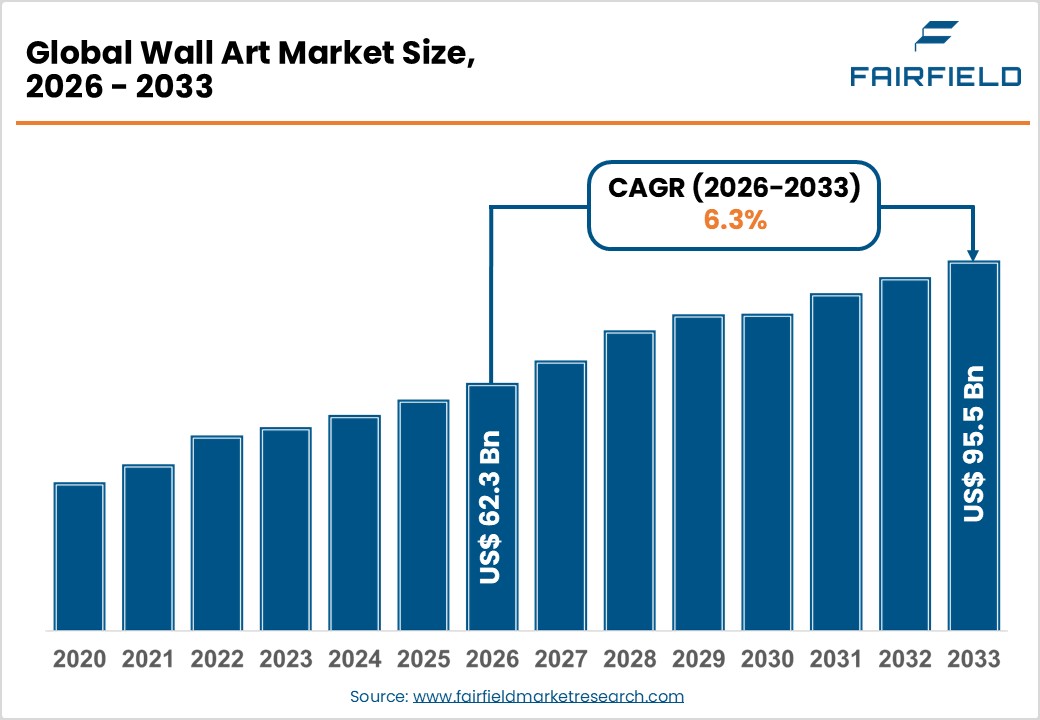
- The global Wall Art Market size is likely to be valued at US$ 62.3 Billion in 2026 and is expected to reach US$ 95.5 Billion by 2033, growing at a CAGR of 6.3% during the forecast period from 2026 to 2033.
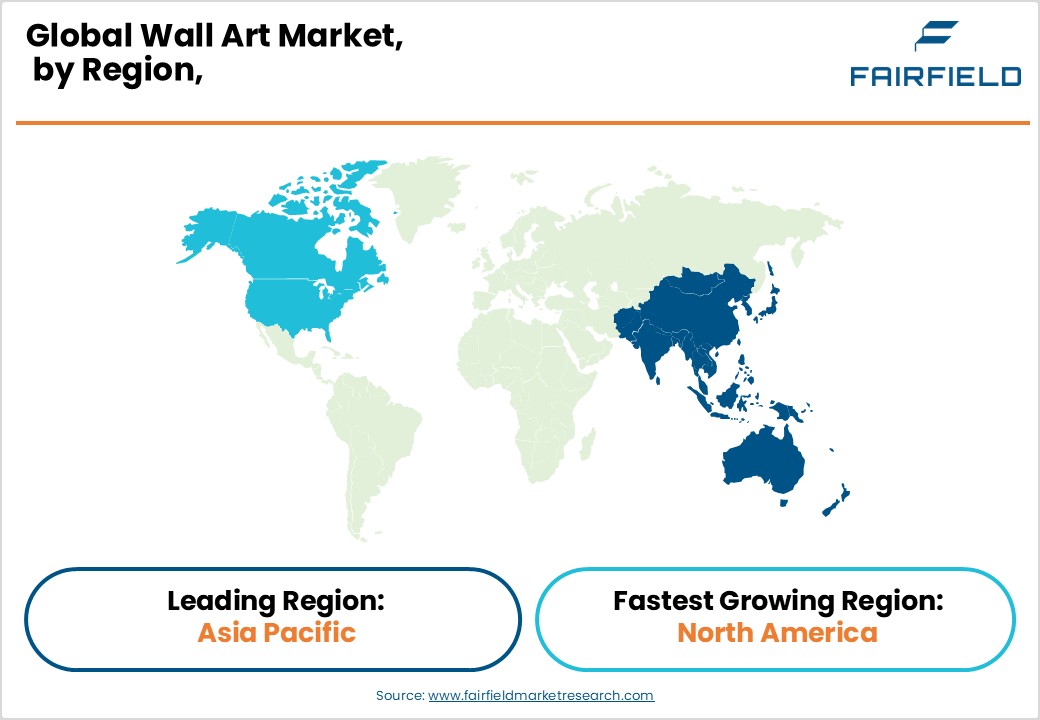
- Leading Region Market: Asia Pacific dominates the global wall art market with approximately 45% share in 2026, driven by rapid urbanization in China and India, rising middle-class incomes, and a robust e-commerce infrastructure enabling wide consumer access.
- Fastest Growing Region Market: North America is the fastest-growing regional market, supported by robust consumer spending on home décor, high digital platform adoption, and sustained post-pandemic home personalization trends across the S. and Canada.
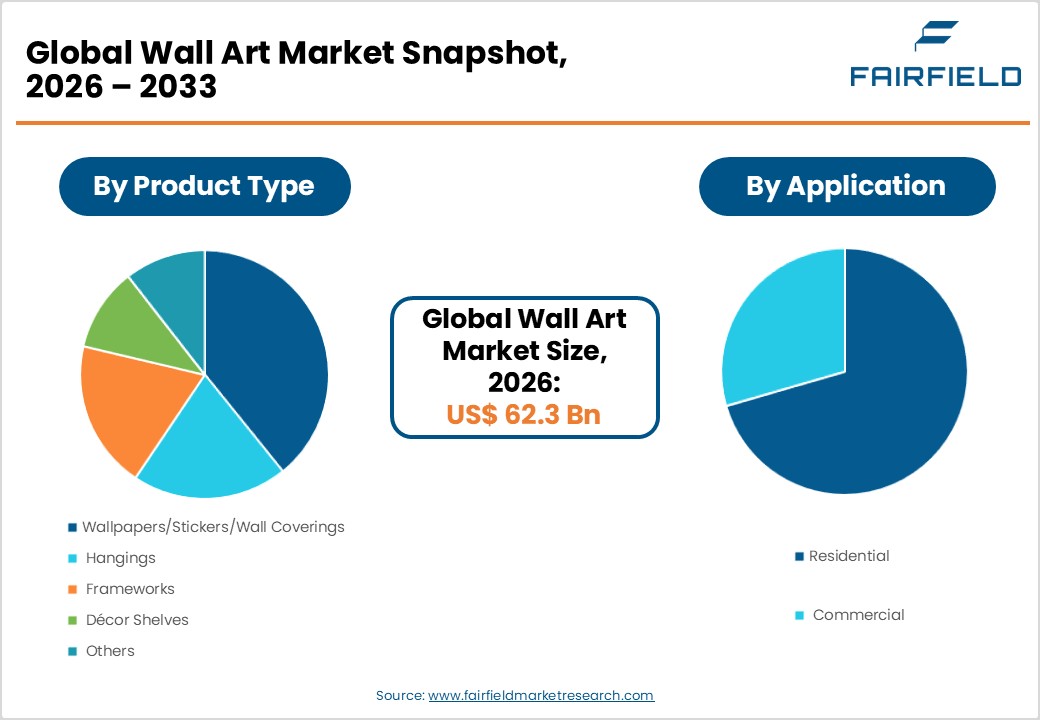
- Dominant Segment: The Frameworks segment leads the product type category with approximately 34% market share in 2026, driven by consumer preference for ready-to-hang customizable art and the growing gallery-wall trend in residential and commercial applications.
- Fastest Growing Segment: Online Sales Channel The Online sales channel is the fastest-growing distribution segment, benefiting from the proliferation of art e-commerce platforms, growing digital connectivity, and durable behavioral shifts toward online purchasing post-pandemic.
- Key Market Opportunity: AI-Powered Personalization Integration of AI-driven design and print-on-demand capabilities represents the leading opportunity, enabling companies to offer mass-customized wall art aligned with millennial and Gen Z consumer preferences for unique, personalized aesthetics.
Market Dynamics
Market Growth Drivers
Rising Urbanization and Home Décor Spending
Global urbanization continues its upward trajectory, with the United Nations projecting that nearly 68% of the world's population will reside in urban areas by 2050, up from approximately 56% today. Urban households typically exhibit greater disposable income and a higher propensity for home improvement and interior decoration spending. The U.S. Bureau of Economic Analysis reports that personal consumption expenditure on furnishings and household equipment has grown steadily year-on-year, reflecting a secular consumer trend toward better-quality living spaces. Post-pandemic behavioral shifts have further reinforced home personalization, with millions of workers adopting hybrid arrangements and investing in improved home environments. This sustained demand for curated wall aesthetics spanning framed artwork, canvas prints, decorative hangings, and premium wall coverings has consistently expanded the customer base for the wall art market across both residential and commercial applications.
Expansion of E-Commerce and Digital Printing Technologies
The rapid growth of e-commerce platforms and advancements in digital printing technologies have fundamentally redefined how consumers discover, customize, and purchase wall art. According to the U.S. Census Bureau, e-commerce retail sales have consistently grown as a share of total retail, with home furnishings and décor emerging as one of the fastest-expanding categories. Digital printing technologies enable high-resolution, customizable, and cost-efficient reproduction of artwork, allowing companies to offer thousands of unique designs at accessible price points. Platforms such as Etsy, Inc., Society6, Inc., and Desenio AB have democratized art consumption, enabling independent artists to reach global audiences at scale. The seamless consumer experience enabled by online browsing, personalized recommendations, and direct-to-door delivery has sharply reduced friction in wall art purchases, making online channels the dominant growth driver in the wall art sales ecosystem.
Market Restraints
Intense Competition from Low-Cost Substitutes and DIY Culture
The wall art market faces meaningful competitive pressure from low-cost substitutes, including printed decals, removable wallpaper stickers, and do-it-yourself art projects. The proliferation of DIY home décor culture particularly among millennials and Gen Z consumers has led a significant portion of the target demographic toward self-made solutions or mass-produced, budget-priced alternatives. The Home Improvement Research Institute has noted the sustained growth of the DIY home improvement segment over recent years. Price sensitivity remains especially pronounced in emerging markets across Asia Pacific and Latin America, where consumers prioritize value over aesthetics. These dynamics collectively restrain premium wall art adoption, creating margin pressure for established brands and limiting addressable revenue in the lower-income consumer segments.
Volatility in Raw Material Costs and Supply Chain Disruptions
Wall art manufacturers are significantly exposed to fluctuations in raw material costs, including canvas, specialty papers, printing inks, framing materials, and packaging components. According to the World Bank's Commodity Markets Outlook, paper and paperboard prices experienced notable volatility in recent years, driven by supply imbalances and rising energy costs. Global supply chain disruptions first triggered by the COVID-19 pandemic and subsequently by geopolitical tensions have led to elevated logistics costs and longer lead times for sourcing key inputs. These pressures have squeezed manufacturer and retailer margins, sometimes necessitating retail price increases that dampen consumer demand, particularly in price-sensitive residential and budget commercial segments.
Market Opportunities
Growing Demand from the Global Hospitality and Commercial Sector
The global hospitality and commercial real estate sectors represent a substantial and expanding opportunity for wall art market participants. According to the World Travel & Tourism Council (WTTC), the global travel and tourism industry has returned to strong growth, contributing approximately 10% of global GDP and driving significant capital investment in hotel, resort, and entertainment infrastructure. Hotels, restaurants, corporate offices, retail spaces, and healthcare facilities are increasingly prioritizing aesthetic interiors as a means of enhancing customer and employee experience. This commercial shift creates robust demand for large-format wall coverings, customized hangings, branded frameworks, and bespoke wall art installations. Emerging markets across Asia Pacific and the Middle East & Africa, where hospitality and commercial construction activity remains at elevated levels, represent particularly high-growth opportunity zones for players capable of delivering scalable, customized wall art solutions.
Personalization and Custom Art Through AI and Digital Platforms
The integration of artificial intelligence and generative design tools into digital art creation platforms represents a transformative opportunity for wall art market players. AI-powered customization tools now enable consumers to generate unique, room-specific artwork tailored to precise dimensions, color schemes, and personal aesthetics driving a new wave of demand for custom-printed wall art. According to Adobe's Creative Trends reporting, personalized visual content is among the fastest-growing consumer preferences in home décor globally. Digital-native platforms leveraging print-on-demand fulfillment are particularly well-positioned to capitalize on this trend, as they eliminate inventory risk while offering virtually unlimited design options. Companies that invest in intuitive AI-driven design interfaces, seamless checkout experiences, and rapid fulfillment capabilities are poised to capture this fast-growing, high-margin consumer segment, with premium pricing power supported by personalization value.
Segmental Insights
Product Type Analysis
Among the various product type segments, Frameworks encompassing canvas prints, framed posters, framed photographs, and mounted art holds the leading position, accounting for approximately 34% share in 2026. The dominance of this segment is underpinned by broad consumer preference for ready-to-hang, professionally finished art that requires minimal effort to display and instantly elevates interior spaces. Frameworks offer the widest range of customization options, from print subject and size to mat color and frame finish, making them appealing across diverse demographic and income segments. According to consumer spending data from the National Retail Federation (NRF), framed art and prints consistently rank among the top purchased and gifted home décor items in North America and Europe. The growing trend of gallery-wall arrangements in residential spaces has further accelerated frameworks sales, reinforcing the segment's commanding position in the overall wall art market.
Sales Channel Analysis
The Online sales channel has emerged as the dominant segment in the wall art market by sales channel, accounting for approximately 55% of total market share. The exponential growth of art-focused e-commerce platforms, combined with expanding digital connectivity and the convenience of home delivery, has fundamentally shifted purchasing behavior away from traditional brick-and-mortar retail. Platforms including Etsy, Inc., Society6, Inc., Art.com, Inc., and Desenio AB allow consumers to browse expansive catalogs of tens of thousands of designs and place customized orders with ease. According to the U.S. Census Bureau's e-commerce tracking data, online retail continues to capture an increasing share of total home furnishings and décor sales annually. Consumer adoption of digital purchasing habits, accelerated by the COVID-19 pandemic, has proven durable, with online wall art sales remaining at elevated levels across the forecast period.
Application Analysis
The Residential segment is the dominant application category in the wall art market, commanding approximately 62% of total revenue. Sustained growth in home improvement spending, rising homeownership rates in key markets, and the cultural shift toward personalized living spaces have collectively driven strong residential demand. According to the Joint Center for Housing Studies at Harvard University, annual home improvement and maintenance expenditure in the U.S. alone has consistently exceeded $400 billion, with interior décor and wall art constituting a growing share of that spending. Post-pandemic remote work arrangements have intensified the residential wall art opportunity, as consumers seek to create aesthetically pleasing and productive home environments. The affordability of digital prints and modular art solutions makes wall art accessible to a broad income spectrum, ensuring the residential segment remains the largest and most consistent driver of overall market growth.
Regional Insights
North America Wall Art Trends
North America holds a prominent position as the fastest-growing region in the global wall art market, anchored by the United States' robust consumer spending on home décor, a mature e-commerce ecosystem, and a culturally ingrained appreciation for interior aesthetics. According to the American Home Furnishings Alliance (AHFA), the U.S. home furnishings and décor market has demonstrated sustained annual growth, with wall art and decorative items capturing an increasing share of consumer expenditure. The proliferation of platforms such as Minted LLC, Society6, Inc., and Great Big Canvas has elevated consumer engagement and created highly competitive digital art marketplaces that drive continuous category growth.
Canada reflects similar growth dynamics, with consumers increasingly allocating discretionary budgets toward home renovation and interior personalization. The strong influence of design-focused media, home renovation programming, and social platforms such as Pinterest and Instagram continues to inspire aspirational home décor purchases across age groups. North America's favorable regulatory environment, well-established logistics infrastructure, and high digital adoption rates collectively position the region as the primary driver of incremental global wall art market growth through 2033.
Europe Wall Art Trends
Europe represents a mature but steadily expanding market for wall art, supported by a rich cultural heritage, deep appreciation for aesthetics, and consistent consumer investment in home furnishings. Germany, the United Kingdom, and France are the leading contributors to regional revenue, each buoyed by strong household spending on interior design. The U.K.'s home décor sector has benefited from active government housing programs, rising homeownership aspirations among younger consumers, and a thriving online retail sector. Germany's strong manufacturing base supports cost-effective production of framed prints and canvas art, while France's cultural emphasis on art, design, and quality drives significant premium segment demand.
Scandinavian design aesthetics have attained substantial influence across European consumer markets, driving demand for minimalist and modern wall art styles—well exemplified by Desenio AB's continued European expansion. Spain and Italy contribute meaningfully to regional demand through their strong hospitality and residential renovation sectors. The European Union's regulatory harmonization facilitates seamless cross-border trade, enabling wall art companies to serve diverse national markets from centralized distribution hubs, thereby enhancing operational efficiency and market reach across the continent.
Asia Pacific Wall Art Trends
Asia Pacific stands as the leading region in the global wall art market, commanding approximately 45% of total global market share. China and India serve as the primary growth engines, propelled by rapid urbanization, a rapidly expanding middle class, and rising disposable incomes. According to the National Bureau of Statistics of China, urban household spending on housing-related goods, including interior décor, has grown substantially over the past decade. China's highly developed domestic e-commerce infrastructure anchored by platforms such as Taobao, Tmall, and JD.com has made diverse wall art products widely accessible to consumers across Tier 1 and Tier 2 cities alike.
India is experiencing accelerated wall art market growth, fueled by its large and digitally active millennial population, rising apartment living culture in urban centers such as Mumbai, Bengaluru, and Delhi, and increasing consumer spending on home décor. Japan and key ASEAN economiesincluding Indonesia, Vietnam, and Thailand are also registering meaningful market contributions, supported by growing hospitality construction activity and expanding middle-class consumer bases. The Asia Pacific region's significant manufacturing advantages in digital printing, canvas production, and framing materials further reinforce its competitive cost position and support robust export-driven growth.
Competitive Landscape
The global wall art market exhibits a moderately fragmented competitive structure, featuring a combination of large international lifestyle retailers, specialized digital art platforms, and independent artist marketplaces. Leading players such as IKEA, Etsy, Inc., and West Elm (Williams-Sonoma, Inc.) leverage extensive distribution networks, strong brand equity, and broad product assortments to sustain market leadership. Digital-first competitors including Desenio AB, Society6, Inc., and Minted LLC differentiate through proprietary artist collaboration frameworks, on-demand printing capabilities, and highly engaged social media communities. Strategic investment priorities across the competitive landscape include geographic expansion into high-growth emerging markets, adoption of AI-driven personalization tools, enhancement of direct-to-consumer digital channels, and integration of sustainable, eco-friendly materials as an emerging competitive differentiator and brand positioning lever.
Key Market Developments
March 2025: IKEA launched an expanded global Art Event collection featuring works from over 20 emerging international artists, reinforcing its positioning as a democratic and accessible provider of quality wall art across price segments.
November 2024: Minted LLC announced a strategic partnership with leading interior design platforms to offer curated wall art bundles directly to professional interior designers and residential consumers, broadening its B2B channel.
July 2024: Etsy, Inc. reported that wall art and prints remained among the top-performing categories on its marketplace, with independent artists collectively generating record revenues through the platform during the first half of 2024.
Companies Covered in the Wall Art Market
- IKEA
- Minted LLC
- com, Inc.
- Desenio AB
- Society6, Inc.
- Etsy, Inc. (Marketplace for independent artists)
- West Elm (Williams-Sonoma, Inc.)
- Urban Outfitters, Inc.
- Saatchi Art
- Great Big Canvas
- com (Cavendish Square Holding)
- Redbubble Ltd.
- Shutterfly, Inc.
- Framebridge
- Artsy, Inc.
- JUNIQE GmbH
Market Segmentation
By Product Type
- Wallpapers/Stickers/Wall Coverings
- Hangings
- Frameworks
- Décor Shelves
- Others
By Sales Channel
- Offline
- Hypermarkets and Supermarkets
- Specialty Stores
- Others
- Online
By Application
- Residential
- Commercial
By Region
- North America
- Europe
- Asia Pacific
- Latin America
- Middle East & Africa
- Executive Summary
1.1. Global Wall Art Market Snapshot
1.2. Future Projections
1.3. Key Market Trends
1.4. Regional Snapshot, by Value, 2026
1.5. Analyst Recommendations
- Market Overview
2.1. Market Definitions and Segmentations
2.2. Market Dynamics
2.2.1. Drivers
2.2.2. Restraints
2.2.3. Market Opportunities
2.3. Value Chain Analysis
2.4. COVID-19 Impact Analysis
2.5. Porter's Five Forces Analysis
2.6. Impact of Russia-Ukraine Conflict
2.7. PESTLE Analysis
2.8. Regulatory Analysis
2.9. Price Trend Analysis
2.9.1. Current Prices and Future Projections, 2025-2033
2.9.2. Price Impact Factors
- Global Wall Art Market Outlook, 2020 - 2033
3.1. Global Wall Art Market Outlook, by Product Type, Value (US$ Bn), 2020-2033
3.1.1. Wallpapers/Stickers/Wall Coverings
3.1.1.1.
3.1.2. Hangings
3.1.3. Frameworks
3.1.4. Décor Shelves
3.1.5. Others
3.2. Global Wall Art Market Outlook, by Application, Value (US$ Bn), 2020-2033
3.2.1. Residential
3.2.2. Commercial
3.3. Global Wall Art Market Outlook, by Sales Channel, Value (US$ Bn), 2020-2033
3.3.1. Offline
3.3.2. Online
3.4. Global Wall Art Market Outlook, by Region, Value (US$ Bn), 2020-2033
3.4.1. North America
3.4.2. Europe
3.4.3. Asia Pacific
3.4.4. Latin America
3.4.5. Middle East & Africa
- North America Wall Art Market Outlook, 2020 - 2033
4.1. North America Wall Art Market Outlook, by Product Type, Value (US$ Bn), 2020-2033
4.1.1. Wallpapers/Stickers/Wall Coverings
4.1.1.1.
4.1.2. Hangings
4.1.3. Frameworks
4.1.4. Décor Shelves
4.1.5. Others
4.2. North America Wall Art Market Outlook, by Application, Value (US$ Bn), 2020-2033
4.2.1. Residential
4.2.2. Commercial
4.3. North America Wall Art Market Outlook, by Sales Channel, Value (US$ Bn), 2020-2033
4.3.1. Offline
4.3.2. Online
4.4. North America Wall Art Market Outlook, by Country, Value (US$ Bn), 2020-2033
4.4.1. U.S. Wall Art Market Outlook, by Product Type, 2020-2033
4.4.2. U.S. Wall Art Market Outlook, by Application, 2020-2033
4.4.3. U.S. Wall Art Market Outlook, by Sales Channel, 2020-2033
4.4.4. Canada Wall Art Market Outlook, by Product Type, 2020-2033
4.4.5. Canada Wall Art Market Outlook, by Application, 2020-2033
4.4.6. Canada Wall Art Market Outlook, by Sales Channel, 2020-2033
4.5. BPS Analysis/Market Attractiveness Analysis
- Europe Wall Art Market Outlook, 2020 - 2033
5.1. Europe Wall Art Market Outlook, by Product Type, Value (US$ Bn), 2020-2033
5.1.1. Wallpapers/Stickers/Wall Coverings
5.1.1.1.
5.1.2. Hangings
5.1.3. Frameworks
5.1.4. Décor Shelves
5.1.5. Others
5.2. Europe Wall Art Market Outlook, by Application, Value (US$ Bn), 2020-2033
5.2.1. Residential
5.2.2. Commercial
5.3. Europe Wall Art Market Outlook, by Sales Channel, Value (US$ Bn), 2020-2033
5.3.1. Offline
5.3.2. Online
5.4. Europe Wall Art Market Outlook, by Country, Value (US$ Bn), 2020-2033
5.4.1. Germany Wall Art Market Outlook, by Product Type, 2020-2033
5.4.2. Germany Wall Art Market Outlook, by Application, 2020-2033
5.4.3. Germany Wall Art Market Outlook, by Sales Channel, 2020-2033
5.4.4. Italy Wall Art Market Outlook, by Product Type, 2020-2033
5.4.5. Italy Wall Art Market Outlook, by Application, 2020-2033
5.4.6. Italy Wall Art Market Outlook, by Sales Channel, 2020-2033
5.4.7. France Wall Art Market Outlook, by Product Type, 2020-2033
5.4.8. France Wall Art Market Outlook, by Application, 2020-2033
5.4.9. France Wall Art Market Outlook, by Sales Channel, 2020-2033
5.4.10. U.K. Wall Art Market Outlook, by Product Type, 2020-2033
5.4.11. U.K. Wall Art Market Outlook, by Application, 2020-2033
5.4.12. U.K. Wall Art Market Outlook, by Sales Channel, 2020-2033
5.4.13. Spain Wall Art Market Outlook, by Product Type, 2020-2033
5.4.14. Spain Wall Art Market Outlook, by Application, 2020-2033
5.4.15. Spain Wall Art Market Outlook, by Sales Channel, 2020-2033
5.4.16. Russia Wall Art Market Outlook, by Product Type, 2020-2033
5.4.17. Russia Wall Art Market Outlook, by Application, 2020-2033
5.4.18. Russia Wall Art Market Outlook, by Sales Channel, 2020-2033
5.4.19. Rest of Europe Wall Art Market Outlook, by Product Type, 2020-2033
5.4.20. Rest of Europe Wall Art Market Outlook, by Application, 2020-2033
5.4.21. Rest of Europe Wall Art Market Outlook, by Sales Channel, 2020-2033
5.5. BPS Analysis/Market Attractiveness Analysis
- Asia Pacific Wall Art Market Outlook, 2020 - 2033
6.1. Asia Pacific Wall Art Market Outlook, by Product Type, Value (US$ Bn), 2020-2033
6.1.1. Wallpapers/Stickers/Wall Coverings
6.1.1.1.
6.1.2. Hangings
6.1.3. Frameworks
6.1.4. Décor Shelves
6.1.5. Others
6.2. Asia Pacific Wall Art Market Outlook, by Application, Value (US$ Bn), 2020-2033
6.2.1. Residential
6.2.2. Commercial
6.3. Asia Pacific Wall Art Market Outlook, by Sales Channel, Value (US$ Bn), 2020-2033
6.3.1. Offline
6.3.2. Online
6.4. Asia Pacific Wall Art Market Outlook, by Country, Value (US$ Bn), 2020-2033
6.4.1. China Wall Art Market Outlook, by Product Type, 2020-2033
6.4.2. China Wall Art Market Outlook, by Application, 2020-2033
6.4.3. China Wall Art Market Outlook, by Sales Channel, 2020-2033
6.4.4. Japan Wall Art Market Outlook, by Product Type, 2020-2033
6.4.5. Japan Wall Art Market Outlook, by Application, 2020-2033
6.4.6. Japan Wall Art Market Outlook, by Sales Channel, 2020-2033
6.4.7. South Korea Wall Art Market Outlook, by Product Type, 2020-2033
6.4.8. South Korea Wall Art Market Outlook, by Application, 2020-2033
6.4.9. South Korea Wall Art Market Outlook, by Sales Channel, 2020-2033
6.4.10. India Wall Art Market Outlook, by Product Type, 2020-2033
6.4.11. India Wall Art Market Outlook, by Application, 2020-2033
6.4.12. India Wall Art Market Outlook, by Sales Channel, 2020-2033
6.4.13. Southeast Asia Wall Art Market Outlook, by Product Type, 2020-2033
6.4.14. Southeast Asia Wall Art Market Outlook, by Application, 2020-2033
6.4.15. Southeast Asia Wall Art Market Outlook, by Sales Channel, 2020-2033
6.4.16. Rest of SAO Wall Art Market Outlook, by Product Type, 2020-2033
6.4.17. Rest of SAO Wall Art Market Outlook, by Application, 2020-2033
6.4.18. Rest of SAO Wall Art Market Outlook, by Sales Channel, 2020-2033
6.5. BPS Analysis/Market Attractiveness Analysis
- Latin America Wall Art Market Outlook, 2020 - 2033
7.1. Latin America Wall Art Market Outlook, by Product Type, Value (US$ Bn), 2020-2033
7.1.1. Wallpapers/Stickers/Wall Coverings
7.1.1.1.
7.1.2. Hangings
7.1.3. Frameworks
7.1.4. Décor Shelves
7.1.5. Others
7.2. Latin America Wall Art Market Outlook, by Application, Value (US$ Bn), 2020-2033
7.2.1. Residential
7.2.2. Commercial
7.3. Latin America Wall Art Market Outlook, by Sales Channel, Value (US$ Bn), 2020-2033
7.3.1. Offline
7.3.2. Online
7.4. Latin America Wall Art Market Outlook, by Country, Value (US$ Bn), 2020-2033
7.4.1. Brazil Wall Art Market Outlook, by Product Type, 2020-2033
7.4.2. Brazil Wall Art Market Outlook, by Application, 2020-2033
7.4.3. Brazil Wall Art Market Outlook, by Sales Channel, 2020-2033
7.4.4. Mexico Wall Art Market Outlook, by Product Type, 2020-2033
7.4.5. Mexico Wall Art Market Outlook, by Application, 2020-2033
7.4.6. Mexico Wall Art Market Outlook, by Sales Channel, 2020-2033
7.4.7. Argentina Wall Art Market Outlook, by Product Type, 2020-2033
7.4.8. Argentina Wall Art Market Outlook, by Application, 2020-2033
7.4.9. Argentina Wall Art Market Outlook, by Sales Channel, 2020-2033
7.4.10. Rest of LATAM Wall Art Market Outlook, by Product Type, 2020-2033
7.4.11. Rest of LATAM Wall Art Market Outlook, by Application, 2020-2033
7.4.12. Rest of LATAM Wall Art Market Outlook, by Sales Channel, 2020-2033
7.5. BPS Analysis/Market Attractiveness Analysis
- Middle East & Africa Wall Art Market Outlook, 2020 - 2033
8.1. Middle East & Africa Wall Art Market Outlook, by Product Type, Value (US$ Bn), 2020-2033
8.1.1. Wallpapers/Stickers/Wall Coverings
8.1.1.1.
8.1.2. Hangings
8.1.3. Frameworks
8.1.4. Décor Shelves
8.1.5. Others
8.2. Middle East & Africa Wall Art Market Outlook, by Application, Value (US$ Bn), 2020-2033
8.2.1. Residential
8.2.2. Commercial
8.3. Middle East & Africa Wall Art Market Outlook, by Sales Channel, Value (US$ Bn), 2020-2033
8.3.1. Offline
8.3.2. Online
8.4. Middle East & Africa Wall Art Market Outlook, by Country, Value (US$ Bn), 2020-2033
8.4.1. GCC Wall Art Market Outlook, by Product Type, 2020-2033
8.4.2. GCC Wall Art Market Outlook, by Application, 2020-2033
8.4.3. GCC Wall Art Market Outlook, by Sales Channel, 2020-2033
8.4.4. South Africa Wall Art Market Outlook, by Product Type, 2020-2033
8.4.5. South Africa Wall Art Market Outlook, by Application, 2020-2033
8.4.6. South Africa Wall Art Market Outlook, by Sales Channel, 2020-2033
8.4.7. Egypt Wall Art Market Outlook, by Product Type, 2020-2033
8.4.8. Egypt Wall Art Market Outlook, by Application, 2020-2033
8.4.9. Egypt Wall Art Market Outlook, by Sales Channel, 2020-2033
8.4.10. Nigeria Wall Art Market Outlook, by Product Type, 2020-2033
8.4.11. Nigeria Wall Art Market Outlook, by Application, 2020-2033
8.4.12. Nigeria Wall Art Market Outlook, by Sales Channel, 2020-2033
8.4.13. Rest of Middle East Wall Art Market Outlook, by Product Type, 2020-2033
8.4.14. Rest of Middle East Wall Art Market Outlook, by Application, 2020-2033
8.4.15. Rest of Middle East Wall Art Market Outlook, by Sales Channel, 2020-2033
8.5. BPS Analysis/Market Attractiveness Analysis
- Competitive Landscape
9.1. Company Vs Segment Heatmap
9.2. Company Market Share Analysis, 2025
9.3. Competitive Dashboard
9.4. Company Profiles
9.4.1. IKEA
9.4.1.1. Company Overview
9.4.1.2. Product Portfolio
9.4.1.3. Financial Overview
9.4.1.4. Business Strategies and Developments
9.4.2. Minted LLC
9.4.3. Art.com, Inc.
9.4.4. Desenio AB
9.4.5. Society6, Inc.
9.4.6. Etsy, Inc. (Marketplace for independent artists)
9.4.7. West Elm (Williams-Sonoma, Inc.)
9.4.8. Urban Outfitters, Inc.
9.4.9. Saatchi Art
9.4.10. Great Big Canvas
9.4.11. AllPosters.com (Cavendish Square Holding)
9.4.12. Z Gallerie
9.4.13. Hobby Lobby Stores, Inc.
9.4.14. Target Corporation (Home décor & wall art segment)
9.4.15. Fine Art America
- Appendix
10.1. Research Methodology
10.2. Report Assumptions
10.3. Acronyms and Abbreviations
|
BASE YEAR |
HISTORICAL DATA |
FORECAST PERIOD |
UNITS |
|||
 |
2025 |
 |
2020 - 2025 |
 |
2026 - 2033 |
Value: US$ Million |
|
REPORT FEATURES |
DETAILS |
|
By Product Type Coverage |
|
|
By Application Coverage |
|
|
Geographical Coverage |
|
|
Leading Companies |
|
|
Report Highlights |
Key Market Indicators, Macro-micro economic impact analysis, Technological Roadmap, Key Trends, Driver, Restraints, and Future Opportunities & Revenue Pockets, Porter’s 5 Forces Analysis, Historical Trend (2019-2024), Market Estimates and Forecast, Market Dynamics, Industry Trends, Competition Landscape, Category, Region, Country-wise Trends & Analysis, COVID-19 Impact Analysis (Demand and Supply Chain) |
Our Research Methodology
Considering the volatility of business today, traditional approaches to strategizing a game plan can be unfruitful if not detrimental. True ambiguity is no way to determine a forecast. A myriad of predetermined factors must be accounted for such as the degree of risk involved, the magnitude of circumstances, as well as conditions or consequences that are not known or unpredictable. To circumvent binary views that cast uncertainty, the application of market research intelligence to strategically posture, move, and enable actionable outcomes is necessary.
View Methodology
Quality Assured
Rigorous Validation Process

Confidentiality Assured
End-to-end Data Security

Custom Research Services
Tailored To Your Objectives
FAQs
The Wall Art market size is US$ 62.3 Billion in 2026.
The Wall Art market is projected to grow at a CAGR of 6.3% by 2033.
The Wall Art market growth drivers include rising urbanization, increasing home décor spending, and expansion of e-commerce platforms.
Asia Pacific is a dominating region for the Wall Art market.
IKEA, Etsy, Inc., Desenio AB, Society6, Inc., and Minted LLC are some leading industry players in the Wall Art market.
Related Reports
Cosmeceutical API Insights, Competitive Landscape, and Market Forecast 2026 to 2033
Cosmeceutical API Market is projected to grow from US$5.6 billion in 2026 to US$9.23 billion by 2033, at a CAGR of 7.4%.
Cosmeceuticals Insights, Competitive Landscape, and Market Forecast 2026 to 2033
The global cosmeceuticals market will reach US$ 112.1 Bn by 2033, growing at a 7.4% CAGR, driven by rising demand for skincare and beauty products
Disappearing Packaging Insights, Competitive Landscape, and Market Forecast 2026 to 2033
The global Disappearing Packaging Market is projected to grow from US$1.42 billion in 2026 to US$3.51 billion by 2033, at a CAGR of 13.8%.
Packaging Primer Insights, Competitive Landscape, and Market Forecast 2026 to 2033
Packaging Primer Market to reach US$3.8 Bn by 2033, growing at 6.8% CAGR, driven by recyclable packaging, digital printing, and high-barrier films.
Immersive Sports Viewing Market Insights, Competitive Landscape, and Market Forecast - 2033
The Immersive Sports Viewing Market will grow from USD 2.20 Bn in 2026 to USD 10.26 Bn by 2033, expanding at a strong CAGR of 24.6%.
Earwax Removal Market
The global earwax removal market will reach US$ 1,416.74 Mn by 2033, growing at an 8.9% CAGR from 2026-2033, driven by rising demand for ear care solutions