



Wearable Cameras Market
Wearable Cameras Market Size, Share, Insights, Competitive Landscape, and Forecast 2026 to 2033
Wearable Cameras Market Size and Trend Analysis
How Fast Is the Wearable Cameras Market Growing?
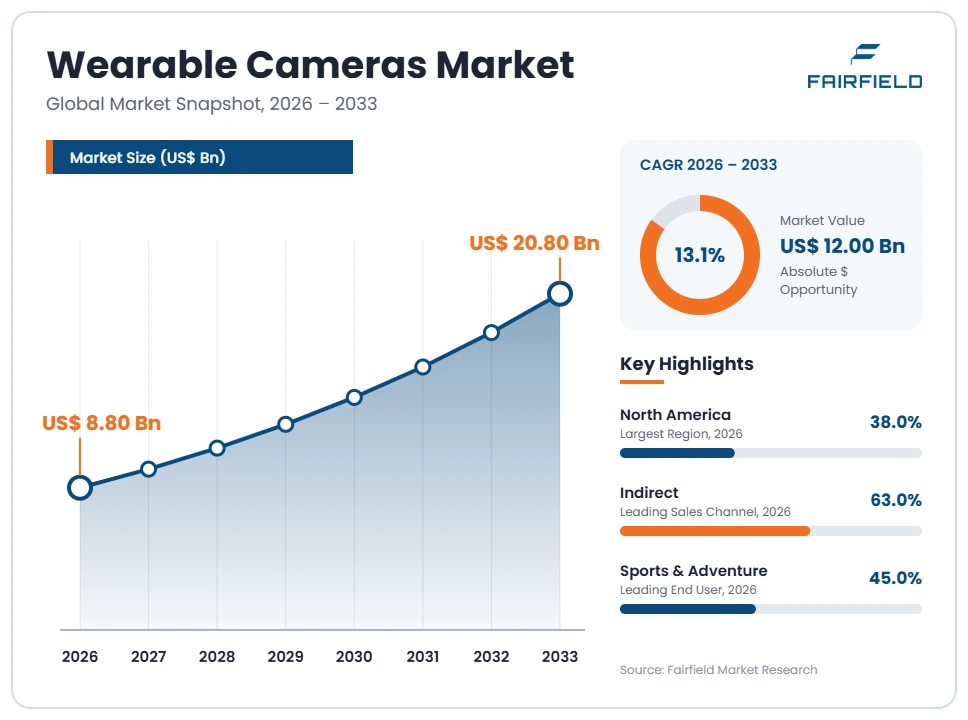
The global wearable cameras market size is expected to be valued at US$ 8.80 billion in 2026 and projected to reach US$ 20.80 billion by 2033, growing at a CAGR of 13.1% between 2026 and 2033.
Between 2020 and 2025, the market grew at a CAGR of about 11.0%, as outdoor sports recovered after the pandemic, social video platforms rewarded first-person content, and police forces expanded body-worn camera programs. Wearable cameras are small devices worn on the head, body, chest, helmet, or face that record photos and video hands-free. Three factors now drive growth: creators who film for social media, the spread of smart glasses with built-in cameras and AI assistants, and the use of body-worn cameras in policing, security, retail, and healthcare. The market is shifting toward 360-degree cameras with automatic reframing, small clip-on cameras, and action cameras with better stabilization, low-light sensors, and longer battery life. In September 2025, Meta Platforms unveiled the Meta Ray-Ban Display glasses at US$ 799, adding an in-lens screen to camera glasses and raising interest in camera-equipped eyewear.
Key Report Takeaways
- By Type: Body-Mounted cameras held 41.0% share in 2026, while Smart Glasses are projected to expand at a 19.5% CAGR through 2033, driven by camera glasses with AI assistants from Meta Platforms and EssilorLuxottica.
- By Sales Channel: Indirect channels held 63.0% share in 2026, while Direct channels are projected to expand at a 14.6% CAGR through 2033, driven by brand online stores, subscriptions, and direct contracts with police agencies.
- By End User: Sports & Adventure held 45.0% share in 2026, while Security is projected to expand at a 14.9% CAGR through 2033, driven by body-worn cameras for police, retail workers, and private security guards.
- By Region: North America held 38.0% share in 2026, while Asia Pacific is projected to expand at a 15.2% CAGR through 2033, driven by creator demand and manufacturing in China, Japan, South Korea, and India.
Global Wearable Cameras Market Trends and Insights
Drivers Impact Analysis
Two drivers carry the strongest influence on wearable cameras demand during the forecast period.
| Driver | Impact on CAGR Forecast | Geographic Relevance | Impact Timeline |
| Creator economy and adventure sports | High | North America, Asia Pacific, Europe | Long term (≥4 years) |
| Body-worn cameras in policing and security | High | North America, Europe | Medium term (2–4 years) |
Social Video Creators Are Driving the Wearable Cameras Market
Social video creators and adventure sports are the strongest driver of the wearable cameras market. People want to film their lives and activities from their own point of view.
The mechanism is the reward that social platforms give to engaging video. Platforms such as YouTube, TikTok, and Instagram favor short, dynamic clips, and first-person footage from biking, skiing, surfing, diving, and travel performs well. Action cameras from GoPro, DJI, and Insta360 offer strong stabilization, waterproof bodies, and easy sharing to phones. 360-degree cameras let users film everything and choose the angle later, which saves time. Vloggers use small clip-on cameras for hands-free recording. AI editing tools in companion apps now create highlight reels automatically. Rising participation in outdoor sports and travel adds buyers each year. These trends keep demand strong among consumers.
Police and Security Use Is Expanding the Wearable Cameras Market
The use of body-worn cameras in policing and security is expanding the wearable cameras market. Agencies use cameras to record interactions and gather evidence.
The cause is demand for accountability and safety. Police forces in the United States, United Kingdom, and many other countries equip officers with cameras to document encounters, reduce complaints, and support court cases. Axon Enterprise and Motorola Solutions sell cameras with cloud evidence management and live streaming. Retailers give staff cameras to reduce theft and abuse. Hospitals and transit operators use cameras to protect workers. Private security firms add cameras for guards. Government funding supports purchases. These programs create recurring hardware and software revenue. Many agencies buy cameras as part of multi-year bundles that include cloud storage, redaction tools, and regular device upgrades, which keeps customers loyal.
Restraints Impact Analysis
Two restraints limit how quickly the wearable cameras market grows.
| Restraint | Impact on CAGR Forecast | Geographic Relevance | Impact Timeline |
| Smartphone competition and market saturation | Medium | Global | Long term (≥4 years) |
| Privacy concerns and regulation | Medium | Europe, North America | Medium term (2–4 years) |
Smartphone Competition Slows the Wearable Cameras Market
Smartphone competition and saturation slow the wearable cameras market. Many people already carry a good camera in their pocket.
The specific causes are the rapid improvement of phone cameras and long replacement cycles. Modern smartphones from Apple and Samsung offer strong stabilization, high resolution, and action modes, which reduce the need for a separate camera for casual users. Many action camera owners keep devices for years, so replacement sales are slow. Price competition from low-cost brands squeezes margins. GoPro has faced falling sales and losses as competition increased. Battery life and overheating limit long recording sessions. Accessories and subscriptions are needed to keep users engaged. These factors limit growth in the core consumer segment. Brands must release new features each year to persuade owners of older action cameras to upgrade.
Privacy Concerns Restrict the Wearable Cameras Market
Privacy concerns and regulation restrict the wearable cameras market. People worry about being recorded without consent.
The underlying causes are social discomfort and legal rules. Smart glasses with cameras can record without others noticing, which raises concerns in public places, workplaces, and schools. Data protection laws in Europe, such as the General Data Protection Regulation, set strict rules on recording and storing images of people. Some venues ban camera glasses. Police body camera programs face debates over when cameras must be on and who can see footage. Storage and data security add costs. Facial recognition features face legal limits. These concerns slow adoption, especially for camera glasses. Makers add recording lights and privacy controls to reassure the public, but critics say small indicator lights are easy to miss or cover.
Market Opportunities
Smart Glasses Open a Fast-Growth Revenue Pool
Smart glasses open a fast-growth revenue pool in the wearable cameras market. Camera glasses combine photos, video, music, calls, and AI assistance.
Eyewear makers and technology companies can capture this opportunity. Meta Platforms and EssilorLuxottica have sold millions of Ray-Ban Meta glasses, and the Meta Ray-Ban Display adds a screen in the lens. Other companies, including Google, Samsung, and Chinese brands, are developing camera glasses. AI assistants can describe what the wearer sees, translate signs, and answer questions. Glasses that look like normal eyewear lower the barrier to wearing them all day. Prescription lens options expand the audience. Partnerships between tech firms and eyewear brands speed distribution through optical stores. Sports versions of smart glasses for cycling and running also extend the category into adventure use.
Enterprise and Healthcare Use Creates a Professional Revenue Pool
Enterprise and healthcare use creates a professional revenue pool in the wearable cameras market. Workers use cameras for training, remote help, and documentation.
Camera and software companies can capture this opportunity. Field technicians wear cameras so remote experts can guide repairs. Surgeons and medical teams use head-mounted cameras to record procedures for teaching. Factories use cameras to document quality checks. Logistics workers record deliveries. Body-worn cameras protect retail and healthcare staff from abuse. Software that stores, searches, and shares footage securely adds recurring revenue. Rugged designs and long battery life suit industrial work. Smart glasses with cameras let warehouse staff scan items and follow instructions hands-free. Insurers and utilities use cameras to document inspections and damage claims. Vendors that offer secure cloud platforms and integration with business software can win long contracts with large employers.
Segment Analysis
- By Type: Body-Mounted Cameras Lead While Smart Glasses Grow Fastest
Body-Mounted cameras held 41.0% share in 2026. This group includes action cameras mounted on chests, helmets, bikes, and gear, as well as police body-worn cameras. GoPro, DJI, Insta360, Axon Enterprise, and Motorola Solutions lead this segment with rugged, stabilized devices and large accessory ranges.
Smart Glasses are the fastest-growing type, expanding at a 19.5% CAGR through 2033. Camera glasses from Meta Platforms and EssilorLuxottica combine hands-free video with AI assistants and audio. New models with displays and better cameras attract buyers. Head-mounted cameras serve professional and sports users, while other types include clip-on and pendant cameras. For the market, smart glasses shift value toward eyewear and AI software.
- By Sales Channel: Indirect Channels Lead While Direct Channels Grow Fastest
Indirect channels held 63.0% share in 2026. Electronics retailers, sporting goods stores, online marketplaces such as Amazon, and optical stores sell most consumer cameras and glasses. Distributors also supply security and enterprise buyers.
Direct channels are the fastest-growing sales channel, expanding at a 14.6% CAGR through 2033. Brands sell through their own websites and apps, often with subscription plans for cloud storage and replacements. GoPro relies on subscriptions for recurring revenue. Police camera makers sign direct multi-year contracts with agencies. For the market, direct sales improve margins and customer data. Brands use app data to recommend accessories and upgrades. Body-worn cameras for police are almost always sold directly with software contracts, while optical stores are becoming an important channel for smart glasses.
- By End User: Sports & Adventure Leads While Security Grows Fastest
Sports & Adventure held 45.0% share in 2026. Surfers, cyclists, skiers, divers, climbers, and motorsport fans buy action cameras and 360-degree cameras to film their activities. Travelers and vloggers also fall into this group.
Security is the fastest-growing end user, expanding at a 14.9% CAGR through 2033. Police, retail, transit, and private security buyers deploy body-worn cameras with evidence software. Healthcare uses cameras for training and staff safety, while military and defense buyers use rugged head and body cameras. For the market, security growth adds stable contracts. Sports buyers favor waterproof action cameras and 360-degree cameras with strong stabilization, while vloggers prefer small clip-on cameras. Healthcare demand is smaller but growing, as hospitals record procedures for training and protect staff from violence.
Geography Analysis
- Which Region Is Leading the Wearable Cameras Market?
North America is leading the wearable cameras market with a 38.0% share in 2026. The United States has a large base of outdoor sports fans and social video creators, early adoption of smart glasses, and widespread use of body-worn cameras by police. GoPro, Axon Enterprise, Motorola Solutions, and Meta Platforms are based in the region. Canada adds demand from winter sports and policing. Retail chains are adding cameras for staff safety. Key barriers include market saturation and privacy concerns. One change shaping the region is AI camera glasses sold through optical stores and major electronics retailers.
- Europe Builds the Wearable Cameras Market Through Outdoor Sports and Policing
Europe is a major wearable cameras market. Germany, the United Kingdom, France, Italy, and Spain have strong cycling, skiing, and motorsport cultures. Police forces in the United Kingdom use body cameras widely. EssilorLuxottica in France and Italy co-develops camera glasses. GoPro and Insta360 sell widely through sports retailers, and ski tourism in France, Switzerland, and Austria drives seasonal demand. Retailers and transit operators in the United Kingdom issue cameras to staff to reduce abuse. Key barriers include strict privacy rules under data protection law and public concern about camera glasses. One opportunity is enterprise use in field service and logistics.
- Which Region Is Growing Fastest in the Wearable Cameras Market?
Asia Pacific is growing fastest in the wearable cameras market at a 15.2% CAGR through 2033. China is home to DJI and Insta360 and has a huge creator community. Japan hosts Sony, Panasonic, and Ricoh, and South Korea hosts Samsung. India has a growing creator economy. Australia has strong surfing, mountain biking, and police body camera use. Low-cost brands such as AKASO compete on price. Key barriers include price competition and uneven privacy rules. One change shaping the region is local camera glasses from Chinese technology companies, which pair cameras with AI assistants and translation features.
- Latin America Grows the Wearable Cameras Market Through Sports and Security
Latin America is a growing wearable cameras market. Brazil has strong surfing and cycling communities and uses police body cameras in some states. Mexico and Colombia add security demand from police, private guards, and transport operators. Adventure tourism in Chile, Peru, Argentina, and Costa Rica supports sales of action cameras to travelers and guides. Online marketplaces make cameras easier to buy, and social video creators are growing fast in Brazil and Mexico. Key barriers include import costs, currency swings, and high taxes on electronics. One opportunity is policing, as more state forces adopt body-worn cameras.
- Middle East & Africa Expands the Wearable Cameras Market Through Security
Middle East & Africa is an emerging wearable cameras market. The United Arab Emirates and Saudi Arabia use body cameras in policing and buy premium consumer devices. South Africa has adventure sports demand from surfing, safari tourism, and mountain biking. Desert driving, diving, and skydiving in the United Arab Emirates create demand for action cameras. Retail, transport, and private security firms in Saudi Arabia add cameras as large projects expand. Israel has a strong technology sector and police camera use. Key barriers include limited retail channels outside major cities. One opportunity is security for large events, airports, and infrastructure projects.
Competitive Landscape
The wearable cameras market is moderately concentrated. GoPro, DJI, and Insta360 lead in action cameras and 360-degree cameras, while Meta Platforms with EssilorLuxottica leads in smart glasses. Axon Enterprise and Motorola Solutions lead in body-worn cameras for police. Sony, Garmin, Panasonic, Ricoh, AKASO, and Samsung compete in specific niches.
Companies compete on image quality, stabilization, battery life, durability, software, price, and brand. Consumer brands rely on social media marketing and creator partnerships. Police camera makers compete on evidence software, cloud security, and integration with other police systems. Camera glasses depend on eyewear design and AI features. Low-cost brands put pressure on prices in the entry segment.
Strategic moves show how competition is changing. In July 2025, GoPro teased its MAX2 360 camera to compete with Insta360. In August 2025, Insta360 launched the GO Ultra small clip-on camera. In September 2025, Meta Platforms unveiled the Meta Ray-Ban Display glasses. These moves show competition shifting toward 360 video, smaller hands-free cameras, and camera glasses that combine recording with displays and AI assistance. Police camera makers are also adding real-time translation and AI report writing.
Three themes shape vendor strategy. First, companies are adding AI features for editing and search. Second, they are building camera glasses. Third, they are growing software subscriptions for cloud storage, editing, and evidence management. Vendors that combine strong hardware, smart software, and wide distribution are best placed to win share.
Recent Industry Developments
- September 2025: Meta Platforms unveiled the Meta Ray-Ban Display glasses with an in-lens display at US$ 799 – expands smart glasses beyond camera-only designs.
- August 2025: Insta360 launched the GO Ultra small wearable camera with magnetic mounting – strengthens hands-free creator filming.
- July 2025: GoPro teased the MAX2 360 camera with higher-resolution capture – intensifies competition in 360-degree cameras.
Companies Covered in the Report
- GoPro
- Meta Platforms
- Insta360
- DJI
- Axon Enterprise
- Motorola Solutions
- Sony
- Garmin
- Panasonic
- Ricoh
- AKASO
- Samsung Electronics
Wearable Cameras Market Report Scope
| Metric | Value |
| Study Period | 2020–2033 |
| Market Size 2026 | US$ 8.80 Billion |
| Market Size 2033 | US$ 20.80 Billion |
| CAGR 2026–2033 | 13.1% |
| Absolute Dollar Opportunity | US$ 12.00 Billion |
| Largest Market | North America |
| Fastest-Growing Market | Asia Pacific |
| Market Concentration | Moderate |
| Major Players | GoPro, Meta Platforms, Insta360, DJI, Axon Enterprise |
Wearable Cameras Market Segmentation
Type
- Head-Mounted
- Body-Mounted
- Smart Glasses
- Others
Sales Channel
- Direct
- Indirect
End User
- Healthcare
- Sports & Adventure
- Security
- Military & Defense
- Others
Regions
- North America
- Europe
- Asia Pacific
- Latin America
- Middle East & Africa
- Executive Summary
- Global Wearable Cameras Market Snapshot
- Future Projections
- Key Report Takeaways
- Regional Snapshot
- Market Overview
- Market Definition and Report Scope
- Historical Trends 2020–2025
- Market Dynamics
- Drivers
- Social Video Creators Are Driving the Wearable Cameras Market
- Police and Security Use Is Expanding the Wearable Cameras Market
- Restraints
- Smartphone Competition Slows the Wearable Cameras Market
- Privacy Concerns Restrict the Wearable Cameras Market
- Market Opportunities
- Smart Glasses Open a Fast-Growth Revenue Pool
- Enterprise and Healthcare Use Creates a Professional Revenue Pool
- Drivers
- Global Wearable Cameras Market Outlook, 2020-2033
- Global Wearable Cameras Market Outlook, by Type, Value (US$ Billion), 2020-2033
- Head-Mounted
- Body-Mounted
- Smart Glasses
- Others
- Global Wearable Cameras Market Outlook, by Sales Channel, Value (US$ Billion), 2020-2033
- Direct
- Indirect
- Global Wearable Cameras Market Outlook, by End User, Value (US$ Billion), 2020-2033
- Healthcare
- Sports & Adventure
- Security
- Military & Defense
- Others
- Global Wearable Cameras Market Outlook, by Region, Value (US$ Billion), 2020-2033
- North America
- Europe
- Asia Pacific
- Latin America
- Middle East & Africa
- Global Wearable Cameras Market Outlook, by Type, Value (US$ Billion), 2020-2033
- North America Wearable Cameras Market Outlook, 2020-2033
- North America Wearable Cameras Market Outlook, by Type, Value (US$ Billion), 2020-2033
- Head-Mounted
- Body-Mounted
- Smart Glasses
- Others
- North America Wearable Cameras Market Outlook, by Sales Channel, Value (US$ Billion), 2020-2033
- Direct
- Indirect
- North America Wearable Cameras Market Outlook, by End User, Value (US$ Billion), 2020-2033
- Healthcare
- Sports & Adventure
- Security
- Military & Defense
- Others
- North America Wearable Cameras Market Outlook, by Country, Value (US$ Billion), 2020-2033
- United States Wearable Cameras Market Outlook, by Type, 2020-2033
- United States Wearable Cameras Market Outlook, by Sales Channel, 2020-2033
- United States Wearable Cameras Market Outlook, by End User, 2020-2033
- Canada Wearable Cameras Market Outlook, by Type, 2020-2033
- Canada Wearable Cameras Market Outlook, by Sales Channel, 2020-2033
- Canada Wearable Cameras Market Outlook, by End User, 2020-2033
- North America Wearable Cameras Market Outlook, by Type, Value (US$ Billion), 2020-2033
- Europe Wearable Cameras Market Outlook, 2020-2033
- Europe Wearable Cameras Market Outlook, by Type, Value (US$ Billion), 2020-2033
- Head-Mounted
- Body-Mounted
- Smart Glasses
- Others
- Europe Wearable Cameras Market Outlook, by Sales Channel, Value (US$ Billion), 2020-2033
- Direct
- Indirect
- Europe Wearable Cameras Market Outlook, by End User, Value (US$ Billion), 2020-2033
- Healthcare
- Sports & Adventure
- Security
- Military & Defense
- Others
- Europe Wearable Cameras Market Outlook, by Country, Value (US$ Billion), 2020-2033
- Germany Wearable Cameras Market Outlook, by Type, 2020-2033
- Germany Wearable Cameras Market Outlook, by Sales Channel, 2020-2033
- Germany Wearable Cameras Market Outlook, by End User, 2020-2033
- United Kingdom Wearable Cameras Market Outlook, by Type, 2020-2033
- United Kingdom Wearable Cameras Market Outlook, by Sales Channel, 2020-2033
- United Kingdom Wearable Cameras Market Outlook, by End User, 2020-2033
- France Wearable Cameras Market Outlook, by Type, 2020-2033
- France Wearable Cameras Market Outlook, by Sales Channel, 2020-2033
- France Wearable Cameras Market Outlook, by End User, 2020-2033
- Italy Wearable Cameras Market Outlook, by Type, 2020-2033
- Italy Wearable Cameras Market Outlook, by Sales Channel, 2020-2033
- Italy Wearable Cameras Market Outlook, by End User, 2020-2033
- Spain Wearable Cameras Market Outlook, by Type, 2020-2033
- Spain Wearable Cameras Market Outlook, by Sales Channel, 2020-2033
- Spain Wearable Cameras Market Outlook, by End User, 2020-2033
- Switzerland Wearable Cameras Market Outlook, by Type, 2020-2033
- Switzerland Wearable Cameras Market Outlook, by Sales Channel, 2020-2033
- Switzerland Wearable Cameras Market Outlook, by End User, 2020-2033
- Austria Wearable Cameras Market Outlook, by Type, 2020-2033
- Austria Wearable Cameras Market Outlook, by Sales Channel, 2020-2033
- Austria Wearable Cameras Market Outlook, by End User, 2020-2033
- Europe Wearable Cameras Market Outlook, by Type, Value (US$ Billion), 2020-2033
- Asia Pacific Wearable Cameras Market Outlook, 2020-2033
- Asia Pacific Wearable Cameras Market Outlook, by Type, Value (US$ Billion), 2020-2033
- Head-Mounted
- Body-Mounted
- Smart Glasses
- Others
- Asia Pacific Wearable Cameras Market Outlook, by Sales Channel, Value (US$ Billion), 2020-2033
- Direct
- Indirect
- Asia Pacific Wearable Cameras Market Outlook, by End User, Value (US$ Billion), 2020-2033
- Healthcare
- Sports & Adventure
- Security
- Military & Defense
- Others
- Asia Pacific Wearable Cameras Market Outlook, by Country, Value (US$ Billion), 2020-2033
- China Wearable Cameras Market Outlook, by Type, 2020-2033
- China Wearable Cameras Market Outlook, by Sales Channel, 2020-2033
- China Wearable Cameras Market Outlook, by End User, 2020-2033
- Japan Wearable Cameras Market Outlook, by Type, 2020-2033
- Japan Wearable Cameras Market Outlook, by Sales Channel, 2020-2033
- Japan Wearable Cameras Market Outlook, by End User, 2020-2033
- South Korea Wearable Cameras Market Outlook, by Type, 2020-2033
- South Korea Wearable Cameras Market Outlook, by Sales Channel, 2020-2033
- South Korea Wearable Cameras Market Outlook, by End User, 2020-2033
- India Wearable Cameras Market Outlook, by Type, 2020-2033
- India Wearable Cameras Market Outlook, by Sales Channel, 2020-2033
- India Wearable Cameras Market Outlook, by End User, 2020-2033
- Australia Wearable Cameras Market Outlook, by Type, 2020-2033
- Australia Wearable Cameras Market Outlook, by Sales Channel, 2020-2033
- Australia Wearable Cameras Market Outlook, by End User, 2020-2033
- Asia Pacific Wearable Cameras Market Outlook, by Type, Value (US$ Billion), 2020-2033
- Latin America Wearable Cameras Market Outlook, 2020-2033
- Latin America Wearable Cameras Market Outlook, by Type, Value (US$ Billion), 2020-2033
- Head-Mounted
- Body-Mounted
- Smart Glasses
- Others
- Latin America Wearable Cameras Market Outlook, by Sales Channel, Value (US$ Billion), 2020-2033
- Direct
- Indirect
- Latin America Wearable Cameras Market Outlook, by End User, Value (US$ Billion), 2020-2033
- Healthcare
- Sports & Adventure
- Security
- Military & Defense
- Others
- Latin America Wearable Cameras Market Outlook, by Country, Value (US$ Billion), 2020-2033
- Brazil Wearable Cameras Market Outlook, by Type, 2020-2033
- Brazil Wearable Cameras Market Outlook, by Sales Channel, 2020-2033
- Brazil Wearable Cameras Market Outlook, by End User, 2020-2033
- Mexico Wearable Cameras Market Outlook, by Type, 2020-2033
- Mexico Wearable Cameras Market Outlook, by Sales Channel, 2020-2033
- Mexico Wearable Cameras Market Outlook, by End User, 2020-2033
- Colombia Wearable Cameras Market Outlook, by Type, 2020-2033
- Colombia Wearable Cameras Market Outlook, by Sales Channel, 2020-2033
- Colombia Wearable Cameras Market Outlook, by End User, 2020-2033
- Chile Wearable Cameras Market Outlook, by Type, 2020-2033
- Chile Wearable Cameras Market Outlook, by Sales Channel, 2020-2033
- Chile Wearable Cameras Market Outlook, by End User, 2020-2033
- Peru Wearable Cameras Market Outlook, by Type, 2020-2033
- Peru Wearable Cameras Market Outlook, by Sales Channel, 2020-2033
- Peru Wearable Cameras Market Outlook, by End User, 2020-2033
- Argentina Wearable Cameras Market Outlook, by Type, 2020-2033
- Argentina Wearable Cameras Market Outlook, by Sales Channel, 2020-2033
- Argentina Wearable Cameras Market Outlook, by End User, 2020-2033
- Costa Rica Wearable Cameras Market Outlook, by Type, 2020-2033
- Costa Rica Wearable Cameras Market Outlook, by Sales Channel, 2020-2033
- Costa Rica Wearable Cameras Market Outlook, by End User, 2020-2033
- Latin America Wearable Cameras Market Outlook, by Type, Value (US$ Billion), 2020-2033
- Middle East & Africa Wearable Cameras Market Outlook, 2020-2033
- Middle East & Africa Wearable Cameras Market Outlook, by Type, Value (US$ Billion), 2020-2033
- Head-Mounted
- Body-Mounted
- Smart Glasses
- Others
- Middle East & Africa Wearable Cameras Market Outlook, by Sales Channel, Value (US$ Billion), 2020-2033
- Direct
- Indirect
- Middle East & Africa Wearable Cameras Market Outlook, by End User, Value (US$ Billion), 2020-2033
- Healthcare
- Sports & Adventure
- Security
- Military & Defense
- Others
- Middle East & Africa Wearable Cameras Market Outlook, by Country, Value (US$ Billion), 2020-2033
- United Arab Emirates Wearable Cameras Market Outlook, by Type, 2020-2033
- United Arab Emirates Wearable Cameras Market Outlook, by Sales Channel, 2020-2033
- United Arab Emirates Wearable Cameras Market Outlook, by End User, 2020-2033
- Saudi Arabia Wearable Cameras Market Outlook, by Type, 2020-2033
- Saudi Arabia Wearable Cameras Market Outlook, by Sales Channel, 2020-2033
- Saudi Arabia Wearable Cameras Market Outlook, by End User, 2020-2033
- South Africa Wearable Cameras Market Outlook, by Type, 2020-2033
- South Africa Wearable Cameras Market Outlook, by Sales Channel, 2020-2033
- South Africa Wearable Cameras Market Outlook, by End User, 2020-2033
- Israel Wearable Cameras Market Outlook, by Type, 2020-2033
- Israel Wearable Cameras Market Outlook, by Sales Channel, 2020-2033
- Israel Wearable Cameras Market Outlook, by End User, 2020-2033
- Middle East & Africa Wearable Cameras Market Outlook, by Type, Value (US$ Billion), 2020-2033
- Competitive Landscape
- Market Concentration and Industry Leaders
- Competitive Differentiation
- Strategic Moves and Market Direction
- Recent Industry Developments
- Company Profiles
- GoPro
- Meta Platforms
- Insta360
- DJI
- Axon Enterprise
- Motorola Solutions
- Sony
- Garmin
- Panasonic
- Ricoh
- AKASO
- Samsung Electronics
- Appendix
- Research Methodology
- Report Assumptions
- Acronyms and Abbreviations
Type
- Head-Mounted
- Body-Mounted
- Smart Glasses
- Others
Sales Channel
- Direct
- Indirect
End User
- Healthcare
- Sports & Adventure
- Security
- Military & Defense
- Others
Regions
- North America
- Europe
- Asia Pacific
- Latin America
- Middle East & Africa
Our Research Methodology
Considering the volatility of business today, traditional approaches to strategizing a game plan can be unfruitful if not detrimental. True ambiguity is no way to determine a forecast. A myriad of predetermined factors must be accounted for such as the degree of risk involved, the magnitude of circumstances, as well as conditions or consequences that are not known or unpredictable. To circumvent binary views that cast uncertainty, the application of market research intelligence to strategically posture, move, and enable actionable outcomes is necessary.
View Methodology
Quality Assured
Rigorous Validation Process

Confidentiality Assured
End-to-end Data Security

Custom Research Services
Tailored To Your Objectives
FAQs
The wearable cameras market is valued at US$ 8.80 billion in 2026, led by body-mounted cameras and North America.
The market is projected to reach US$ 20.80 billion by 2033, growing at a 13.1% CAGR and adding US$ 12.00 billion.
Smart glasses are growing fastest at a 19.5% CAGR through 2033, driven by camera glasses with AI assistants and displays.
Asia Pacific is growing fastest at a 15.2% CAGR through 2033, driven by creators and camera makers in China and Japan.
North America holds the largest share at 38.0% in 2026, supported by outdoor sports, creators, and police body cameras.
Related Reports
Spend Analytics Market Size, Share, Insights, Competitive Landscape, and Forecast 2026 to 2033
The global spend analytics market is valued at US$3.90 billion in 2026, reaching US$10.40 billion by 2033, growing at a 15.0% CAGR
IoT Security Market Size, Share, Insights, Competitive Landscape, and Forecast 2026 to 2033
The global IoT security market is valued at US$21.40 billion in 2026, reaching US$66.60 billion by 2033, growing at a 17.6% CAGR
Insurance Analytics Market Size, Share, Insights, Competitive Landscape, and Forecast 2026 to 2033
The global insurance analytics market is valued at US$17.30 billion in 2026, reaching US$39.70 billion by 2033, growing at a 12.6% CAGR
Smart Lighting Market Size, Share, Insights, Competitive Landscape, and Forecast 2026 to 2033
The smart lighting market is projected to grow from US$27.52 billion in 2026 to US$97.29 billion by 2033, at a 19.8% CAGR, led by connected lighting demand.
Lit Fiber Market Size, Share, Insights, Competitive Landscape, and Forecast 2026 to 2033
The lit fiber market is projected to grow from US$7.13 billion in 2026 to US$20.52 billion by 2033, at a 16.3% CAGR, driven by AI and cloud connectivity.
Laser Processing Market Size, Share, Insights, Competitive Landscape, and Forecast 2026 to 2033
The laser processing market is projected to grow from US$27.97 billion in 2026 to US$47.32 billion by 2033, at a 7.8% CAGR, driven by precision manufacturing.