



3D Motion Capture System Market
3d Motion Capture System Market Insights, Competitive Landscape, and Market Forecast - 2033
Global 3D Motion Capture System Market Forecast
The 3d Motion Capture System Market is expected to grow from USD 310.7 Million in 2026 to USD 708.6 Million by 2033, reflecting strong industry expansion and registering a CAGR of 12.5% during the forecast period from 2026 to 2033.
Quick Report Digest
A Look Back and a Look Forward – Comparative Analysis
The 3D motion capture system market is growing due to increasing demand in various industries, including entertainment, sports, healthcare, and automotive. Advancements in motion capture technologies, rising applications in virtual reality (VR) and augmented reality (AR), and the need for accurate and real-time motion tracking drive market growth.
Moreover, the expanding gaming industry and the adoption of motion capture in biomechanical research contribute to the market's upward trajectory, fostering innovation and widespread adoption.
The market witnessed staggered growth during the historical period 2018 – 2022. This is due to the substantial growth of major applications such as media and entertainment, biomechanical research, and medical. However, in some applications, the demand for 3D motion capture systems has increased, including in Engineering Design and Industrial Applications and education.
The future of the 3D motion capture system market looks promising, driven by expanding applications in gaming, healthcare, sports analysis, and virtual production. Advances in markerless motion capture, AI integration, and the growing demand for realistic, immersive experiences will fuel market growth. Additionally, the increasing adoption of 3D motion capture in robotics, animation, and virtual reality applications is expected to contribute to the market's sustained development and technological evolution.
Key Growth Determinants
- Expanding Entertainment Industry
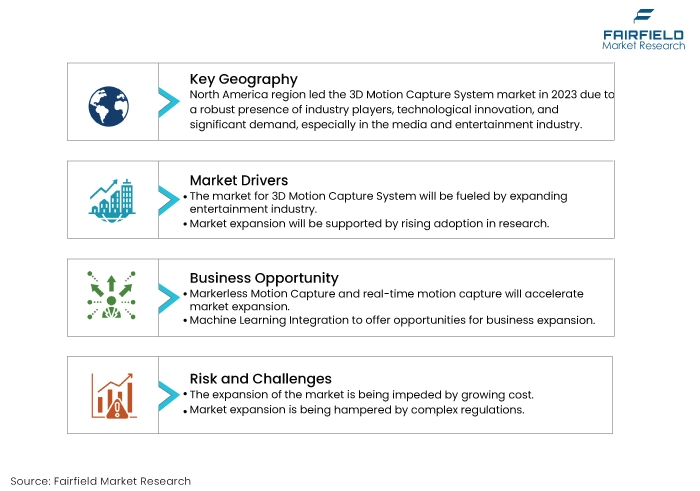
The expanding entertainment industry is a significant driver for the 3D motion capture system market. As demand for realistic animations and immersive experiences rises in movies, video games, and virtual reality, 3D motion capture systems play a pivotal role. These systems enable the capture of intricate movements and expressions, enhancing the authenticity of characters and scenes.
In film and gaming, the quest for realism and engaging storytelling propels the adoption of advanced motion capture technologies. Additionally, the use of 3D motion capture in virtual production further cements its importance, driving innovation and fostering continuous growth within the entertainment sector and the broader motion capture market.
- Rising Adoption in Research
The rising adoption of 3D motion capture systems in research is driving the market by providing precise tools for biomechanics, neuroscience, and ergonomics studies. Researchers utilise these systems for detailed movement analysis, gait studies, and understanding of human motion dynamics.
In fields such as healthcare, sports science, and academic research, 3D motion capture contributes valuable data for rehabilitation, athlete performance assessment, and academic investigations. The technology's ability to capture intricate movements with high accuracy and its applicability in diverse research domains propel its adoption, making 3D motion capture systems indispensable tools for gaining deeper insights into human movement, and behaviour.
- Increasing Robotics Applications
The increasing applications of 3D motion capture systems in robotics drive the market by enabling precise and real-time tracking of robotic movements. In robotics research and development, these systems contribute to advancing control algorithms, enhancing human-robot interaction, and improving overall robotic performance.
3D motion capture facilitates the creation of more responsive and adaptable robotic systems by providing accurate data on movement patterns and spatial awareness.
As robotics applications expand across industries such as manufacturing, healthcare, and automation, the demand for advanced motion capture technologies grows, positioning 3D motion capture systems as essential tools for optimising robotic capabilities and ensuring their seamless integration into various operational environments.
Major Growth Barriers
- Growing Price Points
Growing costs present a challenge to the 3D motion capture system market as the initial investment and ongoing expenses can be prohibitive for many potential users, limiting widespread adoption. High costs involve not only the purchase of hardware and software but also specialised training for system operation and maintenance.
The economic barrier impacts smaller businesses, educational institutions, and research organisations, restricting their ability to leverage advanced motion capture technologies. Addressing cost challenges is essential for market growth, requiring innovations that enhance affordability without compromising the quality and capabilities of 3D motion capture systems.
- Complex Regulations
Complex regulations pose a challenge to the 3D motion capture system market as compliance demands in diverse sectors, including healthcare, entertainment, and research, vary significantly. Meeting regulatory requirements related to data privacy, ethical use, and safety standards requires continuous adaptation.
The dynamic nature of regulations across industries and regions necessitates a comprehensive understanding and implementation, which can be resource-intensive. These complexities may slow down the development and deployment of 3D motion capture systems, impacting market growth as manufacturers and users navigate a landscape with evolving legal and ethical considerations.
Key Trends and Opportunities to Look at
Advancements in markerless systems eliminate the need for physical markers and enhance flexibility and ease of use in various applications. In order to monitor and record an object's or person's movement without the need for physical marks or sensors to be put on their bodies, a technology known as markerless motion capture is employed in the 3D motion capture system industry.
Markerless motion capture systems analyse video footage and extract motion data without the need of markers by utilising computer vision algorithms, depth sensors, and machine learning approaches.
- Real-Time Motion Capture
- Machine Learning Integration
Increasing focus on achieving real-time processing capabilities for immediate feedback in applications such as gaming, virtual reality, and live performances. Several sectors have seen tremendous change as a result of real-time motion capture technology, most notably robots, sports, entertainment, and healthcare.
Real-time features, which allow for rapid feedback and interaction and improve user experience and productivity, are becoming more and more important in the context of the 3D motion capture system industry.
Numerous sectors, including robotics, sports, entertainment, and healthcare, have significantly advanced as a result of the incorporation of machine learning into 3D motion capture systems.
By lowering noise, adding missing data points, and improving tracking algorithms, machine learning algorithms can improve the accuracy and precision of motion capture data. This results in more accurate motion capture data, which is essential for applications like virtual reality, animation, and biomechanical study.
How Does the Regulatory Scenario Shape this Industry?
The 3D motion capture system market is influenced by diverse regulatory frameworks, with specific acts, guidelines, and entities shaping industry practices. In the US, regulatory bodies like the Food and Drug Administration (FDA) may impact motion capture systems used in healthcare applications. Privacy regulations, such as GDPR in Europe, influence data handling and user consent.
Region-specific changes, like China's cybersecurity law, may impact data security in motion capture technologies. Adherence to safety standards and ethical guidelines, often set by industry associations and standards organisations globally, is critical. The dynamic nature of regulations necessitates continuous monitoring and adaptation, influencing product development, marketing, and usage practices in the evolving landscape of the 3D motion capture system market.
Fairfield’s Ranking Board
Top Segments
Hardware components have captured the largest market share in the 3D motion capture system market due to their fundamental role in system functionality. This includes optical cameras, sensors, markers, and supporting infrastructure essential for capturing and processing motion data.
The demand for high-quality and accurate motion tracking, particularly in applications like animation, biomechanics, and virtual reality, underscores the significance of robust hardware. As the technology evolves, innovations in hardware components, such as improved depth-sensing cameras and wireless systems, continue to drive market growth, solidifying their dominance in the 3D motion capture system market.
The software component is experiencing the highest CAGR in the 3D motion capture system market due to the increasing emphasis on software advancements. Innovations in motion tracking algorithms, real-time processing capabilities, and user-friendly interfaces contribute to the growth.
Additionally, the rise of markerless systems and the integration of machine learning algorithms enhance software functionalities. As the demand for sophisticated data processing, analysis, and visualisation tools grows, the Software segment plays a pivotal role, driving its rapid growth within the dynamic landscape of the 3D motion capture system market.
- Active Optical Systems Remain Sought-After
- Maximum Demand Identified in Media and Entertainment Application
Active optical system types have captured the largest market share in the 3D motion capture system market due to their high precision and versatility. Active systems use light sources and sensors to emit and detect signals actively, offering accurate real-time tracking. They excel in capturing complex movements with minimal latency, making them suitable for applications in animation, virtual reality, and biomechanics. The demand for precise motion capture in diverse industries contributes to the dominance of active optical system types, driving their largest market share within the competitive landscape.
The passive optical system type is experiencing the most significant CAGR in the 3D motion capture system market due to advancements in markerless technology. Passive systems, relying on reflective markers, offer improved flexibility and reduced setup complexity. They cater to applications requiring unobtrusive motion capture, such as in sports analysis and healthcare.
As markerless systems gain popularity for their ease of use and suitability in various environments, the passive optical system type sees accelerated adoption, contributing to its rapid growth within the evolving landscape of the 3D motion capture system market.
Media and entertainment applications have captured the largest market share in the 3D motion capture system market due to their extensive use in creating lifelike animations, visual effects, and immersive gaming experiences. The demand for realistic character movements and special effects in movies, video games, and virtual productions propels the adoption of 3D motion capture systems.
The industry's pursuit of cutting-edge technologies to enhance storytelling and audience engagement solidifies the dominance of media and entertainment applications, making them a primary driver in the market's largest share within this dynamic and competitive landscape.
Engineering design and industrial applications are likely to witness the highest CAGR in the 3D motion capture system market due to the increasing adoption of motion capture for design prototyping, ergonomic analysis, and quality control.
Industries utilise 3D motion capture to optimise manufacturing processes, improve product design, and enhance worker safety. The demand for precise movement analysis in engineering and industrial settings drives the growth of 3D motion capture systems, making them essential tools for innovation and efficiency improvements, contributing to the highest CAGR within this specific market segment.
Regional Frontrunners
North America Remains the Undisputable Global Leader
North America has captured the largest market share in the 3D motion capture system market due to a robust presence of key industry players, technological innovation, and significant demand in the region's media and entertainment industry. The US, in particular, hosts major companies driving advancements in motion capture technologies.
Additionally, the widespread adoption of 3D motion capture in applications such as gaming, filmmaking, and virtual reality contributes to the region's dominance. A mature ecosystem, coupled with a strong emphasis on research and development, positions North America at the forefront of market leadership, solidifying its largest market share in the dynamic landscape of the 3D motion capture system market.
Asia Pacific Gains Momentum
Rapid pace of industrialisation, increasing investments in technology, and expanding applications in entertainment and manufacturing are driving growth in Asia Pacific’s market 3D moption capture systems. Countries like China, Japan, and South Korea are witnessing significant adoption of motion capture systems across various industries, including gaming, film production, and engineering.
The region's dynamic market growth is further fueled by the rising demand for advanced technologies, a burgeoning gaming industry, and the integration of motion capture in diverse applications, positioning the Asia Pacific as a key driver in the evolving landscape of the 3D motion capture system market.
Fairfield’s Competitive Landscape Analysis
The 3D motion capture system market features intense competition with key players like Vicon Motion Systems Ltd, Motion Analysis Corporation, and OptiTrack dominating. Continuous innovations in markerless technology, real-time processing, and machine learning integration drive competition.
Strategic collaborations, mergers, and acquisitions further shape the landscape. Companies focus on delivering high-precision, user-friendly systems to meet the diverse demands of entertainment, healthcare, and industrial applications, emphasizing technological advancements to maintain a competitive edge.
Who are the Leaders in the Global 3D Motion Capture System Space?
- Vicon Motion Systems Ltd.
- OptiTrack
- Movella Inc. (Xsens)
- Motion Analysis Corporation
- Qualisys AB
- PhaseSpace, Inc.
- Noitom Ltd.
- Noraxon USA, Inc.
- Codamotion
- Rokoko
3D Motion Capture System Market Segmentation
By System Type
- Optical Motion Capture System
- Non-Optical Motion Capture System
By Component
- Hardware
- Software
- Services
By Application
- Media & Entertainment
- Biomechanical Research & Medical
- Engineering, Design & Industrial Applications
- Education
- Sports & Fitness
By End User
- Healthcare & Research Institutes
- Media & Entertainment Companies
- Educational Institutions
- Industrial Enterprises
- Sports Organizations
By Region
- North America
- Europe
- Asia Pacific
- Latin America
- Middle East & Africa
- Executive Summary
- Global 3D Motion Capture System Market Snapshot
- Future Projections
- Key Market Trends
- Regional Snapshot, by Value, 2026
- Analyst Recommendations
- Market Overview
- Market Definitions and Segmentations
- Market Dynamics
- Drivers
- Restraints
- Market Opportunities
- Value Chain Analysis
- COVID-19 Impact Analysis
- Porter's Five Forces Analysis
- Impact of Russia-Ukraine Conflict
- PESTLE Analysis
- Regulatory Analysis
- Price Trend Analysis
- Current Prices and Future Projections, 2025-2033
- Price Impact Factors
- Global 3D Motion Capture System Market Outlook, 2020 - 2033
- Global 3D Motion Capture System Market Outlook, by System Type, Value (US$ Mn), 2020-2033
- Optical Motion Capture System
- Non-Optical Motion Capture System
- Global 3D Motion Capture System Market Outlook, by Component, Value (US$ Mn), 2020-2033
- Hardware
- Software
- Services
- Global 3D Motion Capture System Market Outlook, by Application, Value (US$ Mn), 2020-2033
- Media & Entertainment
- Biomechanical Research & Medical
- Engineering, Design & Industrial Applications
- Education
- Sports & Fitness
- Global 3D Motion Capture System Market Outlook, by End User, Value (US$ Mn), 2020-2033
- Healthcare & Research Institutes
- Media & Entertainment Companies
- Educational Institutions
- Industrial Enterprises
- Sports Organizations
- Global 3D Motion Capture System Market Outlook, by Region, Value (US$ Mn), 2020-2033
- North America
- Europe
- Asia Pacific
- Latin America
- Middle East & Africa
- Global 3D Motion Capture System Market Outlook, by System Type, Value (US$ Mn), 2020-2033
- North America 3D Motion Capture System Market Outlook, 2020 - 2033
- North America 3D Motion Capture System Market Outlook, by System Type, Value (US$ Mn), 2020-2033
- Optical Motion Capture System
- Non-Optical Motion Capture System
- North America 3D Motion Capture System Market Outlook, by Component, Value (US$ Mn), 2020-2033
- Hardware
- Software
- Services
- North America 3D Motion Capture System Market Outlook, by Application, Value (US$ Mn), 2020-2033
- Media & Entertainment
- Biomechanical Research & Medical
- Engineering, Design & Industrial Applications
- Education
- Sports & Fitness
- North America 3D Motion Capture System Market Outlook, by End User, Value (US$ Mn), 2020-2033
- Healthcare & Research Institutes
- Media & Entertainment Companies
- Educational Institutions
- Industrial Enterprises
- Sports Organizations
- North America 3D Motion Capture System Market Outlook, by Country, Value (US$ Mn), 2020-2033
- U.S. 3D Motion Capture System Market Outlook, by System Type, 2020-2033
- U.S. 3D Motion Capture System Market Outlook, by Component, 2020-2033
- U.S. 3D Motion Capture System Market Outlook, by Application, 2020-2033
- U.S. 3D Motion Capture System Market Outlook, by End User, 2020-2033
- Canada 3D Motion Capture System Market Outlook, by System Type, 2020-2033
- Canada 3D Motion Capture System Market Outlook, by Component, 2020-2033
- Canada 3D Motion Capture System Market Outlook, by Application, 2020-2033
- Canada 3D Motion Capture System Market Outlook, by End User, 2020-2033
- BPS Analysis/Market Attractiveness Analysis
- North America 3D Motion Capture System Market Outlook, by System Type, Value (US$ Mn), 2020-2033
- Europe 3D Motion Capture System Market Outlook, 2020 - 2033
- Europe 3D Motion Capture System Market Outlook, by System Type, Value (US$ Mn), 2020-2033
- Optical Motion Capture System
- Non-Optical Motion Capture System
- Europe 3D Motion Capture System Market Outlook, by Component, Value (US$ Mn), 2020-2033
- Hardware
- Software
- Services
- Europe 3D Motion Capture System Market Outlook, by Application, Value (US$ Mn), 2020-2033
- Media & Entertainment
- Biomechanical Research & Medical
- Engineering, Design & Industrial Applications
- Education
- Sports & Fitness
- Europe 3D Motion Capture System Market Outlook, by End User, Value (US$ Mn), 2020-2033
- Healthcare & Research Institutes
- Media & Entertainment Companies
- Educational Institutions
- Industrial Enterprises
- Sports Organizations
- Europe 3D Motion Capture System Market Outlook, by Country, Value (US$ Mn), 2020-2033
- Germany 3D Motion Capture System Market Outlook, by System Type, 2020-2033
- Germany 3D Motion Capture System Market Outlook, by Component, 2020-2033
- Germany 3D Motion Capture System Market Outlook, by Application, 2020-2033
- Germany 3D Motion Capture System Market Outlook, by End User, 2020-2033
- Italy 3D Motion Capture System Market Outlook, by System Type, 2020-2033
- Italy 3D Motion Capture System Market Outlook, by Component, 2020-2033
- Italy 3D Motion Capture System Market Outlook, by Application, 2020-2033
- Italy 3D Motion Capture System Market Outlook, by End User, 2020-2033
- France 3D Motion Capture System Market Outlook, by System Type, 2020-2033
- France 3D Motion Capture System Market Outlook, by Component, 2020-2033
- France 3D Motion Capture System Market Outlook, by Application, 2020-2033
- France 3D Motion Capture System Market Outlook, by End User, 2020-2033
- U.K. 3D Motion Capture System Market Outlook, by System Type, 2020-2033
- U.K. 3D Motion Capture System Market Outlook, by Component, 2020-2033
- U.K. 3D Motion Capture System Market Outlook, by Application, 2020-2033
- U.K. 3D Motion Capture System Market Outlook, by End User, 2020-2033
- Spain 3D Motion Capture System Market Outlook, by System Type, 2020-2033
- Spain 3D Motion Capture System Market Outlook, by Component, 2020-2033
- Spain 3D Motion Capture System Market Outlook, by Application, 2020-2033
- Spain 3D Motion Capture System Market Outlook, by End User, 2020-2033
- Russia 3D Motion Capture System Market Outlook, by System Type, 2020-2033
- Russia 3D Motion Capture System Market Outlook, by Component, 2020-2033
- Russia 3D Motion Capture System Market Outlook, by Application, 2020-2033
- Russia 3D Motion Capture System Market Outlook, by End User, 2020-2033
- Rest of Europe 3D Motion Capture System Market Outlook, by System Type, 2020-2033
- Rest of Europe 3D Motion Capture System Market Outlook, by Component, 2020-2033
- Rest of Europe 3D Motion Capture System Market Outlook, by Application, 2020-2033
- Rest of Europe 3D Motion Capture System Market Outlook, by End User, 2020-2033
- BPS Analysis/Market Attractiveness Analysis
- Europe 3D Motion Capture System Market Outlook, by System Type, Value (US$ Mn), 2020-2033
- Asia Pacific 3D Motion Capture System Market Outlook, 2020 - 2033
- Asia Pacific 3D Motion Capture System Market Outlook, by System Type, Value (US$ Mn), 2020-2033
- Optical Motion Capture System
- Non-Optical Motion Capture System
- Asia Pacific 3D Motion Capture System Market Outlook, by Component, Value (US$ Mn), 2020-2033
- Hardware
- Software
- Services
- Asia Pacific 3D Motion Capture System Market Outlook, by Application, Value (US$ Mn), 2020-2033
- Media & Entertainment
- Biomechanical Research & Medical
- Engineering, Design & Industrial Applications
- Education
- Sports & Fitness
- Asia Pacific 3D Motion Capture System Market Outlook, by End User, Value (US$ Mn), 2020-2033
- Healthcare & Research Institutes
- Media & Entertainment Companies
- Educational Institutions
- Industrial Enterprises
- Sports Organizations
- Asia Pacific 3D Motion Capture System Market Outlook, by Country, Value (US$ Mn), 2020-2033
- China 3D Motion Capture System Market Outlook, by System Type, 2020-2033
- China 3D Motion Capture System Market Outlook, by Component, 2020-2033
- China 3D Motion Capture System Market Outlook, by Application, 2020-2033
- China 3D Motion Capture System Market Outlook, by End User, 2020-2033
- Japan 3D Motion Capture System Market Outlook, by System Type, 2020-2033
- Japan 3D Motion Capture System Market Outlook, by Component, 2020-2033
- Japan 3D Motion Capture System Market Outlook, by Application, 2020-2033
- Japan 3D Motion Capture System Market Outlook, by End User, 2020-2033
- South Korea 3D Motion Capture System Market Outlook, by System Type, 2020-2033
- South Korea 3D Motion Capture System Market Outlook, by Component, 2020-2033
- South Korea 3D Motion Capture System Market Outlook, by Application, 2020-2033
- South Korea 3D Motion Capture System Market Outlook, by End User, 2020-2033
- India 3D Motion Capture System Market Outlook, by System Type, 2020-2033
- India 3D Motion Capture System Market Outlook, by Component, 2020-2033
- India 3D Motion Capture System Market Outlook, by Application, 2020-2033
- India 3D Motion Capture System Market Outlook, by End User, 2020-2033
- Southeast Asia 3D Motion Capture System Market Outlook, by System Type, 2020-2033
- Southeast Asia 3D Motion Capture System Market Outlook, by Component, 2020-2033
- Southeast Asia 3D Motion Capture System Market Outlook, by Application, 2020-2033
- Southeast Asia 3D Motion Capture System Market Outlook, by End User, 2020-2033
- Rest of SAO 3D Motion Capture System Market Outlook, by System Type, 2020-2033
- Rest of SAO 3D Motion Capture System Market Outlook, by Component, 2020-2033
- Rest of SAO 3D Motion Capture System Market Outlook, by Application, 2020-2033
- Rest of SAO 3D Motion Capture System Market Outlook, by End User, 2020-2033
- BPS Analysis/Market Attractiveness Analysis
- Asia Pacific 3D Motion Capture System Market Outlook, by System Type, Value (US$ Mn), 2020-2033
- Latin America 3D Motion Capture System Market Outlook, 2020 - 2033
- Latin America 3D Motion Capture System Market Outlook, by System Type, Value (US$ Mn), 2020-2033
- Optical Motion Capture System
- Non-Optical Motion Capture System
- Latin America 3D Motion Capture System Market Outlook, by Component, Value (US$ Mn), 2020-2033
- Hardware
- Software
- Services
- Latin America 3D Motion Capture System Market Outlook, by Application, Value (US$ Mn), 2020-2033
- Media & Entertainment
- Biomechanical Research & Medical
- Engineering, Design & Industrial Applications
- Education
- Sports & Fitness
- Latin America 3D Motion Capture System Market Outlook, by End User, Value (US$ Mn), 2020-2033
- Healthcare & Research Institutes
- Media & Entertainment Companies
- Educational Institutions
- Industrial Enterprises
- Sports Organizations
- Latin America 3D Motion Capture System Market Outlook, by Country, Value (US$ Mn), 2020-2033
- Brazil 3D Motion Capture System Market Outlook, by System Type, 2020-2033
- Brazil 3D Motion Capture System Market Outlook, by Component, 2020-2033
- Brazil 3D Motion Capture System Market Outlook, by Application, 2020-2033
- Brazil 3D Motion Capture System Market Outlook, by End User, 2020-2033
- Mexico 3D Motion Capture System Market Outlook, by System Type, 2020-2033
- Mexico 3D Motion Capture System Market Outlook, by Component, 2020-2033
- Mexico 3D Motion Capture System Market Outlook, by Application, 2020-2033
- Mexico 3D Motion Capture System Market Outlook, by End User, 2020-2033
- Argentina 3D Motion Capture System Market Outlook, by System Type, 2020-2033
- Argentina 3D Motion Capture System Market Outlook, by Component, 2020-2033
- Argentina 3D Motion Capture System Market Outlook, by Application, 2020-2033
- Argentina 3D Motion Capture System Market Outlook, by End User, 2020-2033
- Rest of LATAM 3D Motion Capture System Market Outlook, by System Type, 2020-2033
- Rest of LATAM 3D Motion Capture System Market Outlook, by Component, 2020-2033
- Rest of LATAM 3D Motion Capture System Market Outlook, by Application, 2020-2033
- Rest of LATAM 3D Motion Capture System Market Outlook, by End User, 2020-2033
- BPS Analysis/Market Attractiveness Analysis
- Latin America 3D Motion Capture System Market Outlook, by System Type, Value (US$ Mn), 2020-2033
- Middle East & Africa 3D Motion Capture System Market Outlook, 2020 - 2033
- Middle East & Africa 3D Motion Capture System Market Outlook, by System Type, Value (US$ Mn), 2020-2033
- Optical Motion Capture System
- Non-Optical Motion Capture System
- Middle East & Africa 3D Motion Capture System Market Outlook, by Component, Value (US$ Mn), 2020-2033
- Hardware
- Software
- Services
- Middle East & Africa 3D Motion Capture System Market Outlook, by Application, Value (US$ Mn), 2020-2033
- Media & Entertainment
- Biomechanical Research & Medical
- Engineering, Design & Industrial Applications
- Education
- Sports & Fitness
- Middle East & Africa 3D Motion Capture System Market Outlook, by End User, Value (US$ Mn), 2020-2033
- Healthcare & Research Institutes
- Media & Entertainment Companies
- Educational Institutions
- Industrial Enterprises
- Sports Organizations
- Middle East & Africa 3D Motion Capture System Market Outlook, by Country, Value (US$ Mn), 2020-2033
- GCC 3D Motion Capture System Market Outlook, by System Type, 2020-2033
- GCC 3D Motion Capture System Market Outlook, by Component, 2020-2033
- GCC 3D Motion Capture System Market Outlook, by Application, 2020-2033
- GCC 3D Motion Capture System Market Outlook, by End User, 2020-2033
- South Africa 3D Motion Capture System Market Outlook, by System Type, 2020-2033
- South Africa 3D Motion Capture System Market Outlook, by Component, 2020-2033
- South Africa 3D Motion Capture System Market Outlook, by Application, 2020-2033
- South Africa 3D Motion Capture System Market Outlook, by End User, 2020-2033
- Egypt 3D Motion Capture System Market Outlook, by System Type, 2020-2033
- Egypt 3D Motion Capture System Market Outlook, by Component, 2020-2033
- Egypt 3D Motion Capture System Market Outlook, by Application, 2020-2033
- Egypt 3D Motion Capture System Market Outlook, by End User, 2020-2033
- Nigeria 3D Motion Capture System Market Outlook, by System Type, 2020-2033
- Nigeria 3D Motion Capture System Market Outlook, by Component, 2020-2033
- Nigeria 3D Motion Capture System Market Outlook, by Application, 2020-2033
- Nigeria 3D Motion Capture System Market Outlook, by End User, 2020-2033
- Rest of Middle East 3D Motion Capture System Market Outlook, by System Type, 2020-2033
- Rest of Middle East 3D Motion Capture System Market Outlook, by Component, 2020-2033
- Rest of Middle East 3D Motion Capture System Market Outlook, by Application, 2020-2033
- Rest of Middle East 3D Motion Capture System Market Outlook, by End User, 2020-2033
- BPS Analysis/Market Attractiveness Analysis
- Middle East & Africa 3D Motion Capture System Market Outlook, by System Type, Value (US$ Mn), 2020-2033
- Competitive Landscape
- Company Vs Segment Heatmap
- Company Market Share Analysis, 2025
- Competitive Dashboard
- Company Profiles
- Vicon Motion Systems Ltd.
- Company Overview
- Product Portfolio
- Financial Overview
- Business Strategies and Developments
- OptiTrack
- Movella Inc. (Xsens)
- Motion Analysis Corporation
- Qualisys AB
- PhaseSpace, Inc.
- Noitom Ltd.
- Noraxon USA, Inc.
- Codamotion
- Rokoko
- Vicon Motion Systems Ltd.
- Appendix
- Research Methodology
- Report Assumptions
- Acronyms and Abbreviations
|
BASE YEAR |
HISTORICAL DATA |
FORECAST PERIOD |
UNITS |
|||
 |
2025 |
 |
2020 - 2025 |
 |
2026 - 2033 |
Value: US$ Million |
|
REPORT FEATURES |
DETAILS |
|
Component Coverage |
|
|
System Type Coverage |
|
|
Application Coverage |
|
|
Geographical Coverage |
|
|
Leading Companies |
|
|
Report Highlights |
Key Market Indicators, Macro-micro economic impact analysis, Technological Roadmap, Key Trends, Driver, Restraints, and Future Opportunities & Revenue Pockets, Porter’s 5 Forces Analysis, Historical Trend (2019-2021), Market Estimates and Forecast, Market Dynamics, Industry Trends, Competition Landscape, Category, Region, Country-wise Trends & Analysis, COVID-19 Impact Analysis (Demand and Supply Chain) |
Our Research Methodology
Considering the volatility of business today, traditional approaches to strategizing a game plan can be unfruitful if not detrimental. True ambiguity is no way to determine a forecast. A myriad of predetermined factors must be accounted for such as the degree of risk involved, the magnitude of circumstances, as well as conditions or consequences that are not known or unpredictable. To circumvent binary views that cast uncertainty, the application of market research intelligence to strategically posture, move, and enable actionable outcomes is necessary.
View Methodology
Quality Assured
Rigorous Validation Process

Confidentiality Assured
End-to-end Data Security

Custom Research Services
Tailored To Your Objectives
FAQs
The 3D Motion Capture System market is expected to reach USD 310.7 Million in 2026.
The 3D Motion Capture System market is projected to expand at a 12.5% CAGR through 2033.
The 3D Motion Capture System market growth is driven by the expanding entertainment industry, rising adoption in research, and increasing robotics applications.
North America is the dominant regional market for the 3D Motion Capture System market.
Vicon Motion Systems Ltd., OptiTrack, Movella Inc. (Xsens), Motion Analysis Corporation, and Qualisys AB are some leading industry players in the 3D Motion Capture System market.
Related Reports
Open Network Testing and Certification Market
Open Network Testing and Certification Market reaches USD 1,787.05 Million by 2033, growing at 14.8% CAGR from USD 680 Million in 2026.
Graphene Infrared Imaging Sensors Market
Graphene Infrared Imaging Sensors Market is valued at USD 320.00 million in 2026 and projected to reach USD 1,050.35 million by 2033, at 18.5% CAGR.
DevSecOps Orchestration Market
DevSecOps Orchestration Market is valued at USD 2.10 Billion in 2026 and projected to reach USD 7.52 Billion by 2033, growing at a 20.0% CAGR.
CI/CD Pipeline Security Market
CI/CD Pipeline Security Market is valued at USD 1.45 Billion in 2026 and projected to reach USD 5.14 Billion by 2033, growing at a 19.8% CAGR.
Power Quality Meter Insights, Competitive Landscape, and Market Forecast - 2033
Power Quality Meter Market is valued at USD 1.45 Billion in 2026 and projected to reach USD 2.39 Billion by 2033, growing at a 7.4% CAGR.
Rich Communication Services Market Insights, Competitive Landscape, and Market Forecast - 2033
Rich Communication Services (RCS) Market to reach USD 36.19 Bn by 2033, growing at 19.5% CAGR from USD 10.40 Bn in 2026 as adoption rises rapidly worldwide