



D-Psicose (Allulose) Market
D-Psicose (Allulose) Market Size, Share, Insights, Competitive Landscape, and Forecast 2026 to 2033
D-Psicose Market Analysis, 2026–2033
D-Psicose Market
D-Psicose Market Size, Share, Insights, Competitive Landscape, and Forecast 2026 to 2033
D-Psicose Market Size and Trend Analysis
How Fast Is the D-Psicose Market Growing?
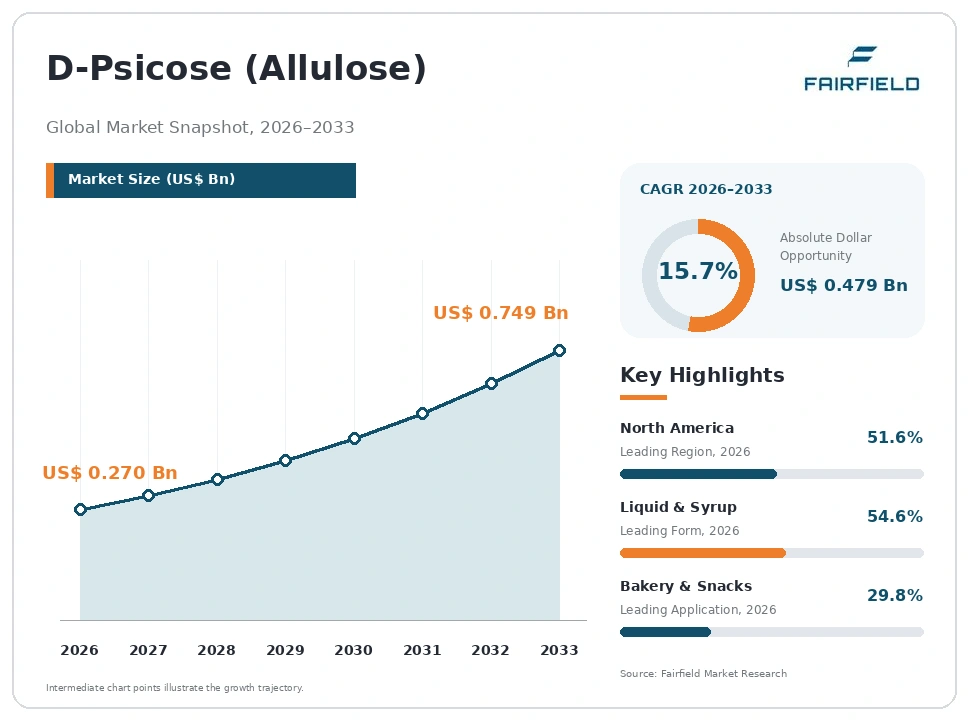
The global D-psicose market size is expected to be valued at US$ 0.270 billion in 2026 and projected to reach US$ 0.749 billion by 2033, growing at a CAGR of 15.7% between 2026 and 2033.
Between 2020 and 2025, the market grew at a CAGR of about 13.8%, after the U.S. Food and Drug Administration allowed D-psicose, also called allulose, to be excluded from total and added sugars on nutrition labels, sparking hundreds of new product launches. Three factors now drive growth: global sugar reduction goals and sugar taxes, consumer demand for low-calorie sweetener options that taste like sugar, and new regulatory approvals in Asia Pacific. The market is shifting from syrup to crystalline forms, expanding into beverages and nutraceuticals, and growing through keto-friendly and diabetic-friendly products made with this rare sugar.
Key Report Takeaways
- By Form: Liquid & Syrup held 54.6% share in 2026, while Crystalline & Powder is projected to expand at a 17.0% CAGR through 2033, driven by tabletop sweeteners, dry mixes, and confectionery.
- By Application: Bakery & Snacks held 29.8% share in 2026, while Pharmaceuticals & Nutraceuticals is projected to expand at a 19.2% CAGR through 2033, driven by syrups, gummies, and functional supplements.
- By Sales Channel: Food & Beverage Manufacturers held 82.4% share in 2026, while Retail & E-commerce is projected to expand at a 18.6% CAGR through 2033, driven by consumer-facing allulose sweetener brands.
- By Region: North America held 51.6% share in 2026, while Asia Pacific is projected to expand at a 17.6% CAGR through 2033, driven by approvals and production in China, South Korea, and Australia.
Global D-Psicose Market Trends and Insights
Drivers Impact Analysis
Two drivers carry the strongest influence on D-psicose demand during the forecast period.
| Driver | Impact on CAGR Forecast | Geographic Relevance | Impact Timeline |
| Sugar reduction policies and consumer health trends | High | North America, Asia Pacific, Latin America | Long term (≥4 years) |
| Favorable labeling and new regulatory approvals | High | North America, Asia Pacific | Medium term (2-4 years) |
Sugar Reduction Trends Are Driving the D-Psicose Market
Sugar reduction policies and consumer health trends are the strongest drivers of the D-psicose market. Food makers need sweeteners that cut sugar without changing taste or texture.
The mechanism is health concerns and regulation. Obesity, diabetes, and heart disease are rising worldwide, and health authorities such as the World Health Organization recommend limiting added sugars. More than 100 countries and cities have introduced sugar taxes on beverages. Allulose is about 70% as sweet as sugar but has only about 0.4 calories per gram, compared with 4 for sugar, and it does not raise blood glucose significantly. Unlike many high-intensity sweeteners, it browns, caramelizes, and adds bulk like sugar, making it useful in baking and confectionery. Keto-friendly, low-carb, and diabetic-friendly products are growing. The rise of GLP-1 weight-loss drugs is also increasing interest in lower-sugar foods.
Favorable Labeling and Approvals Are Expanding the D-Psicose Market
Favorable labeling and new regulatory approvals are expanding the D-psicose market. Rules determine where and how allulose can be sold and labeled.
The cause is regulatory recognition of allulose’s unique metabolism. The U.S. Food and Drug Administration recognizes allulose as generally recognized as safe and allows it to be excluded from total and added sugar counts, making it very attractive for sugar reduction claims. Mexico, Canada, Japan, South Korea, and Singapore also allow its use. Samyang Corporation received novel food approval from Food Standards Australia New Zealand in November 2024, and China has authorized D-allulose as a new food ingredient. Each new approval opens large markets to food, beverage, and supplement makers. Approvals in more countries also make global product launches easier for multinational brands. These regulatory gains support rapid volume growth.
Restraints Impact Analysis
Two restraints limit how quickly the D-psicose market grows.
| Restraint | Impact on CAGR Forecast | Geographic Relevance | Impact Timeline |
| Lack of European approval and regulatory uncertainty | High | Europe, Middle East & Africa | Medium term (2-4 years) |
| High production costs and digestive tolerance limits | Medium | Global | Short term (≤2 years) |
Lack of European Approval Slows the D-Psicose Market
The lack of European approval and regulatory uncertainty slow the D-psicose market. Europe is one of the world’s largest food markets, but allulose cannot yet be sold there as a food ingredient.
The specific causes are strict novel food rules and safety reviews. Under European Union rules, ingredients without a history of significant consumption before 1997 need novel food approval. An industry consortium including Tate & Lyle, Samyang Corporation, and Ingredion has sought approval for years. The European Food Safety Authority panel has concluded that the safety of D-allulose as a novel food cannot yet be established, and several applications remain pending. The United Kingdom also requires its own approval. Some countries in the Middle East & Africa region follow European Union rules. These delays block access to large markets and limit global brand launches.
High Costs and Tolerance Limits Restrict the D-Psicose Market
High production costs and digestive tolerance limits restrict the D-psicose market. Allulose is more expensive than sugar and many other sweeteners.
The underlying causes are complex production and physiological effects. Allulose is made by converting fructose with enzymes, followed by separation, purification, and crystallization, which add cost. It is several times more expensive than sugar per unit of sweetness. Crystalline allulose is harder to produce than syrup. Large doses can cause bloating or digestive discomfort in some people, limiting the amount used per serving. Competing sweeteners such as erythritol, stevia, monk fruit, and sucralose are cheaper and well established. Consumer awareness is still low; a survey found only 13% of U.S. respondents had heard of allulose. Supply is concentrated among a few producers, which can limit price competition. These factors limit wider adoption.
Market Opportunities
Beverages and Nutraceuticals Open a High-growth Revenue Pool
Beverages and nutraceuticals open a high-growth revenue pool in the D-psicose market. These products can use allulose to cut sugar while keeping mouthfeel and taste.
Ingredient suppliers and brand owners can capture this opportunity. Beverage makers use allulose in soft drinks, sports drinks, ready-to-drink coffee, and flavored waters to meet sugar tax thresholds. Nutraceutical and pharmaceutical companies use it in syrups, chewable tablets, gummies, and protein bars to improve taste without sugar. Blends with stevia and monk fruit balance sweetness, taste, and cost. Clinical research on blood sugar and metabolic benefits supports future health claims. Products for people with diabetes and those using GLP-1 drugs offer new markets. Suppliers with application laboratories and technical support for formulators can win long-term contracts with major brands.
New Capacity and Asia Pacific Markets Create a Volume Revenue Pool
New capacity and Asia Pacific markets create a volume revenue pool in the D-psicose market. Larger plants lower costs and support new regions.
Producers that scale efficiently can capture this opportunity. Samyang Corporation completed a plant in Ulsan, South Korea, with 13,000 tonnes of annual capacity in 2024, and Baolingbao Biology is expanding capacity in China. New enzyme technologies, such as producing allulose directly from starch, could lower costs. China’s approval opens the world’s largest food and beverage market. Australia, New Zealand, Japan, and South Korea have growing low-sugar product categories. Ingredion’s planned acquisition of Tate & Lyle could combine sweetener portfolios and distribution. Lower prices will help allulose compete with other sweeteners in mass-market products.
Segment Analysis
By Form: Liquid & Syrup Leads While Crystalline & Powder Grows Fastest
Liquid & Syrup held 54.6% share in 2026. Allulose syrup is easier and cheaper to produce than crystals and blends well into beverages, sauces, dairy products, and bakery fillings. Food manufacturers often prefer syrups for liquid processes. Tate & Lyle and Samyang Corporation supply large volumes of allulose syrup.
Crystalline & Powder is the fastest-growing form, expanding at a 17.0% CAGR through 2033. Crystalline allulose is used in tabletop sweeteners, powdered drink mixes, chocolate, baked goods, and supplements. Retail brands sell crystalline allulose directly to consumers for home baking and keto-friendly cooking. Improved crystallization processes are increasing supply. Blends with other sweeteners form a smaller segment. Crystalline allulose also improves texture in sugar-free chocolate and ice cream. For the market, crystalline growth expands applications and retail sales.
By Application: Bakery & Snacks Leads While Pharmaceuticals & Nutraceuticals Grow Fastest
Bakery & Snacks held 29.8% share in 2026. Allulose browns and caramelizes like sugar, providing color, texture, and moisture in baked goods, cookies, bars, and snacks. It lets bakers make reduced-sugar products without losing quality. Beverages, confectionery, and dairy and frozen desserts form other large applications.
Pharmaceuticals & Nutraceuticals is the fastest-growing application, expanding at a 19.2% CAGR through 2033. Allulose sweetens syrups, chewable tablets, gummies, and dietary supplements without adding sugar or raising blood glucose. Research into potential benefits for blood sugar control and fat metabolism supports interest. Diabetic nutrition products and sports supplements are growing uses. Pharmaceutical makers value its low reactivity and pleasant taste in children’s medicines. For the market, nutraceutical growth adds high-value demand.
By Sales Channel: Food & Beverage Manufacturers Lead While Retail & E-commerce Grows Fastest
Food & Beverage Manufacturers held 82.4% share in 2026. Most allulose is sold business-to-business to food, beverage, and supplement makers that use it as an ingredient. Large manufacturers sign supply contracts with producers such as Tate & Lyle, Samyang Corporation, and CJ CheilJedang. Ingredient distributors serve smaller manufacturers.
Retail & E-commerce is the fastest-growing sales channel, expanding at a 18.6% CAGR through 2033. Consumer brands sell allulose as a low-calorie sweetener for home use, coffee, and baking, often online. Keto-friendly and diabetic communities share recipes and product recommendations on social media. Supermarkets increasingly stock allulose sweeteners. Allulose is also sold in blends with monk fruit and stevia. For the market, retail growth raises consumer awareness.
Geography Analysis
Which Region Is Leading the D-Psicose Market?
North America is leading the D-psicose market with a 51.6% share in 2026. The United States was the first major market to allow allulose to be excluded from sugar labels, leading to hundreds of product launches in beverages, bakery, confectionery, and keto-friendly foods. Tate & Lyle produces allulose in Tennessee, and brands such as Quest Nutrition and RXBAR use it. Canada and Mexico also allow allulose. Strong low-carb and diabetic consumer communities support demand. Restaurant chains and coffee shops are testing allulose syrups for drinks. One change shaping the region is Ingredion’s planned acquisition of Tate & Lyle.
Europe Awaits the D-Psicose Market Opening
Europe is a potential D-psicose market that currently has very limited sales because allulose has not received novel food approval. The European Food Safety Authority has raised safety data questions, and several applications are pending. An industry consortium continues to seek approval. If approved, strong sugar reduction policies and sugar taxes in the United Kingdom, France, and other countries would drive rapid growth. Food makers in Germany and the Netherlands are interested in new sweeteners. Food makers already prepare reformulated recipes so they can launch quickly. Switzerland and Norway, outside the European Union, follow similar rules. One opportunity is rapid launches after approval.
Which Region Is Growing Fastest in the D-Psicose Market?
Asia Pacific is growing fastest in the D-psicose market at a 17.6% CAGR through 2033. South Korea hosts Samyang Corporation and CJ CheilJedang, and Japan hosts Matsutani Chemical Industry, a pioneer in rare sugars. China has authorized D-allulose and is home to Baolingbao Biology, which is expanding capacity. Australia and New Zealand approved allulose in 2024. Rising diabetes rates and low-sugar trends drive demand, and beverage makers in China have launched many sugar-free drinks. India and Singapore are reviewing or allowing new sweeteners. One opportunity is beverages in China, the world’s largest soft drink market by volume.
Latin America Grows the D-Psicose Market Through Mexico
Latin America is a growing D-psicose market. Mexico allows allulose and has high sugar taxes and front-of-pack warning labels that push food makers to reduce sugar. Brazil, Chile, and Colombia also have sugar reduction policies and warning labels. Multinational beverage and snack makers have reformulated many products in Mexico to avoid warning labels. Argentina and Peru have also adopted front-of-pack labeling. Local diabetes rates are high, increasing interest in low-sugar foods. Key barriers include regulatory approvals in some countries, import costs, and price. One opportunity is reduced-sugar beverages, dairy drinks, and snacks.
Middle East & Africa Explores the D-Psicose Market
Middle East & Africa is an early-stage D-psicose market. Saudi Arabia and the United Arab Emirates have high diabetes rates and excise taxes of up to 50% on sweetened drinks. South Africa has a health levy on sugary drinks that encourages reformulation, and Egypt and Morocco have growing processed food and beverage industries. Many countries across the region follow Codex Alimentarius or European Union guidance, which slows approval. Key barriers include limited approvals, low awareness, and higher prices than sugar. One opportunity is diabetic-friendly foods and beverages sold in Saudi Arabia and the United Arab Emirates.
Competitive Landscape
The D-psicose market is highly concentrated. Tate & Lyle leads with about 40% share through its US production and customer network, followed by Samyang Corporation with about 14% and CJ CheilJedang with about 9%. The top five, including Matsutani Chemical Industry and Baolingbao Biology, hold about 78%.
Companies compete on production cost, product purity, crystalline capacity, regulatory approvals, technical support, and supply reliability for large food brands. Patented enzyme technologies are an important advantage, since they determine yield and cost. Large ingredient companies offer allulose with other sweeteners, fibers, and texturants as part of complete sugar reduction solutions for customers. Asian producers compete mainly on cost and capacity, while Western suppliers focus on technical support, application know-how, and customer relationships. New entrants such as Bonumose are developing lower-cost production from starch, and Chinese producers are adding capacity that may lower global prices over time.
Strategic moves show how competition is changing across regions. In September 2024, Samyang Corporation completed a 13,000-tonne allulose plant in Ulsan. In November 2024, Samyang Corporation received approval in Australia and New Zealand. In June 2026, Ingredion announced a recommended acquisition of Tate & Lyle. These moves show competition shifting toward manufacturing scale, regional expansion, and broader sweetener portfolios.
Three themes shape vendor strategy. First, companies are expanding crystalline and syrup capacity. Second, they are seeking new regulatory approvals, especially in Europe and India. Third, they are consolidating to offer broader sweetener portfolios.
D-Psicose Market Industry Leaders
- Tate & Lyle
- Samyang Corporation
- CJ CheilJedang
- Matsutani Chemical Industry
- Baolingbao Biology
Recent Industry Developments
- June 2026: Ingredion announced a recommended all-cash acquisition of Tate & Lyle, valued at about £3.7 billion - would combine leading sweetener and texturant portfolios.
- November 2024: Samyang Corporation received novel food approval for allulose from Food Standards Australia New Zealand - the first allulose supplier approved in the region.
- September 2024: Samyang Corporation completed an allulose plant in Ulsan with 13,000 tonnes of annual capacity - South Korea’s largest allulose facility.
Companies Covered in the Report
- Tate & Lyle
- Samyang Corporation
- CJ CheilJedang
- Matsutani Chemical Industry
- Baolingbao Biology
- Ingredion
- Bonumose
- Anderson Advanced Ingredients
- Shandong Bailong Chuangyuan
- Daesang
- Apura Ingredients
- Savanna Ingredients
D-Psicose Market Report Scope
This report covers D-psicose, also known as allulose, in liquid and syrup, crystalline and powder, and blended forms, used in bakery and snacks, beverages, confectionery, dairy and frozen desserts, and pharmaceuticals and nutraceuticals, sold to food and beverage manufacturers and through retail and e-commerce. It excludes other rare sugars such as tagatose. The base year is 2025, and the forecast period runs from 2026 to 2033. All values are expressed in US$ Billion.
Form
- Liquid & Syrup
- Crystalline & Powder
- Blends
Application
- Bakery & Snacks
- Beverages
- Confectionery
- Dairy & Frozen Desserts
- Pharmaceuticals & Nutraceuticals
Sales Channel
- Food & Beverage Manufacturers
- Retail & E-commerce
Regions
- North America
- Europe
- Asia Pacific
- Latin America
- Middle East & Africa
Key Questions Answered in the Report
How big is the D-psicose market in 2026?
The D-psicose market is valued at US$ 0.270 billion in 2026, led by liquid allulose syrup for food and beverage manufacturers.
What is the D-psicose market forecast to 2033?
The market is projected to reach US$ 0.749 billion by 2033, growing at a 15.7% CAGR and adding US$ 0.479 billion.
Which application is growing fastest in the D-psicose market?
Pharmaceuticals & Nutraceuticals is growing fastest at a 19.2% CAGR through 2033, driven by syrups, gummies, and functional supplements.
Which region is growing fastest in the D-psicose market?
Asia Pacific is growing fastest at a 17.6% CAGR through 2033, driven by approvals and production in China and South Korea.
Which region holds the largest D-psicose market share?
North America holds the largest share at 51.6% in 2026, supported by favorable sugar labeling rules in the United States.
1. Executive Summary
1.1. Global D-Psicose Market Snapshot
1.2. Future Projections
1.3. Key Report Takeaways
1.4. Regional Snapshot
2. Market Overview
2.1. Market Definition and Report Scope
2.2. Historical Trends 2020–2025
2.3. Market Dynamics
2.3.1. Drivers
2.3.1.1. Sugar Reduction Trends Are Driving the D-Psicose Market
2.3.1.2. Favorable Labeling and Approvals Are Expanding the D-Psicose Market
2.3.2. Restraints
2.3.2.1. Lack of European Approval Slows the D-Psicose Market
2.3.2.2. High Costs and Tolerance Limits Restrict the D-Psicose Market
2.3.3. Market Opportunities
2.3.3.1. Beverages and Nutraceuticals Open a High-growth Revenue Pool
2.3.3.2. New Capacity and Asia Pacific Markets Create a Volume Revenue Pool
3. Global D-Psicose Market Outlook, 2020-2033
3.1. Global D-Psicose Market Outlook, by Form, Value (US$ Billion), 2020-2033
3.1.1. Liquid & Syrup
3.1.2. Crystalline & Powder
3.1.3. Blends
3.2. Global D-Psicose Market Outlook, by Application, Value (US$ Billion), 2020-2033
3.2.1. Bakery & Snacks
3.2.2. Beverages
3.2.3. Confectionery
3.2.4. Dairy & Frozen Desserts
3.2.5. Pharmaceuticals & Nutraceuticals
3.3. Global D-Psicose Market Outlook, by Sales Channel, Value (US$ Billion), 2020-2033
3.3.1. Food & Beverage Manufacturers
3.3.2. Retail & E-commerce
3.4. Global D-Psicose Market Outlook, by Region, Value (US$ Billion), 2020-2033
3.4.1. North America
3.4.2. Europe
3.4.3. Asia Pacific
3.4.4. Latin America
3.4.5. Middle East & Africa
4. North America D-Psicose Market Outlook, 2020-2033
4.1. North America D-Psicose Market Outlook, by Form, Value (US$ Billion), 2020-2033
4.1.1. Liquid & Syrup
4.1.2. Crystalline & Powder
4.1.3. Blends
4.2. North America D-Psicose Market Outlook, by Application, Value (US$ Billion), 2020-2033
4.2.1. Bakery & Snacks
4.2.2. Beverages
4.2.3. Confectionery
4.2.4. Dairy & Frozen Desserts
4.2.5. Pharmaceuticals & Nutraceuticals
4.3. North America D-Psicose Market Outlook, by Sales Channel, Value (US$ Billion), 2020-2033
4.3.1. Food & Beverage Manufacturers
4.3.2. Retail & E-commerce
4.4. North America D-Psicose Market Outlook, by Country, Value (US$ Billion), 2020-2033
4.4.1. United States D-Psicose Market Outlook, by Form, 2020-2033
4.4.2. United States D-Psicose Market Outlook, by Application, 2020-2033
4.4.3. United States D-Psicose Market Outlook, by Sales Channel, 2020-2033
4.4.4. Canada D-Psicose Market Outlook, by Form, 2020-2033
4.4.5. Canada D-Psicose Market Outlook, by Application, 2020-2033
4.4.6. Canada D-Psicose Market Outlook, by Sales Channel, 2020-2033
4.4.7. Mexico D-Psicose Market Outlook, by Form, 2020-2033
4.4.8. Mexico D-Psicose Market Outlook, by Application, 2020-2033
4.4.9. Mexico D-Psicose Market Outlook, by Sales Channel, 2020-2033
5. Europe D-Psicose Market Outlook, 2020-2033
5.1. Europe D-Psicose Market Outlook, by Form, Value (US$ Billion), 2020-2033
5.1.1. Liquid & Syrup
5.1.2. Crystalline & Powder
5.1.3. Blends
5.2. Europe D-Psicose Market Outlook, by Application, Value (US$ Billion), 2020-2033
5.2.1. Bakery & Snacks
5.2.2. Beverages
5.2.3. Confectionery
5.2.4. Dairy & Frozen Desserts
5.2.5. Pharmaceuticals & Nutraceuticals
5.3. Europe D-Psicose Market Outlook, by Sales Channel, Value (US$ Billion), 2020-2033
5.3.1. Food & Beverage Manufacturers
5.3.2. Retail & E-commerce
5.4. Europe D-Psicose Market Outlook, by Country, Value (US$ Billion), 2020-2033
5.4.1. United Kingdom D-Psicose Market Outlook, by Form, 2020-2033
5.4.2. United Kingdom D-Psicose Market Outlook, by Application, 2020-2033
5.4.3. United Kingdom D-Psicose Market Outlook, by Sales Channel, 2020-2033
5.4.4. France D-Psicose Market Outlook, by Form, 2020-2033
5.4.5. France D-Psicose Market Outlook, by Application, 2020-2033
5.4.6. France D-Psicose Market Outlook, by Sales Channel, 2020-2033
5.4.7. Germany D-Psicose Market Outlook, by Form, 2020-2033
5.4.8. Germany D-Psicose Market Outlook, by Application, 2020-2033
5.4.9. Germany D-Psicose Market Outlook, by Sales Channel, 2020-2033
5.4.10. Netherlands D-Psicose Market Outlook, by Form, 2020-2033
5.4.11. Netherlands D-Psicose Market Outlook, by Application, 2020-2033
5.4.12. Netherlands D-Psicose Market Outlook, by Sales Channel, 2020-2033
5.4.13. Switzerland D-Psicose Market Outlook, by Form, 2020-2033
5.4.14. Switzerland D-Psicose Market Outlook, by Application, 2020-2033
5.4.15. Switzerland D-Psicose Market Outlook, by Sales Channel, 2020-2033
5.4.16. Norway D-Psicose Market Outlook, by Form, 2020-2033
5.4.17. Norway D-Psicose Market Outlook, by Application, 2020-2033
5.4.18. Norway D-Psicose Market Outlook, by Sales Channel, 2020-2033
6. Asia Pacific D-Psicose Market Outlook, 2020-2033
6.1. Asia Pacific D-Psicose Market Outlook, by Form, Value (US$ Billion), 2020-2033
6.1.1. Liquid & Syrup
6.1.2. Crystalline & Powder
6.1.3. Blends
6.2. Asia Pacific D-Psicose Market Outlook, by Application, Value (US$ Billion), 2020-2033
6.2.1. Bakery & Snacks
6.2.2. Beverages
6.2.3. Confectionery
6.2.4. Dairy & Frozen Desserts
6.2.5. Pharmaceuticals & Nutraceuticals
6.3. Asia Pacific D-Psicose Market Outlook, by Sales Channel, Value (US$ Billion), 2020-2033
6.3.1. Food & Beverage Manufacturers
6.3.2. Retail & E-commerce
6.4. Asia Pacific D-Psicose Market Outlook, by Country, Value (US$ Billion), 2020-2033
6.4.1. South Korea D-Psicose Market Outlook, by Form, 2020-2033
6.4.2. South Korea D-Psicose Market Outlook, by Application, 2020-2033
6.4.3. South Korea D-Psicose Market Outlook, by Sales Channel, 2020-2033
6.4.4. Japan D-Psicose Market Outlook, by Form, 2020-2033
6.4.5. Japan D-Psicose Market Outlook, by Application, 2020-2033
6.4.6. Japan D-Psicose Market Outlook, by Sales Channel, 2020-2033
6.4.7. China D-Psicose Market Outlook, by Form, 2020-2033
6.4.8. China D-Psicose Market Outlook, by Application, 2020-2033
6.4.9. China D-Psicose Market Outlook, by Sales Channel, 2020-2033
6.4.10. Australia D-Psicose Market Outlook, by Form, 2020-2033
6.4.11. Australia D-Psicose Market Outlook, by Application, 2020-2033
6.4.12. Australia D-Psicose Market Outlook, by Sales Channel, 2020-2033
6.4.13. New Zealand D-Psicose Market Outlook, by Form, 2020-2033
6.4.14. New Zealand D-Psicose Market Outlook, by Application, 2020-2033
6.4.15. New Zealand D-Psicose Market Outlook, by Sales Channel, 2020-2033
6.4.16. India D-Psicose Market Outlook, by Form, 2020-2033
6.4.17. India D-Psicose Market Outlook, by Application, 2020-2033
6.4.18. India D-Psicose Market Outlook, by Sales Channel, 2020-2033
6.4.19. Singapore D-Psicose Market Outlook, by Form, 2020-2033
6.4.20. Singapore D-Psicose Market Outlook, by Application, 2020-2033
6.4.21. Singapore D-Psicose Market Outlook, by Sales Channel, 2020-2033
7. Latin America D-Psicose Market Outlook, 2020-2033
7.1. Latin America D-Psicose Market Outlook, by Form, Value (US$ Billion), 2020-2033
7.1.1. Liquid & Syrup
7.1.2. Crystalline & Powder
7.1.3. Blends
7.2. Latin America D-Psicose Market Outlook, by Application, Value (US$ Billion), 2020-2033
7.2.1. Bakery & Snacks
7.2.2. Beverages
7.2.3. Confectionery
7.2.4. Dairy & Frozen Desserts
7.2.5. Pharmaceuticals & Nutraceuticals
7.3. Latin America D-Psicose Market Outlook, by Sales Channel, Value (US$ Billion), 2020-2033
7.3.1. Food & Beverage Manufacturers
7.3.2. Retail & E-commerce
7.4. Latin America D-Psicose Market Outlook, by Country, Value (US$ Billion), 2020-2033
7.4.1. Mexico D-Psicose Market Outlook, by Form, 2020-2033
7.4.2. Mexico D-Psicose Market Outlook, by Application, 2020-2033
7.4.3. Mexico D-Psicose Market Outlook, by Sales Channel, 2020-2033
7.4.4. Brazil D-Psicose Market Outlook, by Form, 2020-2033
7.4.5. Brazil D-Psicose Market Outlook, by Application, 2020-2033
7.4.6. Brazil D-Psicose Market Outlook, by Sales Channel, 2020-2033
7.4.7. Chile D-Psicose Market Outlook, by Form, 2020-2033
7.4.8. Chile D-Psicose Market Outlook, by Application, 2020-2033
7.4.9. Chile D-Psicose Market Outlook, by Sales Channel, 2020-2033
7.4.10. Colombia D-Psicose Market Outlook, by Form, 2020-2033
7.4.11. Colombia D-Psicose Market Outlook, by Application, 2020-2033
7.4.12. Colombia D-Psicose Market Outlook, by Sales Channel, 2020-2033
7.4.13. Argentina D-Psicose Market Outlook, by Form, 2020-2033
7.4.14. Argentina D-Psicose Market Outlook, by Application, 2020-2033
7.4.15. Argentina D-Psicose Market Outlook, by Sales Channel, 2020-2033
7.4.16. Peru D-Psicose Market Outlook, by Form, 2020-2033
7.4.17. Peru D-Psicose Market Outlook, by Application, 2020-2033
7.4.18. Peru D-Psicose Market Outlook, by Sales Channel, 2020-2033
8. Middle East & Africa D-Psicose Market Outlook, 2020-2033
8.1. Middle East & Africa D-Psicose Market Outlook, by Form, Value (US$ Billion), 2020-2033
8.1.1. Liquid & Syrup
8.1.2. Crystalline & Powder
8.1.3. Blends
8.2. Middle East & Africa D-Psicose Market Outlook, by Application, Value (US$ Billion), 2020-2033
8.2.1. Bakery & Snacks
8.2.2. Beverages
8.2.3. Confectionery
8.2.4. Dairy & Frozen Desserts
8.2.5. Pharmaceuticals & Nutraceuticals
8.3. Middle East & Africa D-Psicose Market Outlook, by Sales Channel, Value (US$ Billion), 2020-2033
8.3.1. Food & Beverage Manufacturers
8.3.2. Retail & E-commerce
8.4. Middle East & Africa D-Psicose Market Outlook, by Country, Value (US$ Billion), 2020-2033
8.4.1. Saudi Arabia D-Psicose Market Outlook, by Form, 2020-2033
8.4.2. Saudi Arabia D-Psicose Market Outlook, by Application, 2020-2033
8.4.3. Saudi Arabia D-Psicose Market Outlook, by Sales Channel, 2020-2033
8.4.4. United Arab Emirates D-Psicose Market Outlook, by Form, 2020-2033
8.4.5. United Arab Emirates D-Psicose Market Outlook, by Application, 2020-2033
8.4.6. United Arab Emirates D-Psicose Market Outlook, by Sales Channel, 2020-2033
8.4.7. South Africa D-Psicose Market Outlook, by Form, 2020-2033
8.4.8. South Africa D-Psicose Market Outlook, by Application, 2020-2033
8.4.9. South Africa D-Psicose Market Outlook, by Sales Channel, 2020-2033
8.4.10. Egypt D-Psicose Market Outlook, by Form, 2020-2033
8.4.11. Egypt D-Psicose Market Outlook, by Application, 2020-2033
8.4.12. Egypt D-Psicose Market Outlook, by Sales Channel, 2020-2033
8.4.13. Morocco D-Psicose Market Outlook, by Form, 2020-2033
8.4.14. Morocco D-Psicose Market Outlook, by Application, 2020-2033
8.4.15. Morocco D-Psicose Market Outlook, by Sales Channel, 2020-2033
9. Competitive Landscape
9.1. Market Concentration and Industry Leaders
9.2. Competitive Differentiation
9.3. Strategic Moves and Market Direction
9.4. Recent Industry Developments
9.5. Company Profiles
9.5.1. Tate & Lyle
9.5.2. Samyang Corporation
9.5.3. CJ CheilJedang
9.5.4. Matsutani Chemical Industry
9.5.5. Baolingbao Biology
9.5.6. Ingredion
9.5.7. Bonumose
9.5.8. Anderson Advanced Ingredients
9.5.9. Shandong Bailong Chuangyuan
9.5.10. Daesang
9.5.11. Apura Ingredients
9.5.12. Savanna Ingredients
10. Appendix
10.1. Research Methodology
10.2. Report Assumptions
10.3. Acronyms and Abbreviations
| Segment | Categories |
|---|---|
| Form | Liquid & Syrup, Crystalline & Powder, Blends |
| Application | Bakery & Snacks, Beverages, Confectionery, Dairy & Frozen Desserts, Pharmaceuticals & Nutraceuticals |
| Sales Channel | Food & Beverage Manufacturers, Retail & E-commerce |
| Regions | North America, Europe, Asia Pacific, Latin America, Middle East & Africa |
Our Research Methodology
Considering the volatility of business today, traditional approaches to strategizing a game plan can be unfruitful if not detrimental. True ambiguity is no way to determine a forecast. A myriad of predetermined factors must be accounted for such as the degree of risk involved, the magnitude of circumstances, as well as conditions or consequences that are not known or unpredictable. To circumvent binary views that cast uncertainty, the application of market research intelligence to strategically posture, move, and enable actionable outcomes is necessary.
View Methodology
Quality Assured
Rigorous Validation Process

Confidentiality Assured
End-to-end Data Security

Custom Research Services
Tailored To Your Objectives
FAQs
The D-psicose market is valued at US$ 0.270 billion in 2026, led by liquid allulose syrup for food and beverage manufacturers.
The market is projected to reach US$ 0.749 billion by 2033, growing at a 15.7% CAGR and adding US$ 0.479 billion.
Pharmaceuticals & Nutraceuticals is growing fastest at a 19.2% CAGR through 2033, driven by syrups, gummies, and functional supplements.
Asia Pacific is growing fastest at a 17.6% CAGR through 2033, driven by approvals and production in China and South Korea.
North America holds the largest share at 51.6% in 2026, supported by favorable sugar labeling rules in the United States.
Related Reports
Corrosion Protection Coatings Market Size, Share, Insights, Competitive Landscape, and Forecast 2026 to 2033
Explore the corrosion protection coatings market outlook for 2026–2033, including resin trends, application methods, regional demand, and key suppliers.
Coated Abrasives Market Size, Share, Insights, Competitive Landscape, and Forecast 2026 to 2033
The coated abrasives market is projected to grow from US$13.4 billion in 2026 to US$19.0 billion by 2033 at a 5.1% CAGR.
Aerosol Propellants Market Size, Share, Insights, Competitive Landscape, and Forecast 2026 to 2033
The aerosol propellants market is projected to grow from US$11.90 billion in 2026 to US$16.63 billion by 2033 at a 4.9% CAGR.
Marine Oligosaccharides Market Size, Share, Insights, Competitive Landscape, and Forecast 2026 to 2033
The marine oligosaccharides market is projected to grow from US$0.3 billion in 2026 to US$0.6 billion by 2033 at a 10.4% CAGR.
Liquid Crystal Polymer Market Size, Share, Insights, Competitive Landscape, and Forecast 2026 to 2033
The global liquid crystal polymer market is valued at US$1.5 billion in 2026, reaching US$2.7 billion by 2033, growing at an 8.8% CAGR
Lignin Based Resins Market Size, Share, Insights, Competitive Landscape, and Forecast 2026 to 2033
The global lignin based resins market is valued at US$0.9 billion in 2026, reaching US$1.5 billion by 2033, growing at a 7.6% CAGR