



Artificial Intelligence Market
Artificial Intelligence Market Insights, Competitive Landscape, and Market Forecast - 2033
Global Artificial Intelligence Market Forecast
The Artificial Intelligence Market is expected to grow from USD 370 billion in 2026 to USD 2060.2 billion by 2033, reflecting strong industry expansion and registering a CAGR of 27.8% during the forecast period from 2026 to 2033.
Artificial Intelligence Market Summary: Key Insights & Trends
- Cloud AI dominates with over 60% share, driven by scalability, flexibility, and widespread adoption across BFSI, retail, and healthcare sectors.
- On-premises deployment holds nearly 27% share, gaining traction as enterprises prioritize data sovereignty, security, and compliance.
- Large enterprises lead with over 65% market share, leveraging advanced ML and NLP tools for automation, analytics, and enterprise-wide intelligence.
- SMEs account for around 30% share, supported by SaaS and no-code AI platforms that democratize access to affordable and scalable AI solutions.
- BFSI remains the top vertical with ~20% share, while healthcare rapidly expands its presence through AI-driven diagnostics and telemedicine.
- AI software captures about 40% share, with services steadily expanding as consulting and integration drive broader adoption among non-tech users.
- Machine Learning leads technologies with ~37% share, followed by NLP at roughly 30%, reflecting strong demand for predictive and conversational AI.
- North America commands ~38% of global share, while Asia Pacific, at nearly 31%, continues to emerge as the fastest-growing regional market.
Key Growth Drivers
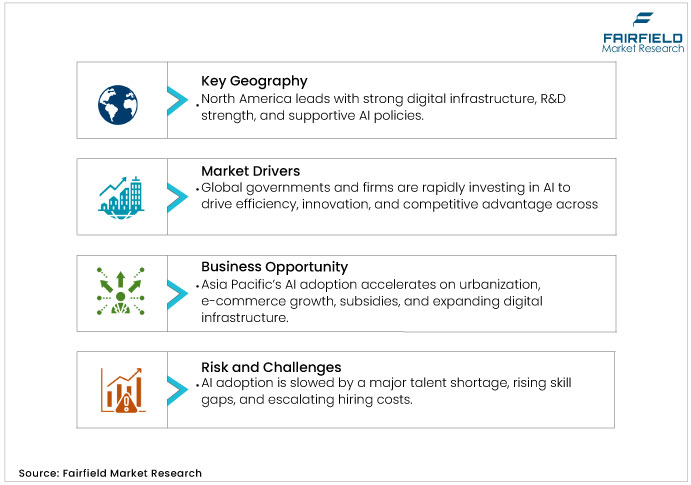
- Global Surge in AI Infrastructure Funding Accelerates Innovation and Efficiency
Governments and corporations globally are pouring resources into AI to boost operational efficiency and innovation. Several national programmes now run into multiple tens of billions of USD over the coming years. In industrial operations, AI-enabled predictive maintenance and optimisation have demonstrated cost reductions on the order of 20-40%, and downtime reductions of up to 50% or more. Theoretical methods from reinforcement learning and game theory are increasingly applied in supply-chain and resource-allocation settings, helping justify continued investment as firms seek competitive advantages in dynamic environments. This drives a virtuous investment cycle: better algorithms attract more capital, accelerating R&D and embedding AI more deeply in strategy and operations.
- AI Revolutionizes Healthcare Through Predictive Analytics and Personalized Treatment
Healthcare has emerged as a cornerstone for AI adoption, driven by the need to enhance diagnostic accuracy and operational efficiency amid ageing populations and workforce shortages. AI-powered predictive analytics are increasingly used to personalize treatments and support early disease detection, with studies showing diagnostic accuracy improvements ranging between 15% and 30% in radiology and pathology applications. The rising adoption of AI-based remote monitoring tools and virtual health assistants reflects a demographic shift toward chronic care management and elderly support. Evidence from pilot programs indicates that AI-enabled predictive models reduce hospital readmissions by up to 20% through proactive interventions. As ethical and regulatory frameworks mature, healthcare providers are increasingly integrating explainable and privacy-compliant AI solutions to ensure transparency, strengthen patient trust, and align with global data protection standards.
Key Restraints
- Talent Deficit and Rising Hiring Costs Slow Global AI Deployment
The market continues to face a pronounced talent shortage that hampers large-scale implementation. Studies show that around 37% of organizations cite the lack of skilled AI professionals as a major barrier to adoption in 2025. The shortage is driven by rapid technological evolution outpacing workforce training, leaving demand far above supply. According to IBM, the AI talent gap exceeds 50% globally, while salary premiums for AI-skilled workers have risen by up to 30–50% in key markets. This fierce competition inflates hiring costs and delays project execution, constraining AI deployment, particularly across emerging economies.
- Compliance Challenges and Algorithmic Bias Hamper AI Adoption Across Industries
Regulatory uncertainties pose significant barriers in the Artificial Intelligence Market, as frameworks lag behind innovation paces. Bias in algorithms, rooted in flawed training data theories, raises fairness concerns, with 55% of enterprises delaying deployments due to compliance fears in 2025. Governments impose stringent data governance, increasing operational overheads and slowing adoption, particularly in sensitive verticals such as finance.
Artificial Intelligence Market Trends and Opportunities
- Rapid Digital Transformation and Government Support Drive AI Growth in Asia Pacific
The artificial intelligence market holds vast potential in the Asia Pacific, where digital transformation accelerates adoption. Regional AI investments are forecasted to surge 25% in 2025, driven by urbanization and e-commerce booms in countries such as India and South Korea. Theoretically, this leverages comparative advantage, as low-cost data centres enable affordable AI solutions for SMEs. Governments fuel this via subsidies. India's $1.2 billion AI mission aims to strengthen AI infrastructure, promote indigenous models, and generate millions of new digital jobs. In logistics, AI-driven predictive systems are improving supply chain visibility and reducing operational inefficiencies by up to 10–12%. In agriculture, AI-enabled analytics are enhancing crop management and boosting yields by 10–15% in pilot projects across rice and wheat farms. As infrastructure matures, the AI market could capture 35% global share here by 2030, blending local innovation with international partnerships for sustainable growth.
- AI-IoT Convergence Enhances Real-Time Intelligence and Operational Efficiency
IoT-AI synergy unlocks opportunities by enabling real-time decision-making at the edge. By 2025, connected devices will number over 21 billion, generating massive data volumes processed locally through AI to reduce latency by 30–40% compared to traditional cloud-based systems. This convergence embodies network effects theory, where interconnected systems amplify value exponentially. In manufacturing, predictive maintenance powered by edge AI is estimated to reduce unplanned downtime by up to 50% and cut maintenance costs by 20–25% annually. The automotive sector is steadily advancing toward autonomy, with Level 4 vehicles expected to achieve limited commercial deployment after 2026, supported by 5G connectivity. Privacy gains from on-device processing align with regulations, while 5G rollout enhances scalability. Theoretically, it shifts from centralized clouds to distributed intelligence, empowering remote applications in energy grids.
Segment-wise Trends & Analysis
- Cloud AI Leads Adoption While On-Premises Gains from Data Sovereignty Trends
Cloud dominates the deployment segment, capturing approximately 60% share in 2025. Its leadership stems from scalability and cost-efficiency, enabling seamless integration for data-intensive applications. Public cloud hyperscalers, led by AWS, Azure, and Google Cloud, collectively manage over 55% of global cloud infrastructure workloads.
On-premises emerges as a fast-growing option, projected to expand at a 24% CAGR amid rising data sovereignty concerns. Drivers include regulatory compliance in defense sectors, where localized control mitigates risks. Theoretically, hybrid models bridge gaps, but on-premises appeals to enterprises prioritizing security, reshaping competitive dynamics toward specialized hardware providers.
- Large Enterprises Dominate AI Adoption as SMEs Accelerate Through SaaS Access
Large enterprises lead the market with ~65% share in 2025, leveraging vast resources for comprehensive AI rollouts. Their dominance reflects mature IT infrastructures supporting complex deployments, with 42% already operationalizing AI. Positioning emphasizes enterprise-grade solutions from IBM and Oracle.
SMEs represent the emerging segment, growing at a robust CAGR due to accessible SaaS models democratizing AI. Cost barriers diminish via no-code platforms, driving adoption in niche verticals. This trajectory challenges incumbents, favoring agile vendors such as Okta in tailored offerings.
- BFSI Maintains Leadership While Healthcare Emerges as Fastest-Growing AI User
BFSI commands over 20% share in the Artificial Intelligence Market in 2025, fueled by fraud detection and personalization needs. Leadership arises from high-stakes data environments, with AI enhancing risk models theoretically grounded in probabilistic computing. Competitors such as Microsoft hold strong positions via integrated fintech suites.
Healthcare surges as a fast-growing industry, driven by diagnostic tools and telemedicine. Theoretical neural network advancements enable precise imaging, positioning innovators such as IBM Watson as frontrunners amid regulatory tailwinds.
- Marketing & Sales Drive AI Utilization as Security Rapidly Gains Momentum
Marketing & Sales leads with ~30% share in 2025, harnessing AI for targeted campaigns and customer insights. Organisations using AI in sales report that 83% of sales teams with AI achieved revenue growth, compared to 66% of teams without. Targeted personalisation and AI-driven optimisation are helping improve conversion rates by about 20-30%.
Security emerges rapidly, growing at a sustainable CAGR, propelled by cyber threat evolution. Anomaly detection models justify investments, with Cisco leading in proactive defenses, altering competitive landscapes toward AI-native security firms.
- AI Software Leads Market Share While Services Bridge Implementation Gaps
Software spearheads the artificial intelligence market offerings at ~40% share in 2025, offering versatile platforms for model deployment. Leadership reflects modular architectures enabling customization, with Google Cloud capturing 10-15% via open-source tools. Theoretical API ecosystems enhance interoperability.
Services grow fastest at a robust CAGR, addressing implementation complexities for non-tech firms. Consulting models bridge skill gaps, positioning Deloitte-such as players advantageously in bespoke solutions.
- Machine Learning Dominates Core Applications While NLP Expands Conversational AI
Machine Learning (ML) holds ~37% share in 2025, fueled by supervised and deep learning models that enhance predictive analytics and decision automation across industries. NVIDIA’s GPU advancements continue to optimize model training and inference speeds, achieving up to 30–35% faster performance in enterprise AI workloads.
Natural Language Processing (NLP) accelerates as emerging, with a sustainable CAGR from conversational AI demand. Semantic analysis theories drive chatbots, favoring OpenAI in generative applications and intensifying rivalry.
Regional Trends & Analysis
North America Retains AI Leadership Backed by Robust Infrastructure and R&D Investments
North America maintains market leadership with approximately 38% share in 2025, supported by advanced digital infrastructure, substantial R&D investments, and favorable government initiatives. The region benefits from the presence of major technology companies, including Microsoft, Google, Amazon, IBM, and NVIDIA, which collectively drive innovation and market development. Federal funding programs and strategic policy frameworks create supportive environments for AI development and deployment across enterprises.
U.S. Artificial Intelligence Market – 2025 Snapshot & Outlook
The U.S. dominates North American AI leadership through comprehensive government initiatives and substantial private sector investments. America's AI Action Plan, launched in July 2025 establishes sweeping federal policies eliminating regulatory barriers while promoting infrastructure development and talent cultivation. The CHIPS and Science Act provides significant funding for AI-ready semiconductor facilities, supporting domestic supply chains and technological independence. Major technology companies, including Microsoft, Google, Amazon, and IBM, maintain global AI leadership through continuous innovation and strategic partnerships. Enterprise adoption accelerates across healthcare, finance, manufacturing, and retail sectors, driven by cloud-native AI platform accessibility. Government agencies implement AI-first strategies while federal programs support workforce development and research initiatives.
Asia Pacific Emerges as Fastest-Growing Hub Driven by Government AI Investments
Asia Pacific represents the fastest-growing regional market, projected to register a 36.8% CAGR through 2030. The region benefits from substantial government investments, thriving startup ecosystems, and increasing automation adoption across industries. China has reportedly planned a support package exceeding RMB 1 trillion to bolster its domestic semiconductor industry, primarily through initiatives such as the China Integrated Circuit Industry Investment Fund (“Big Fund”), whose third phase, launched in 2024, has a registered capital of RMB 344 billion.
Japan Artificial Intelligence Market – 2025 Snapshot & Outlook
Japan strengthens AI capabilities through strategic international partnerships and substantial investment commitments toward emerging markets. The government commits ¥10 trillion ($68 billion) in private-sector investment toward India over the next decade, focusing on semiconductors, AI technology, and talent exchange programs. Japan addresses domestic skilled worker shortages by partnering with talent-rich markets while establishing AI research collaboration frameworks. Major corporations adopt "China Plus One" strategies, redirecting investments toward India and Southeast Asia to diversify supply chains and leverage competitive advantages. Japanese firms increasingly explore AI applications across manufacturing, healthcare, and financial services sectors.
India Artificial Intelligence Market – 2025 Snapshot & Outlook
India emerges as a major AI investment destination, ranking 7th globally with $11.1 billion in total AI investments. The India AI Mission allocates Rs 10,372 crore over five years to build a comprehensive AI infrastructure, including over 10,000 GPUs. Government initiatives support AI development across public health, education, and governance sectors while promoting startup innovation. Indian organizations demonstrate strong AI adoption intent, with 93% planning to increase investments in 2025. The market is projected to be valued at $21.4 billion by 2025. Healthcare leader Apollo Hospitals plans to double AI investments, exemplifying enterprise-level commitment to AI transformation.
Europe Advances AI Governance and Innovation Through Unified Policy Frameworks
Europe demonstrates significant AI market development with projected values reaching €51.2 billion in 2025. The European Union is implementing the AI Act, establishing one of the world’s most comprehensive governance frameworks while promoting innovation through regulatory sandboxes and R&D funding. Leading markets such as the UK, Germany, and France are driving adoption, supported by dynamic startup ecosystems, significant enterprise investments, and government-backed AI strategies fostering competitiveness and responsible growth across the region.
Germany Artificial Intelligence Market – 2025 Snapshot & Outlook
Germany continues to expand rapidly, driven by strong industrial capabilities and growing enterprise adoption. In 2023, the number of AI-focused startups generating revenue rose by 67%, reaching 508, according to the U.S. Commercial Service. The country leverages a strong manufacturing heritage and engineering expertise to develop industry-specific AI applications. German enterprises increasingly adopt AI for automation, predictive maintenance, and supply chain optimization across automotive and industrial sectors. Government support programs and EU-level initiatives provide favorable environments for AI innovation and international collaboration.
France Artificial Intelligence Market – 2025 Snapshot & Outlook
France leads European AI funding with €1.9 billion raised in 2024, representing approximately half of total European AI investment. The country demonstrates strong government support through substantial AI strategy investments and public-private partnerships. Mistral AI achieved €600 million funding in 2024, exemplifying French AI innovation capabilities and international competitiveness. French enterprises across telecommunications, aerospace, and energy sectors increasingly deploy AI solutions for operational optimization and customer service enhancement.
Competitive Landscape Analysis
The players in the artificial intelligence market are focusing on strategic partnerships to accelerate innovation and market penetration. This approach counters fragmentation by pooling expertise, as evidenced by OpenAI’s 2025 collaboration with Google Cloud, expanding its access to multi-cloud infrastructure and reinforcing global compute availability. Such alliances underscore the industry’s shift toward ecosystem-based scalability, with cross-cloud and AI infrastructure partnerships increasing steadily as vendors seek efficiency and interoperability advantages.
M&A activity and regulatory reforms are reshaping the AI landscape. Google’s USD 32 billion acquisition of Wiz strengthens its cybersecurity and cloud portfolio, positioning it to enhance trust in enterprise AI adoption. The EU Artificial Intelligence Act, which came into force in 2025, introduces new transparency and compliance requirements for high-risk AI systems, likely increasing short-term compliance costs but creating fresh opportunities for ethical AI and governance solution providers.
Key Companies
- Cisco Systems
- Microsoft Corporation
- Sailpoint Technologies
- Oracle
- DELL
- IBM
- HITACHI
- CA Technologies
- Okta
- Micro Focus
- Centrify Corp
Global Artificial Intelligence Market Segmentation
By Deployment
- On-Premises
- Cloud
By Organization Size
- Small and Medium Enterprises
- Large Enterprises
By Vertical
- BFSI
- Government & Defense
- Manufacturing
- Healthcare
- Retail & E commerce
- Transportation & Logistics
- Others
By Business Function
- Finance
- Security
- Human Resources
- Law
- Marketing & Sales
- Others
By Offerings
- Hardware
- Software
- Services
By Technology
- ML
- Natural Language Processing
- Context-Aware Computing
- Computer Vision
By Region
- North America
- Europe
- Asia Pacific
- Latin America
- Middle East & Africa
- Executive Summary
- Global Artificial Intelligence Market Snapshot
- Future Projections
- Key Market Trends
- Regional Snapshot, by Value, 2026
- Analyst Recommendations
- Market Overview
- Market Definitions and Segmentations
- Market Dynamics
- Drivers
- Restraints
- Market Opportunities
- Value Chain Analysis
- COVID-19 Impact Analysis
- Porter's Five Forces Analysis
- Impact of Russia-Ukraine Conflict
- PESTLE Analysis
- Regulatory Analysis
- Price Trend Analysis
- Current Prices and Future Projections, 2025-2033
- Price Impact Factors
- Global Artificial Intelligence Market Outlook, 2020 - 2033
- Global Artificial Intelligence Market Outlook, by Deployment, Value (US$ Mn), 2020-2033
- On-Premises
- Cloud
- Global Artificial Intelligence Market Outlook, by Organization Size, Value (US$ Mn), 2020-2033
- Small and Medium Enterprises
- Large Enterprises
- Global Artificial Intelligence Market Outlook, by Vertical, Value (US$ Mn), 2020-2033
- BFSI
- Government & Defense
- Manufacturing
- Healthcare
- Retail & E commerce
- Transportation & Logistics
- Others
- Global Artificial Intelligence Market Outlook, by Business Function, Value (US$ Mn), 2020-2033
- Finance
- Security
- Human Resources
- Law
- Marketing & Sales
- Others
- Global Artificial Intelligence Market Outlook, by Offerings, Value (US$ Mn), 2020-2033
- Hardware
- Software
- Services
- Global Artificial Intelligence Market Outlook, by Region, Value (US$ Mn), 2020-2033
- North America
- Europe
- Asia Pacific
- Latin America
- Middle East & Africa
- Global Artificial Intelligence Market Outlook, by Deployment, Value (US$ Mn), 2020-2033
- North America Artificial Intelligence Market Outlook, 2020 - 2033
- North America Artificial Intelligence Market Outlook, by Deployment, Value (US$ Mn), 2020-2033
- On-Premises
- Cloud
- North America Artificial Intelligence Market Outlook, by Organization Size, Value (US$ Mn), 2020-2033
- Small and Medium Enterprises
- Large Enterprises
- North America Artificial Intelligence Market Outlook, by Vertical, Value (US$ Mn), 2020-2033
- BFSI
- Government & Defense
- Manufacturing
- Healthcare
- Retail & E commerce
- Transportation & Logistics
- Others
- North America Artificial Intelligence Market Outlook, by Business Function, Value (US$ Mn), 2020-2033
- Finance
- Security
- Human Resources
- Law
- Marketing & Sales
- Others
- North America Artificial Intelligence Market Outlook, by Offerings, Value (US$ Mn), 2020-2033
- Hardware
- Software
- Services
- North America Artificial Intelligence Market Outlook, by Country, Value (US$ Mn), 2020-2033
- U.S. Artificial Intelligence Market Outlook, by Deployment, 2020-2033
- U.S. Artificial Intelligence Market Outlook, by Organization Size, 2020-2033
- U.S. Artificial Intelligence Market Outlook, by Vertical, 2020-2033
- U.S. Artificial Intelligence Market Outlook, by Business Function, 2020-2033
- U.S. Artificial Intelligence Market Outlook, by Offerings, 2020-2033
- Canada Artificial Intelligence Market Outlook, by Deployment, 2020-2033
- Canada Artificial Intelligence Market Outlook, by Organization Size, 2020-2033
- Canada Artificial Intelligence Market Outlook, by Vertical, 2020-2033
- Canada Artificial Intelligence Market Outlook, by Business Function, 2020-2033
- Canada Artificial Intelligence Market Outlook, by Offerings, 2020-2033
- BPS Analysis/Market Attractiveness Analysis
- North America Artificial Intelligence Market Outlook, by Deployment, Value (US$ Mn), 2020-2033
- Europe Artificial Intelligence Market Outlook, 2020 - 2033
- Europe Artificial Intelligence Market Outlook, by Deployment, Value (US$ Mn), 2020-2033
- On-Premises
- Cloud
- Europe Artificial Intelligence Market Outlook, by Organization Size, Value (US$ Mn), 2020-2033
- Small and Medium Enterprises
- Large Enterprises
- Europe Artificial Intelligence Market Outlook, by Vertical, Value (US$ Mn), 2020-2033
- BFSI
- Government & Defense
- Manufacturing
- Healthcare
- Retail & E commerce
- Transportation & Logistics
- Others
- Europe Artificial Intelligence Market Outlook, by Business Function, Value (US$ Mn), 2020-2033
- Finance
- Security
- Human Resources
- Law
- Marketing & Sales
- Others
- Europe Artificial Intelligence Market Outlook, by Offerings, Value (US$ Mn), 2020-2033
- Hardware
- Software
- Services
- Europe Artificial Intelligence Market Outlook, by Country, Value (US$ Mn), 2020-2033
- Germany Artificial Intelligence Market Outlook, by Deployment, 2020-2033
- Germany Artificial Intelligence Market Outlook, by Organization Size, 2020-2033
- Germany Artificial Intelligence Market Outlook, by Vertical, 2020-2033
- Germany Artificial Intelligence Market Outlook, by Business Function, 2020-2033
- Germany Artificial Intelligence Market Outlook, by Offerings, 2020-2033
- Italy Artificial Intelligence Market Outlook, by Deployment, 2020-2033
- Italy Artificial Intelligence Market Outlook, by Organization Size, 2020-2033
- Italy Artificial Intelligence Market Outlook, by Vertical, 2020-2033
- Italy Artificial Intelligence Market Outlook, by Business Function, 2020-2033
- Italy Artificial Intelligence Market Outlook, by Offerings, 2020-2033
- France Artificial Intelligence Market Outlook, by Deployment, 2020-2033
- France Artificial Intelligence Market Outlook, by Organization Size, 2020-2033
- France Artificial Intelligence Market Outlook, by Vertical, 2020-2033
- France Artificial Intelligence Market Outlook, by Business Function, 2020-2033
- France Artificial Intelligence Market Outlook, by Offerings, 2020-2033
- U.K. Artificial Intelligence Market Outlook, by Deployment, 2020-2033
- U.K. Artificial Intelligence Market Outlook, by Organization Size, 2020-2033
- U.K. Artificial Intelligence Market Outlook, by Vertical, 2020-2033
- U.K. Artificial Intelligence Market Outlook, by Business Function, 2020-2033
- U.K. Artificial Intelligence Market Outlook, by Offerings, 2020-2033
- Spain Artificial Intelligence Market Outlook, by Deployment, 2020-2033
- Spain Artificial Intelligence Market Outlook, by Organization Size, 2020-2033
- Spain Artificial Intelligence Market Outlook, by Vertical, 2020-2033
- Spain Artificial Intelligence Market Outlook, by Business Function, 2020-2033
- Spain Artificial Intelligence Market Outlook, by Offerings, 2020-2033
- Russia Artificial Intelligence Market Outlook, by Deployment, 2020-2033
- Russia Artificial Intelligence Market Outlook, by Organization Size, 2020-2033
- Russia Artificial Intelligence Market Outlook, by Vertical, 2020-2033
- Russia Artificial Intelligence Market Outlook, by Business Function, 2020-2033
- Russia Artificial Intelligence Market Outlook, by Offerings, 2020-2033
- Rest of Europe Artificial Intelligence Market Outlook, by Deployment, 2020-2033
- Rest of Europe Artificial Intelligence Market Outlook, by Organization Size, 2020-2033
- Rest of Europe Artificial Intelligence Market Outlook, by Vertical, 2020-2033
- Rest of Europe Artificial Intelligence Market Outlook, by Business Function, 2020-2033
- Rest of Europe Artificial Intelligence Market Outlook, by Offerings, 2020-2033
- BPS Analysis/Market Attractiveness Analysis
- Europe Artificial Intelligence Market Outlook, by Deployment, Value (US$ Mn), 2020-2033
- Asia Pacific Artificial Intelligence Market Outlook, 2020 - 2033
- Asia Pacific Artificial Intelligence Market Outlook, by Deployment, Value (US$ Mn), 2020-2033
- On-Premises
- Cloud
- Asia Pacific Artificial Intelligence Market Outlook, by Organization Size, Value (US$ Mn), 2020-2033
- Small and Medium Enterprises
- Large Enterprises
- Asia Pacific Artificial Intelligence Market Outlook, by Vertical, Value (US$ Mn), 2020-2033
- BFSI
- Government & Defense
- Manufacturing
- Healthcare
- Retail & E commerce
- Transportation & Logistics
- Others
- Asia Pacific Artificial Intelligence Market Outlook, by Business Function, Value (US$ Mn), 2020-2033
- Finance
- Security
- Human Resources
- Law
- Marketing & Sales
- Others
- Asia Pacific Artificial Intelligence Market Outlook, by Offerings, Value (US$ Mn), 2020-2033
- Hardware
- Software
- Services
- Asia Pacific Artificial Intelligence Market Outlook, by Country, Value (US$ Mn), 2020-2033
- China Artificial Intelligence Market Outlook, by Deployment, 2020-2033
- China Artificial Intelligence Market Outlook, by Organization Size, 2020-2033
- China Artificial Intelligence Market Outlook, by Vertical, 2020-2033
- China Artificial Intelligence Market Outlook, by Business Function, 2020-2033
- China Artificial Intelligence Market Outlook, by Offerings, 2020-2033
- Japan Artificial Intelligence Market Outlook, by Deployment, 2020-2033
- Japan Artificial Intelligence Market Outlook, by Organization Size, 2020-2033
- Japan Artificial Intelligence Market Outlook, by Vertical, 2020-2033
- Japan Artificial Intelligence Market Outlook, by Business Function, 2020-2033
- Japan Artificial Intelligence Market Outlook, by Offerings, 2020-2033
- South Korea Artificial Intelligence Market Outlook, by Deployment, 2020-2033
- South Korea Artificial Intelligence Market Outlook, by Organization Size, 2020-2033
- South Korea Artificial Intelligence Market Outlook, by Vertical, 2020-2033
- South Korea Artificial Intelligence Market Outlook, by Business Function, 2020-2033
- South Korea Artificial Intelligence Market Outlook, by Offerings, 2020-2033
- India Artificial Intelligence Market Outlook, by Deployment, 2020-2033
- India Artificial Intelligence Market Outlook, by Organization Size, 2020-2033
- India Artificial Intelligence Market Outlook, by Vertical, 2020-2033
- India Artificial Intelligence Market Outlook, by Business Function, 2020-2033
- India Artificial Intelligence Market Outlook, by Offerings, 2020-2033
- Southeast Asia Artificial Intelligence Market Outlook, by Deployment, 2020-2033
- Southeast Asia Artificial Intelligence Market Outlook, by Organization Size, 2020-2033
- Southeast Asia Artificial Intelligence Market Outlook, by Vertical, 2020-2033
- Southeast Asia Artificial Intelligence Market Outlook, by Business Function, 2020-2033
- Southeast Asia Artificial Intelligence Market Outlook, by Offerings, 2020-2033
- Rest of SAO Artificial Intelligence Market Outlook, by Deployment, 2020-2033
- Rest of SAO Artificial Intelligence Market Outlook, by Organization Size, 2020-2033
- Rest of SAO Artificial Intelligence Market Outlook, by Vertical, 2020-2033
- Rest of SAO Artificial Intelligence Market Outlook, by Business Function, 2020-2033
- Rest of SAO Artificial Intelligence Market Outlook, by Offerings, 2020-2033
- BPS Analysis/Market Attractiveness Analysis
- Asia Pacific Artificial Intelligence Market Outlook, by Deployment, Value (US$ Mn), 2020-2033
- Latin America Artificial Intelligence Market Outlook, 2020 - 2033
- Latin America Artificial Intelligence Market Outlook, by Deployment, Value (US$ Mn), 2020-2033
- On-Premises
- Cloud
- Latin America Artificial Intelligence Market Outlook, by Organization Size, Value (US$ Mn), 2020-2033
- Small and Medium Enterprises
- Large Enterprises
- Latin America Artificial Intelligence Market Outlook, by Vertical, Value (US$ Mn), 2020-2033
- BFSI
- Government & Defense
- Manufacturing
- Healthcare
- Retail & E commerce
- Transportation & Logistics
- Others
- Latin America Artificial Intelligence Market Outlook, by Business Function, Value (US$ Mn), 2020-2033
- Finance
- Security
- Human Resources
- Law
- Marketing & Sales
- Others
- Latin America Artificial Intelligence Market Outlook, by Offerings, Value (US$ Mn), 2020-2033
- Hardware
- Software
- Services
- Latin America Artificial Intelligence Market Outlook, by Country, Value (US$ Mn), 2020-2033
- Brazil Artificial Intelligence Market Outlook, by Deployment, 2020-2033
- Brazil Artificial Intelligence Market Outlook, by Organization Size, 2020-2033
- Brazil Artificial Intelligence Market Outlook, by Vertical, 2020-2033
- Brazil Artificial Intelligence Market Outlook, by Business Function, 2020-2033
- Brazil Artificial Intelligence Market Outlook, by Offerings, 2020-2033
- Mexico Artificial Intelligence Market Outlook, by Deployment, 2020-2033
- Mexico Artificial Intelligence Market Outlook, by Organization Size, 2020-2033
- Mexico Artificial Intelligence Market Outlook, by Vertical, 2020-2033
- Mexico Artificial Intelligence Market Outlook, by Business Function, 2020-2033
- Mexico Artificial Intelligence Market Outlook, by Offerings, 2020-2033
- Argentina Artificial Intelligence Market Outlook, by Deployment, 2020-2033
- Argentina Artificial Intelligence Market Outlook, by Organization Size, 2020-2033
- Argentina Artificial Intelligence Market Outlook, by Vertical, 2020-2033
- Argentina Artificial Intelligence Market Outlook, by Business Function, 2020-2033
- Argentina Artificial Intelligence Market Outlook, by Offerings, 2020-2033
- Rest of LATAM Artificial Intelligence Market Outlook, by Deployment, 2020-2033
- Rest of LATAM Artificial Intelligence Market Outlook, by Organization Size, 2020-2033
- Rest of LATAM Artificial Intelligence Market Outlook, by Vertical, 2020-2033
- Rest of LATAM Artificial Intelligence Market Outlook, by Business Function, 2020-2033
- Rest of LATAM Artificial Intelligence Market Outlook, by Offerings, 2020-2033
- BPS Analysis/Market Attractiveness Analysis
- Latin America Artificial Intelligence Market Outlook, by Deployment, Value (US$ Mn), 2020-2033
- Middle East & Africa Artificial Intelligence Market Outlook, 2020 - 2033
- Middle East & Africa Artificial Intelligence Market Outlook, by Deployment, Value (US$ Mn), 2020-2033
- On-Premises
- Cloud
- Middle East & Africa Artificial Intelligence Market Outlook, by Organization Size, Value (US$ Mn), 2020-2033
- Small and Medium Enterprises
- Large Enterprises
- Middle East & Africa Artificial Intelligence Market Outlook, by Vertical, Value (US$ Mn), 2020-2033
- BFSI
- Government & Defense
- Manufacturing
- Healthcare
- Retail & E commerce
- Transportation & Logistics
- Others
- Middle East & Africa Artificial Intelligence Market Outlook, by Business Function, Value (US$ Mn), 2020-2033
- Finance
- Security
- Human Resources
- Law
- Marketing & Sales
- Others
- Middle East & Africa Artificial Intelligence Market Outlook, by Offerings, Value (US$ Mn), 2020-2033
- Hardware
- Software
- Services
- Middle East & Africa Artificial Intelligence Market Outlook, by Country, Value (US$ Mn), 2020-2033
- GCC Artificial Intelligence Market Outlook, by Deployment, 2020-2033
- GCC Artificial Intelligence Market Outlook, by Organization Size, 2020-2033
- GCC Artificial Intelligence Market Outlook, by Vertical, 2020-2033
- GCC Artificial Intelligence Market Outlook, by Business Function, 2020-2033
- GCC Artificial Intelligence Market Outlook, by Offerings, 2020-2033
- South Africa Artificial Intelligence Market Outlook, by Deployment, 2020-2033
- South Africa Artificial Intelligence Market Outlook, by Organization Size, 2020-2033
- South Africa Artificial Intelligence Market Outlook, by Vertical, 2020-2033
- South Africa Artificial Intelligence Market Outlook, by Business Function, 2020-2033
- South Africa Artificial Intelligence Market Outlook, by Offerings, 2020-2033
- Egypt Artificial Intelligence Market Outlook, by Deployment, 2020-2033
- Egypt Artificial Intelligence Market Outlook, by Organization Size, 2020-2033
- Egypt Artificial Intelligence Market Outlook, by Vertical, 2020-2033
- Egypt Artificial Intelligence Market Outlook, by Business Function, 2020-2033
- Egypt Artificial Intelligence Market Outlook, by Offerings, 2020-2033
- Nigeria Artificial Intelligence Market Outlook, by Deployment, 2020-2033
- Nigeria Artificial Intelligence Market Outlook, by Organization Size, 2020-2033
- Nigeria Artificial Intelligence Market Outlook, by Vertical, 2020-2033
- Nigeria Artificial Intelligence Market Outlook, by Business Function, 2020-2033
- Nigeria Artificial Intelligence Market Outlook, by Offerings, 2020-2033
- Rest of Middle East Artificial Intelligence Market Outlook, by Deployment, 2020-2033
- Rest of Middle East Artificial Intelligence Market Outlook, by Organization Size, 2020-2033
- Rest of Middle East Artificial Intelligence Market Outlook, by Vertical, 2020-2033
- Rest of Middle East Artificial Intelligence Market Outlook, by Business Function, 2020-2033
- Rest of Middle East Artificial Intelligence Market Outlook, by Offerings, 2020-2033
- BPS Analysis/Market Attractiveness Analysis
- Middle East & Africa Artificial Intelligence Market Outlook, by Deployment, Value (US$ Mn), 2020-2033
- Competitive Landscape
- Company Vs Segment Heatmap
- Company Market Share Analysis, 2025
- Competitive Dashboard
- Company Profiles
- Cisco Systems
- Company Overview
- Product Portfolio
- Financial Overview
- Business Strategies and Developments
- Microsoft Corporation
- Sailpoint Technologies
- Oracle
- DELL
- IBM
- HITACHI
- CA Technologies
- Okta
- Micro Focus
- Cisco Systems
- Appendix
- Research Methodology
- Report Assumptions
- Acronyms and Abbreviations
|
BASE YEAR |
HISTORICAL DATA |
FORECAST PERIOD |
UNITS |
|||
 |
2025 |
 |
2020 - 2025 |
 |
2025 - 2032 |
Value: US$ Billion |
|
REPORT FEATURES |
DETAILS |
|
Deployment Coverage |
|
|
Organization Size Coverage |
|
|
Vertical Coverage |
|
|
Business Function Coverage |
|
|
Offerings Coverage |
|
|
Technology Coverage |
|
|
Geographical Coverage |
|
|
Leading Companies |
|
|
Report Highlights |
Market Estimates and Forecast, Market Dynamics, Industry Trends, Competition Landscape, Product-, Application-, Region-, Country-wise Trends & Analysis, COVID-19 Impact Analysis, Key Trends |
Our Research Methodology
Considering the volatility of business today, traditional approaches to strategizing a game plan can be unfruitful if not detrimental. True ambiguity is no way to determine a forecast. A myriad of predetermined factors must be accounted for such as the degree of risk involved, the magnitude of circumstances, as well as conditions or consequences that are not known or unpredictable. To circumvent binary views that cast uncertainty, the application of market research intelligence to strategically posture, move, and enable actionable outcomes is necessary.
View Methodology
Quality Assured
Rigorous Validation Process

Confidentiality Assured
End-to-end Data Security

Custom Research Services
Tailored To Your Objectives
FAQs
The Artificial Intelligence Market size is USD 370 Billion in 2026.
The Artificial Intelligence Market is projected to grow at a 27.8% CAGR by 2033.
The Artificial Intelligence Market growth drivers include AI infrastructure investments, healthcare digitization, and AI-IoT convergence.
North America is a dominating region for the Artificial Intelligence Market.
Cisco Systems, Microsoft, Oracle, IBM, and Dell are some leading industry players in the Artificial Intelligence Market.
Related Reports
Building Information Modeling Market Size, Share, Insights, Competitive Landscape, and Forecast 2026 to 2033
The building information modeling market is set to reach US$29.8 Bn by 2033, growing at a 14.3% CAGR from US$11.7 Bn in 2026, driven by digital construction
Smart Water Meter Market Size, Share, Insights, Competitive Landscape, and Forecast 2026 to 2033
The smart water meter market is projected to grow from US$7.8 billion in 2026 to US$15.4 billion by 2033, at a 10.2% CAGR
Battery Leasing-as-a-Service Insights, Competitive Landscape, and Market Forecast 2026 to 2033
Battery Leasing-as-a-Service Market to reach US$11.5 Bn by 2033, growing at 22.4% CAGR, driven by EV adoption, battery swapping, and fleet electrification.
Commercial Small Launch Rockets Market Insights, Competitive Landscape, and Market Forecast 2033
The commercial small launch rockets market to reach USD 8.99 Bn by 2033 from USD 2.60 Bn in 2026, growing at 19.4% CAGR, driven by rising satellite launches
3D Printed Satellite Market Insights, Competitive Landscape, and Market Forecast 2033
The global 3D printed satellite market will reach USD 3,030.77 million by 2033, growing at a 23.8% CAGR from USD 680.00 million in 2026
VLEO Satellite Platforms Market Insights, Competitive Landscape, and Market Forecast 2033
The global VLEO satellite platforms market will reach USD 5.67 billion by 2033, growing at a 26.4% CAGR from USD 1.10 billion in 2026